Eisenstein circle packings and the Eisenpint Schmidt arrangement
Pith reviewed 2026-05-19 21:49 UTC · model grok-4.3
The pith
The Eisenpint Schmidt arrangement consists exactly of all primitive Eisenstein circle packings.
A machine-rendered reading of the paper's core claim, the machinery that carries it, and where it could break.
Core claim
The Eisenpint Schmidt arrangement, obtained from the orbit of the extended real line under PSL(2, O_K) for K = Q(sqrt(-3)), is formed of exactly all primitive Eisenstein circle packings. Associated families of quadratic forms are studied, with the arrangement exhibiting strong approximation and a density-one local-global principle. Quadratic but no cubic reciprocity obstructions appear, along with a bipartite structure, congruence subgroups, and the need for first-odd quadratic forms.
What carries the argument
The Eisenpint Schmidt arrangement, a specific modification of the PSL(2, O_K) orbit for the Eisenstein integers that enumerates precisely the primitive integral circle packings and supports their arithmetic analysis.
Load-bearing premise
The specific modification that defines the Eisenpint version must select exactly the circles coming from primitive integral Eisenstein packings, with none missing or added by mistake.
What would settle it
Exhibiting one primitive Eisenstein circle packing whose circle is absent from the Eisenpint Schmidt arrangement, or one circle inside the arrangement that does not arise from any primitive integral Eisenstein packing.
Figures


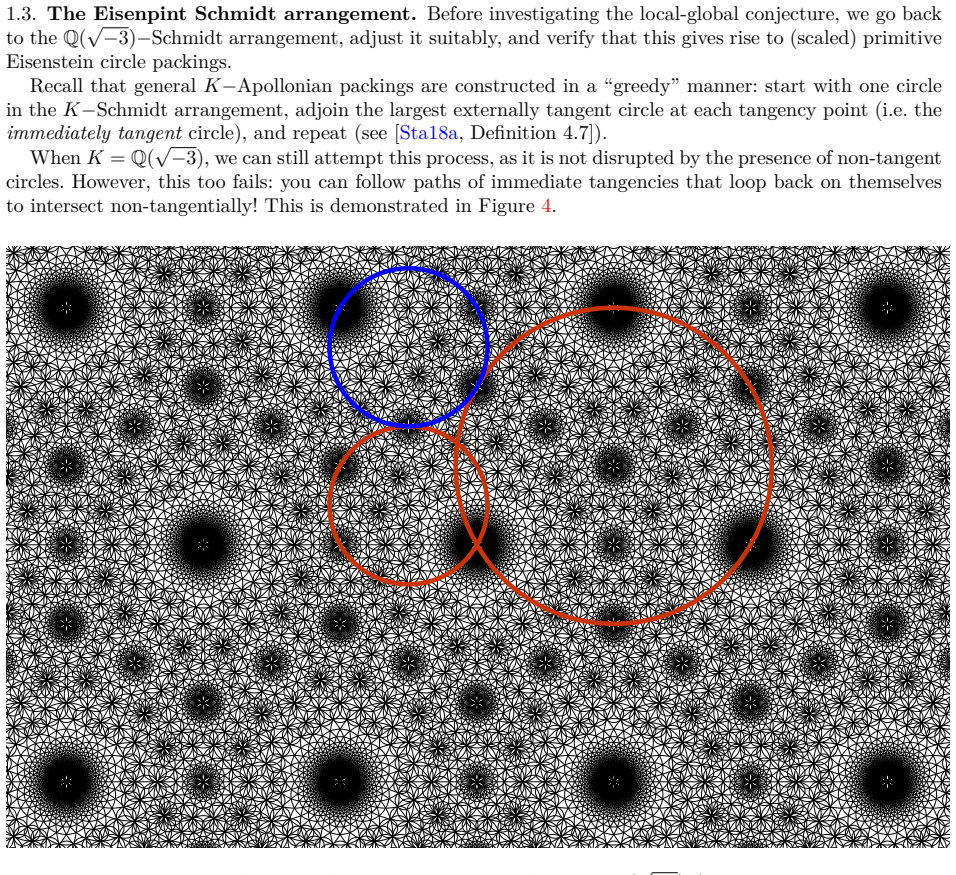
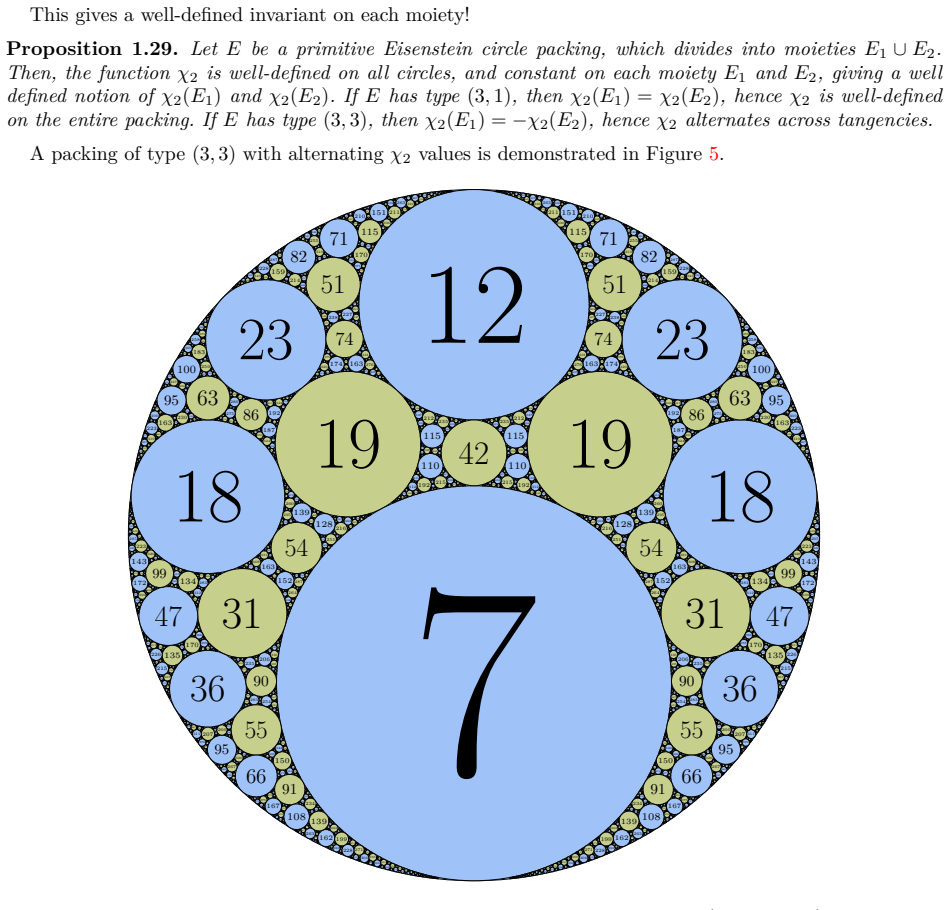
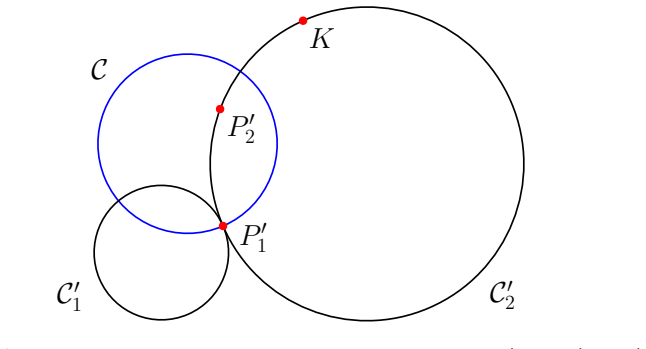


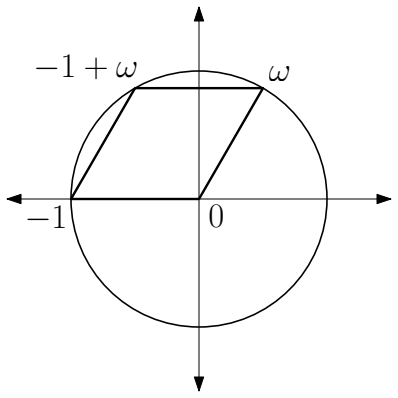


read the original abstract
The Schmidt arrangement of an imaginary quadratic number field $K$ is the orbit of the extended real line under $\text{PSL}(2, \mathcal{O}_K)$ as M\"obius transformations on the extended complex plane. If $K\neq\mathbb{Q}(\sqrt{-3})$, then the resulting set of circles can only intersect tangentially, leading to various classes of integral circle packings, including Apollonian circle packings. When $K=\mathbb{Q}(\sqrt{-3})$, circles can intersect at angles of $\frac{\pi}{3}$ and $\frac{2\pi}{3}$, making it unclear how to extract circle packings from the arrangement. The goal of this paper is to study a modification of the $\mathbb{Q}(\sqrt{-3})-$Schmidt arrangement called the "Eisenpint Schmidt arrangement" and associated integral "Eisenstein circle packings". In analogy to the study of Apollonian circle packings, we study the number theory of such packings, including associated families of quadratic forms, show the Eisenpint Schmidt arrangement is formed of exactly all primitive Eisenstein circle packings, show strong approximation and classify congruence obstructions, prove a density-one local-global statement, and find quadratic -- but alas no cubic -- reciprocity obstructions. Unexpected aspects of the Eisenstein case include the role of congruence subgroups, the bipartite nature of the packings and reciprocity obstructions, the coefficients of quadratic obstructions, an abundance of extra symmetry, and the need to use "first-odd" quadratic forms.
Editorial analysis
A structured set of objections, weighed in public.
Referee Report
Summary. The paper defines the Eisenpint Schmidt arrangement as a modification of the standard Schmidt arrangement for K = Q(sqrt(-3)), using congruence subgroups and first-odd quadratic forms to handle circles intersecting at angles of pi/3 and 2pi/3. It introduces primitive Eisenstein circle packings, claims that the arrangement consists exactly of all such packings, studies associated quadratic forms, proves strong approximation, classifies congruence obstructions, establishes a density-one local-global statement with quadratic but no cubic reciprocity obstructions, and highlights features including the bipartite nature, extra symmetry, and the role of congruence subgroups.
Significance. If the central claims hold, this extends the arithmetic theory of integral circle packings to the Eisenstein case with 60-degree intersections, analogous to Apollonian packings but revealing new phenomena such as the absence of cubic reciprocity obstructions, the necessity of proper subgroups, and the bipartite structure. The density-one local-global principle and strong approximation results would strengthen the number-theoretic understanding of quadratic forms over Q(sqrt(-3)), with the explicit use of first-odd forms and classification of obstructions providing concrete, falsifiable predictions.
major comments (2)
- [§2] §2 (definition of Eisenpint Schmidt arrangement): The claim that the modification via congruence subgroups and first-odd quadratic forms yields precisely the primitive Eisenstein packings (with no extraneous circles or omissions) is load-bearing for the 'exactly all' statement in the abstract; an explicit bijection or enumeration argument is required, as the full PSL(2, O_K) orbit includes non-primitive elements and the pi/3 intersection condition alone does not guarantee the selection rule is exhaustive.
- [Theorem on density-one local-global statement] Theorem on density-one local-global statement (likely §5 or §6): The classification of congruence obstructions and the assertion of quadratic but no cubic reciprocity obstructions must be verified against all local conditions; the extra symmetry and bipartite nature noted in the abstract could introduce additional splitting behaviors at primes above 3 that are not fully addressed by the quadratic-form families.
minor comments (2)
- [Introduction] Introduction: The etymology or motivation for the term 'Eisenpint' is not explained, which would aid readers unfamiliar with the construction.
- [Notation section] Notation section: Standardize the notation for the quadratic forms associated to the packings early, to distinguish clearly from those in the classical Schmidt arrangement.
Simulated Author's Rebuttal
We thank the referee for the careful reading and constructive suggestions for major revision. We address each major comment below and clarify the supporting arguments from the manuscript while making targeted revisions for explicitness.
read point-by-point responses
-
Referee: [§2] §2 (definition of Eisenpint Schmidt arrangement): The claim that the modification via congruence subgroups and first-odd quadratic forms yields precisely the primitive Eisenstein packings (with no extraneous circles or omissions) is load-bearing for the 'exactly all' statement in the abstract; an explicit bijection or enumeration argument is required, as the full PSL(2, O_K) orbit includes non-primitive elements and the pi/3 intersection condition alone does not guarantee the selection rule is exhaustive.
Authors: We agree that the selection rule requires an explicit justification to confirm it produces exactly the primitive packings. Section 2 defines the Eisenpint Schmidt arrangement via the appropriate congruence subgroup of PSL(2, O_K) together with the first-odd quadratic forms to enforce the pi/3 and 2pi/3 intersection angles while excluding non-primitive circles. In the revised version we will insert a short lemma that enumerates the integral solutions to the associated quadratic forms and shows that the restricted group action gives a bijection onto the set of all primitive Eisenstein circle packings, thereby ruling out both omissions and extraneous elements. revision: yes
-
Referee: [Theorem on density-one local-global statement] Theorem on density-one local-global statement (likely §5 or §6): The classification of congruence obstructions and the assertion of quadratic but no cubic reciprocity obstructions must be verified against all local conditions; the extra symmetry and bipartite nature noted in the abstract could introduce additional splitting behaviors at primes above 3 that are not fully addressed by the quadratic-form families.
Authors: The density-one local-global statement in §5 is proved by classifying all congruence obstructions through the families of quadratic forms attached to the packings. Local conditions are checked at every prime, including those lying above 3, via the Hilbert symbol and the splitting law in O_K; the bipartite structure is encoded in the first-odd condition on the forms, which already incorporates the extra symmetry of the Eisenstein case. No cubic reciprocity obstructions appear because the class group and unit group of Q(sqrt(-3)) produce only quadratic-type conditions in this setting. To address the concern directly we will add an explicit local computation at the prime above 3 in the revised manuscript. revision: partial
Circularity Check
No significant circularity: equivalence established by independent proof
full rationale
The paper defines the Eisenpint Schmidt arrangement as a specific modification of the standard PSL(2, O_K) orbit for K = Q(sqrt(-3)), using congruence subgroups and first-odd quadratic forms. It then proves via group actions and quadratic-form theory that this arrangement consists exactly of the primitive Eisenstein circle packings. No derivation step reduces a central claim to a fitted parameter, self-referential definition, or load-bearing self-citation; the local-global statements and reciprocity analysis rest on external number-theoretic machinery that does not presuppose the target equivalence.
Axiom & Free-Parameter Ledger
axioms (2)
- domain assumption The orbit of the extended real line under PSL(2, O_K) produces circles that intersect only tangentially when K is not Q(sqrt(-3)).
- standard math Standard properties of Möbius transformations and the action of PSL(2, O_K) on the extended complex plane.
invented entities (1)
-
Eisenpint Schmidt arrangement
no independent evidence
Lean theorems connected to this paper
-
IndisputableMonolith/Foundation/AlexanderDuality.leanalexander_duality_circle_linking (D=3 forcing) unclear?
unclearRelation between the paper passage and the cited Recognition theorem.
The Eisenpint Schmidt arrangement is the orbit of bR under ΓE := {M ∈ PSL(2,Z[ω]) : M ≡ (1 0 ; * 1) (mod 2)}, ... every Eisenpint tangency packing is a primitive Eisenstein circle packing scaled by 1/√3.
-
IndisputableMonolith/Foundation/ArithmeticFromLogic.leanLogicNat ≃ Nat (Peano recovery) unclear?
unclearRelation between the paper passage and the cited Recognition theorem.
The Eisenstein swap group E is isomorphic to <a,b,c,d | aca^{-1}c^{-1}, bdb^{-1}d^{-1}, a²,b²,c²,d²>.
What do these tags mean?
- matches
- The paper's claim is directly supported by a theorem in the formal canon.
- supports
- The theorem supports part of the paper's argument, but the paper may add assumptions or extra steps.
- extends
- The paper goes beyond the formal theorem; the theorem is a base layer rather than the whole result.
- uses
- The paper appears to rely on the theorem as machinery.
- contradicts
- The paper's claim conflicts with a theorem or certificate in the canon.
- unclear
- Pith found a possible connection, but the passage is too broad, indirect, or ambiguous to say the theorem truly supports the claim.
Reference graph
Works this paper leans on
- [1]
-
[2]
Bishop, Christopher J. and Jones, Peter W. , TITLE =. Acta Math. , FJOURNAL =. 1997 , NUMBER =
work page 1997
-
[3]
Sheydvasser, Arseniy , TITLE =. Comm. Algebra , FJOURNAL =. 2023 , NUMBER =
work page 2023
-
[4]
Beardon, A. F. , TITLE =. Proc. Cambridge Philos. Soc. , FJOURNAL =. 1965 , PAGES =
work page 1965
-
[5]
Bourgain, Jean and Varj\'. Expansion in. Invent. Math. , FJOURNAL =. 2012 , NUMBER =
work page 2012
- [6]
-
[7]
On the dimension spectrum of infinite subsystems of continued fractions , JOURNAL =
Chousionis, Vasileios and Leykekhman, Dmitriy and Urba\'. On the dimension spectrum of infinite subsystems of continued fractions , JOURNAL =. 2020 , NUMBER =
work page 2020
-
[8]
Jean Bourgain and Alex Kontorovich , year=. On. 1107.3776v1 , archivePrefix=
work page internal anchor Pith review Pith/arXiv arXiv
-
[9]
Bourgain, Jean and Kontorovich, Alex , TITLE =. Ann. of Math. (2) , FJOURNAL =. 2014 , NUMBER =
work page 2014
-
[10]
Pollicott, M. and Vytnova, P. , TITLE =. Trans. Amer. Math. Soc. Ser. B , FJOURNAL =. 2022 , PAGES =
work page 2022
-
[11]
Patterson, S. J. , TITLE =. Monatsh. Math. , FJOURNAL =. 1976 , NUMBER =
work page 1976
-
[12]
Beardon, A. F. , TITLE =. Proc. London Math. Soc. (3) , FJOURNAL =. 1968 , PAGES =
work page 1968
-
[13]
Falk, Kurt and Matsuzaki, Katsuhiko , TITLE =. Conform. Geom. Dyn. , FJOURNAL =. 2015 , PAGES =
work page 2015
-
[14]
Mauldin, R. Daniel and Urba\'. Dimensions and measures in infinite iterated function systems , JOURNAL =. 1996 , NUMBER =
work page 1996
-
[15]
Iwaniec, Henryk , TITLE =. Demonstratio Math. , FJOURNAL =. 1978 , NUMBER =
work page 1978
-
[16]
GitHub repository , HOWPUBLISHED =
Rickards, James , TITLE =. GitHub repository , HOWPUBLISHED =. 2023 , PUBLISHER =
work page 2023
-
[17]
Zaremba, S. K. , TITLE =. Applications of number theory to numerical analysis (. 1972 , MRCLASS =
work page 1972
-
[18]
Graham, Ronald L. and Lagarias, Jeffrey C. and Mallows, Colin L. and Wilks, Allan R. and Yan, Catherine H. , TITLE =. J. Number Theory , FJOURNAL =. 2003 , NUMBER =
work page 2003
-
[19]
Fuchs, Elena and Sanden, Katherine , TITLE =. Exp. Math. , FJOURNAL =. 2011 , NUMBER =
work page 2011
-
[20]
Frolenkov, Dmitrii A. and Kan, Igor D. , TITLE =. Mosc. J. Comb. Number Theory , FJOURNAL =. 2014 , NUMBER =
work page 2014
-
[21]
Kan, I. D. , TITLE =. Funct. Anal. Appl. , FJOURNAL =. 2022 , NUMBER =
work page 2022
-
[22]
Niederreiter, Harald , TITLE =. Bull. Amer. Math. Soc. , FJOURNAL =. 1978 , NUMBER =
work page 1978
-
[23]
Effective estimates of ergodic quantities illustrated on the
Mark Pollicott and Julia Slipantschuk , year=. Effective estimates of ergodic quantities illustrated on the. 2308.04293 , archivePrefix=
-
[24]
Lagrange approximation of transfer operators associated with holomorphic data , author=. 2020 , eprint=
work page 2020
-
[25]
Kontorovich, Alex , TITLE =. Bull. Amer. Math. Soc. (N.S.) , FJOURNAL =. 2013 , NUMBER =
work page 2013
-
[26]
Bourgain, Jean and Kontorovich, Alex , TITLE =. Geom. Funct. Anal. , FJOURNAL =. 2010 , NUMBER =
work page 2010
-
[27]
Hensley, Doug , TITLE =. Th\'. 1989 , MRCLASS =
work page 1989
-
[28]
Hensley, Doug , TITLE =. J. Number Theory , FJOURNAL =. 1990 , NUMBER =
work page 1990
-
[29]
Hensley, Douglas , TITLE =. J. Number Theory , FJOURNAL =. 1996 , NUMBER =
work page 1996
-
[30]
Zhang, Xin , TITLE =. J. Reine Angew. Math. , FJOURNAL =. 2018 , PAGES =
work page 2018
-
[31]
Fuchs, Elena and Stange, Katherine E. and Zhang, Xin , TITLE =. Compos. Math. , FJOURNAL =. 2019 , NUMBER =
work page 2019
-
[32]
Huang, ShinnYih , TITLE =. Geom. Funct. Anal. , FJOURNAL =. 2015 , NUMBER =
work page 2015
-
[33]
Bourgain, Jean and Kontorovich, Alex , TITLE =. Invent. Math. , FJOURNAL =. 2014 , NUMBER =
work page 2014
-
[34]
Kontorovich, Alex , TITLE =. J. Mod. Dyn. , FJOURNAL =. 2019 , PAGES =
work page 2019
-
[35]
Haag, Summer and Kertzer, Clyde and Rickards, James and Stange, Katherine , TITLE =. Ann. of Math. (2) , FJOURNAL =. 2024 , NUMBER =
work page 2024
-
[36]
Kontorovich, Alex and Zhang, Xin , TITLE =. Math. Ann. , FJOURNAL =. 2023 , DOI =
work page 2023
- [37]
-
[38]
Rickards, James , TITLE =. Int. Math. Res. Not. IMRN , FJOURNAL =. 2024 , NUMBER =
work page 2024
- [39]
- [40]
- [41]
-
[42]
Bourgain, Jean and Kontorovich, Alex , TITLE =. Discrete Anal. , FJOURNAL =. 2018 , PAGES =
work page 2018
-
[43]
Milovic, Djordjo , TITLE =. Geom. Funct. Anal. , FJOURNAL =. 2017 , NUMBER =
work page 2017
- [44]
-
[45]
Schulze-Pillot, Rainer , TITLE =. J. Number Theory , FJOURNAL =. 1980 , NUMBER =
work page 1980
-
[46]
Dynamics and analytic number theory , SERIES =
Kontorovich, Alex , TITLE =. Dynamics and analytic number theory , SERIES =. 2016 , MRCLASS =
work page 2016
-
[47]
Pomerance, Carl , TITLE =. Integers , FJOURNAL =. 2011 , NUMBER =
work page 2011
-
[48]
Niven, Ivan and Zuckerman, Herbert S. and Montgomery, Hugh L. , TITLE =. 1991 , PAGES =
work page 1991
-
[49]
Barkley and Schoenfeld, Lowell , TITLE =
Rosser, J. Barkley and Schoenfeld, Lowell , TITLE =. Illinois J. Math. , FJOURNAL =. 1962 , PAGES =
work page 1962
- [50]
-
[51]
Frolenkov, D. A. and Soundararajan, K. , TITLE =. Ramanujan J. , FJOURNAL =. 2013 , NUMBER =
work page 2013
-
[52]
On the maximum number of consecutive integers on which a character is constant , JOURNAL =
Trevi\. On the maximum number of consecutive integers on which a character is constant , JOURNAL =. 2012 , NUMBER =
work page 2012
-
[53]
Darren and Lubotzky, Alexander and Reid, Alan W
Kontorovich, Alex and Long, D. Darren and Lubotzky, Alexander and Reid, Alan W. , TITLE =. Notices Amer. Math. Soc. , FJOURNAL =. 2019 , NUMBER =
work page 2019
- [54]
- [55]
-
[56]
Series, Caroline , TITLE =. J. London Math. Soc. (2) , FJOURNAL =. 1985 , NUMBER =
work page 1985
- [57]
- [58]
-
[59]
Coxeter, H. S. M. , TITLE =. Ann. Mat. Pura Appl. (4) , FJOURNAL =. 1966 , PAGES =
work page 1966
- [60]
- [61]
-
[62]
Kontorovich, Alex and Nakamura, Kei , TITLE =. Proc. Natl. Acad. Sci. USA , FJOURNAL =. 2019 , NUMBER =
work page 2019
- [63]
- [64]
-
[65]
Chait-Roth, Devora and Cui, Alisa and Stier, Zachary , TITLE =. J. Number Theory , FJOURNAL =. 2020 , PAGES =
work page 2020
-
[66]
Fuchs, Elena , TITLE =. J. Number Theory , FJOURNAL =. 2011 , NUMBER =
work page 2011
-
[67]
Chait-Roth, Devora and Cui, Alisa and Stier, Zachary , title =
discussion (0)
Sign in with ORCID, Apple, or X to comment. Anyone can read and Pith papers without signing in.