Generative 3D Gaussians with Learned Density Control
Pith reviewed 2026-05-20 22:28 UTC · model grok-4.3
The pith
Modeling 3D Gaussian centers as samples from a learnable octree density enables adaptive density control during generative training.
A machine-rendered reading of the paper's core claim, the machinery that carries it, and where it could break.
Core claim
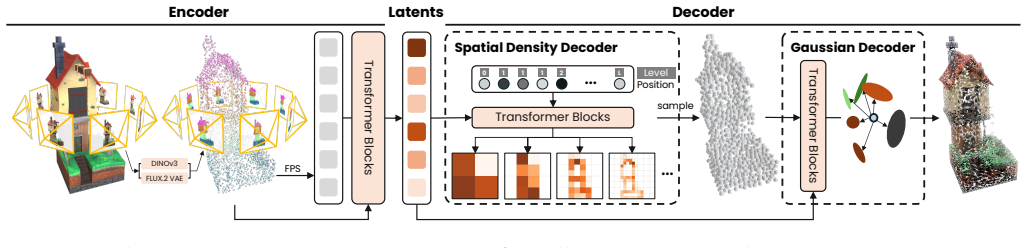
DeG defines Gaussian centers as samples drawn from a learnable probability density function over an octree. The spatial density and Gaussian attributes are optimized together under rendering supervision, with a render loss contribution gradient acting as a continuous substitute for discrete densification steps. VecSeq reindexes the resulting unordered latent tokens to a deterministic Sobol sequence, allowing a standard diffusion model to generate them as an ordered sequence rather than an ambiguous set. The pipeline therefore supports variable sampling budgets from one latent code while achieving state-of-the-art single-image-to-3D quality.
What carries the argument
Learnable probability density over an octree for sampling Gaussian centers, guided by a differentiable render loss contribution gradient, plus VecSeq re-indexing to a 3D Sobol sequence for diffusion.
If this is right
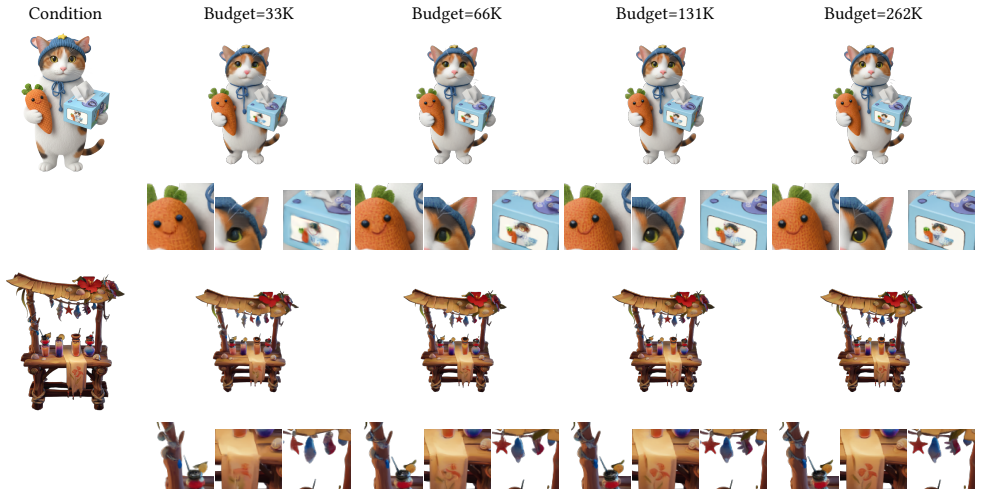
- Variable numbers of Gaussians can be decoded from the same latent code by changing only the number of samples drawn.
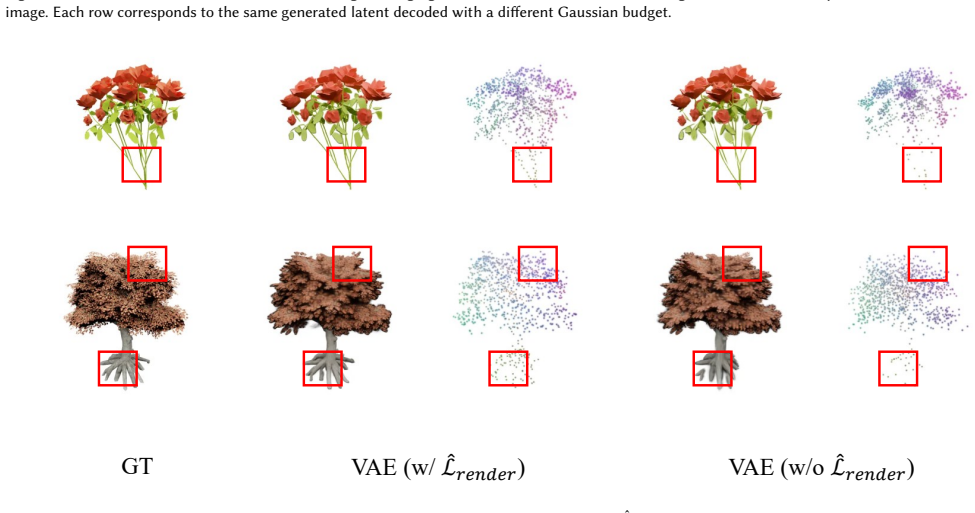
- Density automatically increases in regions of high geometric complexity without manual heuristics.
- The method combines the structural flexibility of point-based representations with the training stability of fixed-grid approaches.
- Generative modeling of 3D scenes becomes possible at multiple resolutions from a single trained model.
Where Pith is reading between the lines
- Similar density-based sampling could be tested on other generative tasks involving variable numbers of elements, such as point cloud generation.
- The Sobol sequence ordering might reduce variance in training for other permutation-invariant data types in diffusion models.
- Future work could measure whether the learned density correlates with local surface curvature or detail level in the output geometry.
Load-bearing premise
The gradients of the rendering loss must be sufficient to steer the placement and count of Gaussians toward regions that need more detail, and reordering the points by Sobol sequence must preserve enough spatial information for the diffusion model to succeed.
What would settle it
Compare models trained with and without the render loss contribution gradient on scenes with varying complexity; if the version without the gradient does not concentrate more Gaussians in detailed areas, the adaptive control claim would be falsified.
Figures







read the original abstract
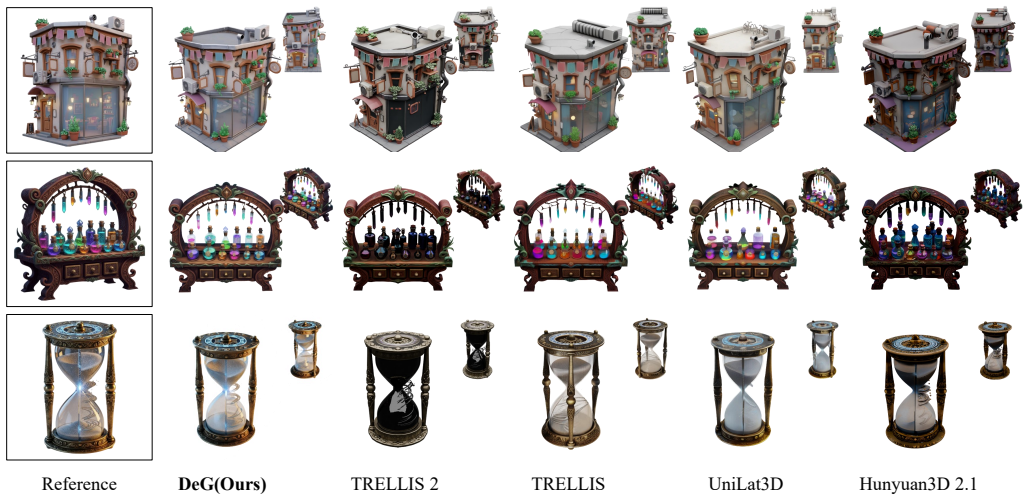
We present Density-Sampled Gaussians (DeG), a novel 3D representation designed to bridge the gap between adaptive rendering primitives and scalable generative modeling. Unlike existing approaches that constrain 3D Gaussians to fixed voxel grids or arrays, DeG models Gaussian centers as samples from a learnable probability density function defined over an octree. This formulation provides a rigorous mathematical framework for adaptive density control: by jointly optimizing the spatial density and Gaussian attributes under rendering supervision, our model naturally concentrates primitives in regions of high geometric complexity. We achieve this via a new render loss contribution gradient that serves as a fully differentiable analogue to the discrete densification and pruning heuristics used in standard Gaussian Splatting. The resulting representation is highly flexible, supporting variable-resolution decoding from a single latent code by simply adjusting the sampling budget. To enable generative synthesis, we train a latent diffusion model on DeG. We identify a critical challenge in applying diffusion to unordered set-structured latents, which can significantly slow convergence, and propose VecSeq, a canonical re-indexing mechanism that anchors latent tokens to a deterministic 3D Sobol sequence. This transforms the ambiguous set-generation problem into a robust sequence modeling task. Extensive experiments demonstrate that our pipeline achieves state-of-the-art quality in single-image-to-3D generation, combining the structural adaptivity of unstructured primitives with the training stability of grid-based methods.
Editorial analysis
A structured set of objections, weighed in public.
Referee Report
Summary. The manuscript introduces Density-Sampled Gaussians (DeG), a 3D representation in which Gaussian centers are modeled as samples drawn from a learnable probability density function defined over an octree. This enables adaptive density control through joint optimization of spatial density and Gaussian attributes under rendering supervision, using a new render loss contribution gradient as a differentiable analogue to the discrete densification and pruning steps of standard Gaussian Splatting. To support generative modeling, the authors train a latent diffusion model on DeG latents and introduce VecSeq, a canonical re-indexing scheme that maps unordered Gaussian latents to a deterministic 3D Sobol sequence, converting the set-generation task into sequence modeling. The pipeline is reported to achieve state-of-the-art quality for single-image-to-3D generation.
Significance. If the empirical claims hold, the work provides a principled bridge between the structural adaptivity of unstructured 3D primitives and the training stability of grid-based generative models. The variable-resolution decoding property and the deterministic re-indexing mechanism address practical challenges in scaling generative 3D representations. No machine-checked proofs or fully reproducible code releases are described, but the formulation supplies a clear, falsifiable prediction that adjusting the sampling budget alone should yield consistent quality gains across resolutions.
major comments (3)
- [Abstract and §3] Abstract and §3: The central claim that the pipeline achieves state-of-the-art quality rests on the render loss contribution gradient and VecSeq, yet the manuscript supplies no quantitative metrics, ablation tables, error bars, or dataset specifications to demonstrate that these components deliver the reported gains over prior single-image-to-3D baselines.
- [§4.2, Eq. (7)] §4.2, Eq. (7): The claim that the render loss contribution gradient constitutes a fully differentiable analogue to discrete densification and pruning is load-bearing for the adaptive-density argument, but the derivation does not specify the exact gradient computation or analyze its numerical stability across optimization steps.
- [§5.1] §5.1: VecSeq is asserted to preserve essential spatial information when converting unordered sets to sequences via a deterministic Sobol ordering, yet no ablation or convergence comparison against direct set modeling or alternative ordering schemes is provided to substantiate that the transformation does not discard critical geometric structure.
minor comments (2)
- Notation for the octree-based density function could be introduced with an explicit diagram or pseudocode to aid readers who are not already familiar with hierarchical sampling.
- Figure captions for the qualitative results should include the exact sampling budget used for each displayed reconstruction to allow direct comparison with the variable-resolution claim.
Simulated Author's Rebuttal
We thank the referee for the constructive and detailed feedback. We address each major comment point by point below, indicating where revisions will be made to improve clarity and substantiation.
read point-by-point responses
-
Referee: [Abstract and §3] Abstract and §3: The central claim that the pipeline achieves state-of-the-art quality rests on the render loss contribution gradient and VecSeq, yet the manuscript supplies no quantitative metrics, ablation tables, error bars, or dataset specifications to demonstrate that these components deliver the reported gains over prior single-image-to-3D baselines.
Authors: We agree that the current manuscript would benefit from more explicit quantitative support for the state-of-the-art claims. Although Section 5 presents comparative results against baselines, dedicated ablation tables, error bars across runs, and precise dataset specifications are not sufficiently detailed. In the revised version we will add these elements, including tables isolating the contributions of the render loss contribution gradient and VecSeq, to make the empirical gains transparent. revision: yes
-
Referee: [§4.2, Eq. (7)] §4.2, Eq. (7): The claim that the render loss contribution gradient constitutes a fully differentiable analogue to discrete densification and pruning is load-bearing for the adaptive-density argument, but the derivation does not specify the exact gradient computation or analyze its numerical stability across optimization steps.
Authors: The referee is correct that the load-bearing nature of this claim requires a more precise treatment. The present derivation in Equation (7) outlines the conceptual mapping but omits the explicit back-propagation steps and any stability discussion. We will expand Section 4.2 with the full gradient expression, implementation details in the differentiable renderer, and an analysis of numerical behavior over training iterations, including any observed instabilities and mitigation strategies. revision: yes
-
Referee: [§5.1] §5.1: VecSeq is asserted to preserve essential spatial information when converting unordered sets to sequences via a deterministic Sobol ordering, yet no ablation or convergence comparison against direct set modeling or alternative ordering schemes is provided to substantiate that the transformation does not discard critical geometric structure.
Authors: We acknowledge that an explicit ablation would strengthen the justification for VecSeq. The manuscript relies on the deterministic property of the Sobol sequence to argue preservation of spatial structure, yet direct comparisons to set modeling or other orderings are absent. In the revision we will add such an ablation in Section 5.1, reporting convergence curves and geometric fidelity metrics for VecSeq versus direct set diffusion and alternative canonical orderings. revision: yes
Circularity Check
No circularity: claims rest on novel mechanisms without definitional reduction
full rationale
The abstract and provided context introduce DeG as modeling Gaussian centers via a learnable density over an octree, with a render loss contribution gradient serving as a differentiable analogue to densification/pruning, and VecSeq as a Sobol-based re-indexing to convert sets to sequences. These are presented as independent innovations enabling adaptive primitives and stable diffusion training. No equations, fitted parameters, or self-citations are shown reducing the SOTA claim or core performance to inputs by construction. The derivation chain remains self-contained against external benchmarks, with results positioned as empirical outcomes rather than tautological.
Axiom & Free-Parameter Ledger
free parameters (1)
- sampling budget
axioms (1)
- domain assumption The render loss contribution gradient serves as a fully differentiable analogue to discrete densification and pruning heuristics.
invented entities (2)
-
Density-Sampled Gaussians (DeG)
no independent evidence
-
VecSeq
no independent evidence
Lean theorems connected to this paper
-
IndisputableMonolith/Foundation/AlexanderDuality.leanalexander_duality_circle_linking echoes?
echoesECHOES: this paper passage has the same mathematical shape or conceptual pattern as the Recognition theorem, but is not a direct formal dependency.
we factorize the joint probability as q_θ(x|Z) = ∏_{l=1}^L q_θ(x_{0:l}|x_{0:l-1},Z) ... 8-way categorical distribution over the children of a parent cell
What do these tags mean?
- matches
- The paper's claim is directly supported by a theorem in the formal canon.
- supports
- The theorem supports part of the paper's argument, but the paper may add assumptions or extra steps.
- extends
- The paper goes beyond the formal theorem; the theorem is a base layer rather than the whole result.
- uses
- The paper appears to rely on the theorem as machinery.
- contradicts
- The paper's claim conflicts with a theorem or certificate in the canon.
- unclear
- Pith found a possible connection, but the passage is too broad, indirect, or ambiguous to say the theorem truly supports the claim.
Reference graph
Works this paper leans on
-
[1]
Proceedings of the IEEE/CVF Conference on Computer Vision and Pattern Recognition , pages=
Image neural field diffusion models , author=. Proceedings of the IEEE/CVF Conference on Computer Vision and Pattern Recognition , pages=
-
[2]
Proceedings of the Computer Vision and Pattern Recognition Conference , pages=
Pup 3d-gs: Principled uncertainty pruning for 3d gaussian splatting , author=. Proceedings of the Computer Vision and Pattern Recognition Conference , pages=
-
[3]
arXiv preprint arXiv:2603.21304 , year=
F4Splat: Feed-Forward Predictive Densification for Feed-Forward 3D Gaussian Splatting , author=. arXiv preprint arXiv:2603.21304 , year=
-
[4]
Proceedings of the IEEE conference on computer vision and pattern recognition , pages=
A point set generation network for 3d object reconstruction from a single image , author=. Proceedings of the IEEE conference on computer vision and pattern recognition , pages=
-
[5]
Proceedings of the IEEE/CVF conference on computer vision and pattern recognition , pages=
Xcube: Large-scale 3d generative modeling using sparse voxel hierarchies , author=. Proceedings of the IEEE/CVF conference on computer vision and pattern recognition , pages=
-
[6]
Proceedings of the Computer Vision and Pattern Recognition Conference , pages=
Maskgaussian: Adaptive 3d gaussian representation from probabilistic masks , author=. Proceedings of the Computer Vision and Pattern Recognition Conference , pages=
-
[7]
Computer graphics forum , volume=
Consistent shape maps via semidefinite programming , author=. Computer graphics forum , volume=. 2013 , organization=
work page 2013
- [8]
-
[9]
Advances in Neural Information Processing Systems , pages =
Policy Gradient Methods for Reinforcement Learning with Function Approximation , author =. Advances in Neural Information Processing Systems , pages =
-
[10]
Conference on Robot Learning , pages=
Improved adversarial systems for 3d object generation and reconstruction , author=. Conference on Robot Learning , pages=. 2017 , organization=
work page 2017
-
[11]
Sparc3D: Sparse Representation and Construction for High-Resolution 3D Shapes Modeling , author=. arXiv preprint arXiv:2505.14521 , year=
-
[12]
Advances in Neural Information Processing Systems , volume=
Direct3d: Scalable image-to-3d generation via 3d latent diffusion transformer , author=. Advances in Neural Information Processing Systems , volume=
-
[13]
TripoSG: High-Fidelity 3D Shape Synthesis using Large-Scale Rectified Flow Models
TripoSG: High-Fidelity 3D Shape Synthesis using Large-Scale Rectified Flow Models , author=. arXiv preprint arXiv:2502.06608 , year=
work page internal anchor Pith review Pith/arXiv arXiv
-
[14]
Proceedings of the IEEE/CVF conference on computer vision and pattern recognition , pages=
Richdreamer: A generalizable normal-depth diffusion model for detail richness in text-to-3d , author=. Proceedings of the IEEE/CVF conference on computer vision and pattern recognition , pages=
-
[15]
Proceedings of the IEEE/CVF international conference on computer vision , pages=
Fantasia3d: Disentangling geometry and appearance for high-quality text-to-3d content creation , author=. Proceedings of the IEEE/CVF international conference on computer vision , pages=
-
[16]
Instantsplat: Sparse-view gaussian splatting in seconds
Instantsplat: Unbounded sparse-view pose-free gaussian splatting in 40 seconds , author=. arXiv preprint arXiv:2403.20309 , volume=
-
[17]
European Conference on Computer Vision , pages=
Lgm: Large multi-view gaussian model for high-resolution 3d content creation , author=. European Conference on Computer Vision , pages=. 2024 , organization=
work page 2024
-
[18]
Proceedings of the IEEE/CVF International Conference on Computer Vision , pages=
Long-lrm: Long-sequence large reconstruction model for wide-coverage gaussian splats , author=. Proceedings of the IEEE/CVF International Conference on Computer Vision , pages=
-
[19]
European Conference on Computer Vision , pages=
Grm: Large gaussian reconstruction model for efficient 3d reconstruction and generation , author=. European Conference on Computer Vision , pages=. 2024 , organization=
work page 2024
-
[20]
European Conference on Computer Vision , pages=
Gs-lrm: Large reconstruction model for 3d gaussian splatting , author=. European Conference on Computer Vision , pages=. 2024 , organization=
work page 2024
-
[21]
Proceedings of the IEEE/CVF conference on computer vision and pattern recognition , pages=
Dngaussian: Optimizing sparse-view 3d gaussian radiance fields with global-local depth normalization , author=. Proceedings of the IEEE/CVF conference on computer vision and pattern recognition , pages=
-
[22]
arXiv preprint arXiv:2312.00206 , year=
Sparsegs: Real-time 360 \ deg \ sparse view synthesis using gaussian splatting , author=. arXiv preprint arXiv:2312.00206 , year=
-
[23]
Proceedings of the IEEE/CVF International Conference on Computer Vision , pages=
Resgs: Residual densification of 3d gaussian for efficient detail recovery , author=. Proceedings of the IEEE/CVF International Conference on Computer Vision , pages=
-
[24]
SIGGRAPH Asia 2024 Conference Papers , pages=
Taming 3dgs: High-quality radiance fields with limited resources , author=. SIGGRAPH Asia 2024 Conference Papers , pages=
work page 2024
-
[25]
European Conference on Computer Vision , pages=
Revising densification in gaussian splatting , author=. European Conference on Computer Vision , pages=. 2024 , organization=
work page 2024
-
[26]
Proceedings of the 32nd ACM International Conference on Multimedia , pages=
Absgs: Recovering fine details in 3d gaussian splatting , author=. Proceedings of the 32nd ACM International Conference on Multimedia , pages=
-
[27]
3dgs2: Near second-order converging 3d gaussian splatting , author=. Proceedings of the Special Interest Group on Computer Graphics and Interactive Techniques Conference Conference Papers , pages=
-
[28]
Advances in Neural Information Processing Systems , volume=
3d gaussian splatting as markov chain monte carlo , author=. Advances in Neural Information Processing Systems , volume=
-
[29]
DreamGaussian: Generative Gaussian Splatting for Efficient 3D Content Creation , author=. ICLR , year=
-
[30]
Dinov3 , author=. arXiv preprint arXiv:2508.10104 , year=
work page internal anchor Pith review Pith/arXiv arXiv
-
[31]
International conference on machine learning , pages=
Learning transferable visual models from natural language supervision , author=. International conference on machine learning , pages=. 2021 , organization=
work page 2021
-
[32]
Proceedings of the IEEE conference on computer vision and pattern recognition , pages=
Rethinking the inception architecture for computer vision , author=. Proceedings of the IEEE conference on computer vision and pattern recognition , pages=
-
[33]
DINOv2: Learning Robust Visual Features without Supervision
Dinov2: Learning robust visual features without supervision , author=. arXiv preprint arXiv:2304.07193 , year=
work page internal anchor Pith review Pith/arXiv arXiv
-
[34]
Advances in neural information processing systems , volume=
Learning a probabilistic latent space of object shapes via 3d generative-adversarial modeling , author=. Advances in neural information processing systems , volume=
-
[35]
Advances in neural information processing systems , volume=
Get3d: A generative model of high quality 3d textured shapes learned from images , author=. Advances in neural information processing systems , volume=
-
[36]
Communications of the ACM , volume=
Nerf: Representing scenes as neural radiance fields for view synthesis , author=. Communications of the ACM , volume=. 2021 , publisher=
work page 2021
-
[37]
Proceedings of the IEEE/CVF conference on computer vision and pattern recognition , pages=
Mip-splatting: Alias-free 3d gaussian splatting , author=. Proceedings of the IEEE/CVF conference on computer vision and pattern recognition , pages=
-
[38]
Splatt3R: Zero-shot Gaussian Splatting from Uncalibrated Image Pairs
Splatt3r: Zero-shot gaussian splatting from uncalibrated image pairs , author=. arXiv preprint arXiv:2408.13912 , year=
work page internal anchor Pith review Pith/arXiv arXiv
-
[39]
Atlas gaussians diffusion for 3d generation , author=. arXiv preprint arXiv:2408.13055 , year=
-
[40]
arXiv preprint arXiv:2411.08033 , year=
GaussianAnything: Interactive Point Cloud Flow Matching For 3D Object Generation , author=. arXiv preprint arXiv:2411.08033 , year=
-
[41]
Proceedings of the IEEE/CVF International Conference on Computer Vision , pages=
Baking gaussian splatting into diffusion denoiser for fast and scalable single-stage image-to-3d generation and reconstruction , author=. Proceedings of the IEEE/CVF International Conference on Computer Vision , pages=
-
[42]
MonST3R: A Simple Approach for Estimating Geometry in the Presence of Motion
Monst3r: A simple approach for estimating geometry in the presence of motion , author=. arXiv preprint arXiv:2410.03825 , year=
work page internal anchor Pith review Pith/arXiv arXiv
-
[43]
Proceedings of the IEEE/CVF Conference on Computer Vision and Pattern Recognition , pages=
Dust3r: Geometric 3d vision made easy , author=. Proceedings of the IEEE/CVF Conference on Computer Vision and Pattern Recognition , pages=
-
[44]
LRM: Large Reconstruction Model for Single Image to 3D
Lrm: Large reconstruction model for single image to 3d , author=. arXiv preprint arXiv:2311.04400 , year=
work page internal anchor Pith review Pith/arXiv arXiv
-
[45]
Advances in Neural Information Processing Systems , volume=
One-2-3-45: Any single image to 3d mesh in 45 seconds without per-shape optimization , author=. Advances in Neural Information Processing Systems , volume=
-
[46]
Zero123++: a Single Image to Consistent Multi-view Diffusion Base Model
Zero123++: a single image to consistent multi-view diffusion base model , author=. arXiv preprint arXiv:2310.15110 , year=
work page internal anchor Pith review Pith/arXiv arXiv
-
[47]
Proceedings of the IEEE/CVF conference on computer vision and pattern recognition , pages=
Wonder3d: Single image to 3d using cross-domain diffusion , author=. Proceedings of the IEEE/CVF conference on computer vision and pattern recognition , pages=
-
[48]
Proceedings of the IEEE/CVF conference on computer vision and pattern recognition , pages=
Luciddreamer: Towards high-fidelity text-to-3d generation via interval score matching , author=. Proceedings of the IEEE/CVF conference on computer vision and pattern recognition , pages=
-
[49]
Advances in neural information processing systems , volume=
Prolificdreamer: High-fidelity and diverse text-to-3d generation with variational score distillation , author=. Advances in neural information processing systems , volume=
-
[50]
arXiv preprint arXiv:2501.05445 , year=
Consistent flow distillation for text-to-3d generation , author=. arXiv preprint arXiv:2501.05445 , year=
-
[51]
Advances in Neural Information Processing Systems , volume=
Unique3d: High-quality and efficient 3d mesh generation from a single image , author=. Advances in Neural Information Processing Systems , volume=
-
[52]
Proceedings of the IEEE/CVF conference on computer vision and pattern recognition , pages=
pixelsplat: 3d gaussian splats from image pairs for scalable generalizable 3d reconstruction , author=. Proceedings of the IEEE/CVF conference on computer vision and pattern recognition , pages=
-
[53]
Proceedings of the Computer Vision and Pattern Recognition Conference , pages=
Vggt: Visual geometry grounded transformer , author=. Proceedings of the Computer Vision and Pattern Recognition Conference , pages=
-
[54]
Proceedings of the IEEE/CVF conference on computer vision and pattern recognition , pages=
Mip-nerf 360: Unbounded anti-aliased neural radiance fields , author=. Proceedings of the IEEE/CVF conference on computer vision and pattern recognition , pages=
-
[55]
ACM transactions on graphics (TOG) , volume=
Instant neural graphics primitives with a multiresolution hash encoding , author=. ACM transactions on graphics (TOG) , volume=. 2022 , publisher=
work page 2022
-
[56]
ACM Transactions on Graphics (TOG) , volume=
Clay: A controllable large-scale generative model for creating high-quality 3d assets , author=. ACM Transactions on Graphics (TOG) , volume=. 2024 , publisher=
work page 2024
-
[57]
Proceedings of the IEEE/CVF international conference on computer vision , pages=
Zero-1-to-3: Zero-shot one image to 3d object , author=. Proceedings of the IEEE/CVF international conference on computer vision , pages=
-
[58]
DreamFusion: Text-to-3D using 2D Diffusion
Dreamfusion: Text-to-3d using 2d diffusion , author=. arXiv preprint arXiv:2209.14988 , year=
work page internal anchor Pith review Pith/arXiv arXiv
- [59]
-
[60]
ACM Transactions On Graphics (TOG) , volume=
3dshape2vecset: A 3d shape representation for neural fields and generative diffusion models , author=. ACM Transactions On Graphics (TOG) , volume=. 2023 , publisher=
work page 2023
-
[61]
Proceedings of the Computer Vision and Pattern Recognition Conference , pages=
Structured 3d latents for scalable and versatile 3d generation , author=. Proceedings of the Computer Vision and Pattern Recognition Conference , pages=
-
[62]
Native and Compact Structured Latents for 3D Generation
Native and Compact Structured Latents for 3D Generation , author=. arXiv preprint arXiv:2512.14692 , year=
work page internal anchor Pith review arXiv
-
[63]
arXiv preprint arXiv:2509.25079 , year=
Unilat3d: Geometry-appearance unified latents for single-stage 3d generation , author=. arXiv preprint arXiv:2509.25079 , year=
-
[64]
Proceedings of the IEEE/CVF conference on computer vision and pattern recognition , pages=
Using shape to categorize: Low-shot learning with an explicit shape bias , author=. Proceedings of the IEEE/CVF conference on computer vision and pattern recognition , pages=
-
[65]
Proceedings of the IEEE/CVF conference on computer vision and pattern recognition , pages=
Objaverse: A universe of annotated 3d objects , author=. Proceedings of the IEEE/CVF conference on computer vision and pattern recognition , pages=
-
[66]
Advances in Neural Information Processing Systems , volume=
Objaverse-xl: A universe of 10m+ 3d objects , author=. Advances in Neural Information Processing Systems , volume=
- [67]
-
[68]
arXiv preprint arXiv:2511.04283 , year=
FastGS: Training 3D Gaussian Splatting in 100 Seconds , author=. arXiv preprint arXiv:2511.04283 , year=
-
[69]
Proceedings of the IEEE/CVF conference on computer vision and pattern recognition , pages=
High-resolution image synthesis with latent diffusion models , author=. Proceedings of the IEEE/CVF conference on computer vision and pattern recognition , pages=
-
[70]
arXiv preprint arXiv:2412.15618 , year=
3D Shape Tokenization via Latent Flow Matching , author=. arXiv preprint arXiv:2412.15618 , year=
-
[71]
Advances in Complex Systems , volume=
Optimal payoff functions for members of collectives , author=. Advances in Complex Systems , volume=. 2001 , publisher=
work page 2001
-
[72]
Distributed agent-based air traffic flow management , author=. Proceedings of the 6th international joint conference on Autonomous agents and multiagent systems , pages=
-
[73]
Flow Matching for Generative Modeling
Flow matching for generative modeling , author=. arXiv preprint arXiv:2210.02747 , year=
work page internal anchor Pith review Pith/arXiv arXiv
-
[74]
Z-Image: An Efficient Image Generation Foundation Model with Single-Stream Diffusion Transformer
Z-Image: An Efficient Image Generation Foundation Model with Single-Stream Diffusion Transformer , author=. arXiv preprint arXiv:2511.22699 , year=
work page internal anchor Pith review Pith/arXiv arXiv
-
[75]
Hunyuan3D 2.1: From Images to High-Fidelity 3D Assets with Production-Ready PBR Material
Hunyuan3D 2.1: From Images to High-Fidelity 3D Assets with Production-Ready PBR Material , author=. arXiv preprint arXiv:2506.15442 , year=
work page internal anchor Pith review Pith/arXiv arXiv
-
[76]
Gaussiancube: A structured and explicit radiance representation for 3d generative modeling , author=. arXiv preprint arXiv:2403.19655 , year=
-
[77]
arXiv preprint arXiv:2512.03052 (2025)
LATTICE: Democratize High-Fidelity 3D Generation at Scale , author=. arXiv preprint arXiv:2512.03052 , year=
-
[78]
USSR Computational mathematics and mathematical physics , volume=
Distribution of points in a cube and approximate evaluation of integrals , author=. USSR Computational mathematics and mathematical physics , volume=
-
[79]
Roformer: Enhanced transformer with rotary position embedding , author=. Neurocomputing , volume=. 2024 , publisher=
work page 2024
-
[80]
arXiv preprint arXiv:2512.14391 , year=
RePo: Language Models with Context Re-Positioning , author=. arXiv preprint arXiv:2512.14391 , year=
discussion (0)
Sign in with ORCID, Apple, or X to comment. Anyone can read and Pith papers without signing in.