Microdroplets Fail to Retain Exhaled Volatile Biomarkers within a Single Breath
Pith reviewed 2026-05-20 22:19 UTC · model grok-4.3
The pith
Microdroplets in exhaled breath condensate lose volatile biomarkers within a single breath cycle.
A machine-rendered reading of the paper's core claim, the machinery that carries it, and where it could break.
Core claim
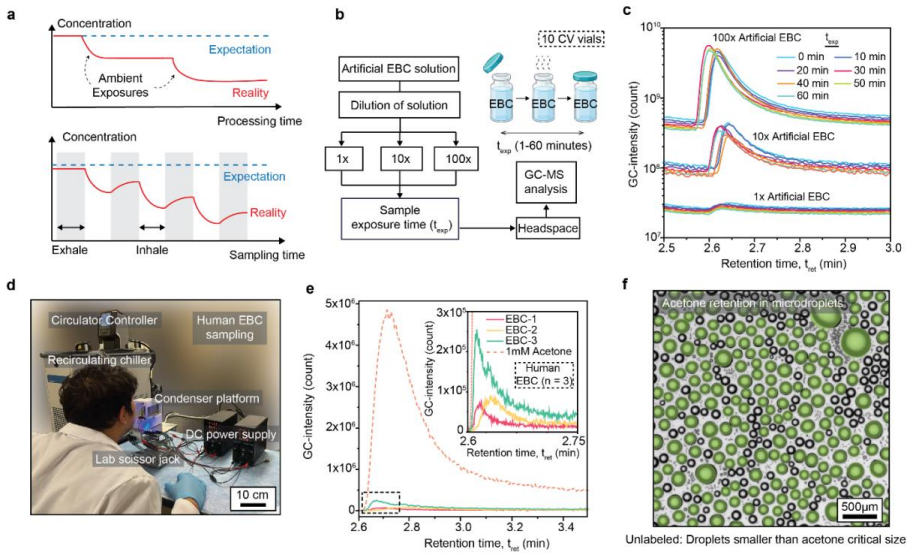
By isolating volatile co-condensation and transient evaporation from biological interference, EBC microdroplets smaller than 100 μm lose clinically significant volatile content within a single breath cycle. This challenges the assumption that condensate faithfully reflects airway lining fluid. A physics-based model predicts this loss across disease-relevant biomarkers and establishes conditions for reliable EBC sampling.
What carries the argument
The physics-based model of volatile loss through co-condensation and transient evaporation in microdroplets.
If this is right
- Conditions for reliable EBC sampling can be established to minimize volatile loss.
- Variability in EBC measurements can be addressed through better collection methods rather than averaging biological noise.
- Previous studies on over 100 biomarkers may need re-evaluation for physical loss effects.
- Engineering solutions can make EBC a viable clinical tool for disease diagnosis.
Where Pith is reading between the lines
- This finding may extend to other forms of breath analysis or condensate collection methods.
- New device designs could target larger droplet sizes to improve biomarker retention.
- Further tests could validate the model in human subjects under controlled conditions.
Load-bearing premise
The experimental setup successfully isolates physical volatile loss mechanisms from biological factors.
What would settle it
Direct observation of volatile content in microdroplets of different sizes over the time scale of a single breath cycle in a controlled non-biological setup.
Figures


read the original abstract
Exhaled breath condensate (EBC) contains volatile metabolites and is promising for non-invasive disease diagnosis, but after decades of research spanning over 100 biomarkers and 10 diseases, no EBC-based test has reached clinical use. The measurement variability that can span orders of magnitude, far exceeding the clinically required 10%, has long been attributed to biological factors. Here, we reveal a fundamentally different origin: the collected microdroplets themselves fail to retain volatile biomarkers. By isolating volatile co-condensation and transient evaporation from biological interference, we show that EBC microdroplets smaller than 100 {\mu}m lose clinically significant volatile content within a single breath cycle. This challenges the implicit assumption underlying decades of EBC research, that condensate faithfully reflects airway lining fluid. We develop and validate a physics-based model that predicts this loss across disease-relevant biomarkers and establishes the conditions for reliable EBC sampling. This work reframes EBC variability as a solvable engineering problem rather than an inherent biological limitation.
Editorial analysis
A structured set of objections, weighed in public.
Referee Report
Summary. The paper claims that exhaled breath condensate (EBC) microdroplets smaller than 100 μm lose clinically significant volatile biomarkers within a single breath cycle due to physical mechanisms of volatile co-condensation and transient evaporation, rather than biological factors. By isolating these effects, the authors develop and validate a physics-based model that predicts loss across disease-relevant biomarkers and identifies conditions for reliable EBC sampling, challenging the long-standing assumption that condensate faithfully reflects airway lining fluid.
Significance. If the central claim holds, the work has substantial significance for the EBC field by reframing measurement variability as a solvable physical/engineering issue rather than an inherent biological limitation. This could enable improved collection protocols and potentially advance non-invasive diagnostics for the >100 biomarkers and 10 diseases studied over decades. The physics-based model, if parameter-independent and validated with quantitative fits, represents a strength that provides falsifiable predictions for future sampling designs.
major comments (2)
- [Methods] Methods section: The experimental setup description does not provide quantitative controls (e.g., non-volatile tracers or larger-droplet benchmarks) to demonstrate that apparatus-induced losses from collection tubes, cooling surfaces, or flow paths are negligible relative to the reported microdroplet losses. Without such controls, the isolation of co-condensation and transient evaporation from apparatus artifacts remains insecure, directly affecting attribution of the observed loss to droplet physics alone.
- [Model validation] Model validation (likely §4 or equivalent): The physics-based model is described as predictive across biomarkers, yet it is unclear whether key parameters (such as the 100 μm droplet size threshold or evaporation rates) are derived from independent physical measurements or fitted to the same volatile loss observations used for validation. This raises a moderate risk that the cross-biomarker agreement reduces to circularity rather than independent confirmation.
minor comments (2)
- [Abstract] Abstract and introduction: The claim of 'clinically significant' loss would benefit from explicit quantification (e.g., percentage loss thresholds relative to the 10% clinical requirement) with error bars or confidence intervals from the data.
- [Figures] Figure clarity: Ensure all figures showing droplet size distributions or loss curves include error bars, sample sizes (n), and clear legends distinguishing experimental data from model predictions.
Simulated Author's Rebuttal
We thank the referee for their constructive comments, which help clarify the robustness of our experimental controls and model parameterization. We address each major point below and have revised the manuscript accordingly where needed.
read point-by-point responses
-
Referee: [Methods] Methods section: The experimental setup description does not provide quantitative controls (e.g., non-volatile tracers or larger-droplet benchmarks) to demonstrate that apparatus-induced losses from collection tubes, cooling surfaces, or flow paths are negligible relative to the reported microdroplet losses. Without such controls, the isolation of co-condensation and transient evaporation from apparatus artifacts remains insecure, directly affecting attribution of the observed loss to droplet physics alone.
Authors: We agree that the methods section would benefit from more explicit quantitative controls to isolate droplet physics from potential apparatus effects. In the revised manuscript, we will add results from control experiments using non-volatile fluorescent tracers to measure losses in collection tubes and cooling surfaces (found to be <5% of the volatile losses reported for microdroplets). We will also include benchmarks with larger droplets (>100 μm) that show near-complete retention of volatiles, confirming that the observed size-dependent losses are attributable to the microdroplet mechanisms rather than the apparatus. revision: yes
-
Referee: [Model validation] Model validation (likely §4 or equivalent): The physics-based model is described as predictive across biomarkers, yet it is unclear whether key parameters (such as the 100 μm droplet size threshold or evaporation rates) are derived from independent physical measurements or fitted to the same volatile loss observations used for validation. This raises a moderate risk that the cross-biomarker agreement reduces to circularity rather than independent confirmation.
Authors: The parameters, including the 100 μm size threshold and evaporation rates, were derived from independent physical measurements and literature on aerosol droplet dynamics (e.g., co-condensation partitioning coefficients and transient evaporation models from prior non-biomarker studies), not fitted to the volatile loss observations. The model was then used to generate predictions that were validated against the biomarker data. We will revise the model section to explicitly list the independent sources for each parameter and detail the validation procedure to remove any ambiguity about circularity. revision: yes
Circularity Check
No significant circularity in derivation chain
full rationale
The paper presents a physics-based model for volatile loss in microdroplets derived from first-principles considerations of co-condensation and transient evaporation, then validates it against experimental observations of biomarker retention in EBC samples. No load-bearing step reduces by construction to fitted inputs or self-citations; the model is described as predictive across biomarkers with independent validation steps that do not equate the output to the input data by definition. The central claim rests on isolating physical mechanisms experimentally rather than on any self-referential renaming or ansatz smuggling. This is a self-contained derivation against external benchmarks of droplet physics.
Axiom & Free-Parameter Ledger
free parameters (1)
- droplet size threshold
axioms (1)
- domain assumption Physical processes of co-condensation and transient evaporation can be isolated from biological interference in the experimental design.
Lean theorems connected to this paper
-
IndisputableMonolith/Cost/FunctionalEquation.leanwashburn_uniqueness_aczel unclear?
unclearRelation between the paper passage and the cited Recognition theorem.
n_v(t) = n_v,0 (1 - t K / R0²)^(β/K) with K and β defined via Dw, Dv, p_v^*, θ, Sv, Sw (Eqs. 1-3); t90 ≈ R0² scaling; critical radius Rcri ~10-100 μm
-
IndisputableMonolith/Foundation/RealityFromDistinction.leanreality_from_one_distinction unclear?
unclearRelation between the paper passage and the cited Recognition theorem.
Leveque scaling, Marangoni ring structure, gas-phase boundary-layer resistance Sv < 0.1
What do these tags mean?
- matches
- The paper's claim is directly supported by a theorem in the formal canon.
- supports
- The theorem supports part of the paper's argument, but the paper may add assumptions or extra steps.
- extends
- The paper goes beyond the formal theorem; the theorem is a base layer rather than the whole result.
- uses
- The paper appears to rely on the theorem as machinery.
- contradicts
- The paper's claim conflicts with a theorem or certificate in the canon.
- unclear
- Pith found a possible connection, but the passage is too broad, indirect, or ambiguous to say the theorem truly supports the claim.
Reference graph
Works this paper leans on
-
[1]
Y. Qu, H. Wang, H. Liu, Z. Yin, X. Yang, Smart Wearable Devices for Exhaled Breath Condensate Harvesting and Health Monitoring. The FASEB Journal 39, e71102 (2025)
work page 2025
-
[2]
N. M. Grob, M. Aytekin, R. A. Dweik, Biomarkers in exhaled breath condensate: a review of collection, processing and analysis. J. Breath Res. 2, 037004 (2008)
work page 2008
-
[3]
S. R. Carter, C. S. Davis, E. J. Kovacs, Exhaled breath condensate collection in the mechanically ventilated patient. Respiratory Medicine 106, 601–613 (2012)
work page 2012
-
[4]
A. Moeller, E. Dompeling, “Exhaled breath condensates” in Paediatric Lung Function , (European Respiratory Society, 2025), pp. 155–182
work page 2025
-
[5]
Q. Liang, et al., Ultrasensitive multispecies spectroscopic breath analysis for real-time health monitoring and diagnostics. Proceedings of the National Academy of Sciences 118, e2105063118 (2021)
work page 2021
-
[6]
F. Ghelli, et al. , Inflammatory Biomarkers in Exhaled Breath Condensate: A Systematic Review. International Journal of Molecular Sciences 23, 9820 (2022)
work page 2022
-
[7]
I. Horváth, et al. , Exhaled breath condensate: methodological recommendations and unresolved questions. Eur Respir J 26, 523–548 (2005)
work page 2005
- [8]
-
[9]
Hunt, Exhaled Breath Condensate—an overview
J. Hunt, Exhaled Breath Condensate—an overview. Immunol Allergy Clin North Am 27, 587– v (2007)
work page 2007
-
[10]
Heng, et al., A smart mask for exhaled breath condensate harvesting and analysis
W. Heng, et al., A smart mask for exhaled breath condensate harvesting and analysis. Science 385, 954–961 (2024)
work page 2024
-
[11]
J. Wang, et al. , Bioinspired Face Mask for Exhaled Breath Condensate Collection and Multiplexed Biomarkers Analysis. ACS Nano 19, 42816–42825 (2025)
work page 2025
-
[12]
Heng, et al., A battery-free smart mask for long-term exhaled breath biochemical sensing
W. Heng, et al., A battery-free smart mask for long-term exhaled breath biochemical sensing. Nat. Sens. 1–13 (2026). https://doi.org/10.1038/s44460-026-00041-3
-
[13]
Ahmadzai, et al., Exhaled breath condensate: a comprehensive update
H. Ahmadzai, et al., Exhaled breath condensate: a comprehensive update. Clinical Chemistry and Laboratory Medicine 51, 1343–1361 (2013)
work page 2013
-
[14]
Rosias, Methodological aspects of exhaled breath condensate collection and analysis
P. Rosias, Methodological aspects of exhaled breath condensate collection and analysis. J. Breath Res. 6, 027102 (2012). 18
work page 2012
- [15]
-
[16]
Bioanalytical Method Validation Guidance for Industry. (2018)
work page 2018
-
[17]
P. Cáp, K. Dryahina, F. Pehal, P. Spanel, Selected ion flow tube mass spectrometry of exhaled breath condensate headspace. Rapid Commun Mass Spectrom 22, 2844–2850 (2008)
work page 2008
-
[18]
Ma, et al., Airborne biomarker localization engine for open-air point-of-care detection
J. Ma, et al., Airborne biomarker localization engine for open-air point-of-care detection. Nat Chem Eng 2, 321–333 (2025)
work page 2025
-
[19]
K. Schallschmidt, et al. , Comparison of volatile organic compounds from lung cancer patients and healthy controls-challenges and limitations of an observational study. J Breath Res 10, 046007 (2016)
work page 2016
- [20]
-
[21]
Y. Wang, C. He, Z. Fu, H. Wang, D. Ma, Exhaled breath acetone in predicting the presence and severity of respiratory failure. J Breath Res 19 (2025)
work page 2025
-
[22]
A. W. Jones, A. Sagarduy, E. Ericsson, H. J. Arnqvist, Concentrations of acetone in venous blood samples from drunk drivers, type -I diabetic outpatients, and healthy blood donors. J Anal Toxicol 17, 182–185 (1993)
work page 1993
-
[23]
G. Wang, G. Maranelli, L. Perbellini, E. Raineri, F. Brugnone, Blood acetone concentration in “normal people” and in exposed workers 16 h after the end of the workshift. Int Arch Occup Environ Health 65, 285–289 (1994)
work page 1994
-
[24]
C. Deng, W. Zhang, J. Zhang, X. Zhang, Rapid determination of acetone in human plasma by gas chromatography -mass spectrometry and solid -phase microextraction with on -fiber derivatization. J Chromatogr B Analyt Technol Biomed Life Sci 805, 235–240 (2004)
work page 2004
- [25]
-
[26]
R. Andreoli, P. Manini, M. Corradi, A. Mutti, W. M. A. Niessen, Determination of patterns of biologically relevant aldehydes in exhaled breath condensate of healthy subjects by liquid chromatography/atmospheric chemical ionization tandem mass spectrometry . Rapid Commun Mass Spectrom 17, 637–645 (2003)
work page 2003
-
[27]
Xie, et al., Analysis of a broad range of carbonyl metabolites in exhaled breath by UHPLC- MS
Z. Xie, et al., Analysis of a broad range of carbonyl metabolites in exhaled breath by UHPLC- MS. Anal Chem 95, 4344–4352 (2023). 19
work page 2023
-
[28]
Y.-H. Kim, J. Park, Development of a Simple and Powerful Analytical Method for Formaldehyde Detection and Quantitation in Blood Samples. J Anal Methods Chem 2020, 8810726 (2020)
work page 2020
-
[29]
H. D. Heck, et al., Formaldehyde (CH2O) concentrations in the blood of humans and Fischer- 344 rats exposed to CH2O under controlled conditions. Am Ind Hyg Assoc J 46, 1–3 (1985)
work page 1985
-
[30]
F. M. Schmidt, et al., Ammonia in breath and emitted from skin. J Breath Res 7, 017109 (2013)
work page 2013
- [31]
- [32]
-
[33]
J. S. Bajaj, et al., Variability and Lability of Ammonia Levels in Healthy Volunteers and Patients With Cirrhosis: Implications for Trial Design and Clinical Practice. Am J Gastroenterol 115, 783–785 (2020)
work page 2020
-
[34]
Warneke, et al., Proton transfer reaction mass spectrometry (PTR-MS): propanol in human breath
C. Warneke, et al., Proton transfer reaction mass spectrometry (PTR-MS): propanol in human breath. International Journal of Mass Spectrometry and Ion Processes 154, 61–70 (1996)
work page 1996
-
[35]
V. A. Boumba, N. Kourkoumelis, K. Ziavrou, T. Vougiouklakis, Estimating a Reliable Cutoff Point of 1 -Propanol in Postmortem Blood as Marker of Microbial Ethanol Production. Journal of Forensic Science and Medicine 5, 141 (2019)
work page 2019
-
[36]
Below, et al., Dermal and pulmonary absorption of propan -1-ol and propan -2-ol from hand rubs
H. Below, et al., Dermal and pulmonary absorption of propan -1-ol and propan -2-ol from hand rubs. Am J Infect Control 40, 250–257 (2012)
work page 2012
-
[37]
Y.-Y. Zhou, et al., A non -invasive method for the detection of glucose in human exhaled breath by condensation collection coupled with ion chromatography. J Chromatogr A 1685, 463564 (2022)
work page 2022
-
[38]
D. Tankasala, J. C. Linnes, Noninvasive glucose detection in exhaled breath condensate. Transl Res 213, 1–22 (2019)
work page 2019
- [39]
-
[40]
Tirosh, et al., Normal fasting plasma glucose levels and type 2 diabetes in young men
A. Tirosh, et al., Normal fasting plasma glucose levels and type 2 diabetes in young men. N Engl J Med 353, 1454–1462 (2005)
work page 2005
-
[41]
G. Freckmann, et al., Continuous glucose profiles in healthy subjects under everyday life conditions and after different meals. J Diabetes Sci Technol 1, 695–703 (2007)
work page 2007
-
[42]
E. M. Marek, et al., Measurements of lactate in exhaled breath condensate at rest and after maximal exercise in young and healthy subjects. J Breath Res 4, 017105 (2010)
work page 2010
-
[43]
S. Zhang, et al., Rapid Measurement of Lactate in the Exhaled Breath Condensate: Biosensor Optimization and In-Human Proof of Concept. ACS Sens 7, 3809–3816 (2022)
work page 2022
-
[44]
C. Ahlgrim, M. W. Baumstark, K. Roecker, Clarifying the Link Between the Blood Lactate Concentration and Cardiovascular Risk. Int J Sports Med 43, 1106–1112 (2022)
work page 2022
-
[45]
I. A. Hashim, M. Mohamed, A. Cox, F. Fernandez, P. Kutscher, Plasma lactate measurement as an example of encountered gaps between routine clinical laboratory processes and manufactures’ sample -handling instructions. Practical Laboratory Medicine 12, e00109 (2018)
work page 2018
-
[46]
M. Schollin -Borg, P. Nordin, H. Zetterström, J. Johansson, Blood Lactate Is a Useful Indicator for the Medical Emergency Team. Crit Care Res Pract 2016, 5765202 (2016)
work page 2016
-
[47]
P. P. Rosias, et al., Biomarker reproducibility in exhaled breath condensate collected with different condensers. Eur Respir J 31, 934–942 (2008)
work page 2008
- [48]
-
[49]
Z. L. Borrill, K. Roy, D. Singh, Exhaled breath condensate biomarkers in COPD. European Respiratory Journal 32, 472–486 (2008)
work page 2008
-
[50]
R. Mukherjee, A. S. Berrier, K. R. Murphy, J. R. Vieitez, J. B. Boreyko, How Surface Orientation Affects Jumping-Droplet Condensation. Joule 3, 1360–1376 (2019)
work page 2019
-
[51]
I. Park, L. E. O’Neill, C. R. Kharangate, I. Mudawar, Assessment of body force effects in flow condensation, Part I: Experimental investigation of liquid film behavior for different orientations. International Journal of Heat and Mass Transfer 106, 295–312 (2017)
work page 2017
-
[52]
M. Afshari, H. Moghadasi, L. Mohammadpour, Assessing parameters impact in dropwise condensation heat transfer for an individual droplet on inclined/grooved surfaces: a sobol sensitivity analysis. Sci Rep 15, 42650 (2025). 21
work page 2025
-
[53]
C. T. Hand, S. Peuker, An experimental study of the influence of orientation on water condensation of a thermoelectric cooling heatsink. Heliyon 5 (2019)
work page 2019
-
[54]
M. Azzolin, S. Bortolin, D. Del Col, Convective condensation at low mass flux: Effect of turbulence and tube orientation on the heat transfer. International Journal of Heat and Mass Transfer 144, 118646 (2019)
work page 2019
-
[55]
G. M. Mutlu, K. W. Garey, R. A. Robbins, L. H. Danziger, I. Rubinstein, Collection and analysis of exhaled breath condensate in humans. Am J Respir Crit Care Med 164, 731–737 (2001)
work page 2001
-
[56]
M. Maniscalco, et al. , Exhaled breath condensate as matrix for toluene detection: A preliminary study. Biomarkers 11, 233–240 (2006)
work page 2006
-
[57]
H. Javanmardi, et al., Comprehensive analysis of exhaled breath VOCs using GC -MS and GC×GC-TOF-MS: a comparative platform evaluation with TFME and NTD sampling for free and total concentrations. Anal Bioanal Chem 418, 759–770 (2026)
work page 2026
- [58]
-
[59]
J. F. Davies, R. E. H. Miles, A. E. Haddrell, J. P. Reid, Influence of organic films on the evaporation and condensation of water in aerosol. Proc Natl Acad Sci U S A 110, 8807–8812 (2013)
work page 2013
-
[60]
L. Yang, A. A. Pahlavan, H. A. Stone, C. D. Bain, Evaporation of alcohol droplets on surfaces in moist air. Proc Natl Acad Sci U S A 120, e2302653120 (2023)
work page 2023
-
[61]
Z. Li, et al., Experimental investigation on evaporation of a single droplet levitated in acoustic field in 2022 20th International Conference on Mechatronics - Mechatronika (ME), (2022), pp. 1–5
work page 2022
-
[62]
Moriyama, Evaporation Rate of Single Water Droplet on Hot Solid Surface
A. Moriyama, Evaporation Rate of Single Water Droplet on Hot Solid Surface. Tetsu To Hagane-journal of The Iron and Steel Institute of Japan 59, 1373–1379 (1973)
work page 1973
-
[63]
H. Xiong, et al. , Design of Breath Sampling Device and Procedure for Volatile Organic Compounds and Exhaled Breath Condensate in 2022 IEEE International Symposium on Olfaction and Electronic Nose (ISOEN), (2022), pp. 1–3
work page 2022
-
[64]
M. Wang, “Study of Volatile Organic Compounds (VOC) in the cloudy atmosphere : air/droplet partitioning of VOC,” Université Clermont Auvergne [2017-2020]. (2019). 22
work page 2017
-
[65]
Li, Evaporating Multicomponent Droplets
Y. Li, Evaporating Multicomponent Droplets. (2020). https://doi.org/10.3990/1.9789036550048
-
[66]
Z. Wang, D. Orejon, Y. Takata, K. Sefiane, Wetting and evaporation of multicomponent droplets. Physics Reports 960, 1–37 (2022)
work page 2022
-
[67]
D. L. Bones, J. P. Reid, D. M. Lienhard, U. K. Krieger, Comparing the mechanism of water condensation and evaporation in glassy aerosol. Proc Natl Acad Sci U S A 109, 11613–11618 (2012)
work page 2012
-
[68]
M. Ait Saada, S. Chikh, L. Tadrist, Evaporation of a sessile drop with pinned or receding contact line on a substrate with different thermophysical properties. International Journal of Heat and Mass Transfer 58, 197–208 (2013)
work page 2013
-
[69]
S. Y. Misyura, Contact angle and droplet evaporation on the smooth and structured wall surface in a wide range of droplet diameters. Applied Thermal Engineering 113, 472–480 (2017)
work page 2017
-
[70]
R. Pal, S. Sarkar, A. Mukhopadhyay, Influence of ambient conditions on evaporation and transport of respiratory droplets in indoor environment. International Communications in Heat and Mass Transfer 129, 105750 (2021)
work page 2021
-
[71]
Diddens, Detailed finite element method modeling of evaporating multi -component droplets
C. Diddens, Detailed finite element method modeling of evaporating multi -component droplets. Journal of Computational Physics 340, 670–687 (2017)
work page 2017
- [72]
-
[73]
A. A. Aksenov, et al., Analytical methodologies for broad metabolite coverage of exhaled breath condensate. J Chromatogr B Analyt Technol Biomed Life Sci 1061–1062, 17 –25 (2017)
work page 2017
-
[74]
K. Chingin, H. Chen, G. Gamez, R. Zenobi, Exploring fluorescence and fragmentation of ions produced by electrospray ionization in ultrahigh vacuum. J. Am. Soc. Mass Spectrom. 20, 1731–1738 (2009)
work page 2009
-
[75]
H. F. Hubbard, J. R. Sobus, J. D. Pleil, M. C. Madden, S. Tabucchi, Application of novel method to measure endogenous VOCs in exhaled breath condensate before and after exposure to diesel exhaust. J Chromatogr B Analyt Technol Biomed Life Sci 877, 3652–3658 (2009). 23
work page 2009
-
[76]
C. Liu, E. Bonaccurso, H.-J. Butt, Evaporation of sessile water/ethanol drops in a controlled environment. Phys. Chem. Chem. Phys. 10, 7150–7157 (2008)
work page 2008
-
[77]
A. Erb, J. Kind, T. L. Zankel, R. W. Stark, C. M. Thiele, Visualization and quantification of local concentration gradients in evaporating water/glycerol droplets with micrometer resolution. Proceedings of the National Academy of Sciences 122, e2423660122 (2025)
work page 2025
-
[78]
G. E. Cossali, S. Tonini, Analytical solutions for modelling the evaporation of sessile drops. Applied Mathematical Modelling 114, 61–77 (2023)
work page 2023
-
[79]
H. Gelderblom, C. Diddens, A. Marin, Evaporation-driven liquid flow in sessile droplets. Soft Matter 18, 8535–8553 (2022)
work page 2022
-
[80]
Reichardt, Solvatochromic Dyes as Solvent Polarity Indicators
C. Reichardt, Solvatochromic Dyes as Solvent Polarity Indicators. Chem. Rev. 94, 2319 – 2358 (1994)
work page 1994
discussion (0)
Sign in with ORCID, Apple, or X to comment. Anyone can read and Pith papers without signing in.