SN 2023fyq: direct detection of a Type Ibn supernova progenitor and its multi-wavelength environmental constraints
Pith reviewed 2026-05-25 06:23 UTC · model grok-4.3
The pith
Pre-explosion images detect the progenitor of Type Ibn supernova SN 2023fyq as a hot luminous source that later vanished.
A machine-rendered reading of the paper's core claim, the machinery that carries it, and where it could break.
Core claim
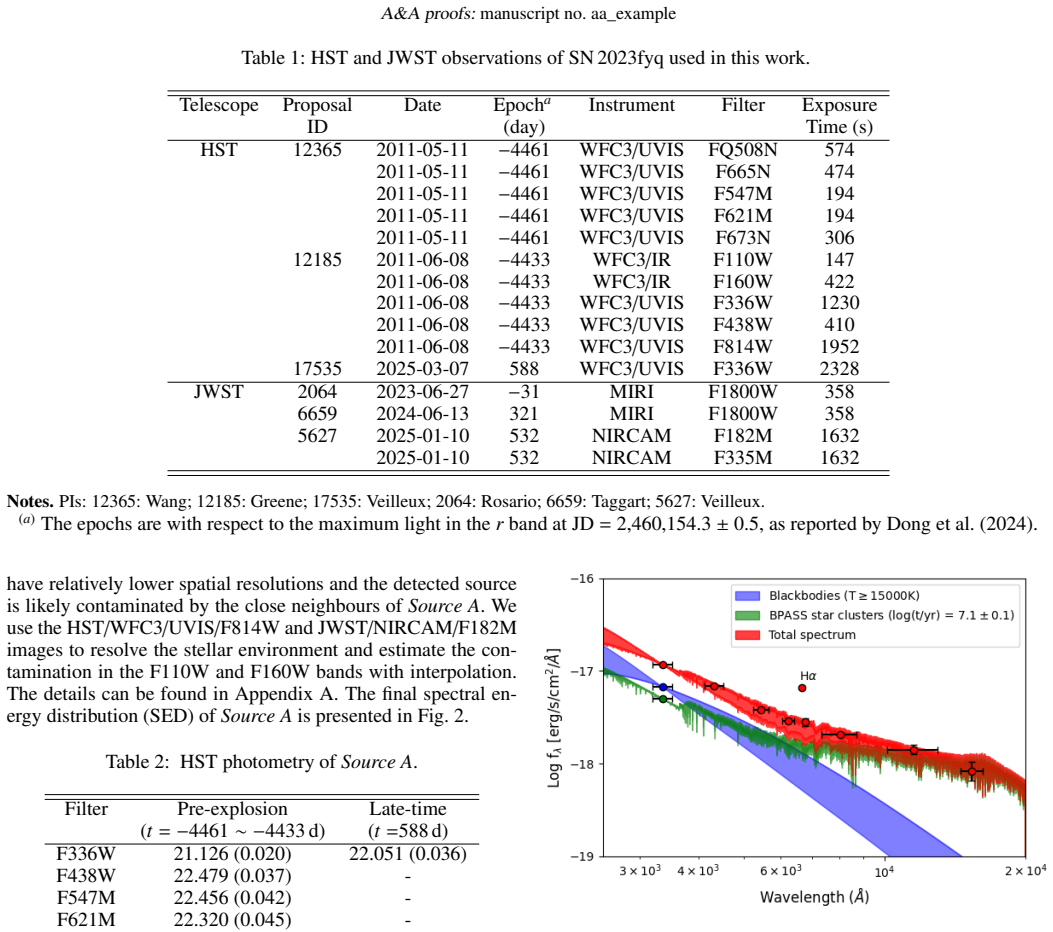
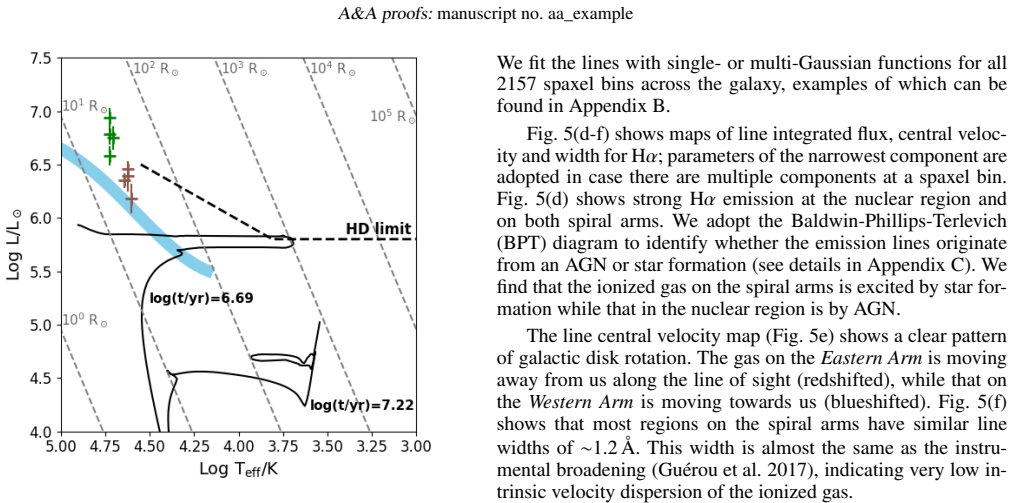
We discover a pre-explosion source at the SN position, which is consistent with a hot (T>15000 K) and luminous (log(L/L⊙)≳5.5) SN progenitor and a possible host star cluster. The progenitor is confirmed to have disappeared after explosion. Analysis of the SN environment implies that the progenitor likely has an age of log(t/yr) = 7.1--7.2. These phenomena disfavor a very massive single-star progenitor and instead support a binary scenario involving a low-mass helium star and a compact object; the observed progenitor emission likely arises from binary interaction that began at least ∼12 yr before the explosion.
What carries the argument
Pre- and post-explosion HST and JWST imaging to detect the vanishing source, combined with multi-wavelength mapping of stars, dust, ionized gas and molecular gas using VLT/MUSE and ALMA to constrain the progenitor age.
If this is right
- The progenitor's visible emission is produced by binary interaction that began at least 12 years before explosion.
- A very massive single-star channel is disfavored for SN 2023fyq.
- Type Ibn supernovae can form through at least two distinct channels: massive Wolf-Rayet stars and lower-mass helium stars in binaries.
- The event is the first Type Ibn supernova with both a directly detected progenitor and a candidate host star cluster.
Where Pith is reading between the lines
- Similar pre-explosion searches for other Type Ibn events may need to account for possible binary-interaction signatures lasting a decade or more.
- Deeper imaging of the candidate cluster could test whether the age estimate holds when individual stars are resolved.
- If binary interaction is common, some Type Ibn light curves may show early-time signatures of pre-explosion mass transfer.
Load-bearing premise
The detected pre-explosion source is the progenitor itself rather than a chance alignment or unrelated object, which requires accurate astrometric registration between images.
What would settle it
High-precision astrometry showing the pre-explosion source is offset from the supernova position by more than the measurement uncertainty, or future images showing the source reappearing at the same location.
Figures






read the original abstract
Context. Type Ibn supernovae (SNe) are characterized by narrow helium emission lines arising from ejecta-circumstellar medium interaction, yet their progenitors remain debated, with both massive Wolf-Rayet stars and low-mass helium stars in binaries proposed. Aims. We aim to directly identify the progenitor of the Type Ibn SN 2023fyq and to characterize its environment in order to constrain the progenitor's nature and evolutionary channel. Methods. We search for the SN progenitor based on pre-explosion and late-time HST and JWST images and derive its properties by fitting the spectral energy distribution. We investigate the SN environment by probing the stars, dust, ionized gas and molecular gas with a multi-wavelength dataset including HST and JWST imaging, VLT/MUSE integral-field-unit spectroscopy and ALMA CO (2--1) radio interferometry. Results. We discover a pre-explosion source at the SN position, which is consistent with a hot ($T>$15000 K) and luminous (log($L$/$L_\odot$) $\gtrsim$ 5.5) SN progenitor and a possible host star cluster. The progenitor is confirmed to have disappeared after explosion. Analysis of the SN environment implies that the progenitor likely has an age of log($t$/yr) = 7.1--7.2. These phenomena disfavor a very massive single-star progenitor and instead support a binary scenario involving a low-mass helium star and a compact object; the observed progenitor emission likely arises from binary interaction that began at least $\sim$12 yr before the explosion. Conclusions. SN 2023fyq is the first Type Ibn SN with a directly detected progenitor and a possible host star cluster. It adds to the diversity of Type Ibn SNe in terms of their progenitor channels and mass-loss mechanisms.
Editorial analysis
A structured set of objections, weighed in public.
Referee Report
Summary. The paper reports the first direct detection of a progenitor for a Type Ibn supernova, SN 2023fyq. Using pre-explosion HST and JWST imaging, the authors identify a source at the SN position that is consistent with a hot (T > 15000 K) and luminous (log(L/L⊙) ≳ 5.5) object, confirm its disappearance in late-time images, and use multi-wavelength data (HST/JWST imaging, VLT/MUSE spectroscopy, ALMA CO interferometry) to derive an environmental age of log(t/yr) = 7.1–7.2. These results are interpreted as favoring a binary progenitor channel involving a low-mass helium star and compact object, with the observed emission arising from binary interaction beginning at least ~12 yr prior to explosion, rather than a very massive single Wolf-Rayet star.
Significance. If the source identification and environmental constraints hold, this would represent a major advance as the first direct progenitor detection for any Type Ibn SN, providing concrete observational constraints on progenitor mass, evolutionary channel, and mass-loss mechanisms for this rare class. The combination of disappearance confirmation with multi-wavelength population analysis strengthens the case for binary-driven scenarios and adds to the known diversity of Ibn progenitors.
major comments (3)
- [Results] Results section (pre-explosion source identification): The manuscript does not report quantitative astrometric registration metrics (e.g., RMS alignment error, number of reference sources, or transformation residuals) between pre- and post-explosion HST/JWST frames, nor a chance-alignment probability calculation. These are load-bearing for the central claim that the detected source is the progenitor rather than a chance coincidence or unresolved cluster member.
- [Methods and Results] Methods/Results (SED fitting): No details are provided on the SED fitting procedure, including the specific models used, χ² values, parameter uncertainties, or explicit comparison (e.g., via Bayesian evidence or residual analysis) between a single hot source and a possible host star cluster. This omission prevents assessment of whether the T > 15000 K, log(L/L⊙) ≳ 5.5 solution is uniquely favored.
- [Environmental analysis] Environmental analysis (age derivation): The reported age range log(t/yr) = 7.1–7.2 lacks reported uncertainties, discussion of data exclusion criteria for the multi-wavelength dataset (HST/JWST/MUSE/ALMA), or quantitative treatment of potential population mixing or selection biases that could decouple the local stellar population age from the progenitor's formation time.
minor comments (2)
- [Abstract and Results] Abstract and Results: The phrase 'possible host star cluster' is used without a clear definition or quantitative criterion for when the source is treated as a single star versus a cluster; this should be clarified for consistency.
- [Figures] Figure captions: Several figures showing pre- and post-explosion images would benefit from explicit scale bars, north-east orientation arrows, and reported positional offsets with uncertainties.
Simulated Author's Rebuttal
We thank the referee for their detailed and constructive report. We address each major comment below and will incorporate the requested details into a revised manuscript.
read point-by-point responses
-
Referee: [Results] Results section (pre-explosion source identification): The manuscript does not report quantitative astrometric registration metrics (e.g., RMS alignment error, number of reference sources, or transformation residuals) between pre- and post-explosion HST/JWST frames, nor a chance-alignment probability calculation. These are load-bearing for the central claim that the detected source is the progenitor rather than a chance coincidence or unresolved cluster member.
Authors: We agree these quantitative metrics strengthen the identification. In revision we will add the RMS alignment error, number of reference sources, transformation residuals, and a formal chance-alignment probability calculated from the local source density. revision: yes
-
Referee: [Methods and Results] Methods/Results (SED fitting): No details are provided on the SED fitting procedure, including the specific models used, χ² values, parameter uncertainties, or explicit comparison (e.g., via Bayesian evidence or residual analysis) between a single hot source and a possible host star cluster. This omission prevents assessment of whether the T > 15000 K, log(L/L⊙) ≳ 5.5 solution is uniquely favored.
Authors: We will expand the methods and results sections to describe the SED models employed, report χ² values and parameter uncertainties, and include a direct statistical comparison (residuals and evidence ratio) between the single hot source and a cluster model. revision: yes
-
Referee: [Environmental analysis] Environmental analysis (age derivation): The reported age range log(t/yr) = 7.1–7.2 lacks reported uncertainties, discussion of data exclusion criteria for the multi-wavelength dataset (HST/JWST/MUSE/ALMA), or quantitative treatment of potential population mixing or selection biases that could decouple the local stellar population age from the progenitor's formation time.
Authors: We will revise the environmental analysis to quote uncertainties on the age, list explicit data-inclusion/exclusion criteria, and add a quantitative discussion of population mixing and selection biases with supporting metrics from the multi-wavelength data. revision: yes
Circularity Check
No significant circularity; results from direct multi-wavelength observations and standard data analysis
full rationale
The paper's core claims rest on pre- and post-explosion HST/JWST imaging for source detection and disappearance, SED fitting to observed photometry, astrometric registration, and environmental constraints from MUSE spectroscopy plus ALMA CO data. These steps use empirical measurements and standard stellar population synthesis models applied to the data; no load-bearing step reduces by the paper's own equations or self-citations to a fitted input renamed as a prediction. The binary-channel inference is an interpretation of the observed properties rather than a tautological derivation. This is the expected outcome for an observational discovery paper whose central result is falsifiable against the imaging frames themselves.
Axiom & Free-Parameter Ledger
free parameters (2)
- SED-derived temperature and luminosity =
T>15000 K, log(L/Lsun)≳5.5
- Environmental age =
7.1-7.2
axioms (2)
- domain assumption Positional coincidence plus post-explosion disappearance identifies the source as the progenitor
- domain assumption The measured environmental stellar population age accurately reflects the progenitor's age
Reference graph
Works this paper leans on
-
[1]
Abdeen, S., Kennefick, D., Kennefick, J., et al. 2020, MNRAS, 496, 2,
work page 2020
-
[2]
doi:10.1093/mnras/staa1596 Asplund, M., Grevesse, N., Sauval, A. J., et al. 2009, ARA&A, 47, 1,
-
[3]
doi:10.1146/annurev.astro.46.060407.145222 Baer-Way, R., A. J., N., Jacobson-Galán, W., et al. 2025, ApJ, 995, 2, L49. doi:10.3847/2041-8213/ae1cb8 Baldwin, J. A., Phillips, M. M., & Terlevich, R. 1981, PASP, 93,
-
[4]
doi:10.1086/130766 Brennan, S. J., Sollerman, J., Irani, I., et al. 2024, A&A, 684, L18. doi:10.1051/0004-6361/202449350 Bressan, A., Marigo, P., Girardi, L., et al. 2012, MNRAS, 427, 1,
-
[5]
doi:10.1111/j.1365-2966.2012.21948.x Bruzual, G. & Charlot, S. 2003, MNRAS, 344, 4,
-
[6]
doi:10.1046/j.1365- 8711.2003.06897.x Byrne, C. M., Stanway, E. R., Eldridge, J. J., et al. 2022, MNRAS, 512, 4,
-
[7]
doi:10.1093/mnras/stac807 Cai, Y .-Z., Pastorello, A., Maeda, K., et al. 2026, A&A, 707, A157. doi:10.1051/0004-6361/202558014 Cardelli, J. A., Clayton, G. C., & Mathis, J. S. 1989, ApJ, 345,
-
[8]
doi:10.1086/167900 Cid Fernandes, R., Mateus, A., Sodré, L., et al. 2005, MNRAS, 358, 2,
-
[9]
doi:10.1111/j.1365-2966.2005.08752.x Crowther, P. A., Schnurr, O., Hirschi, R., et al. 2010, MNRAS, 408, 2,
-
[10]
doi:10.1111/j.1365-2966.2010.17167.x Damas-Segovia, A., Beck, R., V ollmer, B., et al. 2016, ApJ, 824, 1,
-
[11]
2023, Transient Name Server Discovery Report, 2023-825,
doi:10.3847/0004-637X/824/1/30 De, K. 2023, Transient Name Server Discovery Report, 2023-825,
-
[12]
Dessart, L., Hillier, D. J., & Kuncarayakti, H. 2022, A&A, 658, A130. doi:10.1051/0004-6361/202142436 Dolphin, A. E. 2000, PASP, 112, 776,
-
[13]
2016, Astrophysics Source Code Library
doi:10.1086/316630 Dolphin, A. 2016, Astrophysics Source Code Library. ascl:1608.013 Dong, Y ., Tsuna, D., Valenti, S., et al. 2024, ApJ, 977, 2,
-
[15]
J., Smith, N., Ganeshalingam, M., et al
doi:10.48550/arXiv.astro- ph/0401344 Foley, R. J., Smith, N., Ganeshalingam, M., et al. 2007, ApJ, 657, 2, L105. doi:10.1086/513145 Font, J., Beckman, J. E., Querejeta, M., et al. 2014, ApJS, 210, 1,
-
[16]
doi:10.1088/0067-0049/210/1/2 Fremling, C., Covarrubias, S., Sollerman, J., et al. 2026, arXiv:2603.29043. doi:10.48550/arXiv.2603.29043 Fujiwara, K., Ueda, Y ., Ogawa, S., et al. 2026, arXiv:2604.06719. doi:10.48550/arXiv.2604.06719 Guérou, A., Krajnovi ´c, D., Epinat, B., et al. 2017, A&A, 608, A5. doi:10.1051/0004-6361/201730905 Hong, X., Sun, N.-C., N...
-
[17]
doi:10.3847/1538-4357/836/2/158 Hosseinzadeh, G., McCully, C., Zabludoff, A. I., et al. 2019, ApJ, 871, 1, L9. doi:10.3847/2041-8213/aafc61 Hou, L. G. & Han, J. L. 2015, MNRAS, 454, 1,
-
[18]
doi:10.1093/mnras/stv1904 Humphreys, R. M. & Davidson, K. 1979, ApJ, 232,
-
[19]
doi:10.1086/157301 Karamehmetoglu, E., Taddia, F., Sollerman, J., et al. 2017, A&A, 602, A93. doi:10.1051/0004-6361/201629619 Kewley, L. J., Heisler, C. A., Dopita, M. A., et al. 2001, ApJS, 132, 1,
-
[20]
doi:10.1086/318944 Kostiuk, V . S., Marchuk, A. A., & Gusev, A. S. 2024, Research in Astronomy and Astrophysics, 24, 7, 075007. doi:10.1088/1674-4527/ad4d3b Kostiuk, V ., Marchuk, A., Gusev, A., et al. 2025, Galaxies, 13, 2,
-
[21]
doi:10.3390/galaxies13020027 Marchuk, A. A. 2024, A&A, 686, L14. doi:10.1051/0004-6361/202450602 Marino, R. A., Rosales-Ortega, F. F., Sánchez, S. F., et al. 2013, A&A, 559, A114. doi:10.1051/0004-6361/201321956 Matheson, T., Filippenko, A. V ., Chornock, R., et al. 2000, AJ, 119, 5,
-
[22]
doi:10.1086/301352 Article number, page 9 A&A proofs:manuscript no. aa_example Maund, J. R. & Ramirez-Ruiz, E. 2016, MNRAS, 456, 3,
-
[23]
doi:10.1093/mnras/stv2760 Moriya, T. J., Müller, B., Blinnikov, S. I., et al. 2025, PASJ, 77, 6,
-
[24]
doi:10.1093/pasj/psaf119 Niu, Z., Sun, N.-C., Maund, J. R., et al. 2023, ApJ, 955, 1, L15. doi:10.3847/2041-8213/acf4e3 Niu, Z., Sun, N.-C., Zapartas, E., et al. 2026, ApJ, 1001, 1,
-
[25]
doi:10.3847/1538- 4357/ae4bd6 Osterbrock, D. E. & Ferland, G. J. 2006, . Pastorello, A., Smartt, S. J., Mattila, S., et al. 2007, Nature, 447, 7146,
-
[26]
doi:10.1038/nature05825 Pastorello, A., Mattila, S., Zampieri, L., et al. 2008, MNRAS, 389, 1,
-
[27]
doi:10.1111/j.1365-2966.2008.13602.x Salpeter, E. E. 1955, ApJ, 121,
-
[28]
doi:10.1086/145971 Schlafly, E. F. & Finkbeiner, D. P. 2011, ApJ, 737, 2,
-
[29]
doi:10.1088/0004- 637X/737/2/103 Shivvers, I., Zheng, W., Van Dyk, S. D., et al. 2017, MNRAS, 471, 4,
-
[30]
doi:10.1093/mnras/stx1885 Smith, N. 2017, Handbook of Supernovae,
-
[31]
doi:10.1007/978-3-319-21846- 5_38 Sun, N.-C., Maund, J. R., Hirai, R., et al. 2020, MNRAS, 491, 4,
-
[32]
doi:10.1093/mnras/stz3431 Sun, N.-C., Maund, J. R., Crowther, P. A., et al. 2021, MNRAS, 504, 2,
-
[33]
doi:10.1093/mnras/stab994 Sun, N.-C., Maund, J. R., Crowther, P. A., et al. 2022, MNRAS, 510, 3,
-
[34]
doi:10.1093/mnras/stab3768 Sun, N.-C., Maund, J. R., Shao, Y ., et al. 2023, MNRAS, 519, 3,
-
[35]
doi:10.1093/mnras/stac3773 Sun, N.-C., Maund, J. R., & Crowther, P. A. 2023, MNRAS, 521, 2,
-
[36]
doi:10.1093/mnras/stad690 Tsuna, D., Wu, S. C., Fuller, J., et al. 2024, The Open Journal of Astrophysics, 7,
-
[37]
doi:10.33232/001c.123897 Tully, R. B., Courtois, H. M., & Sorce, J. G. 2016, AJ, 152, 2,
-
[38]
2023, Transient Name Server Clas- sification Report, 2023-1777,
doi:10.3847/0004-6256/152/2/50 Valerin, G., Benetti, S., Elias-Rosa, N., et al. 2023, Transient Name Server Clas- sification Report, 2023-1777,
-
[39]
Veilleux, S., Bland-Hawthorn, J., Cecil, G., et al. 1999, ApJ, 520, 1,
work page 1999
-
[40]
doi:10.1086/307453 Walmswell, J. J., Eldridge, J. J., Brewer, B. J., et al. 2013, MNRAS, 435, 3,
-
[41]
doi:10.1093/mnras/stt1444 Wang, Z.-Y ., Pastorello, A., Maeda, K., et al. 2024, A&A, 691, A156. doi:10.1051/0004-6361/202451131 Wang, Z.-Y ., Pastorello, A., Cai, Y .-Z., et al. 2025, A&A, 700, A156. doi:10.1051/0004-6361/202554768 Xi, Q., Sun, N.-C., Zhao, Y .-H., et al. 2025, MNRAS, 542, 3,
-
[42]
doi:10.1093/mnras/staf1275 Xi, Q., Sun, N.-C., Zhao, Y ., et al. 2026, arXiv:2604.03032. doi:10.48550/arXiv.2604.03032 Article number, page 10 Hong et al.: SN 2023fyq: direct detection of a Type Ibn supernova progenitor and its multi-wavelength environmental constraints Appendix A: Decontamination of neighboring sources Since the HST/WFC3/IR images have a...
work page internal anchor Pith review Pith/arXiv arXiv doi:10.1093/mnras/staf1275 2026
-
[43]
with the maximum starburst line defined by Kewley et al. (2001). The BPT diagram is a powerful optical diagnostic tool to distinguish the dominant ionization mechanism of ionized gas. With this diagram, we found that the spiral arms are ionized by star formation while the nuclear region is ionized by AGN. Article number, page 11 A&A proofs:manuscript no. ...
work page 2001
-
[44]
The black line is the maximum starburst line defined by Kewley et al. (2001). Article number, page 12
work page 2001
discussion (0)
Sign in with ORCID, Apple, or X to comment. Anyone can read and Pith papers without signing in.