PEARLS: JWST Counterparts of Micro-Jy Radio Sources in the NEP Time Domain Field. II. All Four Spokes
Pith reviewed 2026-05-20 15:32 UTC · model grok-4.3
The pith
JWST identifies infrared counterparts for 206 of 211 faint radio sources and finds star formation explains the radio emission in about 79 percent of them.
A machine-rendered reading of the paper's core claim, the machinery that carries it, and where it could break.
Core claim
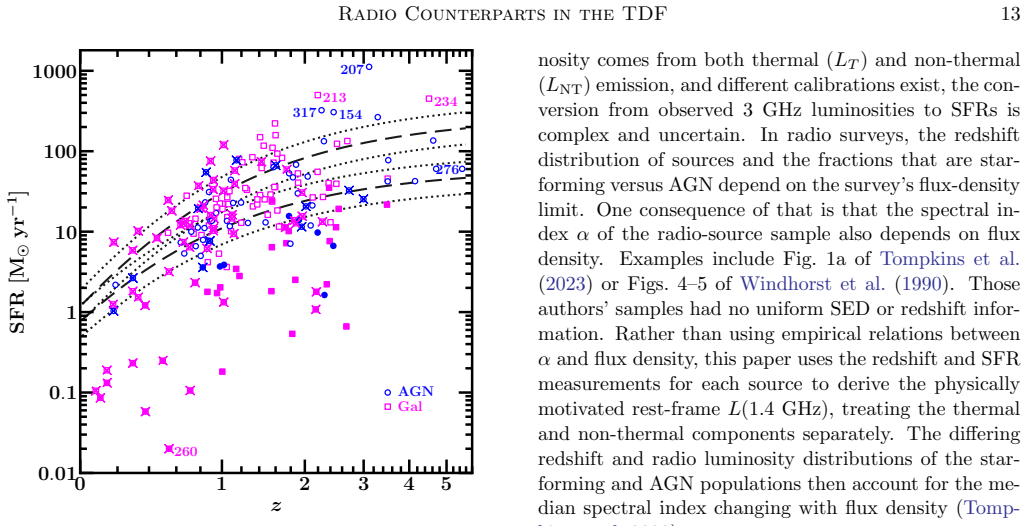
The paper claims that the radio emission from these micro-Jy sources is consistent with a star-formation origin in about 79 percent of the sample once the non-linear dependence of radio luminosity on star-formation rate is taken into account. This follows from successful JWST counterpart identification for nearly all sources in the NEP Time Domain Field, where the median host redshift is 1.14 and two-thirds of the galaxies show some AGN signature.
What carries the argument
The non-linear radio luminosity to star-formation rate relation that classifies whether observed radio flux matches expectations from star formation.
If this is right
- Radio emission at these faint levels is powered primarily by star formation rather than AGN activity.
- Monitoring for variability in the TDF can help separate hidden star formation from AGN contributions.
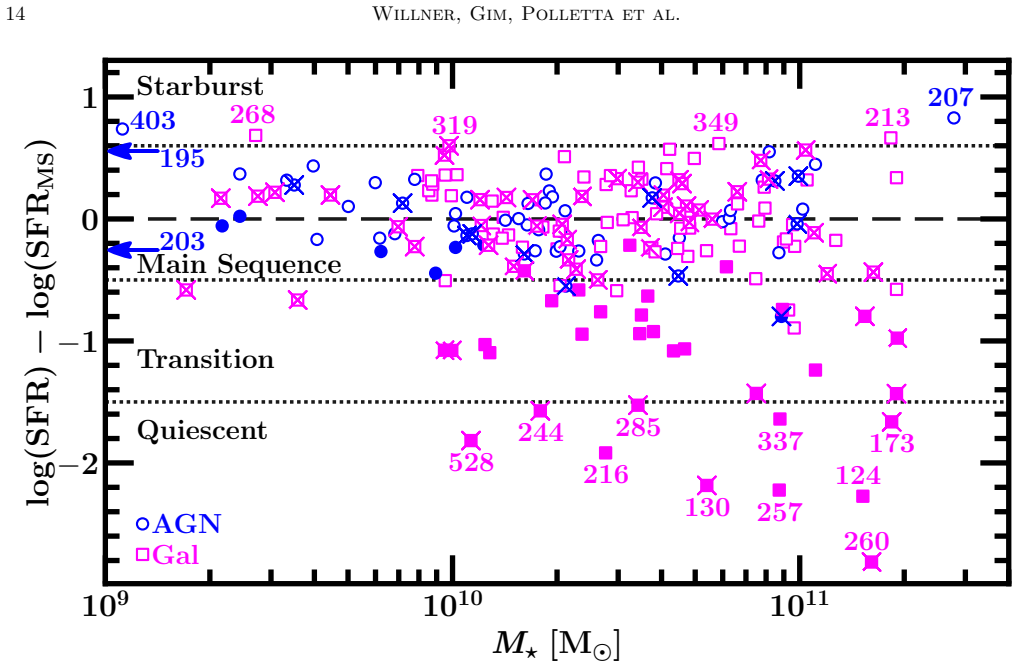
- Two-thirds of the radio hosts show at least one AGN indicator even when radio flux is attributed to star formation.
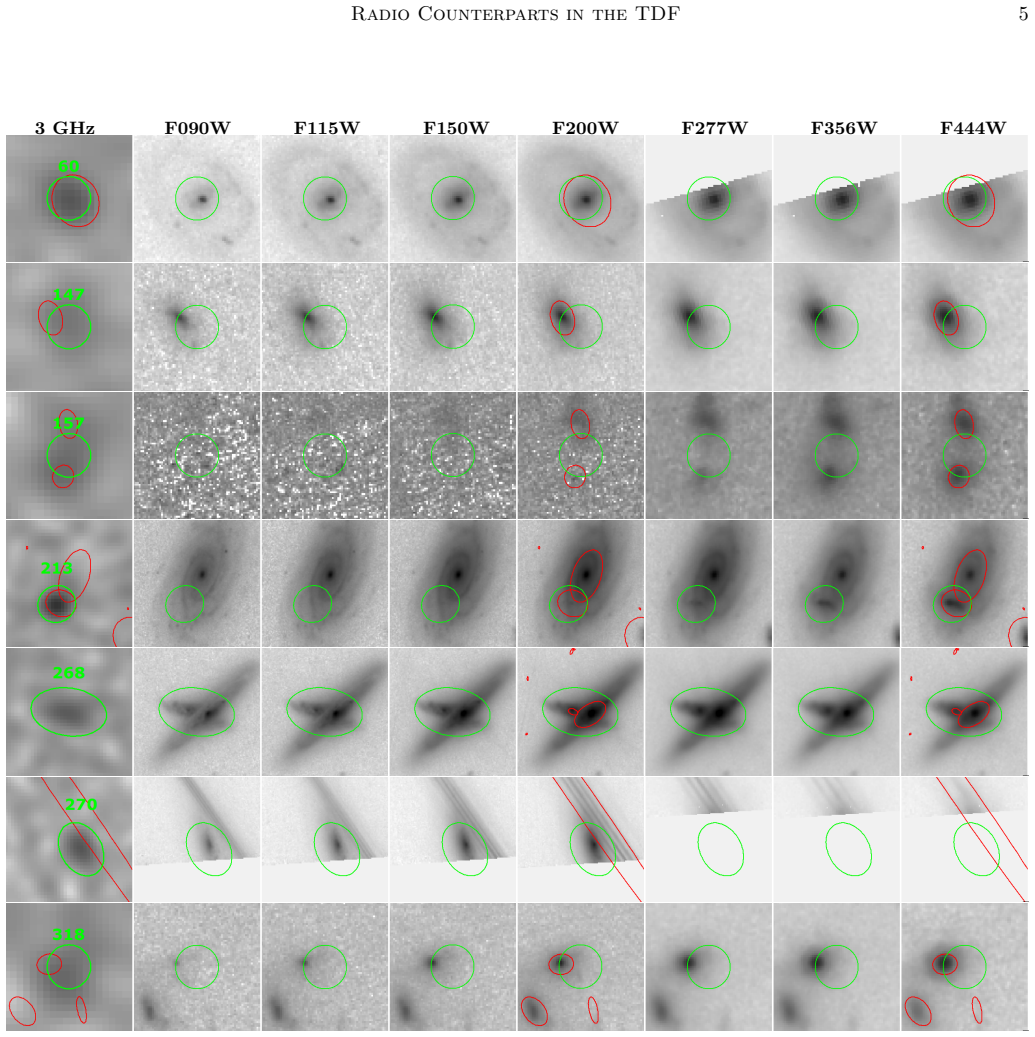
- Simple position matching without deblending would fail to identify many true counterparts.
Where Pith is reading between the lines
- Micro-Jy radio surveys at 3 GHz largely trace the star-forming galaxy population around redshift 1.
- Joint radio and JWST data can help identify galaxies where AGN and star formation operate together.
- Repeating the analysis in other fields would test whether the 79 percent star-formation fraction is typical.
Load-bearing premise
The adopted non-linear radio luminosity to star-formation rate relation accurately classifies the origin of the radio flux without significant systematic bias from dust obscuration or AGN contamination.
What would settle it
A measurement showing that radio luminosity exceeds the star-formation rate prediction for substantially more than 21 percent of the sources, or that a large fraction of the 0.3 arcsec matches are not true physical associations.
Figures






read the original abstract
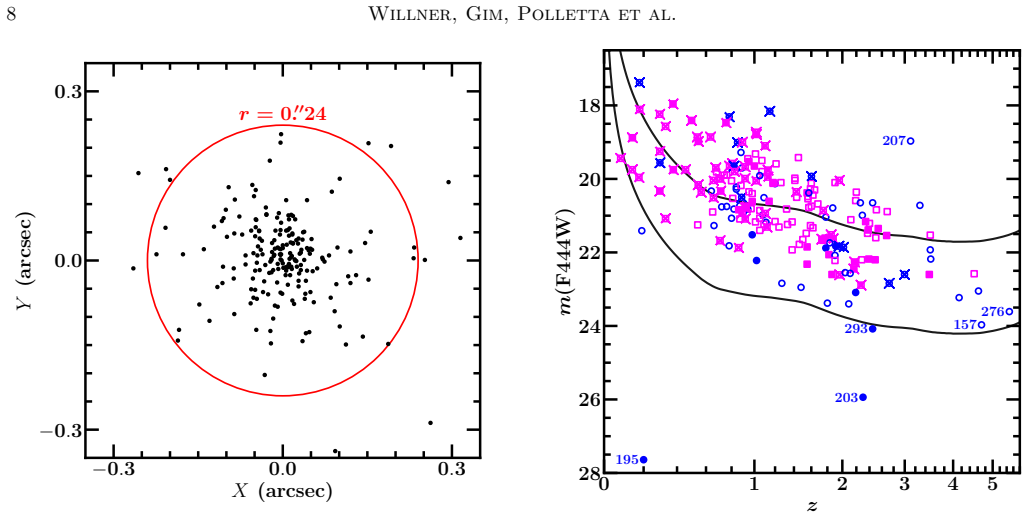
JWST/NIRCam observations in the North Ecliptic Pole Time Domain Field (TDF) identify 4.4 micron counterparts for 206 of 211 radio sources with S(3 GHz) \gapprox 5 micro-Jy in a 65arcmin^2 field. One of the remaining radio sources is likely to be a radio lobe of a nearby Seyfert galaxy, and the four radio sources without counterparts could be spurious. All but five counterparts are brighter than magnitude 23.5 AB at 4.4 micron. A simple position match with radius 0.3 arcsec would have identified 198 of the counterparts but only in a 4.4 micron catalog created with aggressive deblending of multiple peaks within an object's brightness distribution into distinct catalog sources. The properties of the radio-host galaxies are mostly consistent with those found in Paper 1: the median redshift is 1.14, and the radio emission, calculated taking into account the non-linear dependence of radio luminosity on star-formation rate, is consistent with a star formation origin in ~79% of the sample. For the other ~21%, the radio flux could come from star formation hidden behind dust or from an active galactic nucleus. One difference from other studies of radio-source counterparts is that 66% of the radio hosts show at least one indication of an AGN's presence. The presence of AGN and of hidden star formation could be elucidated by monitoring for source variability, and the TDF is the field most suited to such observations.
Editorial analysis
A structured set of objections, weighed in public.
Referee Report
Summary. The manuscript reports JWST/NIRCam 4.4 micron counterparts for 206 of 211 micro-Jy (S(3 GHz) ≳ 5 μJy) radio sources in a 65 arcmin² region of the NEP Time Domain Field. A 0.3-arcsec position match after aggressive deblending recovers 198 counterparts; the remaining sources are interpreted as possible spurious detections or radio lobes. The radio-host sample has median redshift 1.14 and, after applying a literature non-linear radio-luminosity–SFR scaling, the radio emission is attributed to star formation in ~79 % of cases, with the remaining ~21 % possibly arising from dust-obscured star formation or low-level AGN. Sixty-six percent of hosts exhibit at least one AGN indicator.
Significance. If the classification is robust, the work supplies a statistically useful anchor for the faint end of the radio source population at z ≈ 1, quantifies the overlap between radio and near-IR selected samples, and demonstrates that a substantial fraction of micro-Jy sources can be explained by star formation once the non-linear L_radio(SFR) dependence is taken into account. The suggestion that the TDF is ideal for variability monitoring is a concrete, testable implication.
major comments (2)
- [Abstract / Results] Abstract and §3 (or equivalent results section): the 79 % star-formation fraction is obtained by applying an external non-linear radio–SFR relation rather than by an internal fit or direct SFR indicators. Given that 66 % of the hosts already display at least one AGN indicator, the manuscript must demonstrate that these indicators are too weak to affect the radio flux at the level that would change the classification; otherwise the tension between the two statements undermines the central claim.
- [Methods / Counterpart matching] Methods / counterpart identification: the 0.3-arcsec matching radius after aggressive deblending is stated, but no completeness simulations, false-positive rate estimates, or quantitative assessment of the five sources lacking counterparts are provided. These numbers directly enter the 79 % fraction and must be shown to be robust before the result can be considered load-bearing.
minor comments (1)
- [Abstract] The abstract states “All but five counterparts are brighter than magnitude 23.5 AB”; a histogram or cumulative distribution of magnitudes would make this statement more quantitative and allow direct comparison with Paper I.
Simulated Author's Rebuttal
We thank the referee for the constructive and detailed report. We address each major comment below and indicate the revisions that will be incorporated into the next version of the manuscript.
read point-by-point responses
-
Referee: [Abstract / Results] Abstract and §3 (or equivalent results section): the 79 % star-formation fraction is obtained by applying an external non-linear radio–SFR relation rather than by an internal fit or direct SFR indicators. Given that 66 % of the hosts already display at least one AGN indicator, the manuscript must demonstrate that these indicators are too weak to affect the radio flux at the level that would change the classification; otherwise the tension between the two statements undermines the central claim.
Authors: We acknowledge the apparent tension and the need for clearer justification. The 79 % classification is obtained by comparing each source’s observed 3 GHz luminosity against the luminosity predicted from its SFR via the literature non-linear L_radio–SFR relation; sources lying within the expected scatter are counted as star-formation dominated. The 66 % AGN-indicator fraction refers to the presence of at least one diagnostic (mid-IR color, X-ray detection, or optical line ratio), but these indicators are typically weak in our faint sample. In the revised §3 and discussion we will add a quantitative paragraph showing that the radio excess expected from low-luminosity AGN at these flux levels remains well below the scatter of the adopted relation, so that the radio-based classification is not altered. We will also explicitly state that the remaining 21 % already encompass possible AGN contributions or dust-obscured star formation. This clarification will be added without changing the numerical result. revision: partial
-
Referee: [Methods / Counterpart matching] Methods / counterpart identification: the 0.3-arcsec matching radius after aggressive deblending is stated, but no completeness simulations, false-positive rate estimates, or quantitative assessment of the five sources lacking counterparts are provided. These numbers directly enter the 79 % fraction and must be shown to be robust before the result can be considered load-bearing.
Authors: We agree that quantitative validation of the matching procedure strengthens the result. In the revised Methods section we will insert a new paragraph describing the aggressive deblending algorithm and reporting a false-positive rate estimated by applying the same 0.3-arcsec match to 1000 random radio-position shifts within the field; we expect this rate to be <3 %. For the five sources without counterparts we will expand the existing discussion with their individual radio properties (flux density, spectral index where available, and morphology) to argue that one is a lobe of a nearby Seyfert and the other four are consistent with spurious detections. While a full Monte-Carlo completeness simulation of the entire JWST catalog is beyond the scope of the current data release, the high recovery fraction (198/206) obtained with the simple positional match already provides supporting evidence that the deblending step is not introducing large systematic errors. revision: yes
Circularity Check
No significant circularity detected; central classification uses external literature relation
full rationale
The paper derives the ~79% star-formation origin fraction by applying a pre-existing non-linear radio luminosity–SFR scaling from the literature to the measured 3 GHz fluxes and JWST-derived host properties, without fitting that relation internally or renaming a data-driven fit as a prediction. The 0.3-arcsec matching radius is stated explicitly and applied uniformly after aggressive deblending; it is not tuned to produce the reported fraction. References to Paper I are limited to consistency checks on ancillary galaxy properties and do not supply the load-bearing classification step. No self-definitional equations, ansatzes imported via self-citation, or uniqueness theorems from the same author group appear in the derivation chain. The result therefore remains independent of the present dataset’s fitted values and is self-contained against external benchmarks.
Axiom & Free-Parameter Ledger
axioms (2)
- domain assumption The non-linear dependence of radio luminosity on star-formation rate is correctly described by the relation adopted from prior literature.
- domain assumption A 0.3 arcsec position match with aggressive deblending in the 4.4 micron catalog recovers true physical counterparts without significant false positives or missed associations.
Reference graph
Works this paper leans on
-
[1]
doi:10.5281/zenodo.4905459 , url =
Angus Comrie and Kuo-Song Wang and Shou-Chieh Hsu and Anthony Moraghan and Pamela Harris and Qi Pang and Adrianna Pińska and Cheng-Chin Chiang and Tien-Hao Chang and Yu-Hsuan Hwang and Hengtai Jan and Ming-Yi Lin and Rob Simmonds , title =. doi:10.5281/zenodo.4905459 , url =
-
[2]
Planck 2018 results. VI. Cosmological parameters. , keywords =. doi:10.1051/0004-6361/201833910 , archivePrefix =. 1807.06209 , primaryClass =
work page internal anchor Pith review Pith/arXiv arXiv doi:10.1051/0004-6361/201833910 2018
-
[3]
The Galactic Disk Mass Budget. I. Stellar Mass Function and Density. , keywords =. doi:10.1086/321401 , archivePrefix =. astro-ph/0107018 , primaryClass =
work page internal anchor Pith review Pith/arXiv arXiv doi:10.1086/321401
-
[4]
A CIGALE module tailored (not only) for low-luminosity active galactic nuclei. , keywords =. doi:10.1051/0004-6361/202450510 , archivePrefix =. 2404.16938 , primaryClass =
-
[5]
Information Handling in Astronomy - Historical Vistas , year = 2003, editor =
AIPS, the VLA, and the VLBA. Information Handling in Astronomy - Historical Vistas , year = 2003, editor =. doi:10.1007/0-306-48080-8_7 , adsurl =
-
[6]
PyBDSF: Python Blob Detection and Source Finder
-
[7]
Nature of Faint Radio Sources in GOODS-North and GOODS-South Fields. I. Spectral Index and Radio-FIR Correlation. , keywords =. doi:10.3847/1538-4357/ab1011 , archivePrefix =. 1903.07632 , primaryClass =
work page internal anchor Pith review Pith/arXiv arXiv doi:10.3847/1538-4357/ab1011 1903
-
[8]
Cosmic Star-Formation History. , keywords =. doi:10.1146/annurev-astro-081811-125615 , archivePrefix =. 1403.0007 , primaryClass =
work page internal anchor Pith review Pith/arXiv arXiv doi:10.1146/annurev-astro-081811-125615
-
[9]
Sub-millijansky 1.4 GHz source counts and multicolor studies of weak rado galaxy populations. , keywords =. doi:10.1086/162911 , adsurl =
-
[10]
The Radio/Optical Catalog of the SSA 13 Field. , keywords =. doi:10.1086/508169 , adsurl =
-
[11]
Optical Morphologies of Millijansky Radio Galaxies Observed by the Hubble Space Telescope and in the Very Large Array FIRST Survey. , keywords =. doi:10.1086/592045 , adsurl =
-
[12]
, year = 1995, month = jun, volume =
Identification of faint radio sources with optically luminous interacting disk galaxies. , year = 1995, month = jun, volume =. doi:10.1038/375471a0 , adsurl =
-
[13]
The cosmic radio background from 150 MHz to 8.4 GHz and its division into AGN and star-forming galaxy flux. , keywords =. doi:10.1093/mnras/stad116 , adsurl =
-
[14]
A deep Westerbork survey of areas with multicolor Mayall 4 m plates. II. Optical identifications. , keywords =
-
[15]
, year = 2003, month = sep, volume =
The microJansky and nanoJansky population. , year = 2003, month = sep, volume =. doi:10.1016/S1387-6473(03)00045-9 , adsurl =
-
[16]
The Astropy Project: Building an inclusive, open-science project and status of the v2.0 core package
The Astropy Project: Building an Open-science Project and Status of the v2.0 Core Package. , keywords =. doi:10.3847/1538-3881/aabc4f , archivePrefix =. 1801.02634 , primaryClass =
work page internal anchor Pith review Pith/arXiv arXiv doi:10.3847/1538-3881/aabc4f
-
[17]
Astropy: A Community Python Package for Astronomy
Astropy: A community Python package for astronomy. , keywords =. 2013. doi:10.1051/0004-6361/201322068 , archivePrefix =. 1307.6212 , primaryClass =
work page internal anchor Pith review Pith/arXiv arXiv doi:10.1051/0004-6361/201322068 2013
-
[19]
Quantifying the Observational Effort Required for the Radial Velocity Characterization of TESS Planets. , keywords =. 2018. doi:10.3847/1538-3881/aacea9 , archivePrefix =. 1807.01263 , primaryClass =
work page internal anchor Pith review Pith/arXiv arXiv doi:10.3847/1538-3881/aacea9 2018
-
[20]
X-Ray Scattering Echoes and Ghost Halos from the Intergalactic Medium: Relation to the Nature of AGN Variability. , keywords =. 2015. doi:10.1088/0004-637X/805/1/23 , archivePrefix =. 1503.01475 , primaryClass =
work page internal anchor Pith review Pith/arXiv arXiv doi:10.1088/0004-637x/805/1/23 2015
-
[21]
Binospec: A Wide-field Imaging Spectrograph for the MMT
Binospec: A Wide-field Imaging Spectrograph for the MMT. , keywords =. doi:10.1088/1538-3873/ab1d78 , archivePrefix =. 1905.03320 , primaryClass =
work page internal anchor Pith review Pith/arXiv arXiv doi:10.1088/1538-3873/ab1d78 1905
- [22]
-
[23]
T _ E X and LAT _ E X Macro Definition Files for Astronomical Publications. , year = "1989", month = "Mar", pages =
work page 1989
-
[24]
Binospec Software System. , keywords =. doi:10.1088/1538-3873/ab1ceb , archivePrefix =. 1905.03321 , primaryClass =
work page internal anchor Pith review Pith/arXiv arXiv doi:10.1088/1538-3873/ab1ceb 1905
-
[25]
LaTeX: A Document Preparation System. 1994
work page 1994
-
[26]
Quasi-periodic Fast Propagating Magnetoacoustic Waves during the Magnetic Reconnection Between Solar Coronal Loops. , keywords =. 2018. doi:10.3847/2041-8213/aaf167 , archivePrefix =. 1811.08553 , primaryClass =
work page internal anchor Pith review Pith/arXiv arXiv doi:10.3847/2041-8213/aaf167 2018
-
[27]
The DEEP2 Galaxy Redshift Survey: Design, Observations, Data Reduction, and Redshifts
The DEEP2 Galaxy Redshift Survey: Design, Observations, Data Reduction, and Redshifts. , keywords =. doi:10.1088/0067-0049/208/1/5 , archivePrefix =. 1203.3192 , primaryClass =
work page internal anchor Pith review Pith/arXiv arXiv doi:10.1088/0067-0049/208/1/5
-
[28]
Nominal values for selected solar and planetary quantities: IAU 2015 Resolution B3
Nominal Values for Selected Solar and Planetary Quantities: IAU 2015 Resolution B3. , keywords =. 2016. doi:10.3847/0004-6256/152/2/41 , archivePrefix =. 1605.09788 , primaryClass =
work page internal anchor Pith review Pith/arXiv arXiv doi:10.3847/0004-6256/152/2/41 2015
-
[29]
Swift X-Ray Observations of Classical Novae. II. The Super Soft Source Sample. , keywords =. 2011. doi:10.1088/0067-0049/197/2/31 , archivePrefix =. 1110.6224 , primaryClass =
work page internal anchor Pith review Pith/arXiv arXiv doi:10.1088/0067-0049/197/2/31 2011
-
[30]
Galaxy emission line classification using 3D line ratio diagrams
Galaxy Emission Line Classification Using Three-dimensional Line Ratio Diagrams. , keywords =. 2014. doi:10.1088/0004-637X/793/2/127 , archivePrefix =. 1406.5186 , primaryClass =
work page internal anchor Pith review Pith/arXiv arXiv doi:10.1088/0004-637x/793/2/127 2014
-
[31]
The VLA-COSMOS 3 GHz Large Project: Multiwavelength counterparts and the composition of the faint radio population. , keywords =. doi:10.1051/0004-6361/201630223 , archivePrefix =. 1703.09719 , primaryClass =
work page internal anchor Pith review Pith/arXiv arXiv doi:10.1051/0004-6361/201630223
-
[32]
A Multiwavelength Analysis of the Faint Radio Sky (COSMOS-XS): the Nature of the Ultra-faint Radio Population. , keywords =. doi:10.3847/1538-4357/abb77a , archivePrefix =. 2009.13531 , primaryClass =
-
[33]
COLDz: Probing Cosmic Star Formation With Radio Free-Free Emission. , keywords =. doi:10.3847/1538-4357/ac34f5 , archivePrefix =. 2111.01153 , primaryClass =
-
[34]
The Last of FIRST: The Final Catalog and Source Identifications
The Last of FIRST: The Final Catalog and Source Identifications. , keywords =. doi:10.1088/0004-637X/801/1/26 , archivePrefix =. 1501.01555 , primaryClass =
work page internal anchor Pith review Pith/arXiv arXiv doi:10.1088/0004-637x/801/1/26
-
[35]
The James Webb Space Telescope North Ecliptic Pole Time-domain Field. I. Field Selection of a JWST Community Field for Time-domain Studies. , keywords =. doi:10.1088/1538-3873/aae476 , archivePrefix =. 1807.05278 , primaryClass =
work page internal anchor Pith review Pith/arXiv arXiv doi:10.1088/1538-3873/aae476
-
[36]
Prime Extragalactic Areas for Reionization and Lensing Science: Project Overview and First Results
JWST PEARLS. Prime Extragalactic Areas for Reionization and Lensing Science: Project Overview and First Results. , keywords =. doi:10.3847/1538-3881/aca163 , archivePrefix =. 2209.04119 , primaryClass =
-
[37]
The JCMT SCUBA-2 Survey of the James Webb Space Telescope North Ecliptic Pole Time-Domain Field. , keywords =. doi:10.3847/1538-4365/ac9bf4 , archivePrefix =. 2301.02786 , primaryClass =
-
[38]
SExtractor: Software for source extraction. , keywords =. doi:10.1051/aas:1996164 , adsurl =
-
[39]
The Massive Hosts of Radio Galaxies Across Cosmic Time
The Massive Hosts of Radio Galaxies across Cosmic Time. , keywords =. doi:10.1086/517887 , archivePrefix =. astro-ph/0703224 , primaryClass =
work page internal anchor Pith review Pith/arXiv arXiv doi:10.1086/517887
-
[40]
Bright radio sources at 178 MHz : flux densities, optical identifications and the cosmological evolution of powerful radio galaxies. , keywords =. doi:10.1093/mnras/204.1.151 , adsurl =
-
[41]
A Fully-Identified Sample of AEGIS20 Microjansky Radio Sources
A Fully Identified Sample of AEGIS20 Microjansky Radio Sources. , keywords =. doi:10.1088/0004-637X/756/1/72 , archivePrefix =. 1206.4571 , primaryClass =
work page internal anchor Pith review Pith/arXiv arXiv doi:10.1088/0004-637x/756/1/72
-
[42]
A third update of the status of the 3 CR sources : further new redshifts and new identifications of distant galaxies. , keywords =. doi:10.1086/131647 , adsurl =
-
[43]
Galaxy And Mass Assembly: The 1.4GHz SFR indicator, SFR-M* relation and predictions for ASKAP-GAMA
Galaxy And Mass Assembly: the 1.4 GHz SFR indicator, SFR-M _ * relation and predictions for ASKAP-GAMA. , keywords =. doi:10.1093/mnras/stw3080 , archivePrefix =. 1701.06242 , primaryClass =
work page internal anchor Pith review Pith/arXiv arXiv doi:10.1093/mnras/stw3080
-
[44]
The Star Formation Reference Survey - III. A multiwavelength view of star formation in nearby galaxies. , keywords =. doi:10.1093/mnras/sty2699 , archivePrefix =. 1810.01336 , primaryClass =
work page internal anchor Pith review Pith/arXiv arXiv doi:10.1093/mnras/sty2699
-
[45]
A Highly Consistent Framework for the Evolution of the Star-Forming "Main Sequence" from z~0-6
A Highly Consistent Framework for the Evolution of the Star-Forming ``Main Sequence'' from z -0.5ex 0-6. , keywords =. doi:10.1088/0067-0049/214/2/15 , archivePrefix =. 1405.2041 , primaryClass =
work page internal anchor Pith review Pith/arXiv arXiv doi:10.1088/0067-0049/214/2/15 2041
-
[46]
2019, A&A, 622, A103, doi: 10.1051/0004-6361/201834156
CIGALE: a python Code Investigating GALaxy Emission. , keywords =. doi:10.1051/0004-6361/201834156 , archivePrefix =. 1811.03094 , primaryClass =
work page internal anchor Pith review Pith/arXiv arXiv doi:10.1051/0004-6361/201834156
-
[47]
Stellar population synthesis at the resolution of 2003. , keywords =. doi:10.1046/j.1365-8711.2003.06897.x , archivePrefix =. astro-ph/0309134 , primaryClass =
-
[48]
Evolutionary population synthesis: models, analysis of the ingredients and application to high-z galaxies. , keywords =. doi:10.1111/j.1365-2966.2005.09270.x , archivePrefix =. astro-ph/0410207 , primaryClass =
-
[49]
Infrared Emission from Interstellar Dust. IV. The Silicate-Graphite-PAH Model in the Post-Spitzer Era. , keywords =. doi:10.1086/511055 , archivePrefix =. astro-ph/0608003 , primaryClass =
work page internal anchor Pith review Pith/arXiv arXiv doi:10.1086/511055
-
[50]
Andromeda's Dust. , keywords =. doi:10.1088/0004-637X/780/2/172 , archivePrefix =. 1306.2304 , primaryClass =
work page internal anchor Pith review Pith/arXiv arXiv doi:10.1088/0004-637x/780/2/172
-
[51]
The global dust modelling framework THEMIS. , keywords =. doi:10.1051/0004-6361/201630225 , archivePrefix =. 1703.00775 , primaryClass =
work page internal anchor Pith review Pith/arXiv arXiv doi:10.1051/0004-6361/201630225
-
[52]
A Two-parameter Model for the Infrared/Submillimeter/Radio Spectral Energy Distributions of Galaxies and Active Galactic Nuclei. , keywords =. doi:10.1088/0004-637X/784/1/83 , archivePrefix =. 1402.1495 , primaryClass =
work page internal anchor Pith review Pith/arXiv arXiv doi:10.1088/0004-637x/784/1/83
-
[53]
The Dust Content and Opacity of Actively Star-forming Galaxies. , keywords =. doi:10.1086/308692 , archivePrefix =. astro-ph/9911459 , primaryClass =
work page internal anchor Pith review Pith/arXiv arXiv doi:10.1086/308692
-
[54]
A Simple Model for the Absorption of Starlight by Dust in Galaxies
A Simple Model for the Absorption of Starlight by Dust in Galaxies. , keywords =. doi:10.1086/309250 , archivePrefix =. astro-ph/0003128 , primaryClass =
work page internal anchor Pith review Pith/arXiv arXiv doi:10.1086/309250
-
[55]
3D radiative transfer modelling of the dusty tori around active galactic nuclei as a clumpy two-phase medium. , keywords =. doi:10.1111/j.1365-2966.2011.19775.x , archivePrefix =. 1109.1286 , primaryClass =
-
[56]
The dust covering factor in active galactic nuclei
The dust covering factor in active galactic nuclei. , keywords =. doi:10.1093/mnras/stw444 , archivePrefix =. 1602.06954 , primaryClass =
work page internal anchor Pith review Pith/arXiv arXiv doi:10.1093/mnras/stw444
-
[57]
X-CIGALE: Fitting AGN/galaxy SEDs from X-ray to infrared. , keywords =. doi:10.1093/mnras/stz3001 , archivePrefix =. 2001.08263 , primaryClass =
-
[58]
Fitting AGN/Galaxy X-Ray-to-radio SEDs with CIGALE and Improvement of the Code. , keywords =. doi:10.3847/1538-4357/ac4971 , archivePrefix =. 2201.03718 , primaryClass =
-
[59]
, year = 1955, month = jan, volume =
The Luminosity Function and Stellar Evolution. , year = 1955, month = jan, volume =. doi:10.1086/145971 , adsurl =
-
[60]
Complex Ly Profiles in Redshift 6.6 Ultraluminous Ly Emitters. , keywords =. doi:10.3847/1538-4357/aac021 , archivePrefix =. 1805.00490 , primaryClass =
-
[61]
HEROES: The Hawaii eROSITA Ecliptic Pole Survey Catalog. , keywords =. doi:10.3847/1538-4365/accd70 , archivePrefix =. 2302.11581 , primaryClass =
-
[62]
MMT & Magellan Infrared Spectrograph
MMT and Magellan Infrared Spectrograph. , keywords =. doi:10.1086/669044 , archivePrefix =. 1211.6174 , primaryClass =
work page internal anchor Pith review Pith/arXiv arXiv doi:10.1086/669044
-
[63]
Data Reduction Pipeline for the MMT and Magellan Infrared Spectrograph
Data Reduction Pipeline for the MMT and Magellan Infrared Spectrograph. , keywords =. doi:10.1086/680598 , archivePrefix =. 1503.07504 , primaryClass =
work page internal anchor Pith review Pith/arXiv arXiv doi:10.1086/680598
-
[64]
Detection of quiescent galaxies in a bicolor sequence from z=0-2
Detection of Quiescent Galaxies in a Bicolor Sequence from Z = 0-2. , keywords =. doi:10.1088/0004-637X/691/2/1879 , archivePrefix =. 0806.0625 , primaryClass =
work page internal anchor Pith review Pith/arXiv arXiv doi:10.1088/0004-637x/691/2/1879
-
[65]
Encoding the infrared excess (IRX) in the NUVrK color diagram for star-forming galaxies
Encoding of the infrared excess in the NUVrK color diagram for star-forming galaxies. , keywords =. doi:10.1051/0004-6361/201321768 , archivePrefix =. 1309.0008 , primaryClass =
work page internal anchor Pith review Pith/arXiv arXiv doi:10.1051/0004-6361/201321768
-
[66]
Star Formation in the Milky Way and Nearby Galaxies
Star Formation in the Milky Way and Nearby Galaxies. , keywords =. doi:10.1146/annurev-astro-081811-125610 , archivePrefix =. 1204.3552 , primaryClass =
work page internal anchor Pith review Pith/arXiv arXiv doi:10.1146/annurev-astro-081811-125610
-
[67]
The NRAO VLA Sky Survey. , keywords =. doi:10.1086/300337 , adsurl =
-
[68]
Astronomical Data Analysis Software and Systems III , year = 1994, editor =
The VLA's FIRST Survey. Astronomical Data Analysis Software and Systems III , year = 1994, editor =
work page 1994
-
[69]
The 1.6um Bump as a Photometric Redshift Indicator
The 1.6 Micron Bump as a Photometric Redshift Indicator. , keywords =. doi:10.1086/344682 , archivePrefix =. astro-ph/0209437 , primaryClass =
work page internal anchor Pith review Pith/arXiv arXiv doi:10.1086/344682
-
[70]
Hectospec, the MMT's 300 Optical Fiber-Fed Spectrograph
Hectospec, the MMT's 300 Optical Fiber-Fed Spectrograph. , keywords =. doi:10.1086/497385 , archivePrefix =. astro-ph/0508554 , primaryClass =
work page internal anchor Pith review Pith/arXiv arXiv doi:10.1086/497385
-
[71]
Calibrating Extinction-Free Star Formation Rate Diagnostics with 33GHz Free-Free Emission in NGC6946
Calibrating Extinction-free Star Formation Rate Diagnostics with 33 GHz Free-free Emission in NGC 6946. , keywords =. doi:10.1088/0004-637X/737/2/67 , archivePrefix =. 1105.4877 , primaryClass =
work page internal anchor Pith review Pith/arXiv arXiv doi:10.1088/0004-637x/737/2/67
-
[72]
Spectral Energy Distributions of Hard X-ray selected AGNs in the XMDS Survey
Spectral Energy Distributions of Hard X-Ray Selected Active Galactic Nuclei in the XMM-Newton Medium Deep Survey. , keywords =. doi:10.1086/518113 , archivePrefix =. astro-ph/0703255 , primaryClass =
work page internal anchor Pith review Pith/arXiv arXiv doi:10.1086/518113
-
[73]
A New Method to Separate Star-forming from AGN Galaxies at Intermediate Redshift: The Submillijansky Radio Population in the VLA-COSMOS Survey. , keywords =. doi:10.1086/588028 , archivePrefix =. 0803.0997 , primaryClass =
work page internal anchor Pith review Pith/arXiv arXiv doi:10.1086/588028
-
[74]
American Astronomical Society Meeting Abstracts , year = 2021, series =
The VLITE Commensal Sky Survey (VCSS): A 340 MHz Companion to the VLA Sky Survey (VLASS). American Astronomical Society Meeting Abstracts , year = 2021, series =
work page 2021
-
[75]
LOFAR: The LOw-Frequency ARray
LOFAR: The LOw-Frequency ARray. , keywords =. doi:10.1051/0004-6361/201220873 , archivePrefix =. 1305.3550 , primaryClass =
work page internal anchor Pith review Pith/arXiv arXiv doi:10.1051/0004-6361/201220873
-
[76]
Infrared-faint radio sources: a cosmological view. AGN number counts, the cosmic X-ray background and SMBH formation. , keywords =. doi:10.1051/0004-6361/201016264 , archivePrefix =. 1104.0564 , primaryClass =
work page internal anchor Pith review Pith/arXiv arXiv doi:10.1051/0004-6361/201016264
-
[77]
The radio spectral energy distribution of infrared-faint radio sources
The radio spectral energy distribution of infrared-faint radio sources. , keywords =. doi:10.1051/0004-6361/201527000 , archivePrefix =. 1607.02707 , primaryClass =
work page internal anchor Pith review Pith/arXiv arXiv doi:10.1051/0004-6361/201527000
-
[78]
The spectra and energies of classical double radio lobes
The Spectra and Energies of Classical Double Radio Lobes. , keywords =. doi:10.1086/301254 , archivePrefix =. astro-ph/0001327 , primaryClass =
work page internal anchor Pith review Pith/arXiv arXiv doi:10.1086/301254
-
[79]
The Deep Swire Field. IV. First Properties of the sub-mJy Galaxy Population: Redshift Distribution, AGN Activity, and Star Formation. , keywords =. doi:10.1088/0004-637X/714/2/1305 , archivePrefix =. 1003.4734 , primaryClass =
work page internal anchor Pith review Pith/arXiv arXiv doi:10.1088/0004-637x/714/2/1305
-
[80]
Deep JVLA Imaging of GOODS-N at 20cm
Deep JVLA Imaging of GOODS-N at 20 cm. , keywords =. doi:10.3847/1538-4365/aab4a1 , archivePrefix =. 1803.05455 , primaryClass =
work page internal anchor Pith review Pith/arXiv arXiv doi:10.3847/1538-4365/aab4a1
-
[81]
Seven-Year Wilkinson Microwave Anisotropy Probe (WMAP) Observations: Cosmological Interpretation
Seven-year Wilkinson Microwave Anisotropy Probe (WMAP) Observations: Cosmological Interpretation. , keywords =. doi:10.1088/0067-0049/192/2/18 , archivePrefix =. 1001.4538 , primaryClass =
work page internal anchor Pith review Pith/arXiv arXiv doi:10.1088/0067-0049/192/2/18
discussion (0)
Sign in with ORCID, Apple, or X to comment. Anyone can read and Pith papers without signing in.