Ensuring reliability in 100% renewable microgrids: a scenario-based joint planning and operational design framework
Pith reviewed 2026-05-20 15:20 UTC · model grok-4.3
The pith
A two-stage stochastic framework co-optimizes planning and operation to deliver 99.998% reliability in 100% renewable microgrids.
A machine-rendered reading of the paper's core claim, the machinery that carries it, and where it could break.
Core claim
The paper claims that by formulating a two-stage stochastic program, first deciding on photovoltaic and battery capacities and then optimizing dispatch under uncertainty scenarios derived from data clustering, the system can meet utility-grade reliability standards of 99.998% supply availability while minimizing total costs and respecting operational limits such as line capacities and voltage bounds.
What carries the argument
Two-stage stochastic programming model with scenario generation via statistical clustering of historical data, which handles investment decisions in the first stage and operational dispatch in the second stage under reliability constraints.
If this is right
- Distributed resource placement becomes feasible through power sharing between microgrid nodes, enhancing resilience to outages.
- Expected energy not served stays below 0.002% of annual demand even with simultaneous equipment failures.
- Total system costs are reduced by co-optimizing investments and operations rather than treating reliability separately.
- Microgrids can maintain load continuity by rerouting power during component outages.
Where Pith is reading between the lines
- Similar methods might apply to microgrids incorporating wind or other variable renewables by expanding the uncertainty scenarios accordingly.
- Validation in actual field deployments could reveal if the clustered scenarios capture rare but severe events adequately.
- Adoption in policy could shift focus toward integrated planning tools for renewable-only systems in isolated communities.
Load-bearing premise
Statistical clustering of historical data is assumed to produce scenarios that fully capture all relevant uncertainties in demand, solar output, and equipment failures.
What would settle it
Running the optimized capacities in a real-world microgrid for one year and measuring whether the actual energy not served exceeds 0.002% of the annual demand.
Figures




read the original abstract
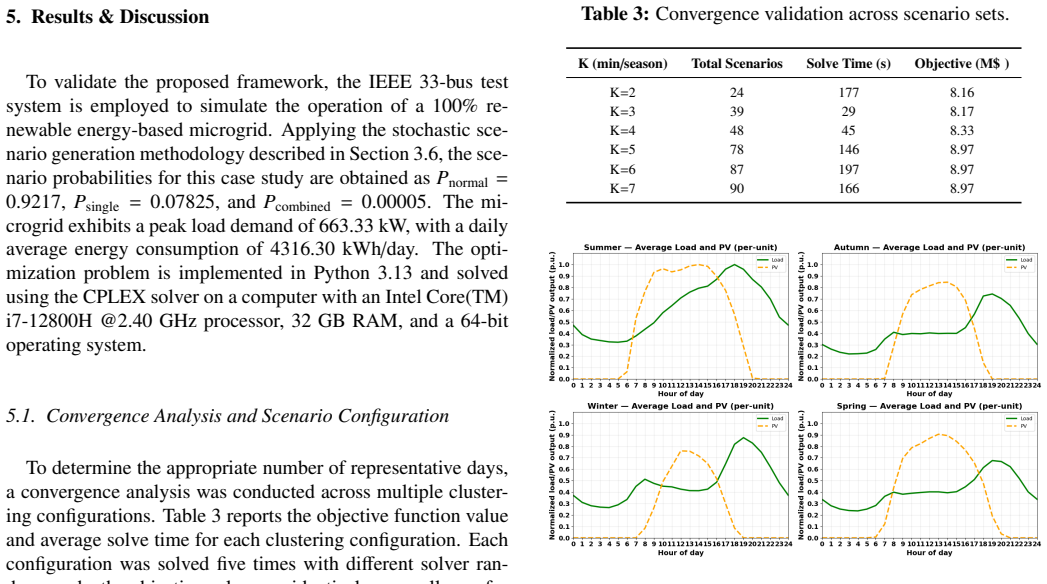
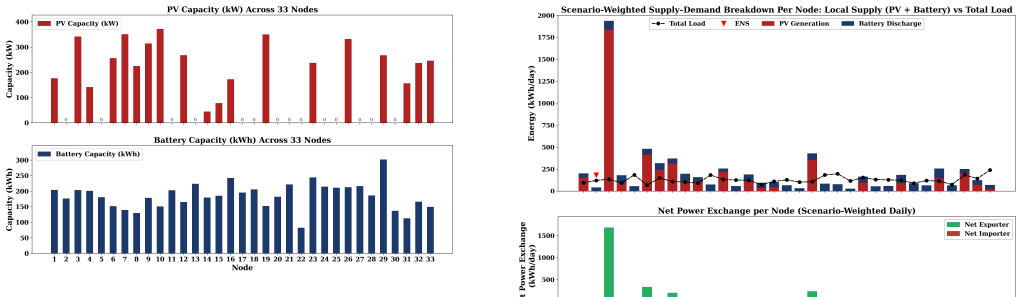
Off-grid microgrids powered entirely by renewable energy sources face substantial challenges in achieving utility-grade reliability standards. Existing microgrid planning frameworks often prioritize cost minimization while treating reliability as a secondary metric, thereby leading to suboptimal designs. This paper presents a comprehensive scenario-based optimization framework that simultaneously addresses long-term capacity planning and short-term operational dispatch in two stages for 100%-renewable microgrids. The developed two-stage stochastic programming model co-optimizes the investment and operation of photovoltaic generation and battery energy storage, while ensuring compliance with stringent reliability constraints following utility grid standards. Network modeling with operational constraints, such as line capacities and voltage limits, is incorporated to allow distributed resource placement leveraging power sharing between microgrid nodes. A novel scenario generation approach captures critical uncertainties, including seasonal demand fluctuations, solar output variations, and probabilistic equipment failures, through the statistical clustering of historical data. The optimization framework integrates utility-grade reliability constraints limiting the expected energy not served to below 0.002% of the annual demand while minimizing the total system costs. Numerical simulations demonstrate the effectiveness of the proposed framework, achieving 99.998% supply reliability using only photovoltaic power and battery energy storage. The optimized network-aware distributed resource allocation provides inherent resilience through power rerouting during component outages, maintaining load continuity even under simultaneous equipment failures. This study confirms the feasibility of 100%-renewable microgrids to support remote communities while meeting utility-grade reliability benchmarks.
Editorial analysis
A structured set of objections, weighed in public.
Referee Report
Summary. The paper proposes a two-stage stochastic programming framework for simultaneous long-term capacity planning and short-term operational dispatch in 100% renewable off-grid microgrids. It co-optimizes PV generation and battery energy storage investments and operations subject to network constraints (line capacities, voltage limits) while enforcing a utility-grade reliability constraint that limits expected energy not served (EENS) to below 0.002% of annual demand. Scenarios are generated via statistical clustering of historical data to represent seasonal demand, solar variability, and probabilistic equipment failures. Numerical simulations are reported to achieve 99.998% supply reliability with distributed resource placement providing resilience through power rerouting.
Significance. If the retained scenarios adequately represent tail events such as multi-day low-irradiance periods coinciding with high demand and outages, the work provides a concrete demonstration that 100% renewable microgrids can meet stringent reliability benchmarks while minimizing costs. The joint planning-operational formulation and explicit network modeling are strengths that could inform practical design for remote communities.
major comments (2)
- [Scenario generation approach (as described in abstract and methods)] The headline reliability result (EENS < 0.002% of annual demand) is obtained by enforcing the constraint inside the two-stage stochastic program whose uncertainty set is produced by statistical clustering. The manuscript must demonstrate that the clustering preserves multi-day temporal autocorrelation and includes representative instances of consecutive low-irradiance days; otherwise the in-sample EENS guarantee does not establish out-of-sample reliability under storage-depleting extremes. This is load-bearing for the central claim.
- [Numerical simulations / results section] The abstract states that the framework 'ensures compliance with stringent reliability constraints' and reports 99.998% supply reliability, but provides no explicit verification that the optimizer meets the EENS limit without post-hoc adjustments or that the scenario reduction retains sufficient probability mass on failure modes. A table or subsection quantifying the number of retained scenarios, their coverage of outage combinations, and sensitivity of EENS to scenario count would be required.
minor comments (2)
- [Model formulation] Notation for the two-stage formulation (first-stage investment variables vs. second-stage operational variables) should be introduced with explicit indices for nodes, time periods, and scenarios to improve readability.
- [Abstract and results] The paper should clarify whether the reported 99.998% figure is the complement of the enforced EENS limit or an additional post-optimization metric; if the former, it is tautological and should be stated as such.
Simulated Author's Rebuttal
We thank the referee for their thorough review and constructive comments on our manuscript. The points raised regarding scenario generation and verification of the reliability results are important for strengthening the paper's claims. We address each comment below and indicate the revisions we will make to the manuscript.
read point-by-point responses
-
Referee: [Scenario generation approach (as described in abstract and methods)] The headline reliability result (EENS < 0.002% of annual demand) is obtained by enforcing the constraint inside the two-stage stochastic program whose uncertainty set is produced by statistical clustering. The manuscript must demonstrate that the clustering preserves multi-day temporal autocorrelation and includes representative instances of consecutive low-irradiance days; otherwise the in-sample EENS guarantee does not establish out-of-sample reliability under storage-depleting extremes. This is load-bearing for the central claim.
Authors: We agree that validating the scenario generation method's ability to capture extreme events and temporal correlations is essential to support the reliability claims. Our clustering approach is based on historical data that includes periods of consecutive low-irradiance days, and the statistical clustering is designed to retain representative patterns from the data. However, to explicitly address this concern, in the revised version we will add a detailed analysis in the methods section showing the autocorrelation functions for key variables (solar irradiance, demand) in the original data versus the clustered scenarios. We will also provide examples of retained scenarios that include multi-day low solar periods coinciding with high demand and potential outages. revision: yes
-
Referee: [Numerical simulations / results section] The abstract states that the framework 'ensures compliance with stringent reliability constraints' and reports 99.998% supply reliability, but provides no explicit verification that the optimizer meets the EENS limit without post-hoc adjustments or that the scenario reduction retains sufficient probability mass on failure modes. A table or subsection quantifying the number of retained scenarios, their coverage of outage combinations, and sensitivity of EENS to scenario count would be required.
Authors: We appreciate this suggestion for improved transparency. The EENS constraint is directly incorporated into the two-stage stochastic optimization model as a hard constraint on the expected value over the scenarios, so the solution inherently satisfies it without post-hoc adjustments. To provide the requested verification, we will include in the revised results section a new table listing the number of retained scenarios (e.g., after k-means clustering), the distribution of scenarios across different outage combinations, and a sensitivity study demonstrating that the EENS remains below the threshold for varying scenario counts. This will confirm that sufficient probability mass is retained on critical failure modes. revision: yes
Circularity Check
No significant circularity in derivation chain
full rationale
The paper describes a two-stage stochastic programming model that co-optimizes PV and BESS investment/operation subject to an explicit EENS reliability constraint (below 0.002% of annual demand) and uses statistical clustering on external historical data to generate scenarios. The reported 99.998% supply reliability is the direct numerical counterpart of the enforced constraint and is obtained by solving the optimization; it is not presented as an independent prediction or first-principles derivation. No self-definitional steps, fitted parameters renamed as predictions, load-bearing self-citations, or uniqueness theorems appear in the provided text. The central claims rest on standard optimization techniques and externally sourced data, remaining self-contained against external benchmarks.
Axiom & Free-Parameter Ledger
free parameters (1)
- reliability threshold (expected energy not served)
axioms (1)
- domain assumption Historical data clustering captures all relevant uncertainties for reliability assessment
Reference graph
Works this paper leans on
-
[1]
D. Akinyele, R. K. Rayudu, Strategy for developing en- ergy systems for remote communities: Insights to best practices and sustainability, Sustainable Energy Technolo- gies and Assessments 16 (2016) 106–127
work page 2016
-
[2]
B. Domenech, M. Ranaboldo, L. Ferrer-Martí, R. Pastor, D. Flynn, Local and regional microgrid models to opti- mise the design of isolated electrification projects, Renew- able Energy 119 (2018) 795–808. 21
work page 2018
-
[3]
E. I. C. Zebra, H. J. van der Windt, G. Nhumaio, A. P. Faaij, A review of hybrid renewable energy systems in mini-grids for off-grid electrification in developing coun- tries, Renewable and Sustainable Energy Reviews 144 (2021) 111036
work page 2021
-
[4]
S. R. Isihak, Achieving universal electricity access in line with sdg7 using gis-based model: an application of onsset for rural electrification planning in nigeria, Energy Strat- egy Reviews 45 (2023) 101021
work page 2023
-
[5]
A. Valencia-Díaz, E. M. Toro, R. A. Hincapié, Optimal planning and management of the energy–water–carbon nexus in hybrid ac/dc microgrids for sustainable develop- ment of remote communities, Applied Energy 377 (2025) 124517
work page 2025
-
[6]
Australian Energy Market Commission (AEMC), Relia- bility, security and safety frameworks in the NEM - an explanatory statement, Technical report (June 2024)
work page 2024
-
[7]
S. O. Sanni, J. Y . Oricha, T. O. Oyewole, F. I. Bawonda, Analysis of backup power supply for unreliable grid using hybrid solar pv/diesel/biogas system, Energy 227 (2021) 120506
work page 2021
- [8]
-
[9]
M. Ranaboldo, B. Domenech, G. A. Reyes, L. Ferrer- Martí, R. P. Moreno, A. García-Villoria, Off-grid commu- nity electrification projects based on wind and solar ener- gies: A case study in nicaragua, Solar Energy 117 (2015) 268–281
work page 2015
- [10]
-
[11]
S. Tsianikas, J. Zhou, D. P. Birnie III, D. W. Coit, Eco- nomic trends and comparisons for optimizing grid-outage resilient photovoltaic and battery systems, Applied energy 256 (2019) 113892
work page 2019
- [12]
-
[13]
G. Notton, M.-L. Nivet, C. V oyant, C. Paoli, C. Darras, F. Motte, A. Fouilloy, Intermittent and stochastic charac- ter of renewable energy sources: Consequences, cost of intermittence and benefit of forecasting, Renewable and sustainable energy reviews 87 (2018) 96–105
work page 2018
-
[14]
N. Saddari, N. S. A. Derkyi, F. Peprah, S. Gyamfi, G. K. Donkor, Techno-economic and environmental assessment of grid and solar photovoltaic microgrid supply options for isolated off-grid rural communities toward sustainable and affordable electricity in nkoranza south, bono east, ghana, Results in Engineering 25 (2025) 103915
work page 2025
- [15]
-
[16]
A. Rochd, A. Raihani, O. Mahir, M. Kissaoui, M. Laamim, A. Lahmer, B. El-Barkouki, M. El-Qasery, H. SUN, J. M. Guerrero, Swarm intelligence-driven multi- objective optimization for microgrid energy management and trading considering ders and evs integration: Case studies from green energy park, morocco, Results in En- gineering (2025) 104400
work page 2025
-
[17]
D. R. Prathapaneni, K. P. Detroja, An integrated frame- work for optimal planning and operation schedule of mi- crogrid under uncertainty, Sustainable Energy, Grids and Networks 19 (2019) 100232
work page 2019
-
[18]
S. Wang, F. Luo, Z. Y . Dong, G. Ranzi, Joint planning of active distribution networks considering renewable power uncertainty, International Journal of Electrical Power & Energy Systems 110 (2019) 696–704
work page 2019
-
[19]
D. Huo, M. Santos, I. Sarantakos, M. Resch, N. Wade, D. Greenwood, A reliability-aware chance-constrained battery sizing method for island microgrid, Energy 251 (2022) 123978
work page 2022
- [20]
-
[21]
C. Xie, D. Wang, C. S. Lai, R. Wu, X. Wu, L. L. Lai, Optimal sizing of battery energy storage system in smart microgrid considering virtual energy storage system and high photovoltaic penetration, Journal of Cleaner Produc- tion 281 (2021) 125308
work page 2021
-
[22]
S. S. K. R. Vaka, S. K. Matam, Optimal sizing and man- agement of battery energy storage systems in microgrids for operating cost minimization, Electric Power Compo- nents and Systems 49 (16-17) (2021) 1319–1332
work page 2021
-
[23]
F. A. Kassab, B. Celik, F. Locment, M. Sechilariu, S. Li- aquat, T. M. Hansen, Optimal sizing and energy manage- ment of a microgrid: A joint milp approach for minimiza- tion of energy cost and carbon emission, Renewable En- ergy 224 (2024) 120186
work page 2024
-
[24]
A. A. Hafez, A. Y . Abdelaziz, M. A. Hendy, A. F. Ali, Optimal sizing of off-line microgrid via hybrid multi- objective simulated annealing particle swarm optimizer, Computers & Electrical Engineering 94 (2021) 107294. 22
work page 2021
-
[25]
D. B. Aeggegn, G. N. Nyakoe, C. Wekesa, Optimal sizing of grid connected multi-microgrid system using grey wolf optimization, Results in Engineering 23 (2024) 102421
work page 2024
-
[26]
S. Yang, H. Lin, L. Ju, J. Ma, Chance-constrained bi-level optimal dispatching model and benefit allocation strategy for off-grid microgrid considering bilateral uncertainty of supply and demand, International Journal of Electrical Power & Energy Systems 146 (2023) 108719
work page 2023
-
[27]
C. Mokhtara, B. Negrou, A. Bouferrouk, Y . Yao, N. Set- tou, M. Ramadan, Integrated supply–demand energy man- agement for optimal design of off-grid hybrid renewable energy systems for residential electrification in arid cli- mates, Energy Conversion and Management 221 (2020) 113192
work page 2020
-
[28]
D. A. Copp, T. A. Nguyen, R. H. Byrne, B. R. Chalamala, Optimal sizing of distributed energy resources for plan- ning 100% renewable electric power systems, Energy 239 (2022) 122436
work page 2022
-
[29]
S. B. Jeyaprabha, J. V . Milanovi ´c, Probabilistic techno- economic design of isolated microgrid, IEEE Transactions on Power Systems 38 (6) (2022) 5267–5277
work page 2022
- [30]
-
[31]
Y . Wang, A. O. Rousis, G. Strbac, A three-level planning model for optimal sizing of networked microgrids consid- ering a trade-offbetween resilience and cost, IEEE Trans- actions on Power Systems 36 (6) (2021) 5657–5669
work page 2021
-
[32]
M. H. Rasool, U. Perwez, Z. Qadir, S. M. H. Ali, Scenario-based techno-reliability optimization of an off- grid hybrid renewable energy system: A multi-city study framework, Sustainable Energy Technologies and Assess- ments 53 (2022) 102411
work page 2022
-
[33]
X. Wu, W. Zhao, X. Wang, H. Li, An milp-based plan- ning model of a photovoltaic/diesel/battery stand-alone microgrid considering the reliability, IEEE Transactions on Smart Grid 12 (5) (2021) 3809–3818
work page 2021
-
[34]
N. Sakthivelnathan, A. Arefi, C. Lund, A. Mehrizi- Sani, S. Muyeen, Cost-effective reliability level in 100% renewables-based standalone microgrids considering in- vestment and expected energy not served costs, Energy 311 (2024) 133426
work page 2024
-
[35]
A. Chebabhi, I. Tegani, A. D. Benhamadouche, O. Kraa, Optimal design and sizing of renewable energies in mi- crogrids based on financial considerations a case study of biskra, algeria, Energy Conversion and Management 291 (2023) 117270
work page 2023
- [36]
- [37]
-
[38]
A. Nargeszar, A. Ghaedi, M. Nafar, M. Simab, Reliability evaluation of the renewable energy-based microgrids con- sidering resource variation, IET Renewable Power Gener- ation 17 (3) (2023) 507–527
work page 2023
-
[39]
P. M. Krishna, P. Sekhar, T. Behera, A robust optimal siz- ing of renewable-rich multi-source microgrid under uncer- tainties with multi-storage options, Electrical Engineering 106 (5) (2024) 6547–6563
work page 2024
-
[40]
M. Nurunnabi, N. K. Roy, E. Hossain, H. R. Pota, Size optimization and sensitivity analysis of hybrid wind/pv micro-grids-a case study for bangladesh, IEEE Access 7 (2019) 150120–150140
work page 2019
-
[41]
S. A. Shezan, M. F. Ishraque, G. Shafiullah, I. Kamwa, L. C. Paul, S. Muyeen, R. Nss, M. Z. Saleheen, P. P. Kumar, Optimization and control of solar-wind islanded hybrid microgrid by using heuristic and deterministic op- timization algorithms and fuzzy logic controller, Energy reports 10 (2023) 3272–3288
work page 2023
-
[42]
F. Firdouse, M. Surender Reddy, A hybrid energy storage system using ga and pso for an islanded microgrid appli- cations, Energy Storage 5 (7) (2023) e460
work page 2023
-
[43]
M. M. Kamal, I. Ashraf, E. Fernandez, Planning and op- timization of microgrid for rural electrification with inte- gration of renewable energy resources, Journal of Energy Storage 52 (2022) 104782
work page 2022
-
[44]
S. Mansouri, F. Zishan, O. D. Montoya, M. Azimizadeh, D. A. Giral-Ramírez, Using an intelligent method for mi- crogrid generation and operation planning while consid- ering load uncertainty, Results in Engineering 17 (2023) 100978
work page 2023
-
[45]
M. S. Borujeni, A. A. Foroud, A. Dideban, Accurate mod- eling of uncertainties based on their dynamics analysis in microgrid planning, Solar Energy 155 (2017) 419–433
work page 2017
-
[46]
M. Li, D. Allinson, M. He, Seasonal variation in house- hold electricity demand: A comparison of monitored and synthetic daily load profiles, Energy and Buildings 179 (2018) 292–300
work page 2018
-
[47]
K. Zeng, H. Yang, T. Li, Y . Long, Human-centric micro- grid optimization: A two-time-scale framework integrat- ing consumer behavior, Electronics 14 (4) (2025) 808. 23
work page 2025
-
[48]
A. S. Soliman, L. Xu, J. Dong, P. Cheng, Numerical inves- tigation of a photovoltaic module under different weather conditions, Energy Reports 8 (2022) 1045–1058
work page 2022
-
[49]
Y . Tang, J. W. Cheng, Q. Duan, C. W. Lee, J. Zhong, Eval- uating the variability of photovoltaics: A new stochas- tic method to generate site-specific synthetic solar data and applications to system studies, Renewable energy 133 (2019) 1099–1107
work page 2019
-
[50]
M. Gholami, S. A. Mousavi, S. Muyeen, Enhanced mi- crogrid reliability through optimal battery energy storage system type and sizing, IEEE Access 11 (2023) 62733– 62743
work page 2023
-
[51]
N. Ochoa, Australian MV-LV Net- works and Demand/DER profiles, https://github.com/Team-Nando, accessed: 2025- 01-23 (2025)
work page 2025
-
[52]
S. Pfenninger, I. Staffell, Renewables.ninja - PV and Wind Power Generation Data, A web platform that uses NASA MERRA-2 and SARAH satellite data to simulate hourly power output from wind and solar power plants (2016). URLhttps://www.renewables.ninja/
work page 2016
-
[53]
URLhttps://www.visitvictoria.com/practical-information/melbourne-weather
Visit Victoria, Victoria Weather and Seasons, [Online; accessed 4-August-2025] (2025). URLhttps://www.visitvictoria.com/practical-information/melbourne-weather
work page 2025
-
[54]
J. Han, M. Kamber, J. Pei, Data mining: Concepts and, Techniques, Waltham: Morgan Kaufmann Publish- ers (2012) 2012–13
work page 2012
- [55]
-
[56]
A. Lengyel, Z. Botta-Dukát, Silhouette width using gen- eralized mean—a flexible method for assessing clustering efficiency, Ecology and evolution 9 (23) (2019) 13231– 13243
work page 2019
- [57]
- [58]
-
[59]
M. Quashie, C. Marnay, F. Bouffard, G. Joós, Optimal planning of microgrid power and operating reserve capac- ity, Applied Energy 210 (2018) 1229–1236
work page 2018
-
[60]
Australian Energy Regulator, Final report on values of customer reliability 2024, Technical report, Australian Energy Regulator (December 2024)
work page 2024
-
[61]
S. H. Low, Convex relaxation of optimal power flow—part i: Formulations and equivalence, IEEE Transactions on Control of Network Systems 1 (1) (2014) 15–27
work page 2014
-
[62]
A. Scalfati, D. Iannuzzi, M. Fantauzzi, M. Roscia, Opti- mal sizing of distributed energy resources in smart micro- grids: A mixed integer linear programming formulation, in: 2017 IEEE 6th International Conference on Renew- able Energy Research and Applications (ICRERA), IEEE, 2017, pp. 568–573. 24 Appendix A. Robustness Analysis: Battery-Only Node Under ...
work page 2017
discussion (0)
Sign in with ORCID, Apple, or X to comment. Anyone can read and Pith papers without signing in.