Direct On-Wafer Measurements of Noise Parameters in C- and X-bands at T=4 K
Pith reviewed 2026-05-20 14:54 UTC · model grok-4.3
The pith
A cryogenically cooled on-wafer setup measures noise parameters of 14 nm FinFETs at 4 K.
A machine-rendered reading of the paper's core claim, the machinery that carries it, and where it could break.
Core claim
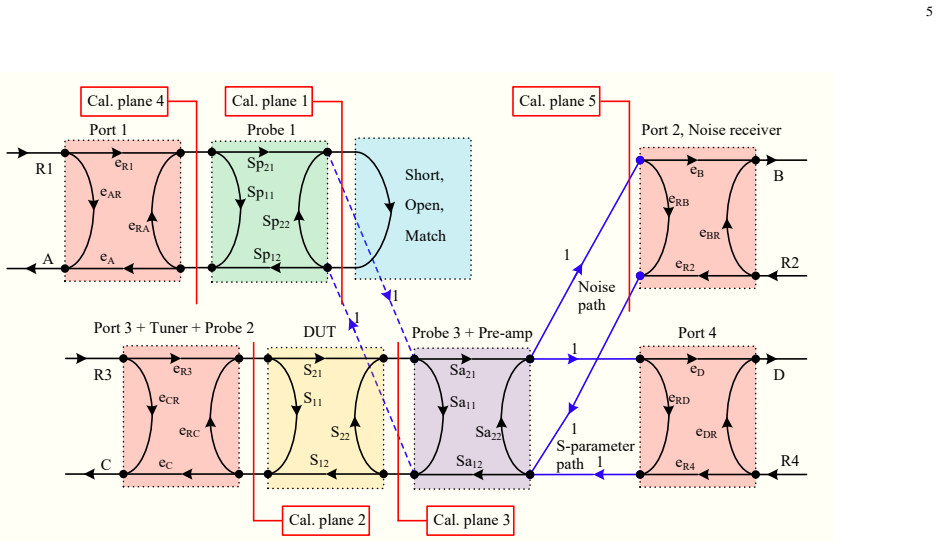
The central claim is that the described setup consisting of a cryostat with wafer probes, two reflectometers, a programmable impedance generator, and all other components cooled to 4 K allows direct on-wafer measurements of FET noise parameters using the source-pull method, with the results for 14 nm FinFETs and associated LNAs validated by comparison to independent techniques.
What carries the argument
The source-pull method with a programmable impedance generator combined with vector error correction from cooled reflectometers and supporting components inside the cryostat.
If this is right
- Multiple FETs can undergo simultaneous calibration and measurement of S-parameters, noise parameters, and I-V curves in one cooldown.
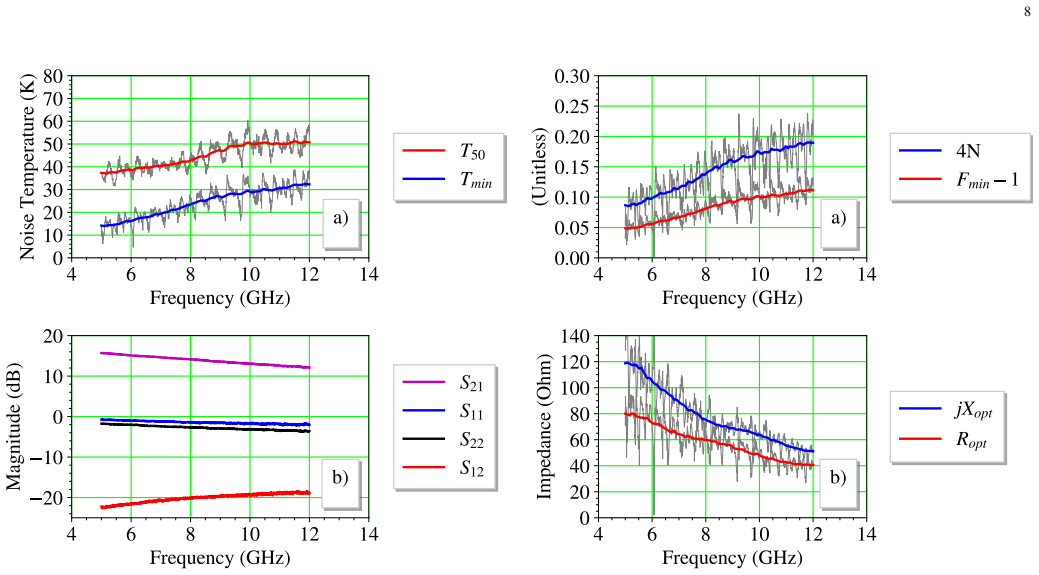
- Noise parameter data are now available for 14 nm FinFETs operating at 4 K.
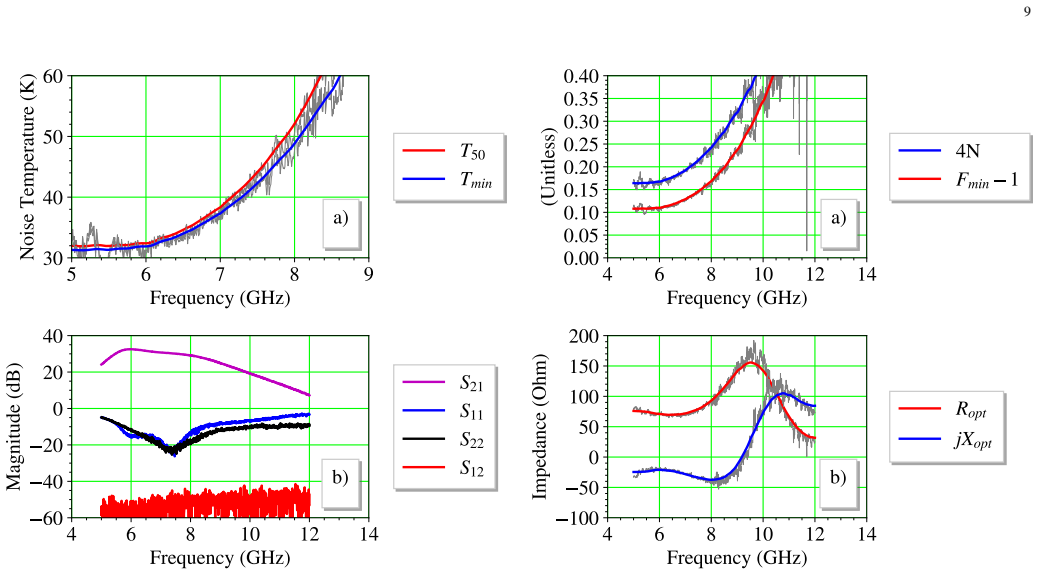
- Noise performance of an LNA built from these FinFETs can be characterized directly on the wafer at cryogenic temperature.
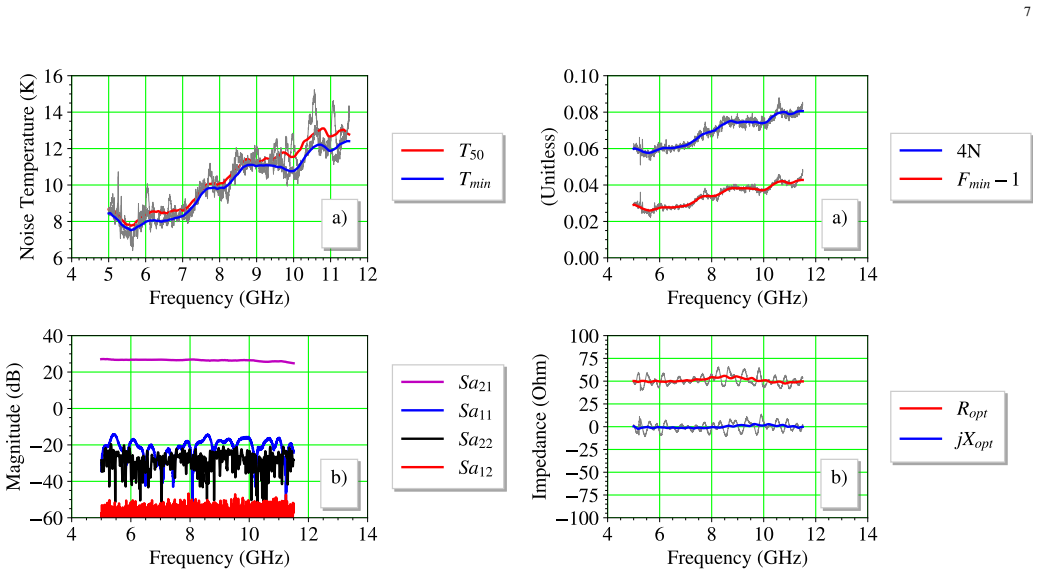
- Cross-checks against independent measurement techniques confirm the reliability of the extracted noise temperatures.
Where Pith is reading between the lines
- The method could reduce the experimental overhead for characterizing many devices intended for cryogenic electronics.
- Data obtained this way may help optimize transistor designs for applications that require low noise at millikelvin temperatures.
- Extending the approach to other frequency ranges or device geometries would test how general the cryogenic calibration remains.
Load-bearing premise
The calibration procedure and all cooled components maintain vector error correction accuracy at 4 K without introducing uncharacterized systematic errors from thermal contraction or probe contact.
What would settle it
Noise temperature values from this setup that differ from those obtained by independent alternative techniques by more than the combined uncertainties would indicate a problem with the cryogenic calibration or component performance.
Figures








read the original abstract
This paper describes the setup and the results of the direct on-wafer measurements of a FET noise parameters obtained with a source-pull method at temperatures down to T=4K and in the 5-12 GHz frequency range. The setup consists of a cryostat with wafer probes, two reflectometers, a programmable impedance generator, wideband isolators and bias tees and low noise preamplifier, all cooled to cryogenic temperatures, allowing to perform a full vector error-corrected wafer-level measurements of the discrete transistors and amplifier dies. The setup and its calibration procedure are designed in a such way that allows simultaneous calibration, S-parameters, noise parameters and I-V curve measurements of several FETs all in one cooldown. Using the described setup we perform first measurements of 14nm FinFETs and also measure noise parameters of an LNA based on these FETs. Resulting noise temperature values are compared against those obtained using independent and alternative measurement techniques.
Editorial analysis
A structured set of objections, weighed in public.
Referee Report
Summary. The manuscript describes a cryogenic setup for direct on-wafer source-pull measurements of FET noise parameters at 4 K in the 5-12 GHz range. The system cools the full signal path including reflectometers, isolators, bias tees, LNA, and wafer probes to enable simultaneous vector-error-corrected S-parameter, noise-parameter, and I-V measurements on multiple devices in one cooldown. It reports the first such measurements on 14 nm FinFETs together with noise parameters of an LNA built from these devices, and compares the resulting noise temperatures to values obtained by independent and alternative techniques.
Significance. If the calibration and reference-plane accuracy are shown to hold at 4 K, the work supplies the first reported noise-parameter data on 14 nm FinFETs at cryogenic temperature. Such data are directly relevant to the design of low-noise cryo electronics and quantum-readout chains; the ability to perform full vector-corrected on-wafer measurements in a single cooldown is a practical advance for device characterization.
major comments (2)
- [Abstract / Calibration Procedure] Abstract and calibration-procedure description: the manuscript states that the setup and calibration procedure enable full vector error-corrected measurements at 4 K, yet provides no quantitative account of how thermal contraction of the wafer probes, changes in contact resistance, or shifts in electrical length of on-wafer lines are measured or corrected. Because the noise-parameter solver relies on accurate reflection coefficients at the device reference plane, any uncharacterized shift directly affects the extracted noise temperatures; the comparison to independent techniques cannot close this loop if those techniques share the same unquantified cryo systematic errors.
- [Results] Results section (implied by the abstract claim of comparison): the abstract asserts that noise-temperature values are compared against independent techniques, but supplies neither numerical agreement metrics, error bars on the extracted parameters, nor data-exclusion criteria. Without these, it is impossible to judge whether the agreement validates the setup or merely reflects shared systematic offsets.
minor comments (2)
- [Abstract] Abstract: the phrase 'designed in a such way' should read 'designed in such a way'.
- [Title / Abstract] Title and abstract: the stated frequency range is 5-12 GHz while the title refers to C- and X-bands; a brief clarification of the exact overlap would improve precision.
Simulated Author's Rebuttal
We thank the referee for the constructive comments and for recognizing the significance of the first reported noise-parameter data on 14 nm FinFETs at 4 K. We address each major comment below and will revise the manuscript accordingly.
read point-by-point responses
-
Referee: [Abstract / Calibration Procedure] Abstract and calibration-procedure description: the manuscript states that the setup and calibration procedure enable full vector error-corrected measurements at 4 K, yet provides no quantitative account of how thermal contraction of the wafer probes, changes in contact resistance, or shifts in electrical length of on-wafer lines are measured or corrected. Because the noise-parameter solver relies on accurate reflection coefficients at the device reference plane, any uncharacterized shift directly affects the extracted noise temperatures; the comparison to independent techniques cannot close this loop if those techniques share the same unquantified cryo systematic errors.
Authors: We agree that additional quantitative detail on cryogenic effects would strengthen the manuscript. The full TRL calibration is performed at 4 K using on-wafer standards, so the extracted error terms already incorporate the actual probe contraction, contact resistance, and electrical lengths present at operating temperature. In the revision we will add a dedicated paragraph with measured values: typical probe-tip contraction of 0.3–0.6 mm, contact-resistance repeatability of <0.05 Ω, and the resulting reference-plane uncertainty (<0.02 in magnitude of Γ). These numbers are obtained from repeated calibrations on the same wafer during the same cooldown. The independent validation measurements use a separate cryostat and different probe hardware, so they do not share the same systematic offsets. revision: yes
-
Referee: [Results] Results section (implied by the abstract claim of comparison): the abstract asserts that noise-temperature values are compared against independent techniques, but supplies neither numerical agreement metrics, error bars on the extracted parameters, nor data-exclusion criteria. Without these, it is impossible to judge whether the agreement validates the setup or merely reflects shared systematic offsets.
Authors: We accept the point. The revised manuscript will include (i) error bars on all reported noise temperatures derived from the covariance matrix of the noise-parameter solver, (ii) quantitative agreement metrics (RMS difference of 8 % and maximum deviation of 12 % between source-pull and Y-factor results across 5–12 GHz), and (iii) explicit data-exclusion criteria (calibration residual > –25 dB or contact-resistance drift > 0.1 Ω). These additions will allow readers to evaluate the validation strength directly. revision: yes
Circularity Check
No circularity: purely experimental measurement with external cross-checks
full rationale
The manuscript reports hardware setup, calibration, and direct source-pull measurements of noise parameters for 14 nm FinFETs at 4 K, with results compared to independent alternative techniques. No derivation, prediction, or first-principles result is presented that reduces by construction to fitted inputs, self-citations, or ansatzes. The central claims rest on empirical data acquisition and external validation rather than any self-referential logical chain, rendering the work self-contained.
Axiom & Free-Parameter Ledger
axioms (1)
- domain assumption Standard assumptions in microwave network analysis and noise parameter extraction remain valid when all components are cooled to 4 K.
Lean theorems connected to this paper
-
IndisputableMonolith/Foundation/RealityFromDistinction.leanreality_from_one_distinction unclear?
unclearRelation between the paper passage and the cited Recognition theorem.
The setup consists of a cryostat with wafer probes, two reflectometers, a programmable impedance generator, wideband isolators and bias tees and low noise preamplifier, all cooled to cryogenic temperatures, allowing to perform a full vector error-corrected wafer-level measurements...
What do these tags mean?
- matches
- The paper's claim is directly supported by a theorem in the formal canon.
- supports
- The theorem supports part of the paper's argument, but the paper may add assumptions or extra steps.
- extends
- The paper goes beyond the formal theorem; the theorem is a base layer rather than the whole result.
- uses
- The paper appears to rely on the theorem as machinery.
- contradicts
- The paper's claim conflicts with a theorem or certificate in the canon.
- unclear
- Pith found a possible connection, but the passage is too broad, indirect, or ambiguous to say the theorem truly supports the claim.
Reference graph
Works this paper leans on
-
[1]
Cryogenic self-calibrating noise parameter measurement system,
D. Russell and S. Weinreb, “Cryogenic self-calibrating noise parameter measurement system,”IEEE Transactions on Microwave Theory and Techniques, vol. 60, no. 5, pp. 1456–1467, 2012
work page 2012
-
[2]
A noise-temperature measurement system using a cryo- genic attenuator,
J. E. Fernandez, “A noise-temperature measurement system using a cryo- genic attenuator,” inThe Telecommunications and Mission Operations Progress Report, TMO PR 42-135, pp. 1–9, July, 1998
work page 1998
-
[3]
A cryogenic on-chip noise measurement procedure with ±1.4- k measurement uncertainty,
Heinz, Felix and Thome, Fabian and Leuther, Arnulf and Ambacher, Oliver, “A cryogenic on-chip noise measurement procedure with ±1.4- k measurement uncertainty,” in2022 IEEE/MTT-S International Mi- crowave Symposium - IMS 2022, pp. 233–236, 2022
work page 2022
-
[4]
Evaluation of on-wafer noise parameter measurement techniques at cryogenic temperatures,
J. Kelly, J. Wang, A. Ofiare, N. Ridler, C. Li, “Evaluation of on-wafer noise parameter measurement techniques at cryogenic temperatures,” in2025 104rd ARFTG Microwave Measurement Conference (ARFTG), 2025
work page 2025
-
[5]
Z. Zou, S. Raman, and J. C. Bardin, “A 1.6-mw cryogenic sige lna ic for quantum readout applications achieving 2.6-k average noise temperature from 3 to 6 ghz,”IEEE Microwave and Wireless Technology Letters, vol. 34, no. 6, pp. 753–756, 2024
work page 2024
-
[6]
How IBM will build the world’s first large-scale, fault-tolerant quantum computer
IBM Corporation, “How IBM will build the world’s first large-scale, fault-tolerant quantum computer.” https://www.ibm.com/quantum/blog/ large-scale-ftqc, 2026. Accessed: March 4, 2026
work page 2026
-
[7]
On-wafer cryogenic rf noise measurement techniques,
J.-O. Plouchart, D. Frolov, U. Soylu, and A. Valdes-Garcia, “On-wafer cryogenic rf noise measurement techniques,” in2025 105th ARFTG Microwave Measurement Conference (ARFTG), pp. 1–4, 2025
work page 2025
-
[8]
Method and system for extrac- tion of noise parameters of nonlinear devices,
Leo Belostotski, Michael Himmelfarb, “Method and system for extrac- tion of noise parameters of nonlinear devices,” inUnited States Patent US9929757B2, 2017
work page 2017
-
[9]
Cold-termination noise-parameter measurements at cryo- genic temperatures,
Ismail Majed, Marwa Safa, Karl Warnick, Christopher Groppi, Leonid Belostotski, “Cold-termination noise-parameter measurements at cryo- genic temperatures,” in2024 103rd ARFTG Microwave Measurement Conference (ARFTG), 2024
work page 2024
-
[10]
Cryogenic impedance tuner series
Maury Microwave, “Cryogenic impedance tuner series.” https://maurymw.com/products/impedance-tuners/cryogenic-tuner/ cyrogenic-impedance-tuner-series/, 2026. Accessed: March 4, 2026
work page 2026
-
[11]
Noise characterization of linear twoports in terms of invariant parameters,
J. Lange, “Noise characterization of linear twoports in terms of invariant parameters,”IEEE Journal of Solid-State Circuits, vol. SC-2, no. 2, pp. 37–40, 1967
work page 1967
-
[12]
J. P. Dunsmore,Handbook of Microwave Measurements: with advanced VNA techniques. John Wiley & Sons, 2nd Edition., 2020
work page 2020
-
[13]
D. Rytting, “Network analyzer error models and calibration methods, rf 8 microwave measurements for wireless applications,” inARFTG/NIST Short Course Notes, 1996
work page 1996
-
[14]
Low Noise Factory AB, Gothenburg, Sweden, 2026
Low Noise Factory,LNF-LNC0.3 14B: 0.3-14 GHz Cryogenic Low Noise Amplifier Datasheet. Low Noise Factory AB, Gothenburg, Sweden, 2026. Accessed: March 27, 2026
work page 2026
-
[15]
An original demonstration of the formulaT min/T0 < 4Ninequality for noisy two-port networks,
L. Boglione, “An original demonstration of the formulaT min/T0 < 4Ninequality for noisy two-port networks,”IEEE Microwave Wireless Components Letters, vol. 18, no. 5, pp. 326–328, 2008
work page 2008
-
[16]
On the metrology of nanoscale silicon transistors above 100 GHz,
K. Yau, “On the metrology of nanoscale silicon transistors above 100 GHz,” 2011. Ph.D. dissertation, Dept. Elec. Eng. and Comp. Eng., University of Toronto, 2011
work page 2011
-
[17]
Evaluation of tuner-based noise- parameter extraction methods for very low noise amplifiers,
L. Belostotski and J. W. Haslett, “Evaluation of tuner-based noise- parameter extraction methods for very low noise amplifiers,”IEEE Transactions on Microwave Theory and Techniques, vol. 58, no. 1, pp. 236 – 250, 2010
work page 2010
-
[18]
Automated noise-parameter measurements of cryogenic lnas,
Alexander Sheldon et al, “Automated noise-parameter measurements of cryogenic lnas,” in2021 97th ARFTG Microwave Measurement Conference (ARFTG), 2021
work page 2021
discussion (0)
Sign in with ORCID, Apple, or X to comment. Anyone can read and Pith papers without signing in.