HyDRA: Hybrid Dynamic Routing Architecture for Heterogeneous LLM Pools
Pith reviewed 2026-05-20 15:07 UTC · model grok-4.3
The pith
HyDRA routes each query to the cheapest model whose static profile meets the query's predicted multi-dimensional needs, achieving large cost savings with matched or better quality.
A machine-rendered reading of the paper's core claim, the machinery that carries it, and where it could break.
Core claim
HyDRA predicts fine-grained, multi-dimensional capability requirements per query and matches them against configuration-defined model profiles via shortfall matching. A ModernBERT encoder with K=4 independent sigmoid heads scores each query along reasoning, code generation, debugging, and tool use; a shortfall-matching algorithm then selects the cheapest model whose capabilities meet the predicted requirements. The deployed predictor runs at 86 ms median CPU inference latency and is fully decoupled from the model catalog.
What carries the argument
shortfall-matching algorithm that selects the cheapest model whose static capability profile meets or exceeds the query's predicted scores across four dimensions
If this is right
- Peak-quality operation exceeds the always-strong baseline quality while cutting cost 12.9 percent on SWE-Bench Verified.
- Iso-quality operation matches the strong baseline at 54.1 percent cost savings, six times the savings of a prior binary router.
- Aggressive operation reaches 72.5 percent savings for a 3.2-point quality trade-off.
- Results generalize to LiveCodeBench, BigCodeBench, and tau-bench.
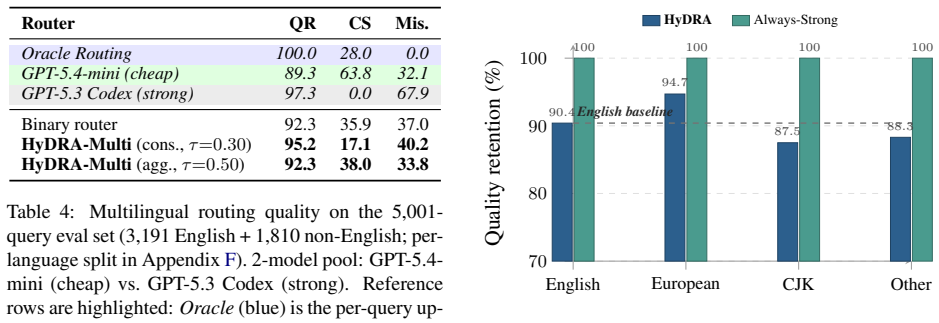
- Routing decisions remain effective across CJK, European, and other script families without language-specific changes.
Where Pith is reading between the lines
- Teams could add new specialized models to the pool and begin using them immediately by editing only the configuration file.
- The same shortfall logic could be applied to other production workloads such as retrieval-augmented generation or multi-step agent tasks.
- Increasing the number of scored dimensions might tighten the quality-cost frontier on broader task distributions.
Load-bearing premise
That scoring a query on only four capability dimensions is enough to decide which model will actually succeed without needing direct performance labels for every model-query pair.
What would settle it
Measure actual task resolution rates on a held-out set of queries routed at different shortfall thresholds and check whether the observed quality-cost curve reproduces the three reported regimes versus always using the strongest model.
Figures



read the original abstract
Production LLM deployments increasingly maintain heterogeneous model pools spanning order-of-magnitude cost differences. Existing routers make binary strong-vs-weak decisions and couple learned parameters to specific model identities, requiring retraining whenever the catalog changes. We present HyDRA (Hybrid Dynamic Routing Architecture), a framework that predicts fine-grained, multi-dimensional capability requirements per query and matches them against configuration-defined model profiles via shortfall matching. A ModernBERT encoder with K=4 independent sigmoid heads scores each query along reasoning, code generation, debugging, and tool use; a shortfall-matching algorithm then selects the cheapest model whose capabilities meet the predicted requirements. The deployed predictor runs at 86 ms median CPU inference latency in production, and is fully decoupled from the model catalog -- adding or removing models requires only a configuration change, with zero retraining. On SWE-Bench Verified (5-model pool: GPT-5.4-mini, Claude Haiku 4.5, GPT-5.3 Codex, Claude Sonnet 4.6, GPT-5.4), HyDRA's tunable shortfall threshold spans three regimes: peak-quality exceeds the always-strong Claude Sonnet 4.6 baseline (75.4% vs. 74.2% resolution) at 12.9% cost savings; iso-quality matches Sonnet at 54.1% cost savings, a 6x improvement over our prior in-house binary router at 9.1%; aggressive pushes savings to 72.5% for a 3.2-point quality trade. Results generalize across LiveCodeBench, BigCodeBench, and tau-bench. HyDRA is deployed to all users in GitHub Copilot's VS Code Chat auto-mode and -- to our knowledge for the first time in the LLM routing literature -- demonstrates language-invariant routing across CJK, European, and other script families.
Editorial analysis
A structured set of objections, weighed in public.
Referee Report
Summary. The manuscript introduces HyDRA, a routing framework for heterogeneous LLM pools that decouples a query-level capability predictor from the model catalog. A ModernBERT encoder with K=4 independent sigmoid heads predicts requirements along reasoning, code generation, debugging, and tool use; shortfall matching then selects the cheapest model whose static profile meets or exceeds the predicted scores. The router requires only a configuration change when models are added or removed. On SWE-Bench Verified (5-model pool), three operating regimes are reported: peak quality of 75.4% (exceeding Claude Sonnet 4.6 at 74.2%) with 12.9% cost savings; iso-quality matching at 54.1% savings (6x prior binary router); and aggressive mode at 72.5% savings for a 3.2-point quality drop. Generalization is claimed across LiveCodeBench, BigCodeBench, and tau-bench, with production deployment in GitHub Copilot and language-invariant behavior across scripts.
Significance. If the central results hold, the work is significant for production LLM serving. The explicit decoupling of the learned predictor from model identities removes the retraining requirement that limits prior routers, and the tunable shortfall threshold provides concrete, controllable quality-cost operating points with large reported savings. The 86 ms median CPU latency, real deployment, and cross-script invariance are practical strengths. The approach also supplies a falsifiable prediction mechanism (capability scores must correlate with per-model success) that future work can test directly.
major comments (2)
- [Abstract and §4] Abstract and §4 (Results): The headline regimes (75.4% peak quality at 12.9% savings, 54.1% iso-quality savings) rest on shortfall matching between the four predicted capability scores and static model profiles. No table or figure shows the empirical correlation between these four ModernBERT outputs and actual per-model resolution success on SWE-Bench Verified or the other benchmarks. Without this validation, it is unclear whether the observed trade-offs are driven by genuine capability prediction or by incidental alignment with the particular 5-model pool and benchmark distribution.
- [§3.1] §3.1 (Capability Encoder): The selection of exactly the four dimensions (reasoning, code generation, debugging, tool use) and K=4 heads is presented as given, with no ablation on alternative dimension sets or on the effect of removing any head. If one or more dimensions are weakly predictive of success for the models in the pool, the shortfall-matching rule could systematically under- or over-estimate requirements, undermining the claim that the router generalizes beyond the reported benchmarks.
minor comments (2)
- [Table 1] Table 1: The cost-savings percentages are reported to one decimal place while quality is given to one decimal; clarify whether these are means over multiple runs and whether error bars or standard deviations are available.
- [§5] §5 (Deployment): The 86 ms median CPU latency is stated without the hardware configuration, batch size, or sequence-length distribution used for the measurement; add these details for reproducibility.
Simulated Author's Rebuttal
We thank the referee for the constructive and detailed comments. We address each major comment below and describe the revisions we plan to make.
read point-by-point responses
-
Referee: [Abstract and §4] Abstract and §4 (Results): The headline regimes (75.4% peak quality at 12.9% savings, 54.1% iso-quality savings) rest on shortfall matching between the four predicted capability scores and static model profiles. No table or figure shows the empirical correlation between these four ModernBERT outputs and actual per-model resolution success on SWE-Bench Verified or the other benchmarks. Without this validation, it is unclear whether the observed trade-offs are driven by genuine capability prediction or by incidental alignment with the particular 5-model pool and benchmark distribution.
Authors: We agree that a direct empirical validation of the correlation between the four predicted capability scores and per-model resolution success would strengthen the manuscript. While the reported generalization across LiveCodeBench, BigCodeBench, and tau-bench, together with the production deployment results, provide indirect support, we will add a new figure and accompanying analysis in the revised version that reports Pearson correlations and scatter plots between each predicted dimension and observed per-model success rates on SWE-Bench Verified. revision: yes
-
Referee: [§3.1] §3.1 (Capability Encoder): The selection of exactly the four dimensions (reasoning, code generation, debugging, tool use) and K=4 heads is presented as given, with no ablation on alternative dimension sets or on the effect of removing any head. If one or more dimensions are weakly predictive of success for the models in the pool, the shortfall-matching rule could systematically under- or over-estimate requirements, undermining the claim that the router generalizes beyond the reported benchmarks.
Authors: The four dimensions were selected to align with the core capabilities needed for the coding, debugging, and tool-use tasks in our benchmarks and GitHub Copilot deployment. We acknowledge that no ablation on the number or choice of dimensions was included. We will add an ablation study to the appendix of the revised manuscript that measures the effect of using subsets of the heads on routing accuracy, cost savings, and generalization. revision: yes
Circularity Check
Derivation is self-contained with no circular reductions
full rationale
The paper describes a hybrid routing system where a ModernBERT model with four sigmoid heads predicts capability scores for queries, which are then matched to static model profiles using shortfall matching. The performance claims, including cost savings and quality metrics on SWE-Bench Verified, LiveCodeBench, BigCodeBench, and tau-bench, are presented as empirical results from deploying this system. These outcomes are measured against external baselines such as always selecting Claude Sonnet 4.6 and compared to a prior router for context. No part of the central derivation or results reduces by construction to the fitted parameters or relies on self-citations in a way that makes the claims tautological. The architecture is explicitly decoupled from specific model identities, requiring only configuration changes for catalog updates. The evaluation uses independent benchmark resolution rates, making the reported trade-offs falsifiable and not internally defined.
Axiom & Free-Parameter Ledger
free parameters (2)
- shortfall threshold
- K=4 capability heads
axioms (1)
- domain assumption Query requirements can be usefully decomposed into the four independent dimensions of reasoning, code generation, debugging, and tool use.
Lean theorems connected to this paper
-
IndisputableMonolith/Cost/FunctionalEquation.leanwashburn_uniqueness_aczel unclear?
unclearRelation between the paper passage and the cited Recognition theorem.
shortfall s_m := Σ w̃_k · max(0, r̂_k − c_m,k); cheapest model with shortfall ≤ τ
-
IndisputableMonolith/Foundation/AlexanderDuality.leanalexander_duality_circle_linking unclear?
unclearRelation between the paper passage and the cited Recognition theorem.
K=4 independent sigmoid heads for reasoning, code generation, debugging, tool use
What do these tags mean?
- matches
- The paper's claim is directly supported by a theorem in the formal canon.
- supports
- The theorem supports part of the paper's argument, but the paper may add assumptions or extra steps.
- extends
- The paper goes beyond the formal theorem; the theorem is a base layer rather than the whole result.
- uses
- The paper appears to rely on the theorem as machinery.
- contradicts
- The paper's claim conflicts with a theorem or certificate in the canon.
- unclear
- Pith found a possible connection, but the passage is too broad, indirect, or ambiguous to say the theorem truly supports the claim.
Reference graph
Works this paper leans on
-
[1]
Multilingual routing in mixture-of-experts,
Multilingual routing in mixture-of-experts. InThe Fourteenth International Conference on Learning Representa- tions (ICLR). ArXiv:2510.04694. Stephen Bates, Anastasios Angelopoulos, Lihua Lei, Jitendra Malik, and Michael Jordan
-
[2]
FrugalGPT: How to Use Large Language Models While Reducing Cost and Improving Performance
FrugalGPT: How to use large language models while reducing cost and improving performance.arXiv preprint arXiv:2305.05176. Dujian Ding, Ankur Mallick, Chi Wang, Robert Sim, Subhabrata Mukherjee, Victor Ruhle, Laks V .S. Lakshmanan, and Ahmed Hassan Awadallah
work page internal anchor Pith review Pith/arXiv arXiv
- [3]
-
[4]
RouteNLP: Closed-Loop LLM Routing with Conformal Cascading and Distillation Co-Optimization
RouteNLP: Closed-loop LLM routing with confor- mal cascading and distillation co-optimization. In Proceedings of the 64th Annual Meeting of the As- sociation for Computational Linguistics (ACL), In- dustry Track. ArXiv:2604.23577. Naman Jain, King Han, Alex Gu, Wen-Ding Li, Fan- jia Yan, Tianjun Zhang, Sida Wang, Armando Solar- Lezama, Koushik Sen, and Ion Stoica
work page internal anchor Pith review Pith/arXiv arXiv
-
[5]
LiveCodeBench: Holistic and Contamination Free Evaluation of Large Language Models for Code
Live- CodeBench: Holistic and contamination-free eval- uation of large language models for code.arXiv preprint arXiv:2403.07974. Albert Q Jiang, Alexandre Sablayrolles, Antoine Roux, Arthur Mensch, Blanche Savary, Chris Bamford, Devendra Singh Chaplot, Diego de las Casas, and 1 others
work page internal anchor Pith review Pith/arXiv arXiv
-
[6]
Mixtral of experts. InarXiv preprint arXiv:2401.04088. Dongfu Jiang, Xiang Ren, and Bill Yuchen Lin
work page internal anchor Pith review Pith/arXiv arXiv
-
[7]
Task-Aware LLM Routing with Multi-Level Task-Profile-Guided Data Synthesis for Cold-Start Scenarios
Task-aware LLM routing with multi-level task-profile-guided data synthesis for cold-start scenarios. InProceedings of the 64th Annual Meeting of the Association for Com- putational Linguistics (ACL). ArXiv:2604.09377. Keming Lu, Bowen Yu, Chang Zhou, and Jingren Zhou
work page internal anchor Pith review Pith/arXiv arXiv
-
[8]
Aman Madaan, Pranjal Aggarwal, Ankit Anand, Sriv- idya Potdar, Sandro Savarese, and Shafiq Jain
Routing to the expert: Efficient reward- guided ensemble of large language models.arXiv preprint arXiv:2311.08692. Aman Madaan, Pranjal Aggarwal, Ankit Anand, Sriv- idya Potdar, Sandro Savarese, and Shafiq Jain
-
[9]
arXiv preprint arXiv:2310.12963
AutoMix: Automatically mixing language models. arXiv preprint arXiv:2310.12963. Lech Madeyski
-
[10]
Triage: Routing Software Engineering Tasks to Cost-Effective LLM Tiers via Code Quality Signals
Triage: Routing software en- gineering tasks to cost-effective LLM tiers via code quality signals.arXiv preprint arXiv:2604.07494. Microsoft Azure
work page internal anchor Pith review Pith/arXiv arXiv
-
[11]
com/azure/foundry/openai/concepts/ model-router
Model router for Microsoft Foundry.https://learn.microsoft. com/azure/foundry/openai/concepts/ model-router. Accessed 2026-05-06. Isaac Ong, Amjad Almahairi, Vincent Wu, Wei-Lin Chiang, Tianhao Wu, Joseph E Gonzalez, M Waleed Kadous, and Ion Stoica
work page 2026
-
[12]
RouteLLM: Learning to Route LLMs with Preference Data
RouteLLM: Learning to route LLMs with preference data. InProceedings of the International Conference on Machine Learn- ing (ICML). ArXiv:2406.18665. OpenRouter
work page internal anchor Pith review Pith/arXiv arXiv
-
[13]
OpenRouter auto rout- ing.https://openrouter.ai/docs/ features/auto-router. Accessed 2026-05-
work page 2026
-
[14]
Haochun Tang, Yuliang Yan, Jiahua Lu, Huaxiao Liu, and Enyan Dai
Routes- plain: Towards faithful and intervenable routing for software-related tasks.Preprint, arXiv:2511.09373. Haochun Tang, Yuliang Yan, Jiahua Lu, Huaxiao Liu, and Enyan Dai
-
[15]
Route to Rome Attack: Directing LLM Routers to Expensive Models via Adversarial Suffix Optimization
Route to rome attack: Direct- ing LLM routers to expensive models via adversarial suffix optimization. InProceedings of the 64th An- nual Meeting of the Association for Computational Linguistics (ACL). ArXiv:2604.15022. Tanay Varshney, Annie Surla, Michelle Xu, Go- mathy Venkata Krishnan, Maximilian Jeblick, David Austin, Neal Vaidya, and Davide Onofrio
work page internal anchor Pith review Pith/arXiv arXiv
-
[16]
LLM router: Rethinking routing with prefill activa- tions.arXiv preprint arXiv:2603.20895. Benjamin Warner, Benjamin Clavi´e, Orion Weller, Os- kar Hallstr ¨om, Said Taghadouini, Alexis Galkin, Raja Biber, Stephen Labusch, Mehmet Emin Dur- mus, and Nomic AI
-
[17]
ModernBERT: A mod- ern approach to encoder-only transformers.arXiv preprint arXiv:2412.13663. Shunyu Yao, Noah Shinn, Pedram Razavi, and Karthik Narasimhan. 2024.τ-bench: A benchmark for tool- agent-user interaction in real-world domains.arXiv preprint arXiv:2406.12045.https://github. com/sierra-research/tau-bench. Jiarui Zhang, Xiangyu Liu, Yong Hu, Chao...
work page internal anchor Pith review arXiv 2024
-
[18]
Yiqun Zhang, Hao Li, Jianhao Chen, Hangfan Zhang, Peng Ye, Lei Bai, and Shuyue Hu
EcoAssistant: Using LLM assistant more affordably and accurately.arXiv preprint arXiv:2310.03046. Yiqun Zhang, Hao Li, Jianhao Chen, Hangfan Zhang, Peng Ye, Lei Bai, and Shuyue Hu
-
[19]
InProceedings of the International Confer- ence on Distributed Artificial Intelligence (DAI)
Be- yond GPT-5: Making LLMs cheaper and bet- ter via performance-efficiency optimized rout- ing. InProceedings of the International Confer- ence on Distributed Artificial Intelligence (DAI). ArXiv:2508.12631. Yiqun Zhang, Hao Li, Zihan Wang, Shi Feng, Xi- aocui Yang, Daling Wang, Bo Zhang, Lei Bai, and Shuyue Hu. 2026b. MTRouter: Cost-aware multi- turn LL...
-
[20]
BigCodeBench: Benchmarking code generation with diverse function calls and complex instructions.arXiv preprint arXiv:2406.15877
work page internal anchor Pith review Pith/arXiv arXiv
discussion (0)
Sign in with ORCID, Apple, or X to comment. Anyone can read and Pith papers without signing in.