TClone: Low-Latency Forking of Live GUI Environments for Computer-Use Agents
Pith reviewed 2026-05-19 22:51 UTC · model grok-4.3
pith:DBFULCHJ Add to your LaTeX paper
What is a Pith Number?\usepackage{pith}
\pithnumber{DBFULCHJ}
Prints a linked pith:DBFULCHJ badge after your title and writes the identifier into PDF metadata. Compiles on arXiv with no extra files. Learn more
The pith
TClone forks live GUI workspaces at low latency by separating fast branch creation from durable checkpointing.
A machine-rendered reading of the paper's core claim, the machinery that carries it, and where it could break.
Core claim
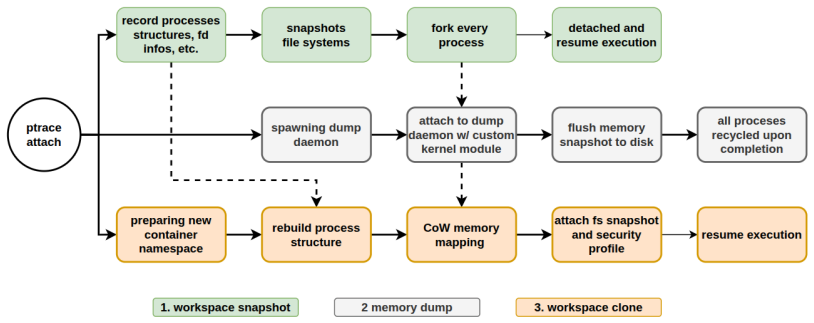
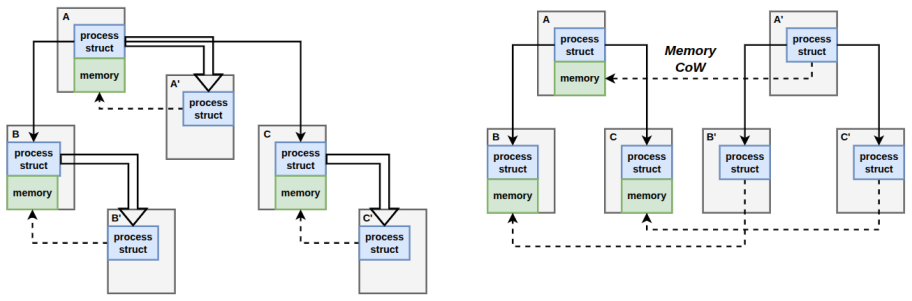
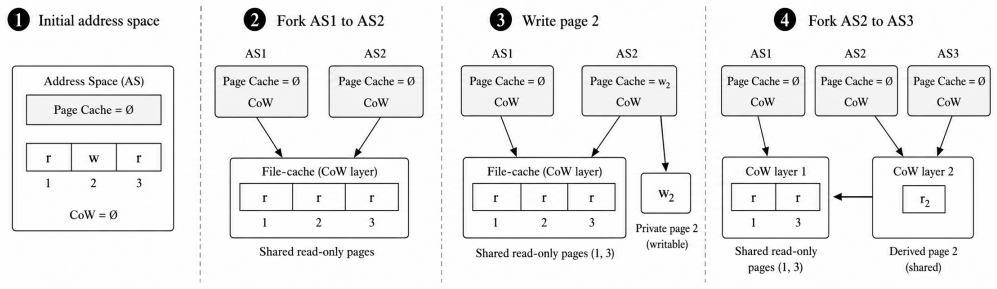
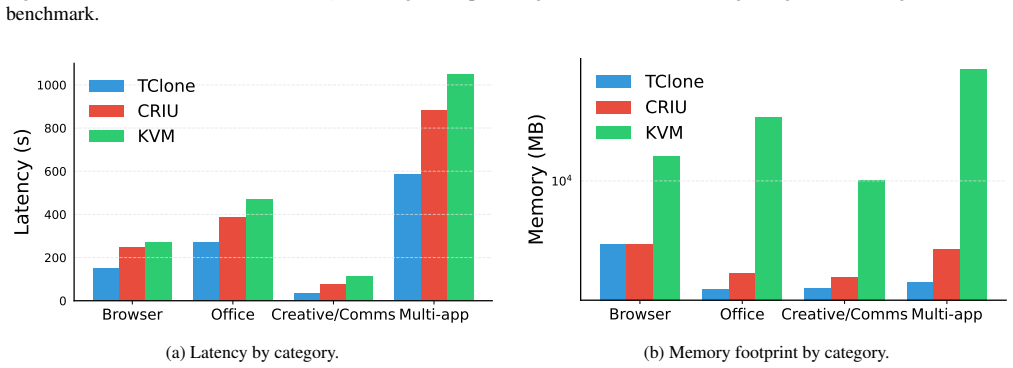
TClone enables a live GUI workspace to be snapshotted, forked into isolated branches, rolled back, and selectively committed or merged. Its design separates fast branch creation from durable checkpointing using sibling containers, copy-on-write memory sharing, filesystem versioning, GUI-local execution, and asynchronous checkpointing. In end-to-end agent-loop measurements this yields total task latency reductions of 1.9x over KVM and 1.5x over CRIU, turning workspace versioning into a first-class systems primitive for safer and higher-quality agent execution over real personal computing environments.
What carries the argument
Separation of fast branch creation from durable checkpointing via sibling containers, copy-on-write memory sharing, filesystem versioning, GUI-local execution, and asynchronous checkpointing.
If this is right
- Agents gain the ability to run speculative actions in parallel isolated branches without risking the main workspace state.
- Rollback becomes a low-cost operation that lets agents recover quickly from mistaken actions on files or sessions.
- Selective commit and merge allow successful exploratory paths to be integrated back into the persistent workspace.
- Overall agent task loops complete faster because forking overhead no longer dominates the execution time.
- Workspace versioning can be treated as a routine primitive rather than an expensive external operation.
Where Pith is reading between the lines
- The same separation of fast forking from durable saves could be applied to non-GUI interactive environments such as terminal sessions or browser tabs.
- Combining TClone-style branching with existing container orchestration tools could let agent frameworks scale speculative search across many machines.
- Long-running authenticated sessions inside branches may still require careful handling of network state that the current design treats as local.
- Measuring how often agents actually benefit from more than a handful of concurrent branches would test whether the latency gains translate to higher task success rates.
Load-bearing premise
The separation of fast branch creation from durable checkpointing using sibling containers, copy-on-write memory sharing, filesystem versioning, GUI-local execution, and asynchronous checkpointing delivers both low latency and adequate isolation for live interactive GUI workspaces in practice.
What would settle it
An end-to-end agent-loop run in which TClone fails to show at least a 1.5 times latency reduction versus CRIU, or a case where a forked branch corrupts state visible in the parent workspace.
Figures





read the original abstract
Computer-use agents increasingly operate inside live personal workspaces, where their actions can modify files, applications, GUI state, credentials, and authenticated sessions. This creates a tension between safety and quality: agents need isolation and rollback to avoid damaging user state, but also need fast branching to support speculative execution and parallel search. Existing VMs, containers, and checkpoint/restore systems can isolate or recover workloads, but they do not provide low-latency versioning of a full interactive workspace. We present TClone, a forkable personal workspace system for computer-use agents. TClone enables a live GUI workspace to be snapshotted, forked into isolated branches, rolled back, and selectively committed or merged. Its design separates fast branch creation from durable checkpointing, using sibling containers, copy-on-write memory sharing, filesystem versioning, GUI-local execution, and asynchronous checkpointing. In our end-to-end agent-loop measurement, TClone reduces total task latency by 1.9x and 1.5x over KVM and CRIU. By making workspace versioning a first-class systems primitive, TClone supports safer and higher-quality agent execution over real personal computing environments.
Editorial analysis
A structured set of objections, weighed in public.
Referee Report
Summary. The manuscript presents TClone, a system for low-latency forking of live GUI environments for computer-use agents. It enables snapshotting a live GUI workspace, forking into isolated branches, rollback, and selective commit or merge. The design separates fast branch creation (sibling containers, copy-on-write memory sharing, filesystem versioning, GUI-local execution) from durable checkpointing via asynchronous mechanisms. End-to-end agent-loop measurements claim 1.9x and 1.5x reductions in total task latency over KVM and CRIU.
Significance. If substantiated, TClone would provide a valuable first-class primitive for workspace versioning in interactive GUI settings, helping resolve the safety-quality tension for agents by supporting speculative execution and rollback without damaging user state. The separation of fast forking from checkpointing is a promising systems approach for real personal computing environments.
major comments (2)
- [Abstract and Evaluation] Abstract and §Evaluation: the abstract reports concrete latency reductions of 1.9x over KVM and 1.5x over CRIU from end-to-end agent-loop measurements, yet provides no workload descriptions, controls, error bars, or run counts. This absence is load-bearing for assessing the central performance claim.
- [Design] Design section: the approach relies on sibling containers, CoW memory sharing, and GUI-local execution for isolation during forking. It is unclear how open sockets to the display server (X11/Wayland compositor) and in-memory session state or file descriptors are duplicated or namespaced, which risks violating the isolation premise that supports both safety and the reported latency gains.
minor comments (1)
- A table or figure summarizing the latency results with statistical details would improve clarity of the performance claims.
Simulated Author's Rebuttal
We thank the referee for the constructive comments, which help clarify the presentation of our performance results and the isolation mechanisms. We address each major comment below and will revise the manuscript to incorporate the suggested improvements.
read point-by-point responses
-
Referee: [Abstract and Evaluation] Abstract and §Evaluation: the abstract reports concrete latency reductions of 1.9x over KVM and 1.5x over CRIU from end-to-end agent-loop measurements, yet provides no workload descriptions, controls, error bars, or run counts. This absence is load-bearing for assessing the central performance claim.
Authors: We agree that the abstract would be strengthened by additional context for the reported latency numbers. In the revised manuscript we will update the abstract to include a concise description of the workloads (representative computer-use agent tasks involving GUI interactions and state changes) and will explicitly direct readers to the full details in §Evaluation. The evaluation section already documents the experimental controls, error bars computed over repeated runs, and the number of trials; we will ensure these elements are cross-referenced more prominently from the abstract and introduction. revision: yes
-
Referee: [Design] Design section: the approach relies on sibling containers, CoW memory sharing, and GUI-local execution for isolation during forking. It is unclear how open sockets to the display server (X11/Wayland compositor) and in-memory session state or file descriptors are duplicated or namespaced, which risks violating the isolation premise that supports both safety and the reported latency gains.
Authors: We thank the referee for highlighting this aspect of the isolation design. The current Design section emphasizes sibling containers and GUI-local execution, but we acknowledge that the handling of display-server sockets, session state, and file descriptors merits explicit description. In the revision we will add a dedicated paragraph (or short subsection) explaining that (1) display connections are isolated by instantiating per-branch virtual displays or proxies within the container namespace, (2) mutable in-memory session state is copied on write while immutable portions remain shared, and (3) file descriptors and sockets are duplicated through standard Linux namespace mechanisms (PID, network, and IPC) at fork time. These additions will make the isolation guarantees and their contribution to both safety and low latency fully transparent. revision: yes
Circularity Check
No circularity: latency results are direct measurements from described implementation
full rationale
The paper presents TClone as a systems design using sibling containers, copy-on-write memory, filesystem versioning, GUI-local execution, and asynchronous checkpointing. End-to-end latency reductions (1.9x over KVM, 1.5x over CRIU) are reported as empirical measurements from agent-loop experiments rather than quantities derived from equations, fitted parameters, or self-referential definitions. No load-bearing self-citations, uniqueness theorems, or ansatzes appear in the provided text that would collapse the central claims back to their inputs by construction. The derivation chain is self-contained as an engineering artifact evaluated externally.
Axiom & Free-Parameter Ledger
Lean theorems connected to this paper
-
IndisputableMonolith/Cost/FunctionalEquation.leanwashburn_uniqueness_aczel unclear?
unclearRelation between the paper passage and the cited Recognition theorem.
Its design separates fast branch creation from durable checkpointing, using sibling containers, copy-on-write memory sharing, filesystem versioning, GUI-local execution, and asynchronous checkpointing.
-
IndisputableMonolith/Foundation/AlexanderDuality.leanalexander_duality_circle_linking unclear?
unclearRelation between the paper passage and the cited Recognition theorem.
TClone reconstructs the tree rather than forking it in place... recreates each task with its recorded namespace-local PID
What do these tags mean?
- matches
- The paper's claim is directly supported by a theorem in the formal canon.
- supports
- The theorem supports part of the paper's argument, but the paper may add assumptions or extra steps.
- extends
- The paper goes beyond the formal theorem; the theorem is a base layer rather than the whole result.
- uses
- The paper appears to rely on the theorem as machinery.
- contradicts
- The paper's claim conflicts with a theorem or certificate in the canon.
- unclear
- Pith found a possible connection, but the passage is too broad, indirect, or ambiguous to say the theorem truly supports the claim.
Reference graph
Works this paper leans on
-
[1]
Firecracker: Lightweight virtualization for serverless applications
Alexandru Agache, Marc Brooker, Andreea Florescu, Alexandra Iordache, Anthony Liguori, Rolf Neugebauer, Phil Piwonka, and Diana-Maria Popa. Firecracker: Lightweight virtualization for serverless applications. In17th USENIX Symposium on Networked Systems De- sign and Implementation (NSDI 20), pages 419–434, Santa Clara, CA, 2020. USENIX Association
work page 2020
-
[2]
Agent S: An open agen- tic framework that uses computers like a human
Saaket Agashe, Jiuzhou Han, Shuyu Gan, Jiachen Yang, Ang Li, and Xin Eric Wang. Agent S: An open agen- tic framework that uses computers like a human. In International Conference on Learning Representations, 2025
work page 2025
-
[3]
Anthropic. Claude Cowork by anthropic. https: //www.anthropic.com/product/claude-cowork,
-
[5]
Anthropic. Computer use tool. https://platform. claude.com/docs/en/agents-and-tools/ tool-use/computer-use-tool , 2026. Claude API documentation; accessed: 2026-05-15
work page 2026
-
[6]
Anthropic. Computer use tool. https://platform. claude.com/docs/en/agents-and-tools/ tool-use/computer-use-tool , 2026. Claude API documentation; accessed: 2026-05-14
work page 2026
-
[7]
Let claude use your computer in cowork
Anthropic. Let claude use your computer in cowork. https://support.claude.com/en/articles/ 14128542-let-claude-use-your-computer-in-cowork , April 2026. Claude Help Center; accessed: 2026-05-14
work page 2026
-
[8]
Overview of virtual machine snapshots in vSphere
Broadcom. Overview of virtual machine snapshots in vSphere. https://knowledge. broadcom.com/external/article/342618/ overview-of-virtual-machine-snapshots-in. html, 2025. Accessed: 2026-05-15
work page 2025
-
[9]
CRIU: Checkpoint/restore in userspace
Checkpoint/Restore Project. CRIU: Checkpoint/restore in userspace. https://criu.org/Main_Page, 2025. Accessed: 2026-05-15
work page 2025
-
[10]
Live migration of virtual machines
Christopher Clark, Keir Fraser, Steven Hand, Ja- cob Gorm Hansen, Eric Jul, Christian Limpach, Ian Pratt, and Andrew Warfield. Live migration of virtual machines. In2nd Symposium on Networked Systems Design & Implementation (NSDI 05), Boston, MA, May
-
[11]
Re- mus: High availability via asynchronous virtual machine replication
Brendan Cully, Geoffrey Lefebvre, Dutch Meyer, Mike Feeley, Norm Hutchinson, and Andrew Warfield. Re- mus: High availability via asynchronous virtual machine replication. In5th USENIX Symposium on Networked Systems Design and Implementation (NSDI 08), San Francisco, CA, April 2008. USENIX Association
work page 2008
-
[12]
Docker Inc. docker checkpoint. https: //docs.docker.com/reference/cli/docker/ checkpoint/, 2026. Docker CLI documentation; accessed: 2026-05-15
work page 2026
-
[13]
gVisor: The container security platform
Google. gVisor: The container security platform. https://gvisor.dev/, 2026. Accessed: 2026-05-15
work page 2026
-
[14]
Kristian Hoegsberg.The Wayland Protocol. Wayland Project, 2012. Accessed: 2026-05-15
work page 2012
-
[15]
Kata Containers: Open source con- tainer runtime software
Kata Containers. Kata Containers: Open source con- tainer runtime software. https://katacontainers. io/, 2026. Accessed: 2026-05-15
work page 2026
-
[16]
Andrés Lagar-Cavilla, Joseph A
H. Andrés Lagar-Cavilla, Joseph A. Whitney, Adin Scan- nell, Philip Patchin, Stephen M. Rumble, Eyal de Lara, Michael Brudno, and M. Satyanarayanan. SnowFlock: Rapid virtual machine cloning for cloud computing. In Proceedings of the 4th ACM European Conference on Computer Systems, EuroSys ’09, pages 1–12. ACM, 2009
work page 2009
-
[17]
Webtop: Linux in a web browser
LinuxServer.io. Webtop: Linux in a web browser. https://github.com/linuxserver/ docker-webtop, 2026. Accessed: 2026-05-15
work page 2026
-
[18]
Meyer, Gitika Aggarwal, Brendan Cully, Geof- frey Lefebvre, Michael J
Dutch T. Meyer, Gitika Aggarwal, Brendan Cully, Geof- frey Lefebvre, Michael J. Feeley, Norman C. Hutchin- son, and Andrew Warfield. Parallax: Virtual disks for virtual machines. InProceedings of the 3rd ACM SIGOPS/EuroSys European Conference on Computer Systems, EuroSys ’08, pages 41–54. ACM, 2008
work page 2008
-
[19]
Fast transparent migration for virtual machines
Michael Nelson, Beng-Hong Lim, and Greg Hutchins. Fast transparent migration for virtual machines. In2005 USENIX Annual Technical Conference (USENIX ATC 05), Anaheim, CA, April 2005. USENIX Association
work page 2005
-
[20]
Hermes Agent: Computer use (ma- cos)
Nous Research. Hermes Agent: Computer use (ma- cos). https://hermes-agent.nousresearch.com/ docs/user-guide/features/computer-use, 2026. Accessed: 2026-05-14
work page 2026
-
[21]
OpenAI. Codex sandbox. https://developers. openai.com/codex/concepts/sandboxing, 2026. OpenAI developer documentation; accessed: 2026-05- 15
work page 2026
-
[22]
Codex Web: Delegate to codex in the cloud
OpenAI. Codex Web: Delegate to codex in the cloud. https://developers.openai.com/codex/ cloud, 2026. OpenAI developer documentation; ac- cessed: 2026-05-14
work page 2026
-
[23]
Codex Web: Delegate to codex in the cloud
OpenAI. Codex Web: Delegate to codex in the cloud. https://developers.openai.com/codex/ cloud, 2026. OpenAI developer documentation; ac- cessed: 2026-05-14. 13
work page 2026
-
[24]
OpenAI. Sandbox agents. https://developers. openai.com/api/docs/guides/agents/ sandboxes, 2026. OpenAI API documentation; accessed: 2026-05-15
work page 2026
-
[25]
OpenClaw: Personal ai as- sistant
OpenClaw Contributors. OpenClaw: Personal ai as- sistant. https://github.com/openclaw/openclaw,
-
[26]
Accessed: 2026-05-14
work page 2026
-
[27]
Robert W. Scheifler and Jim Gettys. The X window system.ACM Transactions on Graphics, 5(2):79–109, April 1986
work page 1986
-
[28]
Selkies: Linux WebRTC HTML5 re- mote desktop streaming platform
Selkies Project. Selkies: Linux WebRTC HTML5 re- mote desktop streaming platform. https://github. com/selkies-project/selkies, 2024. Accessed: 2026-05-15
work page 2024
-
[29]
Agent S3: Approaching human-level com- puter use with wide scaling
Simular AI. Agent S3: Approaching human-level com- puter use with wide scaling. https://www.simular. ai/articles/agent-s3, October 2025. Accessed: 2026-05-14
work page 2025
-
[30]
Sizhe Tang, Rongqian Chen, and Tian Lan. Agent al- pha: Tree search unifying generation, exploration and evaluation for computer-use agents.arXiv preprint arXiv:2602.02995, 2026
-
[31]
Michael Vrable, Justin Ma, Jay Chen, David Moore, Erik Vandekieft, Alex C. Snoeren, Geoffrey M. V oelker, and Stefan Savage. Scalability, fidelity, and containment in the Potemkin virtual honeyfarm. InProceedings of the 20th ACM Symposium on Operating Systems Principles, SOSP ’05, pages 148–162. ACM, 2005
work page 2005
-
[32]
GTA: A benchmark for general tool agents
Jize Wang, Zerun Ma, Yining Li, Songyang Zhang, Cail- ian Chen, Kai Chen, and Xinyi Le. GTA: A benchmark for general tool agents. InAdvances in Neural Informa- tion Processing Systems, pages 75749–75790, 2024
work page 2024
- [33]
-
[34]
OSWorld: Benchmarking Multimodal Agents for Open-Ended Tasks in Real Computer Environments
Tianbao Xie, Danyang Zhang, Jixuan Chen, Xiaochuan Li, Siheng Zhao, Ruisheng Cao, Toh Jing Hua, Zhoujun Cheng, Dongchan Shin, Fangyu Lei, Yitao Liu, Yiheng Xu, Shuyan Zhou, Silvio Savarese, Caiming Xiong, Vic- tor Zhong, and Tao Yu. OSWorld: Benchmarking mul- timodal agents for open-ended tasks in real computer environments.arXiv preprint arXiv:2404.07972, 2024
work page internal anchor Pith review Pith/arXiv arXiv 2024
-
[35]
Jimenez, Alexander Wettig, Kil- ian Lieret, Shunyu Yao, Karthik Narasimhan, and Ofir Press
John Yang, Carlos E. Jimenez, Alexander Wettig, Kil- ian Lieret, Shunyu Yao, Karthik Narasimhan, and Ofir Press. SWE-agent: Agent-computer interfaces enable automated software engineering. InAdvances in Neural Information Processing Systems, 2024
work page 2024
-
[36]
GTA1: GUI test-time scaling agent
Yan Yang, Dongxu Li, Yutong Dai, Yuhao Yang, Ziyang Luo, Zirui Zhao, Zhiyuan Hu, Junzhe Huang, Amrita Saha, Zeyuan Chen, Ran Xu, Liyuan Pan, Caiming Xiong, and Junnan Li. GTA1: GUI test-time scaling agent. InInternational Conference on Learning Repre- sentations, 2026
work page 2026
-
[37]
Griffiths, Yuan Cao, and Karthik Narasimhan
Shunyu Yao, Dian Yu, Jeffrey Zhao, Izhak Shafran, Thomas L. Griffiths, Yuan Cao, and Karthik Narasimhan. Tree of thoughts: Deliberate problem solving with large language models. InAdvances in Neural Information Processing Systems, 2023
work page 2023
-
[38]
Scaling test-time compute for LLM agents.arXiv preprint arXiv:2506.12928, 2025
King Zhu, Hanhao Li, Siwei Wu, Tianshun Xing, De- hua Ma, Xiangru Tang, Minghao Liu, Jian Yang, Jia- heng Liu, Yuchen Eleanor Jiang, Changwang Zhang, Chenghua Lin, Jun Wang, Ge Zhang, and Wangchunshu Zhou. Scaling test-time compute for LLM agents.arXiv preprint arXiv:2506.12928, 2025. 14
discussion (0)
Sign in with ORCID, Apple, or X to comment. Anyone can read and Pith papers without signing in.