Coupled quintessence with a potential from supergravity exhibits sign-changing interaction
Pith reviewed 2026-05-20 09:38 UTC · model grok-4.3
The pith
Observations favor coupled supergravity quintessence where dark energy and dark matter exchange energy with a sign change.
A machine-rendered reading of the paper's core claim, the machinery that carries it, and where it could break.
Core claim
Current observations strongly favor a coupling between dark energy and dark matter in the SUGRA quintessence scenario, with the coupling parameter deviating from zero at more than 4 sigma. The data select the branch in which the energy transfer changes sign, allowing the effective dark-energy equation of state to cross the phantom divide. This coupled SUGRA branch is statistically indistinguishable from dark energy described by the CPL parametrization, with only a very small difference in minimum chi-squared, and therefore supplies a field-theoretic realization of the evolving dark energy behavior indicated by the latest observations.
What carries the argument
The supergravity-motivated quintessence potential together with a coupling function to dark matter that permits the direction of energy transfer to reverse, which produces the sign-changing interaction and the phantom-divide crossing.
If this is right
- The effective dark-energy equation of state crosses the phantom divide because the energy transfer between sectors reverses sign.
- The coupling strength between dark energy and dark matter is constrained to be non-zero at greater than 4 sigma by the combined dataset.
- The model reproduces the observed evolution in dark energy while remaining statistically equivalent to the CPL parametrization.
- The sign-changing interaction supplies a dynamical, field-theoretic account for the departure from a pure cosmological constant.
Where Pith is reading between the lines
- If the sign change is confirmed, it would imply that the scalar-field potential has a specific shape that naturally produces a reversal in the interaction term at late times.
- Similar coupled scalar models in other modified-gravity frameworks might exhibit analogous sign-changing behavior once tested against the same datasets.
- Next-generation measurements of the growth rate of structure could distinguish this model from CPL by searching for the predicted scale-dependent effects of the interaction.
Load-bearing premise
The specific functional form of the supergravity potential and the chosen coupling between the scalar field and dark matter are the correct microphysical description of the two dark sectors.
What would settle it
A future data release from Euclid or a similar survey that shows the coupling parameter consistent with zero at high significance, or no evidence for a phantom-divide crossing, would undermine the preference for the sign-changing coupled branch.
Figures


read the original abstract
Quintessence with a potential motivated by supergravity (SUGRA) exhibits several intriguing features. Depending on its initial conditions, it can behave either as dynamical dark energy or effectively as a cosmological constant. Moreover, when quintessence is coupled to dark matter, the effective dark-energy equation of state can cross the phantom divide. In this paper, we test both coupled and uncoupled SUGRA quintessence models using DESI BAO, DES-Dovekie SNIa, and Planck CMB data. We find that current observations strongly favor a coupling between dark energy and dark matter, with the coupling parameter deviating from zero at more than $4\sigma$. The data also favor the branch of coupled SUGRA quintessence in which the energy transfer between the two dark sectors changes sign, leading to a crossing of the phantom divide by the effective dark-energy equation of state. Interestingly, this coupled SUGRA branch is statistically indistinguishable from dark energy described by the CPL parametrization, with only a very small difference in $\chi^2_\mathrm{min}$. Our results suggest that coupled quintessence with a SUGRA potential provides a field-theoretic realization of the evolving dark energy behavior favored by the latest observations.
Editorial analysis
A structured set of objections, weighed in public.
Referee Report
Summary. The manuscript analyzes both coupled and uncoupled quintessence models with a supergravity-motivated potential using DESI BAO, DES-Dovekie SNIa, and Planck CMB data. It reports that observations strongly favor a non-zero coupling between dark energy and dark matter at >4σ significance, with preference for the sign-changing energy-transfer branch that produces a phantom-divide crossing in the effective dark-energy equation of state. The coupled SUGRA model is found to be statistically indistinguishable from the CPL parametrization, with only a small Δχ² difference.
Significance. If the specific SUGRA potential and coupling function are the correct microphysical description, the work supplies a field-theoretic realization of the evolving dark energy favored by recent data, including a natural mechanism for phantom crossing via sign-changing interaction. This could bridge supergravity constructions with observational hints of dark-sector coupling, but the result's broader impact is limited by its dependence on the chosen functional forms rather than a parameter-free or alternative-model-robust derivation.
major comments (1)
- [Abstract and model definition] The central claim of >4σ preference for non-zero coupling and for the sign-changing branch rests on fixing the SUGRA potential V(φ) and the interaction term Q while varying only the single coupling strength parameter. Because these functional forms are selected and fitted to the same data used to claim the deviation, the significance and branch preference are outputs of the fit rather than independent predictions; an alternative potential (e.g., pure exponential) or coupling function could alter or eliminate the reported preference. This model-dependence is load-bearing for the abstract's conclusions.
minor comments (1)
- [Abstract] The abstract mentions a 'very small difference in χ²_min' relative to CPL but does not quantify the exact Δχ² value or report the number of degrees of freedom; including these numbers would clarify the statistical indistinguishability claim.
Simulated Author's Rebuttal
We are grateful to the referee for their detailed review and valuable suggestions. Below we provide a point-by-point response to the major comment.
read point-by-point responses
-
Referee: The central claim of >4σ preference for non-zero coupling and for the sign-changing branch rests on fixing the SUGRA potential V(φ) and the interaction term Q while varying only the single coupling strength parameter. Because these functional forms are selected and fitted to the same data used to claim the deviation, the significance and branch preference are outputs of the fit rather than independent predictions; an alternative potential (e.g., pure exponential) or coupling function could alter or eliminate the reported preference. This model-dependence is load-bearing for the abstract's conclusions.
Authors: We acknowledge the referee's point that the reported significance and branch preference are obtained within a fixed functional form for the SUGRA potential and the interaction term. The potential is not chosen phenomenologically to fit the data but is instead taken from established supergravity constructions that yield a specific functional dependence on the scalar field; likewise, the interaction is the standard form employed in the coupled quintessence literature precisely because it permits a sign change in the energy transfer. Our claim is therefore that, within this theoretically motivated framework, current data prefer a non-zero coupling at >4σ and favor the sign-changing branch. We do not assert that the result is independent of the chosen forms. To address the concern, we will revise the manuscript by adding explicit discussion of this model dependence in the introduction and conclusions, together with a brief comparison to alternative potentials such as a pure exponential. revision: yes
Circularity Check
No significant circularity; results are direct fits to external data.
full rationale
The paper conducts standard Bayesian parameter estimation of the coupling strength β and branch choice in the SUGRA-motivated quintessence model against independent datasets (DESI BAO, DES-Dovekie SNIa, Planck CMB). The reported >4σ preference for non-zero coupling and the sign-changing branch are outputs of the likelihood analysis on these external observations, not quantities derived from the model's own equations or prior self-citations. The potential form is taken from established supergravity literature as an input assumption, and the analysis tests rather than presupposes the data's preference. No step equates a fitted parameter to an independent prediction by construction, and the central claims remain falsifiable against the same external benchmarks.
Axiom & Free-Parameter Ledger
free parameters (1)
- coupling parameter
axioms (1)
- domain assumption The supergravity-derived functional form of the quintessence potential is the appropriate microphysical description.
Lean theorems connected to this paper
-
IndisputableMonolith/Cost/FunctionalEquation.leanwashburn_uniqueness_aczel unclear?
unclearRelation between the paper passage and the cited Recognition theorem.
V(ϕ) = V0 (ϕ/MPl)^−α exp(ϕ²/2MPl²) … Q = β/MPl ρc ϕ̇ … minimum-start branch produces sign change in energy transfer
-
IndisputableMonolith/Foundation/RealityFromDistinction.leanreality_from_one_distinction unclear?
unclearRelation between the paper passage and the cited Recognition theorem.
β deviates from zero at >4σ; Δχ² ≈ −13 relative to ΛCDM
What do these tags mean?
- matches
- The paper's claim is directly supported by a theorem in the formal canon.
- supports
- The theorem supports part of the paper's argument, but the paper may add assumptions or extra steps.
- extends
- The paper goes beyond the formal theorem; the theorem is a base layer rather than the whole result.
- uses
- The paper appears to rely on the theorem as machinery.
- contradicts
- The paper's claim conflicts with a theorem or certificate in the canon.
- unclear
- Pith found a possible connection, but the passage is too broad, indirect, or ambiguous to say the theorem truly supports the claim.
Forward citations
Cited by 1 Pith paper
-
Signatures of Modified Gravity Below $\mathcal{O}(10)$ Mpc in a Dynamical Dark Energy Background
Modified gravity below O(10) Mpc in a CPL dynamical dark energy background is required to suppress structure growth at low redshifts while satisfying CMB constraints from ISW and lensing.
Reference graph
Works this paper leans on
-
[1]
For the minimally coupling case, the constraints on free parameters are summa- rized in Tab
Attractor-start branch The attractor-start branch initializes the field on the inverse power law tail of the SUGRA potential. For the minimally coupling case, the constraints on free parameters are summa- rized in Tab. II, and the posterior distribution ofαis plotted in the left panel of Fig. 2. We find thatα= 0.066 +0.017 −0.054, Ω m = 0.3062±0.038 andH ...
-
[2]
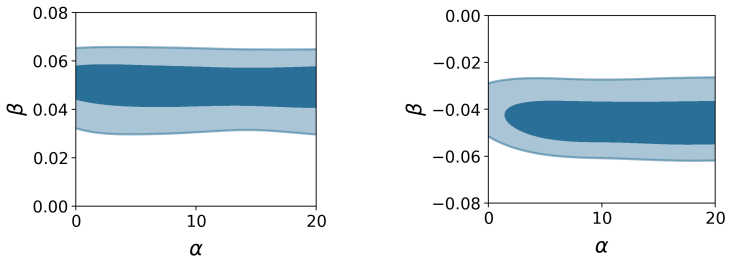
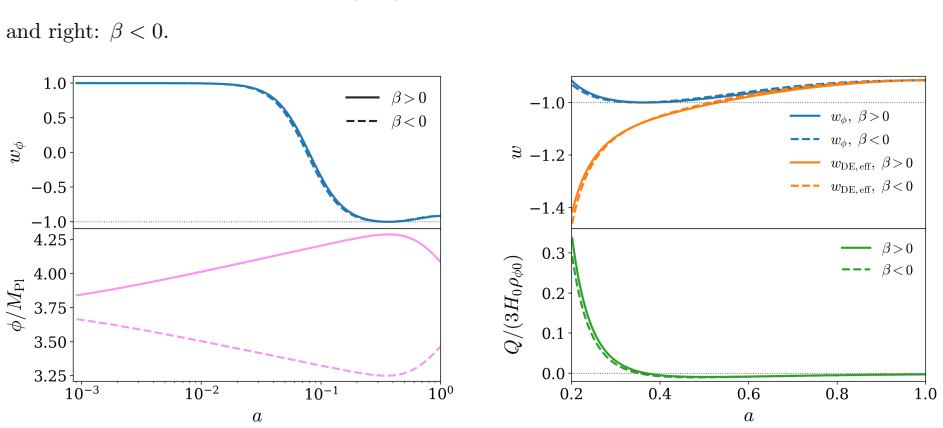
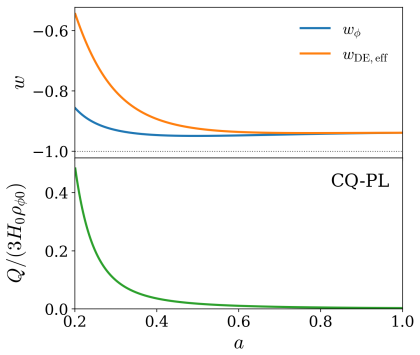
Minimum-start branch At this branch, the field is initially positioned at the minimum of the SUGRA potential. If there is no coupling between quintessence and CDM, the field always stays at this minimum and quintessence behaves like a cosmological constant. The corresponding cosmological model reduces to the ΛCDM. However, when a coupling between quintess...
-
[3]
A. G. Riess, A. V. Filippenko, P. Challis, et al., Astron. J.116, 1009 (1998)
work page 1998
-
[4]
S. Perlmutter, G. Aldering, G. Goldhaber, et al., Astrophys. J.517, 565 (1999)
work page 1999
-
[5]
D. J. Eisenstein, I. Zehavi, D. W. Hogg, et al., Astrophys. J.633, 560 (2005)
work page 2005
- [6]
-
[7]
R. R. Caldwell, R. Dave, and P. J. Steinhardt, Phys. Rev. Lett.80, 1582 (1998)
work page 1998
- [8]
- [9]
-
[10]
R. R. Caldwell, Phys. Lett. B545, 23 (2002)
work page 2002
-
[11]
S. M. Carroll, M. Hoffman and M. Trodden, Phys. Rev. D68, 023509 (2003)
work page 2003
-
[12]
J. M. Cline, S. Jeon, and G. D. Moore, Phys. Rev. D70, 043543 (2004)
work page 2004
-
[13]
A. G. Adame, J. Aguilar, S. Ahlen, et al., J. Cosmol. Astropart. Phys.02, 021 (2025)
work page 2025
-
[14]
M. Abdul Karim et al. (DESI Collaboration), Phys. Rev. D112, 083515 (2025)
work page 2025
- [15]
-
[16]
E. V. Linder, Phys. Rev. Lett.90, 091301 (2003)
work page 2003
-
[17]
T. M. C. Abbott et al. (DES Collaboration), Astrophys. J. Lett.973, L14 (2024)
work page 2024
-
[18]
B. Wang, E. Abdalla, F. Atrio-Barandela, and D. Pav´ on, Rep. Prog. Phys.87, 036901 (2024)
work page 2024
-
[19]
A. Chakraborty, T. Ray, S. Das, A. Banerjee, and V. Ganesan, Astrophys. J.998, 83 (2026)
work page 2026
-
[20]
W. Giar` e, M. A. Sabogal, R. C. Nunes, and E. Di Valentino, Phys. Rev. Lett.133, 251003 (2024)
work page 2024
- [21]
-
[22]
A. Chakraborty, P. K. Chanda, S. Das, and K. Dutta, J. Cosmol. Astropart. Phys.11, 047 (2025). 16
work page 2025
-
[23]
R. Shah, P. Mukherjee, and S. Pal, Mon. Not. R. Astron. Soc.542, 2936 (2025)
work page 2025
- [24]
-
[25]
C. You, D. Wang, and T. Yang, Phys. Rev. D112, 043503 (2025)
work page 2025
-
[26]
S. Pan, S. Paul, E. N. Saridakis, and W. Yang, Phys. Rev. D113, 023515 (2026)
work page 2026
- [27]
-
[28]
S. L. Guedezounme, B. R. Dinda, and R. Maartens, J. Cosmol. Astropart. Phys.01, 062 (2026)
work page 2026
- [29]
- [30]
-
[31]
T.-N. Li, G.-H. Du, Y.-H. Li, Y. Li, J.-L. Ling, J.-F. Zhang, and X. Zhang, arXiv:2510.11363
- [32]
-
[33]
D. Figueruelo, M. van der Westhuizen, A. Abebe, and E. Di Valentino, Phys. Dark Univ.52, 102238 (2026)
work page 2026
-
[34]
Constraints on Coupled Dark Energy in the DESI Era
A. G´ omez-Valent, Z. Zheng, and L. Amendola, arXiv:2604.12032
work page internal anchor Pith review Pith/arXiv arXiv
- [35]
- [36]
- [37]
-
[38]
J. Beltr´ an Jim´ enez, K. Ichiki, X. Liu, F. A. Teppa Pannia, and S. Tsujikawa, arXiv:2603.15805
-
[39]
Coupled Dark Energy and Dark Matter for DESI: An Effective Guide to the Phantom Divide
S. Antusch, S. F. King, and X. Wang, arXiv:2604.08449
work page internal anchor Pith review Pith/arXiv arXiv
-
[40]
Generalizing the CPL Parametrization through Dark Sector Interaction
M. Artola, R. Lazkoz, and V. Salzano, arXiv:2604.25373
work page internal anchor Pith review Pith/arXiv arXiv
-
[41]
J.-Q. Wang, R.-G. Cai, Z.-K. Guo, and S.-J. Wang, Phys. Rev. D113, 083534 (2026)
work page 2026
-
[42]
V. Pettorino, L. Amendola, and C. Wetterich, Phys. Rev. D86, 103507 (2012)
work page 2012
- [43]
- [44]
-
[45]
A. G´ omez-Valent, V. Pettorino, and L. Amendola, Phys. Rev. D101, 123513 (2020)
work page 2020
- [46]
- [47]
-
[48]
E. J. Copeland, A. R. Liddle, and D. Wands, Phys. Rev. D57, 4686 (1998)
work page 1998
-
[49]
T. Barreiro, E. J. Copeland, and N. J. Nunes, Phys. Rev. D61, 127301 (2000). 17
work page 2000
-
[50]
O. F. Ramadan, J. Sakstein, and D. Rubin, Phys. Rev. D110, L041303 (2024)
work page 2024
-
[51]
R. de Souza, G. Rodrigues, and J. Alcaniz, Phys. Rev. D112, 083533 (2025)
work page 2025
-
[52]
Non-minimally coupled quintessence with sign-switching interaction
J.-Q. Wang, R.-G. Cai, Z.-K. Guo, Y.-H. Li, S.-J. Wang, and X. Zhang, arXiv:2604.02204
work page internal anchor Pith review Pith/arXiv arXiv
- [53]
-
[54]
R. Mainini, L. P. L. Colombo, and S. A. Bonometto, Astrophys. J.632, 691 (2005)
work page 2005
-
[55]
S. A. Bonometto, L. Casarini, L. P. L. Colombo, and R. Mainini, arXiv:astro-ph/0612672
work page internal anchor Pith review Pith/arXiv arXiv
-
[56]
G. La Vacca, S. A. Bonometto, and L. P. L. Colombo, New Astron.14, 435 (2009)
work page 2009
-
[57]
G. La Vacca, J. R. Kristiansen, L. P. L. Colombo, R. Mainini, and S. A. Bonometto, J. Cosmol. Astropart. Phys.04, 007 (2009)
work page 2009
-
[58]
J. R. Kristiansen, G. La Vacca, L. P. L. Colombo, R. Mainini, and S. A. Bonometto, New Astron.15, 609 (2010)
work page 2010
- [59]
- [60]
-
[61]
C. Carbone, M. Baldi, V. Pettorino, and C. Baccigalupi, J. Cosmol. Astropart. Phys.09, 004 (2013)
work page 2013
- [62]
- [63]
- [64]
- [65]
-
[66]
B. Hu, M. Raveri, N. Frusciante, and A. Silvestri, Phys. Rev. D89, 103530 (2014)
work page 2014
- [67]
- [68]
-
[69]
B. Popovic, P. Shah, W. D. Kenworthy, et al., Mon. Not. R. Astron. Soc.548, stag632 (2026)
work page 2026
-
[70]
E. Rosenberg, S. Gratton, and G. Efstathiou, Mon. Not. R. Astron. Soc.517, 4620 (2022)
work page 2022
- [71]
-
[72]
A. G. Riess, W. Yuan, L. M. Macri, et al., Astrophys. J. Lett.934, L7 (2022). 18
work page 2022
discussion (0)
Sign in with ORCID, Apple, or X to comment. Anyone can read and Pith papers without signing in.