Recognition: 1 theorem link
· Lean TheoremNon-minimally coupled quintessence with sign-switching interaction
Pith reviewed 2026-05-13 20:40 UTC · model grok-4.3
The pith
A non-minimally coupled quintessence model accounts for the late-time weakening of dark energy seen in recent data.
A machine-rendered reading of the paper's core claim, the machinery that carries it, and where it could break.
Core claim
The central claim is that a non-minimally coupled quintessence scalar field, through its interaction with dark matter that switches sign during cosmic evolution, naturally produces the observed late-time weakening of dark energy. The field density stays roughly constant until domination, then decreases, while the effective dark energy equation of state appears to cross -1 due to the modified dark matter behavior, even though the field itself does not. This framework provides a better fit to current data than standard models.
What carries the argument
The non-minimal coupling between the quintessence field and dark matter that generates a sign-switching energy transfer interaction.
If this is right
- The quintessence density remains constant until it dominates, then decreases to explain the late onset of weakening.
- The coupling produces a sign change in the energy transfer between dark matter and dark energy.
- An effective phantom crossing appears in the inferred dark energy equation of state without the field itself crossing w = -1.
- Current cosmological data favor this model more strongly than both Lambda CDM and w0wa CDM.
Where Pith is reading between the lines
- Future surveys could test the exact redshift of the interaction sign switch through combined expansion and growth measurements.
- The effective crossing behavior may reduce the need to invoke phantom fields when interpreting observational hints of w < -1.
- If the coupling form has a deeper origin in scalar-tensor gravity, similar interactions could appear in other late-universe observables.
Load-bearing premise
The specific functional forms of the non-minimal coupling and the scalar potential are assumed to produce the sign switch and the delayed onset of density decrease.
What would settle it
Future high-precision measurements of the dark energy equation of state evolution or the growth of cosmic structure at specific redshifts could confirm or rule out the predicted timing of the interaction sign change.
Figures


read the original abstract
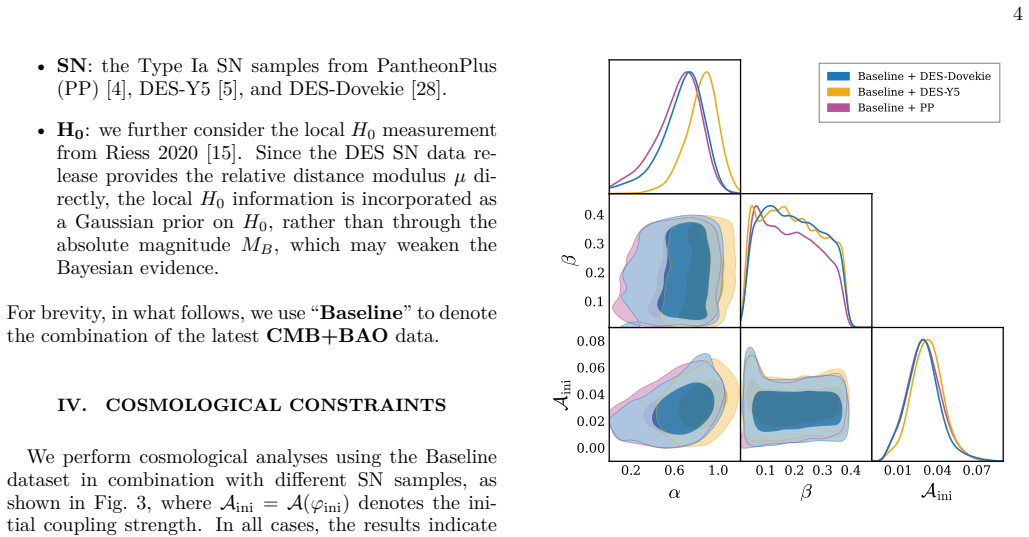
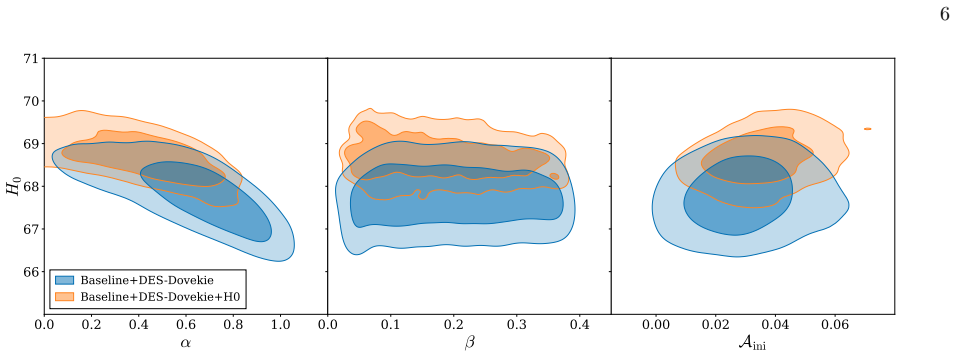
We propose a new non-minimally coupled quintessence model to account for the late-time dark energy dynamics indicated by recent DESI measurements. Within this framework, the quintessence density begins to decrease only when it starts to dominate the universe, which naturally accounts for the late-time onset of dark energy weakening. The coupling also induces a sign change in the effective energy transfer between dark matter and dark energy during cosmic evolution. While the scalar field itself remains canonical and never crosses the phantom divide, the modified evolution of the dark matter density gives rise to an effective crossing behavior in the observationally inferred dark energy sector. Compared with both $\Lambda$CDM and $w_0w_a$CDM models, our model is favored more strongly by current cosmological data. This work may provide a promising avenue for understanding the observational late-time weakening of dark energy and the origin of its dynamics.
Editorial analysis
A structured set of objections, weighed in public.
Referee Report
Summary. The manuscript proposes a non-minimally coupled quintessence model with a sign-switching interaction term between dark energy and dark matter. The canonical scalar field never crosses the phantom divide, but the coupling modifies dark-matter evolution to produce an effective phantom-crossing signature in the inferred dark-energy sector. The model is constructed so that quintessence density begins to decrease only after it dominates, naturally producing late-time weakening. The central claim is that the model is statistically favored over both ΛCDM and w0waCDM by current cosmological data, including DESI measurements.
Significance. If the reported data preference survives proper Occam penalties for the two extra parameters and is shown to be robust, the construction supplies a concrete mechanism that links non-minimal coupling to both sign-switching energy transfer and late-time dark-energy weakening without invoking phantom fields. This would be a useful addition to the set of models addressing the DESI hints of evolving dark energy.
major comments (3)
- [Abstract] Abstract and results section: the claim that the model is 'favored more strongly' by current data is not supported by any reported likelihood ratios, Δχ² values, AIC/BIC differences, or Bayesian evidence that penalize the two additional parameters (coupling strength and sign-switch scale). Without these quantities the central statistical conclusion cannot be assessed.
- [Model definition] Model-construction section: the coupling function is explicitly engineered to produce the sign switch and the late-time weakening; the reported improvement in fit is therefore tied to this functional choice. A quantitative demonstration that the preference persists under reasonable variations of the functional form (or under a more general parametrization) is required to establish that the result is not an artifact of the construction.
- [Results] Results section: no robustness checks against data cuts, alternative datasets, or changes in the dark-matter equation-of-state prior are presented. Given that the effective phantom behavior arises from modified dark-matter evolution, such checks are load-bearing for the claim that the model is preferred by 'current cosmological data'.
minor comments (2)
- [Model definition] The exact functional forms of the non-minimal coupling and the quintessence potential should be written explicitly with all parameters labeled, together with the definition of the sign-switch scale.
- [Introduction] Add a brief discussion of the physical motivation (beyond data fitting) for the chosen coupling function.
Simulated Author's Rebuttal
We thank the referee for the detailed and constructive report. We address each major comment below and will revise the manuscript to incorporate the requested statistical quantifications, model robustness discussion, and checks.
read point-by-point responses
-
Referee: [Abstract] Abstract and results section: the claim that the model is 'favored more strongly' by current data is not supported by any reported likelihood ratios, Δχ² values, AIC/BIC differences, or Bayesian evidence that penalize the two additional parameters (coupling strength and sign-switch scale). Without these quantities the central statistical conclusion cannot be assessed.
Authors: We agree that the statistical preference must be quantified with proper penalties for the extra parameters. In the revised manuscript we will report Δχ², AIC, BIC, and Bayesian evidence comparisons between our model, ΛCDM, and w0waCDM that explicitly account for the two additional degrees of freedom. revision: yes
-
Referee: [Model definition] Model-construction section: the coupling function is explicitly engineered to produce the sign switch and the late-time weakening; the reported improvement in fit is therefore tied to this functional choice. A quantitative demonstration that the preference persists under reasonable variations of the functional form (or under a more general parametrization) is required to establish that the result is not an artifact of the construction.
Authors: The functional form is physically motivated by the non-minimal coupling that generates the sign switch while preserving a canonical scalar field. We will add quantitative results in the revised version for reasonable variations of the coupling function and a generalized parametrization to show that the data preference is not an artifact of the specific choice. revision: yes
-
Referee: [Results] Results section: no robustness checks against data cuts, alternative datasets, or changes in the dark-matter equation-of-state prior are presented. Given that the effective phantom behavior arises from modified dark-matter evolution, such checks are load-bearing for the claim that the model is preferred by 'current cosmological data'.
Authors: We will include the requested robustness tests in the revised manuscript: fits to data subsets, alternative datasets, and variations of the dark-matter equation-of-state prior, to confirm that the effective phantom signature and model preference remain stable. revision: yes
Circularity Check
No significant circularity in derivation chain
full rationale
The paper starts from a standard scalar-tensor action, introduces an explicit ansatz for the non-minimal coupling function chosen to produce the desired sign switch and late-time weakening, derives the background and perturbation equations in the usual way, and then performs a statistical comparison of the resulting model against data. The functional choice is stated upfront as a model-building step rather than derived from prior equations; the reported data preference is a post-fit statistical outcome (not a definitional identity). No equation reduces to its input by construction, no load-bearing premise rests solely on a self-citation chain, and no fitted parameter is relabeled as an independent prediction. The derivation remains self-contained against external benchmarks.
Axiom & Free-Parameter Ledger
free parameters (2)
- coupling strength parameter
- quintessence potential parameters
axioms (2)
- standard math Background spacetime is described by the flat FLRW metric with standard Friedmann equations
- domain assumption The scalar field is minimally coupled to gravity but non-minimally coupled to dark matter only
invented entities (1)
-
sign-switching interaction term
no independent evidence
Lean theorems connected to this paper
-
IndisputableMonolith/Cost/FunctionalEquation.lean (Jcost, washburn_uniqueness_aczel); Foundation/AbsoluteFloorClosure.lean (distinction forcing)reality_from_one_distinction; J_uniquely_calibrated_via_higher_derivative unclearA(φ)=1 + ½ β φ², V(φ)=V0 exp(α φ); effective potential Veff(φ,ρDM)=V'(φ)+(A'/A)ρDM; sign change in energy transfer when φ crosses zero
Forward citations
Cited by 6 Pith papers
-
Late-time reconstruction of non-minimally coupled gravity with a smoothness prior
Non-parametric reconstruction of non-minimally coupled gravity with a smoothness prior on CMB, DESI BAO, supernovae, and DES data yields a 2.8σ hint for coupling and a preference for phantom divide crossing stabilized...
-
Alleviating the Hubble Tension Using $\Lambda$sCDM Model: A Coupled Dark Energy - Dark Matter Interaction
The ΛsCDM model with coupled dark sectors reduces the Hubble tension to 1.2σ via late-time expansion changes while keeping the early-universe sound horizon nearly unchanged.
-
Cosmological intercept tension
Tensions in the supernova intercept a_B at z~0.01 in PantheonPlus and z~0.1 in DES-Y5 point to data systematics or inter-survey inconsistencies rather than new physics, aligning H0 measurements and reducing support fo...
-
Alleviating the Hubble Tension Using $\Lambda$sCDM Model: A Coupled Dark Energy - Dark Matter Interaction
The ΛsCDM interacting dark sector model reduces the Hubble tension to 1.2σ via late-time energy transfer from dark matter to dark energy while leaving the sound horizon nearly unchanged.
-
Constraints on Coupled Dark Energy in the DESI Era
New cosmological data mildly favor a small coupling between dark matter and a scalar dark energy field at |β| ≈ 0.03 while allowing an effective phantom-crossing equation of state.
-
Coupled Dark Energy and Dark Matter for DESI: An Effective Guide to the Phantom Divide
Coupled quintessence-dark matter models can produce an apparent phantom-crossing effective equation of state matching DESI preferences if the scalar field begins frozen in the radiation era.
Reference graph
Works this paper leans on
-
[1]
Planck 2018 results. VI. Cosmological parameters
N. Aghanim et al. (Planck), “Planck 2018 results. VI. Cosmological parameters,” Astron. Astrophys. 641, A6 (2020), [Erratum: Astron.Astrophys. 652, C4 (2021)], arXiv:1807.06209 [astro-ph.CO]
work page internal anchor Pith review Pith/arXiv arXiv 2018
-
[2]
Shadab Alam et al. (eBOSS), “Completed SDSS-IV ex- tended Baryon Oscillation Spectroscopic Survey: Cos- mological implications from two decades of spectroscopic surveys at the Apache Point Observatory,” Phys. Rev. D 103, 083533 (2021) , arXiv:2007.08991 [astro-ph.CO]
-
[3]
DESI 2024 VI: Cosmological Constraints from the Measurements of Baryon Acoustic Oscillations
A. G. Adame et al. (DESI), “DESI 2024 VI: cosmologi- cal constraints from the measurements of baryon acous- tic oscillations,” JCAP 02, 021 (2025) , arXiv:2404.03002 [astro-ph.CO]
work page internal anchor Pith review Pith/arXiv arXiv 2024
-
[4]
The Pantheon+ Analysis: Cosmological Constraints
Dillon Brout et al., “The Pantheon+ Analysis: Cos- mological Constraints,” Astrophys. J. 938, 110 (2022) , arXiv:2202.04077 [astro-ph.CO]
work page internal anchor Pith review Pith/arXiv arXiv 2022
-
[5]
T. M. C. Abbott et al. (DES), “The Dark Energy Sur- vey: Cosmology Results with ∼1500 New High-redshift Type Ia Supernovae Using the Full 5 yr Data Set,” Astro- phys. J. Lett. 973, L14 (2024) , arXiv:2401.02929 [astro- ph.CO]
-
[6]
The Cosmological Constant Prob- lem,
Steven Weinberg, “The Cosmological Constant Prob- lem,” Rev. Mod. Phys. 61, 1–23 (1989)
work page 1989
-
[7]
Dark Energy and the Accelerating Universe
Joshua Frieman, Michael Turner, and Dragan Huterer, “Dark Energy and the Accelerating Universe,” Ann. Rev. Astron. Astrophys. 46, 385–432 (2008) , arXiv:0803.0982 [astro-ph]
work page internal anchor Pith review Pith/arXiv arXiv 2008
-
[8]
The Cosmological Constant and Dark Energy
P. J. E. Peebles and Bharat Ratra, “The Cosmological Constant and Dark Energy,” Rev. Mod. Phys. 75, 559– 606 (2003) , arXiv:astro-ph/0207347
work page internal anchor Pith review Pith/arXiv arXiv 2003
-
[9]
Edmund J. Copeland, M. Sami, and Shinji Tsujikawa, “Dynamics of dark energy,” Int. J. Mod. Phys. D 15, 1753–1936 (2006) , arXiv:hep-th/0603057
work page internal anchor Pith review Pith/arXiv arXiv 1936
-
[10]
The Atacama Cosmology Telescope: DR4 Maps and Cosmological Parameters,
Simone Aiola et al. (ACT), “The Atacama Cosmology Telescope: DR4 Maps and Cosmological Parameters,” JCAP 12, 047 (2020) , arXiv:2007.07288 [astro-ph.CO]
-
[11]
Constraints on ΛCDM ex- tensions from the SPT-3G 2018 EE and TE power spec- tra,
L. Balkenhol et al. (SPT-3G), “Constraints on ΛCDM ex- tensions from the SPT-3G 2018 EE and TE power spec- tra,” Phys. Rev. D 104, 083509 (2021) , arXiv:2103.13618 [astro-ph.CO]
-
[12]
A 2.4% Determination of the Local Value of the Hubble Constant,
Adam G. Riess et al., “A 2.4% Determination of the Local Value of the Hubble Constant,” Astrophys. J. 826, 56 (2016), arXiv:1604.01424 [astro-ph.CO]
-
[13]
Adam G. Riess et al., “New Parallaxes of Galactic Cepheids from Spatially Scanning the Hubble Space Tele- scope: Implications for the Hubble Constant,” Astro- phys. J. 855, 136 (2018), arXiv:1801.01120 [astro-ph.SR]
-
[14]
Adam G. Riess, Stefano Casertano, Wenlong Yuan, Lu- cas M. Macri, and Dan Scolnic, “Large Magellanic Cloud Cepheid Standards Provide a 1% Foundation for the De- termination of the Hubble Constant and Stronger Evi- dence for Physics beyond ΛCDM,” Astrophys. J. 876, 85 (2019), arXiv:1903.07603 [astro-ph.CO]
-
[15]
Adam G. Riess et al., “A Comprehensive Measurement of the Local Value of the Hubble Constant with 1 km s 1 Mpc1 Uncertainty from the Hubble Space Telescope and the SH0ES Team,” Astrophys. J. Lett. 934, L7 (2022) , arXiv:2112.04510 [astro-ph.CO]
work page internal anchor Pith review Pith/arXiv arXiv 2022
-
[16]
In the realm of the Hubble tension—a review of solutions,
Eleonora Di Valentino, Olga Mena, Supriya Pan, Luca Visinelli, Weiqiang Yang, Alessandro Melchiorri, David F. Mota, Adam G. Riess, and Joseph Silk, “In the realm of the Hubble tension—a review of solutions,” Class. Quant. Grav. 38, 153001 (2021) , arXiv:2103.01183 [astro-ph.CO]
-
[17]
Estimating Hubble Constant with Grav- itational Observations: A Concise Review,
Rosa Poggiani, “Estimating Hubble Constant with Grav- itational Observations: A Concise Review,” Galaxies 13, 8 65 (2025) , arXiv:2506.15410 [gr-qc]
-
[18]
Leandros Perivolaropoulos and Foteini Skara, “Chal- lenges for ΛCDM: An update,” New Astron. Rev. 95, 101659 (2022) , arXiv:2105.05208 [astro-ph.CO]
-
[19]
Hubble Tension: The Evidence of New Physics,
Jian-Ping Hu and Fa-Yin Wang, “Hubble Tension: The Evidence of New Physics,” Universe 9, 94 (2023) , arXiv:2302.05709 [astro-ph.CO]
-
[20]
The Hubble Tension and Early Dark Energy,
Marc Kamionkowski and Adam G. Riess, “The Hubble Tension and Early Dark Energy,” Ann. Rev. Nucl. Part. Sci. 73, 153–180 (2023) , arXiv:2211.04492 [astro-ph.CO]
-
[21]
Accelerating Universes with Scaling Dark Matter
Michel Chevallier and David Polarski, “Accelerating uni- verses with scaling dark matter,” Int. J. Mod. Phys. D 10, 213–224 (2001) , arXiv:gr-qc/0009008
work page Pith review arXiv 2001
-
[22]
Exploring the Expansion History of the Universe
Eric V. Linder, “Exploring the expansion history of the universe,” Phys. Rev. Lett. 90, 091301 (2003) , arXiv:astro-ph/0208512
work page Pith review arXiv 2003
-
[23]
Extended Dark Energy analysis using DESI DR2 BAO measurements
K. Lodha et al. (DESI), “Extended dark energy analy- sis using DESI DR2 BAO measurements,” Phys. Rev. D 112, 083511 (2025) , arXiv:2503.14743 [astro-ph.CO]
work page internal anchor Pith review arXiv 2025
-
[24]
DESI DR2 Results II: Measurements of Baryon Acoustic Oscillations and Cosmological Constraints
M. Abdul Karim et al. (DESI), “DESI DR2 Results II: Measurements of Baryon Acoustic Oscillations and Cos- mological Constraints,” (2025), arXiv:2503.14738 [astro- ph.CO]
work page internal anchor Pith review Pith/arXiv arXiv 2025
-
[25]
Evolving dark energy or supernovae systematics?
George Efstathiou, “Evolving dark energy or supernovae systematics?” Mon. Not. Roy. Astron. Soc. 538, 875–882 (2025), arXiv:2408.07175 [astro-ph.CO]
-
[26]
M. Vincenzi et al. (DES), “Comparing the DES-SN5YR and Pantheon+ SN cosmology analyses: investigation based on ‘evolving dark energy or supernovae system- atics’?” Mon. Not. Roy. Astron. Soc. 541, 2585–2593 (2025), arXiv:2501.06664 [astro-ph.CO]
-
[27]
The DESI DR1/DR2 evidence for dynamical dark en- ergy is biased by low-redshift supernovae,
Lu Huang, Rong-Gen Cai, and Shao-Jiang Wang, “The DESI DR1/DR2 evidence for dynamical dark en- ergy is biased by low-redshift supernovae,” Sci. China Phys. Mech. Astron. 68, 100413 (2025), arXiv:2502.04212 [astro-ph.CO]
-
[28]
B. Popovic et al. (DES), “The Dark Energy Survey Supernova Program: A Reanalysis Of Cosmology Re- sults And Evidence For Evolving Dark Energy With An Updated Type Ia Supernova Calibration,” (2025), arXiv:2511.07517 [astro-ph.CO]
work page internal anchor Pith review Pith/arXiv arXiv 2025
-
[29]
How much has DESI dark en- ergy evolved since DR1?
Eoin Ó. Colgáin, Saeed Pourojaghi, M. M. Sheikh- Jabbari, and Lu Yin, “How much has DESI dark en- ergy evolved since DR1?” Phys. Dark Univ. 52, 102268 (2026), arXiv:2504.04417 [astro-ph.CO]
-
[30]
Jia-Le Ling, Guo-Hong Du, Tian-Nuo Li, Jing-Fei Zhang, Shao-Jiang Wang, and Xin Zhang, “Model-independent cosmological inference after the DESI DR2 data with improved inverse distance ladder,” Phys. Rev. D 112, 083528 (2025) , arXiv:2505.22369 [astro-ph.CO]
-
[31]
Can dark energy evolve to the phan- tom?
Alexander Vikman, “Can dark energy evolve to the phan- tom?” Phys. Rev. D 71, 023515 (2005) , arXiv:astro- ph/0407107
-
[32]
Zong-Kuan Guo and Yuan-Zhong Zhang, “Interacting phantom energy,” Phys. Rev. D 71, 023501 (2005) , arXiv:astro-ph/0411524
work page internal anchor Pith review Pith/arXiv arXiv 2005
-
[33]
Cosmological Evolution of Interacting Phantom Energy with Dark Matter
Zong-Kuan Guo, Rong-Gen Cai, and Yuan-Zhong Zhang, “Cosmological evolution of interacting phan- tom energy with dark matter,” JCAP 05, 002 (2005) , arXiv:astro-ph/0412624
work page internal anchor Pith review Pith/arXiv arXiv 2005
-
[34]
Probing the Coupling between Dark Components of the Universe,
Zong-Kuan Guo, Nobuyoshi Ohta, and Shinji Tsujikawa, “Probing the Coupling between Dark Components of the Universe,” Phys. Rev. D 76, 023508 (2007) , arXiv:astro- ph/0702015
-
[35]
Re- constructing the interaction between dark energy and dark matter using Gaussian Processes,
Tao Yang, Zong-Kuan Guo, and Rong-Gen Cai, “Re- constructing the interaction between dark energy and dark matter using Gaussian Processes,” Phys. Rev. D 91, 123533 (2015) , arXiv:1505.04443 [astro-ph.CO]
-
[36]
The Cosmon model for an asymp- totically vanishing time dependent cosmological ’con- stant’,
Christof Wetterich, “The Cosmon model for an asymp- totically vanishing time dependent cosmological ’con- stant’,” Astron. Astrophys. 301, 321–328 (1995), arXiv:hep-th/9408025
-
[37]
Luca Amendola, “Coupled quintessence,” Phys. Rev. D 62, 043511 (2000) , arXiv:astro-ph/9908023
work page Pith review arXiv 2000
-
[38]
Cosmological Evolution With Interaction Be- tween Dark Energy And Dark Matter,
Yu. L. Bolotin, A. Kostenko, O. A. Lemets, and D. A. Yerokhin, “Cosmological Evolution With Interaction Be- tween Dark Energy And Dark Matter,” Int. J. Mod. Phys. D 24, 1530007 (2014) , arXiv:1310.0085 [astro- ph.CO]
-
[39]
Hints of Nonminimally Coupled Gravity in DESI 2024 Baryon Acoustic Oscillation Measurements,
Gen Ye, Matteo Martinelli, Bin Hu, and Alessandra Sil- vestri, “Hints of Nonminimally Coupled Gravity in DESI 2024 Baryon Acoustic Oscillation Measurements,” Phys. Rev. Lett. 134, 181002 (2025) , arXiv:2407.15832 [astro- ph.CO]
-
[40]
Exploring Coupled Quintessence in light of CMB and DESI DR2 measurements,
Atul Ashutosh Samanta, Abhijith Ajith, and Sukanta Panda, “Exploring Coupled Quintessence in light of CMB and DESI DR2 measurements,” (2025), arXiv:2509.09624 [gr-qc]
-
[41]
Comparing Minimal and Non-Minimal Quintessence Models to 2025 DESI Data
Husam Adam, Mark P. Hertzberg, Daniel Jiménez- Aguilar, and Iman Khan, “Comparing Minimal and Non-Minimal Quintessence Models to 2025 DESI Data,” (2025), arXiv:2509.13302 [astro-ph.CO]
work page internal anchor Pith review Pith/arXiv arXiv 2025
-
[42]
Assessing Cosmological Evidence for Nonminimal Coupling,
William J. Wolf, Carlos García-García, Theodore Anton, and Pedro G. Ferreira, “Assessing Cosmological Evidence for Nonminimal Coupling,” Phys. Rev. Lett. 135, 081001 (2025), arXiv:2504.07679 [astro-ph.CO]
-
[43]
Resolving the Planck-DESI tension by nonminimally coupled quintessence
Jia-Qi Wang, Rong-Gen Cai, Zong-Kuan Guo, and Shao-Jiang Wang, “Resolving the Planck-DESI ten- sion by non-minimally coupled quintessence,” (2025), arXiv:2508.01759 [astro-ph.CO]
work page internal anchor Pith review Pith/arXiv arXiv 2025
-
[44]
Non-Minimally Coupled Quintessence in Light of DESI,
Samuel Sánchez López, Alexandros Karam, and Dhi- raj Kumar Hazra, “Non-Minimally Coupled Quintessence in Light of DESI,” (2025), arXiv:2510.14941 [astro- ph.CO]
-
[45]
Strong Evidence for Dark Sector Interactions,
Tian-Nuo Li, William Giarè, Guo-Hong Du, Yun-He Li, Eleonora Di Valentino, Jing-Fei Zhang, and Xin Zhang, “Strong Evidence for Dark Sector Interactions,” (2026), arXiv:2601.07361 [astro-ph.CO]
-
[46]
Tian-Nuo Li, Peng-Ju Wu, Guo-Hong Du, Shang-Jie Jin, Hai-Li Li, Jing-Fei Zhang, and Xin Zhang, “Con- straints on Interacting Dark Energy Models from the DESI Baryon Acoustic Oscillation and DES Supernovae Data,” Astrophys. J. 976, 1 (2024) , arXiv:2407.14934 [astro-ph.CO]
-
[47]
On the Dark Sec- tor Interactions,
Rong-Gen Cai and Qiping Su, “On the Dark Sec- tor Interactions,” Phys. Rev. D 81, 103514 (2010) , arXiv:0912.1943 [astro-ph.CO]
-
[48]
Cosmic sign-reversal: non-parametric reconstruction of interacting dark en- ergy with DESI DR2,
Yun-He Li and Xin Zhang, “Cosmic sign-reversal: non-parametric reconstruction of interacting dark en- ergy with DESI DR2,” JCAP 12, 018 (2025) , arXiv:2506.18477 [astro-ph.CO]
-
[49]
Tian-Nuo Li, Guo-Hong Du, Yun-He Li, Peng-Ju Wu, Shang-Jie Jin, Jing-Fei Zhang, and Xin Zhang, “Probing the sign-changeable interaction between dark energy and dark matter with DESI baryon acoustic oscillations and DES supernovae data,” Sci. China Phys. Mech. Astron. 69, 210413 (2026) , arXiv:2501.07361 [astro-ph.CO] . 9
-
[50]
Dark Energy Is Not That Into You: Variable Couplings after DESI DR2 BAO,
Weiqiang Yang, Sibo Zhang, Olga Mena, Supriya Pan, and Eleonora Di Valentino, “Dark Energy Is Not That Into You: Variable Couplings after DESI DR2 BAO,” (2025), arXiv:2508.19109 [astro-ph.CO]
-
[51]
How Dark Sector Equations of State Govern Interaction Sig- natures,
Peng-Ju Wu, Ming Zhang, and Shang-Jie Jin, “How Dark Sector Equations of State Govern Interaction Sig- natures,” (2025), arXiv:2512.05548 [astro-ph.CO]
-
[52]
Miguel A. Sabogal, Emanuelly Silva, Rafael C. Nunes, Suresh Kumar, and Eleonora Di Valentino, “Sign switch- ing in dark sector coupling interactions as a candidate for resolving cosmological tensions,” Phys. Rev. D 111, 043531 (2025) , arXiv:2501.10323 [astro-ph.CO]
-
[53]
Scaling solutions in general non-minimal coupling theories
Luca Amendola, “Scaling solutions in general nonmini- mal coupling theories,” Phys. Rev. D 60, 043501 (1999) , arXiv:astro-ph/9904120
work page internal anchor Pith review Pith/arXiv arXiv 1999
-
[54]
Dark Energy, the Swampland and the Equivalence Principle,
Carsten van de Bruck and Cameron C. Thomas, “Dark Energy, the Swampland and the Equivalence Principle,” Phys. Rev. D 100, 023515 (2019) , arXiv:1904.07082 [hep- th]
-
[55]
Scalar-Field Dark Energy Nonminimally and Kinetically Coupled to Dark Matter,
Ryotaro Kase and Shinji Tsujikawa, “Scalar-Field Dark Energy Nonminimally and Kinetically Coupled to Dark Matter,” Phys. Rev. D 101, 063511 (2020) , arXiv:1910.02699 [gr-qc]
-
[56]
Coupled quintessence in a power-law case and the cosmic coincidence problem,
Xin Zhang, “Coupled quintessence in a power-law case and the cosmic coincidence problem,” Mod. Phys. Lett. A 20, 2575 (2005) , arXiv:astro-ph/0503072
-
[57]
Constraining interacting dark energy models with black hole superradiance
Zhen-Hong Lyu, Rong-Gen Cai, Shao-Jiang Wang, and Xiang-Xi Zeng, “Constraining interacting dark en- ergy models with black hole superradiance,” (2025), 10.1103/rmgx-rp87, arXiv:2511.16244 [astro-ph.CO]
work page internal anchor Pith review Pith/arXiv arXiv doi:10.1103/rmgx-rp87 2025
-
[58]
Phantom Mirage from Axion Dark Energy,
Rayne Liu, Yijie Zhu, Wayne Hu, and Vivian Miranda, “Phantom Mirage from Axion Dark Energy,” (2025), arXiv:2510.14957 [astro-ph.CO]
-
[59]
Rec- onciling S8: insights from interacting dark sectors,
Rahul Shah, Purba Mukherjee, and Supratik Pal, “Rec- onciling S8: insights from interacting dark sectors,” Mon. Not. Roy. Astron. Soc. 536, 2404–2420 (2024) , arXiv:2404.06396 [astro-ph.CO]
-
[60]
Velocities as a probe of dark sector interactions,
Kazuya Koyama, Roy Maartens, and Yong-Seon Song, “Velocities as a probe of dark sector interactions,” JCAP 10, 017 (2009) , arXiv:0907.2126 [astro-ph.CO]
-
[61]
Justin Khoury and Amanda Weltman, “Chameleon cos- mology,” Phys. Rev. D 69, 044026 (2004) , arXiv:astro- ph/0309411
-
[62]
Quan- tum Stability of Chameleon Field Theories,
Amol Upadhye, Wayne Hu, and Justin Khoury, “Quan- tum Stability of Chameleon Field Theories,” Phys. Rev. Lett. 109, 041301 (2012) , arXiv:1204.3906 [hep-ph]
-
[63]
Hubble Tension as a Window on the Gravitation of the Dark Matter Sector,
Cyril Pitrou and Jean-Philippe Uzan, “Hubble Tension as a Window on the Gravitation of the Dark Matter Sector,” Phys. Rev. Lett. 132, 191001 (2024) , arXiv:2312.12493 [astro-ph.CO]
-
[64]
Jean-Philippe Uzan and Cyril Pitrou, “Hubble tension as a window on the gravitation of the dark matter sector: Exploration of a family of models,” Phys. Rev. D 109, 103505 (2024) , arXiv:2312.12408 [astro-ph.CO]
-
[65]
Efficient Computation of CMB anisotropies in closed FRW models
Antony Lewis, Anthony Challinor, and Anthony Lasenby, “Efficient computation of CMB anisotropies in closed FR W models,” Astrophys. J. 538, 473–476 (2000) , arXiv:astro-ph/9911177
work page internal anchor Pith review Pith/arXiv arXiv 2000
-
[66]
IDECAMB: an implemen- tation of interacting dark energy cosmology in CAMB,
Yun-He Li and Xin Zhang, “IDECAMB: an implemen- tation of interacting dark energy cosmology in CAMB,” JCAP 09, 046 (2023) , arXiv:2306.01593 [astro-ph.CO]
-
[67]
Parametrized Post-Friedmann Framework for Interact- ing Dark Energy,
Yun-He Li, Jing-Fei Zhang, and Xin Zhang, “Parametrized Post-Friedmann Framework for Interact- ing Dark Energy,” Phys. Rev. D 90, 063005 (2014) , arXiv:1404.5220 [astro-ph.CO]
-
[68]
Effective Field Theory of Cosmic Acceler- ation: an implementation in CAMB,
Bin Hu, Marco Raveri, Noemi Frusciante, and Alessan- dra Silvestri, “Effective Field Theory of Cosmic Acceler- ation: an implementation in CAMB,” Phys. Rev. D 89, 103530 (2014) , arXiv:1312.5742 [astro-ph.CO]
-
[69]
A class of methods for solving nonlin- ear simultaneous equations,
C. G. Broyden, “A class of methods for solving nonlin- ear simultaneous equations,” Math. Comput. 19, 577– 593 (1965)
work page 1965
-
[70]
Some convergence properties of broyden’s method,
David M Gay, “Some convergence properties of broyden’s method,” SIAM Journal on Numerical Analysis 16, 623– 630 (1979)
work page 1979
-
[71]
Jesus Torrado and Antony Lewis, “Cobaya: Code for Bayesian Analysis of hierarchical physical models,” JCAP 05, 057 (2021) , arXiv:2005.05290 [astro-ph.IM]
-
[72]
Cobaya: Bayesian analysis in cosmology,
Jesús Torrado and Antony Lewis, “Cobaya: Bayesian analysis in cosmology,” Astrophysics Source Code Li- brary, record ascl:1910.019 (2019)
work page 1910
-
[73]
PolyChord: nested sampling for cosmology
W. J. Handley, M. P. Hobson, and A. N. Lasenby, “Poly- Chord: nested sampling for cosmology,” Mon. Not. Roy. Astron. Soc. 450, L61–L65 (2015) , arXiv:1502.01856 [astro-ph.CO]
work page Pith review arXiv 2015
-
[74]
polychord: next-generation nested sampling,
W. J. Handley, M. P. Hobson, and A. N. Lasenby, “polychord: next-generation nested sampling,” Mon. Not. Roy. Astron. Soc. 453, 4385–4399 (2015) , arXiv:1506.00171 [astro-ph.IM]
-
[75]
Nested sampling for physical sci- entists,
Greg Ashton et al., “Nested sampling for physical sci- entists,” Nature 2 (2022), 10.1038/s43586-022-00121-x , arXiv:2205.15570 [stat.CO]
-
[76]
GetDist: a Python package for analysing Monte Carlo samples,
Antony Lewis, “GetDist: a Python package for analysing Monte Carlo samples,” (2019), arXiv:1910.13970 [astro- ph.IM]
-
[77]
Erik Rosenberg, Steven Gratton, and George Efstathiou, “CMB power spectra and cosmological parameters from Planck PR4 with CamSpec,” Mon. Not. Roy. Astron. Soc. 517, 4620–4636 (2022) , arXiv:2205.10869 [astro-ph.CO]
-
[78]
Aghanim and others (Planck), Astron
N. Aghanim et al. (Planck), “Planck 2018 results. V. CMB power spectra and likelihoods,” Astron. Astrophys. 641, A5 (2020) , arXiv:1907.12875 [astro-ph.CO]
- [79]
-
[80]
The Atacama Cosmology Telescope: DR6 Power Spectra, Likelihoods and $\Lambda$CDM Parameters
Thibaut Louis et al. (Atacama Cosmology Telescope), “The Atacama Cosmology Telescope: DR6 power spec- tra, likelihoods and ΛCDM parameters,” JCAP 11, 062 (2025), arXiv:2503.14452 [astro-ph.CO]
work page internal anchor Pith review Pith/arXiv arXiv 2025
discussion (0)
Sign in with ORCID, Apple, or X to comment. Anyone can read and Pith papers without signing in.