Signatures of Modified Gravity Below mathcal{O}(10) Mpc in a Dynamical Dark Energy Background
Pith reviewed 2026-05-22 05:32 UTC · model grok-4.3
The pith
Modified gravity must act below roughly 10 megaparsecs to reconcile dynamical dark energy with structure growth observations.
A machine-rendered reading of the paper's core claim, the machinery that carries it, and where it could break.
Core claim
In a universe with dynamical dark energy described by the CPL parametrization, any departure of the effective gravitational coupling from Newton's constant must occur sharply below a comoving scale of order 10 Mpc to suppress structure growth at low redshifts while remaining consistent with CMB constraints from the late-time integrated Sachs-Wolfe effect and lensing.
What carries the argument
A two-bin parametrization of the effective gravitational coupling that differs from Newton's constant below a single comoving scale lambda_c, held constant within each redshift bin from z=0 to 1 and z=1 to 3.
Load-bearing premise
The model assumes that any change in the effective gravitational strength happens abruptly below one fixed scale and stays constant across each broad redshift interval without varying inside those intervals.
What would settle it
A precise measurement of the growth rate of structure or the effective gravitational coupling on scales around 10 Mpc at redshifts below 1 that shows no deviation from general relativity would contradict the necessity of the modified gravity component.
Figures


read the original abstract
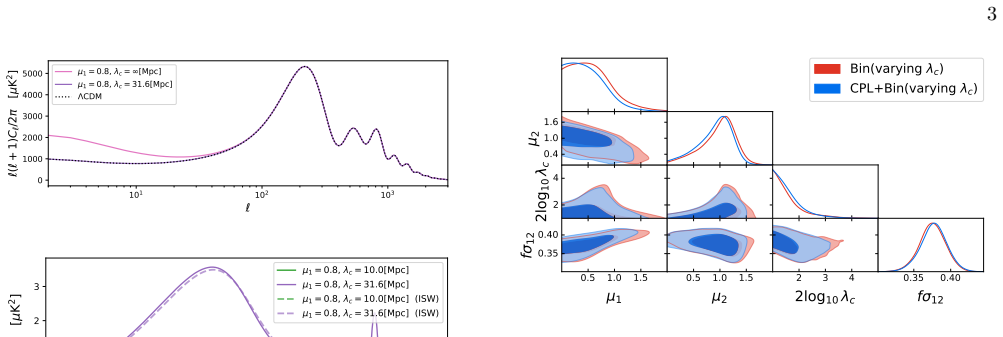
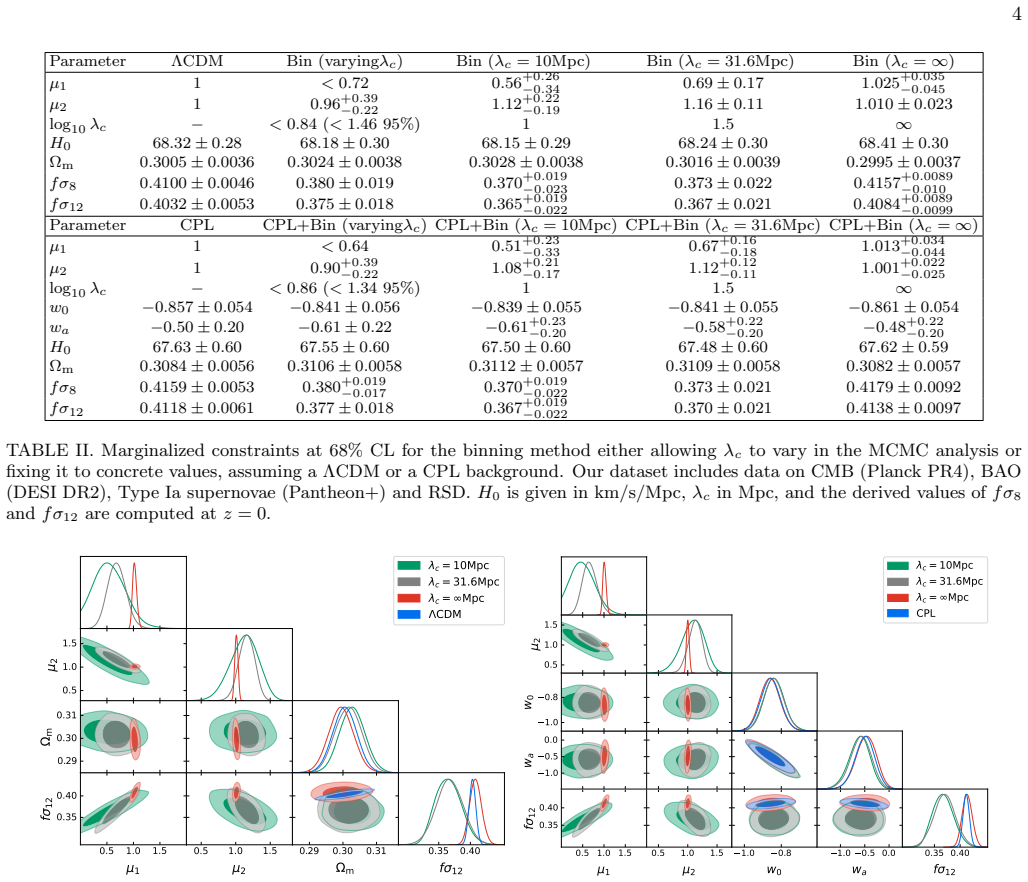
Cosmological data from the cosmic microwave background (CMB), baryon acoustic oscillations, and Type Ia supernovae suggest that the component driving the accelerated expansion of the Universe may be dynamical at the $\sim 2.5$-$3\sigma$ CL. The best-fit CPL model produces a level of cosmic structure similar to that of $\Lambda$CDM, with both models exhibiting mild tension with redshift-space distortion data. In this {\it Letter}, we parametrize possible departures of the effective gravitational coupling from Newton's constant in the late Universe, below a comoving scale $\lambda_c$, using two redshift bins, $0 \leq z < 1$ and $1 \leq z \leq 3$. We then determine the optimal values of $\lambda_c$ and the amplitude of these deviations from General Relativity, assuming a background with dynamical dark energy in CPL form. We find that, in order to achieve the required suppression of structure growth at low redshifts while remaining consistent with CMB constraints -- primarily from the late-time ISW effect at low $\ell$ and lensing at high $\ell$ -- modified gravity effects must appear on scales smaller than $\lambda_c \sim \mathcal{O}(10)\,\mathrm{Mpc}$. Using Planck PR4, DESI DR2, Pantheon+ (or DES-Dovekie) and redshift-space distortions data we confirm that a CPL background with standard gravity is moderately preferred over $\Lambda$CDM; this preference strengthens to a mildly strong level when modified gravity effects are included. This enhancement leaves the CPL parameters largely unchanged, but shifts them slightly further into the quintom region.
Editorial analysis
A structured set of objections, weighed in public.
Referee Report
Summary. The manuscript parametrizes departures of the effective gravitational coupling from Newton's constant below a single comoving scale lambda_c, with constant amplitude in each of two fixed redshift bins (0 <= z < 1 and 1 <= z <= 3), on a CPL dynamical dark energy background. Fits to Planck PR4, DESI DR2, Pantheon+ (or DES-Dovekie) and RSD data are reported to yield lambda_c ~ O(10) Mpc as the scale required to suppress low-redshift structure growth sufficiently to match RSD while remaining consistent with CMB constraints from the late-time ISW effect at low ell and lensing at high ell. The inclusion of these modified-gravity effects is stated to strengthen the preference for CPL over LambdaCDM, with CPL parameters largely unchanged but shifted slightly further into the quintom region.
Significance. If the modeling assumptions are robust, the result would identify a concrete scale below which modified gravity could reconcile the mild RSD tension with standard models without spoiling CMB consistency, while modestly enhancing the dynamical dark energy preference. The use of multiple recent datasets (Planck PR4, DESI DR2, Pantheon+) provides a broad observational basis, but the significance is limited by the lack of tests against alternative scale dependences.
major comments (1)
- [two-bin parametrization paragraph] The paragraph introducing the two-bin parametrization states that the effective gravitational coupling is exactly 1 above lambda_c and takes a constant offset below it, separately in each redshift bin, with no k-dependence inside the bins. This modeling choice is load-bearing for the central claim that lambda_c must be O(10) Mpc: a smoother transition (e.g., tanh roll-off) or additional scale dependence within bins could achieve the same integrated RSD suppression with a larger effective cutoff while still satisfying the same CMB ISW and lensing constraints, weakening the necessity of the reported scale.
minor comments (2)
- [Abstract] Clarify which supernova dataset (Pantheon+ or DES-Dovekie) is used for the primary chains versus the alternative; the abstract presents both without indicating the baseline choice.
- [Data and likelihood section] The covariance treatment between RSD and DESI BAO measurements should be stated explicitly, including whether any cross-covariance is included or neglected.
Simulated Author's Rebuttal
We thank the referee for their careful reading and constructive feedback on our manuscript. We respond to the major comment below and have revised the text to clarify the modeling assumptions and their implications for the reported scale.
read point-by-point responses
-
Referee: [two-bin parametrization paragraph] The paragraph introducing the two-bin parametrization states that the effective gravitational coupling is exactly 1 above lambda_c and takes a constant offset below it, separately in each redshift bin, with no k-dependence inside the bins. This modeling choice is load-bearing for the central claim that lambda_c must be O(10) Mpc: a smoother transition (e.g., tanh roll-off) or additional scale dependence within bins could achieve the same integrated RSD suppression with a larger effective cutoff while still satisfying the same CMB ISW and lensing constraints, weakening the necessity of the reported scale.
Authors: We agree that the sharp cutoff with constant amplitude below lambda_c and no additional k-dependence within bins is a deliberate simplifying choice in our parametrization. This approach was adopted to isolate the characteristic comoving scale at which modifications become necessary while remaining computationally efficient for the MCMC analysis. We acknowledge that a smoother transition (such as a tanh roll-off) or intra-bin scale dependence could in principle redistribute the suppression and permit a modestly larger effective cutoff while preserving consistency with the ISW and lensing constraints. Nevertheless, within the adopted framework the data still require that the onset of modifications occur on scales of order 10 Mpc to achieve the observed RSD suppression without over-affecting the CMB. We have added a new paragraph in Section 3 of the revised manuscript explicitly discussing this modeling limitation, noting that the quoted scale is specific to the step-like parametrization, and highlighting the value of exploring continuous scale dependences in future work. revision: partial
- Quantitative assessment of the shift in preferred lambda_c under a smoother transition function (e.g., tanh) has not been performed and would require new model implementations and additional sampling runs.
Axiom & Free-Parameter Ledger
free parameters (2)
- lambda_c
- deviation_amplitudes
axioms (2)
- domain assumption The background expansion follows the CPL parametrization of dynamical dark energy.
- domain assumption CMB constraints on the model are dominated by the late-time ISW effect at low multipoles and lensing at high multipoles.
invented entities (1)
-
scale-dependent effective gravitational coupling below lambda_c
no independent evidence
Lean theorems connected to this paper
-
IndisputableMonolith/Foundation/RealityFromDistinction.leanreality_from_one_distinction unclear?
unclearRelation between the paper passage and the cited Recognition theorem.
we parametrize possible departures of the effective gravitational coupling from Newton's constant in the late Universe, below a comoving scale λ_c, using two redshift bins... μ(z,k) = 1 + ½[μ₂ + ½(μ₁-μ₂)(1+tanh[β(1-z)])-1] × (1+tanh[β(3-z)]) × k²λ_c²/(1+k²λ_c²)
-
IndisputableMonolith/Cost/FunctionalEquation.leanwashburn_uniqueness_aczel unclear?
unclearRelation between the paper passage and the cited Recognition theorem.
modified gravity effects must appear on scales smaller than λ_c ∼ O(10) Mpc
What do these tags mean?
- matches
- The paper's claim is directly supported by a theorem in the formal canon.
- supports
- The theorem supports part of the paper's argument, but the paper may add assumptions or extra steps.
- extends
- The paper goes beyond the formal theorem; the theorem is a base layer rather than the whole result.
- uses
- The paper appears to rely on the theorem as machinery.
- contradicts
- The paper's claim conflicts with a theorem or certificate in the canon.
- unclear
- Pith found a possible connection, but the passage is too broad, indirect, or ambiguous to say the theorem truly supports the claim.
Reference graph
Works this paper leans on
-
[1]
The second arises from the suppression of gravita- tional lensing. Lensing smooths the acoustic peaks and when it is reduced due to a weaker effective gravitational coupling, the smoothing becomes less efficient, resulting in sharper acoustic features in the high-ℓregion. The effect of the MG parametersµon the RSD observ- ablef σ 12(z) is shown in Fig. 2....
work page 2020
-
[2]
Dark energy two decades after: Observables, probes, consistency tests
D. Huterer and D. L. Shafer, Dark energy two decades after: observables, probes, consistency tests, Rept. Prog. Phys.81, 016901 (2018), arXiv:1709.01091 [astro- ph.CO]. 6
work page internal anchor Pith review Pith/arXiv arXiv 2018
-
[3]
Weinberg, The Cosmological Constant Problem, Rev
S. Weinberg, The Cosmological Constant Problem, Rev. Mod. Phys.61, 1 (1989)
work page 1989
-
[4]
The Case for a Positive Cosmological Lambda-term
V. Sahni and A. A. Starobinsky, The Case for a positive cosmological Lambda term, Int. J. Mod. Phys. D9, 373 (2000), arXiv:astro-ph/9904398
work page internal anchor Pith review Pith/arXiv arXiv 2000
-
[5]
S. M. Carroll, The Cosmological constant, Living Rev. Rel.4, 1 (2001), arXiv:astro-ph/0004075
work page internal anchor Pith review Pith/arXiv arXiv 2001
-
[6]
P. J. E. Peebles and B. Ratra, The Cosmological Con- stant and Dark Energy, Rev. Mod. Phys.75, 559 (2003), arXiv:astro-ph/0207347
work page internal anchor Pith review Pith/arXiv arXiv 2003
-
[7]
Padmanabhan, Cosmological constant: The Weight of the vacuum, Phys
T. Padmanabhan, Cosmological constant: The Weight of the vacuum, Phys. Rept.380, 235 (2003), arXiv:hep- th/0212290
-
[8]
Cosmological constant and vacuum energy: old and new ideas
J. Sola, Cosmological constant and vacuum energy: old and new ideas, J. Phys. Conf. Ser.453, 012015 (2013), arXiv:1306.1527 [gr-qc]
work page internal anchor Pith review Pith/arXiv arXiv 2013
-
[9]
J. Sol` a Peracaula, The cosmological constant prob- lem and running vacuum in the expanding universe, Phil. Trans. Roy. Soc. Lond. A380, 20210182 (2022), arXiv:2203.13757 [gr-qc]
-
[10]
N. Bozorgnia, J. Bramante, J. M. Cline, D. Curtin, D. McKeen, D. E. Morrissey, A. Ritz, S. Viel, A. C. Vincent, and Y. Zhang, Dark matter candi- dates and searches, Can. J. Phys.103, 671 (2025), arXiv:2410.23454 [hep-ph]
-
[11]
Challenges for $\Lambda$CDM: An update
L. Perivolaropoulos and F. Skara, Challenges for ΛCDM: An update, New Astron. Rev.95, 101659 (2022), arXiv:2105.05208 [astro-ph.CO]
work page internal anchor Pith review Pith/arXiv arXiv 2022
-
[12]
E. Di Valentinoet al.(CosmoVerse Network), The CosmoVerse White Paper: Addressing observational tensions in cosmology with systematics and funda- mental physics, Phys. Dark Univ.49, 101965 (2025), arXiv:2504.01669 [astro-ph.CO]
work page internal anchor Pith review Pith/arXiv arXiv 2025
-
[13]
DESI DR2 Results II: Measurements of Baryon Acoustic Oscillations and Cosmological Constraints
M. Abdul Karimet al.(DESI), DESI DR2 results. II. Measurements of baryon acoustic oscillations and cos- mological constraints, Phys. Rev. D112, 083515 (2025), arXiv:2503.14738 [astro-ph.CO]
work page internal anchor Pith review Pith/arXiv arXiv 2025
-
[14]
The Pantheon+ Analysis: The Full Dataset and Light-Curve Release
D. Scolnicet al., The Pantheon+ Analysis: The Full Data Set and Light-curve Release, Astrophys. J.938, 113 (2022), arXiv:2112.03863 [astro-ph.CO]
work page internal anchor Pith review Pith/arXiv arXiv 2022
-
[15]
Union Through UNITY: Cosmology with 2,000 SNe Using a Unified Bayesian Framework
D. Rubinet al., Union Through UNITY: Cosmology with 2,000 SNe Using a Unified Bayesian Framework, Astrophys. J.986, 231 (2025), arXiv:2311.12098 [astro- ph.CO]
work page internal anchor Pith review Pith/arXiv arXiv 2025
-
[16]
B. Popovicet al.(DES), The Dark Energy Survey Su- pernova Program: A Reanalysis Of Cosmology Results And Evidence For Evolving Dark Energy With An Up- dated Type Ia Supernova Calibration, arXiv:2511.07517 (2025), arXiv:2511.07517 [astro-ph.CO]
work page internal anchor Pith review Pith/arXiv arXiv 2025
-
[17]
Planck 2018 results. VI. Cosmological parameters
N. Aghanimet al.(Planck), Planck 2018 results. VI. Cosmological parameters, Astron. Astrophys.641, A6 (2020), [Erratum: Astron.Astrophys. 652, C4 (2021)], arXiv:1807.06209 [astro-ph.CO]
work page internal anchor Pith review Pith/arXiv arXiv 2018
-
[18]
G. Efstathiou and S. Gratton, A Detailed Description of the CAMSPEC Likelihood Pipeline and a Reanalysis of the Planck High Frequency Maps, The Open Journal of Astrophysics4, 10.21105/astro.1910.00483 (2021)
-
[19]
CMB power spectra and cosmological parameters from Planck PR4 with CamSpec
E. Rosenberg, S. Gratton, and G. Efstathiou, CMB power spectra and cosmological parameters from Planck PR4 with CamSpec, Mon. Not. Roy. Astron. Soc.517, 4620 (2022), arXiv:2205.10869 [astro-ph.CO]
work page internal anchor Pith review Pith/arXiv arXiv 2022
-
[20]
A. Chakraborty, T. Ray, S. Das, A. Banerjee, and V. Ganesan, Hint of Dark Matter–Dark Energy Interac- tion in DESI DR2 and Current Cosmological Dataset?, Astrophys. J.998, 83 (2026), arXiv:2403.14247 [astro- ph.CO]
-
[21]
A. G´ omez-Valent and J. Sol` a Peracaula, Phantom Mat- ter: A Challenging Solution to the Cosmological Ten- sions, Astrophys. J.975, 64 (2024), arXiv:2404.18845 [astro-ph.CO]
-
[22]
D. Benisty, S. Pan, D. Staicova, E. Di Valentino, and R. C. Nunes, Late-time constraints on interacting dark energy: Analysis independent of H0, rd, and MB, As- tron. Astrophys.688, A156 (2024), arXiv:2403.00056 [astro-ph.CO]
- [23]
- [24]
- [25]
- [26]
- [27]
-
[28]
A. G´ omez-Valent and J. Sol` a Peracaula, Composite dark energy and the cosmological tensions, Phys. Lett. B864, 139391 (2025), arXiv:2412.15124 [astro-ph.CO]
-
[29]
O. Seto and Y. Toda, DESI constraints on the varying electron mass model and axionlike early dark energy, Phys. Rev. D110, 083501 (2024), arXiv:2405.11869 [astro-ph.CO]
-
[30]
Y. Toda, W. Giar` e, E. ¨Oz¨ ulker, E. Di Valentino, and S. Vagnozzi, Combining pre- and post-recombination new physics to address cosmological tensions: Case study with varying electron mass and sign-switching cosmological constant, Phys. Dark Univ.46, 101676 (2024), arXiv:2407.01173 [astro-ph.CO]
- [31]
-
[32]
W. Giar` e, T. Mahassen, E. Di Valentino, and S. Pan, An overview of what current data can (and cannot yet) say about evolving dark energy, Phys. Dark Univ.48, 101906 (2025), arXiv:2502.10264 [astro-ph.CO]
- [33]
-
[34]
J. Khoury, M.-X. Lin, and M. Trodden, Apparent w<-1 and a Lower S8 from Dark Axion and Dark Baryons Interactions, Phys. Rev. Lett.135, 181001 (2025), arXiv:2503.16415 [astro-ph.CO]. 7
-
[35]
Non-minimally coupled gravity constraints from DESI DR2 data
J. Pan and G. Ye, Nonminimally coupled gravity con- straints from DESI DR2 data, Phys. Rev. D113, L041304 (2026), arXiv:2503.19898 [astro-ph.CO]
work page internal anchor Pith review Pith/arXiv arXiv 2026
- [36]
- [37]
-
[38]
E. Chaussidonet al., Early time solution as an al- ternative to the late time evolving dark energy with DESI DR2 BAO, Phys. Rev. D112, 063548 (2025), arXiv:2503.24343 [astro-ph.CO]
-
[39]
A. Chakraborty, P. K. Chanda, S. Das, and K. Dutta, DESI results: hint towards coupled dark matter and dark energy, JCAP11, 047, arXiv:2503.10806 [astro- ph.CO]
- [40]
-
[41]
X. Chen and A. Loeb, Evolving dark energy or dark matter with an evolving equation-of-state?, JCAP07, 059, arXiv:2505.02645 [astro-ph.CO]
-
[42]
L. Giani, R. Von Marttens, and O. F. Piattella, The matter with(in) CPL, The Open Journal of Astrophysics 8, 10.33232/001c.142699 (2025)
-
[43]
Y. Cai, X. Ren, T. Qiu, M. Li, and X. Zhang, The Quintom theory of dark energy after DESI DR2, arXiv:2505.24732 10.1093/nsr/nwag115 (2025), arXiv: 2505.24732, arXiv:2505.24732 [astro-ph.CO]
work page internal anchor Pith review Pith/arXiv arXiv doi:10.1093/nsr/nwag115 2025
-
[44]
M. Braglia, X. Chen, and A. Loeb, Exotic dark matter and the DESI anomaly, JCAP11, 064, arXiv:2507.13925 [astro-ph.CO]
-
[45]
E. ¨Oz¨ ulker, E. Di Valentino, and W. Giar` e, Dark En- ergy Crosses the Line: Quantifying and Testing the Ev- idence for Phantom Crossing, arXiv:2506.19053 (2025), arXiv:2506.19053 [astro-ph.CO]
- [46]
-
[47]
D. Camarena, K. Greene, J. Houghteling, and F.- Y. Cyr-Racine, Designing concordant distances in the age of precision cosmology: The impact of den- sity fluctuations, Phys. Rev. D112, 083526 (2025), arXiv:2507.17969 [astro-ph.CO]
-
[48]
A. G´ omez-Valent and A. Gonz´ alez-Fuentes, Effective phantom divide crossing with standard and nega- tive quintessence, Phys. Lett. B872, 140096 (2026), arXiv:2508.00621 [astro-ph.CO]
-
[49]
Resolving the Planck-DESI tension by nonminimally coupled quintessence
J.-Q. Wang, R.-G. Cai, Z.-K. Guo, and S.-J. Wang, Re- solving the Planck-DESI tension by nonminimally cou- pled quintessence, Phys. Rev. D113, 083534 (2026), arXiv:2508.01759 [astro-ph.CO]
work page internal anchor Pith review Pith/arXiv arXiv 2026
- [50]
- [51]
- [52]
- [53]
- [54]
- [55]
-
[56]
Tsujikawa, Crossing the phantom divide in scalar- tensor and vector-tensor theories, Phys
S. Tsujikawa, Crossing the phantom divide in scalar- tensor and vector-tensor theories, Phys. Rev. D113, L041301 (2026), arXiv:2508.17231 [astro-ph.CO]
- [57]
-
[58]
T. Adi, Lowering the horizon on Dark Energy: A late- time response to early solutions for the Hubble tension, JCAP03, 015, arXiv:2509.12331 [astro-ph.CO]
-
[59]
G. Alestas, M. Caldarola, I. Ocampo, S. Nesseris, and S. Tsujikawa, DESI constraints on two- field quintessence with exponential potentials, arXiv:2510.21627 (2025), arXiv:2510.21627 [astro- ph.CO]
- [60]
-
[61]
D. Efstratiou, E. A. Paraskevas, and L. Perivolaropou- los, Addressing the DESI DR2 Phantom-Crossing Anomaly and EnhancedH 0 Tension with Reconstructed Scalar-Tensor Gravity, arXiv:2511.04610 (2025), arXiv:2511.04610 [astro-ph.CO]
- [62]
-
[63]
P. Ghedini, R. Hajjar, and O. Mena, Dark energy and neutrinos along the cosmic expansion history, Phys. Dark Univ.52, 102237 (2026), arXiv:2512.16781 [astro- ph.CO]
-
[64]
J. de Cruz P´ erez, A. G´ omez-Valent, and J. Sol` a Per- acaula, Dynamical dark energy models in light of the latest observations, Phys. Rev. D113, 083521 (2026), arXiv:2512.20616 [astro-ph.CO]
-
[65]
Y. Toda and O. Seto, Constraints on the simultaneous variation of the fine structure constant and the electron mass in light of DESI BAO data, Phys. Dark Univ.49, 102035 (2025), arXiv:2504.09136 [astro-ph.CO]
-
[66]
Y. Toda and O. Seto, Constraints on the varying elec- tron mass and early dark energy in light of ACT DR6 and DESI DR2 and the implications for inflation, JCAP 02, 019, arXiv:2508.09025 [astro-ph.CO]
- [67]
-
[68]
Sign-Switching Dark Energy: Smooth Transitions with Recent DESI DR2 Observations
B. Ibarra-Uriondo and M. Bouhmadi-L´ opez, Sign- Switching Dark Energy: Smooth Transitions with Re- cent\textitDESI DR2 Observations, arXiv:2602.12347 (2026), arXiv:2602.12347, arXiv:2602.12347 [astro- ph.CO]
work page internal anchor Pith review Pith/arXiv arXiv 2026
-
[69]
¨O. Akarsu, M. Caruana, K. F. Dialektopoulos, L. A. Escamilla, E. O. Kahya, and J. Levi Said, Hints of sign- changing scalar field energy density and a transient ac- celeration phase atz∼2 from model-agnostic recon- structions, arXiv:2602.08928 (2026), arXiv:2602.08928, arXiv:2602.08928 [astro-ph.CO]
-
[70]
C.-G. Park, J. de Cruz P´ erez, and B. Ratra, Is thew 0waCDM cosmological parameterization evidence for dark energy dynamics partially caused by the excess smoothing of Planck PR4 CMB anisotropy data?, arXiv:2604.03756 (2026), arXiv:2604.03756, arXiv:2604.03756 [astro-ph.CO]
work page internal anchor Pith review Pith/arXiv arXiv 2026
-
[71]
Disentangling cosmic distance tensions with early and late dark energy
T. Jhaveri, T. Karwal, T. Crawford, W. Hu, A. R. Khalife, L. Balkenhol, and F. Ge, Disentangling cosmic distance tensions with early and late dark energy, arXiv:2604.08530 (2026), arXiv:2604.08530, arXiv:2604.08530 [astro-ph.CO]
work page internal anchor Pith review Pith/arXiv arXiv 2026
-
[72]
Non-minimally coupled quintessence with sign-switching interaction
J.-Q. Wang, R.-G. Cai, Z.-K. Guo, Y.-H. Li, S.-J. Wang, and X. Zhang, Non-minimally coupled quintessence with sign-switching interaction, arXiv:2604.02204 (2026), arXiv:2604.02204, arXiv:2604.02204 [astro- ph.CO]
work page internal anchor Pith review Pith/arXiv arXiv 2026
-
[73]
Constraints on Coupled Dark Energy in the DESI Era
A. G´ omez-Valent, Z. Zheng, and L. Amendola, Con- straints on Coupled Dark Energy in the DESI Era, arXiv:2604.12032 (2026), arXiv:2604.12032 [astro- ph.CO]
work page internal anchor Pith review Pith/arXiv arXiv 2026
-
[74]
Generalizing the CPL Parametrization through Dark Sector Interaction
M. Artola, R. Lazkoz, and V. Salzano, Generalizing the CPL Parametrization through Dark Sector Interac- tion, arXiv:2604.25373 (2026), arXiv:2604.25373 [astro- ph.CO]
work page internal anchor Pith review Pith/arXiv arXiv 2026
-
[75]
J. Wang, H. Yu, and P. Wu, Coupled quintessence with a potential from supergravity exhibits sign-changing in- teraction, arXiv:2605.17754 (2026), arXiv:2605.17754 [astro-ph.CO]
work page internal anchor Pith review Pith/arXiv arXiv 2026
-
[76]
R. Calderonet al.(DESI), DESI 2024: Reconstructing Dark Energy using Crossing Statistics with DESI DR1 BAO data, JCAP2410, 048, arXiv:2405.04216 [astro- ph.CO]
-
[77]
J.-Q. Jiang, D. Pedrotti, S. S. da Costa, and S. Vagnozzi, Nonparametric late-time expansion history reconstruction and implications for the Hubble tension in light of recent DESI and type Ia supernovae data, Phys. Rev. D110, 123519 (2024), arXiv:2408.02365 [astro-ph.CO]
-
[78]
Extended Dark Energy analysis using DESI DR2 BAO measurements
K. Lodhaet al.(DESI), Extended dark energy analy- sis using DESI DR2 BAO measurements, Phys. Rev. D 112, 083511 (2025), arXiv:2503.14743 [astro-ph.CO]
work page internal anchor Pith review Pith/arXiv arXiv 2025
- [79]
- [80]
discussion (0)
Sign in with ORCID, Apple, or X to comment. Anyone can read and Pith papers without signing in.