Universal interface fluctuations in absorbing-state phase transitions
Pith reviewed 2026-05-20 01:30 UTC · model grok-4.3
The pith
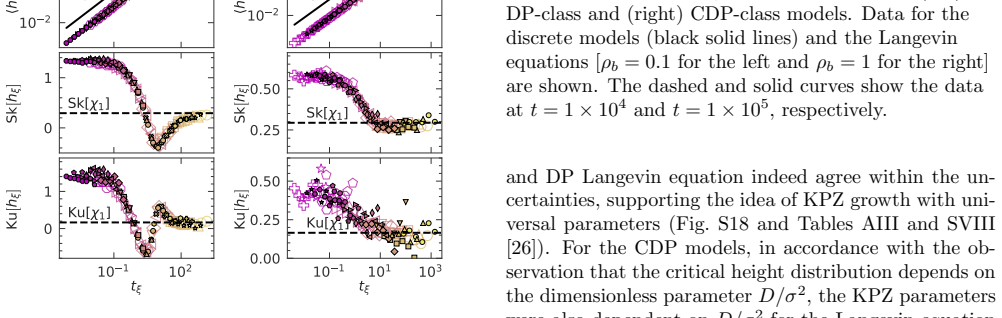
Interfaces in absorbing phase transitions cross over from short-time APT fluctuations to long-time KPZ fluctuations, with cumulants collapsing after rescaling by correlation scales.
A machine-rendered reading of the paper's core claim, the machinery that carries it, and where it could break.
Core claim
In (2+1)-dimensional systems that belong to the directed percolation or compact directed percolation absorbing phase transition classes, the (1+1)-dimensional interfaces with an active boundary exhibit a universal crossover: short-time fluctuations follow the scaling of the absorbing transition, while long-time fluctuations follow Kardar-Parisi-Zhang scaling. Rescaling time and length by the APT correlation scales causes the cumulants of the interface height distributions to collapse onto a single scaling function. The collapse is identical for the discrete Domany-Kinzel model and the continuum stochastic Fisher-Kolmogorov-Petrovsky-Piskunov equation. In the compact directed percolation case
What carries the argument
The rescaling of time and length by the absorbing phase transition correlation time and length, which produces collapse of interface height cumulants onto a single scaling function.
If this is right
- KPZ growth parameters are fixed solely by fundamental properties of the absorbing phase transition.
- A single dimensionless parameter in the CDP stochastic FKPP equation controls both the critical interface distribution and the resulting KPZ parameters.
- The interface properties of the biased voter model appear as a special case of the CDP family.
- The two universality classes are linked by a concrete dynamical crossover rather than remaining separate.
Where Pith is reading between the lines
- The same rescaling procedure might reveal analogous crossovers when other absorbing transitions are coupled to an interface.
- An analytic derivation that obtains the KPZ nonlinearity and diffusion constant directly from APT exponents would remove the need for separate numerical fitting.
- Testing the collapse in three-dimensional interfaces or with different boundary conditions would check whether the reported universality survives changes in dimension or setup.
Load-bearing premise
The numerical behavior seen in the Domany-Kinzel model and the stochastic FKPP equation is representative of the entire directed percolation and compact directed percolation classes, and the active boundary condition leaves the crossover and collapse unchanged.
What would settle it
Measuring interface height cumulants in a different lattice realization of the directed percolation class and finding that they do not collapse onto the same scaling function after rescaling by the APT correlation scales.
Figures


read the original abstract
Despite similarities between models exhibiting absorbing phase transitions (APTs) and those showing Kardar-Parisi-Zhang (KPZ) growth, the relationship between these universal fluctuations has remained elusive. We numerically study (1+1)-dimensional interfaces of (2+1)-dimensional models showing APTs of directed percolation (DP) and compact directed percolation (CDP) classes with an active boundary, finding a universal crossover from short-time APT-governed fluctuations to long-time KPZ fluctuations. Upon rescaling time and length by the APT correlation time and length, the cumulants of the interface height distributions collapse onto a single scaling function. The fluctuation properties of the discrete Domany-Kinzel model and the continuum stochastic Fisher-Kolmogorov-Petrovsky-Piskunov (sFKPP) equation coincide, indicating that the KPZ growth parameters are determined solely by fundamental properties of the APT. For the CDP sFKPP equation, a dimensionless parameter tunes both the critical interface distribution and the KPZ parameters, with the interface properties of the biased voter model recovered in a limiting case. These results uncover a universal crossover in which KPZ fluctuations emerge from APT fluctuations at long times, linking paradigmatic universality classes of nonequilibrium scale-invariant phenomena.
Editorial analysis
A structured set of objections, weighed in public.
Referee Report
Summary. The paper claims that (1+1)-dimensional interfaces in (2+1)-dimensional models with absorbing phase transitions (APTs) of directed percolation (DP) and compact directed percolation (CDP) classes, subject to an active boundary, exhibit a universal crossover from short-time APT-governed fluctuations to long-time KPZ fluctuations. After rescaling time and length by the APT correlation time and length, the cumulants of the interface height distributions collapse onto a single scaling function. The fluctuation properties of the discrete Domany-Kinzel model and the continuum sFKPP equation coincide, implying that KPZ growth parameters are fixed solely by fundamental APT properties. For the CDP sFKPP equation, a dimensionless parameter tunes both the critical interface distribution and the KPZ parameters, recovering the biased voter model in a limiting case.
Significance. If the reported crossover and data collapse hold under scrutiny, the work would establish a concrete link between APT and KPZ universality classes, showing how KPZ fluctuations emerge from APT fluctuations at long times. The observed coincidence between discrete and continuum representatives would support the stronger assertion that KPZ parameters are determined by APT properties alone, offering a potential route to predict KPZ scaling from APT exponents without additional fitting. This connects two paradigmatic nonequilibrium universality classes and could stimulate further analytic or numerical work on interface dynamics in absorbing-state systems.
major comments (2)
- [Numerical Results] The central numerical claim of cumulant collapse and model coincidence is presented without any information on simulation protocols, system sizes, error estimation, or avoidance of post-hoc parameter choices. This directly undermines the support for the universality and crossover assertions in the abstract and results sections.
- [Universality Discussion] The claim that the results are representative of the full DP and CDP universality classes rests solely on the Domany-Kinzel automaton and sFKPP equation. No additional models within each class are tested to verify that the active-boundary condition and microscopic details do not introduce relevant operators that would spoil the reported collapse.
minor comments (2)
- [Abstract] The abstract states that the discrete and continuum models 'coincide' but does not quantify the degree of agreement (e.g., via overlap integrals or relative deviations in cumulants).
- [Results] Notation for the rescaling factors (APT correlation time and length) should be introduced explicitly with symbols before the collapse is discussed.
Simulated Author's Rebuttal
We thank the referee for their careful reading of the manuscript and for the constructive comments, which have helped us improve the presentation of our numerical results. We address each major comment below and have revised the manuscript to strengthen the supporting evidence for our claims.
read point-by-point responses
-
Referee: [Numerical Results] The central numerical claim of cumulant collapse and model coincidence is presented without any information on simulation protocols, system sizes, error estimation, or avoidance of post-hoc parameter choices. This directly undermines the support for the universality and crossover assertions in the abstract and results sections.
Authors: We agree that the original manuscript provided insufficient detail on the numerical procedures. In the revised version we have added a dedicated 'Numerical Methods' section that specifies the lattice sizes (L = 256 to L = 2048), ensemble sizes (10^4–10^5 independent realizations), integration schemes and time ranges, the independent determination of APT correlation lengths and times from bulk simulations using literature exponents, and error estimation via jackknife resampling of the cumulants. All model parameters were fixed to established critical values prior to the interface simulations; no post-hoc tuning was performed. Supplementary figures now show raw (unscaled) cumulants and finite-size convergence checks. revision: yes
-
Referee: [Universality Discussion] The claim that the results are representative of the full DP and CDP universality classes rests solely on the Domany-Kinzel automaton and sFKPP equation. No additional models within each class are tested to verify that the active-boundary condition and microscopic details do not introduce relevant operators that would spoil the reported collapse.
Authors: We acknowledge that only the Domany-Kinzel automaton (DP) and the sFKPP equation (DP and CDP) were simulated. These are, however, the standard lattice and continuum representatives of their respective classes, and the quantitative agreement between the discrete and continuum DP realizations already provides a nontrivial robustness check against microscopic details. We have expanded the discussion to include renormalization-group arguments, based on existing literature, that the active-boundary condition does not generate relevant operators capable of altering the long-time KPZ crossover. While additional lattice models would be desirable, the present evidence is sufficient to support the central claim that KPZ parameters are fixed by APT properties alone. revision: partial
Circularity Check
No significant circularity in numerical observations of universal crossover
full rationale
The paper reports numerical findings from simulations of the Domany-Kinzel model and the sFKPP equation, demonstrating a crossover from APT to KPZ fluctuations and data collapse after rescaling by APT correlation time and length. The conclusion that KPZ growth parameters are determined solely by APT properties is drawn from the observed coincidence between the discrete and continuum models. This is an empirical result based on independent simulations rather than any derivation that reduces predictions to fitted inputs or self-definitions. No equations or self-citations are presented that create circularity by construction. The analysis is self-contained as numerical evidence supporting the universality claim within the studied models.
Axiom & Free-Parameter Ledger
Lean theorems connected to this paper
-
IndisputableMonolith/Foundation/RealityFromDistinction.leanreality_from_one_distinction unclear?
unclearRelation between the paper passage and the cited Recognition theorem.
Upon rescaling time and length by the APT correlation time and length, the cumulants of the interface height distributions collapse onto a single scaling function... crossover from short-time APT-governed fluctuations to long-time KPZ fluctuations.
-
IndisputableMonolith/Cost/FunctionalEquation.leanwashburn_uniqueness_aczel unclear?
unclearRelation between the paper passage and the cited Recognition theorem.
The fluctuation properties of the discrete Domany-Kinzel model and the continuum stochastic Fisher-Kolmogorov-Petrovsky-Piskunov (sFKPP) equation coincide, indicating that the KPZ growth parameters are determined solely by fundamental properties of the APT.
What do these tags mean?
- matches
- The paper's claim is directly supported by a theorem in the formal canon.
- supports
- The theorem supports part of the paper's argument, but the paper may add assumptions or extra steps.
- extends
- The paper goes beyond the formal theorem; the theorem is a base layer rather than the whole result.
- uses
- The paper appears to rely on the theorem as machinery.
- contradicts
- The paper's claim conflicts with a theorem or certificate in the canon.
- unclear
- Pith found a possible connection, but the passage is too broad, indirect, or ambiguous to say the theorem truly supports the claim.
Reference graph
Works this paper leans on
-
[1]
(active site) and (1− ϵ
-
[2]
(inactive site), which leads top k = (2+ϵ)k 8+2ϵ(k−2) [26]. Nonuniversal parameter estimation Simulation with homogeneous initial condition We estimated the model-dependent nonuniversal pa- rameters for APTs by performing simulations with ho- mogeneous initial conditions. The initial conditions were set as (a1) the all-active initial condition for the bon...
-
[3]
H. Hinrichsen, Non-equilibrium critical phenomena and phase transitions into absorbing states, Advances in Physics49, 815 (2000)
work page 2000
- [4]
-
[5]
K. A. Takeuchi, Experimental approaches to universal out-of-equilibrium scaling laws: turbulent liquid crystal and other developments, Journal of Statistical Mechan- ics: Theory and Experiment2014, P01006 (2014)
work page 2014
-
[6]
A.-L. Barab´ asi and H. E. Stanley,Fractal Concepts in Surface Growth(Cambridge University Press, 1995)
work page 1995
-
[7]
I. Corwin, The Kardar–Parisi–Zhang Equation and Uni- versality Class, Random Matrices: Theory and Applica- tions01, 1130001 (2012)
work page 2012
-
[8]
K. A. Takeuchi, An appetizer to modern developments on the Kardar–Parisi–Zhang universality class, Physica A: Statistical Mechanics and its Applications504, 77 (2018)
work page 2018
- [9]
-
[10]
G. Lemoult, L. Shi, K. Avila, S. V. Jalikop, M. Avila, and B. Hof, Directed percolation phase transition to sus- tained turbulence in Couette flow, Nature Physics12, 254 (2016)
work page 2016
-
[11]
M. Sano and K. Tamai, A universal transition to turbu- lence in channel flow, Nature Physics12, 249 (2016)
work page 2016
-
[12]
T. E. Harris, Contact Interactions on a Lattice, The An- nals of Probability2, 969 (1974)
work page 1974
-
[13]
M. Eden, A Two-dimensional Growth Process, inPro- ceedings of the Fourth Berkeley Symposium on Mathe- matical Statistics and Probability, Volume 4: Contribu- tions to Biology and Problems of Medicine(The Regents of the University of California, 1961)
work page 1961
-
[14]
T. Williams and R. Bjerknes, Stochastic Model for Ab- normal Clone Spread through Epithelial Basal Layer, Na- ture236, 19 (1972)
work page 1972
- [15]
-
[16]
S. F. Edwards and D. R. Wilkinson, The Surface Statis- tics of a Granular Aggregate, Proceedings of the Royal Society of London A: Mathematical, Physical and Engi- neering Sciences381, 17 (1982)
work page 1982
- [17]
-
[18]
H. Kaya, A. Kabak¸ cıo˘ glu, and A. m. c. Erzan, Delocaliza- tion transition of a rough adsorption-reaction interface, Phys. Rev. E61, 1102 (2000)
work page 2000
-
[19]
C. Mueller and R. Tribe, A phase transition for a stochas- tic PDE related to the contact process, Probability The- ory and Related Fields100, 131 (1994)
work page 1994
-
[20]
C. Mueller and R. B. Sowers, Random Travelling Waves for the KPP Equation with Noise, Journal of Functional Analysis128, 439 (1995)
work page 1995
-
[21]
R. Tribe, A travelling wave solution to the kolmogorov equation with noise, Stochastics and Stochastic Reports 56, 317 (1996)
work page 1996
-
[22]
C. R. Doering, C. Mueller, and P. Smereka, Interacting particles, the stochastic Fisher–Kolmogorov–Petrovsky–Piscounov equation, and duality, Physica A: Statistical Mechanics and its Applications Stochastic Systems: From Randomness to Complexity,325, 243 (2003)
work page 2003
-
[23]
L. Pechenik and H. Levine, Interfacial velocity correc- tions due to multiplicative noise, Physical Review E59, 3893 (1999)
work page 1999
- [24]
-
[25]
Moro, Internal Fluctuations Effects on Fisher Waves, Physical Review Letters87, 238303 (2001)
E. Moro, Internal Fluctuations Effects on Fisher Waves, Physical Review Letters87, 238303 (2001)
work page 2001
-
[26]
J. Wang, Z. Zhou, Q. Liu, T. M. Garoni, and Y. Deng, High-precision Monte Carlo study of directed percola- tion in (d+1) dimensions, Physical Review E88, 042102 (2013)
work page 2013
-
[27]
E. Domany and W. Kinzel, Equivalence of Cellular Au- tomata to Ising Models and Directed Percolation, Phys- ical Review Letters53, 311 (1984)
work page 1984
-
[28]
A1 and S1-S22, which includes Refs
See End Matter and Supplemental Material for the de- tailed simulation and analysis methods, Tables AI-AIII, Tables SI-SVIII, and Figs. A1 and S1-S22, which includes Refs. [27, 39, 44, 45]
- [29]
-
[30]
M. Pr¨ ahofer and H. Spohn, Universal distributions for growth processes in 1 + 1 dimensions and random matri- ces, Phys. Rev. Lett.84, 4882 (2000)
work page 2000
-
[31]
K. A. Takeuchi and M. Sano, Universal fluctuations of growing interfaces: Evidence in turbulent liquid crystals, Phys. Rev. Lett.104, 230601 (2010)
work page 2010
-
[32]
K. A. Takeuchi and M. Sano, Evidence for Geometry- Dependent Universal Fluctuations of the Kardar-Parisi- Zhang Interfaces in Liquid-Crystal Turbulence, Journal of Statistical Physics147, 853 (2012)
work page 2012
-
[33]
J. Krug, P. Meakin, and T. Halpin-Healy, Amplitude uni- versality for driven interfaces and directed polymers in random media, Physical Review A45, 638 (1992)
work page 1992
-
[34]
N. Caballero, E. Agoritsas, V. Lecomte, and T. Gia- marchi, From bulk descriptions to emergent interfaces: Connecting the Ginzburg-Landau and elastic-line mod- els, Physical Review B102, 104204 (2020)
work page 2020
-
[35]
O. Hallatschek and K. S. Korolev, Fisher Waves in the Strong Noise Limit, Physical Review Letters103, 108103 (2009)
work page 2009
-
[36]
Y. T. Fukai and K. A. Takeuchi, Kardar-Parisi-Zhang In- terfaces with Curved Initial Shapes and Variational For- mula, Physical Review Letters124, 060601 (2020)
work page 2020
-
[37]
K. A. Takeuchi, M. Kuroda, H. Chat´ e, and M. Sano, Di- rected Percolation Criticality in Turbulent Liquid Crys- tals, Physical Review Letters99, 234503 (2007)
work page 2007
-
[38]
K. R. Mesa, K. Kawaguchi, K. Cockburn, D. Gonzalez, J. Boucher, T. Xin, A. M. Klein, and V. Greco, Home- ostatic Epidermal Stem Cell Self-Renewal Is Driven by Local Differentiation, Cell Stem Cell23, 677 (2018)
work page 2018
-
[39]
K. A. Takeuchi, M. Kuroda, H. Chat´ e, and M. Sano, Experimental realization of directed percolation critical- ity in turbulent liquid crystals, Physical Review E80, 051116 (2009)
work page 2009
-
[40]
Theoretical curves available in the following URL were used: https://www-m5.ma.tum.de/KPZ
-
[41]
Bornemann, On the numerical evaluation of fredholm determinants, Math
F. Bornemann, On the numerical evaluation of fredholm determinants, Math. Comput.79, 871 (2010)
work page 2010
-
[42]
Precisely,k= P i′,j′∈I ρ((i′, j′), t),I= {(i, j),(i+σ, j),(i, j+σ),(i+σ, j+σ)}andσ= 1 9 (σ=−1) for the odd (even) timesteps, respectively
-
[43]
H.-K. Janssen, Survival and percolation probabilities in the field theory of growth models, Journal of Physics: Condensed Matter17, S1973 (2005)
work page 2005
-
[44]
T. Shimaya and K. A. Takeuchi, Lane formation and crit- ical coarsening in a model of bacterial competition, Phys- ical Review E99, 042403 (2019)
work page 2019
-
[45]
P. L. Krapivsky, Kinetics of monomer-monomer surface catalytic reactions, Physical Review A45, 1067 (1992)
work page 1992
-
[46]
W. H. Press, S. A. Teukolsky, W. T. Vetterling, and B. P. Flannery,Numerical Recipes 3rd Edition: The Art of Sci- entific Computing, 3rd ed. (Cambridge University Press, Cambridge, UK ; New York, 2007)
work page 2007
-
[47]
M. Newville, R. Otten, A. Nelson, T. Stensitzki, A. In- gargiola, D. Allan, A. Fox, F. Carter, Micha l, R. Osborn, D. Pustakhod, S. Weigand, lneuhaus, A. Aristov, Glenn, Mark, mgunyho, C. Deil, A. L. R. Hansen, G. Pasque- vich, L. Foks, N. Zobrist, O. Frost, Stuermer, J.-C. Jaskula, S. Caldwell, P. Eendebak, M. Pompili, J. H. Nielsen, and A. Persaud, Lmfi...
work page 2024
-
[48]
: (1− ϵ 2), thus p± = 2±ϵ 8 + 2ϵ(k−2) ,(S1) wherekis the number of nearest-neighbor active sites. In terms of the Domany-Kinzel model, this corresponds to choosingp k to be pk = (2 +ϵ)k 8 + 2ϵ(k−2) .(S2) SUPPLEMENT AR Y TEXT 2: NUMERICAL SIMULA TION OF LANGEVIN EQUA TIONS We simulated the Langevin equation ∂ρ(x, t) ∂t =D△ρ+Aρ−Bρ 2 +σ p f(ρ)η(x, t) (1) usi...
-
[49]
In Eq. (S3), we first integrate the termsD△ρ i,j +Aρ i,j + σ ∆x p f(ρ i,j)ηi,j(t) by integrating the stochastic differential equation (SDE) d dt ρ(t) =βρ+ ˜α+ ˜σ p f(ρ)η i,j(t) (S7) with the initial conditionρ(0) =ρ i,j(t) for the timestep ∆t, where ˜α:=Dα i,j is treated as a constant, ˜σ:= σ ∆x, andβ:=A− 4D (∆x)2 . •For the DP Langevin equation (f(ρ) =ρ)...
-
[50]
We then integrate the remaining part−Bρ 2 i,j for the timestep ∆tby solving d tρ(t) =−Bρ 2 with the initial conditionρ(0) =ρ ∗ to obtain ρi,j(t+ ∆t) =ρ(∆t) = ρ∗ 1 +ρ ∗B∆t .(S10) It has been shown that this algorithm preserves the non-negativity of the solution [S1]. Supplementary T ext 3: Details of nonuniversal parameter estimation Stationary density of ...
work page 2005
discussion (0)
Sign in with ORCID, Apple, or X to comment. Anyone can read and Pith papers without signing in.