Cryogenic Time-Division-Multiplexed Voltage Control for Scalable Trapped-Ion Quantum Processors
Pith reviewed 2026-05-20 11:05 UTC · model grok-4.3
The pith
Time-division multiplexing allows reliable cryogenic voltage control for both static and dynamic electrodes in trapped-ion processors.
A machine-rendered reading of the paper's core claim, the machinery that carries it, and where it could break.
Core claim
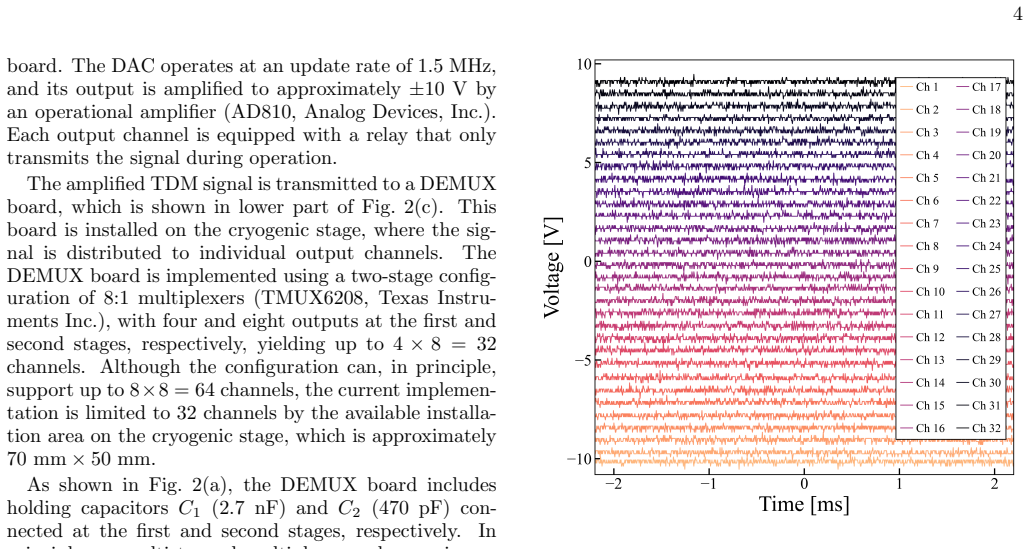
We develop and cryogenically validate TDM-based voltage control schemes for two distinct electrode classes. For static electrodes used in trap-potential compensation, we implement a 32-channel demultiplexed system operating at approximately 27 K, achieving an effective voltage update rate of 37.5 kHz with an output range of ±10 V per channel. For dynamic electrodes used in ion operations such as shuttling, we implement a four-channel demultiplexed system operating at approximately 14 K, achieving an effective voltage update rate of 1 MHz with a comparable output range. These results establish TDM-based voltage control as a practical approach for both electrode classes.
What carries the argument
Time-division-multiplexed (TDM) demultiplexing that switches a shared voltage line across multiple electrodes while preserving stability and low noise at cryogenic temperatures.
If this is right
- Fewer vacuum feedthroughs are needed to support larger numbers of trap electrodes.
- Both static potential compensation and dynamic shuttling operations become feasible under cryogenic conditions.
- The effective update rates suffice for typical trapped-ion control sequences without additional hardware per electrode.
- The method applies separately to static and dynamic electrode groups within the same processor.
Where Pith is reading between the lines
- Combining this TDM approach with other wiring-reduction techniques could further increase qubit counts before feedthrough limits appear.
- The temperature-specific performance data may guide design choices for mixed static-dynamic electrode layouts in future devices.
- Long-term operation tests would reveal whether repeated switching introduces cumulative drift not captured in the initial validation.
- Similar multiplexing could be explored for other cryogenic quantum systems that require many independent voltage channels.
Load-bearing premise
The TDM switching electronics and cabling maintain voltage stability, low noise, and low crosstalk at cryogenic temperatures without degrading the trapping potentials enough to affect ion confinement or operations.
What would settle it
Direct comparison of ion heating rates, loss rates, or gate fidelities between TDM-controlled electrodes and individually wired electrodes at the reported temperatures and update rates.
Figures



read the original abstract
Trapped-ion quantum computers based on the quantum charge-coupled device architecture require on the order of ten trap electrodes per qubit, making the number of vacuum feedthroughs a bottleneck at the system scale. Time-division multiplexed (TDM)-based voltage control for trap electrodes provides a natural route to alleviate this constraint. However, previous studies have been limited to architectural proposals for static trap-potential compensation and room-temperature demonstrations of dynamic-electrode control, leaving cryogenic operation of TDM-based voltage control for static and dynamic electrodes experimentally unexplored. In this study, we develop and cryogenically validate TDM-based voltage control schemes for two distinct electrode classes. For static electrodes used in trap-potential compensation, we implement a 32-channel demultiplexed system operating at approximately 27~K, achieving an effective voltage update rate of 37.5~kHz with an output range of $\pm10~\mathrm{V}$ per channel. For dynamic electrodes used in ion operations, such as shuttling, we implement a four-channel demultiplexed system operating at approximately 14~K, achieving an effective voltage update rate of 1~MHz with a comparable output range. These results establish TDM-based voltage control as a practical approach for both electrode classes, providing a path for mitigating the vacuum feedthrough bottleneck in scalable trapped-ion quantum processors.
Editorial analysis
A structured set of objections, weighed in public.
Referee Report
Summary. The manuscript describes the development and cryogenic validation of time-division-multiplexed (TDM) voltage control for trapped-ion trap electrodes in a QCCD architecture. It reports a 32-channel demultiplexed system for static electrodes operating at ~27 K with 37.5 kHz effective update rate and ±10 V range, plus a 4-channel system for dynamic electrodes at ~14 K with 1 MHz update rate. The central claim is that these TDM schemes provide a practical route to alleviate the vacuum feedthrough bottleneck while maintaining functionality at cryogenic temperatures.
Significance. If the reported cryogenic operation is supported by adequate evidence of voltage stability and low noise, the work would be significant for scalable trapped-ion processors by demonstrating a hardware solution that reduces feedthrough count for both static compensation and dynamic shuttling electrodes. The dual demonstration across electrode classes and the concrete performance metrics (update rates, voltage ranges, temperatures) add practical value for system engineering.
major comments (2)
- [Results] Results section: The abstract and reported performance figures (37.5 kHz at ~27 K, 1 MHz at ~14 K) claim successful cryogenic validation, yet no voltage stability data, noise spectra, error bars, or crosstalk measurements are referenced; without these, it is unclear whether switching transients or cryo-induced effects remain below thresholds that would degrade ion confinement or operations.
- [Methods] Methods/Experimental setup: The manuscript does not describe measurement protocols for confirming that demultiplexed voltages preserve trapping potentials (e.g., via trap-frequency jitter, ion heating rates, or direct electrode voltage monitoring at base temperature), which is load-bearing for the claim that TDM is viable for both electrode classes.
minor comments (2)
- [Abstract] Abstract: Temperature values are stated as 'approximately 27 K' and 'approximately 14 K'; providing measured base temperatures with uncertainties or ranges would improve precision.
- Figure captions or text: Ensure all performance claims (update rates, voltage ranges) are cross-referenced to specific experimental traces or tables for traceability.
Simulated Author's Rebuttal
We thank the referee for their constructive and detailed review of our manuscript. We address each major comment point by point below, providing clarifications and indicating revisions where the manuscript will be updated to strengthen the presentation of our cryogenic validation results.
read point-by-point responses
-
Referee: [Results] Results section: The abstract and reported performance figures (37.5 kHz at ~27 K, 1 MHz at ~14 K) claim successful cryogenic validation, yet no voltage stability data, noise spectra, error bars, or crosstalk measurements are referenced; without these, it is unclear whether switching transients or cryo-induced effects remain below thresholds that would degrade ion confinement or operations.
Authors: We agree that explicit supporting data on voltage stability, noise spectra, error bars, and crosstalk would better substantiate the cryogenic performance claims. In the revised manuscript, we have added these quantitative measurements to the Results section, including time-series voltage recordings with standard deviations, noise spectral density data acquired at the operating temperatures, and inter-channel crosstalk levels. These additions confirm that transients decay rapidly and that noise remains below levels that would impact ion confinement. revision: yes
-
Referee: [Methods] Methods/Experimental setup: The manuscript does not describe measurement protocols for confirming that demultiplexed voltages preserve trapping potentials (e.g., via trap-frequency jitter, ion heating rates, or direct electrode voltage monitoring at base temperature), which is load-bearing for the claim that TDM is viable for both electrode classes.
Authors: We acknowledge that a more explicit description of the protocols is warranted. The revised Methods section now includes a dedicated subsection detailing the direct electrode voltage monitoring setup, which employs high-impedance cryogenic probes and oscilloscope-based logging at base temperature to assess output fidelity, drift, and transient behavior. We note that trap-frequency jitter and ion heating rate measurements were not performed, as this study focused on standalone electrical validation of the TDM hardware; we have added text explaining how the measured voltage precision supports preservation of trapping potentials. revision: partial
- Direct experimental quantification of trap-frequency jitter or ion heating rates under TDM operation, as the present work performed electrical characterization without trapped ions.
Circularity Check
No circularity: direct experimental hardware demonstration
full rationale
The paper reports construction and cryogenic testing of TDM voltage-control hardware for static and dynamic trap electrodes. Performance metrics (37.5 kHz at ~27 K, 1 MHz at ~14 K, ±10 V range) are measured outputs from the built systems rather than outputs of any derivation, fit, or self-referential equation. No mathematical chain, uniqueness theorem, or ansatz is invoked; the central claim rests on empirical validation of the assembled apparatus. Consequently there are no load-bearing steps that reduce to the paper's own inputs by construction.
Axiom & Free-Parameter Ledger
axioms (1)
- standard math Established principles of cryogenic electronics and low-temperature ion trapping apply without modification to the TDM switching hardware.
Reference graph
Works this paper leans on
-
[1]
author author D. J. \ Wineland , author C. Monroe , author W. M. \ Itano , author D. Leibfried , author B. E. \ King ,\ and\ author D. M. \ Meekhof ,\ @noop journal journal J. Res. Natl. Inst. Stand. Technol. \ volume 103 ,\ pages 259 ( year 1998 ) NoStop
work page 1998
-
[2]
author author D. Kielpinski , author C. Monroe ,\ and\ author D. J. \ Wineland ,\ @noop journal journal Nature \ volume 417 ,\ pages 709 ( year 2002 ) NoStop
work page 2002
-
[3]
Helios: A 98-qubit trapped-ion quantum computer
author author A. Ransford , author M. Allman , author J. Arkinstall , et al. ,\ @noop journal journal arXiv:2511.05465 \ ( year 2025 ) NoStop
work page internal anchor Pith review Pith/arXiv arXiv 2025
-
[4]
author author M. Malinowski , author D. Allcock ,\ and\ author C. Ballance ,\ @noop journal journal PRX Quantum \ volume 4 ,\ pages 040313 ( year 2023 ) NoStop
work page 2023
-
[5]
author author S. A. \ Moses , author C. H. \ Baldwin , author M. S. \ Allman , et al. ,\ @noop journal journal Phys. Rev. X \ volume 13 ,\ pages 041052 ( year 2023 ) NoStop
work page 2023
-
[6]
author author R. D. \ Delaney , author L. R. \ Sletten , author M. J. \ Cich , et al. ,\ @noop journal journal Phys. Rev. X \ volume 14 ,\ pages 041028 ( year 2024 ) NoStop
work page 2024
-
[7]
author author J. Stuart , author R. Panock , author C. Bruzewicz , author J. Sedlacek , author R. McConnell , author I. Chuang , author J. Sage ,\ and\ author J. Chiaverini ,\ @noop journal journal Phys. Rev. Appl. \ volume 11 ,\ pages 024010 ( year 2019 ) NoStop
work page 2019
-
[8]
author author M. Sieberer ,\ in\ @noop booktitle 2024 IEEE European Solid-State Electronics Research Conference (ESSERC) \ ( organization IEEE ,\ year 2024 )\ pp.\ pages 480--483 NoStop
work page 2024
-
[9]
author author S. Park , author S. Song , author K. Kim , author H. Lee , author M. Lee ,\ and\ author J.-Y. \ Sim ,\ in\ @noop booktitle 2024 IEEE European Solid-State Electronics Research Conference (ESSERC) \ ( organization IEEE ,\ year 2024 )\ pp.\ pages 488--491 NoStop
work page 2024
-
[10]
author author A. Meyer \ and\ author V. Issakov ,\ in\ @noop booktitle 2025 IEEE International Symposium on Circuits and Systems (ISCAS) \ ( organization IEEE ,\ year 2025 )\ pp.\ pages 1--5 NoStop
work page 2025
-
[11]
author author A. Meyer , author P. J. \ Ritter , author M. Neumann , et al. ,\ https://doi.org/10.1109/TIM.2025.3571087 journal journal IEEE Transactions on Instrumentation and Measurement \ volume 74 ,\ pages 1 ( year 2025 ) NoStop
-
[12]
author author I. M. \ Hunter ,\ @noop title Methods and systems for implementing digital to analogue converters in quantum computers , \ howpublished US Patent Application 18/424,570 ( year 2024 ),\ note published Dec. 19, 2024 NoStop
work page 2024
-
[13]
Architecting Scalable Trapped Ion Quantum Computers using Surface Codes
author author S. Jones \ and\ author P. Murali ,\ @noop journal journal arXiv:2510.23519 \ ( year 2025 ) NoStop
work page internal anchor Pith review Pith/arXiv arXiv 2025
-
[14]
author author R. Ohira , author S. Morisaka , author I. Nakamura , author A. Noguchi ,\ and\ author T. Miyoshi ,\ in\ @noop booktitle 2025 IEEE International Conference on Quantum Computing and Engineering (QCE) ,\ Vol. volume 1 \ ( organization IEEE ,\ year 2025 )\ pp.\ pages 1351--1359 NoStop
work page 2025
-
[15]
author author R. Ohira , author M. Miyamoto , author S. Morisaka , author I. Nakamura , author A. Noguchi , author U. Tanaka ,\ and\ author T. Miyoshi ,\ @noop journal journal Appl. Phys. Lett. \ volume 127 ,\ pages 234001 ( year 2025 b ) NoStop
work page 2025
-
[16]
author author G. Pagano , author P. Hess , author H. Kaplan , author W. Tan , author P. Richerme , author P. Becker , author A. Kyprianidis , author J. Zhang , author E. Birckelbaw , author M. Hernandez , et al. ,\ @noop journal journal Quantum Science and Technology \ volume 4 ,\ pages 014004 ( year 2019 ) NoStop
work page 2019
-
[17]
author author T. Miyoshi , author K. Koike , author S. Morisaka , et al. ,\ in\ @noop booktitle 2025 IEEE International Conference on Consumer Electronics (ICCE) \ ( organization IEEE ,\ year 2025 )\ pp.\ pages 1--5 NoStop
work page 2025
-
[18]
author author Y. Kurimoto , author D. Lee , author K. Ban , et al. ,\ @noop journal journal Review of Scientific Instruments \ volume 97 ( year 2026 ) NoStop
work page 2026
-
[19]
E) ,\ https://www.ti.com/lit/ds/symlink/tmux6208.pdf note Accessed 2026-04-07 NoStop
author author Texas Instruments, TMUX6208 data sheet (Rev. E) ,\ https://www.ti.com/lit/ds/symlink/tmux6208.pdf note Accessed 2026-04-07 NoStop
work page 2026
-
[20]
author author Sumitomo Heavy Industries, Ltd., Cryocooler overview sheet ,\ @noop note Accessed 2026-04-15 NoStop
work page 2026
discussion (0)
Sign in with ORCID, Apple, or X to comment. Anyone can read and Pith papers without signing in.