Nuclear Activity and Host Galaxy Properties of Low-Luminosity AGN Identified from VLA Observations
Pith reviewed 2026-05-20 10:03 UTC · model grok-4.3
The pith
Low-luminosity AGN host smaller black holes and live in lower-mass galaxies with less star formation
A machine-rendered reading of the paper's core claim, the machinery that carries it, and where it could break.
Core claim
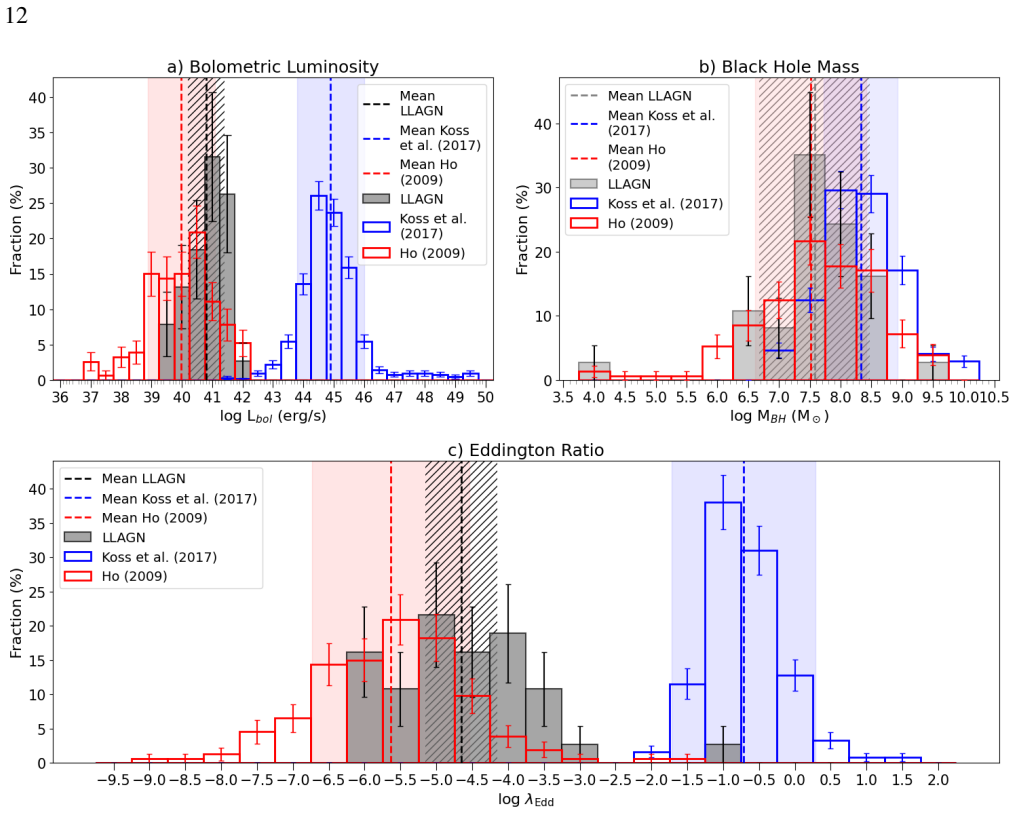
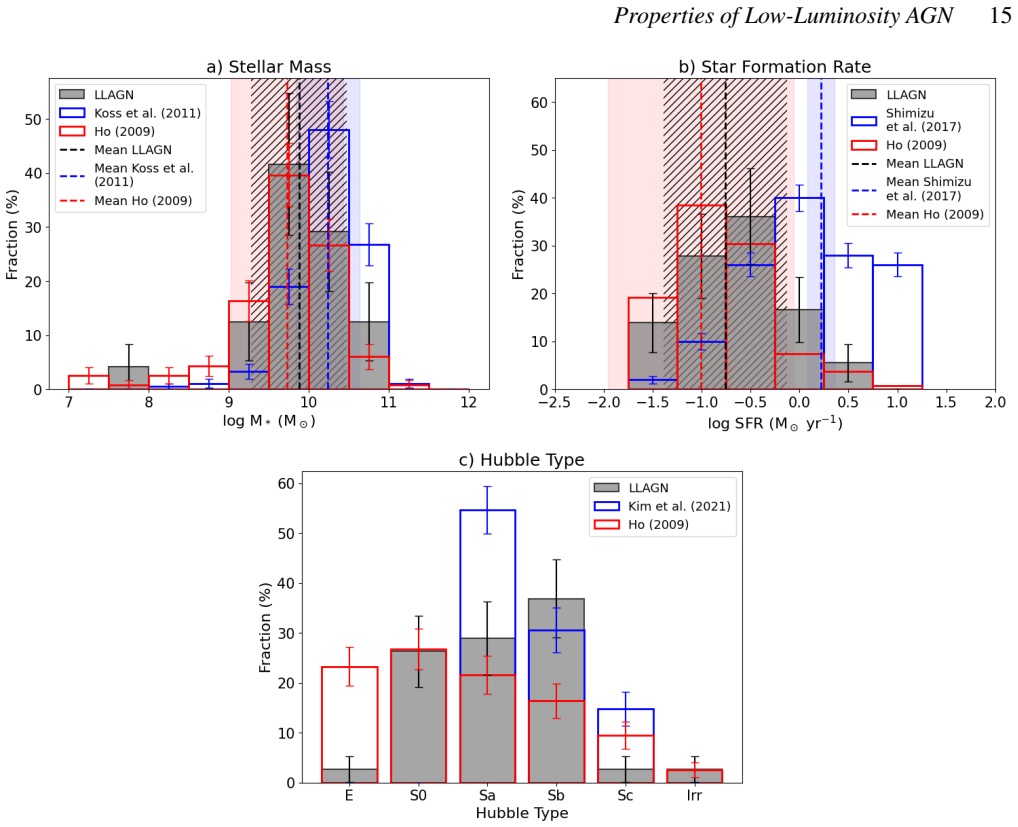
LLAGN selected from sub-arcsecond 15 GHz VLA observations are 4.1 dex fainter in bolometric luminosity than Swift-BAT AGN, host black holes 0.7 dex smaller in mass, and accrete at Eddington ratios 4.2 dex lower. Their host galaxies span disk to bulge morphologies with a subset showing prominent bulges, yet exhibit stellar masses 0.3 dex lower and star formation rates 0.5 dex lower on average.
What carries the argument
Multi-wavelength comparison of black hole mass, Eddington ratio, stellar mass, and star formation rate between a radio-selected LLAGN sample and brighter X-ray selected AGN samples.
Load-bearing premise
The 38 radio sources are powered by nuclear black hole accretion rather than by star formation or other processes in the host galaxy.
What would settle it
Finding that most of the 38 sources show radio properties matching pure star formation models or lack independent nuclear X-ray and optical AGN indicators.
Figures



read the original abstract
Low-luminosity active galactic nuclei (LLAGN; $L_{\rm bol} < 10^{42}$~erg~s$^{-1}$) may comprise a significant fraction of the local AGN population, yet their weak emission makes them difficult to detect. In this paper, we analyse 38 LLAGN identified from a 15~GHz sub-arcsecond Very Large Array survey and assess the effectiveness of X-ray, optical, and infrared wavelengths in identifying LLAGN. We found that optical emission-line diagnostics recovered $84.2^{+15.8}_{-22.9}$\% (32/38) of the sample, X-rays detected $63.2^{+25.7}_{-19.6}$\% (24/38), and infrared methods only identified $13.2^{+14.5}_{-8.0}$\% (5/38), reflecting limited X-ray sensitivity, weak or absent optical lines, and strong host galaxy contamination in the infrared. Compared to \textit{Swift}--BAT AGN, our LLAGN are $\sim$ 4.1~dex fainter in bolometric luminosity (log $L_{\mathrm{bol}} \approx$ 39.3 - 41.9 erg s$^{-1}$), host smaller black holes ($\sim$0.7~dex lower), and accrete at much lower rates (log $\lambda_{\text{Edd}} \approx$ -6.5 to -1.3, i.e., $\sim$ 4.2~dex lower). Host galaxies span a broad range of morphologies, from disk- to bulge-dominated, with a subset exhibiting prominent bulges, potentially representing systems where nuclear activity has faded while the bulge remains dominant. LLAGN also reside in galaxies with lower stellar masses ($\sim$0.3~dex) and suppressed star formation rates ($\sim$0.5~dex) relative to \textit{Swift}--BAT AGN. Overall, LLAGN in our sample systematically host smaller and weakly accreting black holes, residing in galaxies with diverse morphologies, but lower stellar masses and reduced star formation activity, demonstrating the connection between low-level black hole accretion and host galaxy properties in the local Universe.
Editorial analysis
A structured set of objections, weighed in public.
Referee Report
Summary. The manuscript analyzes 38 low-luminosity AGN (LLAGN) selected from a 15 GHz sub-arcsecond VLA survey. It reports multi-wavelength recovery rates using optical emission-line diagnostics (84.2^{+15.8}_{-22.9}% or 32/38), X-rays (63.2^{+25.7}_{-19.6}% or 24/38), and infrared methods (13.2^{+14.5}_{-8.0}% or 5/38). The LLAGN sample is compared to Swift-BAT AGN, showing ~4.1 dex fainter bolometric luminosities (log L_bol ≈ 39.3–41.9 erg s^{-1}), ~0.7 dex smaller black holes, ~4.2 dex lower Eddington ratios (log λ_Edd ≈ -6.5 to -1.3), ~0.3 dex lower stellar masses, and ~0.5 dex suppressed star formation rates, with host galaxies spanning diverse morphologies from disk- to bulge-dominated.
Significance. If the radio-selected sources are confirmed as genuine nuclear accretors, the work supplies concrete empirical evidence for systematic differences between LLAGN and higher-luminosity AGN, including quantified dex offsets in black-hole mass, accretion rate, stellar mass, and SFR. The asymmetric uncertainties on detection fractions and the parameter-free nature of the direct observational comparisons strengthen the assessment of multi-wavelength identification effectiveness and the link between low-level accretion and host-galaxy properties in the local Universe.
major comments (1)
- Abstract: The reported 0.7 dex offset in black-hole mass, 4.2 dex offset in Eddington ratio, and 0.3–0.5 dex offsets in stellar mass and SFR relative to Swift-BAT AGN rest on the assumption that the 15 GHz radio emission in all 38 sources traces nuclear accretion. The abstract notes strong host-galaxy contamination in the infrared and only 13% recovery there, yet provides no quantitative test (radio spectral index, compactness, radio-to-FIR ratio, or variability) to place an upper limit on star-formation contributions to the 15 GHz flux. If even 20–30% of the sample is dominated by host processes, the claimed systematic connection between low-level accretion and host properties becomes unreliable.
Simulated Author's Rebuttal
We thank the referee for their constructive and detailed review of our manuscript. We have addressed the major comment concerning the assumption that the 15 GHz radio emission traces nuclear accretion by clarifying the role of sub-arcsecond resolution in the selection and by adding supporting discussion. We believe these changes strengthen the presentation without altering the core conclusions.
read point-by-point responses
-
Referee: Abstract: The reported 0.7 dex offset in black-hole mass, 4.2 dex offset in Eddington ratio, and 0.3–0.5 dex offsets in stellar mass and SFR relative to Swift-BAT AGN rest on the assumption that the 15 GHz radio emission in all 38 sources traces nuclear accretion. The abstract notes strong host-galaxy contamination in the infrared and only 13% recovery there, yet provides no quantitative test (radio spectral index, compactness, radio-to-FIR ratio, or variability) to place an upper limit on star-formation contributions to the 15 GHz flux. If even 20–30% of the sample is dominated by host processes, the claimed systematic connection between low-level accretion and host properties becomes unreliable.
Authors: We appreciate this important caveat. The sample is drawn from a 15 GHz VLA survey that explicitly uses sub-arcsecond resolution to isolate compact radio cores, which are a hallmark of nuclear AGN activity rather than the extended emission typical of star formation; this selection strategy is described in Section 2 of the manuscript. The low infrared recovery rate (13%) is consistent with the weak mid-IR emission expected from low-accretion-rate LLAGN and does not imply SF dominance in the radio. To directly address the request for quantitative tests, we have added a new paragraph in the revised discussion that applies the radio-to-FIR correlation for star-forming galaxies to place an upper limit on possible SF contributions, finding that SF is unlikely to account for the observed 15 GHz flux in the large majority of sources. We have also updated the abstract to state that the radio sources are selected on the basis of compact emission indicative of nuclear accretion. While we lack multi-frequency or multi-epoch data for spectral-index or variability analysis across the full sample, the combination of high-resolution selection, optical (84%) and X-ray (63%) confirmation rates, and the new radio-to-FIR estimate supports the nuclear interpretation for the bulk of the sample. Even allowing for modest (20–30%) contamination, the reported dex offsets remain robust as they are driven by the confirmed AGN subset. revision: partial
Circularity Check
No circularity in empirical LLAGN sample comparison
full rationale
The paper is an observational analysis of 38 radio-selected LLAGN sources, reporting recovery rates across wavelengths and direct statistical offsets in measured quantities (bolometric luminosity, black-hole mass, Eddington ratio, stellar mass, SFR) relative to an independent Swift-BAT comparison sample. No equations, fitted parameters, or derivations are present that reduce any reported result to its own inputs by construction. All claims rest on independently measured observables from separate surveys; the analysis is therefore self-contained with no self-definitional, fitted-input, or self-citation load-bearing steps.
Axiom & Free-Parameter Ledger
axioms (2)
- domain assumption Radio emission at 15 GHz with sub-arcsecond resolution reliably traces low-level nuclear accretion in these galaxies.
- domain assumption Black hole masses and Eddington ratios derived from available multiwavelength data are accurate enough for statistical comparison across samples.
Reference graph
Works this paper leans on
-
[1]
Compact Binary Merger Rate in Dark-matter Spikes. , keywords =. doi:10.3847/1538-4357/acc1dd , archivePrefix =. 2301.02349 , primaryClass =
-
[2]
Chandra Survey of Nearby Galaxies: An Extended Catalog. , keywords =. doi:10.3847/1538-4357/aba761 , archivePrefix =. 2007.06026 , primaryClass =
-
[3]
Unified models for active galactic nuclei and quasars. , keywords =. doi:10.1146/annurev.aa.31.090193.002353 , adsurl =
-
[4]
The variability and soft X-ray excess properties of narrow-line Seyfert 1 galaxies: The Swift view. , keywords =. doi:10.1051/0004-6361/202142650 , adsurl =
-
[5]
High-Energy Neutrinos from Active Galactic Nuclei. The Encyclopedia of Cosmology. Set 2: Frontiers in Cosmology. Volume 2: Neutrino Physics and Astrophysics , publisher =
-
[6]
X-ray/UV/optical variability of NGC 4593 with Swift: reprocessing of X-rays by an extended reprocessor. , keywords =. doi:10.1093/mnras/sty1983 , archivePrefix =. 1712.04852 , primaryClass =
work page internal anchor Pith review Pith/arXiv arXiv doi:10.1093/mnras/sty1983
-
[7]
Optical spectra and spectral energy distribution modelling
A combined optical and X-ray study of unobscured type 1 active galactic nuclei - I. Optical spectra and spectral energy distribution modelling. , keywords =. doi:10.1111/j.1365-2966.2011.19805.x , archivePrefix =. 1109.2069 , primaryClass =
-
[8]
Polarimetry , year = 2015, editor =
Radiative transfer simulations of multiphase AGN tori: thermal emission and polarisation. Polarimetry , year = 2015, editor =
work page 2015
-
[9]
Galaxy Evolution and Feedback across Different Environments , year = 2021, editor =
Modelling the silicate emission features in type 1 AGNs: Dusty torus and disk+outflow models. Galaxy Evolution and Feedback across Different Environments , year = 2021, editor =
work page 2021
-
[10]
Coronal properties of Swift/BAT-selected Seyfert 1 AGN observed with NuSTAR
Coronal Properties of Swift/BAT-selected Seyfert 1 AGNs Observed with NuSTAR. , keywords =. doi:10.3847/1538-4357/aadd0d , archivePrefix =. 1809.01757 , primaryClass =
work page internal anchor Pith review Pith/arXiv arXiv doi:10.3847/1538-4357/aadd0d
-
[11]
Perseus in Sicily: From Black Hole to Cluster Outskirts , year = 2020, editor =
X-ray probing of NGC 1275 nuclear region with Hitomi, Swift, and Suzaku. Perseus in Sicily: From Black Hole to Cluster Outskirts , year = 2020, editor =
work page 2020
-
[12]
Gamma rays from cloud penetration at the base of AGN jets
Gamma rays from cloud penetration at the base of AGN jets. , keywords =. doi:10.1051/0004-6361/201014660 , archivePrefix =. 1007.2199 , primaryClass =
work page internal anchor Pith review Pith/arXiv arXiv doi:10.1051/0004-6361/201014660
-
[13]
Radio Properties of the BAT AGNs: the FIR-radio Relation, the Fundamental Plane, and the Main Sequence of Star Formation. , keywords =. doi:10.3847/0004-637X/832/2/163 , archivePrefix =. 1610.01167 , primaryClass =
work page internal anchor Pith review Pith/arXiv arXiv doi:10.3847/0004-637x/832/2/163
-
[14]
15-GHz radio emission from nearby low-luminosity active galactic nuclei
15-GHz radio emission from nearby low-luminosity active galactic nuclei. , keywords =. doi:10.1051/0004-6361/201833233 , archivePrefix =. 1805.06696 , primaryClass =
work page internal anchor Pith review Pith/arXiv arXiv doi:10.1051/0004-6361/201833233
-
[15]
Low-luminosity AGN and Normal Galaxies
Low-luminosity AGN and normal galaxies. X-ray Astronomy: Stellar Endpoints, AGN, and the Diffuse X-ray Background , booktitle =. doi:10.1063/1.1434645 , archivePrefix =. astro-ph/0008459 , primaryClass =
work page internal anchor Pith review Pith/arXiv arXiv doi:10.1063/1.1434645
-
[16]
Towards a complete census of the Compton-thick AGN population in the local Universe
-
[17]
Encyclopedia of Physical Science and Technology (Third Edition) , publisher =
Gamma-Ray Astronomy , editor =. Encyclopedia of Physical Science and Technology (Third Edition) , publisher =. 2003 , isbn =. doi:https://doi.org/10.1016/B0-12-227410-5/00274-X , url =
-
[18]
A Large Population of Obscured AGN in Disguise as Low-luminosity AGN in Chandra Deep Field South. , keywords =. doi:10.3847/1538-4357/ab919c , archivePrefix =. 2002.00955 , primaryClass =
-
[19]
Broadband Modeling of Low-luminosity Active Galactic Nuclei Detected in Gamma Rays. , keywords =. doi:10.3847/1538-4357/ac1588 , archivePrefix =. 2107.08256 , primaryClass =
-
[20]
X-Ray Properties of LINERs and Low-Luminosity Seyfert Galaxies Observed with ASCA. I. Observations and Results. , keywords =. doi:10.1086/324373 , archivePrefix =. astro-ph/0203005 , primaryClass =
work page internal anchor Pith review Pith/arXiv arXiv doi:10.1086/324373
-
[21]
The AGN Obscuring Torus -- End of the "Doughnut" Paradigm?
The AGN-obscuring Torus: The End of the ``Doughnut'' Paradigm?. , keywords =. doi:10.1086/508158 , archivePrefix =. astro-ph/0605686 , primaryClass =
work page internal anchor Pith review Pith/arXiv arXiv doi:10.1086/508158
-
[22]
Hints on the gradual re-sizing of the torus in AGN by decomposing IRS/Spitzer spectra
Hints on the Gradual Resizing of the Torus in AGNs through Decomposition of Spitzer/IRS Spectra. , keywords =. doi:10.3847/1538-4357/aa6f16 , archivePrefix =. 1704.06739 , primaryClass =
work page internal anchor Pith review Pith/arXiv arXiv doi:10.3847/1538-4357/aa6f16
-
[23]
The 70 Month Swift-BAT All-Sky Hard X-Ray Survey
The 70 Month Swift-BAT All-sky Hard X-Ray Survey. , keywords =. doi:10.1088/0067-0049/207/2/19 , archivePrefix =. 1212.3336 , primaryClass =
work page internal anchor Pith review Pith/arXiv arXiv doi:10.1088/0067-0049/207/2/19
-
[24]
Mid-infrared Selection of Active Galactic Nuclei with the Wide-field Infrared Survey Explorer. II. Properties of WISE-selected Active Galactic Nuclei in the NDWFS Bo \"o tes Field. , keywords =. doi:10.1088/0004-637X/772/1/26 , archivePrefix =. 1209.6055 , primaryClass =
work page internal anchor Pith review Pith/arXiv arXiv doi:10.1088/0004-637x/772/1/26
-
[25]
Towards a complete census of AGN in nearby Galaxies: a large population of optically unidentified AGN. , keywords =. doi:10.1111/j.1365-2966.2009.15194.x , archivePrefix =. 0906.0772 , primaryClass =
-
[26]
The Second INTEGRAL AGN Catalogue
The second INTEGRAL AGN catalogue. , keywords =. doi:10.1051/0004-6361/200912111 , archivePrefix =. 0907.0654 , primaryClass =
work page internal anchor Pith review Pith/arXiv arXiv doi:10.1051/0004-6361/200912111
-
[27]
Why X-ray--Selected AGN Appear Optically Dull
Why X-Ray-selected Active Galactic Nuclei Appear Optically Dull. , keywords =. doi:10.1086/504067 , archivePrefix =. astro-ph/0603313 , primaryClass =
work page internal anchor Pith review Pith/arXiv arXiv doi:10.1086/504067
-
[28]
Polar dust obscuration in broad-line active galaxies from the XMM-XXL field. , keywords =. doi:10.1051/0004-6361/202141797 , archivePrefix =. 2108.07684 , primaryClass =
-
[29]
On the Optical-to-Silicate Extinction Ratio as a Probe of the Dust Size in Active Galactic Nuclei
On the Optical-to-silicate Extinction Ratio as a Probe of the Dust Size in Active Galactic Nuclei. , keywords =. doi:10.3847/1538-4357/aa6ba4 , archivePrefix =. 1704.01103 , primaryClass =
work page internal anchor Pith review Pith/arXiv arXiv doi:10.3847/1538-4357/aa6ba4
-
[30]
Optical spectra and spectral energy distribution modelling
Defining the intrinsic AGN infrared spectral energy distribution and measuring its contribution to the infrared output of composite galaxies. , keywords =. doi:10.1111/j.1365-2966.2011.18448.x , archivePrefix =. 1102.1425 , primaryClass =
-
[31]
Discovery of a Population of Bulgeless Galaxies with Extremely Red Mid-IR Colors: Obscured AGN Activity in the Low-mass Regime?. , keywords =. doi:10.1088/0004-637X/784/2/113 , archivePrefix =. 1401.5483 , primaryClass =
work page internal anchor Pith review Pith/arXiv arXiv doi:10.1088/0004-637x/784/2/113
-
[32]
AGN in dwarf galaxies: frequency, triggering processes and the plausibility of AGN feedback. , keywords =. doi:10.1093/mnrasl/slz102 , archivePrefix =. 1906.10697 , primaryClass =
-
[33]
Disentangling the independently controllable factors of variation by interacting with the world
Interstellar Dust Grains. , keywords =. doi:10.1146/annurev.astro.41.011802.094840 , archivePrefix =. astro-ph/0304489 , primaryClass =
work page internal anchor Pith review Pith/arXiv arXiv doi:10.1146/annurev.astro.41.011802.094840
-
[34]
Bulletin de la Societe Royale des Sciences de Liege , keywords =
Understanding the dust properties in nearby galaxies. Bulletin de la Societe Royale des Sciences de Liege , keywords =
-
[35]
The Chandra Deep Field-South Survey: 4 Ms Source Catalogs
The Chandra Deep Field-South Survey: 4 Ms Source Catalogs. , keywords =. doi:10.1088/0067-0049/195/1/10 , archivePrefix =. 1105.5643 , primaryClass =
work page internal anchor Pith review Pith/arXiv arXiv doi:10.1088/0067-0049/195/1/10
-
[36]
Communication over an Arbitrarily Varying Channel under a State-Myopic Encoder
Deep Extragalactic X-Ray Surveys. , keywords =. doi:10.1146/annurev.astro.43.051804.102213 , archivePrefix =. astro-ph/0501058 , primaryClass =
work page internal anchor Pith review Pith/arXiv arXiv doi:10.1146/annurev.astro.43.051804.102213
-
[37]
BAT AGN Spectroscopic Survey. XI. The Covering Factor of Dust and Gas in Swift/BAT Active Galactic Nuclei. , keywords =. doi:10.3847/1538-4357/aaef8f , archivePrefix =. 1811.02568 , primaryClass =
work page internal anchor Pith review Pith/arXiv arXiv doi:10.3847/1538-4357/aaef8f
-
[38]
Heavy X-ray Absorption in Soft X-ray Weak Active Galactic Nuclei
Heavy X-Ray Absorption in Soft X-Ray-weak Active Galactic Nuclei. , keywords =. doi:10.1086/318294 , archivePrefix =. astro-ph/0007384 , primaryClass =
work page internal anchor Pith review Pith/arXiv arXiv doi:10.1086/318294
-
[39]
The XXL Survey. XL. Obscuration properties of red AGNs in XXL-N. , keywords =. doi:10.1051/0004-6361/201937161 , archivePrefix =. 2003.04346 , primaryClass =
-
[40]
X-ray radiative transfer in full 3D with SKIRT. , keywords =. doi:10.1051/0004-6361/202245783 , archivePrefix =. 2304.10563 , primaryClass =
-
[41]
Spectral Energy Distributions and Multiwavelength Selection of Type 1 Quasars
Spectral Energy Distributions and Multiwavelength Selection of Type 1 Quasars. , keywords =. doi:10.1086/506525 , archivePrefix =. astro-ph/0601558 , primaryClass =
work page internal anchor Pith review Pith/arXiv arXiv doi:10.1086/506525
-
[42]
The VLA-COSMOS 3~GHz Large Project: AGN and host-galaxy properties out to z$\lesssim$6
The VLA-COSMOS 3 GHz Large Project: AGN and host-galaxy properties out to z 6. , keywords =. doi:10.1051/0004-6361/201629367 , archivePrefix =. 1703.09720 , primaryClass =
work page internal anchor Pith review Pith/arXiv arXiv doi:10.1051/0004-6361/201629367
-
[43]
PRIMUS + DEEP2: Clustering of X-ray, Radio and IR-AGN at z~0.7
PRIMUS + DEEP2: Clustering of X-Ray, Radio, and IR-AGNs at z -0.5ex 0.7. , keywords =. doi:10.3847/0004-637X/821/1/55 , archivePrefix =. 1504.06284 , primaryClass =
work page internal anchor Pith review Pith/arXiv arXiv doi:10.3847/0004-637x/821/1/55
-
[44]
Multi-wavelength Properties of Type 1 and Type 2 AGN Host Galaxies in the Chandra-COSMOS Legacy Survey. , keywords =. doi:10.3847/1538-4357/ab01fb , archivePrefix =. 1902.03244 , primaryClass =
work page internal anchor Pith review Pith/arXiv arXiv doi:10.3847/1538-4357/ab01fb 1902
-
[45]
A Joint Model of the X-Ray and Infrared Extragalactic Backgrounds. I. Model Construction and First Results. , keywords =. doi:10.1088/0004-637X/764/1/28 , archivePrefix =. 1212.3642 , primaryClass =
work page internal anchor Pith review Pith/arXiv arXiv doi:10.1088/0004-637x/764/1/28
-
[46]
NuSTAR Observations of the Compton-thick Active Galactic Nucleus and Ultraluminous X-Ray Source Candidate in NGC 5643. , keywords =. doi:10.1088/0004-637X/815/1/36 , archivePrefix =. 1509.03322 , primaryClass =
work page internal anchor Pith review Pith/arXiv arXiv doi:10.1088/0004-637x/815/1/36
-
[47]
The synthesis of the cosmic X-ray background in the Chandra and XMM-Newton era
The synthesis of the cosmic X-ray background in the Chandra and XMM-Newton era. , keywords =. doi:10.1051/0004-6361:20066334 , archivePrefix =. astro-ph/0610939 , primaryClass =
work page internal anchor Pith review Pith/arXiv arXiv doi:10.1051/0004-6361:20066334
-
[48]
Three years Swift-BAT Survey of AGN: reconciling theory and observations?
Three-year Swift-BAT Survey of Active Galactic Nuclei: Reconciling Theory and Observations?. , keywords =. doi:10.1088/0004-637X/728/1/58 , archivePrefix =. 1012.0302 , primaryClass =
work page internal anchor Pith review Pith/arXiv arXiv doi:10.1088/0004-637x/728/1/58
-
[49]
Chasing highly obscured QSOs in the COSMOS field
Chasing Highly Obscured QSOs in the COSMOS Field. , keywords =. doi:10.1088/0004-637X/693/1/447 , archivePrefix =. 0810.0720 , primaryClass =
work page internal anchor Pith review Pith/arXiv arXiv doi:10.1088/0004-637x/693/1/447
-
[50]
Luminosity-dependent evolution of soft X-ray selected AGN: New Chandra and XMM-Newton surveys
Luminosity-dependent evolution of soft X-ray selected AGN. New Chandra and XMM-Newton surveys. , keywords =. doi:10.1051/0004-6361:20042134 , archivePrefix =. astro-ph/0506118 , primaryClass =
work page internal anchor Pith review Pith/arXiv arXiv doi:10.1051/0004-6361:20042134
-
[51]
The MOSDEF survey: AGN multi-wavelength identification, selection biases and host galaxy properties
The MOSDEF Survey: AGN Multi-wavelength Identification, Selection Biases, and Host Galaxy Properties. , keywords =. doi:10.3847/1538-4357/835/1/27 , archivePrefix =. 1608.05890 , primaryClass =
work page internal anchor Pith review Pith/arXiv arXiv doi:10.3847/1538-4357/835/1/27
-
[52]
Spectroscopic Confirmation of a Large AGN Population in Clusters of Galaxies
Spectroscopic Confirmation of a Large Population of Active Galactic Nuclei in Clusters of Galaxies. , keywords =. doi:10.1086/503521 , archivePrefix =. astro-ph/0602496 , primaryClass =
work page internal anchor Pith review Pith/arXiv arXiv doi:10.1086/503521
-
[53]
The Phoenix Deep Survey: spectroscopic catalog
The Phoenix Deep Survey: Spectroscopic Catalog. , keywords =. doi:10.1086/428923 , archivePrefix =. astro-ph/0411578 , primaryClass =
work page internal anchor Pith review Pith/arXiv arXiv doi:10.1086/428923
-
[54]
Radio continuum properties of luminous infrared galaxies. Identifying the presence of an AGN in the radio. , keywords =. doi:10.1051/0004-6361/201424125 , archivePrefix =. 1408.4177 , primaryClass =
work page internal anchor Pith review Pith/arXiv arXiv doi:10.1051/0004-6361/201424125
-
[55]
Advances in Space Research , keywords =
Interstellar scintillation, ISS, and intrinsic variability of radio AGN. Advances in Space Research , keywords =. doi:10.1016/j.asr.2019.05.003 , adsurl =
-
[56]
VLBA Observations of Sub-Parsec Structure in Mrk 231: Interaction Between a Relativistic Jet and a BAL Wind. , keywords =. doi:10.1088/0004-637X/706/1/851 , archivePrefix =. 0909.5096 , primaryClass =
work page internal anchor Pith review Pith/arXiv arXiv doi:10.1088/0004-637x/706/1/851
-
[57]
Chandra News , year = 2007, month = mar, volume =
CIAO: Chandra's Data Analysis System. Chandra News , year = 2007, month = mar, volume =
work page 2007
-
[58]
Astronomical Data Analysis Software and Systems XII
New Features of SAOImage DS9. Astronomical Data Analysis Software and Systems XII. Astron. Soc. Pac., San Francisco, , year = 2003, editor =
work page 2003
-
[59]
Using the Bright Ultrahard XMM-Newton survey to define an IR selection of luminous AGN based on WISE colours. , keywords =. doi:10.1111/j.1365-2966.2012.21843.x , archivePrefix =. 1208.2530 , primaryClass =
-
[60]
The location of an active nucleus and the soft X-ray shadowing by a tidal tail in the ULIRG Mrk 273
The location of an active nucleus and a shadow of a tidal tail in the ULIRG Mrk 273. , keywords =. doi:10.1051/0004-6361/201015872 , archivePrefix =. 1101.3659 , primaryClass =
work page internal anchor Pith review Pith/arXiv arXiv doi:10.1051/0004-6361/201015872
-
[61]
The detection of [Ne V] emission in five blue compact dwarf galaxies. , keywords =. doi:10.1111/j.1365-2966.2012.22051.x , archivePrefix =. 1209.5265 , primaryClass =
-
[62]
The Infrared Database of Extragalactic Observables from Spitzer. II. The Database and Diagnostic Power of Crystalline Silicate Features in Galaxy Spectra. , keywords =. doi:10.3847/1538-4365/ac4989 , adsurl =
-
[63]
Classification parameters for the emission-line spectra of extragalactic objects. , keywords =. doi:10.1086/130766 , adsurl =
-
[64]
A Search for ``Dwarf'' Seyfert Nuclei. III. Spectroscopic Parameters and Properties of the Host Galaxies. , keywords =. doi:10.1086/313041 , archivePrefix =. astro-ph/9704107 , primaryClass =
work page internal anchor Pith review Pith/arXiv arXiv doi:10.1086/313041
-
[65]
Spectral Classification of Emission-Line Galaxies. , keywords =. doi:10.1086/191166 , adsurl =
-
[66]
The host galaxies and classification of active galactic nuclei. , keywords =. doi:10.1111/j.1365-2966.2006.10859.x , archivePrefix =. astro-ph/0605681 , primaryClass =
-
[67]
Theoretical Modeling of Starburst Galaxies
Theoretical Modeling of Starburst Galaxies. , keywords =. doi:10.1086/321545 , archivePrefix =. astro-ph/0106324 , primaryClass =
work page internal anchor Pith review Pith/arXiv arXiv doi:10.1086/321545
-
[68]
The host galaxies of active galactic nuclei. , keywords =. doi:10.1111/j.1365-2966.2003.07154.x , archivePrefix =. astro-ph/0304239 , primaryClass =
-
[69]
The Relationship of Hard X-ray and Optical Line Emission in Low Redshift Active Galactic Nuclei
The Relationship of Hard X-Ray and Optical Line Emission in Low-Redshift Active Galactic Nuclei. , keywords =. doi:10.1086/491665 , archivePrefix =. astro-ph/0507674 , primaryClass =
work page internal anchor Pith review Pith/arXiv arXiv doi:10.1086/491665
-
[70]
XMM-NEWTON Observations of Red AGN
XMM-Newton Observations of Red AGNs. , keywords =. doi:10.1086/444555 , archivePrefix =. astro-ph/0510062 , primaryClass =
work page internal anchor Pith review Pith/arXiv arXiv doi:10.1086/444555
- [71]
-
[72]
An important paper , journal=
-
[73]
Another Unreal Paper , journal=
-
[74]
A Last Unreal Paper , journal=
-
[75]
Satyapal, S. and Vega, D. and Dudik, R. P. and Abel, N. P. and Heckman, T. , title =. The Astrophysical Journal , volume =
-
[76]
Mid-infrared properties of nearby low-luminosity AGN at high angular resolution
Mid-infrared properties of nearby low-luminosity AGN at high angular resolution. , keywords =. doi:10.1051/0004-6361/201116693 , archivePrefix =. 1109.4873 , primaryClass =
work page internal anchor Pith review Pith/arXiv arXiv doi:10.1051/0004-6361/201116693
-
[77]
A census of X-ray nuclear activity in nearby galaxies
A Census of X-ray Nuclear Activity in Nearby Galaxies. , keywords =. doi:10.1088/0004-637X/699/1/281 , archivePrefix =. 0904.1091 , primaryClass =
work page internal anchor Pith review Pith/arXiv arXiv doi:10.1088/0004-637x/699/1/281
-
[78]
The incidence of X-ray selected AGN in nearby galaxies. , keywords =. doi:10.1093/mnras/stab3573 , archivePrefix =. 2112.03142 , primaryClass =
-
[79]
Multiwavelength and Environmental Properties of Variability Selected Low-luminosity Active Galactic Nuclei. , keywords =. doi:10.3847/1538-4357/addf42 , archivePrefix =. 2501.17844 , primaryClass =
-
[80]
BAT AGN Spectroscopic Survey. I. Spectral Measurements, Derived Quantities, and AGN Demographics. , keywords =. doi:10.3847/1538-4357/aa8ec9 , archivePrefix =. 1707.08123 , primaryClass =
work page internal anchor Pith review Pith/arXiv arXiv doi:10.3847/1538-4357/aa8ec9
discussion (0)
Sign in with ORCID, Apple, or X to comment. Anyone can read and Pith papers without signing in.