Pressure Effects on CeMnSi: Evolution of Ce 4f and Mn 3d Electronic States and Negative Thermal Expansion
Pith reviewed 2026-05-20 00:41 UTC · model grok-4.3
The pith
Pressure suppresses Mn antiferromagnetism in CeMnSi at 1.3 GPa and induces a new anomaly that may alter heavy-fermion stability.
A machine-rendered reading of the paper's core claim, the machinery that carries it, and where it could break.
Core claim
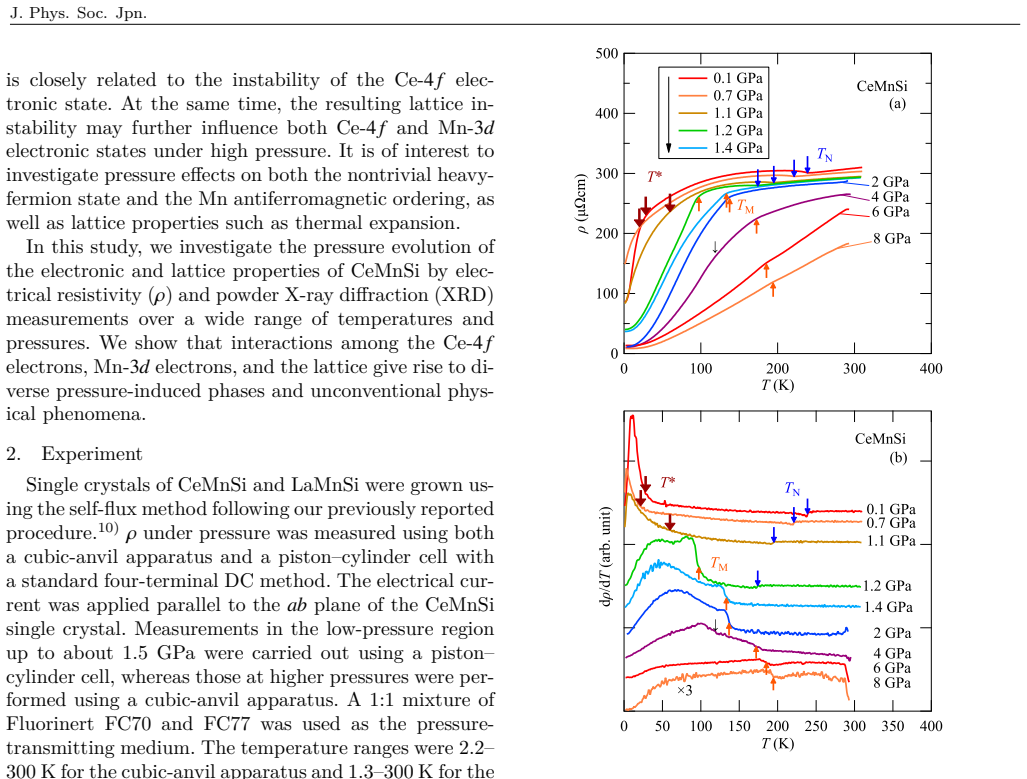
With increasing pressure, the antiferromagnetic order of Mn (T_N ~ 240 K at ambient pressure) is rapidly suppressed and disappears at P_c ~ 1.3 GPa. Instead, a pressure-induced anomaly appears at T_M ~ 97 K and shifts to higher temperatures with increasing pressure. The switching of the Mn magnetic state may reflect a modification of the magnetic symmetry of the system, which could influence the stability of the heavy-fermion state.
What carries the argument
Pressure-driven replacement of the Mn antiferromagnetic order (T_N) by a new lower-temperature anomaly (T_M) that shifts upward, tracked through resistivity and linked to possible magnetic-symmetry change.
If this is right
- The heavy-fermion state becomes unstable or modified once the original Mn antiferromagnetic symmetry is lost.
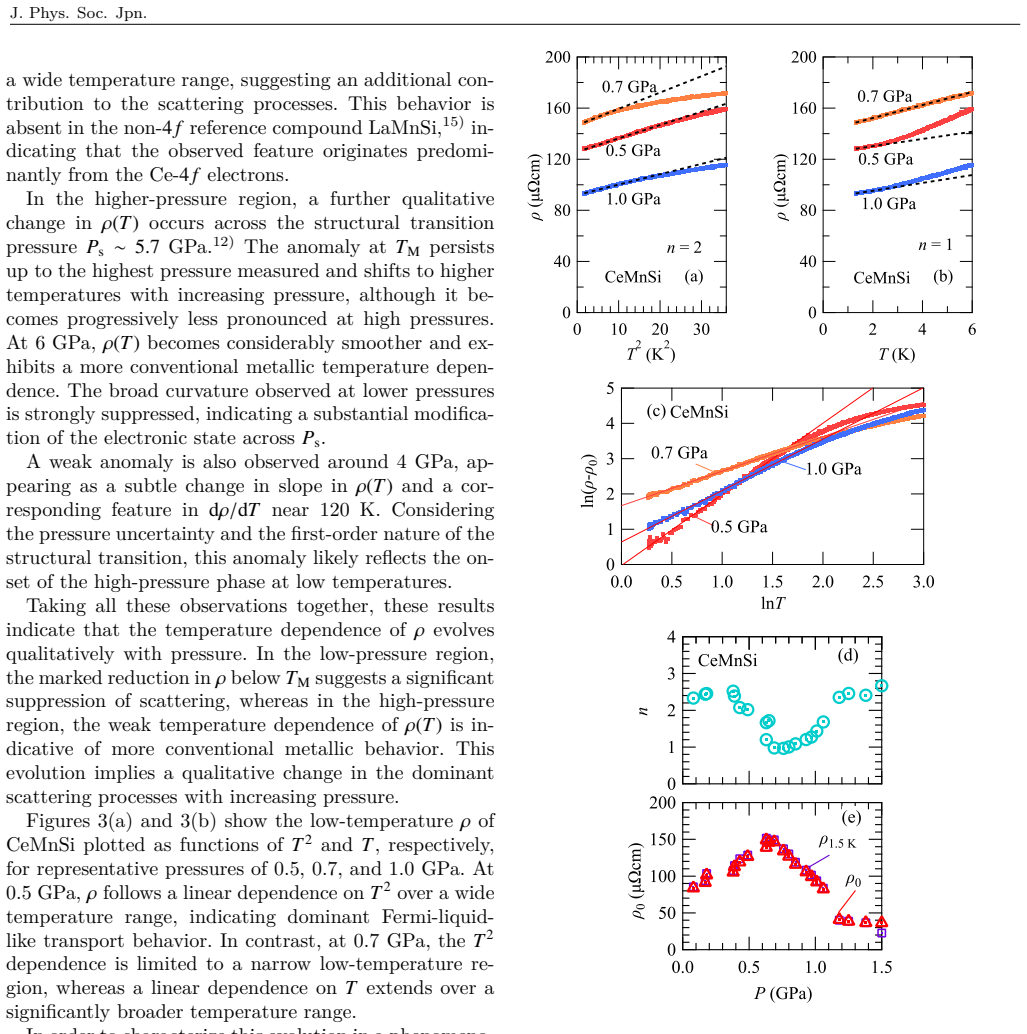
- Non-Fermi-liquid behavior with nearly T-linear resistivity appears in the low-pressure regime near 0.7 GPa.
- Resistivity drops sharply below T_M and the system crosses over to more metallic conduction above the structural transition at 5.7 GPa.
- Negative thermal expansion below 40 K is tied to the heavy-fermion ground state and vanishes when that state is absent, as seen by comparison with LaMnSi.
Where Pith is reading between the lines
- Confirming the symmetry change with neutron scattering under pressure would allow direct mapping of how local-moment magnetism competes with itinerant heavy-fermion formation.
- The pressure window between 1.3 GPa and 5.7 GPa could be used to search for quantum-critical points where the new anomaly meets the Fermi-liquid regime.
- If the negative thermal expansion is driven by the heavy-fermion state, modest pressure might be used to tune its temperature range in related Ce compounds.
Load-bearing premise
The resistivity anomaly at T_M and the loss of T_N are taken to signal a change in magnetic symmetry that directly affects heavy-fermion stability, even without neutron or specific-heat data under pressure to confirm the symmetry change.
What would settle it
A neutron-diffraction measurement under pressure showing unchanged magnetic symmetry across 1.3 GPa would disprove the claimed link between the magnetic-state switch and heavy-fermion stability.
Figures



read the original abstract
We investigated pressure effects on the nontrivial heavy-fermion antiferromagnet CeMnSi by means of electrical resistivity and powder X-ray diffraction. With increasing pressure, the antiferromagnetic order of Mn (T_N ~ 240 K at ambient pressure) is rapidly suppressed and disappears at P_c ~ 1.3 GPa. Instead, a pressure-induced anomaly appears at T_M ~ 97 K and shifts to higher temperatures with increasing pressure. The switching of the Mn magnetic state may reflect a modification of the magnetic symmetry of the system, which could influence the stability of the heavy-fermion state. In the low-pressure region, non-Fermi-liquid-like behavior characterized by nearly T-linear resistivity is observed around 0.7 GPa. In addition, the resistivity shows a marked reduction below T_M and a qualitative change toward more metallic behavior above the structural transition pressure P_s ~ 5.7 GPa. At ambient pressure, CeMnSi exhibits negative thermal expansion below ~40 K, which is absent in LaMnSi, supporting the formation of a heavy-fermion ground state.
Editorial analysis
A structured set of objections, weighed in public.
Referee Report
Summary. The manuscript presents electrical resistivity and powder X-ray diffraction data on CeMnSi under pressure. It reports rapid suppression of Mn antiferromagnetic order (T_N ≈ 240 K at ambient pressure) that vanishes at P_c ≈ 1.3 GPa, replaced by a new resistivity anomaly at T_M ≈ 97 K that increases with pressure. This is interpreted as a possible change in Mn magnetic symmetry affecting heavy-fermion stability. Additional claims include non-Fermi-liquid-like T-linear resistivity near 0.7 GPa, more metallic behavior above the structural transition at P_s ≈ 5.7 GPa, and negative thermal expansion below ~40 K at ambient pressure linked to the Ce 4f heavy-fermion ground state.
Significance. If the reported trends are robust, the work adds to the experimental mapping of pressure-tuned magnetism and electronic states in CeMnSi, highlighting possible interplay between Mn 3d order and Ce 4f heavy-fermion behavior. Such data can inform studies of quantum criticality in related 1-1-1 compounds, though the interpretive link to magnetic symmetry remains qualitative.
major comments (2)
- [Abstract] Abstract: The claim that the resistivity anomaly at T_M reflects a modification of Mn magnetic symmetry influencing heavy-fermion stability is presented as a central interpretation but is supported only by the disappearance of the T_N feature and the drop below T_M in resistivity; no neutron diffraction, magnetization, or specific-heat data under pressure are described to confirm the magnetic character or symmetry change at T_M.
- [Results] Results section (pressure-dependent resistivity): The critical pressure P_c ~1.3 GPa for disappearance of T_N and the pressure evolution of T_M are stated without reported error bars, details on pressure calibration method, or assessment of pressure inhomogeneity; these omissions affect the precision of the phase boundary claims that underpin the evolution narrative.
minor comments (2)
- [Abstract] Abstract and methods: The description of 'nearly T-linear resistivity' for non-Fermi-liquid behavior would benefit from specifying the exact temperature range and any quantitative fitting (e.g., exponent or coefficient).
- [Figures] Figures: Raw resistivity curves, error bars, and explicit description of how lattice parameters were extracted from XRD under pressure would improve reproducibility and clarity of the reported trends.
Simulated Author's Rebuttal
We thank the referee for the careful reading of our manuscript and the constructive comments. We have revised the text to address the concerns about interpretive claims and experimental precision.
read point-by-point responses
-
Referee: [Abstract] Abstract: The claim that the resistivity anomaly at T_M reflects a modification of Mn magnetic symmetry influencing heavy-fermion stability is presented as a central interpretation but is supported only by the disappearance of the T_N feature and the drop below T_M in resistivity; no neutron diffraction, magnetization, or specific-heat data under pressure are described to confirm the magnetic character or symmetry change at T_M.
Authors: We agree that the link between the T_M anomaly and a possible change in Mn magnetic symmetry is an interpretation drawn from the resistivity data alone. The manuscript does not include neutron diffraction, magnetization, or specific-heat measurements under pressure. In the revised version we have rephrased the abstract to present this scenario as a hypothesis suggested by the transport results rather than a firm conclusion, and we have added a sentence in the discussion noting that future neutron work would be required to confirm any symmetry change. revision: yes
-
Referee: [Results] Results section (pressure-dependent resistivity): The critical pressure P_c ~1.3 GPa for disappearance of T_N and the pressure evolution of T_M are stated without reported error bars, details on pressure calibration method, or assessment of pressure inhomogeneity; these omissions affect the precision of the phase boundary claims that underpin the evolution narrative.
Authors: We accept that the original text lacked sufficient methodological detail. The revised manuscript now specifies the pressure calibration technique (ruby fluorescence with a small ruby chip inside the cell), provides estimated uncertainties on P_c and the T_M values derived from the width of the resistivity features, and includes a brief assessment of pressure inhomogeneity based on the sharpness of the observed transitions. revision: yes
Circularity Check
No circularity: purely experimental observations with no derivations or self-referential models.
full rationale
This is an experimental condensed-matter paper reporting resistivity and powder XRD data under pressure. No equations, fitted parameters, predictions, or derivation chains are present. Observed features (suppression of T_N, appearance of T_M anomaly, NTE below 40 K) are directly measured quantities. Interpretive statements about magnetic symmetry changes or influence on heavy-fermion state are presented as hypotheses without reduction to prior inputs or self-citations. The work is self-contained against external benchmarks and contains no load-bearing self-referential steps.
Axiom & Free-Parameter Ledger
axioms (1)
- domain assumption Resistivity anomalies can be assigned to magnetic ordering temperatures without additional probes such as neutron scattering.
Lean theorems connected to this paper
-
IndisputableMonolith/Foundation/Cost/FunctionalEquation.leanwashburn_uniqueness_aczel unclear?
unclearRelation between the paper passage and the cited Recognition theorem.
With increasing pressure, the antiferromagnetic order of Mn (TN ~ 240 K at ambient pressure) is rapidly suppressed and disappears at Pc ~ 1.3 GPa. Instead, a pressure-induced anomaly appears at TM ~ 97 K...
-
IndisputableMonolith/Foundation/AlphaCoordinateFixation.leanJ_uniquely_calibrated_via_higher_derivative unclear?
unclearRelation between the paper passage and the cited Recognition theorem.
At ambient pressure, CeMnSi exhibits negative thermal expansion below ~40 K, which is absent in LaMnSi, supporting the formation of a heavy-fermion ground state.
What do these tags mean?
- matches
- The paper's claim is directly supported by a theorem in the formal canon.
- supports
- The theorem supports part of the paper's argument, but the paper may add assumptions or extra steps.
- extends
- The paper goes beyond the formal theorem; the theorem is a base layer rather than the whole result.
- uses
- The paper appears to rely on the theorem as machinery.
- contradicts
- The paper's claim conflicts with a theorem or certificate in the canon.
- unclear
- Pith found a possible connection, but the passage is too broad, indirect, or ambiguous to say the theorem truly supports the claim.
Reference graph
Works this paper leans on
-
[1]
Introduction Ce-based intermetallic compounds exhibit a wide va- riety of correlated-electron phenomena arising from the dual nature of the Ce- 4 f electrons, which can behave either as localized magnetic moments or as itinerant heavy quasiparticles depending on external control pa- rameters.1, 2) External pressure is one of the most effec- tive tuning pa...
work page internal anchor Pith review Pith/arXiv arXiv 2026
-
[2]
The electrical cur- rent was applied parallel to the ab plane of the CeMnSi single crystal
Experiment Single crystals of CeMnSi and LaMnSi were grown us- ing the self-flux method following our previously reported procedure.10) ρ under pressure was measured using both a cubic-anvil apparatus and a piston–cylinder cell with a standard four-terminal DC method. The electrical cur- rent was applied parallel to the ab plane of the CeMnSi single cryst...
-
[3]
Results 3.1 Electrical Resistivity under Pressure Figure 2(a) shows the temperature dependence of ρ of CeMnSi under various pressures. The characteristic tem- peratures discussed below are determined from anoma- lies in the temperature derivative (dρ/dT ), as shown in Fig. 2(b). TN and TM correspond to points of the steepest slope, while T ∗ is defined as...
-
[4]
Discussion The results demonstrate that pressure induces a reor- ganization of magnetic order, electronic correlations, and the lattice in CeMnSi, leading to a rich temperature– pressure phase diagram. This behavior reflects the dif- ference in energy scales between the high-temperature Mn-derived magnetism and the low-temperature Ce- 4 f 6 J. Phys. Soc. ...
-
[5]
Summary We investigated ρ and powder XRD in CeMnSi under high pressure in order to clarify the pressure evolution of the heavy-fermion state and its coupling to magnetism and the lattice. With increasing pressure, the antiferro- magnetic order of Mn- 3d electrons is rapidly suppressed and disappears at Pc ∼ 1.3 GPa. Around 0.7 GPa, non- Fermi-liquid behav...
-
[6]
G. R. Stewart, Rev. Mod. Phys. 56, 755 (1984)
work page 1984
- [7]
-
[8]
H. v. Löhneysen, A. Rosch, M. Vojta, and P. Wölfle, Rev. Mod. Phys. 79, 1015 (2007)
work page 2007
-
[9]
S. Drotziger, C. Pfleiderer, M. Uhlarz, H. v. Löhneysen, D. Souptel, W. Löser, and G. Behr, Phys. Rev. B 73, 214413 (2006)
work page 2006
-
[10]
Q. Luo, G. Garbarino, B. Sun, D. Fan, Y. Zhang, Z. Wang, Y. Sun, J. Jiao, X. Li, P. Li, N. Mattern, J. Eckert, and J. Shen, Nat. Commun. 6, 5703 (2015)
work page 2015
-
[11]
O. I. Bodak, E. I. Gladyshevskii, and P. I. Kripyakevich, Zh. Strukt. Khim. 11, 283 (1970)
work page 1970
- [12]
- [13]
-
[14]
T. Matsumura, S. Kishida, M. Tsukagoshi, Y. Kawamura, H. Nakao, and H. Tanida, J. Phys. Soc. Jpn. 91, 064704 (2022)
work page 2022
- [15]
-
[16]
Y. Kawamura, H. Tanida, R. Ueda, J. Hayashi, K. Takeda, and C. Sekine, J. Phys. Soc. Jpn. 89, 054702 (2020)
work page 2020
-
[17]
Y. Kawamura, S. Nishiyama, J. Hayashi, K. Takeda, C. Sekine, and H. Tanida, J. Phys. Soc. Jpn. 95, 014601 (2026)
work page 2026
-
[18]
T. F. Smith and C. W. Chu, Phys. Rev. 159, 353 (1967)
work page 1967
-
[19]
H. K. Mao, J. Xu, and P. M. Bell, J. Geophys. Res. 91, 4673 (1986)
work page 1986
- [20]
- [21]
-
[22]
Y. Kawamura, K. Ikeda, A. N. B. A. Dalan, J. Hayashi, K. Takeda, C. Sekine, T. Matsumura, J. Gouchi, Y. Uwatoko, T. Tomita, H. Takahashi, and H. Tanida, J. Phys. Soc. Jpn. 91, 064714 (2022)
work page 2022
-
[23]
E. P. Fetisov and D. I. Khomskii, Solid State Commun. 56, 403 (1985)
work page 1985
- [24]
-
[25]
A. de Visser, A. Lacerda, P. Haen, J. Flouquet, F. E. Kayzel, and J. J. Franse, Phys. Rev. B 39, 11301 (1989)
work page 1989
-
[26]
T. Takeuchi, S. Yoshiuchi, Y. Hirose, F. Honda, R. Settai, and Y. Ōnuki, JPS Conf. Proc. 3, 011017 (2014)
work page 2014
- [27]
-
[28]
C. M. Varma, Rep. Prog. Phys. 79, 082501 (2016). 9 J. Phys. Soc. Jpn
work page 2016
- [29]
- [30]
- [31]
- [32]
discussion (0)
Sign in with ORCID, Apple, or X to comment. Anyone can read and Pith papers without signing in.