DANTE: Physics-Informed Neural Operator for DAS-to-Velocity Waveform Reconstruction Without Co-located Seismometers
Pith reviewed 2026-05-19 23:34 UTC · model grok-4.3
The pith
Physics-informed neural operator reconstructs particle velocity from DAS strain rate without seismometers
A machine-rendered reading of the paper's core claim, the machinery that carries it, and where it could break.
Core claim
DANTE shows that a neural operator trained exclusively on synthetic data can accurately map DAS strain-rate measurements to particle velocity by embedding the exact kinematic relation between strain rate and the spatial gradient of particle velocity together with the one-dimensional elastic wave equation, thereby determining the integration constant and attenuating noise without any co-located seismometer data.
What carries the argument
Fourier Neural Operator trained with the kinematic relation between DAS strain rate and particle-velocity gradient plus the one-dimensional elastic wave equation
If this is right
- Reconstruction on 200 heterogeneous synthetic wavefields reaches mean SNR of 15.3 dB, Pearson correlation 0.907 and SSIM 0.976.
- Zero-shot inference on seven real microseismic events from the Utah FORGE 2019 dataset produces kinematic residuals of 0.003-0.005.
- Mean SNR improvement is approximately 15 dB over the best conventional baseline of trace stacking with n=10.
- The method requires no fine-tuning and no real labeled velocity data.
Where Pith is reading between the lines
- The same constraint-based training strategy could be tested on other ill-posed integration problems in wave physics where boundary constants are missing.
- Successful zero-shot transfer suggests the approach might scale to continuous monitoring of large fiber networks for reservoir or earthquake applications.
- Performance on data from markedly different geological settings would test whether the learned constraints remain sufficient outside the training distribution.
Load-bearing premise
That the physics constraints learned from synthetic heterogeneous media will suffice to resolve the integration constant and suppress noise when the model is applied to real field data whose heterogeneity and noise statistics may differ.
What would settle it
Direct comparison of DANTE-reconstructed velocity waveforms against recordings from a co-located traditional seismometer on additional real DAS deployments would show whether the reported kinematic residuals of 0.003-0.005 correspond to accurate velocity time series.
Figures




read the original abstract
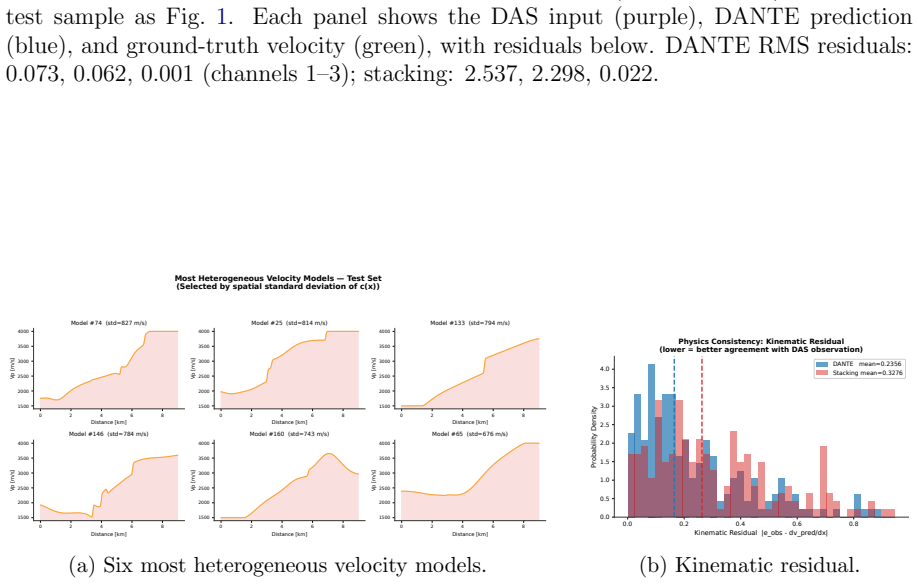
Distributed Acoustic Sensing (DAS) converts existing fibre-optic cables into dense seismic arrays at near-zero deployment cost, but measures strain rate rather than particle velocity -- the quantity required by virtually all seismological analysis tools. Converting strain rate to particle velocity by numerical integration is ill-posed: the integration constant is undefined and noise accumulates without bound. We present DANTE (DAS-to-velocity via physics-informed neural operator for Acoustic-wave recoNstruction in heTErogeneous media), a Fourier Neural Operator (FNO) trained entirely on synthetic data that enforces two physics constraints: (i) the exact kinematic relation between DAS strain rate and the spatial gradient of particle velocity, and (ii) the one-dimensional elastic wave equation. These constraints resolve the undetermined integration constant and suppress noise without requiring co-located seismometers. On a test set of 200 heterogeneous synthetic wavefields, DANTE achieves a mean output SNR of $15.3 \pm 8.8$ dB, Pearson correlation $r = 0.907$, and SSIM $= 0.976$, corresponding to a mean SNR improvement of approximately $+15$ dB over the best conventional baseline (trace stacking, $n = 10$, $0.02 \pm 0.06$ dB), and up to $+28.8$ dB on the most challenging samples. Zero-shot inference on seven real microseismic events from the Utah FORGE 2019 DAS dataset yields a kinematic residual of 0.003--0.005, five times lower than the synthetic test baseline, confirming generalisation to real field data with no fine-tuning and no seismometers.
Editorial analysis
A structured set of objections, weighed in public.
Referee Report
Summary. The paper introduces DANTE, a Fourier Neural Operator (FNO) trained exclusively on synthetic heterogeneous wavefields to reconstruct particle-velocity waveforms from DAS strain-rate data. It enforces two physics constraints—the exact kinematic relation between strain rate and the spatial gradient of particle velocity, plus the one-dimensional elastic wave equation—to resolve the undetermined integration constant and suppress noise without co-located seismometers. On 200 synthetic test cases the method reports mean SNR of 15.3 ± 8.8 dB, Pearson r = 0.907 and SSIM = 0.976, outperforming conventional baselines by ~15 dB on average. Zero-shot inference on seven real microseismic events from the Utah FORGE 2019 DAS dataset yields kinematic residuals of 0.003–0.005.
Significance. If the central claims hold, the work offers a practical route to obtain velocity records from existing DAS installations at negligible additional cost, which would broaden the applicability of dense seismic arrays in microseismic monitoring and other geophysics settings. The combination of physics-informed training on synthetics with demonstrated zero-shot transfer to field data is a notable technical step; the large reported SNR gains over trace-stacking baselines further support potential utility. The absence of independent ground truth on real data, however, limits the strength of the generalization claim.
major comments (2)
- [Real-data results] Real-data results (abstract and corresponding results section): The reported kinematic residual of 0.003–0.005 on the seven Utah FORGE events is presented as evidence of successful zero-shot generalization. However, because this residual only quantifies violation of the two enforced constraints (kinematic relation plus 1-D wave equation), it confirms consistency with the assumed 1-D physics manifold but does not establish that the reconstructed velocity equals the true particle-velocity field. Real DAS recordings may contain 3-D scattering, fiber-coupling effects, and noise statistics absent from the synthetic training distribution; multiple velocity fields can satisfy the constraints yet differ from ground truth. This gap directly affects the headline claim of accurate reconstruction without co-located seismometers.
- [Methods] Methods section on loss formulation: The manuscript states that the two physics constraints are enforced during training, yet it is unclear whether they appear as hard constraints (e.g., via projection or exact satisfaction at collocation points) or as soft penalty terms whose weighting may allow data-driven fitting to dominate. If the latter, the network could achieve low residuals on both synthetic and real data while still relying on statistical patterns rather than the physics, weakening the assertion that the constraints alone resolve the integration ambiguity.
minor comments (2)
- [Abstract] The abstract reports SNR improvement “approximately +15 dB”; the precise baseline value (trace stacking n=10 yields 0.02 ± 0.06 dB) should be stated explicitly in the abstract for immediate clarity.
- [Methods] Notation for the kinematic relation (strain rate = ∂v/∂x) and the 1-D wave equation should be introduced with equation numbers in the methods section and referenced consistently in the results.
Simulated Author's Rebuttal
We thank the referee for the constructive and detailed review. The comments highlight important nuances in the interpretation of real-data results and the precise implementation of the physics constraints. We address each point below and have revised the manuscript accordingly to improve clarity and temper claims where warranted.
read point-by-point responses
-
Referee: [Real-data results] Real-data results (abstract and corresponding results section): The reported kinematic residual of 0.003–0.005 on the seven Utah FORGE events is presented as evidence of successful zero-shot generalization. However, because this residual only quantifies violation of the two enforced constraints (kinematic relation plus 1-D wave equation), it confirms consistency with the assumed 1-D physics manifold but does not establish that the reconstructed velocity equals the true particle-velocity field. Real DAS recordings may contain 3-D scattering, fiber-coupling effects, and noise statistics absent from the synthetic training distribution; multiple velocity fields can satisfy the constraints yet differ from ground truth. This gap directly affects the headline claim of accurate reconstruction without co-located seismometers.
Authors: We agree that the kinematic residual on real data quantifies consistency with the enforced 1-D constraints rather than direct fidelity to unavailable ground truth. This is a genuine limitation of field-data validation without co-located sensors. In the revised manuscript we have updated the abstract and results section to state that the residuals demonstrate successful zero-shot transfer in satisfying the physics model, while explicitly noting the lack of independent ground truth and the possibility of unmodeled 3-D or coupling effects. A new paragraph has been added to the discussion acknowledging this gap and outlining plans for future validation with co-located seismometers. revision: yes
-
Referee: [Methods] Methods section on loss formulation: The manuscript states that the two physics constraints are enforced during training, yet it is unclear whether they appear as hard constraints (e.g., via projection or exact satisfaction at collocation points) or as soft penalty terms whose weighting may allow data-driven fitting to dominate. If the latter, the network could achieve low residuals on both synthetic and real data while still relying on statistical patterns rather than the physics, weakening the assertion that the constraints alone resolve the integration ambiguity.
Authors: The constraints are implemented as soft penalty terms within a composite loss L = L_data + λ_kin L_kin + λ_wave L_wave, where L_kin and L_wave are the mean-squared residuals of the kinematic relation and the 1-D wave equation evaluated at collocation points. The weights λ_kin and λ_wave were determined by hyperparameter search to ensure the physics terms remain influential. We will expand the methods section with the explicit loss equation, the chosen weight values, and a short ablation showing that physics residuals are driven to low levels without being dominated by the data term. This formulation still allows the network to resolve the integration constant via the physics rather than pure statistical fitting, as evidenced by the large SNR gains on synthetic cases with known ground truth. revision: yes
Circularity Check
No circularity; results measured on independent held-out ground truth and external residuals
full rationale
The paper trains an FNO on synthetic heterogeneous wavefields while enforcing standard kinematic strain-rate/velocity-gradient identities and the 1-D elastic wave equation drawn from prior literature. On the 200-sample held-out synthetic test set, SNR, Pearson r, and SSIM are computed directly against known ground-truth particle-velocity fields, not defined by the network outputs themselves. Zero-shot real-data evaluation reports a kinematic residual (0.003–0.005) that quantifies consistency with the enforced physics on unseen field recordings; this residual is an external diagnostic rather than a self-referential quantity. No self-definitional mapping, fitted parameter renamed as prediction, or load-bearing self-citation chain appears in the derivation. The central performance claims therefore rest on independent benchmarks and do not reduce to the training inputs by construction.
Axiom & Free-Parameter Ledger
axioms (2)
- domain assumption The one-dimensional elastic wave equation governs wave propagation in the heterogeneous media under study.
- domain assumption The kinematic relation between DAS strain rate and the spatial gradient of particle velocity holds exactly.
Reference graph
Works this paper leans on
-
[1]
International Conference on Learning Representations , year =
Fourier Neural Operator for Parametric Partial Differential Equations , author =. International Conference on Learning Representations , year =
-
[2]
Physics-informed neural networks:
Raissi, Maziar and Perdikaris, Paris and Karniadakis, George E , journal =. Physics-informed neural networks:. 2019 , doi =
work page 2019
-
[3]
Seismological Research Letters , volume =
Distributed acoustic sensing turns fiber-optic cables into sensitive seismographs , author =. Seismological Research Letters , volume =. 2020 , doi =
work page 2020
-
[4]
Marra, Giuseppe and Clivati, Cecilia and Luckett, Richard and Tampellini, Anna and Kronj. Ultrastable laser interferometry for earthquake detection with terrestrial and submarine cables , journal =. 2018 , doi =
work page 2018
-
[5]
Annual Review of Earth and Planetary Sciences , volume =
Fiber-Optic Seismology , author =. Annual Review of Earth and Planetary Sciences , volume =. 2021 , doi =
work page 2021
-
[6]
Distributed Acoustic Sensing -- a new tool for seismic applications , author =. First Break , volume =
-
[7]
Distributed acoustic sensing using dark fiber for near-surface characterization and broadband seismic event detection , author =. Scientific Reports , volume =. 2019 , doi =
work page 2019
-
[8]
Trabant, Chad and Hutko, Alexander R and Bahavar, Manochehr and Karstens, Richard and Ahern, Tim and Aster, Richard , journal =. Data products at the. 2012 , doi =
work page 2012
-
[9]
Moore, Joseph and McLennan, John and Pankow, Kristine and Simmons, Stuart and Podgorney, Robert and Wannamaker, Philip and Jones, Clay and Rickard, William and Xing, Pengju , journal =. The
-
[10]
Niemz, Peter and Pankow, Kristine and Karvounis, Dimitrios and Dyer, Ben , journal =. Microseismic catalog for the. 2025 , note =
work page 2025
-
[11]
IEEE Transactions on Geoscience and Remote Sensing , volume =
Deep learning for distributed acoustic sensing denoising in urban railway environments , author =. IEEE Transactions on Geoscience and Remote Sensing , volume =. 2022 , doi =
work page 2022
-
[12]
Self-supervised denoising for distributed acoustic sensing seismic data , author =. Geophysics , volume =. 2023 , doi =
work page 2023
-
[13]
Al-Qadasi, Basem and Cui, Yang and Bin Waheed, Umair and Wang, Herbert F. , journal =. A novel deep-learning model to convert. 2026 , doi =
work page 2026
-
[14]
Jurick, Dana and Guzik, Artur and Fishback, Wayne , year =
discussion (0)
Sign in with ORCID, Apple, or X to comment. Anyone can read and Pith papers without signing in.