The spacetime Penrose inequality under a quasi final state hypothesis
Pith reviewed 2026-05-20 09:15 UTC · model grok-4.3
The pith
Under the quasi final state hypothesis, every asymptotically flat initial data set with a MOTS boundary on a black-hole apparent horizon tube satisfies the spacetime Penrose inequality.
A machine-rendered reading of the paper's core claim, the machinery that carries it, and where it could break.
Core claim
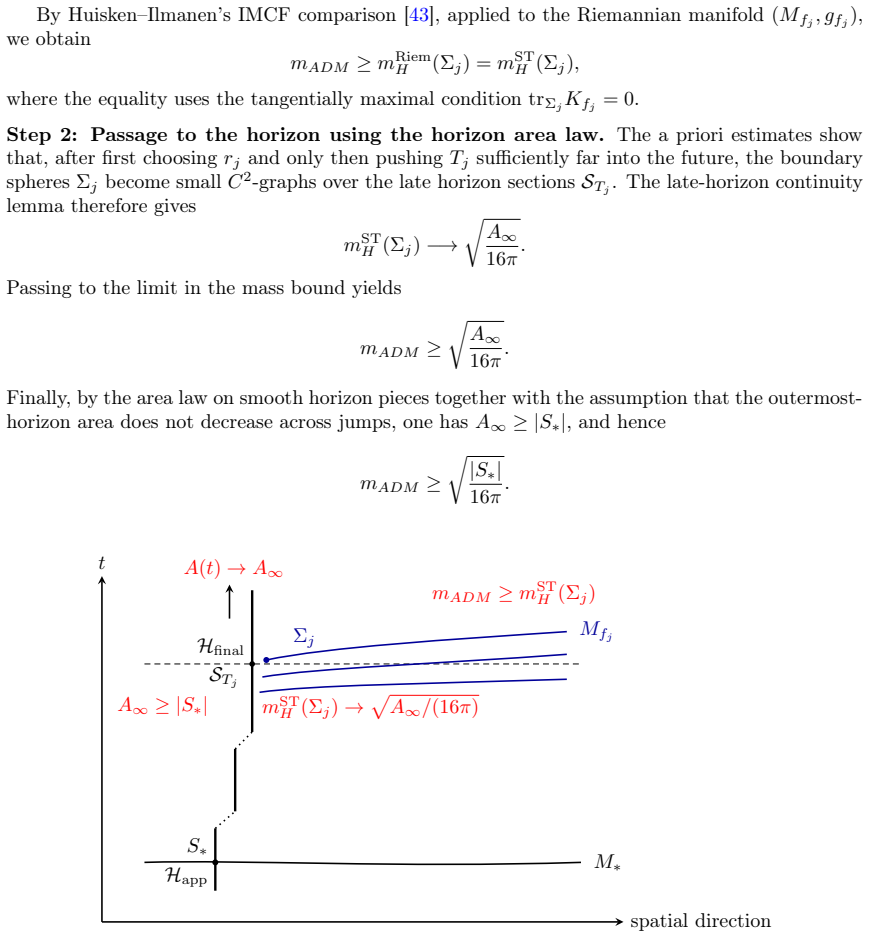
For an asymptotically flat globally hyperbolic spacetime containing a black-hole-type apparent horizon tube H_app that satisfies the dominant energy condition and the quasi final state hypothesis, every asymptotically flat initial data set whose boundary is a MOTS cross-section of H_app obeys the spacetime Penrose inequality. The argument proceeds by constructing tangentially maximal hypersurfaces on which the spacetime Hawking mass reduces to the Riemannian Hawking mass, applying the known Riemannian Penrose inequality, and invoking the area laws for dynamical and isolated horizons.
What carries the argument
Tangentially maximal hypersurface: a spacelike hypersurface carrying a foliation by spheres of vanishing timelike mean curvature, shown to exist globally as the solution of a quasilinear inward-parabolic PDE.
If this is right
- The ADM mass is bounded from below by the square root of the horizon area divided by 16 pi.
- The bound holds for any initial data set whose boundary is a MOTS cross-section of the apparent horizon tube.
- Area monotonicity along the tube from dynamical to isolated horizons connects the initial area to the final area used in the inequality.
- Nonnegative scalar curvature on the tangentially maximal hypersurface follows directly from the dominant energy condition.
Where Pith is reading between the lines
- The parabolic PDE construction may extend to other horizon inequalities or to spacetimes with different matter content where the dominant energy condition is relaxed.
- Numerical evolution codes could test whether the quasi final state decay conditions are realized in concrete gravitational collapse simulations.
- If the hypothesis can be verified for a given family of spacetimes, the inequality becomes a theorem rather than a conjecture for those families.
Load-bearing premise
Global existence of tangentially maximal hypersurfaces on which the spacetime Hawking mass reduces exactly to the Riemannian Hawking mass.
What would settle it
An asymptotically flat spacetime obeying the dominant energy condition and quasi final state hypothesis, yet containing an initial data set with MOTS boundary whose ADM mass lies below the square root of its horizon area over 16 pi, would falsify the claim.
Figures
read the original abstract
Penrose's original heuristic for his eponymous spacetime inequality -- a conjectured lower bound on the ADM mass in terms of the area of a horizon cross-section -- relies on the black hole final state conjecture. In this paper we isolate a substantially weaker but precise late-time condition, which we call the quasi final state hypothesis and prove the spacetime Penrose inequality under this hypothesis. More precisely, for an asymptotically flat globally hyperbolic spacetime with a black-hole-type apparent horizon tube ${H}_{{app}}$ satisfying the dominant energy condition and the quasi final state hypothesis, we show that every asymptotically flat initial data set whose boundary is a MOTS cross-section of ${H}_{{app}}$ satisfies the spacetime Penrose inequality. The quasi final state hypothesis requires only a late-time decay condition on the normal component of the shift and the ratio of timelike to spacelike mean curvature, together with convergence of the cross-sectional areas of ${H}_{{app}}$ to a finite limit. Our approach is new and formulated directly in spacetime. The main geometric object is what we call a \emph{tangentially maximal} hypersurface, carrying a foliation by spacelike spheres whose timelike mean curvature vanishes. We show that these hypersurfaces are governed by a quasilinear inward-parabolic PDE, and we develop the corresponding a priori theory and prove global existence. On these hypersurfaces, the spacetime Hawking mass reduces to the Riemannian Hawking mass, and the dominant energy condition gives nonnegative scalar curvature. The Riemannian Penrose inequality, combined with the area laws for dynamical and isolated horizons, then yields the result.
Editorial analysis
A structured set of objections, weighed in public.
Referee Report
Summary. The paper claims that for an asymptotically flat globally hyperbolic spacetime with a black-hole-type apparent horizon tube H_app satisfying the dominant energy condition and the quasi final state hypothesis (late-time decay of the normal shift component and timelike-to-spacelike mean curvature ratio, plus convergence of cross-sectional areas to a finite limit), every asymptotically flat initial data set whose boundary is a MOTS cross-section of H_app satisfies the spacetime Penrose inequality. The proof introduces tangentially maximal hypersurfaces (with a foliation by spheres of vanishing timelike mean curvature) governed by a quasilinear inward-parabolic PDE, establishes global existence via a priori estimates, reduces the spacetime Hawking mass to the Riemannian Hawking mass on these surfaces, obtains nonnegative scalar curvature from the DEC, and combines the Riemannian Penrose inequality with area laws for dynamical and isolated horizons.
Significance. If the a priori estimates and global existence for the tangentially maximal hypersurfaces hold under the stated hypotheses, this constitutes a notable advance: it proves the spacetime Penrose inequality under a precise, substantially weaker late-time condition than the full black hole final state conjecture, while working directly in spacetime rather than reducing immediately to initial data. The new geometric construction of tangentially maximal hypersurfaces and the mass reduction step are original contributions that could extend to other inequalities involving dynamical horizons. Credit is due for the clean reduction to the Riemannian Penrose inequality (whose proof is external) and for formulating falsifiable late-time conditions.
major comments (1)
- [Global existence and a priori estimates for tangentially maximal hypersurfaces] The global existence proof for the quasilinear inward-parabolic PDE governing tangentially maximal hypersurfaces (detailed in the section developing the a priori theory) relies on the area convergence and late-time decay supplied by the quasi final state hypothesis. However, these conditions may not furnish uniform bounds on the second fundamental form or mean curvature sufficient to exclude finite-time singularities or loss of spacelike character prior to reaching the MOTS cross-section. This is load-bearing for the subsequent reduction of the spacetime Hawking mass to the Riemannian Hawking mass; without such control the mass inequality step does not apply to all initial data sets.
minor comments (2)
- [Introduction and notation] The notation for the apparent horizon tube H_app and its cross-sections is introduced in the abstract but would benefit from an explicit definition and diagram in the introduction or §2 to aid readers unfamiliar with dynamical horizon terminology.
- [Main theorem statement] In the statement of the main theorem, clarify whether the initial data sets are required to be maximal or if the tangentially maximal condition is imposed only on the auxiliary hypersurfaces; the current wording leaves this slightly ambiguous.
Simulated Author's Rebuttal
We thank the referee for their careful reading of the manuscript, their recognition of the significance of the quasi final state hypothesis, and for raising this important point about the a priori estimates. We address the major comment in detail below.
read point-by-point responses
-
Referee: The global existence proof for the quasilinear inward-parabolic PDE governing tangentially maximal hypersurfaces (detailed in the section developing the a priori theory) relies on the area convergence and late-time decay supplied by the quasi final state hypothesis. However, these conditions may not furnish uniform bounds on the second fundamental form or mean curvature sufficient to exclude finite-time singularities or loss of spacelike character prior to reaching the MOTS cross-section. This is load-bearing for the subsequent reduction of the spacetime Hawking mass to the Riemannian Hawking mass; without such control the mass inequality step does not apply to all initial data sets.
Authors: We appreciate the referee's scrutiny of this foundational step. The a priori theory section derives uniform bounds on the second fundamental form and mean curvature directly from the area convergence to a finite limit combined with the late-time decay of the normal shift component and the timelike-to-spacelike mean curvature ratio. These hypotheses are used to apply parabolic maximum principles and regularity theory to the quasilinear inward-parabolic PDE, yielding L^infty control that rules out finite-time singularities and preserves the spacelike character of the evolving hypersurfaces up to the MOTS cross-section. The resulting bounds are then used to reduce the spacetime Hawking mass to its Riemannian counterpart. We will revise the manuscript to include an explicit corollary summarizing these curvature bounds and their dependence on the quasi final state hypothesis, thereby making the argument more transparent. revision: partial
Circularity Check
No circularity in the derivation chain
full rationale
The paper introduces the quasi final state hypothesis as a precise late-time condition on the normal shift and mean curvature ratio with area convergence, then constructs tangentially maximal hypersurfaces via a quasilinear inward-parabolic PDE for which it develops a priori estimates and proves global existence. On these surfaces the spacetime Hawking mass reduces to the Riemannian Hawking mass, nonnegative scalar curvature follows from the dominant energy condition, and the result follows by invoking the established Riemannian Penrose inequality together with area laws for dynamical and isolated horizons. No step equates the target inequality to its inputs by definition, renames a fitted quantity as a prediction, or reduces via a self-citation chain; the central argument is built from independent geometric constructions and external theorems.
Axiom & Free-Parameter Ledger
axioms (3)
- domain assumption Dominant energy condition
- domain assumption Asymptotically flat globally hyperbolic spacetime
- domain assumption Existence of black-hole-type apparent horizon tube
invented entities (1)
-
tangentially maximal hypersurface
no independent evidence
Lean theorems connected to this paper
-
IndisputableMonolith/Cost/FunctionalEquation.leanwashburn_uniqueness_aczel unclear?
unclearRelation between the paper passage and the cited Recognition theorem.
We show that these hypersurfaces are governed by a quasilinear inward-parabolic PDE... On these hypersurfaces, the spacetime Hawking mass reduces to the Riemannian Hawking mass
-
IndisputableMonolith/Foundation/AlexanderDuality.leanalexander_duality_circle_linking unclear?
unclearRelation between the paper passage and the cited Recognition theorem.
asymptotically flat globally hyperbolic spacetime... S² cross-sections of Happ
What do these tags mean?
- matches
- The paper's claim is directly supported by a theorem in the formal canon.
- supports
- The theorem supports part of the paper's argument, but the paper may add assumptions or extra steps.
- extends
- The paper goes beyond the formal theorem; the theorem is a base layer rather than the whole result.
- uses
- The paper appears to rely on the theorem as machinery.
- contradicts
- The paper's claim conflicts with a theorem or certificate in the canon.
- unclear
- Pith found a possible connection, but the passage is too broad, indirect, or ambiguous to say the theorem truly supports the claim.
Reference graph
Works this paper leans on
-
[1]
Spyros Alexakis,The Penrose inequality on perturbations of the Schwarzschild exterior, 2015, Preprint, arXiv:1506.06400 [gr-qc]
work page internal anchor Pith review Pith/arXiv arXiv 2015
- [2]
- [3]
- [4]
-
[5]
Lars Andersson, Marc Mars, and Walter Simon,Local existence of dynamical and trapping horizons, Physical Review Letters95(2005), no. 11, 111102
work page 2005
-
[6]
,Stability of marginally outer trapped surfaces and existence of marginally outer trapped tubes, Advances in Theoretical and Mathematical Physics12(2008), no. 4, 853–888
work page 2008
-
[7]
Lars Andersson and Jan Metzger,The area of horizons and the trapped region, Communications in Mathematical Physics290(2009), no. 3, 941–972
work page 2009
- [8]
-
[9]
Abhay Ashtekar and Gregory J. Galloway,Some uniqueness results for dynamical horizons, Advances in Theoretical and Mathematical Physics9(2005), no. 1, 1–30
work page 2005
-
[10]
AbhayAshtekarandBadriKrishnan,Dynamical horizons and their properties, PhysicalReview D68(2003), no. 10, 104030
work page 2003
-
[11]
,Isolated and dynamical horizons and their applications, Living Reviews in Relativity 7(2004), no. 10
work page 2004
-
[12]
Robert Bartnik,The mass of an asymptotically flat manifold, Communications on Pure and Applied Mathematics39(1986), no. 5, 661–693
work page 1986
-
[13]
Robert Beig and Niall Ó Murchadha,The Poincaré group as the symmetry group of canonical general relativity, Annals of Physics174(1987), no. 2, 463–498
work page 1987
-
[14]
Ishai Ben-Dov,The Penrose inequality and apparent horizons, Physical Review D70(2004), 124031
work page 2004
-
[15]
Antonio N. Bernal and Miguel Sánchez,Smoothness of time functions and the metric splitting of globally hyperbolic spacetimes, Communications in Mathematical Physics257(2005), no. 1, 43–50
work page 2005
-
[16]
,Further results on the smoothability of Cauchy hypersurfaces and Cauchy time func- tions, Letters in Mathematical Physics77(2006), no. 2, 183–197
work page 2006
- [17]
-
[18]
Robert H. Boyer and Richard W. Lindquist,Maximal analytic extension of the Kerr metric, Journal of Mathematical Physics8(1967), no. 2, 265–281
work page 1967
-
[19]
Hubert L. Bray,Proof of the Riemannian Penrose inequality using the positive mass theorem, Journal of Differential Geometry59(2001), no. 2, 177–267
work page 2001
-
[20]
Hubert L. Bray, Sean A. Hayward, Marc Mars, and Walter Simon,Generalized inverse mean curvature flows in spacetime, Communications in Mathematical Physics272(2007), no. 1, 119–138
work page 2007
-
[21]
Hubert L. Bray and Jeffrey L. Jauregui,Time flat surfaces and the monotonicity of the space- time Hawking mass, Communications in Mathematical Physics335(2015), no. 1, 285–307
work page 2015
-
[22]
Hubert L. Bray, Jeffrey L. Jauregui, and Marc Mars,Time flat surfaces and the monotonicity of the spacetime Hawking mass II, Annales Henri Poincaré17(2016), 1457–1475
work page 2016
-
[23]
Hubert L. Bray and Marcus A. Khuri,A Jang equation approach to the Penrose inequality, Discrete and Continuous Dynamical Systems27(2010), no. 2, 741–766
work page 2010
-
[24]
,P.D.E.’s which imply the Penrose conjecture, Asian Journal of Mathematics15(2011), no. 4, 557–610. 136
work page 2011
-
[25]
Hubert L. Bray and Dan A. Lee,On the Riemannian Penrose inequality in dimensions less than eight, Duke Mathematical Journal148(2009), no. 1, 81–106
work page 2009
-
[26]
Armando J. Cabrera Pacheco, Carla Cederbaum, Penelope Gehring, and Alejandro Peñuela Díaz,Constructing electrically charged Riemannian manifolds with minimal bound- ary, prescribed asymptotics, and controlled mass, Journal of Geometry and Physics185(2023), 104746
work page 2023
-
[27]
Alberto Carrasco and Marc Mars,A counter-example to a recent version of the Penrose con- jecture, Classical and Quantum Gravity27(2010), 062001
work page 2010
-
[28]
Piotr T. Chruściel,On the invariant mass conjecture in general relativity, Communications in Mathematical Physics120(1988), 233–248
work page 1988
-
[29]
Piotr T. Chruściel and Erwann Delay,On mapping properties of the general relativistic con- straints operator in weighted function spaces, with applications, Mémoires de la Société Math- ématique de France, no. 94, Société Mathématique de France, 2003
work page 2003
-
[30]
Piotr T. Chruściel, Jacek Jezierski, and Szymon Łęski,The Trautman-Bondi mass of hyper- boloidal initial data sets, Advances in Theoretical and Mathematical Physics8(2004), no. 1, 83–139
work page 2004
-
[31]
Justin Corvino,Scalar curvature deformation and a gluing construction for the Einstein con- straint equations, Communications in Mathematical Physics214(2000), no. 1, 137–189
work page 2000
-
[32]
Justin Corvino and Richard M. Schoen,On the asymptotics for the vacuum Einstein constraint equations, Journal of Differential Geometry73(2006), no. 2, 185–217
work page 2006
- [33]
- [34]
- [35]
-
[36]
Jörg Frauendiener,On the Penrose inequality, Physical Review Letters87(2001), no. 10, 101101
work page 2001
-
[37]
ElenaGiorgi,Stable black holes: in vacuum and beyond, BulletinoftheAmericanMathematical Society60(2023), no. 1, 1–27
work page 2023
-
[38]
Elena Giorgi, Sergiu Klainerman, and Jérémie Szeftel,Wave equations estimates and the non- linear stability of slowly rotating Kerr black holes, Pure and Applied Mathematics Quarterly 20(2024), no. 7, 2865–3849
work page 2024
-
[39]
846, Springer, Berlin, Heidelberg, 2012
Éric Gourgoulhon,3+1 formalism in general relativity: Bases of numerical relativity, Lecture Notes in Physics, vol. 846, Springer, Berlin, Heidelberg, 2012. 137
work page 2012
-
[40]
Stephen W. Hawking,Gravitational radiation in an expanding universe, Journal of Mathemat- ical Physics9(1968), no. 4, 598–604
work page 1968
-
[41]
Hayward,Gravitational energy in spherical symmetry, Physical Review D53(1996), 1938–1949
Sean A. Hayward,Gravitational energy in spherical symmetry, Physical Review D53(1996), 1938–1949
work page 1996
-
[42]
Sven Hirsch,Hawking mass monotonicity for initial data sets, Asian Journal of Mathematics 29(2025), no. 4, 535–558
work page 2025
-
[43]
Gerhard Huisken and Tom Ilmanen,The inverse mean curvature flow and the Riemannian Penrose inequality, Journal of Differential Geometry59(2001), no. 3, 353–437
work page 2001
-
[44]
Marcus Khuri and Hari K. Kunduri,The spacetime Penrose inequality for cohomogeneity one initial data, Advances in Theoretical and Mathematical Physics29(2025), no. 7, 1905–1943
work page 2025
-
[45]
Sergiu Klainerman,The black hole stability problem, Comptes Rendus. Mécanique353(2025), 555–581
work page 2025
-
[46]
Sergiu Klainerman and Jérémie Szeftel,Kerr stability for small angular momentum, Pure and Applied Mathematics Quarterly19(2023), no. 3, 791–1678
work page 2023
-
[47]
N. V. Krylov,Lectures on elliptic and parabolic equations in Hölder spaces, Graduate Studies in Mathematics, vol. 12, American Mathematical Society, Providence, RI, 1996
work page 1996
-
[48]
23, American Mathematical Society, Providence, RI, 1968
O.A.Ladyzhenskaya, V.A.Solonnikov, andN.N.Ural’tseva,Linear and quasi-linear equations of parabolic type, Translations of Mathematical Monographs, vol. 23, American Mathematical Society, Providence, RI, 1968
work page 1968
-
[49]
Pengyu Le,Null Penrose inequality in a perturbed Schwarzschild spacetime, Pure and Applied Mathematics Quarterly20(2024), no. 4, 1667–1696
work page 2024
-
[50]
Gary M. Lieberman,Second order parabolic differential equations, World Scientific Publishing Co., Inc., River Edge, NJ, 1996
work page 1996
- [51]
-
[52]
Edward Malec and Niall Ó Murchadha,Trapped surfaces and the Penrose inequality in spher- ically symmetric geometries, Physical Review D49(1994), no. 12, 6931–6934
work page 1994
-
[53]
,The Jang equation, apparent horizons, and the Penrose inequality, Classical and Quan- tum Gravity21(2004), no. 24, 5777–5787
work page 2004
-
[54]
Marc Mars,Present status of the Penrose inequality, Classical and Quantum Gravity26(2009), no. 19, 193001
work page 2009
-
[55]
Marc Mars and Alberto Soria,The asymptotic behaviour of the Hawking energy along null asymptotically flat hypersurfaces, Classical and Quantum Gravity32(2015), no. 18, 185020
work page 2015
-
[56]
,On the Penrose inequality along null hypersurfaces, Classical and Quantum Gravity 33(2016), no. 11, 115019. 138
work page 2016
-
[57]
Pengzi Miao,Positive mass theorem on manifolds admitting corners along a hypersurface, Advances in Theoretical and Mathematical Physics6(2002), no. 6, 1163–1182
work page 2002
-
[58]
Louis Nirenberg,The Weyl and Minkowski problems in differential geometry in the large, Com- munications on Pure and Applied Mathematics6(1953), no. 3, 337–394
work page 1953
-
[59]
Barrett O’Neill,The geometry of Kerr black holes, A K Peters, Wellesley, MA, 1995
work page 1995
-
[60]
Roger Penrose,Naked singularities, Annals of the New York Academy of Sciences224(1973), no. 1, 125–134
work page 1973
-
[61]
A.V.Pogorelov,Regularity of a convex surface with given Gaussian curvature, Matematicheskii Sbornik. Novaya Seriya31(73)(1952), no. 1, 88–103 (Russian)
work page 1952
-
[62]
Henri Roesch,Quasi-round MOTSs and stability of the Schwarzschild null Penrose inequality, Annales Henri Poincaré22(2021), no. 6, 1937–1978
work page 2021
-
[63]
Henri P. Roesch,Proof of a null Penrose conjecture using a new quasi-local mass, Communi- cations in Analysis and Geometry29(2021), no. 8, 1847–1915
work page 2021
-
[64]
R. K. Sachs,Gravitational waves in general relativity. VIII. waves in asymptotically flat space- time, ProceedingsoftheRoyalSocietyofLondon.SeriesA.MathematicalandPhysicalSciences 270(1962), no. 1340, 103–126
work page 1962
-
[65]
Johannes Sauter,Foliations of null hypersurfaces and the penrose inequality, Ph.D. thesis, ETH Zürich, 2008
work page 2008
- [66]
-
[67]
II, Communications in Mathematical Physics79 (1981), no
,Proof of the positive mass theorem. II, Communications in Mathematical Physics79 (1981), no. 2, 231–260
work page 1981
-
[68]
Dawei Shen,Construction of GCM hypersurfaces in perturbations of Kerr, Annals of PDE9 (2023), no. 1, Paper No. 11, 112 pp
work page 2023
- [69]
-
[70]
László B. Szabados,On the roots of the Poincaré structure of asymptotically flat spacetimes, Classical and Quantum Gravity20(2003), no. 13, 2627–2662
work page 2003
-
[71]
,Quasi-local energy-momentum and angular momentum in general relativity, Living Reviews in Relativity12(2009), no. 4
work page 2009
-
[72]
Michael E. Taylor,Partial differential equations III: Nonlinear equations, 3 ed., Applied Math- ematical Sciences, vol. 117, Springer, Cham, 2023
work page 2023
-
[73]
Edward Witten,A new proof of the positive energy theorem, Communications in Mathematical Physics80(1981), no. 3, 381–402. 139
work page 1981
discussion (0)
Sign in with ORCID, Apple, or X to comment. Anyone can read and Pith papers without signing in.