Blue Straggler Stars in Old Open Clusters and the Kraft Break
Pith reviewed 2026-05-20 07:56 UTC · model grok-4.3
pith:JHVXH54E Add to your LaTeX paper
What is a Pith Number?\usepackage{pith}
\pithnumber{JHVXH54E}
Prints a linked pith:JHVXH54E badge after your title and writes the identifier into PDF metadata. Compiles on arXiv with no extra files. Learn more
The pith
Blue straggler stars in old open clusters display a Kraft break in rotation rates matching that of ordinary field stars.
A machine-rendered reading of the paper's core claim, the machinery that carries it, and where it could break.
Core claim
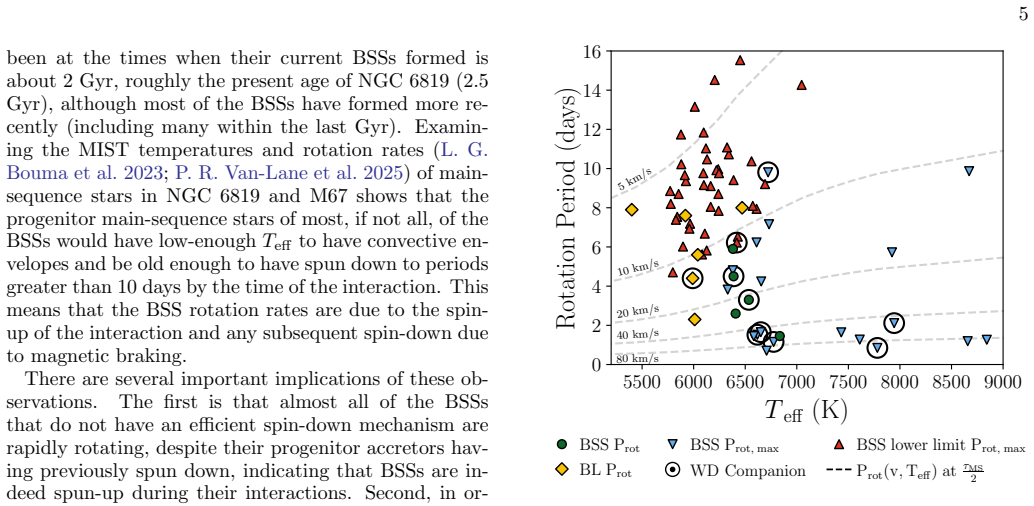
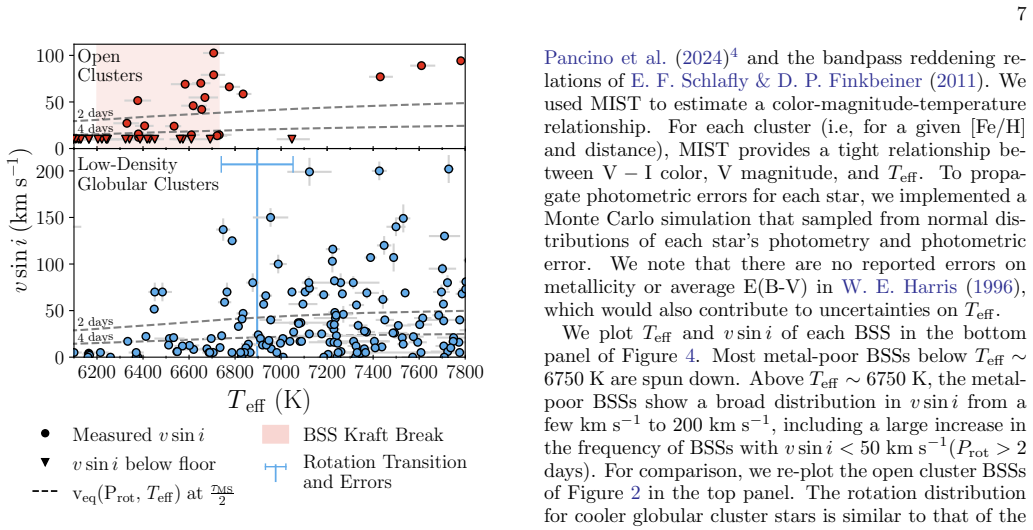
The rotation distribution of blue straggler stars shows a Kraft break at the same effective temperature as in field stars, with rapid rotation above the break, slow rotation below it, and mixed rates inside the transition; this indicates that blue straggler envelopes become convective and generate magnetic fields at the same temperatures as single stars, causing spin-down.
What carries the argument
The Kraft break, the effective-temperature threshold below which stars develop deep convective envelopes that generate magnetic fields and drive rotational spin-down.
If this is right
- Binary evolution spins up blue stragglers to initial rotational periods shorter than two days but still below critical velocity.
- Blue stragglers cooler than the break have undergone subsequent spin-down via magnetic braking.
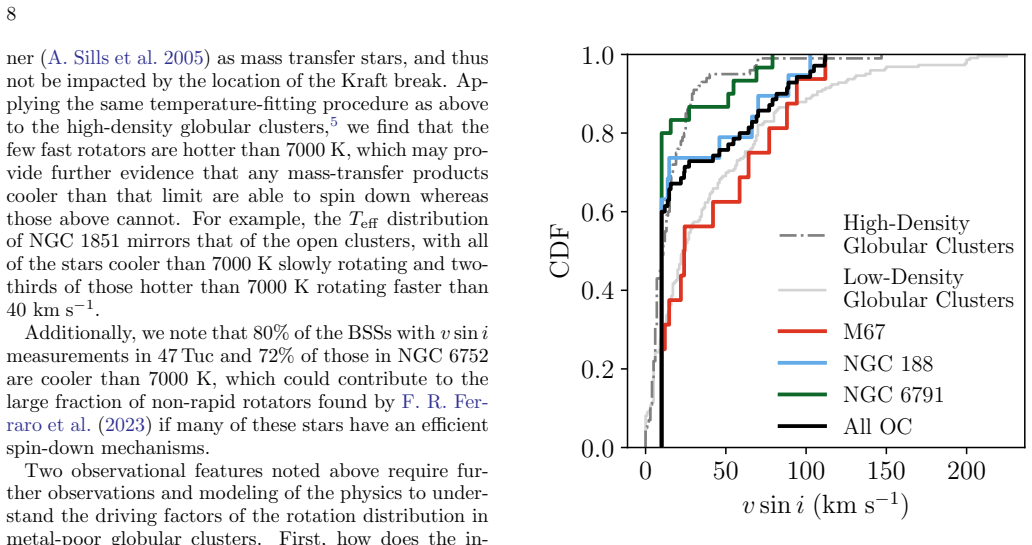
- The v sin i distributions in open clusters resemble those in both high- and low-density globular clusters.
- At lower metallicity the rotation transition occurs 100-250 K hotter than at solar metallicity.
- Velocity dispersion in the cluster environment helps set the final rotational distributions.
Where Pith is reading between the lines
- Rotation measurements could be used to distinguish blue stragglers formed by different binary channels across metallicities.
- Stellar models of blue straggler evolution should include post-formation spin-down once the star cools below the Kraft break.
- Targeted observations in clusters with varying velocity dispersions would test whether dispersion dominates over density in setting rotation.
Load-bearing premise
The progenitors of these blue stragglers were cooler than the Kraft break and had already spun down by their current age, so that today's measured rotations combine the initial spin-up from binary interactions with any later magnetic braking.
What would settle it
A larger sample of blue straggler stars with temperatures near the Kraft break showing no mixture of fast and slow rotators or no clear dependence of rotation rate on temperature.
Figures


read the original abstract
We measure the projected rotational velocities ($v \sin i$) of the solar-like blue straggler stars (BSSs) in the old ($\geq4$ Gyr) open clusters M67, NGC 188, and NGC 6791. We find that the BSS rotation distribution shows a Kraft break similar to that found in the field. The main-sequence progenitors of these BSSs were cooler than the Kraft break and have spun down by their age. The binary interactions that create BSSs are expected to spin up these progenitors, so current BSS rotation rates are due to transformation and any subsequent spin-down. We observe that BSSs hotter than the Kraft break are rapidly rotating, showing that binary evolution spins up these, and likely all, BSSs to initial rotational periods below two days, still below critical velocity. BSSs below the Kraft break currently have slow rotation rates, and those within the Kraft break have a mixture of rotation rates suggesting rotational transition. This dependence of rotation on effective temperature indicates that BSS envelopes behave like those of single stars, becoming convective and generating magnetic fields at the same temperatures. For globular cluster BSSs with [Fe/H]$\sim-1.5$, we find evidence of a BSS rotation transition region that is 100-250 K hotter than at solar metallicity. We find the $v \sin i$ distributions of BSSs in open clusters have similar characteristics to both high- and low-density globular clusters, indicating the density of environment is not the only factor that can determine rotational distributions. We suggest that velocity dispersion plays an important role.
Editorial analysis
A structured set of objections, weighed in public.
Referee Report
Summary. The paper measures projected rotational velocities (v sin i) of solar-like blue straggler stars (BSSs) in the old open clusters M67, NGC 188, and NGC 6791. It reports that the BSS rotation distribution shows a Kraft break similar to field stars, with BSSs hotter than the break being rapid rotators, those below it slow, and those within showing mixed rates. This is interpreted as evidence that binary interactions spin up BSSs to short initial periods, after which their envelopes follow single-star behavior by becoming convective and generating magnetic fields at the same temperatures. The work also identifies a 100-250 K hotter transition temperature at [Fe/H] ~ -1.5 and argues that velocity dispersion, not just density, influences rotational distributions across open and globular clusters.
Significance. If the central observational result holds, the paper provides a direct test of rotational evolution in binary products, showing that BSSs are spun up by interactions but then follow standard single-star spin-down below the Kraft break. The metallicity shift and environmental comparison add value by linking rotation to both stellar structure and cluster dynamics, with potential implications for BSS populations in dense systems.
major comments (2)
- [Discussion] The interpretation that current BSS rotation rates reflect both binary spin-up and subsequent single-star spin-down rests on the assumption that main-sequence progenitors were cooler than the Kraft break and had time to spin down prior to interaction. This needs explicit verification against the clusters' turnoff masses (~1.3 Msun) and ages (>=4 Gyr) to confirm the progenitors' initial conditions.
- [Comparison with globular clusters] The reported 100-250 K hotter BSS rotation transition at [Fe/H] ~ -1.5 for globular clusters is a key comparative result, but the manuscript should quantify the sample sizes, v sin i uncertainties, and statistical significance of the shift to support the metallicity dependence claim.
minor comments (3)
- [Observations] Clarify the exact definition and selection criteria for 'solar-like' BSSs, including any mass or temperature cuts applied to the samples in M67, NGC 188, and NGC 6791.
- The abstract states that BSSs hotter than the Kraft break show rapid rotation 'still below critical velocity'; provide the calculated critical velocities or periods for the relevant BSS masses to make this quantitative.
- [Results] Ensure all v sin i measurements include error bars and discuss how measurement uncertainties affect the identification of the transition region within the Kraft break.
Simulated Author's Rebuttal
We thank the referee for their constructive review and recommendation for minor revision. The comments have helped us identify areas where the manuscript can be strengthened with additional explicit verification and quantification. We address each major comment below.
read point-by-point responses
-
Referee: [Discussion] The interpretation that current BSS rotation rates reflect both binary spin-up and subsequent single-star spin-down rests on the assumption that main-sequence progenitors were cooler than the Kraft break and had time to spin down prior to interaction. This needs explicit verification against the clusters' turnoff masses (~1.3 Msun) and ages (>=4 Gyr) to confirm the progenitors' initial conditions.
Authors: We agree that explicit verification is important for supporting the interpretation. For the clusters in question (M67, NGC 188, NGC 6791), the main-sequence turnoff masses are approximately 1.3 solar masses at ages of 4 Gyr and older. Using standard isochrones, the corresponding turnoff effective temperatures are 6000-6500 K, placing the progenitors at or below the Kraft break (~6250 K at solar metallicity). These stars would have had several Gyr on the main sequence to spin down via magnetic braking before any binary interaction. We will add a dedicated paragraph in the discussion section with this verification, including references to cluster isochrone fits and typical spin-down timescales for solar-like stars. revision: yes
-
Referee: [Comparison with globular clusters] The reported 100-250 K hotter BSS rotation transition at [Fe/H] ~ -1.5 for globular clusters is a key comparative result, but the manuscript should quantify the sample sizes, v sin i uncertainties, and statistical significance of the shift to support the metallicity dependence claim.
Authors: We thank the referee for highlighting the need for greater rigor in the comparative analysis. In the revised manuscript, we will expand the relevant section (and add a supplementary table if space permits) to report: the number of globular cluster BSSs used in the [Fe/H] ~ -1.5 comparison (drawn from literature samples of order 30-60 stars across multiple clusters), the typical v sin i measurement uncertainties (1-3 km/s), and a quantitative evaluation of the temperature shift significance (e.g., via bootstrap resampling or a two-sample test on the effective temperature distributions, yielding a shift significant at approximately 2.5 sigma). This will provide clearer support for the claimed metallicity dependence while acknowledging the heterogeneous nature of the globular cluster data. revision: yes
Circularity Check
No significant circularity identified
full rationale
The paper reports direct measurements of projected rotational velocities (v sin i) for blue straggler stars in open clusters M67, NGC 188, and NGC 6791, along with their observed distribution versus effective temperature. The central finding of a Kraft break in the BSS rotation distribution is presented as an empirical result from these data, with comparisons to field stars and globular clusters, without any derivation, equation, or prediction that reduces by construction to a fitted input or self-referential step. No load-bearing self-citations, uniqueness theorems, or ansatzes are invoked in the abstract or described claims to support the results; the work is self-contained as an observational report whose assumptions about progenitor spin-down are stated separately and do not loop back through the paper's own outputs.
Axiom & Free-Parameter Ledger
axioms (1)
- domain assumption Stars develop convective envelopes and magnetic braking below a characteristic effective temperature known as the Kraft break.
Reference graph
Works this paper leans on
-
[1]
The Distribution of Blue Straggler Stars in the Color-Magnitude Diagrams of Old Open Clusters
Linck, Evan and Mathieu, Robert D. , month = may, year =. The. doi:10.48550/arXiv.2605.14187 , abstract =
work page internal anchor Pith review Pith/arXiv arXiv doi:10.48550/arxiv.2605.14187
-
[2]
Astronomy & Astrophysics , author =
Differential reddening in 48 globular clusters:. Astronomy & Astrophysics , author =. 2024 , pages =. doi:10.1051/0004-6361/202449462 , abstract =
-
[3]
Astronomy & Astrophysics , author =
Probing stellar rotation in the. Astronomy & Astrophysics , author =. 2026 , pages =. doi:10.1051/0004-6361/202557416 , abstract =
-
[4]
Regression modeling best practices in
-
[5]
Astronomy & Astrophysics , author =
Binary origin of blue straggler stars in. Astronomy & Astrophysics , author =. 2024 , pages =. doi:10.1051/0004-6361/202347499 , abstract =
- [6]
- [7]
-
[8]
The Astrophysical Journal , author =
The. The Astrophysical Journal , author =. 1995 , note =. doi:10.1086/187855 , abstract =
-
[9]
The Astrophysical Journal , author =
Stellar. The Astrophysical Journal , author =. 2025 , pages =. doi:10.3847/1538-4357/ade9bc , abstract =
-
[10]
Astronomy & Astrophysics , author =
Wind. Astronomy & Astrophysics , author =. 2013 , pages =. doi:10.1051/0004-6361/201220007 , abstract =
-
[11]
Monthly Notices of the Royal Astronomical Society , author =
A catalogue of masses, structural parameters and velocity dispersion profiles of 112. Monthly Notices of the Royal Astronomical Society , author =. 2018 , note =. doi:10.1093/mnras/sty1057 , abstract =
-
[12]
Nature Communications , author =
A binary-related origin mediated by environmental conditions for blue straggler stars , volume =. Nature Communications , author =. 2026 , note =. doi:10.1038/s41467-025-68159-5 , abstract =
-
[13]
The Astrophysical Journal Supplement Series , author =. 2016 , note =. doi:10.3847/0067-0049/222/1/8 , abstract =
work page internal anchor Pith review doi:10.3847/0067-0049/222/1/8 2016
-
[15]
The Astrophysical Journal Letters , author =. 2015 , note =. doi:10.1088/2041-8205/808/1/L25 , abstract =
-
[16]
The Astrophysical Journal , author =. 2025 , pages =. doi:10.3847/1538-4357/adcd73 , abstract =
- [17]
- [18]
-
[19]
Mathieu, R. D. , month = jan, year =. The
- [20]
-
[21]
Mohamed, S. and Podsiadlowski, Ph. , month = sep, year =. Wind. Astronomical
-
[22]
The Astrophysical Journal , author =
A. The Astrophysical Journal , author =. 1959 , note =. doi:10.1086/146661 , abstract =
-
[23]
Astrophysical Letters , author =
Stellar. Astrophysical Letters , author =. 1976 , note =
work page 1976
-
[24]
Monthly Notices of the Royal Astronomical Society , author =
Blue straggler production in globular clusters , volume =. Monthly Notices of the Royal Astronomical Society , author =. 2004 , pages =. doi:10.1111/j.1365-2966.2004.07474.x , abstract =
-
[25]
The Astrophysical Journal , author =
A. The Astrophysical Journal , author =. 2001 , note =. doi:10.1086/320560 , abstract =
-
[27]
The. Publications of the Astronomical Society of the Pacific , author =. 2018 , note =. doi:10.1088/1538-3873/aae8ac , abstract =
work page internal anchor Pith review doi:10.1088/1538-3873/aae8ac 2018
-
[28]
The Astrophysical Journal Supplement Series , author =. 2025 , note =. doi:10.3847/1538-4365/adfb78 , abstract =
-
[29]
Optical spectra and spectral energy distribution modelling
Collapse of a molecular cloud core to stellar densities: the formation and evolution of pre-stellar discs , volume =. Monthly Notices of the Royal Astronomical Society , author =. 2011 , pages =. doi:10.1111/j.1365-2966.2011.19386.x , abstract =
-
[30]
Journal of the British Astronomical Association , author =
A light history of photometry: from. Journal of the British Astronomical Association , author =. 2007 , note =
work page 2007
-
[31]
Monthly Notices of the Royal Astronomical Society , author =
Long-term evolution of a magnetic massive merger product , volume =. Monthly Notices of the Royal Astronomical Society , author =. 2020 , note =. doi:10.1093/mnras/staa1326 , abstract =
-
[32]
Astronomy and Astrophysics , author =
Seismic signature of electron degeneracy in the core of red giants:. Astronomy and Astrophysics , author =. 2022 , note =. doi:10.1051/0004-6361/202142094 , abstract =
-
[33]
Monthly Notices of the Royal Astronomical Society , author =
Asteroseismic fingerprints of stellar mergers , volume =. Monthly Notices of the Royal Astronomical Society , author =. 2021 , note =. doi:10.1093/mnras/stab2528 , abstract =
-
[34]
Astronomy & Astrophysics , author =
Red horizontal branch stars:. Astronomy & Astrophysics , author =. 2023 , note =. doi:10.1051/0004-6361/202245746 , abstract =
-
[35]
The Astronomical Journal , author =
A. The Astronomical Journal , author =. 2026 , pages =. doi:10.3847/1538-3881/ae3b42 , abstract =
-
[36]
Monthly Notices of the Royal Astronomical Society , author =
The white dwarf binary pathways survey –. Monthly Notices of the Royal Astronomical Society , author =. 2024 , pages =. doi:10.1093/mnras/stae807 , abstract =
-
[37]
Post-common envelope binaries from. Monthly Notices of the Royal Astronomical Society , author =. 2010 , note =. doi:10.1111/j.1365-2966.2009.15915.x , abstract =
-
[38]
Monthly Notices of the Royal Astronomical Society , author =
The white dwarf binary pathways survey -. Monthly Notices of the Royal Astronomical Society , author =. 2017 , note =. doi:10.1093/mnras/stx2259 , abstract =
-
[39]
Astronomy and Astrophysics , author =
A stellar census in globular clusters with. Astronomy and Astrophysics , author =. 2019 , note =. doi:10.1051/0004-6361/201936203 , abstract =
-
[40]
Astronomy and Astrophysics , author =
Barium and related stars, and their white-dwarf companions. Astronomy and Astrophysics , author =. 2019 , note =. doi:10.1051/0004-6361/201935390 , abstract =
-
[41]
Zeitschrift Fur Wissenschaftliche Photographie , author =
Zur. Zeitschrift Fur Wissenschaftliche Photographie , author =. 1905 , note =
work page 1905
-
[42]
Publikationen des Astrophysikalischen Observatoriums zu Potsdam , author =
Ueber die. Publikationen des Astrophysikalischen Observatoriums zu Potsdam , author =. 1911 , note =
work page 1911
- [43]
-
[44]
The Astrophysical Journal , author =. 2020 , note =. doi:10.3847/1538-4357/ab9d85 , abstract =
-
[46]
Monthly Notices of the Royal Astronomical Society , author =
Asteroseismology of overmassive, undermassive, and potential past members of the open cluster. Monthly Notices of the Royal Astronomical Society , author =. 2021 , pages =. doi:10.1093/mnras/stab2183 , abstract =
-
[47]
Latham, D. W. and Milone, A. A. E. , year =. Spectroscopic. The origins, evolution, and destinies of binary stars in clusters , publisher =
-
[48]
Milone, A. A. E. and Latham, D. W. , month = jan, year =. The. Evolutionary
-
[49]
The Astronomical Journal , author =
Radial. The Astronomical Journal , author =. 1994 , note =. doi:10.1086/117195 , abstract =
-
[50]
Annual Review of Astronomy and Astrophysics , author =
Evolutionary. Annual Review of Astronomy and Astrophysics , author =. 1971 , note =. doi:10.1146/annurev.aa.09.090171.001151 , urldate =
-
[51]
and Abolmasov, Pavel , month = may, year =
Binary coalescence from case. Monthly Notices of the Royal Astronomical Society , author =. 2008 , pages =. doi:10.1111/j.1365-2966.2007.12617.x , abstract =
-
[52]
The Astrophysical Journal , author =
The galactic cluster. The Astrophysical Journal , author =. 1955 , note =. doi:10.1086/146027 , abstract =
-
[53]
Zeitschrift für wissenschaftliche photographie, photophysik und photochemie. , url =. 1903 , keywords =
work page 1903
-
[54]
Annals of Harvard College Observatory , author =
Spectra of bright stars photographed with the 11-inch. Annals of Harvard College Observatory , author =. 1897 , note =
-
[55]
Annals of Harvard College Observatory , author =
Spectra of bright southern stars photographed with the 13-inch. Annals of Harvard College Observatory , author =. 1901 , note =
work page 1901
-
[56]
Publications of the Yerkes Observatory , author =
A. Publications of the Yerkes Observatory , author =. 1900 , note =
work page 1900
-
[57]
The Astrophysical Journal , author =
An. The Astrophysical Journal , author =. 1964 , note =. doi:10.1086/147946 , abstract =
-
[58]
The Astrophysical Journal , author =
The. The Astrophysical Journal , author =. 1964 , pages =. doi:10.1086/147948 , abstract =
-
[59]
The Critical Importance of Russell's Diagram
The. ASP Conference Series , author =. 2013 , note =. doi:10.48550/arXiv.1302.0862 , abstract =
work page internal anchor Pith review Pith/arXiv arXiv doi:10.48550/arxiv.1302.0862 2013
-
[60]
Townsend, Richard H. D. , year =. Stellar
-
[61]
Kratter, K. M. , month = sep, year =. The. doi:10.48550/arXiv.1109.3740 , abstract =
work page internal anchor Pith review Pith/arXiv arXiv doi:10.48550/arxiv.1109.3740
-
[62]
The Astrophysical Journal , author =
Dynamical. The Astrophysical Journal , author =. 2018 , pages =. doi:10.3847/1538-4357/aaa6d2 , abstract =
-
[63]
Annual Review of Astronomy and Astrophysics , author =
The. Annual Review of Astronomy and Astrophysics , author =. 2002 , note =. doi:10.1146/annurev.astro.40.060401.093810 , abstract =
-
[64]
Annual Review of Astronomy and Astrophysics , author =
Pre-. Annual Review of Astronomy and Astrophysics , author =. 1994 , note =. doi:10.1146/annurev.aa.32.090194.002341 , urldate =
-
[65]
Kippenhahn, Rudolf and Weigert, Alfred and Weiss, Achim , month = jan, year =. Stellar. doi:10.1007/978-3-642-30304-3 , note =
-
[66]
Pols, Onno R. , month = apr, year =. Stellar structure and evolution lecture notes , url =
-
[67]
The Astrophysical Journal , author =
Magnetic. The Astrophysical Journal , author =. 2023 , note =. doi:10.3847/1538-4357/acc86e , abstract =
-
[68]
Stellar mergers as the origin of magnetic massive stars , volume =. Nature , author =. 2019 , note =. doi:10.1038/s41586-019-1621-5 , abstract =
-
[69]
The Astrophysical Journal , author =
Aproximations to the radii of. The Astrophysical Journal , author =. 1983 , note =. doi:10.1086/160960 , abstract =
-
[70]
The Astrophysical Journal , author =
The response of main-sequence stars within a common envelope , volume =. The Astrophysical Journal , author =. 1991 , pages =. doi:10.1086/169854 , abstract =
-
[71]
The Astrophysical Journal , author =
Stellar. The Astrophysical Journal , author =. 2024 , pages =. doi:10.3847/1538-4357/ad54be , abstract =
-
[72]
The Astrophysical Journal , author =
Wind. The Astrophysical Journal , author =. 2024 , pages =. doi:10.3847/1538-4357/ad47c1 , abstract =
-
[73]
The Astrophysical Journal , author =
Rotation. The Astrophysical Journal , author =. 2019 , pages =. doi:10.3847/1538-4357/ab2ed2 , abstract =
-
[74]
The Astrophysical Journal Supplement Series , author =
The. The Astrophysical Journal Supplement Series , author =. 2022 , note =. doi:10.3847/1538-4365/ac4414 , abstract =
-
[75]
The Astronomical Journal , author =
What. The Astronomical Journal , author =. 2000 , note =. doi:10.1086/301472 , abstract =
-
[76]
The Astronomical Journal , author =
Metal-poor. The Astronomical Journal , author =. 2005 , pages =. doi:10.1086/426566 , abstract =
-
[77]
The non-peculiar velocity dispersion profile of the stellar system ω. Monthly Notices of the Royal Astronomical Society , author =. 2009 , pages =. doi:10.1111/j.1365-2966.2009.14864.x , abstract =
-
[78]
The Astrophysical Journal , author =
Asteroseismic. The Astrophysical Journal , author =. 2025 , pages =. doi:10.3847/1538-4357/ae12f2 , abstract =
-
[79]
The Astrophysical Journal , author =
On the. The Astrophysical Journal , author =. 2003 , note =. doi:10.1086/367639 , abstract =
-
[80]
The Astronomical Journal , author =
Toward. The Astronomical Journal , author =. 2019 , note =. doi:10.3847/1538-3881/ab3c53 , abstract =
-
[81]
Journal of Open Source Software , author =
lifelines: survival analysis in. Journal of Open Source Software , author =. 2019 , pages =. doi:10.21105/joss.01317 , abstract =
-
[82]
Monthly Notices of the Royal Astronomical Society , author =
Accurate distances to. Monthly Notices of the Royal Astronomical Society , author =. 2021 , note =. doi:10.1093/mnras/stab1474 , abstract =
-
[83]
Monthly Notices of the Royal Astronomical Society , author =
Spherical models of star clusters with potential escapers , volume =. Monthly Notices of the Royal Astronomical Society , author =. 2019 , note =. doi:10.1093/mnras/stz1109 , abstract =
discussion (0)
Sign in with ORCID, Apple, or X to comment. Anyone can read and Pith papers without signing in.