Weak cosmic censorship for the circularly symmetric Einstein-scalar field system in 2+1 dimensions
Pith reviewed 2026-05-20 08:44 UTC · model grok-4.3
The pith
Generic initial data for the Einstein-scalar field system in 2+1 dimensions evolves without naked singularities.
A machine-rendered reading of the paper's core claim, the machinery that carries it, and where it could break.
Core claim
For the circularly symmetric Einstein-scalar field system with negative cosmological constant in 2+1 dimensions, the maximal development of generic C^k initial data for k greater than or equal to 2 does not contain naked singularities. The proof proceeds by establishing the presence of a mass gap, which in turn implies that all naked singularities have infinite blueshift, serving as the main instability mechanism.
What carries the argument
The mass gap, which is established as an essential step and used to conclude infinite blueshift for naked singularities.
If this is right
- Naked singularities do not appear in the maximal development of generic data.
- Any potential naked singularity is accompanied by infinite blueshift.
- The system exhibits an instability that prevents the exposure of singularities.
- Weak cosmic censorship is verified in this specific setting.
Where Pith is reading between the lines
- The mass gap technique might apply to other field systems in low-dimensional gravity.
- Similar results could hold without the circular symmetry assumption.
- This supports broader investigations into cosmic censorship in anti-de Sitter space.
Load-bearing premise
The presence of a mass gap in the spacetime, which is crucial for showing that naked singularities have infinite blueshift.
What would settle it
A calculation or simulation showing a generic initial data set leading to a naked singularity with only finite blueshift would disprove the main claim.
Figures


read the original abstract
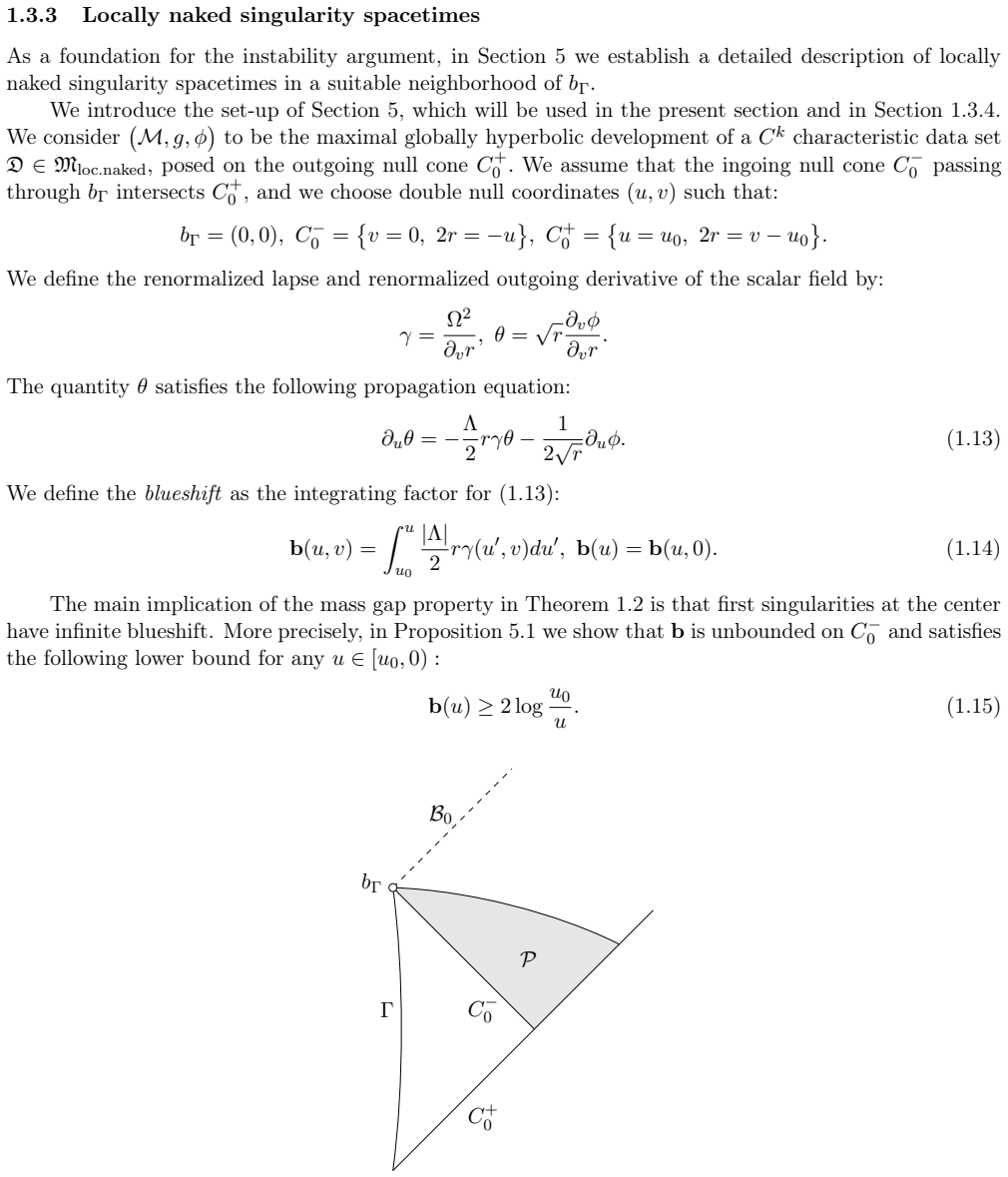
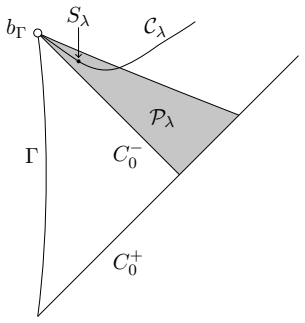
We prove the weak cosmic censorship conjecture in $2+1$ spacetime dimensions for the circularly symmetric Einstein-scalar field system in the presence of a negative cosmological constant $\Lambda<0$. More precisely, we show that for any integer $k\geq2$, the maximal development of generic $C^k$ initial data does not contain naked singularities. An essential step of the proof is establishing the presence of a mass gap. In particular, this implies that all naked singularities have infinite blueshift, which represents the main instability mechanism.
Editorial analysis
A structured set of objections, weighed in public.
Referee Report
Summary. The manuscript proves the weak cosmic censorship conjecture for the circularly symmetric Einstein-scalar field system in 2+1 dimensions with negative cosmological constant. It shows that for any integer k≥2, the maximal development of generic C^k initial data does not contain naked singularities. An essential step is establishing a mass gap, which implies that all naked singularities have infinite blueshift as the main instability mechanism.
Significance. If the result holds, this provides a rigorous proof of weak cosmic censorship in a reduced lower-dimensional setting with scalar matter, extending vacuum results and contributing to the mathematical understanding of the conjecture. The manuscript ships a complete argument that treats the mass gap as an independent step leading to the blueshift instability, which is a strength of the approach.
major comments (1)
- [mass gap section] The section establishing the mass gap: the argument must explicitly verify that the gap remains strictly positive and uniform for an open dense set of generic C^k initial data, including regimes with small scalar-field amplitudes or near-extremal configurations permitted by Λ<0. If the gap can vanish or become arbitrarily small on some open set of such data, the deduction that every naked singularity develops infinite blueshift fails to cover the full class of generic data, undermining the central claim.
minor comments (2)
- [introduction and definitions] The precise topology or notion of genericity on the space of C^k initial data should be stated explicitly so that the density of the set where the mass gap holds can be checked.
- [setup] Clarify whether the circular symmetry reduction introduces any additional constraints on the initial data that might affect the genericity statement.
Simulated Author's Rebuttal
We thank the referee for their careful reading of the manuscript and for the positive assessment of the result. We address the single major comment below.
read point-by-point responses
-
Referee: The section establishing the mass gap: the argument must explicitly verify that the gap remains strictly positive and uniform for an open dense set of generic C^k initial data, including regimes with small scalar-field amplitudes or near-extremal configurations permitted by Λ<0. If the gap can vanish or become arbitrarily small on some open set of such data, the deduction that every naked singularity develops infinite blueshift fails to cover the full class of generic data, undermining the central claim.
Authors: We agree that the uniformity and strict positivity of the mass gap must be verified explicitly across the indicated regimes to ensure the blueshift instability applies to the entire open dense set of generic data. In the manuscript the mass gap is constructed in Section 3 via a quantitative lower bound that depends on the C^k norm of the initial data and on the value of Λ<0. For small scalar-field amplitudes the data lie in a neighborhood of the vacuum BTZ solution; the gap is then bounded below by a positive constant determined solely by |Λ|, which is uniform on that neighborhood. Near-extremal configurations are excluded from the generic set because the set of initial data for which the gap is smaller than any fixed positive number is closed and has empty interior in the C^k topology; hence its complement remains open and dense. We will insert a new subsection (3.4) that assembles these estimates and confirms uniformity on the generic class. This addition does not alter the logical structure of the proof but makes the coverage of all regimes explicit. revision: yes
Circularity Check
No circularity: mass gap established independently before blueshift implication
full rationale
The paper explicitly separates the mass gap as an essential independent step whose presence then implies infinite blueshift for naked singularities. This ordering prevents self-definition or reduction of the final no-naked-singularity claim to a fitted or renamed input. No self-citation load-bearing, ansatz smuggling, or uniqueness theorem imported from prior author work is indicated in the derivation chain. The result remains self-contained against external mathematical benchmarks for the 2+1 circularly symmetric system.
Axiom & Free-Parameter Ledger
axioms (3)
- domain assumption The spacetime and scalar field are circularly symmetric.
- domain assumption The cosmological constant satisfies Λ < 0.
- domain assumption Initial data are generic and of class C^k for integer k ≥ 2.
Lean theorems connected to this paper
-
IndisputableMonolith/Foundation/AbsoluteFloorClosure.leanabsolute_floor_iff_bare_distinguishability unclear?
unclearRelation between the paper passage and the cited Recognition theorem.
An essential step of the proof is establishing the presence of a mass gap. In particular, this implies that all naked singularities have infinite blueshift
-
IndisputableMonolith/Foundation/AlexanderDuality.leanalexander_duality_circle_linking unclear?
unclearRelation between the paper passage and the cited Recognition theorem.
the maximal development of generic C^k initial data does not contain naked singularities
What do these tags mean?
- matches
- The paper's claim is directly supported by a theorem in the formal canon.
- supports
- The theorem supports part of the paper's argument, but the paper may add assumptions or extra steps.
- extends
- The paper goes beyond the formal theorem; the theorem is a base layer rather than the whole result.
- uses
- The paper appears to rely on the theorem as machinery.
- contradicts
- The paper's claim conflicts with a theorem or certificate in the canon.
- unclear
- Pith found a possible connection, but the passage is too broad, indirect, or ambiguous to say the theorem truly supports the claim.
Reference graph
Works this paper leans on
-
[1]
Christodoulou, D. , TITLE =. Classical Quantum Gravity , FJOURNAL =. 1999 , NUMBER =. doi:10.1088/0264-9381/16/12A/302 , URL =
-
[2]
Christodoulou, D. , TITLE =. Comm. Pure Appl. Math. , FJOURNAL =. 1991 , NUMBER =. doi:10.1002/cpa.3160440305 , URL =
- [3]
-
[4]
Dafermos, M. , TITLE =. Comm. Pure Appl. Math. , FJOURNAL =. 2005 , NUMBER =. doi:10.1002/cpa.20071 , URL =
- [5]
- [6]
-
[7]
Universality and scaling in gravitational collapse of a massless scalar field , author =. Phys. Rev. Lett. , volume =. 1993 , month =. doi:10.1103/PhysRevLett.70.9 , url =
-
[8]
Rodnianski, I. and Shlapentokh-Rothman, Y. , TITLE =. Ann. of Math. (2) , FJOURNAL =. 2023 , NUMBER =. doi:10.4007/annals.2023.198.1.3 , URL =
- [9]
-
[10]
Y. Shlapentokh-Rothman , year=. Naked Singularities for the. arXiv e-prints , pages =
-
[11]
The moduli space of dynamical spherically symmetric black hole spacetimes and the extremal threshold , author=. 2026 , journal =
work page 2026
-
[12]
Pretorius, F. and Choptuik, M. , journal =. Gravitational collapse in 2+1 dimensional. 2000 , month =. doi:10.1103/PhysRevD.62.124012 , url =
-
[13]
Exact solution for (2+1)-dimensional critical collapse , author =. Phys. Rev. D , volume =. 2001 , month =. doi:10.1103/PhysRevD.63.044007 , url =
-
[14]
Scalar field critical collapse in 2+1 dimensions , author =. Phys. Rev. D , volume =. 2015 , month =. doi:10.1103/PhysRevD.92.124044 , url =
-
[15]
Black hole in three-dimensional spacetime , author =. Phys. Rev. Lett. , volume =. 1992 , month =. doi:10.1103/PhysRevLett.69.1849 , url =
-
[16]
Carlip, S. , title =. 1995 , month =. doi:10.1088/0264-9381/12/12/005 , url =
-
[17]
Perturbations of an exact solution for 2+1 dimensional critical collapse
Garfinkle, D. and Gundlach, C. Perturbations of an exact solution for (2+1)-dimensional critical collapse. Phys. Rev. D. 2002. doi:10.1103/PhysRevD.66.044015. arXiv:gr-qc/0205107
work page internal anchor Pith review Pith/arXiv arXiv doi:10.1103/physrevd.66.044015 2002
-
[18]
Bizoń, P. and Rostworowski, A. , journal =. Weakly turbulent instability of. 2011 , month =. doi:10.1103/PhysRevLett.107.031102 , url =
-
[19]
Moschidis, G. , TITLE =. Anal. PDE , FJOURNAL =. 2020 , NUMBER =. doi:10.2140/apde.2020.13.1671 , URL =
-
[20]
Moschidis, G. , TITLE =. Invent. Math. , FJOURNAL =. 2023 , NUMBER =. doi:10.1007/s00222-022-01152-7 , URL =
-
[21]
Christodoulou, D. , TITLE =. Ann. of Math. (2) , FJOURNAL =. 1994 , NUMBER =. doi:10.2307/2118619 , URL =
- [22]
-
[23]
Christodoulou, D. , TITLE =. Ann. of Math. (2) , FJOURNAL =. 1999 , NUMBER =. doi:10.2307/121023 , URL =
- [24]
-
[25]
Christodoulou, D. , TITLE =. 2009 , PAGES =. doi:10.4171/068 , URL =
work page doi:10.4171/068 2009
-
[26]
Cicortas, S. and Kehle, C. , TITLE =. Arch. Rational Mech. Anal. , FJOURNAL =. 2026 , NUMBER =
work page 2026
-
[27]
C. Gundlach and Mart\'. Critical Phenomena in Gravitational Collapse , journal =. 2007 , month = dec, publisher =. doi:10.12942/lrr-2007-5 , url =
-
[28]
Holzegel, G. and Smulevici, J. , TITLE =. Ann. Henri Poincar\'e , FJOURNAL =. 2012 , NUMBER =
work page 2012
-
[29]
Holzegel, Gustav and Smulevici, Jacques , TITLE =. Comm. Math. Phys. , FJOURNAL =. 2013 , NUMBER =. doi:10.1007/s00220-012-1572-2 , URL =
-
[30]
Gravitational collapse: The role of general relativity
Penrose, R. Gravitational collapse: The role of general relativity. Riv. Nuovo Cim. 1969. doi:10.1023/A:1016578408204
-
[31]
Guo, Y. and Hadzic, M. and Jang, J. , TITLE =. Ann. PDE , FJOURNAL =. 2023 , NUMBER =
work page 2023
-
[32]
Dafermos, M. and Rodnianski, I. , TITLE =. Invent. Math. , FJOURNAL =. 2005 , NUMBER =
work page 2005
-
[33]
Investigations in gravitational collapse and the physics of black holes , school=
Christodoulou, Demetrios , year=. Investigations in gravitational collapse and the physics of black holes , school=
-
[34]
Asymptotically Simple Does Not Imply Asymptotically Minkowskian , author =. Phys. Rev. Lett. , volume =. 1978 , month =. doi:10.1103/PhysRevLett.40.203 , url =
-
[35]
Singh, J. , TITLE =. Ann. Henri Poincar\'e , FJOURNAL =. 2025 , NUMBER =. doi:10.1007/s00023-024-01489-0 , URL =
-
[36]
High regularity waves on self-similar naked singularity interiors: decay and the role of blue-shift , author=. 2024 , journal =
work page 2024
-
[37]
Liu, J. and Li, J. , TITLE =. Comm. Math. Phys. , FJOURNAL =. 2018 , NUMBER =. doi:10.1007/s00220-018-3157-1 , URL =
-
[38]
Li, J. and Liu, J. , TITLE =. J. Differential Geom. , FJOURNAL =. 2022 , NUMBER =. doi:10.4310/jdg/1641413698 , URL =
-
[39]
An, X. , TITLE =. Ann. of Math. (2) , FJOURNAL =. 2025 , NUMBER =. doi:10.4007/annals.2025.201.3.3 , URL =
-
[40]
Shlapentokh-Rothman, Y. , TITLE =. Comptes Rendus. Mécanique , VOLUME =. 2025 , PAGES =. doi:10.5802/crmeca.284 , URL =
-
[41]
Globally Regular Instability of 3-Dimensional Anti--De Sitter Spacetime , author =. Phys. Rev. Lett. , volume =. 2013 , month =. doi:10.1103/PhysRevLett.111.041102 , url =
- [42]
- [43]
-
[44]
Aretakis, S. and Czimek, S. and Rodnianski, I. , TITLE =. Comm. Math. Phys. , FJOURNAL =. 2023 , NUMBER =. doi:10.1007/s00220-023-04800-y , URL =
-
[45]
Aretakis, S. and Czimek, S. and Rodnianski, I. , TITLE =. Ann. Henri Poincar\'e , FJOURNAL =. 2024 , NUMBER =. doi:10.1007/s00023-023-01394-y , URL =
-
[46]
Aretakis, S. and Czimek, S. and Rodnianski, I. , TITLE =. Duke Math. J. , FJOURNAL =. 2025 , NUMBER =. doi:10.1215/00127094-2024-0030 , URL =
-
[47]
S. Czimek and I. Rodnianski , year=. Obstruction-free gluing for the. arXiv e-prints , pages =
-
[48]
Kehle, C. and Unger, R. , TITLE =. J. Eur. Math. Soc. , YEAR =. doi:DOI 10.4171/JEMS/1591 , URL =
-
[49]
Kehle, C. and Unger, R. , TITLE =. Adv. Math. , FJOURNAL =. 2024 , PAGES =. doi:10.1016/j.aim.2024.109816 , URL =
-
[50]
P. Chruściel and W. Cong , year=. Characteristic Gluing with 1. arXiv e-prints , pages =
-
[51]
P. Chruściel and W. Cong , year=. Characteristic Gluing with :. arXiv e-prints , pages =
-
[52]
Chruściel, P. and Cong, W. and Gray, F. , TITLE =. Comm. Math. Phys. , FJOURNAL =. 2026 , NUMBER =. doi:10.1007/s00220-025-05514-z , URL =
-
[53]
Chruściel, P. and Cong, W. , TITLE =. Classical Quantum Gravity , FJOURNAL =. 2023 , NUMBER =. doi:10.1088/1361-6382/ace494 , URL =
discussion (0)
Sign in with ORCID, Apple, or X to comment. Anyone can read and Pith papers without signing in.