Search for Higgs boson decays into two neutral scalars with unequal masses in final states with b quarks and tau leptons in proton-proton collisions at sqrt{s} = 13 TeV
Pith reviewed 2026-05-20 07:00 UTC · model grok-4.3
pith:JCNDYBT7 Add to your LaTeX paper
What is a Pith Number?\usepackage{pith}
\pithnumber{JCNDYBT7}
Prints a linked pith:JCNDYBT7 badge after your title and writes the identifier into PDF metadata. Compiles on arXiv with no extra files. Learn more
The pith
CMS finds no significant excess in its search for Higgs boson decays to pairs of neutral scalars with unequal masses in b-tau final states.
A machine-rendered reading of the paper's core claim, the machinery that carries it, and where it could break.
Core claim
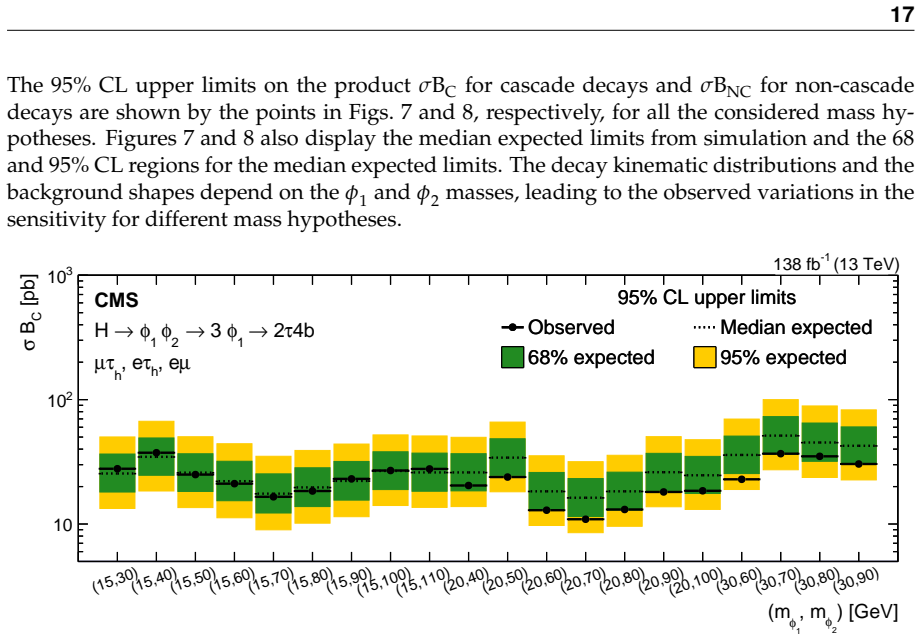
No statistically significant excess over the standard model expectation is observed. Upper limits are set on the products σ ℬ(H → φ1φ2 → 3φ1 → 2τ4b) and σ ℬ(H → φ1φ2) ℬ(φ1 → 2τ) ℬ(φ2 → 2b), ranging between 0.9 and 36.8 pb at 95% confidence level depending on the mass hypothesis and decay scenario.
What carries the argument
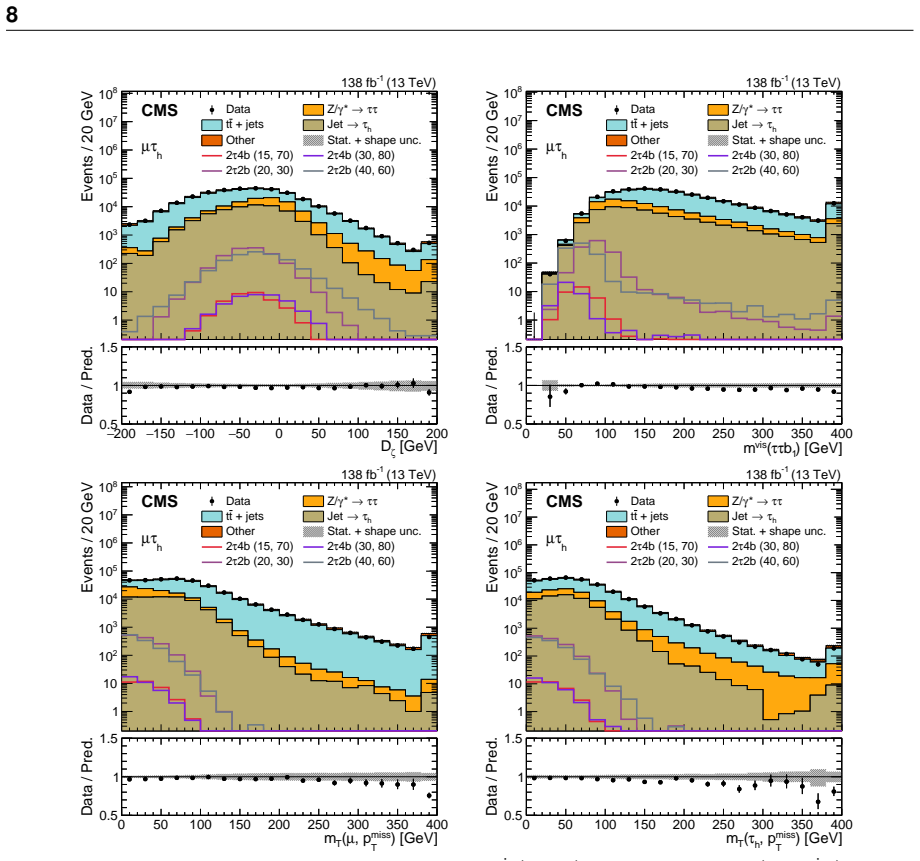
Reconstruction of final states containing two b-tagged jets and two tau leptons, with signal templates generated for hypothesized masses of φ1 and φ2 and compared to data via statistical fits that extract upper limits on signal strength.
If this is right
- The absence of signal constrains the allowed parameter space for extensions of the Higgs sector that include additional neutral scalars decaying to taus and b quarks.
- For any given pair of scalar masses, the Higgs production rate times the branching fraction to the considered final state is bounded above by the quoted limit values.
- The cascade decay scenario φ2 → φ1φ1 is treated separately from the direct decay, each receiving its own set of mass-dependent limits.
- These results apply only to the specific final-state topology with one φ1 decaying to taus and the other to b quarks or to two additional φ1 particles.
Where Pith is reading between the lines
- Similar searches in other final states such as four b quarks or four taus could be combined with these results to strengthen overall constraints on the same scalar models.
- The mass-dependent nature of the limits implies that future data sets with higher luminosity will be most effective at excluding or discovering signals in the regions where current bounds are weakest.
- If a signal appears at higher energies or luminosities, the reported background modeling techniques could be reused as a baseline for the new observation.
Load-bearing premise
The standard model background processes are accurately modeled and the signal efficiencies for the hypothesized scalar masses are correctly estimated from simulations.
What would settle it
A statistically significant excess of events in one or more mass hypotheses that cannot be accounted for by adjustments to the background model would indicate a signal and invalidate the reported upper limits.
Figures





read the original abstract
A search for Higgs boson (H) decays into a pair of neutral scalars $\phi_1$ and $\phi_2$, with $\phi_2$ heavier than $\phi_1$, is performed in final states with b quarks and tau leptons. Depending on the masses of the neutral scalars, $\phi_2$ can undergo a cascade decay into $\phi_1\phi_1$. For both the cascade and non-cascade scenarios, one $\phi_1$ is required to decay to a pair of tau leptons. Proton-proton collision data corresponding to an integrated luminosity of 138 fb$^{-1}$ collected with the CMS detector at the LHC at $\sqrt{s}$ = 13 TeV are analyzed. No statistically significant excess over the standard model expectation is observed. Upper limits are set on the products $\sigma \mathcal{B}$(H $\to$ $\phi_1\phi_2$ $\to$ 3$\phi_1$ $\to$ 2$\tau$4b) and $\sigma \mathcal{B}$(H $\to$ $\phi_1\phi_2$) $\mathcal{B}$($\phi_1$ $\to$ 2$\tau$) $\mathcal{B}$($\phi_2$ $\to$ 2b) where $\sigma$ is the Higgs boson production cross section. The observed upper limits range between 0.9 and 36.8 pb at 95% confidence level, depending on the mass hypothesis and decay scenario.
Editorial analysis
A structured set of objections, weighed in public.
Referee Report
Summary. The paper reports a search for Higgs boson decays to two neutral scalars φ1 and φ2 (with m_φ2 > m_φ1) in final states containing b quarks and tau leptons, using 138 fb^{-1} of CMS proton-proton collision data at √s = 13 TeV. It considers both non-cascade (H → φ1φ2 with φ1 → ττ, φ2 → bb) and cascade (H → φ1φ2 → 3φ1 with φ1 → ττ) scenarios. No statistically significant excess over Standard Model expectations is observed, and 95% CL upper limits are set on the products σB(H → φ1φ2 → 3φ1 → 2τ4b) and σB(H → φ1φ2) B(φ1 → 2τ) B(φ2 → 2b), ranging from 0.9 to 36.8 pb depending on the mass hypothesis.
Significance. If the background modeling and signal efficiencies hold, this provides useful constraints on extended Higgs sectors and exotic decays of the 125 GeV Higgs boson. The analysis covers a range of mass hypotheses for the scalars and employs standard CMS techniques including data-driven background estimation in control regions, b-tagging and tau identification scale factors, and systematic variations. This strengthens the result as a reliable null-search outcome that can guide BSM model building.
minor comments (2)
- The abstract would benefit from a brief statement on the background estimation approach (e.g., data-driven methods in control regions) to improve standalone readability without requiring the full text.
- In the results section, the discussion of how signal efficiencies vary with mass hypotheses could be expanded to explicitly address whether efficiency losses at extreme mass differences impact the quoted limit range.
Simulated Author's Rebuttal
We thank the referee for their careful review of our manuscript and for recommending minor revision. The referee's summary accurately reflects the scope and results of our search for Higgs boson decays to two neutral scalars with unequal masses in the b-quark and tau-lepton final states. No major comments were raised in the report.
Circularity Check
No significant circularity identified
full rationale
The paper is an experimental search in hep-ex that reports no statistically significant excess in collision data over Standard Model backgrounds and derives 95% CL upper limits on signal cross-section times branching fractions. The derivation chain consists of event selection, background estimation (including data-driven methods in control regions), signal efficiency from Monte Carlo, and statistical limit-setting via likelihood fits. None of these steps reduce by construction to self-referential inputs, fitted parameters renamed as predictions, or load-bearing self-citations; the result is directly falsifiable against external data and follows standard CMS procedures with quoted uncertainties.
Axiom & Free-Parameter Ledger
axioms (2)
- domain assumption Standard Model processes accurately describe the expected background in the selected b-tau final states.
- domain assumption Monte Carlo simulations correctly predict signal acceptance and efficiency across the scanned mass hypotheses.
invented entities (2)
-
neutral scalar φ1
no independent evidence
-
neutral scalar φ2
no independent evidence
Lean theorems connected to this paper
-
IndisputableMonolith/Foundation/RealityFromDistinction.leanreality_from_one_distinction unclear?
unclearRelation between the paper passage and the cited Recognition theorem.
No statistically significant excess over the standard model expectation is observed. Upper limits are set on the products σ ℬ(H → ϕ1ϕ2 → 3ϕ1 → 2τ4b) and σ ℬ(H → ϕ1ϕ2) ℬ(ϕ1 → 2τ) ℬ(ϕ2 → 2b) ... range between 0.9 and 36.8 pb at 95% CL
What do these tags mean?
- matches
- The paper's claim is directly supported by a theorem in the formal canon.
- supports
- The theorem supports part of the paper's argument, but the paper may add assumptions or extra steps.
- extends
- The paper goes beyond the formal theorem; the theorem is a base layer rather than the whole result.
- uses
- The paper appears to rely on the theorem as machinery.
- contradicts
- The paper's claim conflicts with a theorem or certificate in the canon.
- unclear
- Pith found a possible connection, but the passage is too broad, indirect, or ambiguous to say the theorem truly supports the claim.
Reference graph
Works this paper leans on
-
[1]
S. Weinberg, “A model of leptons”,Phys. Rev. Lett.19(1967) 1264, doi:10.1103/PhysRevLett.19.1264
-
[2]
Weak and electromagnetic interactions
A. Salam, “Weak and electromagnetic interactions”,Conf. Proc. C680519(1968) 367, doi:10.1142/9789812795915_0034
-
[3]
Broken symmetry and the mass of gauge vector mesons
F. Englert and R. Brout, “Broken symmetry and the mass of gauge vector mesons”, Phys. Rev. Lett.13(1964) 321,doi:10.1103/PhysRevLett.13.321
-
[4]
Broken symmetries, massless particles and gauge fields
P . W. Higgs, “Broken symmetries, massless particles and gauge fields”,Phys. Lett.12 (1964) 132,doi:10.1016/0031-9163(64)91136-9
-
[5]
Broken symmetries and the masses of gauge bosons
P . W. Higgs, “Broken symmetries and the masses of gauge bosons”,Phys. Rev. Lett.13 (1964) 508,doi:10.1103/PhysRevLett.13.508
-
[6]
Global conservation laws and massless particles
G. S. Guralnik, C. R. Hagen, and T. W. B. Kibble, “Global conservation laws and massless particles”,Phys. Rev. Lett.13(1964) 585,doi:10.1103/PhysRevLett.13.585
-
[7]
Spontaneous symmetry breakdown without massless bosons
P . W. Higgs, “Spontaneous symmetry breakdown without massless bosons”,Phys. Rev. 145(1966) 1156,doi:10.1103/PhysRev.145.1156
-
[8]
Symmetry breaking in non-Abelian gauge theories
T. W. B. Kibble, “Symmetry breaking in non-Abelian gauge theories”,Phys. Rev.155 (1967) 1554,doi:10.1103/PhysRev.155.1554
-
[9]
ATLAS Collaboration, “Observation of a new particle in the search for the standard model Higgs boson with the ATLAS detector at the LHC”,Phys. Lett. B716(2012) 1, doi:10.1016/j.physletb.2012.08.020,arXiv:1207.7214
work page internal anchor Pith review Pith/arXiv arXiv doi:10.1016/j.physletb.2012.08.020 2012
-
[10]
Observation of a new boson at a mass of 125 GeV with the CMS experiment at the LHC
CMS Collaboration, “Observation of a new boson at a mass of 125 GeV with the CMS experiment at the LHC”,Phys. Lett. B716(2012) 30, doi:10.1016/j.physletb.2012.08.021,arXiv:1207.7235
work page internal anchor Pith review Pith/arXiv arXiv doi:10.1016/j.physletb.2012.08.021 2012
-
[11]
Observation of a new boson with mass near 125 GeV in pp collisions at sqrt(s) = 7 and 8 TeV
CMS Collaboration, “Observation of a new boson with mass near 125 GeV in pp collisions at √s= 7 and 8 TeV”,JHEP06(2013) 081, doi:10.1007/JHEP06(2013)081,arXiv:1303.4571
work page internal anchor Pith review Pith/arXiv arXiv doi:10.1007/jhep06(2013)081 2013
-
[12]
A Natural Two-Higgs-Doublet Model
B. Grzadkowski and P . Osland, “Tempered two-Higgs-doublet model”,Phys. Rev. D82 (2010) 125026,doi:10.1103/PhysRevD.82.125026,arXiv:0910.4068
work page internal anchor Pith review Pith/arXiv arXiv doi:10.1103/physrevd.82.125026 2010
-
[13]
Extending two-Higgs-doublet models by a singlet scalar field - the Case for Dark Matter
A. Drozd, B. Grzadkowski, J. F. Gunion, and Y. Jiang, “Extending two-Higgs-doublet models by a singlet scalar field - the case for dark matter”,JHEP11(2014) 105, doi:10.1007/JHEP11(2014)105,arXiv:1408.2106. 22
work page internal anchor Pith review Pith/arXiv arXiv doi:10.1007/jhep11(2014)105 2014
-
[14]
A portrait of the Higgs boson by the CMS experiment ten years after the discovery
CMS Collaboration, “A portrait of the Higgs boson by the CMS experiment ten years after the discovery.”,Nature607(2022) 60,doi:10.1038/s41586-022-04892-x, arXiv:2207.00043. [Erratum:doi:10.1038/s41586-023-06164-8]
-
[15]
A detailed map of Higgs boson interactions by the ATLAS experiment ten years after the discovery
ATLAS Collaboration, “A detailed map of Higgs boson interactions by the ATLAS experiment ten years after the discovery”,Nature607(2022) 52, doi:10.1038/s41586-022-04893-w,arXiv:2207.00092. [Erratum: doi:10.1038/s41586-023-06248-5]
-
[16]
ATLAS Collaboration, “Search for new light gauge bosons in Higgs boson decays to four-lepton final states in pp collisions at √s=8 TeV with the ATLAS detector at the LHC”,Phys. Rev. D92(2015) 092001,doi:10.1103/PhysRevD.92.092001, arXiv:1505.07645
work page internal anchor Pith review Pith/arXiv arXiv doi:10.1103/physrevd.92.092001 2015
-
[17]
CMS Collaboration, “Search for a non-standard-model Higgs boson decaying to a pair of new light bosons in four-muon final states”,Phys. Lett. B726(2013) 564, doi:10.1016/j.physletb.2013.09.009,arXiv:1210.7619
work page internal anchor Pith review Pith/arXiv arXiv doi:10.1016/j.physletb.2013.09.009 2013
-
[18]
A search for pair production of new light bosons decaying into muons
CMS Collaboration, “A search for pair production of new light bosons decaying into muons”,Phys. Lett. B752(2016) 146,doi:10.1016/j.physletb.2015.10.067, arXiv:1506.00424
work page internal anchor Pith review Pith/arXiv arXiv doi:10.1016/j.physletb.2015.10.067 2016
-
[19]
CMS Collaboration, “Search for light bosons in decays of the 125 GeV Higgs boson in proton-proton collisions at √s=8 TeV”,JHEP10(2017) 076, doi:10.1007/JHEP10(2017)076,arXiv:1701.02032
work page internal anchor Pith review Pith/arXiv arXiv doi:10.1007/jhep10(2017)076 2017
-
[20]
CMS Collaboration, “Search for a very light NMSSM Higgs boson produced in decays of the 125 GeV scalar boson and decaying intoτleptons in pp collisions at √s=8 TeV”, JHEP01(2016) 079,doi:10.1007/JHEP01(2016)079,arXiv:1510.06534
work page internal anchor Pith review Pith/arXiv arXiv doi:10.1007/jhep01(2016)079 2016
-
[21]
ATLAS Collaboration, “Search for new phenomena in events with at least three photons collected in pp collisions at √s= 8 TeV with the ATLAS detector”,Eur. Phys. J. C76 (2016) 210,doi:10.1140/epjc/s10052-016-4034-8,arXiv:1509.05051
work page internal anchor Pith review Pith/arXiv arXiv doi:10.1140/epjc/s10052-016-4034-8 2016
-
[22]
ATLAS Collaboration, “Search for Higgs boson decays to beyond-the-standard-model light bosons in four-lepton events with the ATLAS detector at √s=13 TeV”,JHEP06 (2018) 166,doi:10.1007/JHEP06(2018)166,arXiv:1802.03388
work page internal anchor Pith review Pith/arXiv arXiv doi:10.1007/jhep06(2018)166 2018
-
[23]
CMS Collaboration, “A search for pair production of new light bosons decaying into muons in proton-proton collisions at 13 TeV”,Phys. Lett. B796(2019) 131, doi:10.1016/j.physletb.2019.07.013,arXiv:1812.00380
work page internal anchor Pith review Pith/arXiv arXiv doi:10.1016/j.physletb.2019.07.013 2019
-
[24]
ATLAS Collaboration, “Search for Higgs bosons decaying to aa in theµµττfinal state in pp collisions at √s=8 TeV with the ATLAS experiment”,Phys. Rev. D92(2015) 052002,doi:10.1103/PhysRevD.92.052002,arXiv:1505.01609
work page internal anchor Pith review Pith/arXiv arXiv doi:10.1103/physrevd.92.052002 2015
-
[25]
CMS Collaboration, “Search for an exotic decay of the Higgs boson to a pair of light pseudoscalars in the final state of two muons and twoτleptons in proton-proton collisions at √s=13 TeV”,JHEP11(2018) 018,doi:10.1007/JHEP11(2018)018, arXiv:1805.04865
work page internal anchor Pith review Pith/arXiv arXiv doi:10.1007/jhep11(2018)018 2018
-
[26]
CMS Collaboration, “Search for a light pseudoscalar Higgs boson in the boostedµµττ final state in proton-proton collisions at √s=13 TeV”,JHEP08(2020) 139, doi:10.1007/JHEP08(2020)139,arXiv:2005.08694. References 23
-
[27]
ATLAS Collaboration, “Search for Higgs boson decays into a pair of light bosons in the bbµµfinal state in pp collision at √s=13 TeV with the ATLAS detector”,Phys. Lett. B 790(2019) 1,doi:10.1016/j.physletb.2018.10.073,arXiv:1807.00539
work page internal anchor Pith review Pith/arXiv arXiv doi:10.1016/j.physletb.2018.10.073 2019
-
[28]
CMS Collaboration, “Search for exotic decays of the Higgs boson to a pair of pseudoscalars in theµµbb andττbb final states”,Eur. Phys. J. C84(2024) 493, doi:10.1140/epjc/s10052-024-12727-4,arXiv:2402.13358
-
[29]
ATLAS Collaboration, “Search for Higgs boson decays into pairs of light (pseudo)scalar particles in theγγjj final state in pp collisions at √s=13 TeV with the ATLAS detector”, Phys. Lett. B782(2018) 750,doi:10.1016/j.physletb.2018.06.011, arXiv:1803.11145
work page internal anchor Pith review Pith/arXiv arXiv doi:10.1016/j.physletb.2018.06.011 2018
-
[30]
CMS Collaboration, “Search for light pseudoscalar boson pairs produced from decays of the 125 GeV Higgs boson in final states with two muons and two nearby tracks in pp collisions at √s=13 TeV”,Phys. Lett. B800(2020) 135087, doi:10.1016/j.physletb.2019.135087,arXiv:1907.07235
-
[31]
CMS Collaboration, “Search for the decay of the Higgs boson to a pair of light pseudoscalar bosons in the final state with four bottom quarks in proton-proton collisions at √s = 13 TeV”,JHEP06(2024) 097,doi:10.1007/JHEP06(2024)097, arXiv:2403.10341
-
[32]
CMS Collaboration, “Search for the exotic decay of the Higgs boson into two light pseudoscalars with four photons in the final state in proton-proton collisions at √s= 13 TeV”,JHEP07(2023) 148,doi:10.1007/JHEP07(2023)148,arXiv:2208.01469
-
[33]
CMS Collaboration, “Search for exotic Higgs boson decays H→ AA →4γwith events containing two merged diphotons in proton-proton collisions at √s= 13 TeV”,Phys. Rev. Lett.131(2023) 101801,doi:10.1103/PhysRevLett.131.101801, arXiv:2209.06197
-
[34]
CMS Collaboration, “Search for light pseudoscalar boson pairs produced from Higgs boson decays using the 4τand 2µ2τfinal states in proton-proton collisions at √s= 13 TeV”, 2025.arXiv:2508.06947. Accepted byJHEP
work page internal anchor Pith review Pith/arXiv arXiv 2025
-
[35]
CMS Collaboration, “Model-independent search for pair production of new bosons decaying into muons in proton-proton collisions at √s= 13 TeV”,JHEP12(2024) 172, doi:10.1007/JHEP12(2024)172,arXiv:2407.20425
-
[36]
ATLAS Collaboration, “Search for Higgs boson exotic decays into Lorentz-boosted light bosons in the four-τfinal state at √s= 13 TeV with the ATLAS detector”,Phys. Lett. B 870(2025) 139843,doi:10.1016/j.physletb.2025.139843,arXiv:2503.05463
-
[37]
Theory and phenomenology of two-Higgs-doublet models
G. C. Branco et al., “Theory and phenomenology of two-Higgs-doublet models”,Phys. Rept.516(2012) 1,doi:10.1016/j.physrep.2012.02.002,arXiv:1106.0034
work page internal anchor Pith review Pith/arXiv arXiv doi:10.1016/j.physrep.2012.02.002 2012
-
[38]
Supergauge invariant extension of the Higgs mechanism and a model for the electron and its neutrino
P . Fayet, “Supergauge invariant extension of the Higgs mechanism and a model for the electron and its neutrino”,Nucl. Phys. B90(1975) 104, doi:10.1016/0550-3213(75)90636-7
-
[39]
R. K. Kaul and P . Majumdar, “Cancellation of quadratically divergent mass corrections in globally supersymmetric spontaneously broken gauge theories”,Nucl. Phys. B199 (1982) 36,doi:10.1016/0550-3213(82)90565-X. 24
-
[40]
Gauge models with spontaneously broken local supersymmetry
R. Barbieri, S. Ferrara, and C. A. Savoy, “Gauge models with spontaneously broken local supersymmetry”,Phys. Lett. B119(1982) 343, doi:10.1016/0370-2693(82)90685-2
-
[41]
Weak interaction breakdown induced by supergravity
H. P . Nilles, M. Srednicki, and D. Wyler, “Weak interaction breakdown induced by supergravity”,Phys. Lett.120(1983) 346,doi:10.1016/0370-2693(83)90460-4
-
[42]
Fermion masses and induction of the weak scale by supergravity
J. M. Frere, D. R. T. Jones, and S. Raby, “Fermion masses and induction of the weak scale by supergravity”,Nucl. Phys. B222(1983) 11, doi:10.1016/0550-3213(83)90606-5
-
[43]
Quantum effects and SU(2)×U(1) breaking in supergravity gauge theories
J. P . Derendinger and C. A. Savoy, “Quantum effects and SU(2)×U(1) breaking in supergravity gauge theories”,Nucl. Phys. B237(1984) 307, doi:10.1016/0550-3213(84)90162-7
-
[44]
Supersymmetric models with extended Higgs sector
M. Drees, “Supersymmetric models with extended Higgs sector”,Int. J. Mod. Phys. A4 (1989) 3635,doi:10.1142/S0217751X89001448
-
[45]
The Next-to-Minimal Supersymmetric extension of the Standard Model reviewed
M. Maniatis, “The next-to-minimal supersymmetric extension of the standard model reviewed”,Int. J. Mod. Phys. A25(2010) 3505,doi:10.1142/S0217751X10049827, arXiv:0906.0777
work page internal anchor Pith review Pith/arXiv arXiv doi:10.1142/s0217751x10049827 2010
-
[46]
The Next-to-Minimal Supersymmetric Standard Model
U. Ellwanger, C. Hugonie, and A. M. Teixeira, “The next-to-minimal supersymmetric standard model”,Phys. Rept.496(2010) 1, doi:10.1016/j.physrep.2010.07.001,arXiv:0910.1785
work page internal anchor Pith review Pith/arXiv arXiv doi:10.1016/j.physrep.2010.07.001 2010
-
[47]
Weak interaction singlet and strong CP invariance
J. E. Kim, “Weak interaction singlet and strong CP invariance”,Phys. Rev. Lett.43(1979) 103,doi:10.1103/PhysRevLett.43.103
-
[48]
Axions as Dark Matter Particles
L. D. Duffy and K. van Bibber, “Axions as dark matter particles”,New J. Phys11(2009) 105008,doi:10.1088/1367-2630/11/10/105008,arXiv:hep-ph/0904.3346
work page internal anchor Pith review Pith/arXiv arXiv doi:10.1088/1367-2630/11/10/105008 2009
-
[49]
N. Arkani-Hamed, D. P . Finkbeiner, T. R. Slatyer, and N. Weiner, “A theory of dark matter”,Phys. Rev. D79(2009) 015014,doi:10.1103/PhysRevD.79.015014, arXiv:0810.0713
work page internal anchor Pith review Pith/arXiv arXiv doi:10.1103/physrevd.79.015014 2009
-
[50]
Non-Abelian Dark Sectors and Their Collider Signatures
M. Baumgart et al., “Non-Abelian dark sectors and their collider signatures”,JHEP04 (2009) 014,doi:10.1088/1126-6708/2009/04/014,arXiv:0901.0283
work page internal anchor Pith review Pith/arXiv arXiv doi:10.1088/1126-6708/2009/04/014 2009
-
[51]
Hidden Higgs Decaying to Lepton Jets
A. Falkowski, J. T. Ruderman, T. Volansky, and J. Zupan, “Hidden Higgs decaying to lepton jets”,JHEP05(2010) 077,doi:10.1007/JHEP05(2010)077, arXiv:1002.2952
work page internal anchor Pith review Pith/arXiv arXiv doi:10.1007/jhep05(2010)077 2010
-
[52]
Two-real-scalar-singlet extension of the SM: LHC phenomenology and benchmark scenarios
T. Robens, T. Stefaniak, and J. Wittbrodt, “Two-real-scalar-singlet extension of the SM: LHC phenomenology and benchmark scenarios”,Eur. Phys. J. C80(2020) 151, doi:10.1140/epjc/s10052-020-7655-x,arXiv:1908.08554
-
[53]
TRSM benchmark planes - EPS-HEP2023 update
T. Robens, “TRSM benchmark planes - EPS-HEP2023 update”, in2023 European Physical Society Conference on High Energy Physics (EPS-HEP), p. 55. 2024.arXiv:2310.18045. [PoS(EPS-HEP2023)055].doi:10.22323/1.449.0055
-
[54]
CMS Collaboration, “Search for a massive scalar resonance decaying to a light scalar and a Higgs boson in the four b quarks final state with boosted topology”,Phys. Lett. B 842(2023) 137392,doi:10.1016/j.physletb.2022.137392,arXiv:2204.12413. References 25
-
[55]
CMS Collaboration, “Search for a new resonance decaying into two spin-0 bosons in a final state with two photons and two bottom quarks in proton-proton collisions at √s= 13 TeV”,JHEP05(2024) 316,doi:10.1007/JHEP05(2024)316, arXiv:2310.01643
-
[56]
Searches for Higgs boson production through decays of heavy resonances
CMS Collaboration, “Searches for Higgs boson production through decays of heavy resonances”,Phys. Rept.1115(2025) 368,doi:10.1016/j.physrep.2024.09.004, arXiv:2403.16926
-
[57]
ATLAS Collaboration, “Search for decays of the Higgs boson into scalar particles decaying into four or six b-quarks using pp collisions at √s=13 TeV with the ATLAS detector”,Phys. Rev. D112(2025) 072005,doi:10.1103/mzld-ldlt, arXiv:2507.01165
-
[58]
HEPData record for this analysis, 2026.doi:10.17182/hepdata.172650
-
[59]
The CMS experiment at the CERN LHC
CMS Collaboration, “The CMS experiment at the CERN LHC”,JINST3(2008) S08004, doi:10.1088/1748-0221/3/08/S08004
-
[60]
Development of the CMS detector for the CERN LHC Run 3
CMS Collaboration, “Development of the CMS detector for the CERN LHC Run 3”, JINST19(2024) P05064,doi:10.1088/1748-0221/19/05/P05064, arXiv:2309.05466
-
[61]
Performance of the CMS Level-1 trigger in proton-proton collisions at √s=13 TeV
CMS Collaboration, “Performance of the CMS Level-1 trigger in proton-proton collisions at √s=13 TeV”,JINST15(2020) P10017, doi:10.1088/1748-0221/15/10/P10017,arXiv:2006.10165
-
[62]
CMS Collaboration, “The CMS trigger system”,JINST12(2017) P01020, doi:10.1088/1748-0221/12/01/P01020,arXiv:1609.02366
work page internal anchor Pith review Pith/arXiv arXiv doi:10.1088/1748-0221/12/01/p01020 2017
-
[63]
Performance of the CMS high-level trigger during LHC Run 2
CMS Collaboration, “Performance of the CMS high-level trigger during LHC Run 2”, JINST19(2024) P11021,doi:10.1088/1748-0221/19/11/P11021, arXiv:2410.17038
-
[64]
Electron and photon reconstruction and identification with the CMS experiment at the CERN LHC
CMS Collaboration, “Electron and photon reconstruction and identification with the CMS experiment at the CERN LHC”,JINST16(2021) P05014, doi:10.1088/1748-0221/16/05/P05014,arXiv:2012.06888
-
[65]
CMS Collaboration, “Performance of the CMS muon detector and muon reconstruction with proton-proton collisions at √s=13 TeV”,JINST13(2018) P06015, doi:10.1088/1748-0221/13/06/P06015,arXiv:1804.04528
work page internal anchor Pith review Pith/arXiv arXiv doi:10.1088/1748-0221/13/06/p06015 2018
-
[66]
Description and performance of track and primary-vertex reconstruction with the CMS tracker
CMS Collaboration, “Description and performance of track and primary-vertex reconstruction with the CMS tracker”,JINST9(2014) P10009, doi:10.1088/1748-0221/9/10/P10009,arXiv:1405.6569
work page internal anchor Pith review Pith/arXiv arXiv doi:10.1088/1748-0221/9/10/p10009 2014
-
[67]
T. Sj ¨ostrand et al., “An Introduction to PYTHIA 8.2”,Comput. Phys. Commun.191 (2015) 159,doi:10.1016/j.cpc.2015.01.024,arXiv:1410.3012
work page internal anchor Pith review Pith/arXiv arXiv doi:10.1016/j.cpc.2015.01.024 2015
-
[68]
GEANT4 Collaboration, “GEANT4—a simulation toolkit”,Nucl. Instrum. Meth. A506 (2003) 250,doi:10.1016/S0168-9002(03)01368-8
-
[69]
J. Alwall et al., “Comparative study of various algorithms for the merging of parton showers and matrix elements in hadronic collisions”,Eur. Phys. J. C53(2008) 473, doi:10.1140/epjc/s10052-007-0490-5,arXiv:0706.2569. 26
work page internal anchor Pith review Pith/arXiv arXiv doi:10.1140/epjc/s10052-007-0490-5 2008
-
[70]
NLO Higgs boson production via gluon fusion matched with shower in POWHEG
S. Alioli, P . Nason, C. Oleari, and E. Re, “NLO Higgs boson production via gluon fusion matched with shower in POWHEG”,JHEP04(2009) 002, doi:10.1088/1126-6708/2009/04/002,arXiv:0812.0578
work page internal anchor Pith review Pith/arXiv arXiv doi:10.1088/1126-6708/2009/04/002 2009
-
[71]
Higgs production via gluon fusion in the POWHEG approach in the SM and in the MSSM
E. Bagnaschi, G. Degrassi, P . Slavich, and A. Vicini, “Higgs production via gluon fusion in the POWHEG approach in the SM and in the MSSM”,JHEP02(2012) 088, doi:10.1007/JHEP02(2012)088,arXiv:1111.2854
work page internal anchor Pith review Pith/arXiv arXiv doi:10.1007/jhep02(2012)088 2012
-
[72]
NLO Higgs boson production via vector-boson fusion matched with shower in POWHEG
P . Nason and C. Oleari, “NLO Higgs boson production via vector-boson fusion matched with shower in POWHEG”,JHEP02(2010) 037,doi:10.1007/JHEP02(2010)037, arXiv:0911.5299
work page internal anchor Pith review Pith/arXiv arXiv doi:10.1007/jhep02(2010)037 2010
-
[73]
HW/HZ + 0 and 1 jet at NLO with the POWHEG BOX interfaced to GoSam and their merging within MiNLO
G. Luisoni, P . Nason, C. Oleari, and F. Tramontano, “HW±/HZ + 0 and 1 jet at NLO with the POWHEG BOX interfaced to GoSam and their merging within MiNLO”,JHEP 10(2013) 083,doi:10.1007/JHEP10(2013)083,arXiv:1306.2542
work page internal anchor Pith review Pith/arXiv arXiv doi:10.1007/jhep10(2013)083 2013
-
[74]
Higgs boson production in association with top quarks in the POWHEG BOX
H. B. Hartanto, B. Jager, L. Reina, and D. Wackeroth, “Higgs boson production in association with top quarks in the POWHEG BOX”,Phys. Rev. D91(2015) 094003, doi:10.1103/PhysRevD.91.094003,arXiv:1501.04498
work page internal anchor Pith review Pith/arXiv arXiv doi:10.1103/physrevd.91.094003 2015
-
[75]
Handbook of LHC Higgs Cross Sections: 4. Deciphering the Nature of the Higgs Sector
D. de Florian et al., “Handbook of LHC Higgs cross sections: 4. Deciphering the nature of the Higgs sector”, CERN Report CERN-2017-002-M, 2016. doi:10.23731/CYRM-2017-002,arXiv:1610.07922
work page internal anchor Pith review Pith/arXiv arXiv doi:10.23731/cyrm-2017-002 2017
-
[76]
An embedding technique to determine $\tau\tau$ backgrounds in proton-proton collision data
CMS Collaboration, “An embedding technique to determineττbackgrounds in proton-proton collision data”,JINST14(2019) P06032, doi:10.1088/1748-0221/14/06/P06032,arXiv:1903.01216
work page internal anchor Pith review Pith/arXiv arXiv doi:10.1088/1748-0221/14/06/p06032 2019
-
[77]
A New Method for Combining NLO QCD with Shower Monte Carlo Algorithms
P . Nason, “A new method for combining NLO QCD with shower Monte Carlo algorithms”,JHEP11(2004) 040,doi:10.1088/1126-6708/2004/11/040, arXiv:hep-ph/0409146
work page internal anchor Pith review Pith/arXiv arXiv doi:10.1088/1126-6708/2004/11/040 2004
-
[78]
Matching NLO QCD computations with Parton Shower simulations: the POWHEG method
S. Frixione, P . Nason, and C. Oleari, “Matching NLO QCD computations with parton shower simulations: the POWHEG method”,JHEP11(2007) 070, doi:10.1088/1126-6708/2007/11/070,arXiv:0709.2092
work page internal anchor Pith review Pith/arXiv arXiv doi:10.1088/1126-6708/2007/11/070 2007
-
[79]
A general framework for implementing NLO calculations in shower Monte Carlo programs: the POWHEG BOX
S. Alioli, P . Nason, C. Oleari, and E. Re, “A general framework for implementing NLO calculations in shower Monte Carlo programs: the POWHEG BOX”,JHEP06(2010) 043,doi:10.1007/JHEP06(2010)043,arXiv:1002.2581
work page internal anchor Pith review Pith/arXiv arXiv doi:10.1007/jhep06(2010)043 2010
-
[80]
S. Alioli et al., “Jet pair production in POWHEG”,JHEP04(2011) 081, doi:10.1007/JHEP04(2011)081,arXiv:1012.3380
work page internal anchor Pith review Pith/arXiv arXiv doi:10.1007/jhep04(2011)081 2011
discussion (0)
Sign in with ORCID, Apple, or X to comment. Anyone can read and Pith papers without signing in.