A novel YOLO26-MoE optimized by an LLM agent for insulator fault detection considering UAV images
Pith reviewed 2026-05-20 05:38 UTC · model grok-4.3
The pith
Integrating a sparse Mixture-of-Experts module into YOLO26 improves detection of subtle insulator faults in UAV images to 0.99 mAP at 0.5 IoU.
A machine-rendered reading of the paper's core claim, the machinery that carries it, and where it could break.
Core claim
The proposed YOLO26-MoE architecture integrates a sparse Mixture-of-Experts module into the high-resolution branch of the YOLO26 detector to enable adaptive feature refinement for subtle and diverse fault patterns in UAV images of power line insulators, while maintaining the efficiency of a one-stage framework. Optimized via a tool-augmented LLM agent, the model achieves 0.9900 mAP@0.5 and 0.9515 mAP@0.5:0.95, outperforming latest YOLO versions.
What carries the argument
Sparse Mixture-of-Experts (MoE) module integrated into the high-resolution branch of YOLO26, which adaptively refines features for diverse fault patterns without sacrificing one-stage detection speed.
Load-bearing premise
The sparse MoE module can be integrated into the high-resolution branch without disrupting the overall detector's balance between accuracy and computational efficiency.
What would settle it
Running the base YOLO26 without the MoE addition on the same insulator UAV dataset and observing whether the mAP scores fall significantly below 0.99 at 0.5 IoU.
Figures


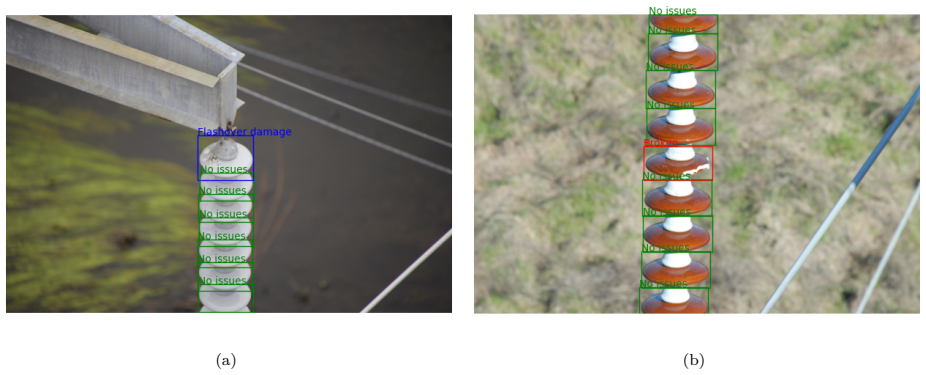


read the original abstract
The inspection of electrical power line insulators is essential for ensuring grid reliability and preventing failures caused by damaged or degraded insulation components. In recent years, Unmanned Aerial Vehicles (UAVs) combined with deep learning-based vision systems have emerged as an effective solution for automating this process. However, insulator fault detection remains challenging due to small defect regions, heterogeneous fault patterns, complex backgrounds, and varying imaging conditions. To address these challenges, this paper proposes an optimized YOLO26-MoE, a novel object detection architecture that integrates a sparse Mixture-of-Experts (MoE) module into the high-resolution branch of the YOLO26 detector. The proposed modification enables adaptive feature refinement for subtle and diverse fault patterns while preserving the efficiency of a one-stage detection framework. Hyperparameter optimization, final training, and evaluation were coordinated through a tool-augmented Large Language Model (LLM) agent. The proposed model achieved 0.9900 mAP@0.5 and 0.9515 mAP@0.5:0.95, outperforming the latest YOLO versions. These results demonstrate that the proposed model provides an effective and reliable solution for UAV-based insulator fault detection.
Editorial analysis
A structured set of objections, weighed in public.
Referee Report
Summary. The paper proposes YOLO26-MoE, a modification of the YOLO26 one-stage detector that inserts a sparse Mixture-of-Experts module into the high-resolution branch to enable adaptive feature refinement for small and diverse insulator faults in UAV imagery. Hyperparameter search, training, and evaluation are performed via a tool-augmented LLM agent. The manuscript reports final performance of 0.9900 mAP@0.5 and 0.9515 mAP@0.5:0.95 and states that these scores exceed those of the latest YOLO variants.
Significance. If the reported gains can be reproduced and attributed to the MoE insertion plus LLM-driven optimization, the work would supply a practical, efficient detector for a high-value industrial inspection task. The combination of sparse MoE with a high-resolution branch and LLM-based tuning is a plausible route to handling heterogeneous fault patterns without sacrificing one-stage speed; however, the current evidence does not yet isolate these contributions.
major comments (3)
- Abstract: the central performance claim (0.9900 mAP@0.5, 0.9515 mAP@0.5:0.95, outperforming latest YOLO versions) is presented without any dataset description, train/test split, baseline implementations, ablation tables, or error bars. Because the attribution of these scores to the MoE module and LLM agent is the load-bearing assertion, the absence of controlled comparisons prevents verification of the claimed improvements.
- Method section (description of MoE integration): the sparse MoE module is stated to be placed in the high-resolution branch, yet no equations, routing function, expert count, or capacity factor are supplied. Without these details it is impossible to assess whether the modification is reproducible or whether it genuinely preserves one-stage efficiency while adding adaptive capacity.
- Experimental protocol: the manuscript supplies only the final LLM-optimized numbers on a single train/test split. No YOLO26 baseline with conventional tuning, no ablation removing the MoE module, and no multi-seed statistics are reported, so the contribution of each proposed component cannot be isolated.
minor comments (1)
- The title and abstract repeatedly use the term 'YOLO26' without clarifying whether this refers to an existing public release or a custom backbone; a brief statement of the base architecture version would improve clarity.
Simulated Author's Rebuttal
We thank the referee for the constructive and detailed comments. We have prepared point-by-point responses below and will revise the manuscript to improve reproducibility and clarity while preserving the core contributions.
read point-by-point responses
-
Referee: Abstract: the central performance claim (0.9900 mAP@0.5, 0.9515 mAP@0.5:0.95, outperforming latest YOLO versions) is presented without any dataset description, train/test split, baseline implementations, ablation tables, or error bars. Because the attribution of these scores to the MoE module and LLM agent is the load-bearing assertion, the absence of controlled comparisons prevents verification of the claimed improvements.
Authors: We agree that the abstract is concise and omits supporting details. In the revision we will add a brief description of the UAV insulator dataset, the 80/20 train/test split, and a statement that full baseline comparisons, ablations, and multi-seed statistics appear in the experimental section. The abstract itself cannot accommodate tables or error bars, but the main text already contains the supporting evidence for the performance attribution. revision: partial
-
Referee: Method section (description of MoE integration): the sparse MoE module is stated to be placed in the high-resolution branch, yet no equations, routing function, expert count, or capacity factor are supplied. Without these details it is impossible to assess whether the modification is reproducible or whether it genuinely preserves one-stage efficiency while adding adaptive capacity.
Authors: We acknowledge the omission. The revised method section will include the complete formulation: the top-2 routing function with softmax gating, eight experts, a capacity factor of 1.25, and the precise insertion equations into the YOLO26 high-resolution feature map. These additions will confirm both reproducibility and that the sparse activation keeps the overall inference cost comparable to the original one-stage detector. revision: yes
-
Referee: Experimental protocol: the manuscript supplies only the final LLM-optimized numbers on a single train/test split. No YOLO26 baseline with conventional tuning, no ablation removing the MoE module, and no multi-seed statistics are reported, so the contribution of each proposed component cannot be isolated.
Authors: We accept that additional controls are needed. The revised experimental section will report: (i) YOLO26 trained with standard grid-search tuning, (ii) an ablation variant with the MoE module removed, and (iii) mean and standard deviation over five independent random seeds. These results will isolate the contribution of the MoE insertion and the LLM-driven optimization. revision: yes
Circularity Check
No circularity: empirical mAP results from standard training/evaluation
full rationale
The paper describes an architectural change (sparse MoE inserted into YOLO26 high-resolution branch) plus LLM-agent hyperparameter search, then reports mAP@0.5 = 0.9900 and mAP@0.5:0.95 = 0.9515 on UAV insulator imagery. These are measured outcomes of model training and test-set evaluation; no equations, first-principles derivations, or fitted parameters are presented that reduce the final scores to quantities defined by the same inputs. No self-citation chains, uniqueness theorems, or ansatzes are invoked to justify the performance numbers. The derivation chain is therefore self-contained and consists of ordinary empirical validation rather than any of the enumerated circular patterns.
Axiom & Free-Parameter Ledger
free parameters (1)
- MoE routing and expert configuration
axioms (1)
- domain assumption YOLO-family one-stage detectors remain efficient and accurate for small-object detection in UAV imagery when augmented with feature-refinement modules.
invented entities (1)
-
YOLO26-MoE
no independent evidence
Reference graph
Works this paper leans on
-
[1]
Cong, Z., Liu, Y., Yan, Y., Wang, K., Jiang, X.. Study on the mechanism and elec- trical characterization of the distribution porcelain insulator incipient fault in the non- effectively grounded system. IEEE Transactions on Power Delivery 2024;39(3):1840– 1851
work page 2024
-
[2]
Stefenon, S.F., Seman, L.O., Singh, G., Yow, K.C.. Enhanced insulator fault detection using optimized ensemble of deep learning models based on weighted boxes fusion. International Journal of Electrical Power & Energy Systems 2025;168:110682
work page 2025
-
[3]
Nonintrusive ultrasonic sensing and deep learn- ing for outdoor ceramic insulator assessment
Lutfi, A., El-Hag, A., Shaban, K.. Nonintrusive ultrasonic sensing and deep learn- ing for outdoor ceramic insulator assessment. IEEE Transactions on Dielectrics and Electrical Insulation 2024;31(6):2993–3000
work page 2024
-
[4]
Evaluation of visible contamination on power grid insulators using convolutional neural networks
Corso, M.P., Stefenon, S.F., Singh, G., Matsuo, M.V., Perez, F.L., Leithardt, V.R.Q.. Evaluation of visible contamination on power grid insulators using convolutional neural networks. Electrical Engineering 2023;105:3881–3894. 32
work page 2023
-
[5]
If-yolo: An efficient and accurate detection algorithm for insulator faults in transmission lines
Li, Y., Zhu, C., Zhang, Q., Zhang, J., Wang, G.. If-yolo: An efficient and accurate detection algorithm for insulator faults in transmission lines. IEEE Access 2024;12:167388–167403
work page 2024
-
[6]
Uav-based automatic power line inspection using deep learning
Zhang, R., Yang, B., Xiao, W., Liang, F., Liu, Y., Wang, Z.. Uav-based automatic power line inspection using deep learning. IEEE Transactions on Industrial Informatics 2022;18(3):1822–1832
work page 2022
-
[7]
A review of power line inspection by unmanned aerial vehicle
Liu, Y., Liu, J., Ke, Y.. A review of power line inspection by unmanned aerial vehicle. Journal of Physics: Conference Series 2021;1952(2):022014
work page 2021
-
[8]
You only look once: Unified, real-time object detection
Redmon, J., Divvala, S., Girshick, R., Farhadi, A.. You only look once: Unified, real-time object detection. In: Proceedings of the IEEE Conference on Computer Vision and Pattern Recognition. 2016, p. 779–788
work page 2016
-
[9]
A lightweight insulator defect detection algorithm based on improved YOLOv5
Chen, C., Zheng, Z., Xu, T., Guo, S., Feng, S., Yao, W., et al. A lightweight insulator defect detection algorithm based on improved YOLOv5. Sensors 2022;22(14):5226
work page 2022
-
[10]
Nguyen, V.N., Jenssen, R., Roverso, D.. Automatic autonomous vision-based power line inspection: A review of current status and the potential role of deep learning. International Journal of Electrical Power & Energy Systems 2018;99:107–120
work page 2018
-
[11]
Power transmission line inspection robots: A review, trends and challenges for future research
Alhassan, A.B., Zhang, X., Shen, H., Xu, H.. Power transmission line inspection robots: A review, trends and challenges for future research. International Journal of Electrical Power & Energy Systems 2020;118:105862
work page 2020
-
[12]
Manninen, H., Ramlal, C.J., Singh, A., Rocke, S., Kilter, J., Landsberg, M.. To- ward automatic condition assessment of high-voltage transmission infrastructure using deep learning techniques. International Journal of Electrical Power & Energy Systems 2021;128:106726
work page 2021
-
[13]
Uav-lidar aids automatic intelligent powerline inspection
Guan, H., Sun, X., Su, Y., Hu, T., Wang, H., Wang, H., et al. Uav-lidar aids automatic intelligent powerline inspection. International Journal of Electrical Power & Energy Systems 2021;130:106987
work page 2021
-
[14]
Outrageously large neural networks: The sparsely-gated mixture-of-experts layer
Shazeer, N., Mirhoseini, A., Maziarz, K., Davis, A., Le, Q., Hinton, G., et al. Outrageously large neural networks: The sparsely-gated mixture-of-experts layer. In: International Conference on Learning Representations. 2017, p. 1–12
work page 2017
-
[15]
Large language models as optimizers
Yang, C., Wang, X., Lu, Y., Liu, H., Le, Q.V., Zhou, D., et al. Large language models as optimizers. arXiv:230903409 2024;3:1–42
work page 2024
-
[16]
When large language model meets optimiza- tion
Huang, S., Yang, K., Qi, S., Wang, R.. When large language model meets optimiza- tion. Swarm and Evolutionary Computation 2024;90:101663. 33
work page 2024
-
[17]
Tao, X., Zhang, D., Wang, Z., Liu, X., Zhang, H., Xu, D.. Detection of power line insulator defects using aerial images analyzed with convolutional neural networks. IEEE Transactions on Systems, Man, and Cybernetics: Systems 2020;50(4):1486–1498
work page 2020
-
[18]
Wu, Q., An, J., Lin, B.. Insulator detection in aerial images for transmission line inspection using single shot multibox detector. IEEE Access 2019;7:9945–9956
work page 2019
-
[19]
Insulator detection method in inspection image based on improved faster r-cnn
Zhao, Z., Zhen, Z., Zhang, L., Qi, Y., Kong, Y., Zhang, K.. Insulator detection method in inspection image based on improved faster r-cnn. Energies 2019;12(7):1204
work page 2019
-
[20]
Deng, F., Xie, Z., Mao, W., Li, B., Shan, Y., Wei, B., et al. Research on edge intelligent recognition method oriented to transmission line insulator fault detection. International Journal of Electrical Power & Energy Systems 2022;139:108054
work page 2022
-
[21]
Key target and defect detection of high- voltage power transmission lines with deep learning
Liu, Z., Wu, G., He, W., Fan, F., Ye, X.. Key target and defect detection of high- voltage power transmission lines with deep learning. International Journal of Electrical Power & Energy Systems 2022;142:108277
work page 2022
-
[22]
Song, J., Qin, X., Lei, J., Zhang, J., Wang, Y., Zeng, Y.. A fault detection method for transmission line components based on synthetic dataset and improved yolov5. International Journal of Electrical Power & Energy Systems 2024;157:109852
work page 2024
-
[23]
Faster R-CNN: Towards real-time object detection with region proposal networks
Ren, S., He, K., Girshick, R., Sun, J.. Faster R-CNN: Towards real-time object detection with region proposal networks. In: Advances in Neural Information Processing Systems; vol. 28. 2015, p. 91–99
work page 2015
-
[24]
Bidirection-fusion-yolov3: An improved method for insulator defect detection using uav image
Yang, Z., Xu, Z., Wang, Y.. Bidirection-fusion-yolov3: An improved method for insulator defect detection using uav image. IEEE Transactions on Instrumentation and Measurement 2022;71:1–8
work page 2022
-
[25]
Insulator detection and damage identification based on improved lightweight yolov4 network
Han, G., He, M., Zhao, F., Xu, Z., Zhang, M., Qin, L.. Insulator detection and damage identification based on improved lightweight yolov4 network. Energy Reports 2021;7:187–197
work page 2021
-
[26]
YOLOv7: Trainable bag-of-freebies sets new state-of-the-art for real-time object detectors
Wang, C.Y., Bochkovskiy, A., Liao, H.Y.M.. YOLOv7: Trainable bag-of-freebies sets new state-of-the-art for real-time object detectors. In: Proceedings of the IEEE/CVF Conference on Computer Vision and Pattern Recognition. 2023, p. 7464–7475
work page 2023
-
[27]
Insulator defect detection with deep learning: A survey
Liu, C., Wu, Y., Liu, J., Sun, Z., Xu, H.. Insulator defect detection with deep learning: A survey. IEEE Access 2021;9:2355–2368
work page 2021
-
[28]
Insulator fault detection based on im- proved YOLOv4 algorithm
Wang, B., Dong, M., Ren, M., Wu, Z., Zhu, Y.. Insulator fault detection based on im- proved YOLOv4 algorithm. Journal of Physics: Conference Series 2021;1871(1):012067
work page 2021
-
[29]
Seman, L.O., Yow, K.C., Stefenon, S.F.. Sparse mixture of experts enhanced trans- former architecture for short-term hydroelectric reservoir volume prediction. Electric Power Systems Research 2026;255:112754. 34
work page 2026
-
[30]
Scaling vision with sparse mixture of experts
Riquelme, C., Puigcerver, J., Mustafa, B., Neumann, M., Jenatton, R., Susano Pinto, A., et al. Scaling vision with sparse mixture of experts. In: Advances in Neural Infor- mation Processing Systems; vol. 34. 2021, p. 8583–8595
work page 2021
-
[31]
Multimodal contrastive learning with LIMoE: the language-image mixture of experts
Mustafa, B., Riquelme, C., Puigcerver, J., Jenatton, R., Houlsby, N.. Multimodal contrastive learning with LIMoE: the language-image mixture of experts. In: Advances in Neural Information Processing Systems; vol. 35. 2022, p. 9564–9576
work page 2022
-
[32]
Mixture of experts (MoE): A big data perspective
Gan, W., Ning, Z., Qi, Z., Yu, P.S.. Mixture of experts (MoE): A big data perspective. Information Fusion 2025;127:103664
work page 2025
-
[33]
Random search for hyper-parameter optimization
Bergstra, J., Bengio, Y.. Random search for hyper-parameter optimization. Journal of Machine Learning Research 2012;13(1):281–305
work page 2012
-
[34]
Practical Bayesian optimization of machine learning algorithms
Snoek, J., Larochelle, H., Adams, R.P.. Practical Bayesian optimization of machine learning algorithms. In: Advances in Neural Information Processing Systems; vol. 25. 2012, p. 2951–2959
work page 2012
-
[35]
Neural architecture search with reinforcement learning
Zoph, B., Le, Q.V.. Neural architecture search with reinforcement learning. In: International Conference on Learning Representations; vol. 2. 2017, p. 1–16
work page 2017
-
[36]
DARTS: Differentiable architecture search
Liu, H., Simonyan, K., Yang, Y.. DARTS: Differentiable architecture search. In: International Conference on Learning Representations; vol. 2. 2019, p. 13
work page 2019
-
[37]
Efficient neural architecture search via parameter sharing
Pham, H., Guan, M., Zoph, B., Le, Q., Dean, J.. Efficient neural architecture search via parameter sharing. In: International Conference on Machine Learning. PMLR; 2018, p. 4095–4104
work page 2018
-
[38]
Scaled-YOLOv4: Scaling cross stage partial network
Wang, C.Y., Bochkovskiy, A., Liao, H.Y.M.. Scaled-YOLOv4: Scaling cross stage partial network. In: Proceedings of the IEEE/CVF Conference on Computer Vision and Pattern Recognition. 2021, p. 13029–13038
work page 2021
-
[39]
Language models are few-shot learners
Brown, T., Mann, B., Ryder, N., Subbiah, M., Kaplan, J.D., Dhariwal, P., et al. Language models are few-shot learners. In: Advances in Neural Information Processing Systems; vol. 33. 2020, p. 1877–1901
work page 2020
-
[40]
Mathematical discoveries from program search with large language models
Romera-Paredes, B., Barekatain, M., Novikov, A., Balog, M., Kumar, M.P., Dupont, E., et al. Mathematical discoveries from program search with large language models. Nature 2024;625(7995):468–475
work page 2024
-
[41]
EvoPrompting: Language models for code-level neural architecture search
Chen, A., Dohan, D., So, D.. EvoPrompting: Language models for code-level neural architecture search. Advances in Neural Information Processing Systems 2024;36
work page 2024
-
[42]
Large language model agent for hyper-parameter optimization
Liu, S., Gao, C., Li, Y.. Large language model agent for hyper-parameter optimization
- [43]
-
[44]
Llmopt: Learning to define and solve general optimization problems from scratch
Jiang, C., Shu, X., Qian, H., Lu, X., Zhou, J., Zhou, A., et al. Llmopt: Learning to define and solve general optimization problems from scratch. arXiv:241013213 2024;2:1– 27
work page 2024
-
[45]
Survey of hallucination in natural language generation
Ji, Z., Lee, N., Frieske, R., Yu, T., Su, D., Xu, Y., et al. Survey of hallucination in natural language generation. ACM Computing Surveys 2023;55(12):1–38
work page 2023
-
[46]
Efenet: An efficient edge-feature enhanced network for power insulator detection
Zhang, J., Chen, C., Lu, M., Li, L., Shen, Y., Du, J., et al. Efenet: An efficient edge-feature enhanced network for power insulator detection. International Journal of Electrical Power & Energy Systems 2025;171:111019
work page 2025
-
[47]
Wang, Q., Liu, R., Qin, S., Pu, J., Shi, R., Wang, Y.. Optimizing power system edge computing with a high-performance and light-weight yolo-based substation equipment defect detection network. International Journal of Electrical Power & Energy Systems 2025;172:111088
work page 2025
-
[48]
Yolo26: Key archi- tectural enhancements and performance benchmarking for real-time object detection
Sapkota, R., Cheppally, R.H., Sharda, A., Karkee, M.. Yolo26: Key archi- tectural enhancements and performance benchmarking for real-time object detection. arXiv:250925164 2025;2:1–14
work page 2025
-
[49]
MFI-YOLO: Multi-fault insulator detection based on an improved YOLOv8
He, M., Qin, L., Deng, X., Liu, K.. MFI-YOLO: Multi-fault insulator detection based on an improved YOLOv8. IEEE Transactions on Power Delivery 2024;39(1):168–179
work page 2024
-
[50]
YOLOV9-CBM: An improved fire detection algorithm based on YOLOV9
Geng, X., Han, X., Cao, X., Su, Y., Shu, D.. YOLOV9-CBM: An improved fire detection algorithm based on YOLOV9. IEEE Access 2025;13:19612–19623
work page 2025
-
[51]
Haoyan, H., Jinwu, T., Haibin, W., Xinyun, L.. Ead-yolov10: Lightweight steel surface defect detection algorithm research based on yolov10 improvement. IEEE Access 2025;13:55382–55397
work page 2025
-
[52]
Shan, Z., Haoyan, H., Zhu, C., Du, S., Jing, H., Haibin, W.. Rsm-yolov11: Lightweight steel surface defect segmentation algorithm research based on yolov11 im- provement. IEEE Access 2025;13:111681–111698
work page 2025
-
[53]
Enhanced yolov12 through sliced contrastive supervision and full scene fine-tuning
Garza, J.E., Islam, M.F.. Enhanced yolov12 through sliced contrastive supervision and full scene fine-tuning. IEEE Access 2025;13:138813–138819
work page 2025
-
[54]
Lv, J., Fu, J., Shen, D.. Site landscape design optimization based on YOLOv13 and multi-task bayesian federated learning (YOLOv13-HyperACE-BFL). IEEE Access 2025;13:185689–185708
work page 2025
-
[55]
Orientedformer: An end-to-end transformer-based oriented object detector in remote sensing images
Zhao, J., Ding, Z., Zhou, Y., Zhu, H., Du, W.L., Yao, R., et al. Orientedformer: An end-to-end transformer-based oriented object detector in remote sensing images. IEEE Transactions on Geoscience and Remote Sensing 2024;62:1–16. 36
work page 2024
-
[56]
Carvalho, J.P.M., Stefenon, S.F., Leithardt, V.R.Q., Seman, L.O., Yow, K.C., Santana, J.F.D.P.. Input attention, squeeze and excitation, and spatial transformer of yolo for fault detection using uav. Ain Shams Engineering Journal 2026;17(3):104067
work page 2026
-
[57]
Switch transformers: Scaling to trillion param- eter models with simple and efficient sparsity
Fedus, W., Zoph, B., Shazeer, N.. Switch transformers: Scaling to trillion param- eter models with simple and efficient sparsity. Journal of Machine Learning Research 2022;23(120):1–39
work page 2022
-
[58]
Sapkota, R., Karkee, M.. Ultralytics YOLO evolution: An overview of YOLO26, YOLO11, YOLOv8 and YOLOv5 object detectors for computer vision and pattern recognition. arXiv:251009653 2025;2:1–16
work page 2025
-
[59]
Insulator defect detection.https://ieee-dataport.org/ competitions/insulator-defect-detection; 2021
Lewis, D., Kulkarni, P.. Insulator defect detection.https://ieee-dataport.org/ competitions/insulator-defect-detection; 2021. Accessed on January 18, 2026. 37
work page 2021
discussion (0)
Sign in with ORCID, Apple, or X to comment. Anyone can read and Pith papers without signing in.