Inverse Design of Metasurface based Absorbers using Physics Guided Conditional Diffusion Models
Pith reviewed 2026-05-20 05:22 UTC · model grok-4.3
The pith
A physics-guided conditional diffusion model generates metasurface absorber designs that match target reflection spectra with spectral MSE of 0.0006 in about 30 seconds.
A machine-rendered reading of the paper's core claim, the machinery that carries it, and where it could break.
Core claim
The physics guided condition quality enhanced diffusion framework integrates target reflection characteristics via feature wise linear modulation and embeds a pre-trained surrogate EM simulator to introduce physics aware regularization through spectrum level loss functions, achieving an average spectral mean squared error of 0.0006 and band alignment accuracy of 0.958 while generating practically realizable metasurfaces.
What carries the argument
The conditional diffusion model with FiLM conditioning on target spectra and spectrum-level regularization from a surrogate EM simulator, which guides generation toward physically consistent and fabricable metasurface geometries.
If this is right
- Multiple distinct yet valid geometries can be produced for any given target spectrum, giving engineers design choices.
- Generation time drops to roughly 30 seconds under comparable resources, replacing months-long iterative optimization loops.
- The approach has been shown to produce designs validated by experimental measurements in the 2 to 18 GHz band.
Where Pith is reading between the lines
- Similar conditioning and surrogate-regularization techniques could be applied to inverse design of other electromagnetic devices such as antennas or filters.
- The framework reduces dependence on repeated full-wave simulations during the design cycle, freeing computational resources for larger parameter spaces.
- Diverse outputs per condition may enable secondary selection criteria such as fabrication tolerance or material constraints.
Load-bearing premise
The pre-trained surrogate electromagnetic simulator must accurately and without bias approximate the full-wave responses of the generated metasurface geometries.
What would settle it
Fabricate a generated metasurface design and measure its experimental reflection spectrum; a large mismatch between the measured spectrum and both the target and the surrogate prediction would falsify the claimed fidelity.
Figures




read the original abstract
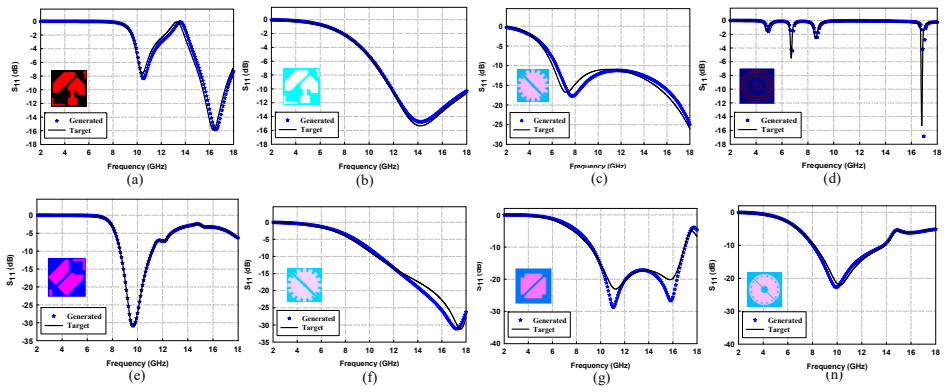
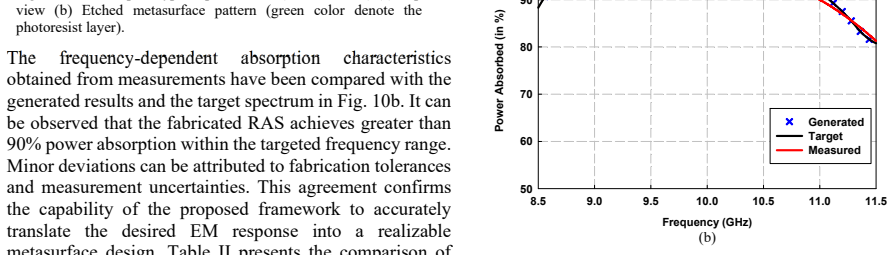
Inverse design of metasurfaces for specific electromagnetic responses requires generating geometries that satisfy stringent spectral constraints while maintaining manufacturability. Conventional design methodologies rely on iterative optimization routines using full wave simulations, which become extremely time consuming and computationally intensive for large design spaces. In addition, commonly employed generative approaches often exhibit limited conditional fidelity and the generated designs often contain fine or irregular features that are impractical to fabricate. In this regard, we propose a physics guided condition quality enhanced diffusion framework for the inverse design of metasurface based absorbers. Here, the conditioning information consisting of target reflection characteristics is integrated into the model using feature wise linear modulation (FiLM). Furthermore, to enforce adherence to target spectra, a pre trained surrogate EM simulator is embedded into the framework introducing physics aware regularization through spectrum level loss functions. The efficiency of the proposed model is demonstrated by generating practically realizable metasurfaces for different types of reflection characteristics in the frequency range of 2 to 18 GHz. The proposed framework achieves an average spectral mean squared error of 0.0006 and band alignment accuracy of 0.958 between the target spectra and the spectra produced by the generated designs, demonstrating high conditional accuracy. In addition, the model generates multiple geometries for the same condition, thereby providing diverse design alternatives to the engineer. The proposed model produces the suitable design in approximately 30 seconds, whereas the conventional approach can take several months under comparable computational resources. The efficiency of the model is also established via experimental measurements.
Editorial analysis
A structured set of objections, weighed in public.
Referee Report
Summary. The manuscript proposes a physics-guided conditional diffusion model for the inverse design of metasurface absorbers in the 2–18 GHz range. Target reflection spectra are injected via FiLM conditioning, and a pre-trained surrogate electromagnetic simulator supplies spectrum-level loss terms to enforce physical fidelity during training and sampling. The framework is reported to produce manufacturable geometries with an average spectral MSE of 0.0006 and band-alignment accuracy of 0.958, generate multiple design alternatives per target, and complete inference in approximately 30 seconds versus months for conventional optimization. Experimental measurements on fabricated samples are cited in support of the results.
Significance. If the surrogate-to-full-wave discrepancy remains small on the generated geometries, the approach would offer a practical acceleration of metasurface absorber design while preserving spectral fidelity and manufacturability. The combination of conditional diffusion with embedded physics regularization and the provision of diverse solutions per target are potentially useful contributions to the inverse-design literature.
major comments (2)
- [Results / Experimental Validation] Results section (performance metrics): the reported spectral MSE of 0.0006 and band-alignment accuracy of 0.958 are obtained by comparing target spectra against spectra produced by the surrogate simulator on the generated geometries. Because the diffusion model is trained with spectrum-level losses derived from the same surrogate, these figures risk being partly tautological; a table comparing surrogate predictions, independent full-wave simulations, and measured data on the identical fabricated samples is required to demonstrate that the low error reflects Maxwell fidelity rather than surrogate fidelity.
- [Methods / Surrogate EM Simulator] Methods (surrogate training): the manuscript does not report the surrogate’s own validation accuracy, training-set size, or out-of-distribution error on geometries similar to those produced by the diffusion model. Without these quantities it is difficult to bound the systematic bias that could be introduced into the physics-aware loss.
minor comments (2)
- [Figures] Figure captions should explicitly state whether the plotted spectra are surrogate-evaluated or full-wave simulated.
- [Abstract] The abstract claims “experimental validation” but provides no quantitative comparison (e.g., measured vs. target MSE); this detail should be added or the claim qualified.
Simulated Author's Rebuttal
We thank the referee for the constructive and detailed comments. We address each major comment below and will revise the manuscript to strengthen the validation of our results and the description of the surrogate model.
read point-by-point responses
-
Referee: [Results / Experimental Validation] Results section (performance metrics): the reported spectral MSE of 0.0006 and band-alignment accuracy of 0.958 are obtained by comparing target spectra against spectra produced by the surrogate simulator on the generated geometries. Because the diffusion model is trained with spectrum-level losses derived from the same surrogate, these figures risk being partly tautological; a table comparing surrogate predictions, independent full-wave simulations, and measured data on the identical fabricated samples is required to demonstrate that the low error reflects Maxwell fidelity rather than surrogate fidelity.
Authors: We agree that the current metrics rely on the surrogate and could appear circular. To demonstrate fidelity to Maxwell's equations and experimental reality, we will add a new table in the revised Results section. The table will compare target spectra against surrogate predictions, independent full-wave simulations performed on the generated geometries, and measured data from the fabricated samples already referenced in the manuscript. We will perform the additional full-wave simulations on the same fabricated designs to provide this direct multi-way comparison. revision: yes
-
Referee: [Methods / Surrogate EM Simulator] Methods (surrogate training): the manuscript does not report the surrogate’s own validation accuracy, training-set size, or out-of-distribution error on geometries similar to those produced by the diffusion model. Without these quantities it is difficult to bound the systematic bias that could be introduced into the physics-aware loss.
Authors: We concur that these details are necessary to evaluate potential bias. In the revised Methods section we will report the surrogate’s validation accuracy on its held-out test set, the size of the training dataset used to train the surrogate, and its error on out-of-distribution geometries that resemble those produced by the diffusion model. This information will allow readers to assess the reliability of the spectrum-level loss terms. revision: yes
Circularity Check
No circularity: metrics benchmarked against independent targets and experiments
full rationale
The paper reports performance via spectral MSE (0.0006) and band alignment (0.958) between target spectra and spectra from generated designs, plus experimental measurements. No equations, self-citations, or fitted parameters are shown that reduce these claims to quantities defined by the model's own inputs or prior self-work. The pre-trained surrogate supplies training loss but the final claims remain externally falsifiable against targets and fabricated samples, keeping the derivation self-contained.
Axiom & Free-Parameter Ledger
free parameters (1)
- diffusion model hyperparameters and loss weights
axioms (1)
- domain assumption The surrogate EM simulator accurately approximates full-wave responses for the purpose of spectrum-level regularization.
Lean theorems connected to this paper
-
IndisputableMonolith/Foundation/Cost/FunctionalEquation.leanwashburn_uniqueness_aczel unclear?
unclearRelation between the paper passage and the cited Recognition theorem.
physics guided condition quality enhanced diffusion framework ... pre-trained surrogate EM simulator ... spectrum-level loss functions
-
IndisputableMonolith/Foundation/AlphaCoordinateFixation.leanalpha_pin_under_high_calibration unclear?
unclearRelation between the paper passage and the cited Recognition theorem.
FiLM ... classifier-free guidance ... spectral MSE 0.0006, band alignment 0.958
What do these tags mean?
- matches
- The paper's claim is directly supported by a theorem in the formal canon.
- supports
- The theorem supports part of the paper's argument, but the paper may add assumptions or extra steps.
- extends
- The paper goes beyond the formal theorem; the theorem is a base layer rather than the whole result.
- uses
- The paper appears to rely on the theorem as machinery.
- contradicts
- The paper's claim conflicts with a theorem or certificate in the canon.
- unclear
- Pith found a possible connection, but the passage is too broad, indirect, or ambiguous to say the theorem truly supports the claim.
Reference graph
Works this paper leans on
-
[1]
C. L. Holloway, E. F. Kuester, J. A. Gordon, J. O. Hara, J. Booth, and D. R. Smith, “An overview of the theory and applications of metasurfaces: The two-dimensional equivalents of metamaterials,” IEEE Antennas and Propagation Magazine , vol. 54, no. 2, pp. 10– 35, Apr. 2012
work page 2012
-
[2]
Light propagation with phase discontinuities: Generalized laws of reflection and refraction,
N. Yu, P. Genevet, M. A. Kats, F. Aieta, J. Tetienne, F. Capasso, and Z. Gaburro, “Light propagation with phase discontinuities: Generalized laws of reflection and refraction,” Science, vol. 334, no. 6054, pp. 333–337, Oct. 2011
work page 2011
-
[3]
Flat optics with designer metasurfaces,
N. Yu and F. Capasso, “Flat optics with designer metasurfaces,” Nature Materials, vol. 13, no. 2, pp. 139–150, Feb. 2014
work page 2014
-
[4]
Metasurfaces for stealth applications: A comprehensive review,
V. Joy, A. Dileep, P. V. Abhilash, R. U. Nair, H. Singh, “Metasurfaces for stealth applications: A comprehensive review,” Journal of Electronics Materials, vol. 50, no. 6, pp. 3129–3148, Jun. 2021
work page 2021
-
[5]
H. Hao, S. Du, and T. Zhang, “Small-Size Broadband Coding Metasurface for RCS Reduction Based on Particle Swarm Optimization Algorithm,” Progress in Electromagnetics Research M, vol. 81, pp. 97–105, 2019
work page 2019
-
[6]
Customized inverse design of metamaterial absorber based on target-driven deep learning method,
J. Hou, H. Lin, W. Xu, X. Shi, R. Tang, L. Chen, and Y. Tian, “Customized inverse design of metamaterial absorber based on target-driven deep learning method,” IEEE Access , vol. 8, pp. 211849–211859, 2020
work page 2020
-
[7]
An ultrathin invisibility skin cloak for visible light,
X. Ni, Z. J. Wong, M. Mrejen, Y. Wang, and X. Zhang, “An ultrathin invisibility skin cloak for visible light,” Science, vol. 349, no. 6254, pp. 1310–1314, Sep. 2015
work page 2015
-
[8]
Polarization- insensitive and transparent frequency-selective surface for dual-band GSM shielding,
Y. Yang, W. Li, K. N. Salama, and A. Shamim, “Polarization- insensitive and transparent frequency-selective surface for dual-band GSM shielding,” IEEE Transactions on Antennas and Propagation, vol. 69, no. 5, pp. 2779–2789, May 2021
work page 2021
-
[9]
Metasurface holograms for visible light,
X. Ni, A. Kildishev, and V. Shalaev, “Metasurface holograms for visible light,” Nature Comm. vol. 4, Art. no. 2807, Nov. 2013
work page 2013
-
[10]
3D-integrated metasurfaces for full-colour holography,
Y. Hu, X. Luo, Y. Chen, Q. Liu, X. Liu, Y. Wang, N. Liu and H. Duan, “3D-integrated metasurfaces for full-colour holography,” Light: Science and Applications, vol. 8, Art. no. 86, Sep. 2019
work page 2019
-
[11]
Reflective metasurface for 5G and beyond wireless communications,
M. Selvaraj, R. Vijay, and R. Anbazhagan, “Reflective metasurface for 5G and beyond wireless communications,” Scientific Reports , vol. 15, Art. no. 126, 2025
work page 2025
-
[12]
Q. Xiong, Z. Zhang, C. Huang, M. Pu, J. Luo, Y. Guo, J. Ye, W. Pan, X. Ma, L. Yan, and X. Luo, “Amplitude–phase independently encoding space-division multiplexed wireless communication using beamforming reconfigurable metasurfaces,” Advanced Optical Materials, vol. 12, no. 28, 2024
work page 2024
-
[13]
A broadband achromatic metalens for focusing and imaging in the visible,
W. T. Chen, A. Y. Zhu, V. Sanjeev, M. Khorasaninejad, Z. Shi, E. Lee, and F. Capasso, “A broadband achromatic metalens for focusing and imaging in the visible,” Nature Nanotechnology, vol. 13, no. 3, pp. 220–226, Mar. 2018
work page 2018
-
[14]
High-efficiency metasurfaces: Principles, realizations, and applications,
Q. He, S. Sun, S. Xiao, and L. Zhou, “High-efficiency metasurfaces: Principles, realizations, and applications,” Advanced Optical Materials, vol. 6, no. 19, Art. no. 1800415, 2018
work page 2018
-
[15]
Metasurface- empowered optical multiplexing and multifunction,
S. Chen, W. Liu, Z. Li, H. Cheng, and J. Tian, “Metasurface- empowered optical multiplexing and multifunction,” Advanced Materials, vol. 32, no. 3, Art. no. 1805912, 2020
work page 2020
-
[16]
Broadband multifunctional efficient meta-gratings based on dielectric waveguide phase shifters,
M. Khorasaninejad and F. Capasso, “Broadband multifunctional efficient meta-gratings based on dielectric waveguide phase shifters,” Nano Letters, vol. 15, no. 10, pp. 6709–6715, Oct. 2015
work page 2015
-
[17]
Structured transparent low- emissivity coatings with high microwave transmission,
O. Bouvard, M. Lanini, and L. Burnier, “Structured transparent low- emissivity coatings with high microwave transmission,” Applied Physics A, vol. 123, no. 1, Art. no. 66, 2017
work page 2017
-
[18]
Loss-assisted metasurface at an exceptional point,
S. Dong, G. Hu, Q. Wang, Y. Jia , Q. Zhang, G. Cao, J. Wang, S. Chen, D. Fan, W. Jiang, Y. Li, A. Alu, and C.-W. Qiu, “Loss-assisted metasurface at an exceptional point,” ACS Photonics, vol. 7, no. 12, pp. 3321–3327, Dec. 2020
work page 2020
-
[19]
J. Fleury, M. Lanini, and C. Pose, “Wide band-pass frequency selective surface with reduced periodicity for energy-efficient windows at higher frequencies,” Applied Physics A, vol. 126, no. 6, Art. no. 417, 2020
work page 2020
-
[20]
Review of numerical optimization techniques for meta-device design,
S. D. Campbell, D. Sell, R.P. Jenkins, E. B. Whiting, J. A. Fan and D.H. Werner, “Review of numerical optimization techniques for meta-device design,” Optical Materials Express , vol. 9, no. 4, pp. 1842–1863, 2019
work page 2019
-
[21]
Topology optimization for nanophotonics,
J. S. Jensen and O. Sigmund, “Topology optimization for nanophotonics,” Laser & Photonics Reviews, vol. 5, no. 2, pp. 308– 321, Mar. 2011
work page 2011
-
[22]
Topology optimization of photonic and phononic crystals and metamaterials: A review,
W. Li, F. Meng, Y. Chen, Y. Li, and X. Huang, “Topology optimization of photonic and phononic crystals and metamaterials: A review,” Advanced Theory and Simulations , vol. 2, Art. no. 1900017, 2019
work page 2019
-
[23]
Near-ideal optical metamaterial absorbers with super-octave bandwidth,
J. A. Bossard, L. Lin, S. Yun, L. Liu, D. H. Werner, and T. S. Mayer, “Near-ideal optical metamaterial absorbers with super-octave bandwidth,” ACS Nano, vol. 8, no. 2, pp. 1517–1524, Feb. 2014
work page 2014
-
[24]
Adaptive genetic algorithm for optical metasurfaces design,
S. Jafar-Zanjani, S. Inampudi, and H. Mosallaei, “Adaptive genetic algorithm for optical metasurfaces design,” Scientific Reports, vol. 8, no. 1, Art. no. 11040, 2018
work page 2018
-
[25]
S. Chakravarty, R. Mittra, and N. R. Williams, “Application of a microgenetic algorithm (MGA) to the design of broadband microwave absorbers using multiple frequency selective surface screens buried in dielectrics,” IEEE Transactions on Antennas and Propagation, vol. 50, no. 3, pp. 284–296, Mar. 2002
work page 2002
-
[26]
M. A. Gingrich and D. H. Werner, “Synthesis of low/zero index of refraction metamaterials from frequency selective surfaces using genetic algorithms,” Electronics Letters, vol. 41, no. 23, pp. 1266– 1267, Nov. 2005
work page 2005
-
[27]
Optimising efficiency and gain of small meander line RFID antennas using ant colony system,
A. Lewis, G. Weis, M. Randall, A. Galehdar and D. Thiel, “Optimising efficiency and gain of small meander line RFID antennas using ant colony system,” in Proceedings of the IEEE Congress on Evolutionary Computation , Norway, 2009, pp. 1486– 1492
work page 2009
-
[28]
D. Z. Zhu, P. L. Werner, and D. H. Werner, “Design and optimization of 3-D frequency-selective surfaces based on a multiobjective lazy ant colony optimization algorithm,” IEEE Transactions on Antennas and Propagation , vol. 65, no. 12, pp. 7137–7149, Dec. 2017
work page 2017
-
[29]
D. Z. Zhu, M. D. Gregory, P. L. Werner, and D. H. Werner, “Fabrication and characterization of multiband polarization- independent 3-D printed frequency selective structures with ultra- wide fields of view,” IEEE Transactions on Antennas and Propagation, vol. 66, no. 11, pp. 6096–6105, Nov. 2018
work page 2018
-
[30]
Particle swarm optimization in electromagnetics,
J. Robinson and Y. Rahmat-Samii, “Particle swarm optimization in electromagnetics,” IEEE Transactions on Antennas and Propagation, vol. 52, no. 2, pp. 397–407, Feb. 2004
work page 2004
-
[31]
Stochastic optimization of low-loss optical negative-index metamaterial,
A. V. Kildishev, U. K. Chettiar, Z. Liu, V. M. Shalaev, D.-H. Kwon, Z. Bayraktar, and D. H. Werner, “Stochastic optimization of low-loss optical negative-index metamaterial,” Journal of the Optical Society of America B, vol. 24, no. 10, pp. A34–A39, Oct. 2007
work page 2007
-
[32]
Deep learning enabled inverse design in nanophotonics,
S. So, T. Badloe, J. Noh, J. Bravo-Abad, and J. Rho, “Deep learning enabled inverse design in nanophotonics,” Nanophotonics, vol. 9, no. 5, pp. 1041–1057, 2020
work page 2020
-
[33]
Deep learning for the design of photonic structures,
W. Ma, Z. Liu, Z. A. Kudyshev, A. Boltasseva, W. Cai, and Y. Liu, “Deep learning for the design of photonic structures,” Nature Photonics, vol. 15, pp. 77–90, Jan. 2021
work page 2021
-
[34]
Nanophotonic particle simulation and inverse design using artificial neural networks,
J. Peurifoy, Y. Shen, L. Jing, Y. Yang, F. Cano-Renteria, B. Delacy, J. D. Joannopoulos, M. Tegmark, and M. Solja čić, “Nanophotonic particle simulation and inverse design using artificial neural networks,” Science Advances, vol. 4, Art. no. eaar4206, 2018
work page 2018
-
[35]
S. So, J. Mun, and J. Rho, “Simultaneous inverse design of materials and structures via deep learning: Demonstration of dipole resonance engineering using core–shell nanoparticles,” ACS Applied Materials & Interfaces, vol. 11, no. 27, pp. 24264–24268, 2019
work page 2019
-
[36]
Plasmonic nanostructure design and characterization via deep learning,
I. Malkiel, M. Mrejen, A. Nagler, U. Arieli, L. Wolf, and H. Suchowski, “Plasmonic nanostructure design and characterization via deep learning,” Light: Science and Applications , vol. 7, . 60, 2018
work page 2018
-
[37]
Training deep neural networks for the inverse design of nanophotonic structures,
D. Liu, Y. Tan, E. Khoram, and Z. Yu, “Training deep neural networks for the inverse design of nanophotonic structures,” ACS Photonics, vol. 5, no. 4, pp. 1365–1369, 2018
work page 2018
-
[38]
Constrained tandem neural network assisted inverse design of metasurfaces for microwave absorption,
X. He, X. Cui, and C. T. Chan, “Constrained tandem neural network assisted inverse design of metasurfaces for microwave absorption,” Optics Express, vol. 31, no. 25, pp. 40969–40979, 2023
work page 2023
-
[39]
Z. Hu, W. Su, K. Hu, and B. Tang, “ A deep learning-driven forward and inverse cooperative network for circular dichroism in chiral metasurfaces,” Journal of Materials Chemistry C, vol. 13, pp. 9717– 9723, 2025
work page 2025
-
[40]
Generative model for the inverse design of metasurfaces,
Z. Liu, D. Zhu, K. Lee, A. S. Kim, and J. R. W. Mark, “Generative model for the inverse design of metasurfaces,” ACS Nano, vol. 12, no. 7, pp. 7073–7083, 2018
work page 2018
-
[41]
M. Kiani and J. Kiani, “Conditional generative adversarial networks for inverse design of multifunctional microwave metasurfaces,” Advanced Photonics Research., vol. 3, Art. no. 202200110, 2022
work page 2022
-
[42]
Synthesis of multi-band reflective polarizing metasurfaces using a generative adversarial network,
P. Naseri, G. Goussetis, N. J. G. Fonseca, and S. V. Hum, “Synthesis of multi-band reflective polarizing metasurfaces using a generative adversarial network,” Scientific Reports., vol. 12, 17006, 2022
work page 2022
-
[43]
A. Nezaratizadeh, S. M. Hashemi, and M. Bod., “Prediction of multi- layer metasurface design using conditional deep convolutional generative adversarial networks,” International Journal for Light and Electron Optics, vol. 313, p. 172005, 2024
work page 2024
-
[44]
Y. Zeng, H. Cao, and X. Jin, “Anchor-controlled generative adversarial network for high-fidelity electromagnetic and structurally diverse metasurface design,” arXiv preprint arXiv:2408.16231v2, 2024
-
[45]
A. Mall, A. Patil, A. Sethi & A. Kumar, “A cyclical deep learning based framework for simultaneous inverse and forward design of nanophotonic metasurfaces,” Scientific Reports , Article number: 19427, 2020
work page 2020
-
[46]
C. Liu, W. M. Yu, Q. Ma, L. Li, and T. J. Cui, “Intelligent coding metasurface holograms by physics-assisted unsupervised generative adversarial network,” Photonics Research, vol. 9, no. 4, pp. B159– B167, Apr. 2021
work page 2021
-
[47]
G. Dai, H. Li, X. Zhang, and Y. Liu, “Single-layer metasurface design with symmetrical free-form patterns using generative adversarial networks,” Applied Soft Computing , vol. 127, Art. no. 109353, 2022
work page 2022
-
[48]
H. P. Wang, D. M. Cao, X. Y. Pang, X. H. Zhang, S. Y. Wang, W. Y. Hou, C. C. Nie, and Y. B. Li, “Inverse design of metasurfaces with customized transmission characteristics of frequency band based on generative adversarial networks,” Optics Express, vol. 31, no. 23, pp. 37763–37783, 2023
work page 2023
-
[49]
Fast design of plasmonic metasurfaces enabled by deep learning,
A. Mall, A. Patil, D. Tamboli, A. Sethi and A. Kumar, “Fast design of plasmonic metasurfaces enabled by deep learning,” Journal of Physics D: Applied Physics, vol. 53, no. 49, October 2020
work page 2020
-
[50]
A Machine learning-based approach to synthesize multilayer metasurfaces,
P. Naseri and S. V. Hum, “A Machine learning-based approach to synthesize multilayer metasurfaces,” 2020 IEEE International Symposium on Antennas and Propagation and North American Radio Science Meeting, Montreal, QC, Canada, 2020, pp. 933-934
work page 2020
-
[51]
A generative machine learning-based approach for inverse design of multilayer metasurfaces,
P. Naseri and S. V. Hum, “A generative machine learning-based approach for inverse design of multilayer metasurfaces,” IEEE Transactions on Antennas and Propagation, vol. 69, no. 9, pp. 5725– 5739, Sep. 2021
work page 2021
-
[52]
An Optimization Approach Based on Separated Latent Space for Inverse Design of Metasurfaces,
J. -H. Kim and I. -P. Hong, "An Optimization Approach Based on Separated Latent Space for Inverse Design of Metasurfaces," in IEEE Antennas and Wireless Propagation Letters, vol. 23, no. 7, pp. 2135-2139, July 2024
work page 2024
-
[53]
A generative meta-atom model for metasurface-based absorber designs,
W. Ding, J. Chen, and R.-X. Wu, “A generative meta-atom model for metasurface-based absorber designs,” Advanced Optical Materials, vol. 11, no. 2, Art. no. 2201959, 2022
work page 2022
-
[54]
Design of Metamaterials for Absorbers Based on Variational Autoencoder,
Q. Li, J. Wang, T. Lei, T. Xiang, C. Qin and M. Yang, “Design of Metamaterials for Absorbers Based on Variational Autoencoder,” IEEE Access, vol. 12, pp. 92328-92336, 2024
work page 2024
-
[55]
H.-I. On, L. Jeong, T.-M. Seo, Y. Jo, W. Choi, D.-J. Kang, J.-H. Park, and H.-J. Lee, “Novel method of performance-optimized metastructure design for electromagnetic wave absorption in specific band using deep learning,” Engineering Applications of Artificial Intelligence, vol. 137, p. 109274, 2024
work page 2024
-
[56]
P. Pillai, B. RaI, and P. Pal, “Modified variational autoencoder for inversely predicting plasmonic nanofeatures for generating structural color,” Scientific Reports, vol. 13, Art. no. 3536, 2023
work page 2023
-
[57]
S. Warrier, J. Dontabhaktuni, “Hybrid quantum generative adversarial networks to inverse design metasurfaces for incident angle-independent unidirectional transmission,” arXiv preprint arXiv:2507.03518, 2025
-
[58]
X. Ding, Y. Wang, Z. Xu, W. J. Welch, and Z. J. Wang, “Continuous conditional generative adversarial networks: Novel empirical losses and label input mechanisms,” IEEE Trans.Pattern Analysis and Machine Intelligence, vol. 45, no. 7, pp. 8143-8158, Jul. 2023
work page 2023
-
[59]
PaDGAN: A generative adversarial network for performance augmented diverse designs,
W. Chen and F. Ahmed, “PaDGAN: A generative adversarial network for performance augmented diverse designs,” arXiv preprint arXiv:2002.11304, 2020
-
[60]
Image super-resolution via iterative refinement,
C. Saharia, J. Ho, W. Chan, T. Salimans, D. J. Fleet and M. Norouzi, “Image super-resolution via iterative refinement,” IEEE Transactions on Pattern Analysis and Machine Intelligence, vol. 45, no. 4, pp. 4713-4726, April 2023
work page 2023
-
[61]
Optimizing metamaterial inverse design with 3D conditional diffusion model and data augmentation,
X. Zheng, J. Shiomi and T. Yamada, “Optimizing metamaterial inverse design with 3D conditional diffusion model and data augmentation,” Advanced Materials Tech., vol. 10, 10p., 2025
work page 2025
-
[62]
Denoising diffusion probabilistic models,
J. Ho, A. Jain, and P. Abbeel, “Denoising diffusion probabilistic models,” in Proceedings of the 34th International Conference on Neural Information Processing Systems (NeurIPS), Vancouver, BC, Canada, 2020, pp. 6840–6851
work page 2020
-
[63]
Classifier-Free Diffusion Guidance
J. Ho and T. Salimans, “Classifier-free diffusion guidance,” arXiv preprint arXiv:2207.12598, 2022
work page internal anchor Pith review Pith/arXiv arXiv 2022
-
[64]
FiLM: Visual reasoning with a general conditioning layer,
E. Perez, F. Strub, H. de Vries, V. Dumoulin, and A. Courville, “FiLM: Visual reasoning with a general conditioning layer,” in Proceedings of the Thirty-Second AAAI Conference on Artificial Intelligence, Article No.: 483, pp. 3942 - 3951, 2018
work page 2018
-
[65]
CST Studio Suite®, CST AG, Germany, www.cst.com
discussion (0)
Sign in with ORCID, Apple, or X to comment. Anyone can read and Pith papers without signing in.