Neutron stars more compact than black holes in quasi-topological gravity: Equilibrium configurations and radial stability
Pith reviewed 2026-05-20 04:16 UTC · model grok-4.3
The pith
Neutron stars in quasi-topological gravity can exceed the black-hole compactness bound and gain radial stability from the theory's corrections.
A machine-rendered reading of the paper's core claim, the machinery that carries it, and where it could break.
Core claim
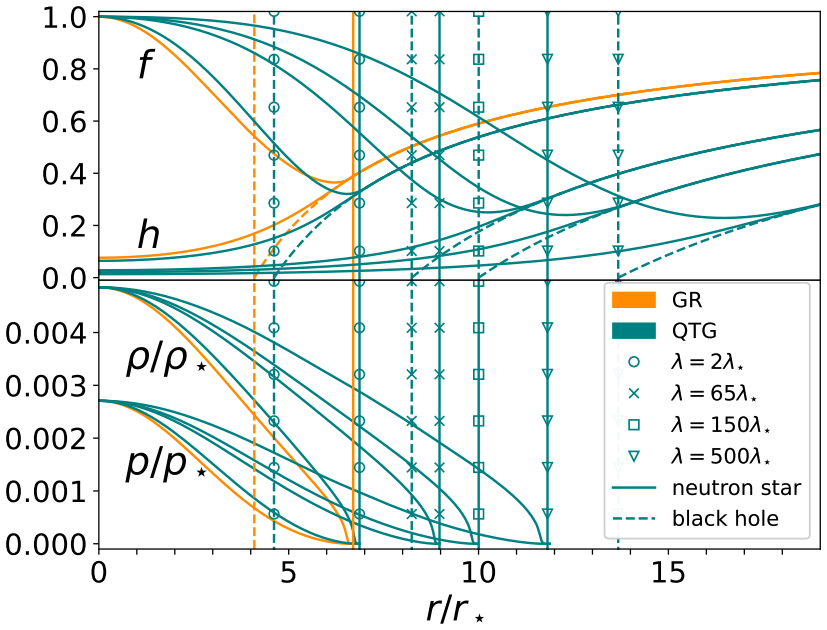
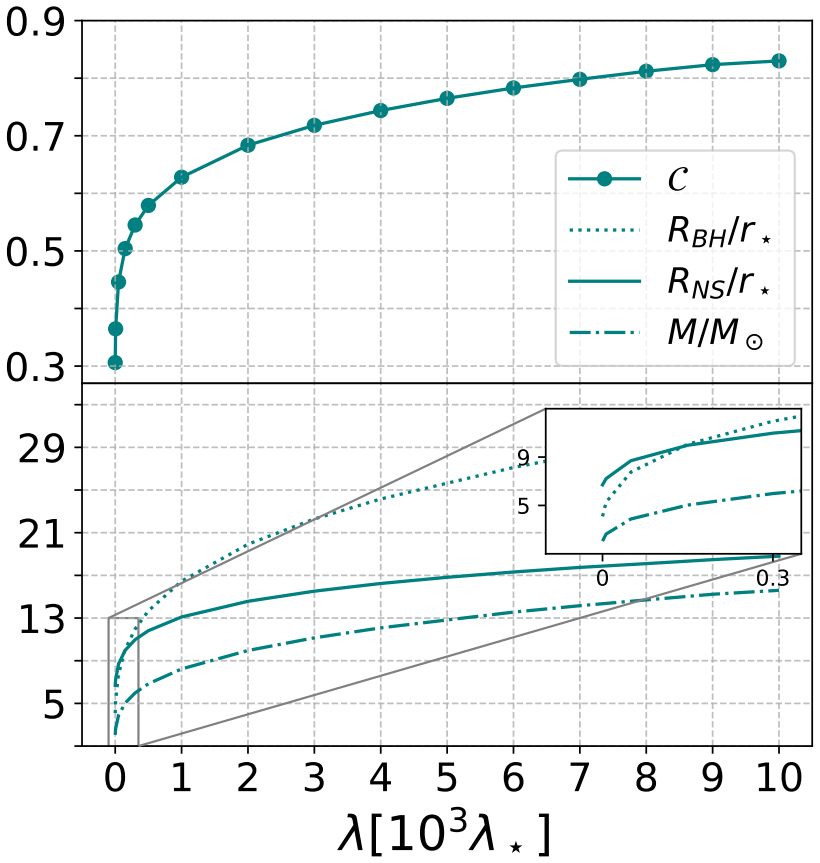
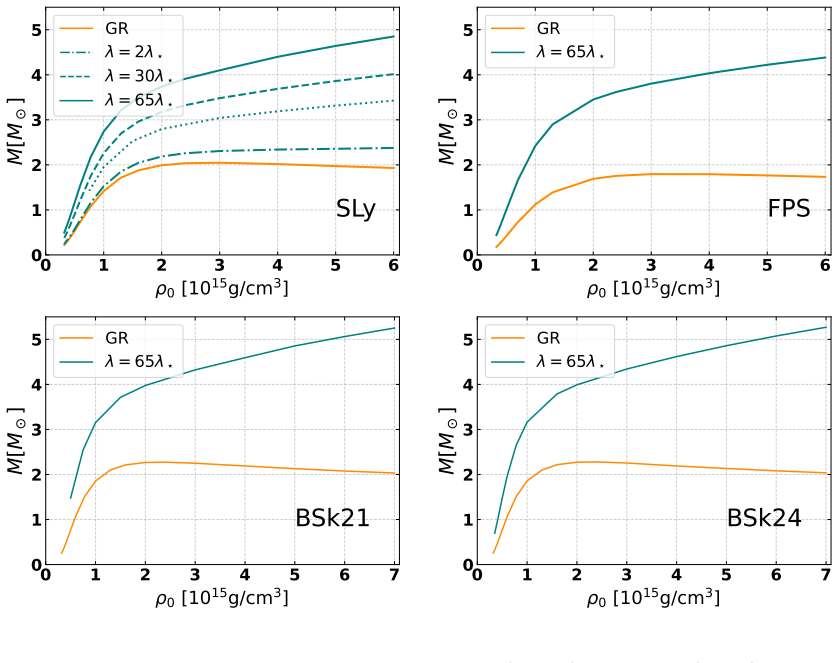
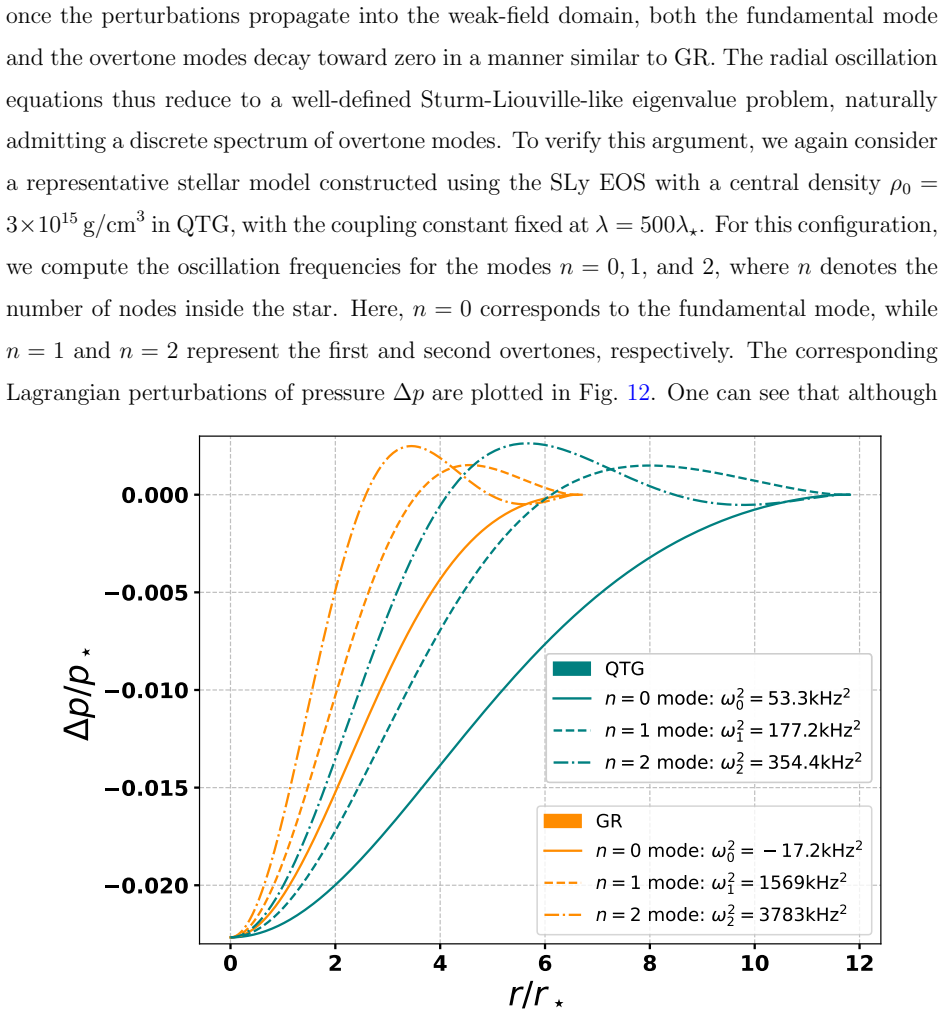
Within general relativity, black holes are widely regarded as the ultimate benchmark for compactness in the Universe. In quasi-topological gravity, however, equilibrium neutron-star configurations can be constructed whose compactness exceeds the black-hole bound. In the high-central-density regime this excess compactness exhibits a universal behavior across several representative equations of state and values of the gravitational coupling. The quasi-topological corrections grow increasingly significant at large central densities and stabilize configurations that remain radially unstable in general relativity over a broad parameter range.
What carries the argument
The equilibrium structure equations and the radial perturbation equations derived from the quasi-topological gravity action, which modify the standard Tolman-Oppenheimer-Volkoff and stellar oscillation equations through higher-curvature contributions.
Load-bearing premise
The analysis assumes that quasi-topological gravity remains a consistent effective description of gravity at the extreme densities inside these neutron stars and that the chosen representative equations of state continue to apply without additional phase transitions or instabilities.
What would settle it
A high-precision mass-radius measurement that places a neutron star at compactness greater than one-half, or a survey that finds no such objects despite sensitivity to radii below the Schwarzschild limit, would directly test the predicted excess compactness.
Figures





read the original abstract
Within general relativity, black holes are widely regarded as the ultimate benchmark for compactness in the Universe. Recently, however, neutron star models have been constructed in a higher-curvature theory -- quasi-topological gravity (QTG) -- whose compactness can exceed the black-hole limit~\cite{LD19666}. Here we present a detailed analysis of both the equilibrium structure and radial stability of such configurations in QTG. By examining several representative equations of state and different values of the gravitational coupling constant, we find that in the high-central-density regime the compactness exceeding the black-hole bound exhibits a universal behavior in QTG. We further show that QTG corrections grow increasingly significant at large central densities and can stabilize configurations that are radially unstable in general relativity over a broad parameter range. These results establish ultra-compact neutron stars in QTG as theoretically viable strong-field configurations and provide a foundation for further investigations of their dynamical and phenomenological implications.
Editorial analysis
A structured set of objections, weighed in public.
Referee Report
Summary. The paper analyzes equilibrium configurations and radial stability of neutron stars in quasi-topological gravity (QTG) for several equations of state and values of the gravitational coupling constant. It reports that, in the high-central-density regime, the compactness can exceed the black-hole bound and exhibits universal behavior independent of the specific equation of state; QTG corrections become significant at large densities and stabilize configurations that are radially unstable in general relativity over a broad parameter range.
Significance. If the reported configurations remain within the regime of validity of QTG as an effective theory, the results would establish ultra-compact neutron stars as viable strong-field solutions in higher-curvature gravity and provide concrete examples of stabilization by higher-order terms. The claimed universality at high central density, if confirmed by explicit checks against post-hoc parameter choices, would strengthen the case for using such models to explore deviations from general relativity in compact-object astrophysics.
major comments (2)
- [§4 and §5] §4 (high-central-density regime) and the stability analysis in §5: the central claim that compactness exceeds the black-hole bound and exhibits universal behavior requires that the local curvature scale (e.g., Kretschmann invariant at the stellar center) remains below the inverse-square of the QTG coupling constant throughout the reported configurations. No explicit cutoff check or comparison of curvature invariants to the coupling scale is provided, so it is unclear whether the reported equilibrium and stability results lie inside the effective-theory regime.
- [Table 2 and Figure 5] Table 2 and Figure 5 (radial stability results): the statement that QTG stabilizes configurations unstable in GR is load-bearing for the second main claim, yet the paper supplies no quantitative error estimates on the eigenfrequencies or explicit verification that the stabilization persists when the equation of state is varied within its observational uncertainties.
minor comments (2)
- [Introduction] The abstract and introduction cite LD19666 but do not clarify how the present numerical methods differ from or improve upon that earlier work; a brief comparison paragraph would help readers assess novelty.
- [Eq. (3)] Notation for the QTG coupling constant is introduced without an explicit definition of its dimensionful scale in the first appearance (Eq. (3)); adding the dimensionful factor explicitly would improve clarity.
Simulated Author's Rebuttal
We thank the referee for the careful reading of our manuscript and the constructive comments. We address each major point below and have revised the manuscript accordingly to strengthen the presentation of our results.
read point-by-point responses
-
Referee: [§4 and §5] §4 (high-central-density regime) and the stability analysis in §5: the central claim that compactness exceeds the black-hole bound and exhibits universal behavior requires that the local curvature scale (e.g., Kretschmann invariant at the stellar center) remains below the inverse-square of the QTG coupling constant throughout the reported configurations. No explicit cutoff check or comparison of curvature invariants to the coupling scale is provided, so it is unclear whether the reported equilibrium and stability results lie inside the effective-theory regime.
Authors: We agree that an explicit check against the effective-theory cutoff is necessary to support the validity of the reported configurations. In the revised manuscript we have added a new subsection in §4 that computes the Kretschmann invariant at the stellar center for every equilibrium sequence and compares it directly to the inverse-square of the QTG coupling constant. For all parameter values and central densities shown in the paper the local curvature remains at least an order of magnitude below the cutoff scale, confirming that the solutions lie inside the regime of validity of QTG as an effective theory. The same check has been repeated for the radially perturbed configurations discussed in §5. revision: yes
-
Referee: [Table 2 and Figure 5] Table 2 and Figure 5 (radial stability results): the statement that QTG stabilizes configurations unstable in GR is load-bearing for the second main claim, yet the paper supplies no quantitative error estimates on the eigenfrequencies or explicit verification that the stabilization persists when the equation of state is varied within its observational uncertainties.
Authors: We acknowledge that quantitative robustness checks strengthen the stabilization claim. In the revised version we have augmented Table 2 with error bars on the eigenfrequencies obtained by propagating the observational uncertainties in the EOS parameters (nuclear saturation density, symmetry energy slope, and high-density stiffness) through the perturbation equations. We have also added a new panel to Figure 5 that overlays results for two additional EOS families (one soft and one stiff) lying within current observational bounds; the sign change in the fundamental eigenfrequency that signals stabilization remains present across all these models. These additions are discussed in the text of §5. revision: yes
Circularity Check
No significant circularity; numerical results on compactness and stability are independent of inputs
full rationale
The paper solves the equilibrium and radial perturbation equations in quasi-topological gravity for multiple equations of state and coupling values, then reports an observed universal compactness trend and stabilization effect at high central densities. These are numerical outcomes, not quantities defined by construction from the coupling constant or prior fits. The cited result on exceeding the black-hole bound is used as motivation rather than a load-bearing self-citation that forces the present conclusions. No self-definitional, fitted-input-renamed-as-prediction, or ansatz-smuggled steps appear in the derivation chain.
Axiom & Free-Parameter Ledger
free parameters (1)
- gravitational coupling constant
axioms (1)
- domain assumption Quasi-topological gravity provides a consistent higher-curvature extension of general relativity suitable for neutron-star interiors.
Lean theorems connected to this paper
-
IndisputableMonolith/Cost/FunctionalEquation.leanwashburn_uniqueness_aczel unclear?
unclearRelation between the paper passage and the cited Recognition theorem.
The gravitational Lagrangian of the QTG model is given by L = R + λ(R³ − 6RR_μνR^μν + 8R^μ_ν R^ν_γ R^γ_μ)
-
IndisputableMonolith/Foundation/DimensionForcing.leanalexander_duality_circle_linking unclear?
unclearRelation between the paper passage and the cited Recognition theorem.
we find that in the high-central-density regime the compactness exceeding the black-hole bound exhibits a universal behavior in QTG
What do these tags mean?
- matches
- The paper's claim is directly supported by a theorem in the formal canon.
- supports
- The theorem supports part of the paper's argument, but the paper may add assumptions or extra steps.
- extends
- The paper goes beyond the formal theorem; the theorem is a base layer rather than the whole result.
- uses
- The paper appears to rely on the theorem as machinery.
- contradicts
- The paper's claim conflicts with a theorem or certificate in the canon.
- unclear
- Pith found a possible connection, but the passage is too broad, indirect, or ambiguous to say the theorem truly supports the claim.
Reference graph
Works this paper leans on
-
[1]
The Confrontation between General Relativity and Experiment
C. M. Will, “The confrontation between general relativity and experiment,” Living Rev. Rel. 17, 4 (2014) [arXiv:1403.7377 [gr-qc]]
work page internal anchor Pith review Pith/arXiv arXiv 2014
-
[2]
Testing General Relativity with Present and Future Astrophysical Observations
E. Berti, E. Barausse, V. Cardoso, L. Gualtieri, P. Pani, U. Sperhake, L. C. Stein, N. Wex, K. Yagi and T. Baker,et al.“Testing general relativity with present and future astrophysical observations,” Class. Quant. Grav.32, 243001 (2015) [arXiv:1501.07274 [gr-qc]]
work page internal anchor Pith review Pith/arXiv arXiv 2015
-
[3]
Black holes, gravitational waves and fundamental physics: a roadmap
L. Barack, V. Cardoso, S. Nissanke, T. P. Sotiriou, A. Askar, C. Belczynski, G. Bertone, E. Bon, D. Blas and R. Brito,et al.“Black holes, gravitational waves and fundamental physics: a roadmap,” Class. Quant. Grav.36, no.14, 143001 (2019) [arXiv:1806.05195 [gr-qc]]
work page internal anchor Pith review Pith/arXiv arXiv 2019
-
[4]
Gravity experiments with radio pulsars,
P. C. C. Freire and N. Wex, “Gravity experiments with radio pulsars,” Living Rev. Rel.27, no.1, 5 (2024) [arXiv:2407.16540 [gr-qc]]
-
[5]
Probes and Tests of Strong-Field Gravity with Observations in the Electromagnetic Spectrum
D. Psaltis, “Probes and tests of strong-field gravity with observations in the electromagnetic spectrum,” Living Rev. Rel.11, 9 (2008) [arXiv:0806.1531 [astro-ph]]
work page internal anchor Pith review Pith/arXiv arXiv 2008
-
[6]
Observation of Gravitational Waves from a Binary Black Hole Merger
B. P. Abbottet al.[LIGO Scientific and Virgo], “Observation of gravitational waves from a binary black hole merger,” Phys. Rev. Lett.116, no.6, 061102 (2016) [arXiv:1602.03837 [gr-qc]]
work page internal anchor Pith review Pith/arXiv arXiv 2016
-
[7]
First M87 Event Horizon Telescope Results. I. The Shadow of the Supermassive Black Hole
K. Akiyamaet al.[Event Horizon Telescope], “First M87 Event Horizon Telescope re- 40 sults. I. The shadow of the supermassive black hole,” Astrophys. J. Lett.875, L1 (2019) [arXiv:1906.11238 [astro-ph.GA]]
work page internal anchor Pith review Pith/arXiv arXiv 2019
-
[8]
Renormalization of higher derivative quantum gravity,
K. S. Stelle, “Renormalization of higher derivative quantum gravity,” Phys. Rev. D16, 953- 969 (1977)
work page 1977
-
[9]
Classical Gravity with Higher Derivatives,
K. S. Stelle, “Classical Gravity with Higher Derivatives,” Gen. Rel. Grav.9, 353-371 (1978)
work page 1978
-
[10]
General relativity as an effective field theory: The leading quantum corrections
J. F. Donoghue, “General relativity as an effective field theory: The leading quantum correc- tions,” Phys. Rev. D50, 3874-3888 (1994) [arXiv:gr-qc/9405057 [gr-qc]]
work page internal anchor Pith review Pith/arXiv arXiv 1994
-
[11]
C. G. Callan, Jr., E. J. Martinec, M. J. Perry and D. Friedan, “Strings in Background Fields,” Nucl. Phys. B262, 593-609 (1985)
work page 1985
-
[12]
A new type of isotropic cosmological models without singularity,
A. A. Starobinsky, “A new type of isotropic cosmological models without singularity,” Phys. Lett. B91, 99-102 (1980)
work page 1980
-
[13]
C. W. Misner, K. S. Thorne and J. A. Wheeler, “Gravitation,” (W. H. Freeman, San Francisco, 1973), ISBN 978-0-7167-0344-0, 978-0-691-17779-3
work page 1973
-
[14]
A Relativist’s Toolkit: The Mathematics of Black-Hole Mechanics,
E. Poisson, “A Relativist’s Toolkit: The Mathematics of Black-Hole Mechanics,” Cambridge University Press, 2009
work page 2009
-
[15]
Gravitational collapse and space-time singularities,
R. Penrose, “Gravitational collapse and space-time singularities,” Phys. Rev. Lett.14, 57-59 (1965)
work page 1965
-
[16]
Neutron stars more compact than black holes as a probe of strong-field gravity,
S. Li, H. L¨ u, Y. Gao, R. Xu, L. Shao, and H. Yu, “Neutron stars more compact than black holes as a probe of strong-field gravity,” submitted, Manuscript ID: LD19666
-
[17]
Quasi-Topological Ricci Polynomial Gravities
Y. Z. Li, H. S. Liu and H. L¨ u, “Quasi-topological Ricci polynomial gravities,” JHEP02, 166 (2018) [arXiv:1708.07198 [hep-th]]
work page internal anchor Pith review Pith/arXiv arXiv 2018
-
[18]
Generalized quasi-topological gravity
R. A. Hennigar, D. Kubizˇ n´ ak and R. B. Mann, “Generalized quasitopological gravity,” Phys. Rev. D95, no.10, 104042 (2017) [arXiv:1703.01631 [hep-th]]
work page internal anchor Pith review Pith/arXiv arXiv 2017
-
[19]
Black Holes in Higher-Derivative Gravity
H. L¨ u, A. Perkins, C. N. Pope and K. S. Stelle, “Black holes in higher derivative gravity,” Phys. Rev. Lett.114, no.17, 171601 (2015) [arXiv:1502.01028 [hep-th]]
work page internal anchor Pith review Pith/arXiv arXiv 2015
-
[20]
Compact stars: Nuclear physics, particle physics, and general relativity,
N. K. Glendenning, “Compact stars: Nuclear physics, particle physics, and general relativity,”
-
[21]
Stellar structure models in modified theories of gravity: Lessons and challenges,
G. J. Olmo, D. Rubiera-Garcia and A. Wojnar, “Stellar structure models in modified theories of gravity: Lessons and challenges,” Phys. Rept.876, 1-75 (2020) [arXiv:1912.05202 [gr-qc]]
-
[22]
A unified equation of state of dense matter and neutron star structure
F. Douchin and P. Haensel, “A unified equation of state of dense matter and neutron star structure,” Astron. Astrophys.380, 151 (2001) [arXiv:astro-ph/0111092 [astro-ph]]
work page internal anchor Pith review Pith/arXiv arXiv 2001
-
[23]
Analytical representations of unified equations of state of neutron-star matter
P. Haensel and A. Y. Potekhin, “Analytical representations of unified equations of state of 41 neutron-star matter,” Astron. Astrophys.428, 191-197 (2004) [arXiv:astro-ph/0408324 [astro- ph]]
work page internal anchor Pith review Pith/arXiv arXiv 2004
-
[24]
K. Yagi and N. Yunes, “I-Love-Q,” Science341, 365-368 (2013) [arXiv:1302.4499 [gr-qc]]
work page internal anchor Pith review Pith/arXiv arXiv 2013
-
[25]
K. Yagi and N. Yunes, “I-Love-Q Relations in Neutron Stars and their Applications to As- trophysics, Gravitational Waves and Fundamental Physics,” Phys. Rev. D88, no.2, 023009 (2013) [arXiv:1303.1528 [gr-qc]]
work page internal anchor Pith review Pith/arXiv arXiv 2013
-
[26]
Approximate universal relations for neutron stars and quark stars,
K. Yagi and N. Yunes, “Approximate universal relations for neutron stars and quark stars,” Phys. Rept.681, 1-72 (2017) [arXiv:1608.02582 [gr-qc]]
-
[27]
Analytical representations of unified equations of state for neutron-star matter
A. Y. Potekhin, A. F. Fantina, N. Chamel, J. M. Pearson and S. Goriely, “Analytical repre- sentations of unified equations of state for neutron-star matter,” Astron. Astrophys.560, A48 (2013) [arXiv:1310.0049 [astro-ph.SR]]
work page internal anchor Pith review Pith/arXiv arXiv 2013
-
[28]
J. M. Pearson, N. Chamel, A. Y. Potekhin, A. F. Fantina, C. Ducoin, A. K. Dutta and S. Goriely, “Unified equations of state for cold non-accreting neutron stars with Brus- sels–Montreal functionals – I. Role of symmetry energy,” Mon. Not. Roy. Astron. Soc. 481, no.3, 2994-3026 (2018) [erratum: Mon. Not. Roy. Astron. Soc.486, no.1, 768 (2019)] [arXiv:1903....
-
[29]
The final phase of inspiral of strange quark star binaries
D. Gondek-Rosinska and F. Limousin, “The final phase of inspiral of strange quark star binaries,” [arXiv:0801.4829 [gr-qc]]
work page internal anchor Pith review Pith/arXiv arXiv
-
[30]
Stringent constraints on neutron-star radii from multimessenger observations and nuclear theory,
C. D. Capano, I. Tews, S. M. Brown, B. Margalit, S. De, S. Kumar, D. A. Brown, B. Krishnan and S. Reddy, “Stringent constraints on neutron-star radii from multimessenger observations and nuclear theory,” Nature Astron.4, no.6, 625-632 (2020) [arXiv:1908.10352 [astro-ph.HE]]
-
[31]
R. Abbottet al.[LIGO Scientific and Virgo], “GW190814: Gravitational waves from the coalescence of a 23 solar mass black hole with a 2.6 solar mass compact object,” Astrophys. J. Lett.896, no.2, L44 (2020)
work page 2020
-
[32]
A. G. Abacet al.[LIGO Scientific, Virgo,, KAGRA and VIRGO], “Observation of gravitational waves from the coalescence of a 2.5–4.5 M ⊙ compact object and a neutron star,” Astrophys. J. Lett.970, no.2, L34 (2024)
work page 2024
-
[33]
Is the gravitational-wave ringdown a probe of the event horizon?
V. Cardoso, E. Franzin and P. Pani, “Is the gravitational-wave ringdown a probe of the event horizon?,” Phys. Rev. Lett.116, no.17, 171101 (2016) [erratum: Phys. Rev. Lett.117, no.8, 089902 (2016)] [arXiv:1602.07309 [gr-qc]]
work page internal anchor Pith review Pith/arXiv arXiv 2016
-
[34]
V. Cardoso, S. Hopper, C. F. B. Macedo, C. Palenzuela and P. Pani, “Gravitational-wave 42 signatures of exotic compact objects and of quantum corrections at the horizon scale,” Phys. Rev. D94, no.8, 084031 (2016) [arXiv:1608.08637 [gr-qc]]
work page internal anchor Pith review Pith/arXiv arXiv 2016
-
[35]
Does the black hole shadow probe the event horizon geometry?
P. V. P. Cunha, C. A. R. Herdeiro and M. J. Rodriguez, “Does the black hole shadow probe the event horizon geometry?,” Phys. Rev. D97, no.8, 084020 (2018) [arXiv:1802.02675 [gr-qc]]
work page internal anchor Pith review Pith/arXiv arXiv 2018
-
[36]
Tests for the existence of horizons through gravitational wave echoes
V. Cardoso and P. Pani, “Tests for the existence of black holes through gravitational wave echoes,” Nature Astron.1, no.9, 586-591 (2017) [arXiv:1709.01525 [gr-qc]]
work page internal anchor Pith review Pith/arXiv arXiv 2017
-
[37]
Testing the nature of dark compact objects: a status report
V. Cardoso and P. Pani, “Testing the nature of dark compact objects: a status report,” Living Rev. Rel.22, no.1, 4 (2019) [arXiv:1904.05363 [gr-qc]]
work page internal anchor Pith review Pith/arXiv arXiv 2019
-
[38]
The Mass-Radius relation for Neutron Stars in $f(R)$ gravity
S. Capozziello, M. De Laurentis, R. Farinelli and S. D. Odintsov, “Mass-radius relation for neutron stars in f(R) gravity,” Phys. Rev. D93, no.2, 023501 (2016) [arXiv:1509.04163 [gr-qc]]
work page internal anchor Pith review Pith/arXiv arXiv 2016
-
[39]
Neutron stars in Gauss-Bonnet extended Starobinsky gravity,
Z. Liu, Z. Li, L. Liang, S. Li and H. Yu, “Neutron stars in Gauss-Bonnet extended Starobinsky gravity,” Phys. Rev. D110, no.12, 124052 (2024) [arXiv:2410.14108 [gr-qc]]
-
[40]
Non-perturbative and self-consistent models of neutron stars in R-squared gravity
S. S. Yazadjiev, D. D. Doneva, K. D. Kokkotas and K. V. Staykov, “Non-perturbative and self-consistent models of neutron stars in R-squared gravity,” JCAP06, 003 (2014) [arXiv:1402.4469 [gr-qc]]
work page internal anchor Pith review Pith/arXiv arXiv 2014
-
[41]
On Theories of Gravitation With Nonlinear Lagrangians,
A. Jakubiec and J. Kijowski, “On Theories of Gravitation With Nonlinear Lagrangians,” Phys. Rev. D37, 1406-1409 (1988)
work page 1988
-
[42]
Radial oscillations of neutron stars in Starobin- sky gravity and its Gauss-Bonnet extension,
Z. Li, Z. X. Yu, Z. Luo, S. Li and H. Yu, “Radial oscillations of neutron stars in Starobin- sky gravity and its Gauss-Bonnet extension,” Phys. Rev. D112, no.4, 044019 (2025) [arXiv:2507.18916 [gr-qc]]
-
[43]
Dynamical instability of gaseous masses approaching the Schwarzschild limit in general relativity,
S. Chandrasekhar, “Dynamical instability of gaseous masses approaching the Schwarzschild limit in general relativity,” Phys. Rev. Lett.12, 114-116 (1964)
work page 1964
-
[44]
Radial oscillations of relativistic stars
K. D. Kokkotas and J. Ruoff, “Radial oscillations of relativistic stars,” Astron. Astrophys. 366, 565 (2001) [arXiv:gr-qc/0011093 [gr-qc]]
work page internal anchor Pith review Pith/arXiv arXiv 2001
-
[45]
Probing Strong-Field Scalar-Tensor Gravity with Gravitational Wave Asteroseismology
H. Sotani and K. D. Kokkotas, “Probing strong-field scalar-tensor gravity with gravitational wave asteroseismology,” Phys. Rev. D70, 084026 (2004) [arXiv:gr-qc/0409066 [gr-qc]]
work page internal anchor Pith review Pith/arXiv arXiv 2004
-
[46]
Toroidal oscillations of slowly rotating relativistic star in tensor-vector-scalar theory
H. Sotani, “Toroidal oscillations of slowly rotating relativistic star in tensor-vector-scalar theory,” Phys. Rev. D82, 124061 (2010) [arXiv:1012.2143 [astro-ph.HE]]
work page internal anchor Pith review Pith/arXiv arXiv 2010
-
[47]
Gravitational wave asteroseismology of neutron and strange stars in $R^2$ gravity
K. V. Staykov, D. D. Doneva, S. S. Yazadjiev and K. D. Kokkotas, “Gravitational wave asteroseismology of neutron and strange stars in R 2 gravity,” Phys. Rev. D92, no.4, 043009 (2015) [arXiv:1503.04711 [gr-qc]]. 43
work page internal anchor Pith review Pith/arXiv arXiv 2015
-
[48]
Black hole scalarization in Gauss-Bonnet extended Starobinsky gravity,
H. S. Liu, H. L¨ u, Z. Y. Tang and B. Wang, “Black hole scalarization in Gauss-Bonnet extended Starobinsky gravity,” Phys. Rev. D103, no.8, 084043 (2021) [arXiv:2004.14395 [gr-qc]]
-
[49]
Quasi-topological gravities on general spherically symmetric metric,
F. Chen, “Quasi-topological gravities on general spherically symmetric metric,” JHEP03, 055 (2023) [arXiv:2301.00235 [hep-th]]
-
[50]
J. L. Friedman, “Ergosphere instability,” Commun. Math. Phys.63, no.3, 243-255 (1978)
work page 1978
-
[51]
On the ergoregion instability,
N. Comins and B. F. Schutz, “On the ergoregion instability,” Proc. R. Soc. Lond. A364, 211-226 (1978)
work page 1978
-
[52]
Ergoregion instability revisited - a new and general method for numerical analysis of stability,
S. Yoshida and Y. Eriguchi, “Ergoregion instability revisited - a new and general method for numerical analysis of stability,” Mon. Not. Roy. Astron. Soc.282, 580 (1996)
work page 1996
-
[53]
The w-mode instability of ultracompact relativistic stars
K. D. Kokkotas, J. Ruoff and N. Andersson, “The w-mode instability of ultracompact rela- tivistic stars,” Phys. Rev. D70, 043003 (2004) [arXiv:astro-ph/0212429 [astro-ph]]
work page internal anchor Pith review Pith/arXiv arXiv 2004
-
[54]
Generic instability of rotating relativistic stars,
J. L. Friedman, “Generic instability of rotating relativistic stars,” Commun. Math. Phys.62, no.3, 247-278 (1978)
work page 1978
-
[55]
Ergoregion instability of ultra-compact astrophysical objects
V. Cardoso, P. Pani, M. Cadoni and M. Cavaglia, “Ergoregion instability of ultracompact astrophysical objects,” Phys. Rev. D77, 124044 (2008) [arXiv:0709.0532 [gr-qc]]
work page internal anchor Pith review Pith/arXiv arXiv 2008
-
[56]
Superradiance -- the 2020 Edition
R. Brito, V. Cardoso and P. Pani, “Superradiance: Energy extraction, black-hole bombs and implications for astrophysics and particle physics,” Lect. Notes Phys.906, pp.1-237 (2015), ISBN 978-3-319-19000-6 [arXiv:1501.06570 [gr-qc]]
work page internal anchor Pith review Pith/arXiv arXiv 2015
-
[57]
Exotic Compact Objects and How to Quench their Ergoregion Instability
E. Maggio, P. Pani and V. Ferrari, “Exotic compact objects and how to quench their ergoregion instability,” Phys. Rev. D96, no.10, 104047 (2017) [arXiv:1703.03696 [gr-qc]]
work page internal anchor Pith review Pith/arXiv arXiv 2017
-
[58]
E. Maggio, V. Cardoso, S. R. Dolan and P. Pani, “Ergoregion instability of exotic compact objects: electromagnetic and gravitational perturbations and the role of absorption,” Phys. Rev. D99, no.6, 064007 (2019) [arXiv:1807.08840 [gr-qc]]
work page internal anchor Pith review Pith/arXiv arXiv 2019
-
[59]
Slowly decaying waves on spherically symmetric spacetimes and ultracompact neu- tron stars,
J. Keir, “Slowly decaying waves on spherically symmetric spacetimes and ultracompact neu- tron stars,” Class. Quant. Grav.33, no.13, 135009 (2016) [arXiv:1404.7036 [gr-qc]]
-
[60]
V. Cardoso, L. C. B. Crispino, C. F. B. Macedo, H. Okawa and P. Pani, “Light rings as obser- vational evidence for event horizons: long-lived modes, ergoregions and nonlinear instabilities of ultracompact objects,” Phys. Rev. D90, no.4, 044069 (2014) [arXiv:1406.5510 [gr-qc]]
work page internal anchor Pith review Pith/arXiv arXiv 2014
-
[61]
Exotic compact objects and the fate of the light-ring instability,
P. V. P. Cunha, C. Herdeiro, E. Radu and N. Sanchis-Gual, “Exotic compact objects and the fate of the light-ring instability,” Phys. Rev. Lett.130, no.6, 061401 (2023) [arXiv:2207.13713 [gr-qc]]. 44
-
[62]
Testing strong-field gravity with tidal Love numbers
V. Cardoso, E. Franzin, A. Maselli, P. Pani and G. Raposo, “Testing strong-field gravity with tidal Love numbers,” Phys. Rev. D95, no.8, 084014 (2017). [arXiv:1701.01116 [gr-qc]]
work page internal anchor Pith review Pith/arXiv arXiv 2017
-
[63]
Probing Planckian corrections at the horizon scale with LISA binaries
A. Maselli, P. Pani, V. Cardoso, T. Abdelsalhin, L. Gualtieri and V. Ferrari, “Probing Planck- ian corrections at the horizon scale with LISA binaries,” Phys. Rev. Lett.120, no.8, 081101 (2018). [arXiv:1703.10612 [gr-qc]]
work page internal anchor Pith review Pith/arXiv arXiv 2018
-
[64]
Testing the binary black hole nature of a compact binary coalescence
N. V. Krishnendu, K. G. Arun and C. K. Mishra, “Testing the binary black hole nature of a compact binary coalescence,” Phys. Rev. Lett.119, no.9, 091101 (2017). [arXiv:1701.06318 [gr-qc]]
work page internal anchor Pith review Pith/arXiv arXiv 2017
-
[65]
New horizons for fundamental physics with LISA,
K. G. Arunet al.[LISA], “New horizons for fundamental physics with LISA,” Living Rev. Rel.25, no.1, 4 (2022). [arXiv:2205.01597 [gr-qc]]. 45
discussion (0)
Sign in with ORCID, Apple, or X to comment. Anyone can read and Pith papers without signing in.