Latent Laplace Diffusion for Irregular Multivariate Time Series
Pith reviewed 2026-05-20 07:26 UTC · model grok-4.3
The pith
Latent Laplace Diffusion generates entire future trajectories for irregular multivariate time series directly without sequential integration over time.
A machine-rendered reading of the paper's core claim, the machinery that carries it, and where it could break.
Core claim
The paper claims that guiding the reverse diffusion process with a stable modal parameterization drawn from stochastic port-Hamiltonian dynamics, and expressing the mean trajectory in the Laplace domain through learnable complex-conjugate poles, permits horizon-wide generation without any step-by-step integration in physical time. Renewal-averaging analysis then maps irregular sampling gaps to effective event-domain poles, which in turn motivates a gap-aware history summarizer that conditions the generative process on the actual observation pattern.
What carries the argument
Parameterization of the mean evolution in the Laplace domain via learnable complex-conjugate poles, combined with renewal-averaging analysis that translates sampling gaps into effective event-domain poles.
If this is right
- The generative process can be evaluated directly at any irregular future timestamp without numerical solvers or accumulated drift.
- Missing values at historical timestamps can be imputed by running the same continuous-time model backward from observed data.
- Long-horizon multivariate forecasts improve over both discrete re-gridding and standard continuous baselines in experiments.
- The gap-aware history summarizer conditions generation on the actual pattern of observations rather than assuming uniform spacing.
Where Pith is reading between the lines
- The Laplace-domain formulation may extend naturally to other point-process or event-stream data where observation times are also irregular.
- Because evaluation cost does not grow with physical horizon length, the method could support real-time forecasting pipelines that must produce predictions at variable future distances.
- The same pole-based parameterization might be combined with other generative backbones to stabilize long rollouts in domains outside time series.
Load-bearing premise
The renewal-averaging analysis correctly converts observed sampling gaps into stable event-domain poles, and the modal parameterization motivated by stochastic port-Hamiltonian dynamics accurately represents the target dynamics.
What would settle it
If forecasts produced by querying the model at arbitrary future times show larger errors than sequential baselines on datasets with large irregular gaps, or if the generated trajectories become unstable when evaluated far beyond the training horizon, the central claim would be falsified.
Figures




read the original abstract
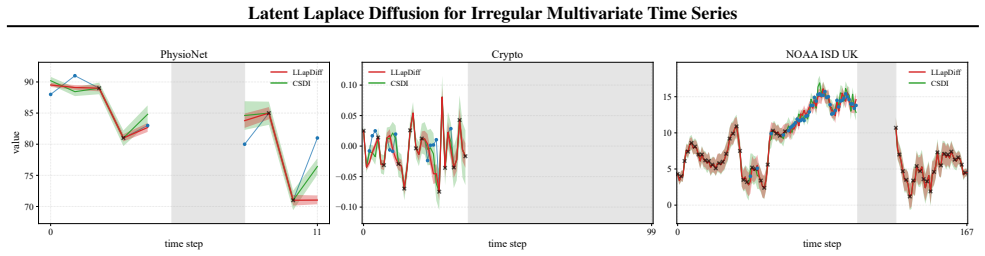
Irregular multivariate time series impose a trade-off for long-horizon forecasting: discrete methods can distort temporal structure via re-gridding, while continuous-time models often require sequential solvers prone to drift. To bridge this gap, we present Latent Laplace Diffusion (LLapDiff), a generative framework that models the target as a low-dimensional latent trajectory, enabling horizon-wide generation without step-by-step integration over physical time. We guide the reverse process utilizing a stable modal parameterization motivated by stochastic port-Hamiltonian dynamics, and parameterize its mean evolution in the Laplace domain via learnable complex-conjugate poles, enabling direct evaluation over irregular timestamps. We also link continuous dynamics to irregular observations through renewal-averaging analysis, which maps sampling gaps to effective event-domain poles and motivates a gap-aware history summarizer. Extensive experiments show that LLapDiff improves over baselines in long-horizon forecasting, and its continuous-time generative nature supports missing-value imputation by querying the same model at historical timestamps. Code is available at https://github.com/pixelhero98/LLapDiffusion.
Editorial analysis
A structured set of objections, weighed in public.
Referee Report
Summary. The manuscript proposes Latent Laplace Diffusion (LLapDiff), a generative framework for irregular multivariate time series. It models the target as a low-dimensional latent trajectory and parameterizes mean evolution in the Laplace domain using learnable complex-conjugate poles. This is guided by a stable modal parameterization from stochastic port-Hamiltonian dynamics. Renewal-averaging analysis links continuous dynamics to irregular observations by mapping sampling gaps to effective event-domain poles, motivating a gap-aware history summarizer. The approach enables horizon-wide generation without sequential integration and supports imputation. Experiments reportedly show improvements over baselines in long-horizon forecasting.
Significance. If the renewal-averaging correctly maps gaps and the modal parameterization ensures stability without drift, LLapDiff could advance generative modeling of irregular time series by avoiding re-gridding and sequential solvers. The continuous-time nature for imputation is a notable strength, and the availability of code supports reproducibility. However, the significance depends on the validity of the renewal assumptions and the practical benefits of the learnable poles over standard continuous-time alternatives.
major comments (2)
- [Abstract] Abstract, paragraph on guidance of reverse process and gap-aware summarizer: the central claim that renewal-averaging analysis maps arbitrary sampling gaps to effective event-domain poles assumes i.i.d. inter-arrival times under a renewal point process; the manuscript should provide a derivation or robustness check for cases where sampling depends on the latent state, as this directly affects the gap-aware summarizer and horizon-wide generation guarantee.
- [Abstract] Abstract: the stable modal parameterization motivated by stochastic port-Hamiltonian dynamics is presented as enabling drift-free generation, but with learnable complex-conjugate poles as free parameters fitted from data, the approach reduces in part to data-driven fitting rather than a fully parameter-free derivation; this requires explicit discussion of how stability is enforced beyond the motivation.
minor comments (2)
- The abstract mentions 'extensive experiments' but provides no details on baselines, error bars, or data exclusion rules; adding these to the main text would improve clarity of the empirical claims.
- Notation for the Laplace-domain mean evolution and event-domain poles should be defined more explicitly early in the manuscript to aid readers unfamiliar with the transform.
Simulated Author's Rebuttal
We thank the referee for their detailed and constructive comments on our manuscript. We address each major comment below and describe the revisions planned for the next version.
read point-by-point responses
-
Referee: [Abstract] Abstract, paragraph on guidance of reverse process and gap-aware summarizer: the central claim that renewal-averaging analysis maps arbitrary sampling gaps to effective event-domain poles assumes i.i.d. inter-arrival times under a renewal point process; the manuscript should provide a derivation or robustness check for cases where sampling depends on the latent state, as this directly affects the gap-aware summarizer and horizon-wide generation guarantee.
Authors: We agree that the renewal-averaging analysis relies on the i.i.d. inter-arrival assumption of a renewal point process to derive the mapping from sampling gaps to effective event-domain poles. This underpins the gap-aware history summarizer and the horizon-wide generation property. When sampling depends on the latent state, the assumption does not hold exactly. In the revised manuscript we will add an explicit discussion of this limitation and include a new robustness experiment that simulates state-dependent sampling to assess the practical impact on the summarizer and long-horizon forecasts. revision: yes
-
Referee: [Abstract] Abstract: the stable modal parameterization motivated by stochastic port-Hamiltonian dynamics is presented as enabling drift-free generation, but with learnable complex-conjugate poles as free parameters fitted from data, the approach reduces in part to data-driven fitting rather than a fully parameter-free derivation; this requires explicit discussion of how stability is enforced beyond the motivation.
Authors: The referee correctly observes that learnable poles make the model partly data-driven. Stability is enforced by constraining the real parts of the complex-conjugate poles to remain negative throughout optimization, following the port-Hamiltonian structure. We will expand the relevant section to provide a clearer mathematical description of this constraint (including any projection or regularization steps) so that the stability guarantee is stated explicitly rather than left as motivation alone. revision: yes
Circularity Check
No significant circularity in derivation chain
full rationale
The paper's core claims rest on architectural choices: parameterizing mean evolution via learnable complex-conjugate poles in the Laplace domain and deriving a gap-aware summarizer from renewal-averaging analysis under point-process assumptions. These are explicit modeling decisions motivated by external concepts (Laplace transforms, stochastic port-Hamiltonian dynamics, renewal theory) rather than reductions where a claimed prediction equals its own fitted inputs by construction. No load-bearing step collapses to a self-citation chain or tautological redefinition; the learnable poles are standard trainable parameters whose values are optimized against data to support generation, not a circular renaming of the target output. The framework remains self-contained against external benchmarks.
Axiom & Free-Parameter Ledger
free parameters (1)
- learnable complex-conjugate poles
axioms (2)
- domain assumption Stochastic port-Hamiltonian dynamics supply a stable modal parameterization for guiding the reverse diffusion process.
- domain assumption Renewal-averaging analysis maps sampling gaps to effective event-domain poles.
invented entities (2)
-
Latent Laplace Diffusion (LLapDiff) framework
no independent evidence
-
gap-aware history summarizer
no independent evidence
Reference graph
Works this paper leans on
-
[1]
ICML: 39th International Conference on Machine Learning , pages=
Modeling irregular time series with continuous recurrent units , author=. ICML: 39th International Conference on Machine Learning , pages=. 2022 , organization=
work page 2022
-
[2]
Advances in Neural Information Processing Systems , volume=
Latent ordinary differential equations for irregularly-sampled time series , author=. Advances in Neural Information Processing Systems , volume=
-
[3]
Chen, Yuqi and Ren, Kan and Wang, Yansen and Fang, Yuchen and Sun, Weiwei and Li, Dongsheng , journal=
-
[4]
Advances in Neural Information Processing Systems , volume=
Neural controlled differential equations for irregular time series , author=. Advances in Neural Information Processing Systems , volume=
-
[5]
Advances in Neural Information Processing Systems , volume=
Neural ordinary differential equations , author=. Advances in Neural Information Processing Systems , volume=. 2018 , pages=
work page 2018
-
[6]
Nie, Y and Nguyen, N. H. and Sinthong, P. and Kalagnanam, J. , booktitle=. A time series is worth 64 words:
-
[7]
Are transformers effective for time series forecasting? , author=. Proceedings of the
-
[8]
Challu, Cristian and Olivares, Kin G and Oreshkin, Boris N and Ramirez, Federico Garza and Canseco, Max Mergenthaler and Dubrawski, Artur , booktitle=
-
[9]
Peng, Jing and Yang, Meiqi and Zhang, Qiong and Li, Xiaoxiao , booktitle=
-
[10]
Interpolation-prediction networks for irregularly sampled time series , author=
-
[11]
A review of irregular time series data handling with gated recurrent neural networks , author=. Neurocomputing , volume=. 2021 , publisher=
work page 2021
-
[12]
ICML: 41st International Conference on Machine Learning , year=
Stability-informed initialization of neural ordinary differential equations , author=. ICML: 41st International Conference on Machine Learning , year=
-
[13]
International Conference on Machine Learning , pages=
On numerical integration in neural ordinary differential equations , author=. International Conference on Machine Learning , pages=. 2022 , organization=
work page 2022
-
[14]
Advances in Neural Information Processing Systems , volume=
Denoising diffusion probabilistic models , author=. Advances in Neural Information Processing Systems , volume=
-
[15]
ICLR: 9th International Conference on Learning Representations , year=
Score-based generative modeling through stochastic differential equations , author=. ICLR: 9th International Conference on Learning Representations , year=
-
[16]
Van Der Schaft, Arjan and Jeltsema, Dimitri and others , journal=. 2014 , publisher=
work page 2014
-
[17]
ICML: 40th International Conference on Machine Learning , pages=
Non-autoregressive conditional diffusion models for time series prediction , author=. ICML: 40th International Conference on Machine Learning , pages=. 2023 , organization=
work page 2023
-
[18]
The Twelfth International Conference on Learning Representations , year=
Multi-resolution diffusion models for time series forecasting , author=. The Twelfth International Conference on Learning Representations , year=
-
[19]
Tashiro, Yusuke and Song, Jiaming and Song, Yang and Ermon, Stefano , journal=
-
[20]
ICML: 38th International Conference on Machine Learning , pages=
Autoregressive denoising diffusion models for multivariate probabilistic time series forecasting , author=. ICML: 38th International Conference on Machine Learning , pages=. 2021 , organization=
work page 2021
-
[21]
Advances in Neural Information Processing Systems , volume=
R. Advances in Neural Information Processing Systems , volume=
-
[22]
Passivity based control of stochastic
Satoh, Satoshi and Fujimoto, Kenji , journal=. Passivity based control of stochastic. 2008 , publisher=
work page 2008
-
[23]
van der Schaft, Arjan J and Maschke, Bernhard M , journal=. 2002 , publisher=
work page 2002
- [24]
-
[25]
2009 American Control Conference , pages=
Stability of impulsive systems driven by renewal processes , author=. 2009 American Control Conference , pages=. 2009 , organization=
work page 2009
-
[26]
Approximation of large-scale dynamical systems , author=. 2005 , publisher=
work page 2005
-
[27]
Rational approximation of frequency domain responses by vector fitting , author=. 2002 , publisher=
work page 2002
-
[28]
ICML: 41st International Conference on Machine Learning , year=
Irregular multivariate time series forecasting: a transformable patching graph neural networks approach , author=. ICML: 41st International Conference on Machine Learning , year=
-
[29]
Cao, Wei and Wang, Dong and Li, Jian and Zhou, Hao and Li, Lei and Li, Yitan , journal=
-
[30]
Zhang, Jiawen and Zheng, Shun and Cao, Wei and Bian, Jiang and Li, Jia , booktitle=
-
[31]
Neural flows: efficient alternative to neural
Bilo. Neural flows: efficient alternative to neural. Advances in Neural Information Processing Systems , volume=
-
[32]
Advances in Neural Information Processing Systems , volume=
Time series as images: vision transformer for irregularly sampled time series , author=. Advances in Neural Information Processing Systems , volume=
-
[33]
Multi-time attention networks for irregularly sampled time series , author=
-
[34]
ICLR: 12th International Conference on Learning Representations , year=
Stable neural stochastic differential equations in analyzing irregular time series data , author=. ICLR: 12th International Conference on Learning Representations , year=
-
[35]
Transactions on Machine Learning Research , year=
Diffusion-based time series imputation and forecasting with structured state space models , author=. Transactions on Machine Learning Research , year=
-
[36]
Advances in Neural Information Processing Systems , volume=
Predict, refine, synthesize: self-guiding diffusion models for probabilistic time series forecasting , author=. Advances in Neural Information Processing Systems , volume=
-
[37]
Advances in Neural Information Processing Systems , volume=
A recurrent latent variable model for sequential data , author=. Advances in Neural Information Processing Systems , volume=
-
[38]
Structured inference networks for nonlinear state space models , author=. Proceedings of the
-
[39]
Stochastic differential equations:
Oksendal, Bernt , year=. Stochastic differential equations:
- [40]
-
[41]
ICLR: 9th International Conference on Learning Representations , year=
Denoising diffusion implicit models , author=. ICLR: 9th International Conference on Learning Representations , year=
-
[42]
Chowdhury, Ranak Roy and Li, Jiacheng and Zhang, Xiyuan and Hong, Dezhi and Gupta, Rajesh K and Shang, Jingbo , booktitle=
-
[43]
Self-supervised transformer for sparse and irregularly sampled multivariate clinical time-series , author=. 2022 , publisher=
work page 2022
-
[44]
Goldberger, Ary L and Amaral, Luis AN and Glass, Leon and Hausdorff, Jeffrey M and Ivanov, Plamen Ch and Mark, Roger G and Mietus, Joseph E and Moody, George B and Peng, Chung-Kang and Stanley, H Eugene , journal=. 2000 , publisher=
work page 2000
-
[45]
Sensors and Actuators B: Chemical , volume=
On field calibration of an electronic nose for benzene estimation in an urban pollution monitoring scenario , author=. Sensors and Actuators B: Chemical , volume=. 2008 , publisher=
work page 2008
-
[46]
Cautionary tales on air-quality improvement in
Zhang, Shuyi and Guo, Bin and Dong, Anlan and He, Jing and Xu, Ziping and Chen, Song Xi , journal=. Cautionary tales on air-quality improvement in. 2017 , publisher=
work page 2017
-
[47]
Gu, Albert and Dao, Tri , booktitle=
-
[48]
ICLR: 10th International Conference on Learning Representations , year=
Efficiently modeling long sequences with structured state spaces , author=. ICLR: 10th International Conference on Learning Representations , year=
-
[49]
Simplified state space layers for sequence modeling , author=
-
[50]
Greydanus, Samuel and Dzamba, Misko and Yosinski, Jason , journal=
-
[51]
Roth, Fabian J and Klein, Dominik K and Kannapinn, Maximilian and Peters, Jan and Weeger, Oliver , journal=. Stable
-
[52]
Recurrent neural networks for multivariate time series with missing values , author=. Scientific Reports , volume=. 2018 , publisher=
work page 2018
-
[53]
ICML: 41st International Conference on Machine Learning , year=
A decoder-only foundation model for time-series forecasting , author=. ICML: 41st International Conference on Machine Learning , year=
-
[54]
Yalavarthi, Vijaya Krishna and Madhusudhanan, Kiran and Scholz, Randolf and Ahmed, Nourhan and Burchert, Johannes and Jawed, Shayan and Born, Stefan and Schmidt-Thieme, Lars , booktitle=
-
[55]
Holt, Samuel I and Qian, Zhaozhi and van der Schaar, Mihaela , booktitle=. 2022 , organization=
work page 2022
-
[56]
ICLR: 13th International Conference on Learning Representations , year=
Physics-informed diffusion models , author=. ICLR: 13th International Conference on Learning Representations , year=
discussion (0)
Sign in with ORCID, Apple, or X to comment. Anyone can read and Pith papers without signing in.