Radiative depolarization of high-energy electron beams in wakefield accelerators
Pith reviewed 2026-05-20 01:40 UTC · model grok-4.3
The pith
Radiative depolarization of high-energy electron beams in wakefield accelerators depends mainly on the alignment of the witness beam with the wakefield.
A machine-rendered reading of the paper's core claim, the machinery that carries it, and where it could break.
Core claim
Through particle-in-cell simulations extended with Monte-Carlo routines to model radiative spin-flips, the authors determine that at high energies the importance of radiative effects on beam polarization mainly comes down to the alignment of the witness beam with respect to the wakefield.
What carries the argument
Particle-in-cell simulations extended with Monte-Carlo routines that track radiative spin-flips during betatron oscillations of the witness electrons.
If this is right
- Polarization loss grows with energy only when the beam is misaligned with the wakefield.
- Precise alignment can keep radiative depolarization small even at collider-relevant energies.
- Betatron oscillations become a source of spin flips once photon emission turns on at high energies.
- Collider concepts using wakefield accelerators must include alignment tolerances in their polarization budget.
Where Pith is reading between the lines
- Injection schemes that enforce tighter alignment could protect polarization without changing other accelerator parameters.
- The same alignment dependence may appear in any plasma accelerator where electrons undergo sustained transverse oscillations.
- Quantitative limits on acceptable misalignment could be extracted by repeating the simulations across a range of offset angles.
Load-bearing premise
The Monte-Carlo routines used to model radiative spin-flips during betatron oscillations correctly represent the physical process at the energies considered.
What would settle it
A controlled wakefield acceleration experiment that varies the initial alignment of a polarized electron beam, measures its final polarization, and compares the result to otherwise identical runs that omit radiative spin-flip modeling.
Figures



read the original abstract
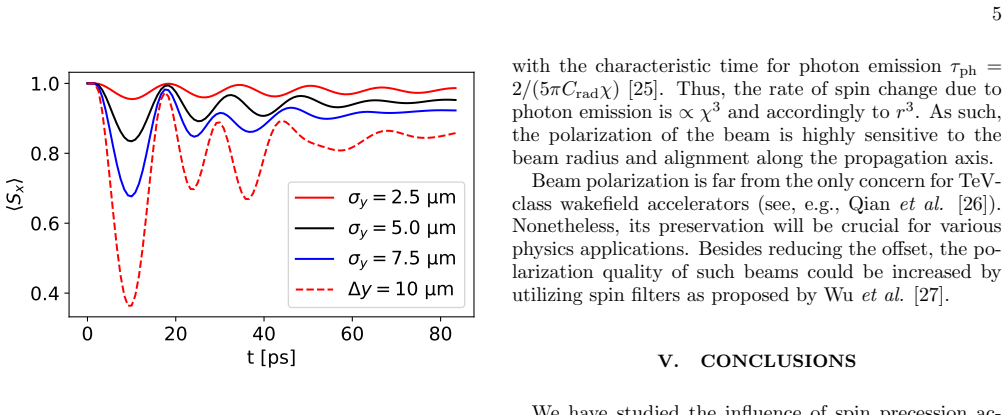
The preservation of witness beam polarization in wakefield accelerators will be crucial for future collider applications. While extensive theoretical studies on the injection and initial acceleration of polarized electrons exist, a study concerning higher-energy regimes has been neglected thus far. Besides the spin precession usually considered in wakefield-related research, radiative effects could become increasingly relevant at higher energies as the witness electrons perform betatron oscillations during which they will emit photons. In the present study, we use particle-in-cell simulations extended with Monte-Carlo routines to study the influence of radiative spin-flips on beam polarization. We find that at high energies, the importance of radiative effects on beam polarization mainly comes down to the alignment of the witness beam with respect to the wakefield.
Editorial analysis
A structured set of objections, weighed in public.
Referee Report
Summary. The manuscript uses particle-in-cell simulations augmented by Monte-Carlo routines to model radiative spin-flips experienced by high-energy witness electrons undergoing betatron oscillations in wakefield accelerators. The central claim is that, in the high-energy regime, the dominant influence on radiative depolarization is the alignment of the witness beam relative to the wakefield rather than other parameters.
Significance. If the numerical results hold after validation, the work would usefully extend prior studies of polarized injection to the high-energy regime relevant for collider applications. The direct numerical treatment of spin-dependent photon emission during oscillatory trajectories is a methodological strength that could guide alignment tolerances in future plasma-based accelerators.
major comments (1)
- [Simulation methods / Monte-Carlo spin-flip routine] The Monte-Carlo implementation for sampling radiative spin-flips (described in the simulation-methods section) is not validated against the Sokolov-Ternov formula for constant fields or against analytic expressions for the polarization evolution under time-varying wakefield forces. Because the headline result—that alignment controls depolarization—rests directly on the sampled flip probabilities and their correlation with emission angle during betatron motion, this cross-check is load-bearing.
minor comments (1)
- [Abstract] The abstract states the qualitative conclusion but supplies no quantitative measures (e.g., depolarization fractions, dependence on energy or misalignment angle, or convergence metrics), which would help readers assess the magnitude of the reported effect.
Simulated Author's Rebuttal
We thank the referee for their constructive feedback, which highlights an important aspect of our simulation methodology. We address the major comment on validation of the Monte-Carlo spin-flip routine below and have incorporated additional checks in the revised manuscript to strengthen the support for our central finding regarding beam alignment.
read point-by-point responses
-
Referee: The Monte-Carlo implementation for sampling radiative spin-flips (described in the simulation-methods section) is not validated against the Sokolov-Ternov formula for constant fields or against analytic expressions for the polarization evolution under time-varying wakefield forces. Because the headline result—that alignment controls depolarization—rests directly on the sampled flip probabilities and their correlation with emission angle during betatron motion, this cross-check is load-bearing.
Authors: We agree that explicit validation is necessary given the reliance of our results on the Monte-Carlo sampling. In the revised manuscript, we have expanded the Simulation Methods section to include direct comparisons of our implementation against the Sokolov-Ternov formula for constant magnetic fields across a range of energies and field strengths, showing agreement within statistical uncertainties. We have also added benchmarks against analytic expressions for polarization evolution in time-varying fields representative of betatron oscillations, confirming that the sampled flip rates and angular correlations reproduce the expected depolarization behavior. These additions provide the requested cross-checks and reinforce that alignment with the wakefield remains the dominant factor in the high-energy regime. revision: yes
Circularity Check
No circularity: results from direct numerical simulation
full rationale
The paper reports outcomes of particle-in-cell simulations augmented by Monte-Carlo sampling of radiative spin-flips during betatron motion. No analytical derivation, parameter fitting, or self-referential definition is presented whose output is then relabeled as a prediction. The headline finding—that radiative depolarization at high energies is governed primarily by witness-beam alignment—arises from the ensemble of simulation runs rather than from any reduction to prior fitted values or self-citation chains. External validation concerns (e.g., cross-checks against Sokolov-Ternov) affect correctness but do not constitute circularity under the defined criteria.
Axiom & Free-Parameter Ledger
Lean theorems connected to this paper
-
IndisputableMonolith/Cost/FunctionalEquation.leanwashburn_uniqueness_aczel unclear?
unclearRelation between the paper passage and the cited Recognition theorem.
We use particle-in-cell simulations extended with Monte-Carlo routines to study the influence of radiative spin-flips on beam polarization. We find that at high energies, the importance of radiative effects on beam polarization mainly comes down to the alignment of the witness beam with respect to the wakefield.
What do these tags mean?
- matches
- The paper's claim is directly supported by a theorem in the formal canon.
- supports
- The theorem supports part of the paper's argument, but the paper may add assumptions or extra steps.
- extends
- The paper goes beyond the formal theorem; the theorem is a base layer rather than the whole result.
- uses
- The paper appears to rely on the theorem as machinery.
- contradicts
- The paper's claim conflicts with a theorem or certificate in the canon.
- unclear
- Pith found a possible connection, but the passage is too broad, indirect, or ambiguous to say the theorem truly supports the claim.
Reference graph
Works this paper leans on
-
[1]
S. Gessner, J. Osterhoff, C. A. Lindstrøm, K. Cassou, S. P. Griso, J. List, E. Adli, B. Foster, J. Palastro, E. Donegani,et al., Design initiative for a 10 tev pcm wakefield collider (2025), arXiv:2503.20214 [physics.acc- ph]
-
[2]
A. Picksley, J. Stackhouse, C. Benedetti, K. Nakamura, H. E. Tsai, R. Li, B. Miao, J. E. Shrock, E. Rock- afellow, H. M. Milchberg, C. B. Schroeder, J. van Tilborg, E. Esarey, C. G. R. Geddes, and A. J. Gon- salves, Matched guiding and controlled injection in dark- current-free, 10-gev-class, channel-guided laser-plasma accelerators, Phys. Rev. Lett.133, ...
work page 2024
-
[3]
C. Glashausser, Nuclear physics with polarized beams, Annual Review of Nuclear and Particle Science29, 33 (1979)
work page 1979
- [4]
-
[5]
L. Reichwein, Z. Gong, C. Zheng, L. L. Ji, A. Pukhov, and M. B¨ uscher, Plasma acceleration of polarized particle beams, Reports on Progress in Physics88, 117001 (2025)
work page 2025
-
[6]
L. R. Yin, X. F. Li, Y. J. Gu, N. Cao, Q. Kong, M. B¨ uscher, S. M. Weng, M. Chen, and Z. M. Sheng, Generation of polarized electron beams through self- injection in the interaction of a laser with a pre-polarized plasma, High Power Laser Science and Engineering12, e28 (2024)
work page 2024
-
[7]
Y. Wu, L. Ji, X. Geng, Q. Yu, N. Wang, B. Feng, Z. Guo, W. Wang, C. Qin, X. Yan, L. Zhang, J. Thomas, A. H¨ utzen, M. B¨ uscher, T. P. Rakitzis, A. Pukhov, B. Shen, and R. Li, Polarized electron-beam acceleration driven by vortex laser pulses, New Journal of Physics21, 073052 (2019). 6 FIG. 5. An exemplary simulation showing the (a) density distribution, ...
work page 2019
-
[8]
Y. Wu, L. Ji, X. Geng, Q. Yu, N. Wang, B. Feng, Z. Guo, W. Wang, C. Qin, X. Yan, L. Zhang, J. Thomas, A. H¨ utzen, A. Pukhov, M. B¨ uscher, B. Shen, and R. Li, Polarized electron acceleration in beam-driven plasma wakefield based on density down-ramp injection, Phys. Rev. E100, 043202 (2019)
work page 2019
- [9]
-
[10]
Pinching injection in wakefields for spin-polarized electron beams
L. Reichwein, D. Sofikitis, O. Mathiak, T. P. Rakitzis, B. Hidding, A. Pukhov, L. Ji, and M. B¨ uscher, Pinching injection in wakefields for spin-polarized electron beams (2026), arXiv:2604.22369 [physics.plasm-ph]
work page internal anchor Pith review Pith/arXiv arXiv 2026
- [11]
-
[12]
D. Sofikitis, L. Reichwein, M. G. Stamatakis, C. Zois, D. G. Papazoglou, S. Cohen, M. B¨ uscher, A. Pukhov, and T. P. Rakitzis, High-energy polarized electron beams from the ionization of isolated spin polarized hydrogen atoms, Phys. Rev. A111, 053119 (2025)
work page 2025
- [13]
-
[14]
Z. Nie, F. Li, F. Morales, S. Patchkovskii, O. Smirnova, W. An, C. Zhang, Y. Wu, N. Nambu, D. Matteo, K. A. Marsh, F. Tsung, W. B. Mori, and C. Joshi, Highly spin- polarized multi-gev electron beams generated by single- species plasma photocathodes, Phys. Rev. Res.4, 033015 (2022)
work page 2022
-
[15]
L. H. Thomas, The motion of the spinning electron, Na- ture117, 514 (1926)
work page 1926
-
[16]
V. Bargmann, L. Michel, and V. L. Telegdi, Precession of the polarization of particles moving in a homogeneous electromagnetic field, Phys. Rev. Lett.2, 435 (1959)
work page 1959
-
[17]
J. Vieira, C.-K. Huang, W. B. Mori, and L. O. Silva, Po- larized beam conditioning in plasma based acceleration, Phys. Rev. ST Accel. Beams14, 071303 (2011)
work page 2011
-
[18]
V. N. Ba˘ ıer, Radiative polarization of electrons in storage rings, Soviet Physics Uspekhi14, 695 (1972)
work page 1972
-
[19]
H.-H. Song, W.-M. Wang, and Y.-T. Li, Dense polar- ized positrons from laser-irradiated foil targets in the qed regime, Phys. Rev. Lett.129, 035001 (2022)
work page 2022
-
[20]
A. Pukhov, Three-dimensional electromagnetic relativis- tic particle-in-cell code vlpl (virtual laser plasma lab), Journal of Plasma Physics61, 425–433 (1999)
work page 1999
-
[21]
A. Pukhov, Particle-In-Cell Codes for Plasma-based Par- ticle Acceleration, CERN Yellow Reports , 181 Pages (2016), artwork Size: 181 Pages Publisher: CERN, Geneva
work page 2016
-
[22]
A. Pukhov, X-dispersionless maxwell solver for plasma- based particle acceleration, Journal of Computational Physics418, 109622 (2020)
work page 2020
-
[23]
I. Kostyukov, A. Pukhov, and S. Kiselev, Phenomenologi- cal theory of laser-plasma interaction in “bubble” regime, Physics of Plasmas11, 5256 (2004)
work page 2004
-
[24]
L. Reichwein, J. Thomas, A. Golovanov, I. Kostyukov, and A. Pukhov, Fixing e-field divergence in strongly non- linear wakefields in homogeneous plasma, Plasma Physics and Controlled Fusion62, 115017 (2020)
work page 2020
-
[25]
I. I. Artemenko and I. Y. Kostyukov, Continuous- radiative-loss model for electron-spin dynamics in the radiation-dominated regime, Phys. Rev. A108, 052206 (2023)
work page 2023
-
[26]
Q. Qian, D. Seipt, Y. Ma, S. S. Bulanov, C. B. Schroeder, and A. G. R. Thomas, Strong-field qed limitations on tev- class plasma wakefield accelerators, Plasma Physics and Controlled Fusion68, 055011 (2026)
work page 2026
-
[27]
Y. Wu, L. Ji, X. Geng, J. Thomas, M. B¨ uscher, A. Pukhov, A. H¨ utzen, L. Zhang, B. Shen, and R. Li, Spin filter for polarized electron acceleration in plasma wakefields, Phys. Rev. Appl.13, 044064 (2020)
work page 2020
-
[28]
Gauss Centre for Supercomputing,https: //www.gauss-centre.eu
discussion (0)
Sign in with ORCID, Apple, or X to comment. Anyone can read and Pith papers without signing in.