A lifting partition theorem for tropical tritangent classes to smooth space sextic curves
Pith reviewed 2026-05-20 04:42 UTC · model grok-4.3
The pith
For a generic smooth space sextic curve, its eight classical tritangent planes realize only six of the ten possible partitions of eight when lifted from their tropical classes.
A machine-rendered reading of the paper's core claim, the machinery that carries it, and where it could break.
Core claim
When the input classical curve is generic, only six out of the ten possible partitions of 8 into powers of 2 arise from lifting multiplicities of tritangent classes. These partitions are completely determined by the dimension of a suitable connected subcomplex of the class and the existence of a member with a tropical tangency of a predetermined combinatorial type.
What carries the argument
The lifting multiplicity partitions of tritangent classes, fixed by the dimension of a connected subcomplex and the presence of a prescribed combinatorial tangency type.
If this is right
- Only six multiplicity patterns are possible for the classical lifts inside each tropical tritangent class.
- The pattern for any given class is read off from the dimension of one of its connected subcomplexes and from the existence of a member with a fixed tangency type.
- Many partitions that are combinatorially possible are excluded for generic curves.
- The classification reduces the problem of determining lift counts to checking two discrete invariants of the tropical class.
Where Pith is reading between the lines
- The result supplies a practical test for predicting lift numbers from tropical data without enumerating classical planes.
- Similar dimension-and-type criteria may apply to lifting problems for other special divisors on tropical curves of higher genus or degree.
- The restriction to six partitions suggests that the space of generic curves induces a coarser stratification on the tropical moduli space than the full set of partitions would require.
Load-bearing premise
The genericity assumption on the classical curve, together with the claim that the observed partitions are completely fixed by subcomplex dimension and combinatorial tangency type.
What would settle it
A single generic smooth space sextic curve whose tropical tritangent class realizes a lifting partition of eight that is not among the six allowed ones, for example a partition containing a 2+2+2+2 sum not covered by the theorem.
Figures









read the original abstract
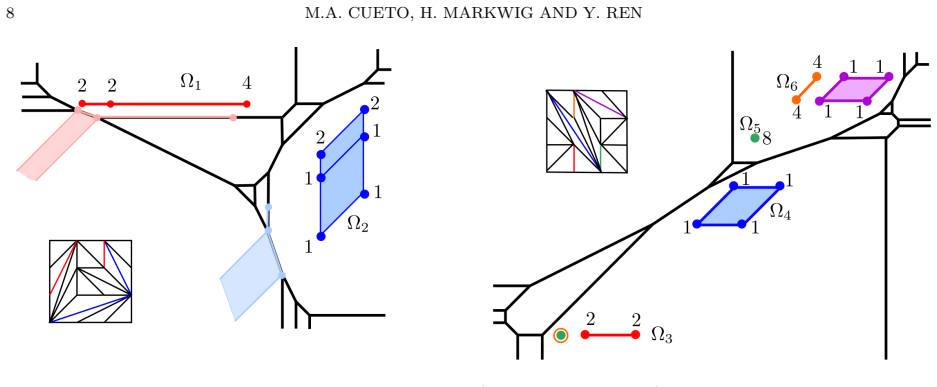
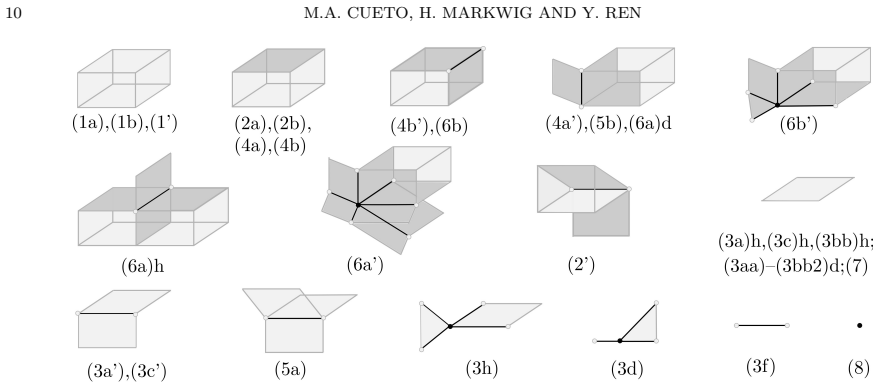
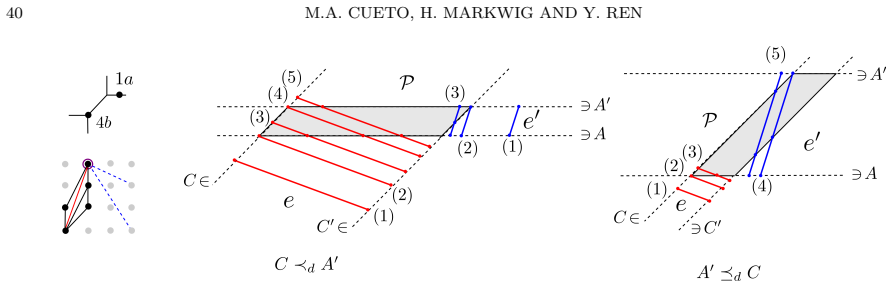
The set of tritangent planes to smooth tropical space sextic curves has 15 connected components, recording continuous displacements of planes preserving the tritangency condition. These 15 tritangent classes are polyhedral complexes in $\mathbf{R}^3$, and each of them contains the tropicalization of precisely eight tritangent planes to any smooth space sextic curve with the given tropicalization. Prior joint work of the authors with Len confirms that each tropical tritangent plane has 0, 1, 2, 4 or 8 lifts to classical tritangent planes defined over the algebraic closure of the field over which the original algebraic curve is defined. Our main theorem states that when the input classical curve is generic, then only six out of the ten possible partitions of 8 into powers of 2 arise from lifting multiplicities of tritangent classes. Furthermore, we show that these partitions are completely determined by the dimension of a suitable connected subcomplex of the class and the existence of a member with a tropical tangency of a predetermined combinatorial type.
Editorial analysis
A structured set of objections, weighed in public.
Referee Report
Summary. The paper establishes a lifting partition theorem for tropical tritangent classes associated to smooth space sextic curves. It builds on prior joint work with Len establishing possible lift numbers of 0, 1, 2, 4 or 8, and proves that for a generic classical curve only six of the ten possible partitions of 8 into powers of 2 arise as lifting multiplicities across the 15 tritangent classes; moreover these partitions are completely determined by the dimension of a suitable connected subcomplex of the class together with the existence of a member realizing a predetermined combinatorial tangency type.
Significance. If the result holds, the theorem supplies an explicit combinatorial classification that reduces the possible lifting behaviors of tritangent planes under tropicalization for generic curves. By linking multiplicity partitions directly to subcomplex dimension and tangency type, the work strengthens the bridge between tropical polyhedral geometry and classical enumerative questions on space sextics, and provides falsifiable criteria that can be checked in explicit examples.
major comments (1)
- [Main Theorem] Main Theorem (abstract and the statement following the reference to prior work with Len): the assertion that the partitions are completely determined by subcomplex dimension plus one predetermined tangency type requires an explicit reduction showing that no additional combinatorial invariants (such as facet incidences or global polyhedral relations within the class) enter the lifting count. Without this, the restriction to exactly six partitions remains conditional on an implicit uniformity that is not yet secured by the given outline.
minor comments (2)
- [Introduction] Clarify the precise definition of 'connected subcomplex' and 'predetermined combinatorial tangency type' with a short example or diagram in the introductory section to aid readers unfamiliar with the polyhedral structure of the tritangent classes.
- [References] The bibliography entry for the prior joint work with Len should include the full arXiv identifier or journal details for easy cross-reference.
Simulated Author's Rebuttal
We thank the referee for their thorough review and valuable suggestions. We address the major comment concerning the Main Theorem below. In response, we have clarified the proof by adding an explicit reduction, as detailed in our point-by-point reply.
read point-by-point responses
-
Referee: Main Theorem (abstract and the statement following the reference to prior work with Len): the assertion that the partitions are completely determined by subcomplex dimension plus one predetermined tangency type requires an explicit reduction showing that no additional combinatorial invariants (such as facet incidences or global polyhedral relations within the class) enter the lifting count. Without this, the restriction to exactly six partitions remains conditional on an implicit uniformity that is not yet secured by the given outline.
Authors: We are grateful for this comment, which highlights a point where the exposition can be strengthened. The proof of the Main Theorem, as outlined in Sections 3 and 4, classifies each tritangent class by the dimension of its connected subcomplex and the combinatorial type of a tangency realized by one of its members. We then determine the lifting multiplicity for each such classified class by direct computation of the possible algebraic lifts, using the results from our prior work with Len. To explicitly address potential additional invariants, we have inserted a new paragraph and a supporting lemma (Lemma 4.5 in the revised manuscript) proving that, for generic curves, any facet incidences or global polyhedral relations within the class are uniquely determined by the subcomplex dimension and the tangency type. This is achieved by showing that variations in these features would contradict the genericity assumption or the fixed combinatorial type. Consequently, the lifting partition depends only on these two parameters, securing the restriction to exactly six partitions out of ten. We have updated the abstract and the theorem statement to reference this reduction explicitly. revision: yes
Circularity Check
Minor self-citation to prior joint work on lift numbers; central restriction to six partitions is independent
specific steps
-
self citation load bearing
[Abstract]
"Prior joint work of the authors with Len confirms that each tropical tritangent plane has 0, 1, 2, 4 or 8 lifts to classical tritangent planes defined over the algebraic closure of the field over which the original algebraic curve is defined. Our main theorem states that when the input classical curve is generic, then only six out of the ten possible partitions of 8 into powers of 2 arise from lifting multiplicities of tritangent classes."
The possible lift numbers are imported from the authors' own prior work, but the theorem's restriction to six partitions under genericity and their determination by dimension plus tangency type constitute an independent combinatorial statement not forced by that citation alone.
full rationale
The paper cites prior joint work with Len to establish the possible lift counts 0,1,2,4,8. The main theorem then adds a genericity-based restriction to six partitions out of ten, determined by subcomplex dimension and a fixed tangency type. This self-citation supports background facts but does not reduce the novel combinatorial determination to a fit or prior result by construction. No self-definitional steps, fitted predictions, or ansatz smuggling appear in the stated claims.
Axiom & Free-Parameter Ledger
axioms (2)
- domain assumption Tropicalization preserves the tritangency condition and produces polyhedral complexes with 15 connected components
- domain assumption Each tropical tritangent plane lifts to 0, 1, 2, 4 or 8 classical tritangent planes
Lean theorems connected to this paper
-
IndisputableMonolith/Foundation/AlexanderDuality.leanalexander_duality_circle_linking echoes?
echoesECHOES: this paper passage has the same mathematical shape or conceptual pattern as the Recognition theorem, but is not a direct formal dependency.
only six out of the ten possible partitions of 8 into powers of 2 arise... completely determined by the dimension of a suitable connected subcomplex of the class and the existence of a member with a tropical tangency of a predetermined combinatorial type
What do these tags mean?
- matches
- The paper's claim is directly supported by a theorem in the formal canon.
- supports
- The theorem supports part of the paper's argument, but the paper may add assumptions or extra steps.
- extends
- The paper goes beyond the formal theorem; the theorem is a base layer rather than the whole result.
- uses
- The paper appears to rely on the theorem as machinery.
- contradicts
- The paper's claim conflicts with a theorem or certificate in the canon.
- unclear
- Pith found a possible connection, but the passage is too broad, indirect, or ambiguous to say the theorem truly supports the claim.
Reference graph
Works this paper leans on
-
[1]
Ueber eine Classe von Gleichungen, welche nur reelle Wurzeln besitzen.J
Alfred Clebsch. Ueber eine Classe von Gleichungen, welche nur reelle Wurzeln besitzen.J. Reine Angew. Math., 62:232–245, 1863
-
[2]
Coble.Algebraic geometry and theta functions, volume Vol
Arthur B. Coble.Algebraic geometry and theta functions, volume Vol. 10 ofAmerican Mathematical Society Colloquium Publications. American Mathematical Society, Providence, RI, 1982. Reprint of the 1929 edition
work page 1982
-
[3]
Tropical methods for building real space sextics with totally real tritangent planes , url =
Maria Angelica Cueto, Yoav Len, Hannah Markwig, and Yue Ren. Tropical methods for building real space sextics with totally real tritangent planes, 2025. arXiv:2512.24277
-
[4]
Combinatorics and real lifts of bitangents to tropical quartic curves
Maria Angelica Cueto and Hannah Markwig. Combinatorics and real lifts of bitangents to tropical quartic curves. Discrete Comput. Geom., 69(3):597–658, 2023
work page 2023
-
[5]
Real tropical quartics and their bitangents: counting with patchworking, 2025
Alheydis Geiger. Real tropical quartics and their bitangents: counting with patchworking, 2025. arXiv:2503.22390
-
[6]
Tritangent planes to space sextics: the algebraic and tropical stories
Corey Harris and Yoav Len. Tritangent planes to space sextics: the algebraic and tropical stories. InCombinato- rial algebraic geometry, volume 80 ofFields Inst. Commun., pages 47–63. Fields Inst. Res. Math. Sci., Toronto, ON, 2017
work page 2017
-
[7]
Stable intersections of tropical varieties.J
Anders Jensen and Josephine Yu. Stable intersections of tropical varieties.J. Algebraic Comb., 43(1):101–128, 2016
work page 2016
-
[8]
Tropicalization of theta characteristics, double covers, and Prym varieties.Selecta Math
David Jensen and Yoav Len. Tropicalization of theta characteristics, double covers, and Prym varieties.Selecta Math. (N.S.), 24(2):1391–1410, 2018
work page 2018
-
[9]
Yoav Len and Hannah Markwig. Lifting tropical bitangents.J. Symbolic Comput., 96:122–152, 2020
work page 2020
-
[10]
American Mathematical Society, Providence, RI, 2015
Diane Maclagan and Bernd Sturmfels.Introduction to tropical geometry, volume 161 ofGraduate Studies in Mathematics. American Mathematical Society, Providence, RI, 2015
work page 2015
-
[11]
Tropical geometry and its applications
Grigory Mikhalkin. Tropical geometry and its applications. InInternational Congress of Mathematicians. Vol. II, pages 827–852. Eur. Math. Soc., Z¨ urich, 2006
work page 2006
-
[12]
Tropical theta characteristics
Ilia Zharkov. Tropical theta characteristics. InMirror symmetry and tropical geometry, volume 527 ofContemp. Math., pages 165–168. Amer. Math. Soc., Providence, RI, 2010. Authors’ addresses: M.A. Cueto, Mathematics Department, The Ohio State University, 231 W 18th Ave, Columbus, OH 43210, USA. Email address:cueto.5@osu.edu H. Markwig, Eberhard Karls Unive...
work page 2010
discussion (0)
Sign in with ORCID, Apple, or X to comment. Anyone can read and Pith papers without signing in.