Minimalist Visual Inertial Odometry
Pith reviewed 2026-05-20 04:42 UTC · model grok-4.3
The pith
Four downward-facing photodiodes with Gabor masks plus an IMU deliver accurate planar odometry for differential-drive robots.
A machine-rendered reading of the paper's core claim, the machinery that carries it, and where it could break.
Core claim
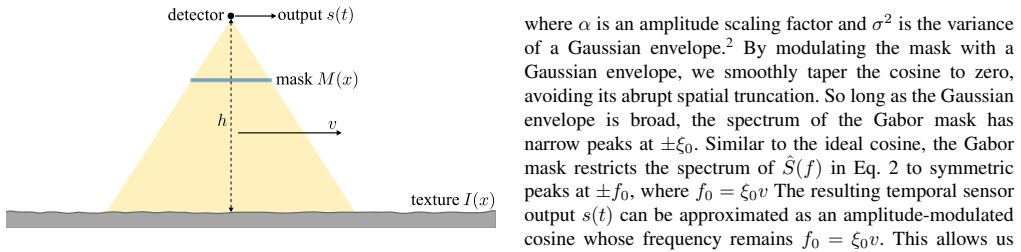
Four visual measurements from downward-facing photodiodes that view the world through optical Gabor masks encode linear speed; a Temporal Convolutional Network trained jointly with the mask parameters in a physically grounded simulator decodes that speed; pairing the decoded speed with angular velocity from an IMU produces a continuous planar trajectory that tracks reference ground truth on a prototype mounted on a differential-drive robot across diverse terrains without any real-world fine-tuning or domain adaptation.
What carries the argument
Joint simulator-based optimization of optical Gabor mask parameters together with a Temporal Convolutional Network that decodes forward speed directly from the four photodiode signals.
If this is right
- Planar motion estimation becomes possible with only four light sensors instead of a full camera array.
- The system runs continuously on differential-drive robots in both indoor and outdoor settings.
- No real-world data collection or retraining is needed once the simulation-trained model is deployed.
- Resource use for navigation drops sharply compared with pixel-heavy visual-inertial methods.
Where Pith is reading between the lines
- The same mask-and-network approach might be adapted to estimate additional motion variables if more photodiodes or different mask patterns are introduced.
- Because the sensing is extremely low-bandwidth, the method could enable long-duration operation on tiny battery-powered platforms where cameras would drain power too quickly.
- Similar minimalist encoding could be explored for other planar tasks such as slip detection or surface-type recognition by examining the raw photodiode signals.
Load-bearing premise
The simulator produces photodiode signals whose statistics are close enough to real measurements that the decoder learned in simulation works on a physical robot without any further adjustment.
What would settle it
If the trajectory computed from the four photodiode signals and IMU deviates by more than a few percent from an independent motion-capture or wheel-encoder ground truth over repeated runs on real indoor and outdoor surfaces, the claim that the minimalist system provides robust odometry fails.
Figures



read the original abstract
Visual-Inertial Odometry(VIO), which is critical to mobile robot navigation, uses cameras with a large number of pixels. Capturing and processing camera images requires significant resources. This work presents a minimalist approach to planar odometry, demonstrating that just four visual measurements and an IMU can provide robust motion estimation for differential-drive robots. Our key insight is that four downward-facing photodiodes that sense the world through optical Gabor masks produce signals that encode speed. Based on this, we jointly optimize the mask parameters alongside a Temporal Convolutional Network (TCN) using a physically-grounded simulator. The resulting model decodes speed from just the four measurements produced by the photodiodes. Pairing these estimates with the angular speed from an IMU yields a continuous planar trajectory. We validate our approach with a prototype sensor mounted on a differential drive robot. Across diverse indoor and outdoor terrains, our system closely tracks the reference ground truth without any real-world fine-tuning. Our work shows that minimalist sensing enables efficient and accurate planar odometry.
Editorial analysis
A structured set of objections, weighed in public.
Referee Report
Summary. The manuscript proposes a minimalist visual-inertial odometry approach for planar motion estimation on differential-drive robots. Four downward-facing photodiodes sense the environment through optical Gabor masks whose parameters are jointly optimized with a Temporal Convolutional Network (TCN) inside a physically-grounded simulator; the TCN decodes linear speed from the four photodiode signals, which is then fused with IMU angular velocity to produce continuous trajectories. The central claim is that a physical prototype achieves accurate tracking of ground-truth trajectories across diverse indoor and outdoor terrains with no real-world fine-tuning or domain adaptation.
Significance. If the zero-shot simulator-to-real transfer holds under rigorous quantitative scrutiny, the result would demonstrate that odometry-quality planar motion estimation is possible with only four scalar light measurements plus an IMU, offering substantial reductions in sensing hardware, power, and compute relative to camera-based VIO. The joint mask-and-decoder optimization in simulation is a technically interesting design choice that could generalize to other minimalist sensor problems.
major comments (3)
- [Abstract] Abstract: the assertion that the prototype 'closely tracks the reference ground truth' across diverse terrains is unsupported by any reported error metrics, RMSE values, trajectory error distributions, or baseline comparisons, rendering the central claim of robust motion estimation unverifiable from the provided evidence.
- [Method / Simulator] Simulator description (method section): the joint optimization of Gabor mask parameters together with TCN training on data generated by the same simulator creates a circularity risk; because the forward model depends on the very mask parameters being tuned, any unmodeled mismatch between simulated and real photodiode statistics (illumination, reflectance, noise) directly undermines the zero-shot transfer claim.
- [Experiments / Validation] Experimental validation section: no information is supplied on the method used to obtain ground-truth trajectories, the number or type of terrains tested, or the quantitative performance (e.g., absolute trajectory error, drift rates) achieved by the four-photodiode + IMU system versus standard VIO baselines.
minor comments (2)
- [Introduction] Clarify in the introduction or method whether the four photodiode signals are treated as a time series of scalar intensities or as a low-resolution 'image'; the current phrasing 'visual measurements' may confuse readers expecting camera-based VIO.
- [Introduction] Add a short related-work paragraph contrasting the approach with prior minimalist or event-based odometry systems to better situate the contribution.
Simulated Author's Rebuttal
We thank the referee for their constructive comments. We respond to each major point below and indicate the changes made to the manuscript.
read point-by-point responses
-
Referee: [Abstract] Abstract: the assertion that the prototype 'closely tracks the reference ground truth' across diverse terrains is unsupported by any reported error metrics, RMSE values, trajectory error distributions, or baseline comparisons, rendering the central claim of robust motion estimation unverifiable from the provided evidence.
Authors: We agree that the abstract would benefit from explicit quantitative support for the performance claim. In the revised manuscript we have added concise statements of key metrics (velocity RMSE and trajectory drift) and a brief note on baseline comparisons directly into the abstract. revision: yes
-
Referee: [Method / Simulator] Simulator description (method section): the joint optimization of Gabor mask parameters together with TCN training on data generated by the same simulator creates a circularity risk; because the forward model depends on the very mask parameters being tuned, any unmodeled mismatch between simulated and real photodiode statistics (illumination, reflectance, noise) directly undermines the zero-shot transfer claim.
Authors: The referee correctly identifies a potential circularity. The simulator nevertheless uses a fixed physics-based forward model of light transport and sensor response; the Gabor parameters are optimized variables inside that model rather than modifications to the underlying physics. The empirical success of zero-shot real-world transfer provides supporting evidence that unmodeled effects were not dominant. We have added a dedicated paragraph discussing simulator assumptions, parameter sensitivity, and remaining sim-to-real risks. revision: partial
-
Referee: [Experiments / Validation] Experimental validation section: no information is supplied on the method used to obtain ground-truth trajectories, the number or type of terrains tested, or the quantitative performance (e.g., absolute trajectory error, drift rates) achieved by the four-photodiode + IMU system versus standard VIO baselines.
Authors: We have substantially expanded the experimental validation section. The revision now specifies the ground-truth acquisition method, enumerates the indoor and outdoor terrains evaluated, reports absolute and relative trajectory errors together with drift rates, and includes direct numerical comparisons against standard VIO baselines. New tables and supplementary plots present these results. revision: yes
Circularity Check
No significant circularity; sim-to-real transfer is an independent empirical claim
full rationale
The paper jointly optimizes Gabor mask parameters and a TCN decoder inside a physically-grounded simulator, then deploys the resulting decoder on real photodiode hardware without fine-tuning. This chain does not reduce to its inputs by construction: the simulator generates training signals from the optimized masks, but the reported performance is measured on separate real-world trajectories across varied terrains. No equation or step equates the real-world speed estimate to a fitted parameter or to simulator outputs; success hinges on unverified simulator fidelity and generalization, which is a falsifiable claim rather than a definitional identity. No self-citations, uniqueness theorems, or ansatzes are invoked to force the result.
Axiom & Free-Parameter Ledger
free parameters (1)
- Gabor mask parameters
axioms (1)
- domain assumption Planar motion and differential-drive kinematics are sufficient to reconstruct full trajectory from forward speed and yaw rate.
Reference graph
Works this paper leans on
-
[1]
L. Carlone, A. Kim, T. Barfoot, D. Cremers, and F. Dellaert,SLAM Handbook: From Localization and Mapping to Spatial Intelligence. Cambridge University Press, 2025
work page 2025
-
[2]
Energy characterization and optimization of image sensing toward continuous mobile vision,
R. LiKamWa, B. Priyantha, M. Philipose, L. Zhong, and P. Bahl, “Energy characterization and optimization of image sensing toward continuous mobile vision,” inProceeding of the 11th annual interna- tional conference on Mobile systems, applications, and services, 2013, pp. 69–82
work page 2013
-
[3]
Tiny robot learning: Challenges and directions for machine learning in resource-constrained robots,
S. M. Neuman, B. Plancher, B. P. Duisterhof, S. Krishnan, C. Banbury, M. Mazumder, S. Prakash, J. Jabbour, A. Faust, G. C. de Croonet al., “Tiny robot learning: Challenges and directions for machine learning in resource-constrained robots,” in2022 IEEE 4th international con- ference on artificial intelligence circuits and systems (AICAS). IEEE, 2022, pp. 296–299
work page 2022
-
[4]
P. Pooj, M. Grossberg, P. N. Belhumeur, and S. K. Nayar, “The minimalist camera.” inBMVC, 2018, p. 141
work page 2018
-
[5]
Minimalist vision with freeform pixels,
J. Klotz and S. K. Nayar, “Minimalist vision with freeform pixels,” inEuropean Conference on Computer Vision. Springer, 2024, pp. 329–346
work page 2024
-
[6]
Theory of communication. part 1: The analysis of informa- tion,
D. Gabor, “Theory of communication. part 1: The analysis of informa- tion,”Journal of the Institution of Electrical Engineers-part III: radio and communication engineering, vol. 93, no. 26, pp. 429–441, 1946
work page 1946
-
[7]
Temporal convolutional networks for action segmentation and detection,
C. Lea, M. D. Flynn, R. Vidal, A. Reiter, and G. D. Hager, “Temporal convolutional networks for action segmentation and detection,” in proceedings of the IEEE Conference on Computer Vision and Pattern Recognition, 2017, pp. 156–165
work page 2017
-
[8]
Ridi: Robust imu double integration,
H. Yan, Q. Shan, and Y . Furukawa, “Ridi: Robust imu double integration,” inProceedings of the European conference on computer vision (ECCV), 2018, pp. 621–636
work page 2018
-
[9]
Tlio: Tight learned inertial odometry,
W. Liu, D. Caruso, E. Ilg, J. Dong, A. I. Mourikis, K. Daniilidis, V . Kumar, and J. Engel, “Tlio: Tight learned inertial odometry,”IEEE Robotics and Automation Letters, vol. 5, no. 4, pp. 5653–5660, 2020
work page 2020
-
[10]
A survey on odometry for autonomous navigation systems,
S. A. Mohamed, M.-H. Haghbayan, T. Westerlund, J. Heikkonen, H. Tenhunen, and J. Plosila, “A survey on odometry for autonomous navigation systems,”IEEE access, vol. 7, pp. 97 466–97 486, 2019
work page 2019
-
[11]
Visual-inertial navigation: A concise review,
G. Huang, “Visual-inertial navigation: A concise review,” in2019 international conference on robotics and automation (ICRA). IEEE, 2019, pp. 9572–9582
work page 2019
-
[12]
Resilient odometry via hierarchical adaptation,
S. Zhao, S. Zhou, Y . Zhang, J. Zhang, C. Wang, W. Wang, and S. Scherer, “Resilient odometry via hierarchical adaptation,”Science Robotics, vol. 10, no. 109, p. eadv1818, 2025
work page 2025
-
[13]
A survey of optical flow techniques for robotics navigation applications,
H. Chao, Y . Gu, and M. Napolitano, “A survey of optical flow techniques for robotics navigation applications,”Journal of Intelligent & Robotic Systems, vol. 73, no. 1, pp. 361–372, 2014
work page 2014
-
[14]
Indoor and outdoor in-flight odometry based solely on optic flows with oscillatory trajectories,
L. Bergantin, C. Coquet, J. Dumon, A. Negre, T. Raharijaona, N. Marchand, and F. Ruffier, “Indoor and outdoor in-flight odometry based solely on optic flows with oscillatory trajectories,”International Journal of Micro Air Vehicles, vol. 15, 2023
work page 2023
-
[15]
Continuous-time visual-inertial odometry for event cameras,
E. Mueggler, G. Gallego, H. Rebecq, and D. Scaramuzza, “Continuous-time visual-inertial odometry for event cameras,”IEEE Transactions on Robotics, vol. 34, no. 6, pp. 1425–1440, 2018
work page 2018
-
[16]
M. F. Land and R. D. Fernald, “The evolution of eyes,”Annual review of neuroscience, vol. 15, no. 1, pp. 1–29, 1992
work page 1992
-
[17]
Spatiotemporal energy models for the perception of motion,
E. H. Adelson and J. R. Bergen, “Spatiotemporal energy models for the perception of motion,”Journal of the optical society of america A, vol. 2, no. 2, pp. 284–299, 1985
work page 1985
-
[18]
Hierarchical material recognition from local appearance,
M. Beveridge and S. K. Nayar, “Hierarchical material recognition from local appearance,” inProceedings of the IEEE/CVF International Conference on Computer Vision, 2025, pp. 8165–8176
work page 2025
-
[19]
Tartanground: A large-scale dataset for ground robot per- ception and navigation,
M. Patel, F. Yang, Y . Qiu, C. Cadena, S. Scherer, M. Hutter, and W. Wang, “Tartanground: A large-scale dataset for ground robot per- ception and navigation,” in2025 IEEE/RSJ International Conference on Intelligent Robots and Systems (IROS). IEEE, 2025, pp. 20 524– 20 531
work page 2025
-
[20]
M. Labb ´e and F. Michaud, “Rtab-map as an open-source lidar and visual simultaneous localization and mapping library for large-scale and long-term online operation,”Journal of field robotics, vol. 36, no. 2, pp. 416–446, 2019
work page 2019
discussion (0)
Sign in with ORCID, Apple, or X to comment. Anyone can read and Pith papers without signing in.