TIC 295741342: A Triply-Eclipsing Triple Star System with a Giant Tertiary
Pith reviewed 2026-05-20 03:48 UTC · model grok-4.3
pith:IGTYMJEE Add to your LaTeX paper
What is a Pith Number?\usepackage{pith}
\pithnumber{IGTYMJEE}
Prints a linked pith:IGTYMJEE badge after your title and writes the identifier into PDF metadata. Compiles on arXiv with no extra files. Learn more
The pith
A triply-eclipsing triple star system contains a giant tertiary that will overflow its Roche lobe in either of two evolutionary states.
A machine-rendered reading of the paper's core claim, the machinery that carries it, and where it could break.
Core claim
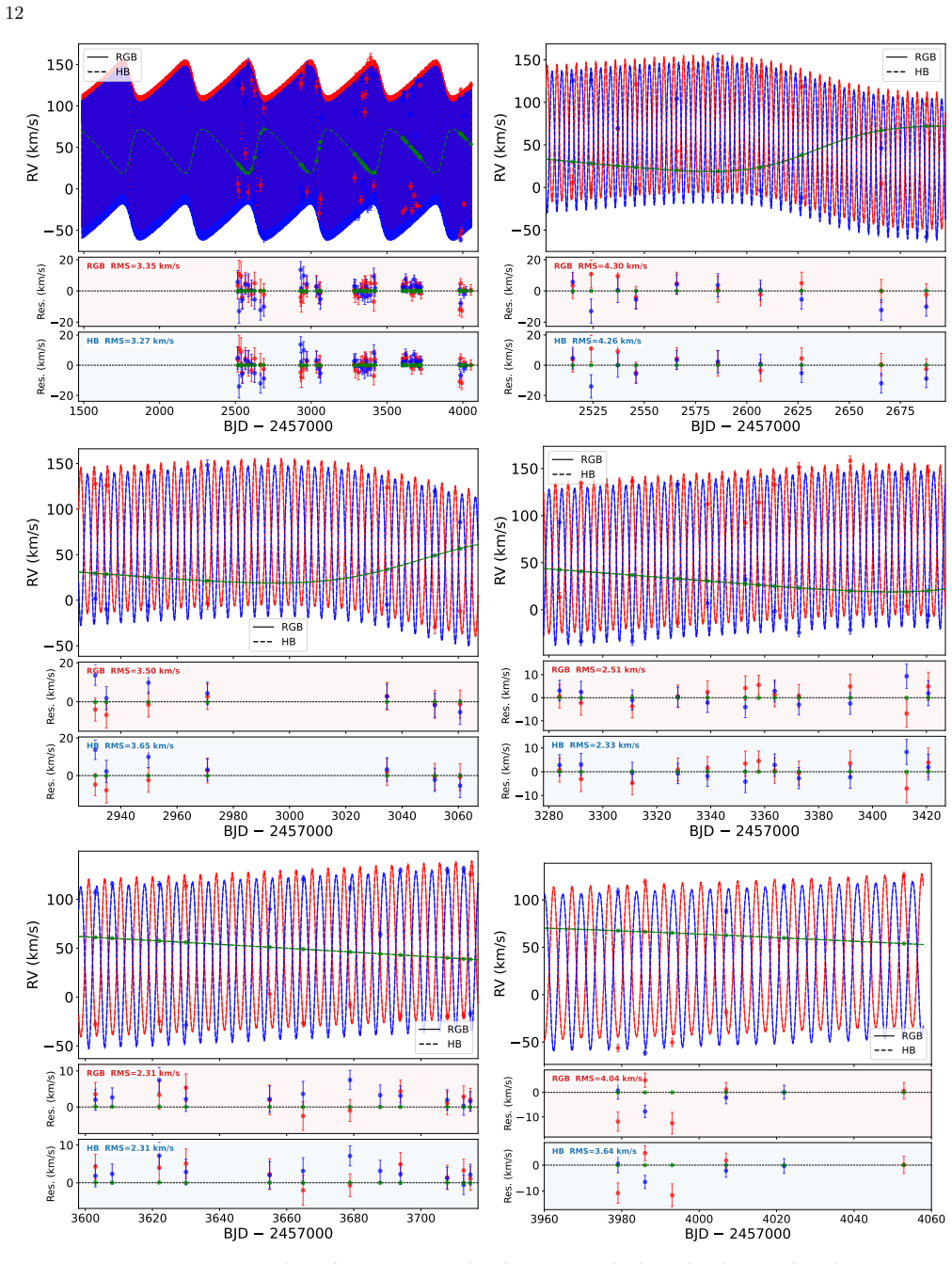
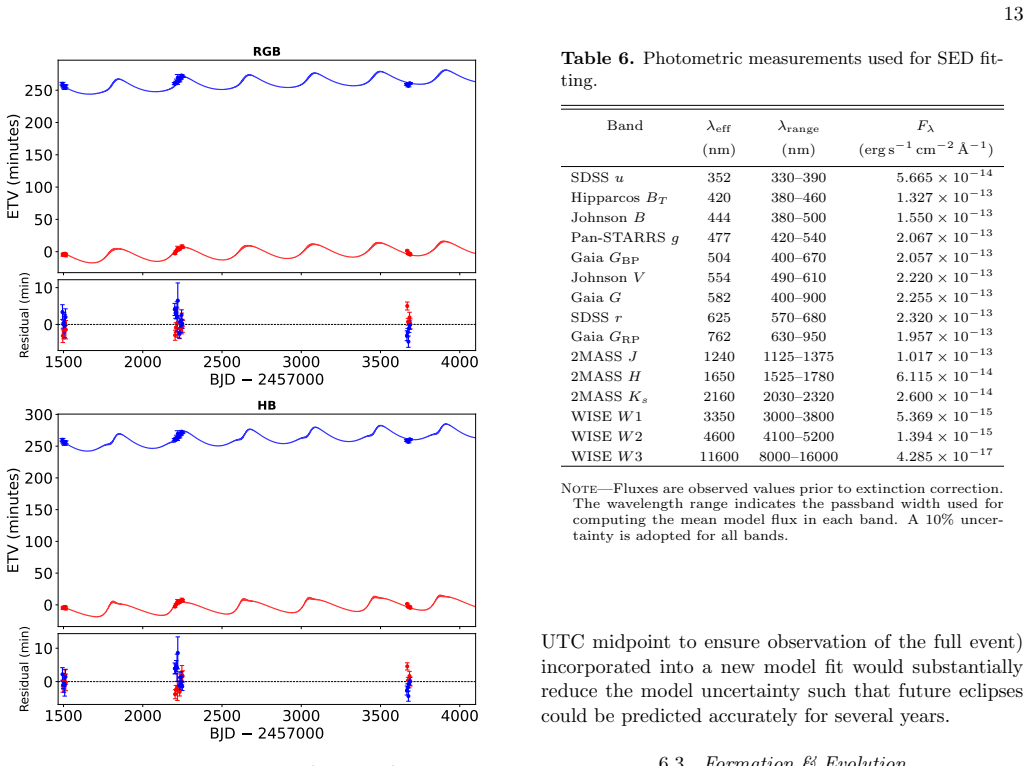
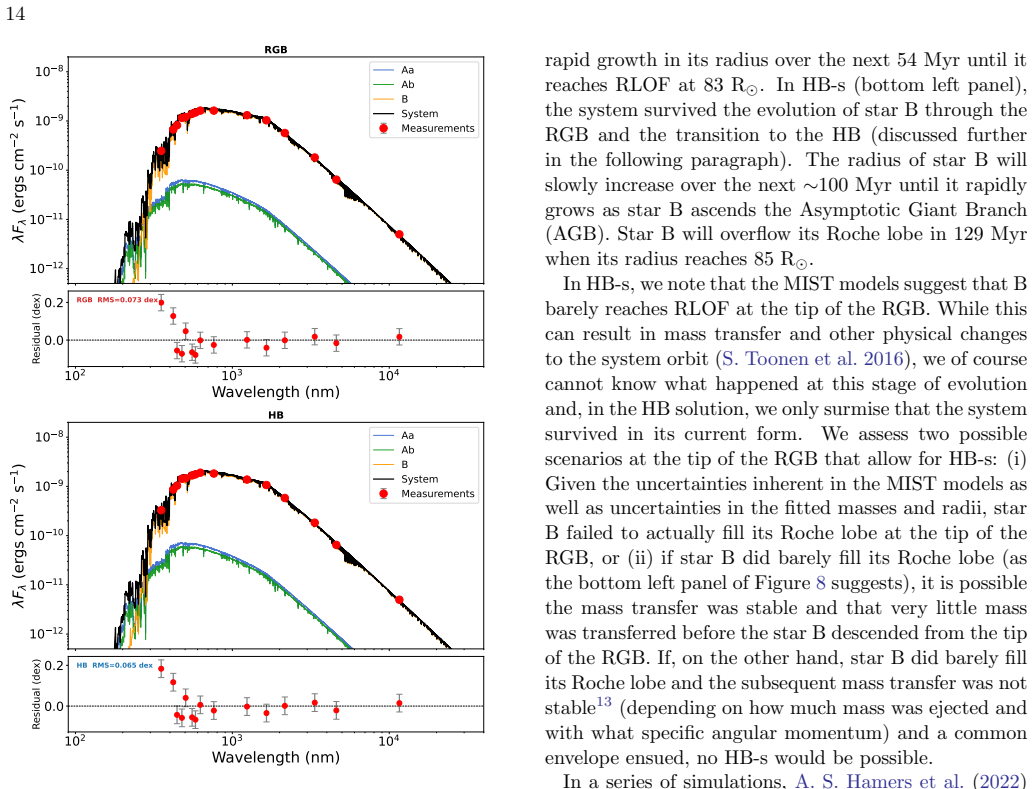
TIC 295741342 consists of an inner eclipsing binary with a 4.75-day period and an outer 412.8-day orbit around a giant tertiary star. Two solutions are found for the tertiary's state, both with near-perfect coplanarity, and both predict future Roche-lobe overflow that will produce either stable mass transfer or common-envelope evolution. Comprehensive spectro-photodynamical modeling of the TESS light curve, eclipse timings, 48 radial-velocity spectra, and spectral energy distribution fixes the stellar radii, masses, and temperatures while the head-and-shoulders eclipse in Sector 33 supplies direct flux and radius ratios.
What carries the argument
A spectro-photodynamical model that simultaneously fits the TESS light curve, eclipse times, spectral energy distribution, and radial velocities from 48 spectra, combined with MIST evolutionary tracks to place the giant tertiary on either the red giant branch or horizontal branch.
If this is right
- The giant tertiary will overflow its Roche lobe while ascending the red giant branch in one solution or the asymptotic giant branch in the other.
- Roche-lobe overflow will initiate either stable mass transfer onto the inner binary or common-envelope evolution that may produce ejections or mergers.
- The midpoint of the next outer eclipse is predicted to occur on September 1 2026, providing an immediate observational test.
- Continued monitoring of eclipse timings will further constrain the orbital elements and distinguish the two solutions.
Where Pith is reading between the lines
- Detection of the predicted outer eclipse would also test whether the inner binary survives the mass-transfer phase intact.
- The near-coplanarity may indicate formation through disk fragmentation or later dynamical alignment, offering a benchmark for triple-star formation models.
- Systems like this could be used to calibrate the onset of common-envelope evolution when a giant overflows onto a close binary.
Load-bearing premise
The MIST evolutionary tracks correctly identify the current state of the giant tertiary and its future Roche-lobe overflow behavior in both the red-giant-branch and horizontal-branch solutions.
What would settle it
Precise photometry of the outer eclipse near September 1 2026 that either matches the predicted midpoint and depth or deviates enough to rule out one or both evolutionary states.
Figures




read the original abstract
We present the discovery and characterization of TIC 295741342, a triply-eclipsing triple star system with a giant tertiary. The eclipsing binary consists of two similar main-sequence stars in a 4.75-day orbit. The binary is in a 412.8-day orbit with the giant tertiary. We found two degenerate solutions for the system: one where the tertiary is ascending the Red Giant Branch (RGB), and the other where the tertiary is on the Horizontal Branch (HB) and will eventually ascend the Asymptotic Giant Branch (AGB). In both solutions, the system is near-perfectly coplanar. In TESS Sector 33, the binary passes behind the giant tertiary, producing a distinctive "head-and-shoulders" eclipse that directly constrains the relative flux contributions and radii of all three stars. We modeled the system using a comprehensive spectro-photodynamical model that simultaneously fits the TESS lightcurve, eclipse times, spectral energy distribution, and radial velocities from 48 TRES spectra obtained over four years of observation resolving all three components. Evolutionary analysis using MIST tracks indicates that, in both solutions, the tertiary will overflow its Roche lobe, one in the RGB and the other in the AGB. The Roche lobe overflow will initiate either a stable mass transfer to the binary or a common envelope evolution that will likely result in ejections and/or mergers. Our models predict the midpoint of the next outer eclipse will occur on September 1, 2026 and we encourage follow-up observations with a $\pm$3 day window to observe the full event and further constrain the system parameters.
Editorial analysis
A structured set of objections, weighed in public.
Referee Report
Summary. The manuscript presents the discovery and characterization of TIC 295741342, a triply-eclipsing triple star system consisting of a 4.75-day eclipsing binary of two similar main-sequence stars in a 412.8-day orbit with a giant tertiary. A joint spectro-photodynamical model is used to fit the TESS light curve (including a distinctive head-and-shoulders eclipse in Sector 33), eclipse times, spectral energy distribution, and 48 TRES radial velocities resolving all three components. Two degenerate solutions are reported for the tertiary: ascending the red giant branch or on the horizontal branch en route to the asymptotic giant branch. Both solutions are near-perfectly coplanar. MIST evolutionary tracks indicate future Roche-lobe overflow (RGB or AGB phase) that may lead to stable mass transfer or common-envelope evolution, with a predicted next outer eclipse midpoint on 1 September 2026.
Significance. If the results hold, the work is significant as a rare, well-constrained example of a hierarchical triple containing a giant tertiary. The head-and-shoulders eclipse and resolved spectra provide direct constraints on relative radii and flux contributions, while the multi-dataset fit (photometry, RVs, SED) strengthens the orbital elements and stellar parameters. The dual evolutionary pathways and explicit prediction for follow-up observations are of interest for studies of triple-star dynamics and future binary evolution involving mass transfer or mergers.
major comments (1)
- [evolutionary analysis paragraph] Evolutionary analysis paragraph: the manuscript reports two degenerate solutions for the tertiary but does not describe a joint isochrone fit or explicit test that the derived tertiary mass, radius, and Teff are consistent with the same age as the main-sequence lifetime of the inner 4.75-day binary. MIST assumptions on overshooting, mass loss, and metallicity could shift the track classification, affecting the viability of both solutions and the predicted Roche-lobe overflow behavior.
Simulated Author's Rebuttal
We thank the referee for their constructive review and positive assessment of the manuscript's significance. We address the single major comment below regarding the evolutionary analysis.
read point-by-point responses
-
Referee: Evolutionary analysis paragraph: the manuscript reports two degenerate solutions for the tertiary but does not describe a joint isochrone fit or explicit test that the derived tertiary mass, radius, and Teff are consistent with the same age as the main-sequence lifetime of the inner 4.75-day binary. MIST assumptions on overshooting, mass loss, and metallicity could shift the track classification, affecting the viability of both solutions and the predicted Roche-lobe overflow behavior.
Authors: We thank the referee for this observation. The inner binary components are main-sequence stars whose main-sequence lifetime (several Gyr for ~1.2 solar-mass stars) provides only a broad upper limit rather than a tight age constraint. The tertiary parameters were obtained from the joint spectro-photodynamical fit and then placed on MIST tracks independently to identify the two degenerate solutions. We agree that an explicit discussion of age consistency and sensitivity to MIST parameters would strengthen the section. In the revised manuscript we will add a paragraph that (i) compares the implied system age from the tertiary tracks to the inner binary's main-sequence lifetime under standard MIST assumptions, (ii) notes that both the RGB and HB solutions remain consistent within the derived uncertainties, and (iii) briefly explores the effects of varying overshooting, mass-loss rates, and metallicity on the track classification and Roche-lobe overflow predictions. These additions will be included without altering the core results. revision: yes
Circularity Check
No significant circularity in the derivation chain
full rationale
The paper derives its results through direct fitting of orbital elements, stellar parameters, and relative fluxes to observational data (TESS light curve, eclipse times, SED, and 48 TRES RVs) via a spectro-photodynamical model. The two degenerate solutions for the tertiary (RGB vs. HB) are obtained by applying external MIST evolutionary tracks to the fitted mass, radius, and Teff values; this is an interpretive step using independent stellar models rather than a reduction of the claim to the inputs by construction. The predicted next outer eclipse midpoint follows from forward integration of the fitted 412.8-day outer orbit and is a standard extrapolation, not a relabeling of a fitted quantity. No self-definitional relations, fitted inputs presented as predictions, load-bearing self-citations, or ansatz smuggling appear in the chain. The analysis remains self-contained against the external data and models.
Axiom & Free-Parameter Ledger
free parameters (2)
- orbital periods, inclinations, and stellar radii
- relative flux contributions
axioms (1)
- domain assumption MIST evolutionary tracks correctly map the tertiary's current state and future Roche-lobe overflow timing
Lean theorems connected to this paper
-
IndisputableMonolith/Foundation/RealityFromDistinction.leanreality_from_one_distinction unclear?
unclearRelation between the paper passage and the cited Recognition theorem.
We modeled the system using a comprehensive spectro-photodynamical model that simultaneously fits the TESS lightcurve, eclipse times, spectral energy distribution, and radial velocities... Evolutionary analysis using MIST tracks
What do these tags mean?
- matches
- The paper's claim is directly supported by a theorem in the formal canon.
- supports
- The theorem supports part of the paper's argument, but the paper may add assumptions or extra steps.
- extends
- The paper goes beyond the formal theorem; the theorem is a base layer rather than the whole result.
- uses
- The paper appears to rely on the theorem as machinery.
- contradicts
- The paper's claim conflicts with a theorem or certificate in the canon.
- unclear
- Pith found a possible connection, but the passage is too broad, indirect, or ambiguous to say the theorem truly supports the claim.
Reference graph
Works this paper leans on
-
[1]
2015, TensorFlow: Large-Scale Machine Learning on Heterogeneous Systems, https://www.tensorflow.org/
Abadi, M., Agarwal, A., Barham, P., et al. 2015, TensorFlow: Large-Scale Machine Learning on Heterogeneous Systems, https://www.tensorflow.org/
work page 2015
-
[2]
Allard, F. 2014, in IAU Symposium, Vol. 299, Exploring the Formation and Evolution of Planetary Systems, ed. M. Booth, B. C. Matthews, & J. R. Graham, 271–272, doi: 10.1017/S1743921313008545
-
[3]
Alonso, R., Deeg, H. J., Hoyer, S., et al. 2015, A&A, 584, L8, doi: 10.1051/0004-6361/201527109 Astropy Collaboration, Robitaille, T. P., Tollerud, E. J., et al. 2013, A&A, 558, A33, doi: 10.1051/0004-6361/201322068 Astropy Collaboration, Price-Whelan, A. M., Sip˝ ocz, B. M., et al. 2018, AJ, 156, 123, doi: 10.3847/1538-3881/aabc4f
-
[4]
2024, A&A, 692, A247, doi: 10.1051/0004-6361/202452637
Bashi, D., & Tokovinin, A. 2024, A&A, 692, A247, doi: 10.1051/0004-6361/202452637
-
[5]
2016, MNRAS, 455, 4136, doi: 10.1093/mnras/stv2530
Borkovits, T., Hajdu, T., Sztakovics, J., et al. 2016, MNRAS, 455, 4136, doi: 10.1093/mnras/stv2530
-
[6]
2015, MNRAS, 448, 946, doi: 10.1093/mnras/stv015
Borkovits, T., Rappaport, S., Hajdu, T., & Sztakovics, J. 2015, MNRAS, 448, 946, doi: 10.1093/mnras/stv015
-
[7]
Borkovits, T., Rappaport, S. A., Hajdu, T., et al. 2020a, MNRAS, 493, 5005, doi: 10.1093/mnras/staa495
-
[8]
Borkovits, T., Rappaport, S. A., Toonen, S., et al. 2022a, MNRAS, 515, 3773, doi: 10.1093/mnras/stac1983
-
[9]
2019, MNRAS, 483, 1934, doi: 10.1093/mnras/sty3157
Borkovits, T., Rappaport, S., Kaye, T., et al. 2019, MNRAS, 483, 1934, doi: 10.1093/mnras/sty3157
-
[10]
Borkovits, T., Rappaport, S. A., Tan, T. G., et al. 2020b, MNRAS, 496, 4624, doi: 10.1093/mnras/staa1817
-
[11]
Borkovits, T., Mitnyan, T., Rappaport, S. A., et al. 2022b, MNRAS, 510, 1352, doi: 10.1093/mnras/stab3397
-
[12]
Borkovits, T., Rappaport, S. A., Mitnyan, T., et al. 2025a, A&A, 695, A209, doi: 10.1051/0004-6361/202453616
-
[13]
Borkovits, T., Rappaport, S. A., Mitnyan, T., et al. 2025b, A&A, 703, A153, doi: 10.1051/0004-6361/202556942
-
[14]
J., Koch, D., Basri, G., et al
Borucki, W. J., Koch, D., Basri, G., et al. 2010, Science, 327, 977, doi: 10.1126/science.1185402 21
-
[15]
Buchhave, L. A., Latham, D. W., Johansen, A., et al. 2012, Nature, 486, 375, doi: 10.1038/nature11121
-
[16]
Buchhave, L. A., Bizzarro, M., Latham, D. W., et al. 2014, Nature, 509, 593, doi: 10.1038/nature13254
-
[17]
J., Levine, A., Fausnaugh, M., et al
Burke, C. J., Levine, A., Fausnaugh, M., et al. 2020, TESS-Point: High precision TESS pointing tool,, Astrophysics Source Code Library http://ascl.net/2003.001
work page 2020
-
[18]
Cardelli, J. A., Clayton, G. C., & Mathis, J. S. 1989, ApJ, 345, 245, doi: 10.1086/167900
-
[19]
Carter, J. A., Fabrycky, D. C., Ragozzine, D., et al. 2011, Science, 331, 562, doi: 10.1126/science.1201274
-
[20]
Choi, J., Dotter, A., Conroy, C., et al. 2016, ApJ, 823, 102, doi: 10.3847/0004-637X/823/2/102
work page internal anchor Pith review doi:10.3847/0004-637x/823/2/102 2016
- [21]
-
[22]
R., Borkovits, T., Mitnyan, T., Rappaport, S
Czavalinga, D. R., Borkovits, T., Mitnyan, T., Rappaport, S. A., & P´ al, A. 2023a, MNRAS, 526, 2830, doi: 10.1093/mnras/stad2759
-
[23]
Czavalinga, D. R., Mitnyan, T., Rappaport, S. A., et al. 2023b, A&A, 670, A75, doi: 10.1051/0004-6361/202245300
-
[24]
MPI for Python: Performance improvements and MPI-2 extensions , journal =
Dalcin, L., Paz, R., Storti, M., & D’Elia, J. 2008, Journal of Parallel and Distributed Computing, 68, 655, doi: http://dx.doi.org/10.1016/j.jpdc.2007.09.005
-
[25]
Derekas, A., Kiss, L. L., Borkovits, T., et al. 2011, Science, 332, 216, doi: 10.1126/science.1201762
-
[26]
Dotter, A. 2016, ApJS, 222, 8, doi: 10.3847/0067-0049/222/1/8
work page internal anchor Pith review doi:10.3847/0067-0049/222/1/8 2016
-
[27]
Ebbighausen, E. G., & Struve, O. 1956, ApJ, 124, 507, doi: 10.1086/146254
-
[28]
Foreman-Mackey, D., Hogg, D. W., Lang, D., & Goodman, J. 2013, PASP, 125, 306, doi: 10.1086/670067 Fur´ esz, G. 2008 PhD thesis, Szeged, Hungary Gaia Collaboration, Vallenari, A., Brown, A. G. A., et al. 2023, A&A, 674, A1, doi: 10.1051/0004-6361/202243940
-
[29]
Glanz, H., & Perets, H. B. 2021, MNRAS, 500, 1921, doi: 10.1093/mnras/staa3242
-
[30]
S., Glanz, H., & Neunteufel, P
Hamers, A. S., Glanz, H., & Neunteufel, P. 2022, ApJS, 259, 25, doi: 10.3847/1538-4365/ac49e7
-
[31]
Harris, C. R., Millman, K. J., van der Walt, S. J., et al. 2020, Nature, 585, 357, doi: 10.1038/s41586-020-2649-2
-
[32]
Research Notes of the American Astronomical Society , keywords =
Huang, C. X., Vanderburg, A., P´ al, A., et al. 2020a, Research Notes of the American Astronomical Society, 4, 204, doi: 10.3847/2515-5172/abca2e
-
[33]
X., Vanderburg, A., P´ al, A., et al
Huang, C. X., Vanderburg, A., P´ al, A., et al. 2020b, Research Notes of the American Astronomical Society, 4, 206, doi: 10.3847/2515-5172/abca2d
-
[34]
Hunter, J. D. 2007, Computing in science & engineering, 9, 90
work page 2007
-
[35]
Kostov, V. B., Powell, B. P., Rappaport, S. A., et al. 2022, ApJS, 259, 66, doi: 10.3847/1538-4365/ac5458
-
[36]
Kostov, V. B., Rappaport, S. A., Borkovits, T., et al. 2024a, ApJ, 974, 25, doi: 10.3847/1538-4357/ad7368
-
[37]
Kostov, V. B., Powell, B. P., Rappaport, S. A., et al. 2024b, MNRAS, 527, 3995, doi: 10.1093/mnras/stad2947
-
[38]
Kostov, V. B., Powell, B. P., Fornear, A. U., et al. 2025, ApJS, 279, 50, doi: 10.3847/1538-4365/ade2d8
-
[39]
Kostov, V. B., Powell, B. P., Rappaport, S. A., et al. 2026, AJ, 171, 29, doi: 10.3847/1538-3881/ae1b8a
-
[40]
Shortest period for outer orbit in compact hierarchical triple? Discovery of SB1 around V0885 Per
Kovalev, M. 2026, arXiv e-prints, arXiv:2604.20314, doi: 10.48550/arXiv.2604.20314
work page internal anchor Pith review Pith/arXiv arXiv doi:10.48550/arxiv.2604.20314 2026
-
[41]
2016, ARA&A, 54, 271, doi: 10.1146/annurev-astro-081915-023307
Kratter, K., & Lodato, G. 2016, ARA&A, 54, 271, doi: 10.1146/annurev-astro-081915-023307
-
[42]
Kristiansen, M. H. K., Rappaport, S. A., Vanderburg, A. M., et al. 2022, PASP, 134, 074401, doi: 10.1088/1538-3873/ac6e06
-
[43]
Research Notes of the American Astronomical Society , keywords =
Kunimoto, M., Tey, E., Fong, W., et al. 2022, Research Notes of the American Astronomical Society, 6, 236, doi: 10.3847/2515-5172/aca158
-
[44]
Research Notes of the American Astronomical Society , keywords =
Kunimoto, M., Huang, C., Tey, E., et al. 2021, Research Notes of the American Astronomical Society, 5, 234, doi: 10.3847/2515-5172/ac2ef0 Lightkurve Collaboration, Cardoso, J. V. d. M., Hedges, C., et al. 2018, Lightkurve: Kepler and TESS time series analysis in Python,, Astrophysics Source Code Library http://ascl.net/1812.013
-
[45]
2010, in Proceedings of the 9th Python in Science Conference, ed
McKinney, W. 2010, in Proceedings of the 9th Python in Science Conference, ed. S. van der Walt & J. Millman, 51 – 56
work page 2010
-
[46]
Mitnyan, T., Borkovits, T., Czavalinga, D. R., et al. 2024, A&A, 685, A43, doi: 10.1051/0004-6361/202348909
-
[47]
Maxted, P. F. L. 2020, MNRAS, 498, 6034, doi: 10.1093/mnras/staa2762
-
[48]
Astronomy and Astrophysics Supplement Series , author =
Ochsenbein, F., Bauer, P., & Marcout, J. 2000, A&AS, 143, 23, doi: 10.1051/aas:2000169
-
[49]
Paxton, B., Bildsten, L., Dotter, A., et al. 2011, ApJS, 192, 3, doi: 10.1088/0067-0049/192/1/3
-
[50]
Paxton, B., Cantiello, M., Arras, P., et al. 2013, ApJS, 208, 4, doi: 10.1088/0067-0049/208/1/4
work page internal anchor Pith review doi:10.1088/0067-0049/208/1/4 2013
-
[51]
Paxton, B., Marchant, P., Schwab, J., et al. 2015, ApJS, 220, 15, doi: 10.1088/0067-0049/220/1/15 P´ erez, F., & Granger, B. E. 2007, Computing in Science and Engineering, 9, 21, doi: 10.1109/MCSE.2007.53
work page internal anchor Pith review doi:10.1088/0067-0049/220/1/15 2015
-
[52]
Powell, B. P., Kostov, V. B., & Tokovinin, A. 2023, MNRAS, 524, 4296, doi: 10.1093/mnras/stad2065
-
[53]
Powell, B. P., Kostov, V. B., Rappaport, S. A., et al. 2021, AJ, 161, 162, doi: 10.3847/1538-3881/abddb5 22
-
[54]
2013, ApJ, 768, 33, doi: 10.1088/0004-637X/768/1/33
Rappaport, S., Deck, K., Levine, A., et al. 2013, ApJ, 768, 33, doi: 10.1088/0004-637X/768/1/33
-
[55]
A., Borkovits, T., Gagliano, R., et al
Rappaport, S. A., Borkovits, T., Gagliano, R., et al. 2022, MNRAS, 513, 4341, doi: 10.1093/mnras/stac957
-
[56]
A., Borkovits, T., Gagliano, R., et al
Rappaport, S. A., Borkovits, T., Gagliano, R., et al. 2023, MNRAS, 521, 558, doi: 10.1093/mnras/stad367
-
[58]
A., Borkovits, T., Mitnyan, T., et al
Rappaport, S. A., Borkovits, T., Mitnyan, T., et al. 2024b, A&A, 686, A27, doi: 10.1051/0004-6361/202449273
-
[59]
2012, Astronomy & Astrophysics, 537, A128
Rein, H., & Liu, S.-F. 2012, Astronomy & Astrophysics, 537, A128
work page 2012
-
[60]
Rein, H., & Spiegel, D. S. 2015, MNRAS, 446, 1424, doi: 10.1093/mnras/stu2164
-
[61]
Ricker, G. R., Winn, J. N., Vanderspek, R., et al. 2015, Journal of Astronomical Telescopes, Instruments, and Systems, 1, 014003, doi: 10.1117/1.JATIS.1.1.014003
work page internal anchor Pith review doi:10.1117/1.jatis.1.1.014003 2015
-
[62]
2021, arXiv e-prints, arXiv:2103.10285
Schmitt, A., & Vanderburg, A. 2021, arXiv e-prints, arXiv:2103.10285. https://arxiv.org/abs/2103.10285
-
[63]
Schmitt, A. R., Hartman, J. D., & Kipping, D. M. 2019, arXiv e-prints, arXiv:1910.08034. https://arxiv.org/abs/1910.08034
-
[64]
Stassun, K. G., Oelkers, R. J., Paegert, M., et al. 2019, AJ, 158, 138, doi: 10.3847/1538-3881/ab3467
-
[65]
1997, Journal of Global Optimization, 11, 341, doi: 10.1023/A:1008202821328
Storn, R., & Price, K. 1997, Journal of Global Optimization, 11, 341, doi: 10.1023/A:1008202821328
-
[66]
Szentgyorgyi, A. H., & Fur´ esz, G. 2007, in Revista Mexicana de Astronomia y Astrofisica Conference Series, Vol. 28, Revista Mexicana de Astronomia y Astrofisica Conference Series, ed. S. Kurtz, 129–133
work page 2007
-
[67]
Tobin, J. J., Kratter, K. M., Persson, M. V., et al. 2016, Nature, 538, 483, doi: 10.1038/nature20094
-
[68]
2017, ApJ, 844, 103, doi: 10.3847/1538-4357/aa7746
Tokovinin, A. 2017, ApJ, 844, 103, doi: 10.3847/1538-4357/aa7746
-
[69]
2022, ApJ, 926, 1, doi: 10.3847/1538-4357/ac4584
Tokovinin, A. 2022, ApJ, 926, 1, doi: 10.3847/1538-4357/ac4584
-
[70]
2023, AJ, 165, 165, doi: 10.3847/1538-3881/acbf32
Tokovinin, A. 2023, AJ, 165, 165, doi: 10.3847/1538-3881/acbf32
-
[71]
2025, AJ, 169, 124, doi: 10.3847/1538-3881/ada3c6
Tokovinin, A. 2025, AJ, 169, 124, doi: 10.3847/1538-3881/ada3c6
-
[72]
Tokovinin, A., & Latham, D. W. 2020, AJ, 160, 251, doi: 10.3847/1538-3881/abbad4
-
[73]
2016, Computational Astrophysics and Cosmology, 3, 6, doi: 10.1186/s40668-016-0019-0
Toonen, S., Hamers, A., & Portegies Zwart, S. 2016, Computational Astrophysics and Cosmology, 3, 6, doi: 10.1186/s40668-016-0019-0
-
[74]
Torres, G., Neuh¨ auser, R., & Guenther, E. W. 2002, AJ, 123, 1701, doi: 10.1086/339178
-
[75]
Virtanen, P., Gommers, R., Oliphant, T. E., et al. 2020, Nature Methods, doi: https://doi.org/10.1038/s41592-019-0686-2
-
[76]
The Astrophysical Journal , author =
Zucker, S., & Mazeh, T. 1994, ApJ, 420, 806, doi: 10.1086/173605
-
[77]
1995, ApJ, 452, 863, doi: 10.1086/176354
Zucker, S., Torres, G., & Mazeh, T. 1995, ApJ, 452, 863, doi: 10.1086/176354
discussion (0)
Sign in with ORCID, Apple, or X to comment. Anyone can read and Pith papers without signing in.