Finite-temperature spin diffusion in the two-dimensional XY model
Pith reviewed 2026-05-20 03:24 UTC · model grok-4.3
The pith
The two-dimensional XY model shows matching spin diffusion constants from high-temperature theory and optical lattice experiments.
A machine-rendered reading of the paper's core claim, the machinery that carries it, and where it could break.
Core claim
The central discovery is that spin diffusion constants extracted from the dynamical high-temperature expansion method and from measurements in the optical lattice hard-core boson quantum simulator show excellent agreement. This agreement is presented as a breakthrough for spin transport studies beyond one dimension and for validating quantum simulators.
What carries the argument
The dynamical high-temperature expansion method that captures long spatiotemporal scales in the hydrodynamic regime, paired with direct experimental observation in the quantum simulator.
If this is right
- Spin diffusion can now be quantitatively studied in two dimensions using validated methods.
- Predictions for dynamic spin conductivity can be tested in future experiments.
- Effects of anisotropy-induced integrability breaking become accessible for investigation.
- Quantum simulators gain credibility for hydrodynamic transport studies.
Where Pith is reading between the lines
- Similar methods could be applied to other lattice models to test universality of diffusion constants.
- Extending to lower or higher temperatures might reveal crossovers in transport behavior.
- Comparison with one-dimensional results could highlight dimensional effects on spin transport.
Load-bearing premise
The dynamical high-temperature expansion method accurately reproduces the long-time and long-distance behavior in the hydrodynamic regime of the two-dimensional XY model.
What would settle it
An experimental measurement of the spin diffusion constant that deviates substantially from the value predicted by the dynamical high-temperature expansion would disprove the reported agreement.
Figures



read the original abstract
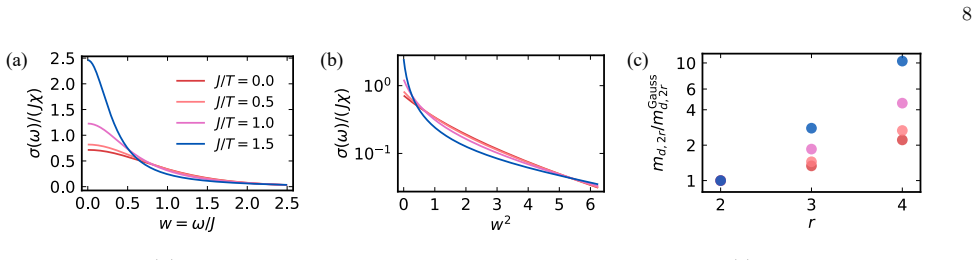
We present a combined theory-experiment study to quantify spin diffusion in the square lattice quantum spin-1/2 XY model at finite temperature. On the theory side, we leverage a recently developed dynamical high-temperature expansion method to faithfully capture the long spatiotemporal scales of the hydrodynamic regime. Experimental results are obtained from an optical lattice hard-core boson quantum simulator. The excellent agreement of spin diffusion constants marks a breakthrough in spin-transport beyond one dimension and for the quantitative validation of state-of-the-art quantum simulation platforms. We also provide theory predictions for future experiments on dynamic spin conductivity or anisotropy-induced integrability breaking.
Editorial analysis
A structured set of objections, weighed in public.
Referee Report
Summary. The manuscript reports a combined theory-experiment study of finite-temperature spin diffusion in the square-lattice spin-1/2 XY model. On the theory side, a dynamical high-temperature expansion is used to access long spatiotemporal scales in the hydrodynamic regime and extract the spin diffusion constant. Experimental data come from a hard-core boson quantum simulator realized in an optical lattice. The central result is quantitative agreement between the theoretical and measured diffusion constants, presented as a breakthrough for spin transport beyond one dimension; the paper also supplies predictions for dynamic spin conductivity and anisotropy-induced integrability breaking.
Significance. If the reported agreement is robust and the theoretical method demonstrably reaches the true hydrodynamic regime, the work would be significant for establishing quantitative benchmarks in two-dimensional spin transport and for validating quantum-simulation platforms. The combined approach and the provision of falsifiable predictions for future experiments are strengths.
major comments (2)
- [§2] §2 (dynamical high-T expansion): The claim that the method 'faithfully capture[s] the long spatiotemporal scales of the hydrodynamic regime' is load-bearing for the central comparison. In the 2D XY model, hydrodynamic behavior is expected only after times much longer than microscopic scales, potentially with logarithmic corrections from BKT physics. The manuscript must show explicit convergence tests (e.g., diffusion constant versus expansion order or versus maximum simulation time) demonstrating that truncation error is smaller than the reported agreement; without this, the quantitative match does not yet confirm the hydrodynamic prediction.
- [Results section] Results section (comparison of D values): The excellent agreement is asserted, but the extraction procedure for the diffusion constant (fitting window, functional form, handling of finite-size or finite-time effects) must be identical between theory and experiment. Any mismatch in the spatiotemporal window used to define D would undermine the claim that the same hydrodynamic quantity is being compared.
minor comments (2)
- Figure captions and legends should explicitly state the expansion order, lattice size, and temperature range used for each curve to allow direct assessment of the hydrodynamic regime.
- A short paragraph clarifying the relation between the hard-core boson mapping and the XY spin model (including any residual interactions) would improve readability for readers outside the immediate subfield.
Simulated Author's Rebuttal
We thank the referee for their careful reading and constructive comments, which help clarify the presentation of our results on spin diffusion in the 2D XY model. We address the major comments point by point below.
read point-by-point responses
-
Referee: [§2] §2 (dynamical high-T expansion): The claim that the method 'faithfully capture[s] the long spatiotemporal scales of the hydrodynamic regime' is load-bearing for the central comparison. In the 2D XY model, hydrodynamic behavior is expected only after times much longer than microscopic scales, potentially with logarithmic corrections from BKT physics. The manuscript must show explicit convergence tests (e.g., diffusion constant versus expansion order or versus maximum simulation time) demonstrating that truncation error is smaller than the reported agreement; without this, the quantitative match does not yet confirm the hydrodynamic prediction.
Authors: We agree that explicit convergence tests are important to substantiate access to the hydrodynamic regime. In the revised manuscript we add supplementary figures and text showing the extracted diffusion constant versus expansion order and versus maximum simulation time. These demonstrate that changes fall below the level of the reported theory-experiment agreement. On BKT-related logarithmic corrections, our working temperatures place the system above the BKT transition in the disordered phase; the quantitative match with experiment at these temperatures indicates that the simulated timescales already capture the hydrodynamic scaling within the precision of the comparison. revision: yes
-
Referee: [Results section] Results section (comparison of D values): The excellent agreement is asserted, but the extraction procedure for the diffusion constant (fitting window, functional form, handling of finite-size or finite-time effects) must be identical between theory and experiment. Any mismatch in the spatiotemporal window used to define D would undermine the claim that the same hydrodynamic quantity is being compared.
Authors: We concur that identical extraction procedures are required for a meaningful comparison. Both the theoretical and experimental analyses employ the same linear fit to the long-time mean-squared displacement (or equivalent correlation decay) within a common spatiotemporal window chosen to lie in the hydrodynamic regime. The revised manuscript now includes an explicit methods subsection that tabulates the precise fitting ranges, functional form, and finite-size/time corrections applied to both datasets, confirming they are matched. revision: yes
Circularity Check
No circularity: derivation relies on independent method and external experimental benchmark
full rationale
The paper computes spin diffusion constants via a dynamical high-temperature expansion method and directly compares the resulting values to independent measurements obtained from an optical-lattice hard-core-boson quantum simulator. The central claim is the quantitative agreement between these two external data sources. No equation or step is shown to reduce by construction to a fitted parameter, a self-definition, or a load-bearing self-citation whose validity is presupposed inside the present work. The method is invoked as a recently developed tool whose hydrodynamic reach is taken as given, but this assumption is tested against the separate experimental dataset rather than being internally forced. Consequently the derivation chain remains self-contained against external benchmarks.
Axiom & Free-Parameter Ledger
Lean theorems connected to this paper
-
IndisputableMonolith/Cost/FunctionalEquation.leanwashburn_uniqueness_aczel unclear?
unclearRelation between the paper passage and the cited Recognition theorem.
We leverage a recently developed dynamical high-temperature expansion method to faithfully capture the long spatiotemporal scales of the hydrodynamic regime... obtain D(T) from Eq. (6) where we use a standard HTE for χ.
What do these tags mean?
- matches
- The paper's claim is directly supported by a theorem in the formal canon.
- supports
- The theorem supports part of the paper's argument, but the paper may add assumptions or extra steps.
- extends
- The paper goes beyond the formal theorem; the theorem is a base layer rather than the whole result.
- uses
- The paper appears to rely on the theorem as machinery.
- contradicts
- The paper's claim conflicts with a theorem or certificate in the canon.
- unclear
- Pith found a possible connection, but the passage is too broad, indirect, or ambiguous to say the theorem truly supports the claim.
Reference graph
Works this paper leans on
-
[1]
as shown in Fig. 2(a). A digital micromirror de- vice (DMD) allows to generate arbitrary potentials and to tune the atom number in the left domain to sat- isfy the condition⟨n⟩ ∼0.5 while avoiding doublons in the right domain. Starting from the initial state in Fig. 2(b) (t= 0), we rapidly switch the DMD potential 4 from domain-wall to a box (22×22 sites)...
work page 2023
-
[2]
E. Altman, K. R. Brown, G. Carleo, L. D. Carr, E. Dem- ler, C. Chin, B. DeMarco, S. E. Economou, M. A. Eriks- son, K.-M. C. Fu, M. Greiner, K. R. Hazzard, R. G. Hulet, A. J. Koll´ ar, B. L. Lev, M. D. Lukin, R. Ma, X. Mi, S. Misra, C. Monroe, K. Murch, Z. Nazario, K.-K. Ni, A. C. Potter, P. Roushan, M. Saffman, M. Schleier- Smith, I. Siddiqi, R. Simmonds,...
work page 2021
- [3]
-
[4]
I. M. Georgescu, S. Ashhab, and F. Nori, Quantum sim- ulation, Reviews of Modern Physics86, 153 (2014)
work page 2014
- [5]
-
[6]
L. P. Kadanoff,Statistical Physics: Statics, Dynamics and Renormalization(World Scientific, 2000)
work page 2000
-
[7]
H. Bruus and K. Flensberg,Many-Body Quantum Theory in Condensed Matter Physics: An Introduction, Oxford Graduate Texts (Oxford University Press, Oxford, New York, 2004)
work page 2004
- [8]
-
[9]
ˇZnidariˇ c, Spin transport in a one-dimensional anisotropic heisenberg model, Phys
M. ˇZnidariˇ c, Spin transport in a one-dimensional anisotropic heisenberg model, Phys. Rev. Lett.106, 220601 (2011)
work page 2011
-
[10]
R. Steinigeweg and W. Brenig, Spin transport in the XXZ chain at finite temperature and momentum, Phys. Rev. Lett.107, 250602 (2011)
work page 2011
-
[11]
B. Bertini, F. Heidrich-Meisner, C. Karrasch, T. Prosen, R. Steinigeweg, and M. ˇZnidariˇ c, Finite-temperature transport in one-dimensional quantum lattice models, Rev. Mod. Phys.93, 025003 (2021)
work page 2021
-
[12]
J. P. Ronzheimer, M. Schreiber, S. Braun, S. S. Hodg- man, S. Langer, I. P. McCulloch, F. Heidrich-Meisner, I. Bloch, and U. Schneider, Expansion dynamics of in- teracting bosons in homogeneous lattices in one and two dimensions, Phys. Rev. Lett.110, 205301 (2013)
work page 2013
-
[13]
H. Maeter, A. A. Zvyagin, H. Luetkens, G. Pas- cua, Z. Shermadini, R. Saint-Martin, A. Revcolevschi, C. Hess, B. B¨ uchner, and H.-H. Klauss, Low temperature ballistic spin transport in the S=1/2 antiferromagnetic heisenberg chain compound SrCuO2, J. Phys.: Condens. Matter25, 365601 (2013)
work page 2013
-
[14]
F. Xiao, J. S. M¨ oller, T. Lancaster, R. C. Williams, F. L. Pratt, S. J. Blundell, D. Ceresoli, A. M. Barton, and J. L. Manson, Spin diffusion in the low-dimensional molecular quantum heisenberg antiferromagnet Cu(pyz)(NO3)2 de- tected with implanted muons, Phys. Rev. B91, 144417 (2015)
work page 2015
-
[15]
U. Schneider, L. Hackerm¨ uller, J. P. Ronzheimer, S. Will, S. Braun, T. Best, I. Bloch, E. Demler, S. Mandt, D. Rasch, and A. Rosch, Fermionic transport and out- of-equilibrium dynamics in a homogeneous hubbard model with ultracold atoms, Nat. Phys.8, 213 (2012)
work page 2012
-
[16]
D. Wei, A. Rubio-Abadal, B. Ye, F. Machado, J. Kemp, K. Srakaew, S. Hollerith, J. Rui, S. Gopalakrishnan, N. Y. Yao, I. Bloch, and J. Zeiher, Quantum gas mi- croscopy of Kardar-Parisi-Zhang superdiffusion, Science 376, 716 (2022)
work page 2022
- [17]
-
[18]
M. A. Nichols, L. W. Cheuk, M. Okan, T. R. Hartke, E. Mendez, T. Senthil, E. Khatami, H. Zhang, and M. W. Zwierlein, Spin transport in a mott insulator of ultracold fermions, Science363, 383 (2019)
work page 2019
-
[19]
L. Pham and E. Khatami, Spin and Charge Conductiv- ity in the Square Lattice Fermi-Hubbard Model (2026), arXiv:2602.03771
-
[20]
R. Burkard, B. Schneider, and B. Sbierski, Dynamic correlations of frustrated quantum spins from high- temperature expansion, Phys. Rev. Lett.136, 056501 (2026)
work page 2026
-
[21]
R. Burkard, B. Schneider, and B. Sbierski, High- temperature series expansion of the dynamic Matsubara spin correlator, Phys. Rev. B113, 075102 (2026)
work page 2026
-
[22]
P. Jung, R. W. Helmes, and A. Rosch, Transport in Al- most Integrable Models: Perturbed Heisenberg Chains, Phys. Rev. Lett.96, 067202 (2006)
work page 2006
-
[23]
P. Jung and A. Rosch, Spin conductivity in almost inte- grable spin chains, Phys. Rev. B76, 245108 (2007)
work page 2007
-
[24]
R. Steinigeweg, F. Heidrich-Meisner, J. Gemmer, K. Michielsen, and H. De Raedt, Scaling of diffusion con- stants in the spin- 1 2 XX ladder, Phys. Rev. B90, 094417 (2014)
work page 2014
-
[25]
and Jakliˇ c, J., Spin diffusion of the t-J model, Phys
Bonˇ ca, J. and Jakliˇ c, J., Spin diffusion of the t-J model, Phys. Rev. B51, 16083 (1995)
work page 1995
-
[26]
J. F. Wienand, S. Karch, A. Impertro, C. Schweizer, E. McCulloch, R. Vasseur, S. Gopalakrishnan, M. Aidels- burger, and I. Bloch, Emergence of fluctuating hydrody- namics in chaotic quantum systems, Nat. Phys.20, 1732 (2024)
work page 2024
-
[27]
This follows from aπ z spin rotation on one sublattice which flips the sign ofJbut leaves thezz-DSF (7) and thus, by Eqns. (6) and (8), alsoDinvariant
-
[28]
D. G. McFadden and R. A. Tahir-Kheli, Space-Time Cor- relations in Anisotropic Heisenberg Paramagnets at Ele- vated Temperatures, Phys. Rev. B1, 3649 (1970)
work page 1970
-
[29]
Morita, Spin Diffusion in the Heisenberg Magnets at Infinite Temperature, Phys
T. Morita, Spin Diffusion in the Heisenberg Magnets at Infinite Temperature, Phys. Rev. B6, 3385 (1972)
work page 1972
-
[30]
J. Wang, M. H. Lamann, R. Steinigeweg, and J. Gemmer, Diffusion constants from the recursion method, Phys. Rev. B110, 104413 (2024)
work page 2024
-
[31]
D. Tarasevych and P. Kopietz, Dissipative spin dynamics in hot quantum paramagnets, Phys. Rev. B104, 024423 (2021)
work page 2021
-
[32]
A. Hams and H. De Raedt, Fast algorithm for finding the eigenvalue distribution of very large matrices, Phys. Rev. E62, 4365 (2000)
work page 2000
-
[33]
Reimann, Dynamical typicality of isolated many-body quantum systems, Phys
P. Reimann, Dynamical typicality of isolated many-body quantum systems, Phys. Rev. E97, 062129 (2018)
work page 2018
-
[34]
C. Lanczos, An iteration method for the solution of the eigenvalue problem of linear differential and integral op- erators, J. Res. Natl. Bur. Stand. B45, 255 (1950)
work page 1950
-
[35]
A. W. Sandvik, A. Avella, and F. Mancini, Computa- tional Studies of Quantum Spin Systems, inAIP Confer- ence Proceedings(AIP, 2010) p. 135–338
work page 2010
-
[36]
J. Jakliˇ c and P. Prelovˇ sek, Lanczos method for the calcu- lation of finite-temperature quantities in correlated sys- tems, Phys. Rev. B49, 5065 (1994)
work page 1994
-
[37]
T. Shimokawa, S. Sabharwal, and N. Shannon, Can experimentally-accessible measures of entanglement dis- tinguish quantum spin liquids from disorder-driven ”ran- dom singlet” phases? (2025), arXiv:2505.11874
-
[38]
V. S. Viswanath and G. M¨ uller,The Recursion Method: Application to Many-Body Dynamics, Vol. 23 (Springer Science+Business Media, 1994)
work page 1994
-
[39]
Thermometry for a Kagome Lattice Dipolar Rydberg Simulator
E. Fitzner, I. Lesanovsky, and B. Sbierski, Thermometry for a Kagome Lattice Dipolar Rydberg Simulator (2026), arXiv:2604.22743
work page internal anchor Pith review Pith/arXiv arXiv 2026
-
[40]
K. Kwon, K. Kim, J. Hur, S. Huh, and J.-y. Choi, Site- resolved imaging of a bosonic mott insulator of7Li atoms, Phys. Rev. A105, 033323 (2022)
work page 2022
- [41]
- [42]
-
[43]
T. Gericke, F. Gerbier, A. Widera, S. F¨ olling, O. Man- del, and I. Bloch, Adiabatic loading of a bose–einstein condensate in a 3d optical lattice, J. Mod. Opt.54, 735 (2007)
work page 2007
-
[44]
M. Boll, T. A. Hilker, G. Salomon, A. Omran, J. Nespolo, L. Pollet, I. Bloch, and C. Gross, Spin- and density- resolved microscopy of antiferromagnetic correlations in Fermi-Hubbard chains, Science353, 1257 (2016)
work page 2016
-
[45]
Equal time correlators⟨S z r Sz 0⟩can be simply obtained from frequency sums of the Dyn-HTE for Matsubara cor- relators [20, 38]
-
[46]
M. A. Cazalilla, R. Citro, T. Giamarchi, E. Orignac, and M. Rigol, One dimensional bosons: From condensed mat- ter systems to ultracold gases, Rev. Mod. Phys.83, 1405 (2011)
work page 2011
-
[47]
J. Labrujere, T. O. Klaassen, and N. J. Poulis, Spin dy- namics in a 3D Heisenberg ferromagnet in the param- agnetic state II, J. Phys. C: Solid State Phys.15, 999 (1982)
work page 1982
-
[48]
R. Anderson, F. Wang, P. Xu, V. Venu, S. Trotzky, F. Chevy, and J. H. Thywissen, Conductivity Spectrum of Ultracold Atoms in an Optical Lattice, Phys. Rev. Lett.122, 153602 (2019)
work page 2019
-
[49]
C. Chen, G. Bornet, M. Bintz, G. Emperauger, L. Leclerc, V. S. Liu, P. Scholl, D. Barredo, J. Hauschild, S. Chatterjee, M. Schuler, A. M. L¨ auchli, M. P. Zale- tel, T. Lahaye, N. Y. Yao, and A. Browaeys, Continuous symmetry breaking in a two-dimensional Rydberg array, Nature616, 691 (2023)
work page 2023
-
[50]
Fitzner, Data and code: https://zenodo.org/records/20277955 (2026)
E. Fitzner, Data and code: https://zenodo.org/records/20277955 (2026)
- [51]
- [52]
-
[53]
C. Chin, R. Grimm, P. Julienne, and E. Tiesinga, Fesh- bach resonances in ultracold gases, Rev. Mod. Phys.82, 1225 (2010)
work page 2010
-
[54]
J. Amato-Grill, N. Jepsen, I. Dimitrova, W. Lunden, and W. Ketterle, Interaction spectroscopy of a two- component mott insulator, Phys. Rev. A99, 033612 (2019)
work page 2019
-
[55]
T. St¨ oferle, H. Moritz, C. Schori, M. K¨ ohl, and T. Esslinger, Transition from a strongly interacting 1d su- perfluid to a mott insulator, Phys. Rev. Lett.92, 130403 (2004). 7 END MA TTER Spin conductivity from Dyn-HTE.—As shown in Eq. (8), the spin conductivityσ(k, ω) is directly re- lated to the DSFS(k, ω) which was the initial objec- tive of Dyn-HTE...
work page 2004
discussion (0)
Sign in with ORCID, Apple, or X to comment. Anyone can read and Pith papers without signing in.