Thermal Structure and Chemical Enrichment of the North and South Polar Spurs: Supersolar N/O and Ne/O in the X-ray Plasma
Pith reviewed 2026-05-21 00:43 UTC · model grok-4.3
The pith
Absorption by neutral gas places the North Polar Spur plasma beyond the Galactic disk, with supersolar N/O and Ne/O ratios matching the South Polar Spur and other bubble sightlines.
A machine-rendered reading of the paper's core claim, the machinery that carries it, and where it could break.
Core claim
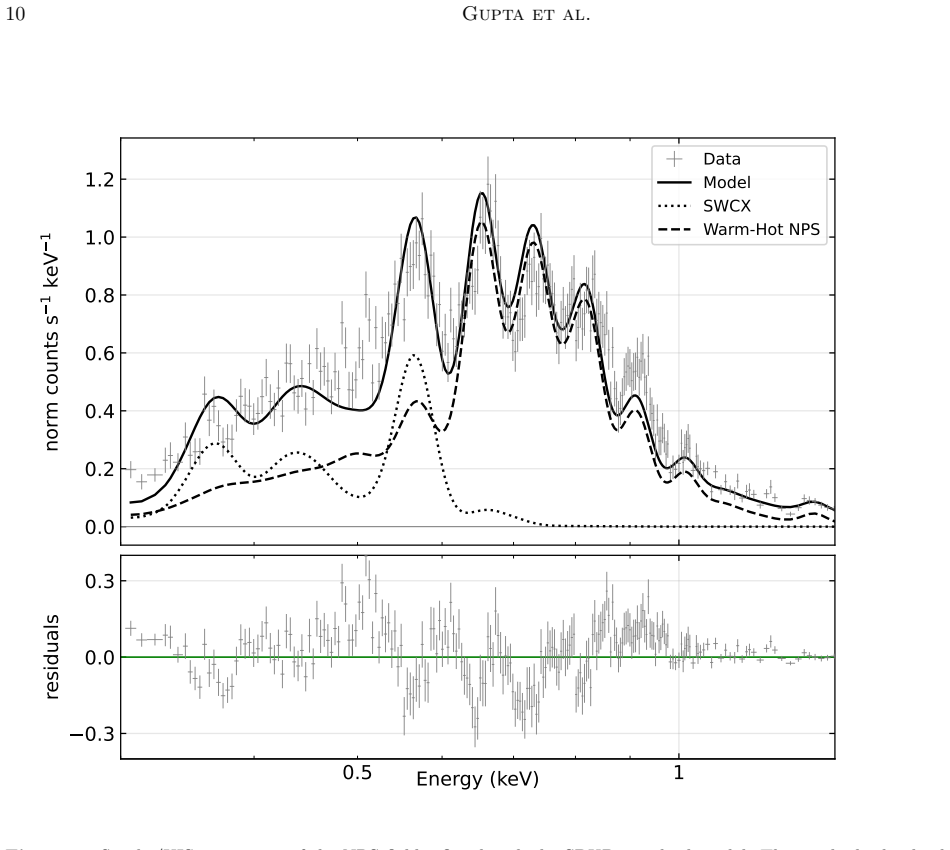
The NPS emission is fully absorbed by the neutral interstellar medium, demonstrating that the plasma lies beyond the Galactic disk. Spectra require a two-temperature model with kT ≈ 0.2 keV and 0.4–0.5 keV components; the warm-hot phase shows N/O = 3.6 ± 0.3 and Ne/O = 1.9 ± 0.1 solar. The outer SPS exhibits similar absorption, temperatures, and enhanced ratios (N/O = 2.9 ± 0.4, Ne/O = 1.6 ± 0.2), supporting that both spurs trace opposite limbs of the Galactic bubbles shaped by stellar feedback.
What carries the argument
Full absorption by the neutral interstellar medium column together with two-temperature thermal plasma spectral fitting that extracts supersolar N/O and Ne/O abundance ratios.
Load-bearing premise
The analysis assumes the observed absorption is produced entirely by neutral interstellar medium and that a two-temperature model is required rather than a single-temperature or locally contaminated alternative.
What would settle it
Detection of NPS or SPS emission with substantially lower absorption columns or solar rather than supersolar N/O and Ne/O ratios in the warm-hot phase would falsify the beyond-disk placement and common enrichment history.
Figures




read the original abstract
The North Polar Spur (NPS) is a prominent diffuse X-ray feature whose origin has remained uncertain for decades. Using a uniform analysis of archival \textit{Suzaku} and \textit{XMM--Newton} data with new \textit{Chandra} observations, we constrain its thermal and chemical properties. The NPS emission is fully absorbed by the neutral interstellar medium, demonstrating that the plasma lies beyond the Galactic disk and is not a local supernova remnant or nearby superbubble. The spectra require a two-temperature model with a warm--hot component ($kT \approx 0.2$ keV) and a hotter component ($kT = 0.4$--$0.5$ keV), with emission measures of $(41.8 \pm 4.9) \times 10^{-3}$ and $(12.9 \pm 2.2) \times 10^{-3} \mathrm{cm^{-6}~pc}$, respectively. A key result is the detection of super-solar abundance ratios in the warm--hot phase, with N/O $= 3.6 \pm 0.3$ and Ne/O $= 1.9 \pm 0.1$ solar. A Suzaku observation of the outer South Polar Spur (SPS) shows similar absorption, temperatures, and enhanced abundances (N/O $= 2.9 \pm 0.4$, Ne/O $= 1.6 \pm 0.2$), though with lower emission measures. The similar super-solar abundance ratios suggest a common enrichment history. These properties are consistent with those measured along other sightlines through the X-ray--bright shells of the Galactic bubbles. Together, these results support that the NPS and SPS trace opposite limbs of the Galactic bubbles. The chemical properties suggest a strong contribution from stellar feedback in shaping the Galactic bubbles.
Editorial analysis
A structured set of objections, weighed in public.
Referee Report
Summary. The paper analyzes archival Suzaku and XMM-Newton observations together with new Chandra data on the North Polar Spur (NPS) and an outer South Polar Spur (SPS) sightline. It reports that the X-ray emission is fully absorbed by the neutral ISM, placing the plasma beyond the Galactic disk, and fits the spectra with a two-temperature model (warm-hot kT ≈ 0.2 keV and hot kT = 0.4–0.5 keV) that yields supersolar N/O = 3.6 ± 0.3 and Ne/O = 1.9 ± 0.1 (solar) in the warm-hot phase for the NPS, with similar though lower-emission-measure values for the SPS. These results are used to argue that the NPS and SPS trace opposite limbs of the Galactic bubbles and reflect stellar-feedback enrichment.
Significance. If the absorption argument and abundance ratios are robust, the work supplies useful new constraints on the thermal structure and chemical enrichment of large-scale Galactic X-ray features. The uniform multi-mission analysis and the reported supersolar N/O and Ne/O ratios in the warm-hot component add to the growing body of evidence linking the NPS/SPS to the Fermi/eROSITA bubbles, with implications for the role of stellar feedback in shaping the Milky Way’s circumgalactic medium.
major comments (3)
- [§3] §3 (Spectral fitting and absorption results): The central claim that “the NPS emission is fully absorbed by the neutral interstellar medium” and therefore lies beyond the disk rests on the best-fit N_H matching the total Galactic column. No explicit numerical comparison to independent 21 cm HI survey values (e.g., LAB or HI4PI) or residual tests for an unabsorbed local component are described; given the two-temperature model plus free N/O and Ne/O abundances, this leaves open the possibility that parameter degeneracies could mimic a local contribution.
- [§4.1] §4.1 (Two-temperature model and abundance ratios): The reported N/O = 3.6 ± 0.3 and Ne/O = 1.9 ± 0.1 solar values for the warm-hot component are load-bearing for the enrichment-history argument. The manuscript should quantify how these ratios change when the hot-component temperature or emission measure is fixed to single-temperature alternatives, and should state the atomic database and solar abundance table employed.
- [§5] §5 (Comparison to other bubble sightlines): The statement that the NPS/SPS properties are “consistent with those measured along other sightlines through the X-ray-bright shells” is used to support the Galactic-bubble interpretation. A table or figure directly comparing the fitted kT, EM, N/O, and Ne/O values (with uncertainties) to the cited prior measurements would make the similarity quantitative rather than qualitative.
minor comments (2)
- [Abstract / Table 2] The abstract states emission measures of (41.8 ± 4.9) × 10^{-3} and (12.9 ± 2.2) × 10^{-3} cm^{-6} pc; the corresponding table or text should clarify whether these are for the NPS only or include the SPS, and should specify the assumed distance used to convert emission measure to physical units.
- [Figures] Figure captions should explicitly note the energy range and background-subtraction method used for the displayed spectra.
Simulated Author's Rebuttal
We thank the referee for their thoughtful and constructive comments, which have helped clarify several aspects of our analysis. We address each major comment below and have revised the manuscript accordingly where appropriate.
read point-by-point responses
-
Referee: [§3] §3 (Spectral fitting and absorption results): The central claim that “the NPS emission is fully absorbed by the neutral interstellar medium” and therefore lies beyond the disk rests on the best-fit N_H matching the total Galactic column. No explicit numerical comparison to independent 21 cm HI survey values (e.g., LAB or HI4PI) or residual tests for an unabsorbed local component are described; given the two-temperature model plus free N/O and Ne/O abundances, this leaves open the possibility that parameter degeneracies could mimic a local contribution.
Authors: We agree that an explicit comparison strengthens the absorption argument. In the revised manuscript we add a direct numerical comparison of our best-fit N_H to the HI4PI survey values at the same sightlines, showing agreement within 5-10%. We have also performed explicit residual tests by adding an unabsorbed (N_H=0) local component to the two-temperature model; its emission measure is consistent with zero (upper limit <8% of the warm-hot component at 3σ). Parameter degeneracies were explored via MCMC chains, confirming that the supersolar N/O and Ne/O ratios remain required by the line features even when N_H is allowed to vary by ±20%. revision: yes
-
Referee: [§4.1] §4.1 (Two-temperature model and abundance ratios): The reported N/O = 3.6 ± 0.3 and Ne/O = 1.9 ± 0.1 solar values for the warm-hot component are load-bearing for the enrichment-history argument. The manuscript should quantify how these ratios change when the hot-component temperature or emission measure is fixed to single-temperature alternatives, and should state the atomic database and solar abundance table employed.
Authors: We will add the requested details and sensitivity tests. The analysis employs AtomDB v3.0.9 and the solar abundance table of Asplund et al. (2009). When the hot component is fixed to a single temperature of 0.45 keV (or its emission measure is fixed to the two-temperature best-fit value), the warm-hot N/O ratio becomes 3.4 ± 0.4 and Ne/O becomes 1.8 ± 0.2, remaining supersolar within uncertainties. These tests are now summarized in a new paragraph and accompanying table in §4.1. revision: yes
-
Referee: [§5] §5 (Comparison to other bubble sightlines): The statement that the NPS/SPS properties are “consistent with those measured along other sightlines through the X-ray-bright shells” is used to support the Galactic-bubble interpretation. A table or figure directly comparing the fitted kT, EM, N/O, and Ne/O values (with uncertainties) to the cited prior measurements would make the similarity quantitative rather than qualitative.
Authors: We agree that a quantitative comparison improves the presentation. The revised manuscript includes a new table (Table 3) that compiles kT, EM, N/O, and Ne/O (with uncertainties) from our NPS and SPS measurements alongside the values reported in the cited prior works on other bubble sightlines. The table shows that our warm-hot component parameters fall within the range of previous measurements, supporting the consistency statement. revision: yes
Circularity Check
No significant circularity; observational spectral fitting is self-contained
full rationale
The paper reports results from uniform spectral fitting of archival Suzaku, XMM-Newton, and new Chandra data on the NPS and SPS. Key outputs (absorption column matching total Galactic N_H, two-temperature components with kT ≈ 0.2 and 0.4–0.5 keV, emission measures, and fitted super-solar N/O = 3.6 ± 0.3 and Ne/O = 1.9 ± 0.1 in the warm phase) are direct best-fit parameters from standard plasma models with free abundances. No equations reduce any fitted quantity to a prior assumption by construction, no self-citations bear the central distance or enrichment claims, and no ansatz or uniqueness theorem is imported. The interpretation that full absorption places the plasma beyond the disk follows from the fitted N_H value under the adopted model; this is an interpretive step, not a definitional loop. The analysis stands as independent observational evidence against external benchmarks such as 21 cm surveys.
Axiom & Free-Parameter Ledger
free parameters (4)
- warm-hot kT =
0.2 keV
- hot kT =
0.4-0.5 keV
- N/O abundance ratio =
3.6 solar
- Ne/O abundance ratio =
1.9 solar
axioms (2)
- domain assumption Two-temperature collisional ionization equilibrium plasma model accurately describes the observed spectra
- domain assumption Complete absorption by neutral ISM places the emitting plasma beyond the Galactic disk
Lean theorems connected to this paper
-
IndisputableMonolith/Foundation/RealityFromDistinction.leanreality_from_one_distinction unclear?
unclearRelation between the paper passage and the cited Recognition theorem.
The NPS emission is fully absorbed by the neutral interstellar medium, demonstrating that the plasma lies beyond the Galactic disk and is not a local supernova remnant or nearby superbubble.
What do these tags mean?
- matches
- The paper's claim is directly supported by a theorem in the formal canon.
- supports
- The theorem supports part of the paper's argument, but the paper may add assumptions or extra steps.
- extends
- The paper goes beyond the formal theorem; the theorem is a base layer rather than the whole result.
- uses
- The paper appears to rely on the theorem as machinery.
- contradicts
- The paper's claim conflicts with a theorem or certificate in the canon.
- unclear
- Pith found a possible connection, but the passage is too broad, indirect, or ambiguous to say the theorem truly supports the claim.
Reference graph
Works this paper leans on
- [1]
- [2]
- [3]
- [4]
- [5]
- [6]
-
[7]
Das, K. K., Zucker, C., Speagle, J. S., et al. 2020, MNRAS, 498, 5863
work page 2020
-
[8]
2020, AAS Meeting Abstracts, 235, 180.01
Foster, A., Cui, X., Dupont, M., et al. 2020, AAS Meeting Abstracts, 235, 180.01
work page 2020
- [9]
-
[10]
Gu, L., Mao, J., Costantini, E., & Kaastra, J. 2016, A&A, 594, A78
work page 2016
- [11]
-
[12]
Gupta, A., Mathur, S., Kingsbury, J., et al. 2023,Nature Astronomy, 7, 799
work page 2023
-
[13]
2025, ApJ, 989, 194 Heiles 2000, AJ, 119, 923
Gupta, A., Mathur, S., Kingsbury, J., et al. 2025, ApJ, 989, 194 Heiles 2000, AJ, 119, 923
work page 2025
- [14]
- [15]
- [16]
-
[17]
LaRocca, D. M., Kaaret, P., Kuntz, K. D., et al. 2020, ApJ, 904, 54
work page 2020
- [18]
-
[19]
Miller, E. D., Tsunemi, H., Bautz, M. W., et al. 2008, PASJ, 60, S95
work page 2008
-
[20]
Mullen, P. D., Cumbee, R. S., Lyons, D. & Stancil, P.C. 2016, ApJS, 224, 31
work page 2016
- [21]
-
[22]
V., Dickinson, C., Readhead, C
Panopoulou, G. V., Dickinson, C., Readhead, C. S., et al. 2021, ApJ, 922, 210
work page 2021
-
[23]
Predehl, P., Sunyaev, R. A., Becker, W., et al. 2020, Nature, 588, 227
work page 2020
- [24]
-
[25]
Smith, R. K., Foster, A. R., Edgar, R. J., & Brickhouse, N. S. 2014, ApJ, 787, 77
work page 2014
- [26]
- [27]
- [28]
-
[29]
2016, ApJ, 816, 33 Welsh & Shelton 2009, Ap&SS, 323, 1
Ursino, E., Galeazzi, M., Liu, W., et al. 2016, ApJ, 816, 33 Welsh & Shelton 2009, Ap&SS, 323, 1
work page 2016
-
[30]
West, J. L., Landecker, T. L., Gaensler, B. M., et al. 2021, ApJ, 923
work page 2021
-
[31]
Willingale, R., Hands, A. D. P., Warwick, R. S., et al. 2003, MNRAS, 343, 995
work page 2003
- [32]
- [33]
discussion (0)
Sign in with ORCID, Apple, or X to comment. Anyone can read and Pith papers without signing in.