Textured phase diagrams of featureless insulators
Pith reviewed 2026-05-21 00:30 UTC · model grok-4.3
The pith
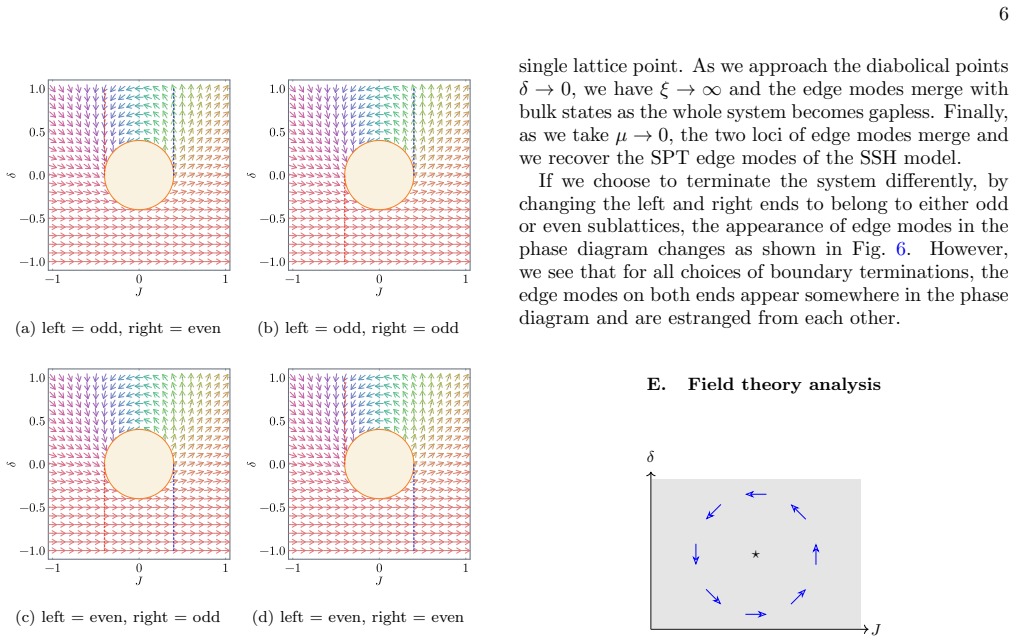
Non-trivial topological families of states endow phase diagrams of featureless insulators with topological textures visualized by higher Berry phases.
A machine-rendered reading of the paper's core claim, the machinery that carries it, and where it could break.
Core claim
We show that the presence of non-trivial topological families of states, including charge pumps and their generalizations, results in phase diagrams being endowed with non-trivial topological textures that can be visualized through Berry phases and their higher-dimensional generalizations. For non-interacting fermion systems with translation invariance these higher Berry phases can be computed using integrals of non-abelian Chern-Simons forms of the Berry-Bloch connection over momentum and parameter spaces. Singularities in these textures correspond to gap-closing loci of diabolical points, which represent the obstruction to contracting topologically non-trivial families of states.
What carries the argument
Higher Berry phases computed as integrals of non-abelian Chern-Simons forms of the Berry-Bloch connection over momentum and parameter spaces.
If this is right
- Singularities in the textures correspond to gap-closing loci of diabolical points.
- Bulk-boundary correspondence produces a locus of robust boundary modes that terminate at the bulk diabolical points.
- With finite chemical potential the edge modes are generically robust without fine-tuning in two and higher dimensions.
- In one dimension the edge modes appear estranged, at different parameter values for different edges.
- The textures remain stable under interactions, with nearby phases described by continuum field theories.
Where Pith is reading between the lines
- The same topological textures may appear in interacting systems once an appropriate many-body generalization of the higher Berry phase is defined.
- Parameter tuning in lattice models or cold-atom experiments could directly map out the diabolical loci and associated boundary-mode loci.
- The approach offers a way to classify the adiabatic connectivity of featureless phases across parameter space without reference to symmetry breaking or topological order.
- Extensions to disordered or open systems would test whether the Chern-Simons computation survives when translation invariance is relaxed.
Load-bearing premise
The systems remain non-interacting fermions with translation invariance so that the higher Berry phases follow from the Berry-Bloch connection.
What would settle it
Construct a microscopic model of class A fermions containing a non-trivial topological family such as a charge pump yet find no corresponding texture or gap-closing singularity in the computed phase diagram.
Figures






read the original abstract
We study phase diagrams of charge-conserving `class A' non-interacting fermions, focusing on the trivial phase in various dimensions. Such phases are usually termed `featureless' to distinguish them from those others with either symmetry-broken or topological order. We show that the presence of non-trivial topological families of states, including charge pumps and their generalizations, results in phase diagrams being endowed with non-trivial topological textures that can be visualized through Berry phases and their higher-dimensional generalizations. We show that for non-interacting fermion systems with translation invariance, these `higher' Berry phases can be computed using integrals of non-abelian Chern-Simons forms of the Berry-Bloch connection over momentum and parameter spaces. Singularities in these textures correspond to gap-closing loci of `diabolical points', which represent the obstruction to contracting topologically non-trivial families of states, and bulk-boundary correspondence results in a locus of robust boundary modes that terminate at the bulk diabolical points. In the presence of finite chemical potential, we argue that the edge modes are generically robust without any need for fine-tuning for two and higher dimensions, whereas in one dimension they are `estranged' in the phase diagram, i.e. appearing at different parameter values for different edges. We demonstrate our results by constructing several microscopic models of non-interacting fermions. We argue stability to interactions and explore proximate phase diagrams by mapping to continuum field theories.
Editorial analysis
A structured set of objections, weighed in public.
Referee Report
Summary. The manuscript studies phase diagrams of charge-conserving class A non-interacting fermions in the trivial ('featureless') phase. It claims that non-trivial topological families of gapped states, including charge pumps and generalizations, endow these phase diagrams with non-trivial topological textures. These textures are visualized via Berry phases and higher-dimensional generalizations, computed for translation-invariant systems as integrals of non-abelian Chern-Simons forms of the Berry-Bloch connection (from the occupied-band projector) over the combined momentum-parameter space. Singularities in the textures correspond to diabolical points (gap closings) that obstruct contraction of the families; bulk-boundary correspondence implies robust boundary modes terminating at these points. The work constructs explicit microscopic models, argues stability under interactions, and maps proximate diagrams to continuum field theories, with special discussion of edge-mode robustness in the presence of finite chemical potential.
Significance. If the higher Berry phase construction is rigorously validated, the paper provides a concrete visualization tool for topological structures in otherwise featureless insulators and unifies concepts of pumps, diabolical points, and boundary modes across dimensions. Explicit microscopic models and the continuum mapping are positive features; the interaction-stability argument and the distinction between estranged edge modes in 1D versus robust modes in higher D add value. The approach could influence studies of parameter-space topology in gapped fermionic systems.
major comments (2)
- [§3] §3 (Computation of higher Berry phases): the central claim that the integral of the non-abelian Chern-Simons form of the Berry-Bloch connection over the torus × parameter manifold is a topological invariant that vanishes for contractible families and jumps at diabolical points is load-bearing. The manuscript must explicitly demonstrate gauge invariance of this integral in the non-abelian setting and confirm that the connection remains smooth away from gap closings; without this, the correspondence between textures, singularities, and robust boundary modes is not secured.
- [§4.1, Eq. (12)] §4.1, Eq. (12): the normalization factor for the higher Berry phase over the Brillouin zone is not stated explicitly. The integer-valued nature of the texture and the precise location of jumps at diabolical points depend on this normalization; an explicit formula or reference to the standard normalization used in the literature is required.
minor comments (3)
- [Figure 2] Figure 2: the color scale for the Berry-phase texture is not labeled with units or range; this makes it difficult to read the magnitude of the visualized phase.
- [Introduction] Introduction, paragraph 3: the relation to prior work on higher Berry phases (e.g., references to existing Chern-Simons constructions in parameter space) should be stated more explicitly to clarify the incremental advance.
- [§5] §5: a brief table summarizing the microscopic models, their dimensions, and the observed textures would improve readability.
Simulated Author's Rebuttal
We thank the referee for their careful reading and constructive comments. We address the major comments point by point below and have revised the manuscript to incorporate the requested clarifications.
read point-by-point responses
-
Referee: [§3] §3 (Computation of higher Berry phases): the central claim that the integral of the non-abelian Chern-Simons form of the Berry-Bloch connection over the torus × parameter manifold is a topological invariant that vanishes for contractible families and jumps at diabolical points is load-bearing. The manuscript must explicitly demonstrate gauge invariance of this integral in the non-abelian setting and confirm that the connection remains smooth away from gap closings; without this, the correspondence between textures, singularities, and robust boundary modes is not secured.
Authors: We agree that an explicit demonstration of gauge invariance for the non-abelian Chern-Simons integral is essential to secure the central claims. In the revised manuscript we have added a dedicated paragraph in §3 that derives the gauge invariance: under a unitary gauge transformation the variation of the Chern-Simons form produces a total derivative whose integral vanishes over the closed manifold (Brillouin-zone torus × parameter space) by virtue of the cyclic property of the trace and the absence of boundary contributions. We also state explicitly that the Berry-Bloch connection remains smooth wherever the gap is open, because the occupied-band projector is a smooth function of momentum and parameters in the gapped region. These additions directly support the topological invariance, the vanishing on contractible families, the jumps at diabolical points, and the bulk-boundary correspondence for robust edge modes. revision: yes
-
Referee: [§4.1, Eq. (12)] §4.1, Eq. (12): the normalization factor for the higher Berry phase over the Brillouin zone is not stated explicitly. The integer-valued nature of the texture and the precise location of jumps at diabolical points depend on this normalization; an explicit formula or reference to the standard normalization used in the literature is required.
Authors: We thank the referee for noting this omission. The normalization in Eq. (12) follows the conventional choice that renders the higher Berry phase integer-valued: the integral of the non-abelian Chern-Simons form is divided by (2π)^d, where d is the dimension of the Brillouin zone. We have now inserted an explicit statement of this prefactor immediately after Eq. (12) in the revised §4.1 and added a reference to the standard literature on non-abelian Berry phases and higher Chern-Simons invariants. This clarification fixes the integer quantization of the textures and the precise parameter values at which jumps occur when diabolical points are crossed. revision: yes
Circularity Check
No significant circularity; derivation uses standard topological invariants
full rationale
The paper defines higher Berry phases via integrals of non-abelian Chern-Simons forms over momentum-parameter space and uses them to visualize textures arising from non-trivial families of gapped states. This follows established constructions in topological band theory for class-A insulators rather than reducing any central claim to a self-definition, fitted input, or self-citation chain. Microscopic models and continuum mappings supply independent content that can be checked against the stated assumptions of translation invariance and gap preservation. No load-bearing step equates a prediction to its own input by construction.
Axiom & Free-Parameter Ledger
axioms (2)
- domain assumption Systems are non-interacting charge-conserving class A fermions
- domain assumption Translation invariance permits computation of higher Berry phases via non-abelian Chern-Simons forms
Lean theorems connected to this paper
-
Foundation/AlexanderDuality.leanalexander_duality_circle_linking unclear?
unclearRelation between the paper passage and the cited Recognition theorem.
higher Berry phases can be computed using integrals of non-abelian Chern-Simons forms of the Berry-Bloch connection over momentum and parameter spaces
What do these tags mean?
- matches
- The paper's claim is directly supported by a theorem in the formal canon.
- supports
- The theorem supports part of the paper's argument, but the paper may add assumptions or extra steps.
- extends
- The paper goes beyond the formal theorem; the theorem is a base layer rather than the whole result.
- uses
- The paper appears to rely on the theorem as machinery.
- contradicts
- The paper's claim conflicts with a theorem or certificate in the canon.
- unclear
- Pith found a possible connection, but the passage is too broad, indirect, or ambiguous to say the theorem truly supports the claim.
Reference graph
Works this paper leans on
-
[1]
F. D. M. Haldane, Nobel lecture: Topological quantum matter, Rev. Mod. Phys.89, 040502 (2017)
work page 2017
-
[2]
J. M. Kosterlitz, Nobel lecture: Topological defects and 25 phase transitions, Rev. Mod. Phys.89, 040501 (2017)
work page 2017
-
[3]
X.-L. Qi and S.-C. Zhang, Topological insulators and su- perconductors, Rev. Mod. Phys.83, 1057 (2011)
work page 2011
-
[4]
M. Z. Hasan and C. L. Kane, Colloquium: Topological insulators, Rev. Mod. Phys.82, 3045 (2010)
work page 2010
-
[5]
L. Savary and L. Balents, Quantum spin liquids: a re- view, Reports on Progress in Physics80, 016502 (2016)
work page 2016
-
[6]
X. G. Wen and Q. Niu, Ground-state degeneracy of the fractional quantum Hall states in the presence of a random potential and on high-genus Riemann surfaces, Phys. Rev. B41, 9377 (1990)
work page 1990
-
[7]
X.-L. Qi, T. L. Hughes, and S.-C. Zhang, Topological field theory of time-reversal invariant insulators, Phys. Rev. B78, 195424 (2008)
work page 2008
-
[8]
D. P´ erez-Garc´ ıa, M. M. Wolf, M. Sanz, F. Verstraete, and J. I. Cirac, String Order and Symmetries in Quantum Spin Lattices, Phys. Rev. Lett.100, 167202 (2008)
work page 2008
-
[9]
C.-K. Chiu, J. C. Y. Teo, A. P. Schnyder, and S. Ryu, Classification of topological quantum matter with sym- metries, Rev. Mod. Phys.88, 035005 (2016)
work page 2016
-
[10]
A. Kitaev, Differential forms on the space of statistical mechanics models (2019), talk at the conference in cele- bration of Dan Freed’s 60th birthdayhttps://web.ma. utexas.edu/topqft/talkslides/kitaev.pdf
work page 2019
-
[11]
X. Wen, M. Qi, A. Beaudry, J. Moreno, M. J. Pflaum, D. Spiegel, A. Vishwanath, and M. Hermele, Flow of higher Berry curvature and bulk-boundary correspon- dence in parametrized quantum systems, Phys. Rev. B 108, 125147 (2023)
work page 2023
-
[12]
P.-S. Hsin, A. Kapustin, and R. Thorngren, Berry phase in quantum field theory: Diabolical points and boundary phenomena, Phys. Rev. B102, 245113 (2020)
work page 2020
-
[13]
Shiozaki, Adiabatic cycles of quantum spin systems, Phys
K. Shiozaki, Adiabatic cycles of quantum spin systems, Phys. Rev. B106, 125108 (2022)
work page 2022
-
[14]
N. G. Jones, R. Thorngren, R. Verresen, and A. Prakash, Charge pumps, pivot Hamiltonians, and symmetry- protected topological phases, Phys. Rev. B112, 165123 (2025)
work page 2025
-
[15]
N. G. Jones, A. Prakash, and P. Fendley, Pivoting through the chiral-clock family, SciPost Phys.18, 094 (2025)
work page 2025
-
[16]
A. Altland and M. R. Zirnbauer, Nonstandard symme- try classes in mesoscopic normal-superconducting hybrid structures, Phys. Rev. B55, 1142 (1997)
work page 1997
-
[17]
B. V. Svistunov, E. S. Babaev, and N. V. Prokof’ev,Su- perfluid states of matter(Crc Press, 2015)
work page 2015
-
[18]
N. D. Mermin, The topological theory of defects in or- dered media, Rev. Mod. Phys.51, 591 (1979)
work page 1979
-
[19]
In search of diabolical critical points
N. Manjunath and D. V. Else, In search of diabolical critical points (2026), arXiv:2601.10783 [cond-mat.str-el]
work page internal anchor Pith review Pith/arXiv arXiv 2026
-
[20]
C. C´ ordova, D. S. Freed, H. T. Lam, and N. Seiberg, Anomalies in the space of coupling constants and their dynamical applications I, SciPost Phys.8, 001 (2020)
work page 2020
-
[21]
C. Kane, Chapter 1 - Topological Band Theory and the Z2 Invariant, inTopological Insulators, Contemporary Concepts of Condensed Matter Science, Vol. 6, edited by M. Franz and L. Molenkamp (Elsevier, 2013) pp. 3–34
work page 2013
-
[22]
Toward a topological classification of many- body quantum states with short-range entanglement,
A. Kitaev, “Toward a topological classification of many- body quantum states with short-range entanglement,” (2011), talk at Simons Center for Geometry and Physics http://scgp.stonybrook.edu/archives/1087
work page 2011
-
[23]
On the classification of short-range entan- gled states,
A. Kitaev, “On the classification of short-range entan- gled states,” (2013), talk at Simons Center for Geometry and Physicshttp://scgp.stonybrook.edu/archives/ 16180
work page 2013
-
[24]
A. Kitaev, “Homotopy-theoretic approach to spt phases in action: Z 16 classification of three- dimensional superconductors,” (2015), talk at Institute for Pure and Applied Mathematics https://www.ipam.ucla.edu/programs/workshops/ symmetry-and-topology-in-quantum-matter/
work page 2015
-
[25]
M. Qi, D. T. Stephen, X. Wen, D. Spiegel, M. J. Pflaum, A. Beaudry, and M. Hermele, Charting the space of ground states with tensor networks, SciPost Phys.18, 168 (2025)
work page 2025
-
[26]
O. E. Sommer, X. Wen, and A. Vishwanath, Higher Berry Curvature from the Wave Function. I. Schmidt Decompo- sition and Matrix Product States, Phys. Rev. Lett.134, 146601 (2025)
work page 2025
-
[27]
O. E. Sommer, A. Vishwanath, and X. Wen, Higher Berry curvature from the wave function. II. Locally parametrized states beyond one dimension, Phys. Rev. B111, 155110 (2025)
work page 2025
-
[28]
S. Ohyama and S. Ryu, Higher structures in matrix prod- uct states, Phys. Rev. B109, 115152 (2024)
work page 2024
-
[29]
S. Ohyama and S. Ryu, Higher Berry connection for ma- trix product states, Phys. Rev. B111, 035121 (2025)
work page 2025
-
[30]
S. Ohyama and S. Ryu, Higher Berry phase from pro- jected entangled pair states in (2 + 1) dimensions, Phys. Rev. B111, 045112 (2025)
work page 2025
-
[31]
A. Prakash and S. A. Parameswaran, Charge pumps, boundary modes, and the necessity of unnecessary criti- cality, Phys. Rev. B112, L241117 (2025)
work page 2025
-
[32]
Hoˇ rava, Stability of Fermi Surfaces andKTheory, Phys
P. Hoˇ rava, Stability of Fermi Surfaces andKTheory, Phys. Rev. Lett.95, 016405 (2005)
work page 2005
-
[33]
A. Kitaev, Periodic table for topological insulators and superconductors, AIP Conference Proceedings1134, 22 (2009)
work page 2009
-
[34]
J. C. Y. Teo and C. L. Kane, Topological defects and gapless modes in insulators and superconductors, Phys. Rev. B82, 115120 (2010)
work page 2010
-
[35]
M. J. Rice and E. J. Mele, Elementary excitations of a linearly conjugated diatomic polymer, Phys. Rev. Lett. 49, 1455 (1982)
work page 1982
-
[36]
J. K. Asb´ oth, L. Oroszl´ any, and A. P´ alyi,A short course on topological insulators(Springer, 2016)
work page 2016
-
[37]
Translations are also needed to allow the use of band theory and are not strictly essential
-
[38]
S. Ryu, A. P. Schnyder, A. Furusaki, and A. W. W. Lud- wig, Topological insulators and superconductors: tenfold way and dimensional hierarchy, New Journal of Physics 12, 065010 (2010)
work page 2010
-
[39]
D. J. Thouless, Quantization of particle transport, Phys. Rev. B27, 6083 (1983)
work page 1983
-
[40]
D. Xiao, M.-C. Chang, and Q. Niu, Berry phase effects on electronic properties, Rev. Mod. Phys.82, 1959 (2010)
work page 1959
-
[41]
W. P. Su, J. R. Schrieffer, and A. J. Heeger, Solitons in polyacetylene, Phys. Rev. Lett.42, 1698 (1979)
work page 1979
-
[42]
Mathematically, so that the edge-mode is normalisable, we are looking for solutions to this equation in the se- quence spacel 2
-
[43]
N. G. Jones, R. Thorngren, and R. Verresen, Bulk- Boundary Correspondence and Singularity-Filling in Long-Range Free-Fermion Chains, Phys. Rev. Lett.130, 246601 (2023)
work page 2023
-
[44]
Coleman, Quantum sine-Gordon equation as the mas- sive Thirring model, Phys
S. Coleman, Quantum sine-Gordon equation as the mas- sive Thirring model, Phys. Rev. D11, 2088 (1975)
work page 2088
-
[45]
T. Giamarchi,Quantum physics in one dimension, In- 26 ternational series of monographs on physics (Clarendon Press, Oxford, 2004)
work page 2004
-
[46]
F. D. M. Haldane, ‘Luttinger liquid theory’ of one- dimensional quantum fluids. I. Properties of the Lut- tinger model and their extension to the general 1D in- teracting spinless Fermi gas, Journal of Physics C: Solid State Physics14, 2585 (1981)
work page 1981
-
[47]
F. D. M. Haldane, Demonstration of the “Luttinger liq- uid” character of Bethe-ansatz-soluble models of 1-D quantum fluids, Physics Letters A81, 153 (1981)
work page 1981
- [48]
-
[49]
Fradkin,Field Theories of Condensed Matter Physics (Cambridge University Press, 2013)
E. Fradkin,Field Theories of Condensed Matter Physics (Cambridge University Press, 2013)
work page 2013
-
[50]
Affleck, Edge magnetic field in the xxz spin-1/2 chain, J
I. Affleck, Edge magnetic field in the xxz spin-1/2 chain, J. Phys. A: Math. Gen.31, 2761 (1998)
work page 1998
-
[51]
A. Prakash, M. Fava, and S. A. Parameswaran, Multi- versality and Unnecessary Criticality in One Dimension, Phys. Rev. Lett.130, 256401 (2023)
work page 2023
-
[52]
R. Jackiw and C. Rebbi, Solitons with fermion number ½, Phys. Rev. D13, 3398 (1976)
work page 1976
- [53]
-
[54]
D. Gaiotto and T. Johnson-Freyd, Symmetry protected topological phases and generalized cohomology, Journal of High Energy Physics2019, 10.1007/jhep05(2019)007 (2019)
-
[55]
C. Z. Xiong, Minimalist approach to the classification of symmetry protected topological phases, Journal of Physics A: Mathematical and Theoretical51, 445001 (2018)
work page 2018
-
[56]
Y. Kubota, Stable homotopy theory of invertible gapped quantum spin systems i: Kitaev’sω-spectrum (2025), arXiv:2503.12618 [math-ph]
-
[57]
Hatcher,Algebraic topology(Cambridge University Press, 2002)
A. Hatcher,Algebraic topology(Cambridge University Press, 2002)
work page 2002
-
[58]
R. Verresen, Topology and edge states survive quan- tum criticality between topological insulators (2020), arXiv:2003.05453 [cond-mat.str-el]
-
[59]
J. E. Avron, R. Seiler, and B. Simon, Homotopy and Quantization in Condensed Matter Physics, Phys. Rev. Lett.51, 51 (1983)
work page 1983
-
[60]
J. E. Avron, L. Sadun, J. Segert, and B. Simon, Topo- logical Invariants in Fermi Systems with Time-Reversal Invariance, Phys. Rev. Lett.61, 1329 (1988)
work page 1988
-
[61]
J. E. Avron, L. Sadun, J. Segert, and B. Simon, Chern numbers, quaternions, and Berry’s phases in Fermi sys- tems, Communications in Mathematical Physics124, 595 (1989)
work page 1989
-
[62]
J. E. Avron, R. Seiler, and B. Simon, Charge deficiency, charge transport and comparison of dimensions, Commu- nications in Mathematical Physics159, 399 (1994)
work page 1994
-
[63]
S.-C. Zhang and J. Hu, A Four-Dimensional Generaliza- tion of the Quantum Hall Effect, Science294, 823 (2001)
work page 2001
-
[64]
C. L. Kane and E. J. Mele, Quantum spin hall effect in graphene, Phys. Rev. Lett.95, 226801 (2005)
work page 2005
-
[65]
An analysis of this case would require more sophisticated tools [72, 73]
Lattice translations allow us to use band theory but even this can be broken weakly. An analysis of this case would require more sophisticated tools [72, 73]
-
[66]
A. Abanov and P. Wiegmann, Theta-terms in nonlinear sigma-models, Nuclear Physics B570, 685–698 (2000)
work page 2000
-
[67]
A. Kapustin and L. Spodyneiko, Higher-dimensional gen- eralizations of the thouless charge pump (2020)
work page 2020
-
[68]
Nakahara,Geometry, topology and physics(CRC press, 2018)
M. Nakahara,Geometry, topology and physics(CRC press, 2018)
work page 2018
-
[69]
M. V. Berry, Quantal phase factors accompanying adia- batic changes, Proceedings of the Royal Society of Lon- don. A. Mathematical and Physical Sciences392, 45 (1984)
work page 1984
-
[70]
A. Kapustin and L. Spodyneiko, Higher-dimensional gen- eralizations of Berry curvature, Phys. Rev. B101, 235130 (2020)
work page 2020
- [71]
-
[72]
A. Kitaev, Anyons in an exactly solved model and be- yond, Annals of Physics321, 2 (2006), January Special Issue
work page 2006
- [73]
-
[74]
A. Sharon, Global aspects of spaces of vacua, Journal of High Energy Physics2020, 10.1007/jhep11(2020)083 (2020)
-
[75]
Parameterized Families of Toric Code Phase: $em$-duality family and higher-order anyon pumping
S. Ohyama, T. Ando, and R. Thorngren, Parameter- ized families of toric code phase:em-duality family and higher-order anyon pumping (2026), arXiv:2605.03891 [cond-mat.str-el]
work page internal anchor Pith review Pith/arXiv arXiv 2026
-
[76]
A. Prakash and N. G. Jones, Classical Origins of Landau- Incompatible Transitions, Phys. Rev. Lett.134, 097103 (2025)
work page 2025
-
[77]
P. K. Vishnu, A. Prakash, R. Narayanan, and T. Chanda, Two-DimensionalJ 1−J2 Clock Model: Enhanced Sym- metries, Emergent Orders, and Landau-Incompatible Transitions, Phys. Rev. Lett.135, 256703 (2025)
work page 2025
discussion (0)
Sign in with ORCID, Apple, or X to comment. Anyone can read and Pith papers without signing in.