The R-process Alliance: A Bright, Strongly R-process-enhanced Extremely Metal-poor Star Observed with GHOST
Pith reviewed 2026-05-21 02:49 UTC · model grok-4.3
The pith
The r-process elements in an extremely metal-poor star align with solar and neutron-star-merger patterns, supporting a universal main r-process.
A machine-rendered reading of the paper's core claim, the machinery that carries it, and where it could break.
Core claim
The r-process elements in G256353 align reasonably well with HD 222925, the scaled-Solar pattern except for the first peak, and a recent predicted pattern associated with neutron star mergers. This consistency reinforces the universality of the main r-process across diverse astrophysical environments.
What carries the argument
High-resolution abundance measurements of fifteen neutron-capture elements, compared against scaled solar, reference-star, and neutron-star-merger yield patterns.
If this is right
- The main r-process operates with the same yield ratios in neutron-star mergers and in whatever site enriched this star.
- Extremely metal-poor stars can be used as clean probes of early-universe heavy-element production once light elements are matched to supernova models of 20-30 solar-mass progenitors.
- Kinematic tagging can identify which metal-poor stars arrived via accretion rather than forming in place.
- Additional stars with similar r-process signatures should show the same abundance pattern if the universality holds.
Where Pith is reading between the lines
- If the pattern is truly universal, then any viable r-process site must produce the same second- and third-peak ratios regardless of total yield or metallicity.
- Finding more such stars with Gaia selection and quick GHOST follow-up could map the spatial distribution of early r-process events.
- The exception at the first peak may point to a separate, weaker process that operates alongside the main r-process and varies with environment.
Load-bearing premise
The derived chemical abundances are free of significant systematic errors from line formation, model atmospheres, or non-LTE effects.
What would settle it
A new spectrum or re-analysis that shifts the first-peak abundances (Sr, Y, Zr) by more than 0.3 dex relative to the second and third peaks while keeping the overall metallicity fixed.
Figures



read the original abstract
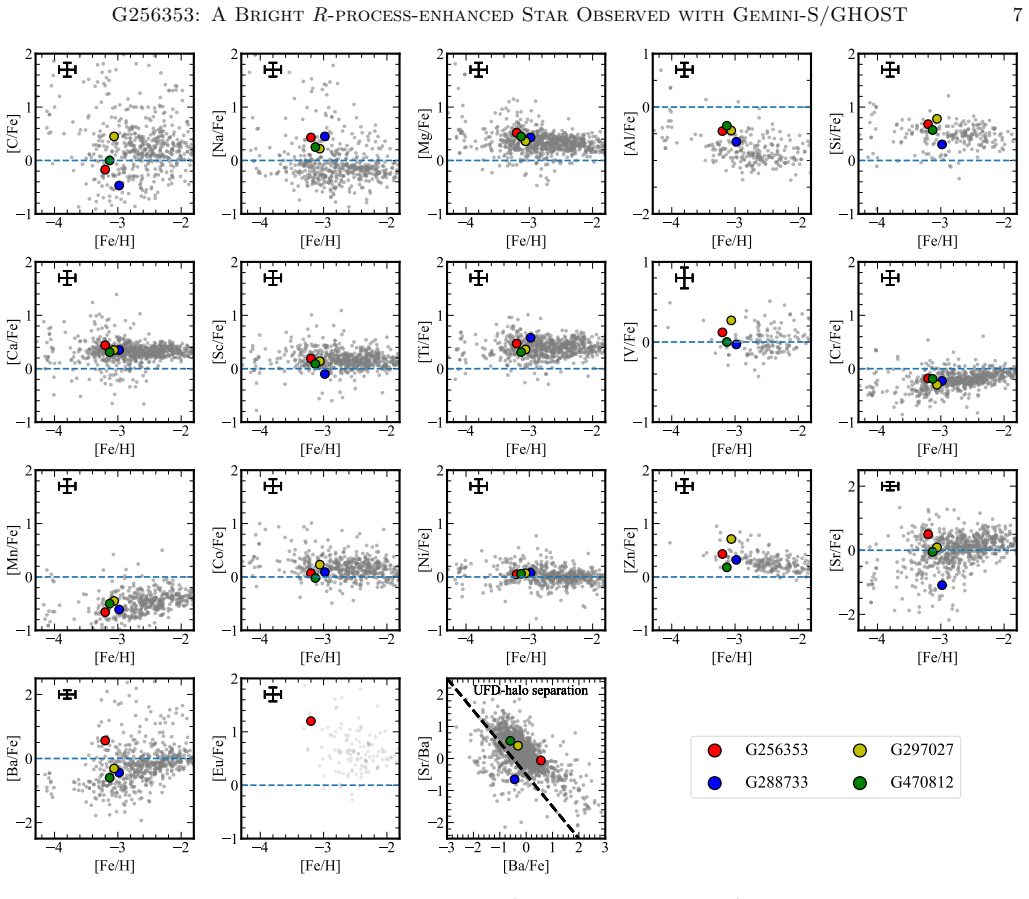
We present a detailed chemical-abundance and kinematic analysis of four extremely metal-poor (EMP; [Fe/H] $\leq -3.0$) stars identified from \textit{Gaia} BP/RP data in our ongoing search for the most primitive stars. This includes a primary target, \textit{Gaia}~DR3~2563539603865382656 (hereafter G256353), a strongly $r$-process-enhanced star with [Eu/Fe]~$= +1.20$ and [Ba/Eu]~$= -0.64$. Our results are based on high-resolution, high-signal-to-noise GHOST spectra from Gemini-South. For the full sample, we statistically match the light-element abundances with those predicted from Population\,III supernova models. The ``best-fit'' model suggests massive progenitors with stellar masses of M$_{\star}\sim$ 20-30\,M$_\odot$. In addition, we determine orbital histories for all of the stars. We find that Gaia~DR3~2887334237669844480 appears to be kinematically associated with Atari, an accreted structure in the Galactic disk. This star has low abundance ratios of strontium ([Sr/Fe] = $-$1.09) and barium ([Ba/Fe] = $-$0.37), which supports an accretion origin. For G256353, we determine chemical abundances for 15 neutron-capture elements. We compare the observed heavy-element pattern for G256353 with that of the Sun, HD~222925, and two neutron star merger models. The $r$-process elements in G256353 align reasonably well with HD~222925, the scaled-Solar pattern (except for the first peak), and a recent predicted pattern associated with neutron star mergers. This consistency reinforces the universality of the main $r$-process across diverse astrophysical environments.
Editorial analysis
A structured set of objections, weighed in public.
Referee Report
Summary. The manuscript presents a chemical abundance and kinematic analysis of four extremely metal-poor stars observed with the GHOST spectrograph on Gemini-South, identified via Gaia BP/RP photometry. The primary focus is on Gaia DR3 2563539603865382656 (G256353), a strongly r-process-enhanced EMP star with [Eu/Fe] = +1.20 and [Ba/Eu] = -0.64. Light-element abundances for the sample are matched to Population III supernova yields, favoring 20-30 M⊙ progenitors. For G256353, abundances of 15 neutron-capture elements are derived and compared to the Sun, HD 222925, and neutron-star-merger models, with the pattern aligning reasonably well (except the first peak) and supporting universality of the main r-process. Orbital histories are also determined, linking one star to the Atari accreted structure.
Significance. If the abundance determinations prove robust, the work adds a new, bright r-process-enhanced EMP star to the sample and provides additional observational evidence that the main r-process pattern is largely universal across different astrophysical sites. The kinematic association with Atari and the Pop III supernova matching for the light elements are also useful contributions to Galactic archaeology. The paper does not ship machine-checked proofs or fully reproducible code, but the high-resolution spectra and multi-element comparisons constitute falsifiable observational tests of r-process models.
major comments (2)
- [§4 and §5] §4 (abundance analysis) and §5 (pattern comparison): The central claim that the r-process pattern in G256353 aligns with HD 222925, the scaled-Solar r-process (except first peak), and NSM yields rests on the assumption that the derived abundances are accurate to ≲0.1–0.2 dex differentially. No quantitative assessment of non-LTE corrections for key species (Ba II, Eu II, Sr II) or sensitivity to 1D vs. 3D model atmospheres is presented; standard LTE analyses of EMP stars can produce element-specific shifts of 0.2–0.3 dex that would alter first-to-second peak ratios and weaken the universality inference.
- [Table 2] Table 2 or equivalent (abundance table for G256353): Error bars, line lists, adopted model-atmosphere parameters (Teff, log g, [Fe/H], microturbulence), and whether non-LTE or 3D corrections were applied are not shown or referenced in sufficient detail to allow independent verification of the 15 neutron-capture abundances. Without these, the claimed consistency with external patterns cannot be evaluated at the precision needed for the universality conclusion.
minor comments (2)
- [Abstract and §3] The abstract and §3 mention 'high-resolution, high-signal-to-noise GHOST spectra' but do not quote the actual resolving power or S/N per pixel; these numbers should be stated explicitly for context.
- [Figure 3] Figure 3 (or equivalent pattern plot): The visual comparison would benefit from explicit overlay of the error bars on the observed points and a quantitative metric (e.g., reduced χ²) for the match to each reference pattern.
Simulated Author's Rebuttal
We thank the referee for their careful reading of the manuscript and for highlighting important points regarding the robustness of our abundance analysis. We address each major comment below and outline the revisions we will implement to strengthen the presentation.
read point-by-point responses
-
Referee: [§4 and §5] §4 (abundance analysis) and §5 (pattern comparison): The central claim that the r-process pattern in G256353 aligns with HD 222925, the scaled-Solar r-process (except first peak), and NSM yields rests on the assumption that the derived abundances are accurate to ≲0.1–0.2 dex differentially. No quantitative assessment of non-LTE corrections for key species (Ba II, Eu II, Sr II) or sensitivity to 1D vs. 3D model atmospheres is presented; standard LTE analyses of EMP stars can produce element-specific shifts of 0.2–0.3 dex that would alter first-to-second peak ratios and weaken the universality inference.
Authors: We agree that non-LTE and 3D effects warrant explicit discussion for a claim of pattern universality at the 0.1–0.2 dex level. Our analysis employs standard 1D LTE spectral synthesis, consistent with the majority of high-resolution studies of EMP stars and with the analysis of the comparison star HD 222925. In the revised manuscript we will add a dedicated paragraph in §4 that (i) cites published non-LTE corrections for Ba II, Eu II, and Sr II at [Fe/H] ≈ −3 (typically +0.1 to +0.3 dex for the first-peak species and smaller for Eu), (ii) notes that differential comparisons to HD 222925 largely cancel these corrections, and (iii) provides a brief sensitivity estimate for 3D effects drawn from the literature. We will also qualify the universality statement to reflect the remaining systematic uncertainty while preserving the overall conclusion that the main r-process pattern is consistent within the quoted precision. revision: yes
-
Referee: [Table 2] Table 2 or equivalent (abundance table for G256353): Error bars, line lists, adopted model-atmosphere parameters (Teff, log g, [Fe/H], microturbulence), and whether non-LTE or 3D corrections were applied are not shown or referenced in sufficient detail to allow independent verification of the 15 neutron-capture abundances. Without these, the claimed consistency with external patterns cannot be evaluated at the precision needed for the universality conclusion.
Authors: We acknowledge that the current Table 2 lacks the level of detail required for full reproducibility. In the revised version we will expand the table (or add an appendix table) to report: (a) the adopted stellar parameters (Teff, log g, [Fe/H], microturbulence) with their uncertainties, (b) the complete line list with wavelengths, excitation potentials, and log gf values for each of the 15 neutron-capture species, (c) individual line abundances together with the final mean and standard deviation, and (d) an explicit statement that all abundances were derived under 1D LTE assumptions with no non-LTE or 3D corrections applied. We will also cite the model-atmosphere grid and the spectral synthesis code used. These additions will allow independent verification of the reported abundances and the pattern comparisons. revision: yes
Circularity Check
No significant circularity in observational abundance analysis
full rationale
The paper reports direct measurements of chemical abundances from high-resolution GHOST spectra of EMP stars, followed by statistical matching of light-element patterns to external Population III supernova yield models and comparison of the heavy-element pattern in G256353 to independent references (HD 222925, scaled Solar r-process, and published NSM predictions). No equations, fitted parameters, or self-citations are used to derive the reported alignment; the consistency claim follows from the measured abundances themselves rather than reducing to an input by construction. The analysis is self-contained against external benchmarks and contains no load-bearing self-referential steps.
Axiom & Free-Parameter Ledger
axioms (2)
- domain assumption Local thermodynamic equilibrium (LTE) or standard 1D model atmospheres suffice for abundance derivation from GHOST spectra
- domain assumption The Population III supernova yield grids used for statistical matching are accurate representations of first-star explosions
Lean theorems connected to this paper
-
IndisputableMonolith/Foundation/RealityFromDistinction.leanreality_from_one_distinction unclear?
unclearRelation between the paper passage and the cited Recognition theorem.
The r-process elements in G256353 align reasonably well with HD 222925, the scaled-Solar pattern (except for the first peak), and a recent predicted pattern associated with neutron star mergers. This consistency reinforces the universality of the main r-process across diverse astrophysical environments.
What do these tags mean?
- matches
- The paper's claim is directly supported by a theorem in the formal canon.
- supports
- The theorem supports part of the paper's argument, but the paper may add assumptions or extra steps.
- extends
- The paper goes beyond the formal theorem; the theorem is a base layer rather than the whole result.
- uses
- The paper appears to rely on the theorem as machinery.
- contradicts
- The paper's claim conflicts with a theorem or certificate in the canon.
- unclear
- Pith found a possible connection, but the passage is too broad, indirect, or ambiguous to say the theorem truly supports the claim.
Reference graph
Works this paper leans on
-
[1]
Abbott, B. P., Abbott, R., Abbott, T. D., et al. 2017a, PhRvL, 119, 161101, doi: 10.1103/PhysRevLett.119.161101 —. 2017b, ApJL, 848, L12, doi: 10.3847/2041-8213/aa91c9
-
[2]
2018, ApJS, 238, 36, doi: 10.3847/1538-4365/aadfe9
Abohalima, A., & Frebel, A. 2018, ApJS, 238, 36, doi: 10.3847/1538-4365/aadfe9
-
[3]
S., Allende Prieto, C., Gonz´ alez Hern´ andez, J
Aguado, D. S., Allende Prieto, C., Gonz´ alez Hern´ andez, J. I., & Rebolo, R. 2018, ApJL, 854, L34, doi: 10.3847/2041-8213/aaadb8
-
[4]
S., Allende Prieto, C., Gonz´ alez Hern´ andez, J
Aguado, D. S., Allende Prieto, C., Gonz´ alez Hern´ andez, J. I., Rebolo, R., & Caffau, E. 2017a, A&A, 604, A9, doi: 10.1051/0004-6361/201731320
-
[5]
Aguado, D. S., Gonz´ alez Hern´ andez, J. I., Allende Prieto, C., & Rebolo, R. 2017b, A&A, 605, A40, doi: 10.1051/0004-6361/201730654
-
[6]
Aguado, D. S., Myeong, G. C., Belokurov, V., et al. 2021, MNRAS, 500, 889, doi: 10.1093/mnras/staa3250
-
[7]
A., Taani, A., ¨Ozdemir, S., et al
Almusleh, N. A., Taani, A., ¨Ozdemir, S., et al. 2021, Astronomische Nachrichten, 342, 625, doi: 10.1002/asna.202113867
-
[8]
Mardini, M. K., & Frebel, A. 2024, MNRAS, 530, 4712, doi: 10.1093/mnras/stae670
-
[9]
Aoki, W., Beers, T. C., Christlieb, N., et al. 2007, ApJ, 655, 492, doi: 10.1086/509817
-
[10]
Aoki, W., Beers, T. C., Lee, Y. S., et al. 2013, AJ, 145, 13, doi: 10.1088/0004-6256/145/1/13
-
[11]
2022, ApJ, 931, 146, doi: 10.3847/1538-4357/ac6515
Aoki, W., Li, H., Matsuno, T., et al. 2022, ApJ, 931, 146, doi: 10.3847/1538-4357/ac6515
-
[12]
Aoki, W., Beers, T. C., Honda, S., et al. 2025, PASJ, 77, 502, doi: 10.1093/pasj/psaf017
-
[13]
2023, A&A Rv, 31, 1, doi: 10.1007/s00159-022-00146-x
Arcones, A., & Thielemann, F.-K. 2023, A&A Rv, 31, 1, doi: 10.1007/s00159-022-00146-x
-
[14]
Annual Review of Astronomy and Astrophysics , author =
Asplund, M., Grevesse, N., Sauval, A. J., & Scott, P. 2009, ARA&A, 47, 481, doi: 10.1146/annurev.astro.46.060407.145222 Astropy Collaboration, Robitaille, T. P., Tollerud, E. J., et al. 2013, A&A, 558, A33, doi: 10.1051/0004-6361/201322068 Astropy Collaboration, Price-Whelan, A. M., Sip˝ ocz, B. M., et al. 2018, AJ, 156, 123, doi: 10.3847/1538-3881/aabc4f...
-
[15]
Bandyopadhyay, A., & Beers, T. C. 2025, Universe, 11, 229, doi: 10.3390/universe11070229
-
[16]
2024, ApJS, 274, 39, doi: 10.3847/1538-4365/ad6f0f
Bandyopadhyay, A., Ezzeddine, R., Allende Prieto, C., et al. 2024, ApJS, 274, 39, doi: 10.3847/1538-4365/ad6f0f
-
[17]
Barklem, P. S., Christlieb, N., Beers, T. C., et al. 2005, A&A, 439, 129, doi: 10.1051/0004-6361:20052967
-
[18]
Beers, T. C., & Christlieb, N. 2005, ARA&A, 43, 531, doi: 10.1146/annurev.astro.42.053102.134057
-
[19]
Behara, N. T., Bonifacio, P., Ludwig, H. G., et al. 2010, A&A, 513, A72, doi: 10.1051/0004-6361/200913213
-
[20]
Belmonte, M. T., Pickering, J. C., Ruffoni, M. P., et al. 2017, ApJ, 848, 125, doi: 10.3847/1538-4357/aa8cd3
-
[21]
Deason, A. J. 2018, MNRAS, 478, 611, doi: 10.1093/mnras/sty982
-
[22]
2024, A&A, 692, A130, doi: 10.1051/0004-6361/202451837
Berczik, P., Ishchenko, M., Sobodar, O., & Mardini, M. 2024, A&A, 692, A130, doi: 10.1051/0004-6361/202451837
-
[23]
Bergemann, M., Lind, K., Collet, R., Magic, Z., & Asplund, M. 2012, MNRAS, 427, 27, doi: 10.1111/j.1365-2966.2012.21687.x Bi´ emont,´E., Blagoev, K., Engstr¨ om, L., et al. 2011, MNRAS, 414, 3350, doi: 10.1111/j.1365-2966.2011.18637.x
-
[24]
Bonaca, A., Conroy, C., Wetzel, A., Hopkins, P. F., & Kereˇ s, D. 2017, ApJ, 845, 101, doi: 10.3847/1538-4357/aa7d0c
-
[25]
2012, A&A, 542, A87, doi: 10.1051/0004-6361/201219004
Bonifacio, P., Sbordone, L., Caffau, E., et al. 2012, A&A, 542, A87, doi: 10.1051/0004-6361/201219004
-
[26]
2024, ApJ, 975, 213, doi: 10.3847/1538-4357/ad7d83
Brethauer, D., Kasen, D., Margutti, R., & Chornock, R. 2024, ApJ, 975, 213, doi: 10.3847/1538-4357/ad7d83
-
[27]
Reviews of Modern Physics , year = 1957, volume = 29, pages =
Burbidge, E. M., Burbidge, G. R., Fowler, W. A., & Hoyle, F. 1957, Reviews of Modern Physics, 29, 547, doi: 10.1103/RevModPhys.29.547
-
[28]
Burris, D. L., Pilachowski, C. A., Armandroff, T. E., et al. 2000, ApJ, 544, 302
work page 2000
-
[29]
2011a, A&A, 534, A4, doi: 10.1051/0004-6361/201117530 —
Caffau, E., Bonifacio, P., Fran¸ cois, P., et al. 2011a, A&A, 534, A4, doi: 10.1051/0004-6361/201117530 —. 2011b, Nature, 477, 67, doi: 10.1038/nature10377 —. 2013, A&A, 560, A15, doi: 10.1051/0004-6361/201322213
-
[30]
Cain, M., Frebel, A., Ji, A. P., et al. 2020, ApJ, 898, 40, doi: 10.3847/1538-4357/ab97ba
-
[31]
Cameron, A. G. W. 1957, PASP, 69, 201, doi: 10.1086/127051
-
[32]
Carollo, D., Beers, T. C., Bovy, J., et al. 2012, ApJ, 744, 195, doi: 10.1088/0004-637X/744/2/195 G256353: A Bright R-process-enhanced Star Observed with Gemini-S/GHOST 19
-
[33]
2002, AJ, 124, 481, doi: 10.1086/340955
Christlieb, N. 2002, AJ, 124, 481, doi: 10.1086/340955
-
[34]
Casagrande, L., & VandenBerg, D. A. 2018a, MNRAS, 475, 5023, doi: 10.1093/mnras/sty149 —. 2018b, MNRAS, 479, L102, doi: 10.1093/mnrasl/sly104
-
[35]
Casey, A. R. 2014, PhD thesis, Australian National
work page 2014
-
[36]
Casey, A. R., & Schlaufman, K. C. 2015, ApJ, 809, 110, doi: 10.1088/0004-637X/809/2/110
-
[37]
Castelli, F., & Kurucz, R. L. 2004, ArXiv Astrophysics e-prints
work page 2004
-
[38]
2004, A&A, 416, 1117, doi: 10.1051/0004-6361:20034074
Cayrel, R., Depagne, E., Spite, M., et al. 2004, A&A, 416, 1117, doi: 10.1051/0004-6361:20034074
-
[39]
Chiti, A., Frebel, A., Mardini, M. K., et al. 2021, ApJS, 254, 31, doi: 10.3847/1538-4365/abf73d
-
[40]
2024, Nature Astronomy, 8, 637, doi: 10.1038/s41550-024-02223-w
Chiti, A., Mardini, M., Limberg, G., et al. 2024, Nature Astronomy, 8, 637, doi: 10.1038/s41550-024-02223-w
-
[41]
Christlieb, N., Bessell, M. S., Beers, T. C., et al. 2002, Nature, 419, 904, doi: 10.1038/nature01142
-
[42]
G., Christlieb, N., Thompson, I., et al
Cohen, J. G., Christlieb, N., Thompson, I., et al. 2013, ApJ, 778, 56, doi: 10.1088/0004-637X/778/1/56
-
[43]
G., Christlieb, N., McWilliam, A., et al
Cohen, J. G., Christlieb, N., McWilliam, A., et al. 2004, ApJ, 612, 1107, doi: 10.1086/422576 Cˆ ot´ e, B., Eichler, M., Arcones, A., et al. 2019, ApJ, 875, 106, doi: 10.3847/1538-4357/ab10db
-
[44]
Cowan, J. J., Sneden, C., Lawler, J. E., et al. 2021, Reviews of Modern Physics, 93, 015002, doi: 10.1103/RevModPhys.93.015002
-
[45]
Kozlov, M. G., & Barzakh, A. E. 2021, PhRvA, 103, 032824, doi: 10.1103/PhysRevA.103.032824 Den Hartog, E. A., Herd, M. T., Lawler, J. E., et al. 2005, ApJ, 619, 639, doi: 10.1086/426381 Den Hartog, E. A., Lawler, J. E., & Roederer, I. U. 2020, ApJS, 248, 10, doi: 10.3847/1538-4365/ab84f5 —. 2021a, ApJS, 254, 5, doi: 10.3847/1538-4365/abe861 Den Hartog, E....
-
[46]
Abundance analysis of two extremely metal-poor stars from the Hamburg/ESO Survey
Depagne, E., Hill, V., Christlieb, N., & Primas, F. 2000, A&A, 364, L6. https://arxiv.org/abs/astro-ph/0008384
work page internal anchor Pith review Pith/arXiv arXiv 2000
-
[47]
2021, ApJ, 913, 26, doi: 10.3847/1538-4357/abf358
Domoto, N., Tanaka, M., Wanajo, S., & Kawaguchi, K. 2021, ApJ, 913, 26, doi: 10.3847/1538-4357/abf358
-
[48]
R., et al., 2017, @doi [Science] 10.1126/science.aaq0049 , 358, 1570
Drout, M. R., Piro, A. L., Shappee, B. J., et al. 2017, Science, 358, 1570, doi: 10.1126/science.aaq0049
-
[49]
Eichler, D., Livio, M., Piran, T., & Schramm, D. N. 1989, Nature, 340, 126, doi: 10.1038/340126a0
-
[50]
2017, ApJ, 847, 142, doi: 10.3847/1538-4357/aa8875
Ezzeddine, R., Frebel, A., & Plez, B. 2017, ApJ, 847, 142, doi: 10.3847/1538-4357/aa8875
-
[51]
Ezzeddine, R., Frebel, A., Roederer, I. U., et al. 2019, ApJ, 876, 97, doi: 10.3847/1538-4357/ab14e7
-
[52]
2020, ApJ, 898, 150, doi: 10.3847/1538-4357/ab9d1a
Ezzeddine, R., Rasmussen, K., Frebel, A., et al. 2020, ApJ, 898, 150, doi: 10.3847/1538-4357/ab9d1a
-
[53]
2010, ApJ, 712, 1359, doi: 10.1088/0004-637X/712/2/1359
Farouqi, K., Kratz, K.-L., Pfeiffer, B., et al. 2010, ApJ, 712, 1359, doi: 10.1088/0004-637X/712/2/1359
-
[54]
Fedchak, J. A., & Lawler, J. E. 1999, ApJ, 523, 734, doi: 10.1086/307763
-
[55]
2020, ApJ, 894, 9, doi: 10.3847/1538-4357/ab86b0
Fischer, T., Wu, M.-R., Wehmeyer, B., et al. 2020, ApJ, 894, 9, doi: 10.3847/1538-4357/ab86b0
-
[56]
2025, in Astronomical Society of the Pacific Conference Series, Vol
Fitzpatrick, M., Placco, V., Bolton, A., et al. 2025, in Astronomical Society of the Pacific Conference Series, Vol. 541, Astronomical Data Analysis Software and Systems XXXIII, ed. A. Jacques, R. Seaman, N. Gandilo, & T. Linder, 461, doi: 10.26624/CETF5821
-
[57]
2010, AJ, 140, 1694, doi: 10.1088/0004-6256/140/6/1694
For, B.-Q., & Sneden, C. 2010, AJ, 140, 1694, doi: 10.1088/0004-6256/140/6/1694
-
[58]
2007, A&A, 476, 935, doi: 10.1051/0004-6361:20077706
Francois, P., Depagne, E., Hill, V., et al. 2007, A&A, 476, 935, doi: 10.1051/0004-6361:20077706
-
[59]
Frebel, A. 2018, Annual Review of Nuclear and Particle Science, 68, 237, doi: 10.1146/annurev-nucl-101917-021141
-
[60]
Frebel, A., Chiti, A., Ji, A., Jacobson, H. R., & Placco, V. 2015, ApJL, 810, L27, doi: 10.1088/2041-8205/810/2/L27
-
[61]
Frebel, A., Christlieb, N., Norris, J. E., et al. 2007, ApJL, 660, L117, doi: 10.1086/518122
-
[62]
2008, ApJ, 684, 588, doi: 10.1086/590327
Frebel, A., Collet, R., Eriksson, K., Christlieb, N., & Aoki, W. 2008, ApJ, 684, 588, doi: 10.1086/590327
-
[63]
Frebel, A., Ji, A. P., Ezzeddine, R., et al. 2019, ApJ, 871, 146, doi: 10.3847/1538-4357/aae848
-
[64]
Frebel, A., Simon, J. D., Geha, M., & Willman, B. 2010, ApJ, 708, 560, doi: 10.1088/0004-637X/708/1/560
-
[65]
Frebel, A., Aoki, W., Christlieb, N., et al. 2005, Nature, 434, 871, doi: 10.1038/nature03455 Fr¨ ohlich, C., Hauser, P., Liebend¨ orfer, M., et al. 2006, ApJ, 637, 415, doi: 10.1086/498224
-
[66]
2023, ApJ, 942, 39, doi: 10.3847/1538-4357/ac9ce0 20 Mardini et al
Fujibayashi, S., Kiuchi, K., Wanajo, S., et al. 2023, ApJ, 942, 39, doi: 10.3847/1538-4357/ac9ce0 20 Mardini et al. Gaia Collaboration, Vallenari, A., Brown, A. G. A., et al. 2022, arXiv e-prints, arXiv:2208.00211. https://arxiv.org/abs/2208.00211
-
[67]
2022, ApJ, 929, 43, doi: 10.3847/1538-4357/ac4d20
Ghosh, S., Wolfe, N., & Fr¨ ohlich, C. 2022, ApJ, 929, 43, doi: 10.3847/1538-4357/ac4d20
-
[68]
Gull, M., Frebel, A., Cain, M. G., et al. 2018, ApJ, 862, 174, doi: 10.3847/1538-4357/aacbc3
-
[69]
2010, A&A, 511, A68, doi: 10.1051/0004-6361/200913672
Gurell, J., Nilsson, H., Engstr¨ om, L., et al. 2010, A&A, 511, A68, doi: 10.1051/0004-6361/200913672
-
[70]
Hannaford, P., Larkins, P. L., & Lowe, R. M. 1981, Journal of Physics B Atomic Molecular Physics, 14, 2321, doi: 10.1088/0022-3700/14/14/004
-
[71]
Hansen, T., Hansen, C. J., Christlieb, N., et al. 2015, ApJ, 807, 173, doi: 10.1088/0004-637X/807/2/173
-
[72]
Hansen, T. T., Holmbeck, E. M., Beers, T. C., et al. 2018, ApJ, 858, 92, doi: 10.3847/1538-4357/aabacc
-
[73]
Hansen, T. T., Roederer, I. U., Shah, S. P., et al. 2025a, A&A, 697, A127, doi: 10.1051/0004-6361/202554123 —. 2025b, A&A, 697, A127, doi: 10.1051/0004-6361/202554123
-
[74]
Harris, C. R., Millman, K. J., van der Walt, S. J., et al. 2020, Nature, 585, 357, doi: 10.1038/s41586-020-2649-2
-
[75]
Hayes, C. R., Venn, K. A., Waller, F., et al. 2023, arXiv e-prints, arXiv:2306.04804, doi: 10.48550/arXiv.2306.04804
-
[76]
Heger, A., & Woosley, S. E. 2010, ApJ, 724, 341, doi: 10.1088/0004-637X/724/1/341
-
[77]
2020, ARA&A, 58, 205, doi: 10.1146/annurev-astro-032620-021917
Helmi, A. 2020, ARA&A, 58, 205, doi: 10.1146/annurev-astro-032620-021917
-
[78]
Helmi, A., Babusiaux, C., Koppelman, H. H., et al. 2018, Nature, 563, 85, doi: 10.1038/s41586-018-0625-x
-
[79]
2002, A&A, 387, 560, doi: 10.1051/0004-6361:20020434
Hill, V., Plez, B., Cayrel, R., et al. 2002, A&A, 387, 560, doi: 10.1051/0004-6361:20020434
-
[80]
Hollek, J. K., Frebel, A., Roederer, I. U., et al. 2011, ApJ, 742, 54, doi: 10.1088/0004-637X/742/1/54
discussion (0)
Sign in with ORCID, Apple, or X to comment. Anyone can read and Pith papers without signing in.