CAdam: Context-Adaptive Moment Estimation for 3D Gaussian Densification in Generative Distillation
Pith reviewed 2026-05-21 05:37 UTC · model grok-4.3
The pith
CAdam uses first moments of gradients to cut 3D Gaussian counts by 85-97 percent in generative distillation while keeping perceptual quality comparable.
A machine-rendered reading of the paper's core claim, the machinery that carries it, and where it could break.
Core claim
Reinterpreting densification as a statistically grounded signal verification problem, CAdam leverages the first moment of gradients to exploit destructive interference that cancels stochastic generative noise while allowing consistent geometric drifts to accumulate through constructive interference; this core mechanism is augmented by quantile-based context awareness and intrinsic SNR gating to ensure robust adaptation across stages and enable soft termination, producing representations with 85 to 97 percent fewer Gaussians while preserving comparable perceptual quality across multiple generative objectives and backbones.
What carries the argument
Context-Adaptive Moment Estimation (CAdam), which treats the first moment of gradients as a filter that accumulates geometric signal via constructive interference and cancels generative noise via destructive interference, then augments the filter with quantile context tracking and SNR-based soft termination.
If this is right
- Memory and compute costs for storing and rendering generative 3D models drop sharply because far fewer primitives are created.
- The same densification schedule works across different generative guidance losses without task-specific retuning.
- Soft termination prevents unnecessary primitive addition in later optimization stages where the scene is already well constrained.
- The resulting compact representations remain compatible with existing 3D Gaussian Splatting rendering pipelines.
Where Pith is reading between the lines
- Similar moment-based filtering could be tested on non-generative 3D reconstruction tasks to see whether the interference principle still reduces redundancy when noise statistics differ.
- If the quantile and SNR components prove critical, they might transfer to other adaptive sampling problems in stochastic optimization outside 3D graphics.
- The reduction in primitive count could enable real-time or mobile deployment of generative 3D models that are currently too heavy for those platforms.
Load-bearing premise
The first moment of gradients reliably separates consistent geometric signals from stochastic generative noise through destructive interference, and the added quantile context plus SNR gating supplies robust adaptation and soft termination across optimization stages.
What would settle it
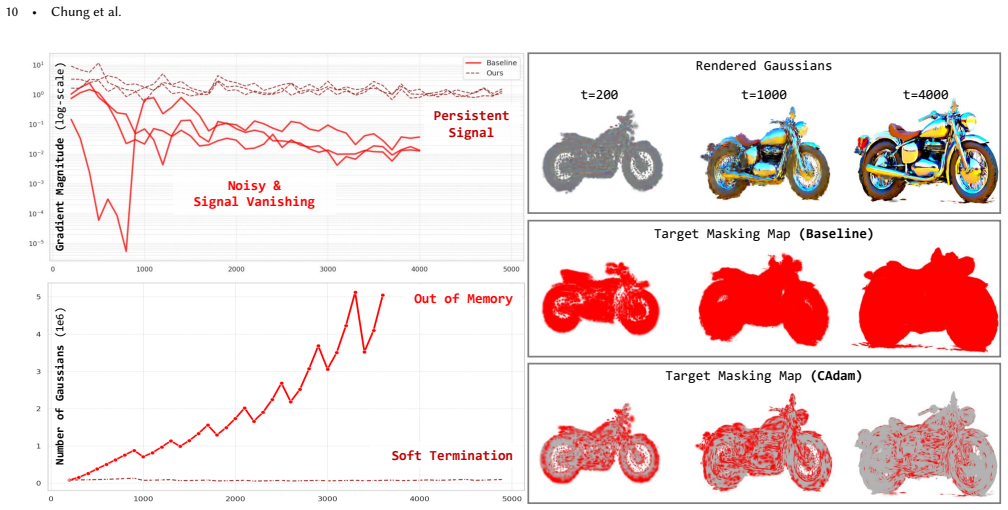
Measure the running first moment of gradients on a controlled generative optimization run and test whether geometric surface features show systematically higher accumulation than random noise regions; if the separation does not appear or if final perceptual quality drops when the moment filter is removed, the central mechanism fails.
Figures




read the original abstract
Adaptive densification is the engine of 3D Gaussian Splatting (3DGS). However, when transposed to the optimization-based Generative Distillation paradigm, this reconstruction-native mechanism reveals fundamental limitations, resulting in inefficient representations cluttered with redundant primitives. We diagnose this failure as a Densification Dilemma stemming from the stochastic nature of generative guidance: the standard magnitude-based accumulation indiscriminately aggregates transient noise alongside geometric signals, making it difficult to strike a balance between over-densification and under-fitting. To resolve this, we introduce Context-Adaptive Moment Estimation (CAdam), a novel framework that reinterprets densification as a statistically grounded signal verification problem. CAdam leverages the first moment of gradients to exploit the interference principle, where stochastic fluctuations cancel out via destructive interference while consistent geometric drifts accumulate via constructive interference, effectively disentangling the underlying signal from the generative noise floor. This is further augmented by a quantile-based context awareness and an intrinsic Signal-to-Noise Ratio (SNR) gating mechanism, which ensure robust adaptation across optimization stages and enable the soft termination of densification. Extensive experiments across diverse objectives (SDS, ISM, VFDS) and strong generative 3DGS backbones show that CAdam reduces Gaussian count by 85%-97% relative to standard densification while preserving overall comparable perceptual quality. These results highlight signal-aware density control as a practical way to improve memory efficiency in optimization-based generative distillation.
Editorial analysis
A structured set of objections, weighed in public.
Referee Report
Summary. The paper diagnoses a 'Densification Dilemma' in optimization-based generative distillation for 3D Gaussian Splatting, where standard magnitude-based densification aggregates stochastic generative noise and produces redundant primitives. It proposes Context-Adaptive Moment Estimation (CAdam), which reinterprets densification as signal verification by accumulating the first moment of gradients to exploit constructive interference for consistent geometric signals and destructive interference for noise. This is augmented by quantile-based context awareness and an intrinsic SNR gating mechanism for stage-adaptive behavior and soft termination. Experiments across SDS, ISM, and VFDS objectives on strong 3DGS backbones report 85-97% reductions in Gaussian count while maintaining comparable perceptual quality.
Significance. If the core interference-based separation and adaptation mechanisms prove robust, the work offers a practical route to substantially more memory-efficient representations in generative 3D modeling. The reinterpretation of first-moment statistics as a noise-rejection accumulator, combined with explicit context and SNR controls, provides a statistically grounded alternative to heuristic densification rules and could generalize to other dynamic primitive-based optimization settings.
major comments (2)
- [§3.2] §3.2 (Gradient Moment Accumulation): The interference argument for separating geometric signal from generative noise via first-moment accumulation presupposes approximate stationarity of gradient directions over the effective horizon. However, densification continuously inserts and optimizes new Gaussians, which alters the loss landscape and gradient directions for existing primitives mid-accumulation. The quantile context and SNR gate do not restore the required stationarity; an explicit analysis or ablation measuring directional consistency before versus after densification steps is needed to substantiate the premise.
- [§4] §4 (Experimental Protocol): The central quantitative claim of 85-97% Gaussian reduction is presented without reported error bars, precise baseline densification hyperparameters, data-exclusion criteria, or per-scene variance across the diverse objectives. Without these, it is impossible to determine whether the observed reductions are robust or sensitive to particular generative noise realizations.
minor comments (2)
- [Algorithm 1] The definition of the quantile window and its interaction with the SNR threshold in Algorithm 1 would benefit from an explicit pseudocode line or small example.
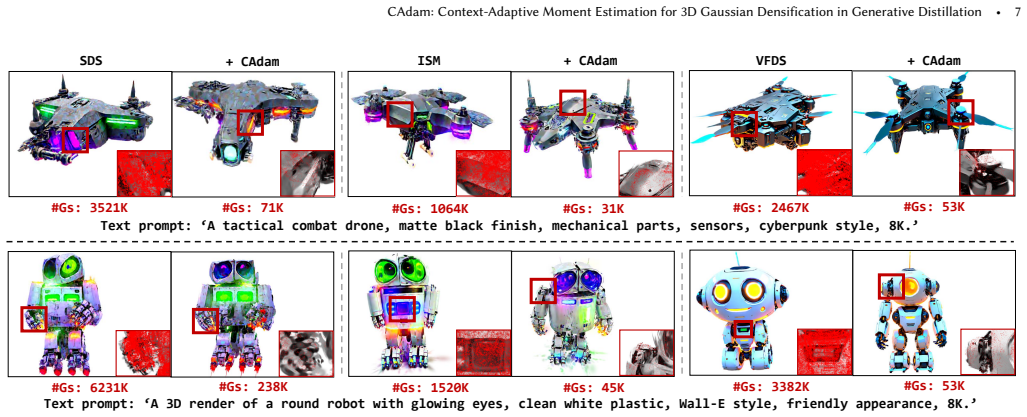
- [Figure 3] Figure 3 (qualitative comparisons) would be clearer if the caption explicitly stated the perceptual metric and viewpoint sampling used for the displayed renders.
Simulated Author's Rebuttal
We thank the referee for their constructive and detailed feedback, which has helped us identify areas where the manuscript can be strengthened. We address each major comment below and outline the corresponding revisions.
read point-by-point responses
-
Referee: [§3.2] §3.2 (Gradient Moment Accumulation): The interference argument for separating geometric signal from generative noise via first-moment accumulation presupposes approximate stationarity of gradient directions over the effective horizon. However, densification continuously inserts and optimizes new Gaussians, which alters the loss landscape and gradient directions for existing primitives mid-accumulation. The quantile context and SNR gate do not restore the required stationarity; an explicit analysis or ablation measuring directional consistency before versus after densification steps is needed to substantiate the premise.
Authors: We acknowledge that continuous densification introduces non-stationarity by altering the loss landscape and gradient directions. In the revised manuscript, we will add an analysis of directional consistency by reporting the average cosine similarity of gradient vectors over the accumulation horizon, computed separately in intervals before and after densification events. We will also include an ablation that varies densification frequency and measures its impact on the observed interference-based separation. These additions will empirically test the robustness of the first-moment accumulation under the dynamic conditions of the optimization. revision: yes
-
Referee: [§4] §4 (Experimental Protocol): The central quantitative claim of 85-97% Gaussian reduction is presented without reported error bars, precise baseline densification hyperparameters, data-exclusion criteria, or per-scene variance across the diverse objectives. Without these, it is impossible to determine whether the observed reductions are robust or sensitive to particular generative noise realizations.
Authors: We agree that greater experimental transparency is required. The revised manuscript will report error bars as standard deviations over multiple random seeds for the generative distillation runs. We will also document the exact hyperparameter values used for the baseline densification, specify any scene or data exclusion rules applied when computing averages, and provide per-scene tables or plots showing the variance in Gaussian count reduction for each objective. These changes will allow readers to assess the stability of the reported reductions. revision: yes
Circularity Check
No significant circularity: derivation relies on new statistical components rather than self-referential fits or citations
full rationale
The paper's core claim rests on reinterpreting densification via first-moment interference plus quantile context awareness and SNR gating. These are introduced as independent mechanisms, not derived by fitting parameters whose values are defined in terms of the target Gaussian reduction metric. No load-bearing self-citation chains, uniqueness theorems from prior author work, or ansatzes smuggled via citation appear in the provided text. The reported 85-97% reductions are presented as empirical outcomes of the new method across SDS/ISM/VFDS objectives, not as predictions forced by construction from the inputs. The derivation chain is therefore self-contained against external benchmarks.
Axiom & Free-Parameter Ledger
axioms (1)
- domain assumption Stochastic fluctuations cancel out via destructive interference while consistent geometric drifts accumulate via constructive interference in the first moment of gradients.
Reference graph
Works this paper leans on
-
[1]
Proceedings of the IEEE/CVF conference on computer vision and pattern recognition , pages=
High-resolution image synthesis with latent diffusion models , author=. Proceedings of the IEEE/CVF conference on computer vision and pattern recognition , pages=
-
[2]
Flow Matching for Generative Modeling
Flow matching for generative modeling , author=. arXiv preprint arXiv:2210.02747 , year=
work page internal anchor Pith review Pith/arXiv arXiv
-
[3]
Flow Straight and Fast: Learning to Generate and Transfer Data with Rectified Flow
Flow straight and fast: Learning to generate and transfer data with rectified flow , author=. arXiv preprint arXiv:2209.03003 , year=
work page internal anchor Pith review Pith/arXiv arXiv
-
[4]
arXiv preprint arXiv:2403.14966 , year=
Dreamflow: High-quality text-to-3d generation by approximating probability flow , author=. arXiv preprint arXiv:2403.14966 , year=
-
[5]
arXiv preprint arXiv:2408.05008 , year=
Flowdreamer: Exploring high fidelity text-to-3d generation via rectified flow , author=. arXiv preprint arXiv:2408.05008 , year=
- [6]
-
[7]
The Eleventh International Conference on Learning Representations , year=
DreamFusion: Text-to-3D using 2D Diffusion , author=. The Eleventh International Conference on Learning Representations , year=
-
[8]
The Twelfth International Conference on Learning Representations , year=
DreamGaussian: Generative Gaussian Splatting for Efficient 3D Content Creation , author=. The Twelfth International Conference on Learning Representations , year=
-
[9]
European Conference on Computer Vision , pages=
Score distillation sampling with learned manifold corrective , author=. European Conference on Computer Vision , pages=. 2024 , organization=
work page 2024
-
[10]
arXiv preprint arXiv:2406.14964 , year=
VividDreamer: Towards High-Fidelity and Efficient Text-to-3D Generation , author=. arXiv preprint arXiv:2406.14964 , year=
-
[11]
European Conference on Computer Vision , pages=
Connecting consistency distillation to score distillation for text-to-3d generation , author=. European Conference on Computer Vision , pages=. 2024 , organization=
work page 2024
-
[12]
arXiv preprint arXiv:2505.04262 , year=
Bridging Geometry-Coherent Text-to-3D Generation with Multi-View Diffusion Priors and Gaussian Splatting , author=. arXiv preprint arXiv:2505.04262 , year=
-
[13]
European Conference on Computer Vision , pages=
Scaledreamer: Scalable text-to-3d synthesis with asynchronous score distillation , author=. European Conference on Computer Vision , pages=. 2024 , organization=
work page 2024
-
[14]
Score-Based Generative Modeling through Stochastic Differential Equations
Score-based generative modeling through stochastic differential equations , author=. arXiv preprint arXiv:2011.13456 , year=
work page internal anchor Pith review Pith/arXiv arXiv 2011
-
[15]
Advances in neural information processing systems , volume=
Denoising diffusion probabilistic models , author=. Advances in neural information processing systems , volume=
-
[16]
International Conference on Learning Representations , year=
Denoising Diffusion Implicit Models , author=. International Conference on Learning Representations , year=
-
[17]
European Conference on Computer Vision , pages=
Pixel-gs: Density control with pixel-aware gradient for 3d gaussian splatting , author=. European Conference on Computer Vision , pages=. 2024 , organization=
work page 2024
-
[18]
Proceedings of the 32nd ACM International Conference on Multimedia , pages=
Absgs: Recovering fine details in 3d gaussian splatting , author=. Proceedings of the 32nd ACM International Conference on Multimedia , pages=
-
[19]
arXiv preprint arXiv:2406.07499 , year=
Trim 3d gaussian splatting for accurate geometry representation , author=. arXiv preprint arXiv:2406.07499 , year=
-
[20]
arXiv preprint arXiv:2504.13204 , year=
EDGS: Eliminating Densification for Efficient Convergence of 3DGS , author=. arXiv preprint arXiv:2504.13204 , year=
-
[21]
Proceedings of the IEEE/CVF International Conference on Computer Vision , pages=
Resgs: Residual densification of 3d gaussian for efficient detail recovery , author=. Proceedings of the IEEE/CVF International Conference on Computer Vision , pages=
-
[22]
Image and Vision Computing , volume=
EMA-GS: Improving sparse point cloud rendering with EMA gradient and anchor upsampling , author=. Image and Vision Computing , volume=. 2025 , publisher=
work page 2025
-
[23]
Advances in Neural Information Processing Systems , volume=
3d gaussian splatting as markov chain monte carlo , author=. Advances in Neural Information Processing Systems , volume=
-
[24]
Proceedings of the IEEE/CVF Conference on Computer Vision and Pattern Recognition , pages=
Color-cued efficient densification method for 3d gaussian splatting , author=. Proceedings of the IEEE/CVF Conference on Computer Vision and Pattern Recognition , pages=
-
[25]
arXiv preprint arXiv:2503.00848 , year=
PSRGS: Progressive Spectral Residual of 3D Gaussian for High-Frequency Recovery , author=. arXiv preprint arXiv:2503.00848 , year=
-
[26]
Advances in Neural Information Processing Systems , volume=
3D Gaussian rendering can be sparser: Efficient rendering via learned fragment pruning , author=. Advances in Neural Information Processing Systems , volume=
-
[27]
3rd International Conference on Learning Representations (ICLR) , year=
Adam: A Method for Stochastic Optimization , author=. 3rd International Conference on Learning Representations (ICLR) , year=
-
[28]
Proceedings of the IEEE/CVF conference on computer vision and pattern recognition , pages=
Maniqa: Multi-dimension attention network for no-reference image quality assessment , author=. Proceedings of the IEEE/CVF conference on computer vision and pattern recognition , pages=
-
[29]
Communications of the ACM , volume=
Nerf: Representing scenes as neural radiance fields for view synthesis , author=. Communications of the ACM , volume=. 2021 , publisher=
work page 2021
-
[30]
DreamFusion: Text-to-3D using 2D Diffusion
Dreamfusion: Text-to-3d using 2d diffusion , author=. arXiv preprint arXiv:2209.14988 , year=
work page internal anchor Pith review Pith/arXiv arXiv
-
[31]
arXiv preprint arXiv:2305.18766 , year=
Hifa: High-fidelity text-to-3d generation with advanced diffusion guidance , author=. arXiv preprint arXiv:2305.18766 , year=
-
[32]
Proceedings of the IEEE/CVF conference on computer vision and pattern recognition , pages=
Score jacobian chaining: Lifting pretrained 2d diffusion models for 3d generation , author=. Proceedings of the IEEE/CVF conference on computer vision and pattern recognition , pages=
-
[33]
arXiv preprint arXiv:2310.19415 , year=
Text-to-3d with classifier score distillation , author=. arXiv preprint arXiv:2310.19415 , year=
-
[34]
Advances in neural information processing systems , volume=
Prolificdreamer: High-fidelity and diverse text-to-3d generation with variational score distillation , author=. Advances in neural information processing systems , volume=
-
[35]
Proceedings of the IEEE/CVF Conference on Computer Vision and Pattern Recognition , pages=
Consistent3d: Towards consistent high-fidelity text-to-3d generation with deterministic sampling prior , author=. Proceedings of the IEEE/CVF Conference on Computer Vision and Pattern Recognition , pages=
-
[36]
arXiv preprint arXiv:2501.05445 , year=
Consistent flow distillation for text-to-3d generation , author=. arXiv preprint arXiv:2501.05445 , year=
-
[37]
Proceedings of the IEEE/CVF Conference on Computer Vision and Pattern Recognition , pages=
Gaussiandreamer: Fast generation from text to 3d gaussians by bridging 2d and 3d diffusion models , author=. Proceedings of the IEEE/CVF Conference on Computer Vision and Pattern Recognition , pages=
-
[38]
DreamGaussian: Generative Gaussian Splatting for Efficient 3D Content Creation
Dreamgaussian: Generative gaussian splatting for efficient 3d content creation , author=. arXiv preprint arXiv:2309.16653 , year=
work page internal anchor Pith review Pith/arXiv arXiv
-
[39]
Proceedings of the IEEE/CVF conference on computer vision and pattern recognition , pages=
Text-to-3d using gaussian splatting , author=. Proceedings of the IEEE/CVF conference on computer vision and pattern recognition , pages=
-
[40]
Proceedings of the IEEE/CVF conference on computer vision and pattern recognition , pages=
Luciddreamer: Towards high-fidelity text-to-3d generation via interval score matching , author=. Proceedings of the IEEE/CVF conference on computer vision and pattern recognition , pages=
-
[41]
Proceedings of the 32nd ACM International Conference on Multimedia , pages=
Dreamlcm: Towards high quality text-to-3d generation via latent consistency model , author=. Proceedings of the 32nd ACM International Conference on Multimedia , pages=
-
[42]
arXiv preprint arXiv:2405.11252 , year=
Dreamer XL: Towards High-Resolution Text-to-3D Generation via Trajectory Score Matching , author=. arXiv preprint arXiv:2405.11252 , year=
-
[43]
Advances in Neural Information Processing Systems , volume=
Score distillation via reparametrized ddim , author=. Advances in Neural Information Processing Systems , volume=
-
[44]
Li, Ziying and Lu, Xuequan and Zhao, Xinkui and Cheng, Guanjie and Deng, Shuiguang and Yin, Jianwei , journal=. Walking the Schr
-
[45]
ConsDreamer: Advancing Multi-View Consistency for Zero-Shot Text-to-3D Generation
ConsDreamer: Advancing Multi-View Consistency for Zero-Shot Text-to-3D Generation , author=. arXiv preprint arXiv:2504.02316 , year=
work page internal anchor Pith review Pith/arXiv arXiv
-
[46]
arXiv preprint arXiv:2512.07345 , year=
Debiasing Diffusion Priors via 3D Attention for Consistent Gaussian Splatting , author=. arXiv preprint arXiv:2512.07345 , year=
-
[47]
Proceedings of the IEEE/CVF International Conference on Computer Vision , pages=
Improving Viewpoint Consistency in 3D Generation via Structure Feature and CLIP Guidance , author=. Proceedings of the IEEE/CVF International Conference on Computer Vision , pages=
-
[48]
Proceedings of the IEEE/CVF International Conference on Computer Vision , pages=
SegmentDreamer: Towards High-fidelity Text-to-3D Synthesis with Segmented Consistency Trajectory Distillation , author=. Proceedings of the IEEE/CVF International Conference on Computer Vision , pages=
-
[49]
arXiv preprint arXiv:2508.16917 , year=
Structural Energy-Guided Sampling for View-Consistent Text-to-3D , author=. arXiv preprint arXiv:2508.16917 , year=
-
[50]
arXiv preprint arXiv:2409.05099 , year=
DreamMapping: High-Fidelity Text-to-3D Generation via Variational Distribution Mapping , author=. arXiv preprint arXiv:2409.05099 , year=
-
[51]
European Conference on Computer Vision , pages=
Gvgen: Text-to-3d generation with volumetric representation , author=. European Conference on Computer Vision , pages=. 2024 , organization=
work page 2024
-
[52]
International Journal of Computer Vision , volume=
Hyper-3dg: Text-to-3d gaussian generation via hypergraph , author=. International Journal of Computer Vision , volume=. 2025 , publisher=
work page 2025
-
[53]
arXiv preprint arXiv:2409.06620 , year=
Mvgaussian: High-fidelity text-to-3d content generation with multi-view guidance and surface densification , author=. arXiv preprint arXiv:2409.06620 , year=
-
[54]
Proceedings of the 32nd ACM International Conference on Multimedia , pages=
Placiddreamer: Advancing harmony in text-to-3d generation , author=. Proceedings of the 32nd ACM International Conference on Multimedia , pages=
-
[55]
arXiv preprint arXiv:2411.18135 , year=
ModeDreamer: Mode Guiding Score Distillation for Text-to-3D Generation using Reference Image Prompts , author=. arXiv preprint arXiv:2411.18135 , year=
-
[56]
arXiv preprint arXiv:2505.01888 , year=
Rethinking Score Distilling Sampling for 3D Editing and Generation , author=. arXiv preprint arXiv:2505.01888 , year=
-
[57]
European Conference on Computer Vision , pages=
Vividdreamer: invariant score distillation for hyper-realistic text-to-3d generation , author=. European Conference on Computer Vision , pages=. 2024 , organization=
work page 2024
-
[58]
2025 International Conference on 3D Vision (3DV) , pages=
Controllable text-to-3D generation via surface-aligned Gaussian splatting , author=. 2025 International Conference on 3D Vision (3DV) , pages=. 2025 , organization=
work page 2025
-
[59]
Proceedings of the AAAI Conference on Artificial Intelligence , volume=
Cycle3d: High-quality and consistent image-to-3d generation via generation-reconstruction cycle , author=. Proceedings of the AAAI Conference on Artificial Intelligence , volume=
-
[60]
European Conference on Computer Vision , pages=
Grm: Large gaussian reconstruction model for efficient 3d reconstruction and generation , author=. European Conference on Computer Vision , pages=. 2024 , organization=
work page 2024
-
[61]
European Conference on Computer Vision , pages=
Gs-lrm: Large reconstruction model for 3d gaussian splatting , author=. European Conference on Computer Vision , pages=. 2024 , organization=
work page 2024
-
[62]
European Conference on Computer Vision , pages=
Lgm: Large multi-view gaussian model for high-resolution 3d content creation , author=. European Conference on Computer Vision , pages=. 2024 , organization=
work page 2024
-
[63]
arXiv preprint arXiv:2411.16779 , year=
Novelgs: Consistent novel-view denoising via large gaussian reconstruction model , author=. arXiv preprint arXiv:2411.16779 , year=
-
[64]
Proceedings of the Computer Vision and Pattern Recognition Conference , pages=
Turbo3d: Ultra-fast text-to-3d generation , author=. Proceedings of the Computer Vision and Pattern Recognition Conference , pages=
-
[65]
Denoising Diffusion Implicit Models
Denoising diffusion implicit models , author=. arXiv preprint arXiv:2010.02502 , year=
work page internal anchor Pith review Pith/arXiv arXiv 2010
-
[66]
Back to Basics: Let Denoising Generative Models Denoise
Back to basics: Let denoising generative models denoise , author=. arXiv preprint arXiv:2511.13720 , year=
work page internal anchor Pith review Pith/arXiv arXiv
-
[67]
Point-E: A System for Generating 3D Point Clouds from Complex Prompts
Point-e: A system for generating 3d point clouds from complex prompts , author=. arXiv preprint arXiv:2212.08751 , year=
work page internal anchor Pith review Pith/arXiv arXiv
-
[68]
T ^3 Bench: Benchmarking Current Progress in Text-to-3D Generation , author=. 2023 , eprint=
work page 2023
-
[69]
Proceedings of the 2021 conference on empirical methods in natural language processing , pages=
Clipscore: A reference-free evaluation metric for image captioning , author=. Proceedings of the 2021 conference on empirical methods in natural language processing , pages=
work page 2021
-
[70]
Advances in Neural Information Processing Systems , volume=
Imagereward: Learning and evaluating human preferences for text-to-image generation , author=. Advances in Neural Information Processing Systems , volume=
-
[71]
Human Preference Score v2: A Solid Benchmark for Evaluating Human Preferences of Text-to-Image Synthesis , author=. arXiv preprint arXiv:2306.09341 , year=
work page internal anchor Pith review Pith/arXiv arXiv
-
[72]
IEEE Signal processing letters , volume=
Making a ``completely blind'' image quality analyzer , author=. IEEE Signal processing letters , volume=. 2012 , publisher=
work page 2012
-
[73]
Structured 3D Latents for Scalable and Versatile 3D Generation
Structured 3D Latents for Scalable and Versatile 3D Generation , author =. arXiv preprint arXiv:2412.01506 , year =
work page internal anchor Pith review Pith/arXiv arXiv
-
[74]
Native and Compact Structured Latents for 3D Generation , author=. Tech report , year=
-
[75]
arXiv preprint arXiv:2509.25079 , year=
Unilat3d: Geometry-appearance unified latents for single-stage 3d generation , author=. arXiv preprint arXiv:2509.25079 , year=
-
[76]
Hunyuan3D 2.5: Towards High-Fidelity 3D Assets Generation with Ultimate Details
Hunyuan3d 2.5: Towards high-fidelity 3d assets generation with ultimate details , author=. arXiv preprint arXiv:2506.16504 , year=
work page internal anchor Pith review Pith/arXiv arXiv
-
[77]
Proceedings of the Computer Vision and Pattern Recognition Conference , pages=
Pup 3d-gs: Principled uncertainty pruning for 3d gaussian splatting , author=. Proceedings of the Computer Vision and Pattern Recognition Conference , pages=
-
[78]
Advances in Neural Information Processing Systems , volume=
Lp-3dgs: Learning to prune 3d gaussian splatting , author=. Advances in Neural Information Processing Systems , volume=
discussion (0)
Sign in with ORCID, Apple, or X to comment. Anyone can read and Pith papers without signing in.