Privacy-Preserving Distributed Optimization Under Time Constraints Using Secure Multi-Party Computation and Evolutionary Algorithms
Pith reviewed 2026-05-21 02:09 UTC · model grok-4.3
The pith
Evolutionary algorithms combined with secure multi-party computation allow privacy-preserving optimization to finish within strict deadlines.
A machine-rendered reading of the paper's core claim, the machinery that carries it, and where it could break.
Core claim
By restricting expensive MPC operations to a small number of fitness evaluations inside an evolutionary search loop, the combined method reduces privacy-related runtime overhead enough that a solution can still be returned before the given time bound expires. Obfuscation of the evaluation outcomes provides extra input protection at the cost of some solution quality.
What carries the argument
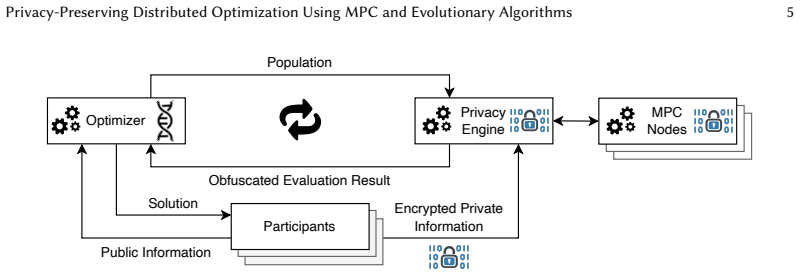
A hybrid loop that runs evolutionary search to propose candidates and invokes MPC only for their fitness evaluation, with optional result obfuscation.
If this is right
- Time-critical privacy-preserving optimization becomes feasible for assignment and traveling-salesperson problems using genetic algorithms or NSGA-II.
- The number of secure evaluations can be controlled by population size and generation count to respect the time bound.
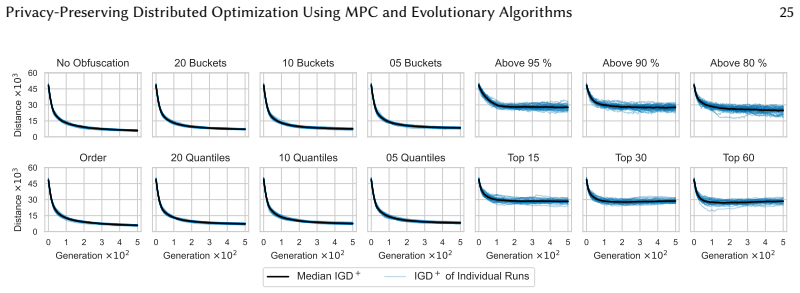
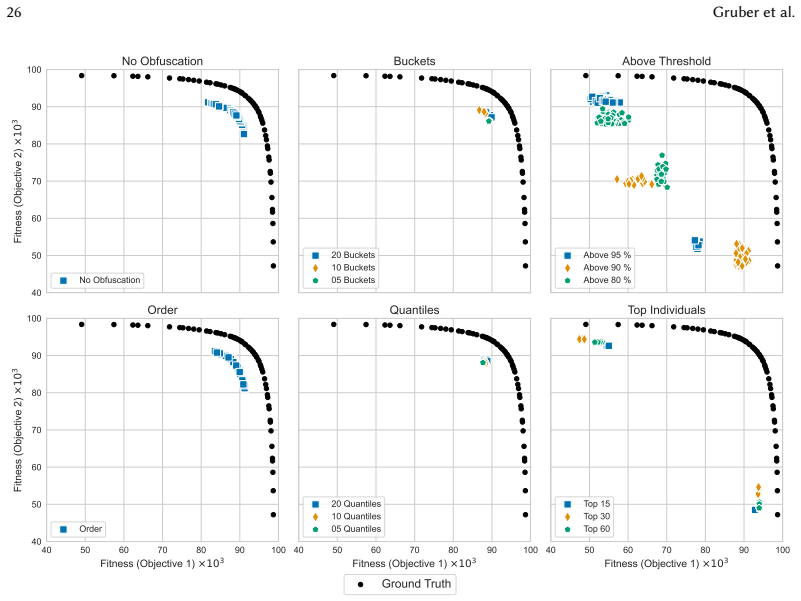
- Obfuscation strength can be tuned to trade input protection against solution quality in both single- and multi-objective cases.
Where Pith is reading between the lines
- The same selective-MPC pattern could be tested on other evolutionary or swarm methods that already keep evaluation budgets low.
- In practice the approach would require an early-stopping rule that aborts further MPC calls once the remaining time is insufficient.
- Extending the method to dynamic or streaming problems would need a way to reuse prior MPC results across changing time windows.
Load-bearing premise
The evolutionary algorithm needs so few MPC fitness evaluations that the total time, including communication and any obfuscation, still stays inside the deadline.
What would settle it
A run on a concrete problem instance and deadline where the measured wall-clock time for the required MPC evaluations plus overhead exceeds the allowed limit.
Figures



read the original abstract
In distributed optimization, multiple parties collaborate to find an optimal solution to a problem. Privacy-preserving distributed optimization uses techniques, such as secure multi-party computation (MPC), to protect the private inputs of each party. In time-critical settings, the runtime overhead introduced by privacy-preserving computations may prevent the optimization from finishing within the deadline. This paper presents an approach for privacy-preserving distributed optimization in time-critical settings that combines evolutionary algorithms for solution search and MPC for the evaluation of solutions. The approach reduces the impact of privacy-preserving computations on runtime and allows to return solution within the deadline. Obfuscation of evaluation results provides additional protection for private inputs from an honest-but-curious platform provider, but introduces a potential trade-off between protection and solution quality. This trade-off is investigated in experiments using a genetic algorithm for both the single-objective assignment problem and the traveling salesperson problem, as well as NSGA-II for the multi-objective assignment problem.
Editorial analysis
A structured set of objections, weighed in public.
Referee Report
Summary. The manuscript proposes combining evolutionary algorithms (genetic algorithms and NSGA-II) with secure multi-party computation (MPC) for fitness evaluation to perform privacy-preserving distributed optimization under hard time deadlines. The core idea is that selective use of MPC plus result obfuscation reduces privacy overhead enough to meet deadlines on assignment and TSP instances, while the obfuscation introduces an explicit quality-protection trade-off that is examined empirically.
Significance. If the reported timing results on small instances hold under the stated conditions, the work supplies a practical engineering bridge between evolutionary search and MPC that addresses a real deployment constraint (hard deadlines) not typically handled by either field alone. The explicit treatment of the obfuscation trade-off and the use of both single- and multi-objective EAs are positive features.
major comments (2)
- [Experiments] Experiments section: the central claim that the method 'reduces the impact of privacy-preserving computations on runtime and allows to return solution within the deadline' is supported only by observed timing on small assignment and TSP instances; no analytical bound or worst-case argument is given showing that the number of MPC evaluations stays inside the deadline once communication and obfuscation costs are included for larger problem sizes.
- [Approach / Experiments] The manuscript treats the number of generations and per-evaluation MPC cost as observed quantities rather than deriving or bounding them; this makes the 'fits inside the deadline' claim instance-specific and limits the strength of the general contribution.
minor comments (2)
- [Abstract] The abstract states that 'a quality-protection trade-off was observed' yet supplies no quantitative metrics, error bars, or baseline comparisons; these should be added to the abstract or a summary table for clarity.
- [Approach] Notation for the obfuscation parameter and its effect on solution quality should be introduced once and used consistently across the approach and experimental sections.
Simulated Author's Rebuttal
We thank the referee for the constructive comments and the recommendation of minor revision. We address each major comment below.
read point-by-point responses
-
Referee: [Experiments] Experiments section: the central claim that the method 'reduces the impact of privacy-preserving computations on runtime and allows to return solution within the deadline' is supported only by observed timing on small assignment and TSP instances; no analytical bound or worst-case argument is given showing that the number of MPC evaluations stays inside the deadline once communication and obfuscation costs are included for larger problem sizes.
Authors: We agree that the reported results are based on timing observations for small instances and that no analytical bounds or worst-case arguments are provided for larger sizes that incorporate communication and obfuscation overhead. The manuscript positions the work as a practical engineering approach demonstrated empirically on the tested problems rather than a theoretical guarantee. In revision we will add a dedicated limitations paragraph in the Discussion section that explicitly notes the instance-specific nature of the timing results and the lack of scalability bounds. revision: yes
-
Referee: [Approach / Experiments] The manuscript treats the number of generations and per-evaluation MPC cost as observed quantities rather than deriving or bounding them; this makes the 'fits inside the deadline' claim instance-specific and limits the strength of the general contribution.
Authors: The number of generations is governed by the evolutionary algorithm's convergence behavior and stopping criteria as observed in the experiments, while per-evaluation MPC costs are measured from the concrete implementation. We do not derive closed-form bounds because the contribution centers on a deployable combination that meets deadlines under realistic time constraints rather than on asymptotic analysis. We will revise the text to state the empirical basis more clearly and to qualify the generalizability of the deadline-satisfaction claim. revision: yes
Circularity Check
No significant circularity detected
full rationale
The paper describes an engineering approach that combines evolutionary algorithms (GA and NSGA-II) with MPC-based fitness evaluation and result obfuscation to meet time deadlines in privacy-preserving distributed optimization. All performance claims rest on empirical timing measurements from concrete experiments on small assignment and TSP instances; no mathematical derivation chain, fitted parameters presented as predictions, or self-citation load-bearing steps appear in the manuscript. The central argument is therefore self-contained against external benchmarks and does not reduce to its own inputs by construction.
Axiom & Free-Parameter Ledger
Lean theorems connected to this paper
-
IndisputableMonolith/Cost/FunctionalEquation.leanwashburn_uniqueness_aczel unclear?
unclearRelation between the paper passage and the cited Recognition theorem.
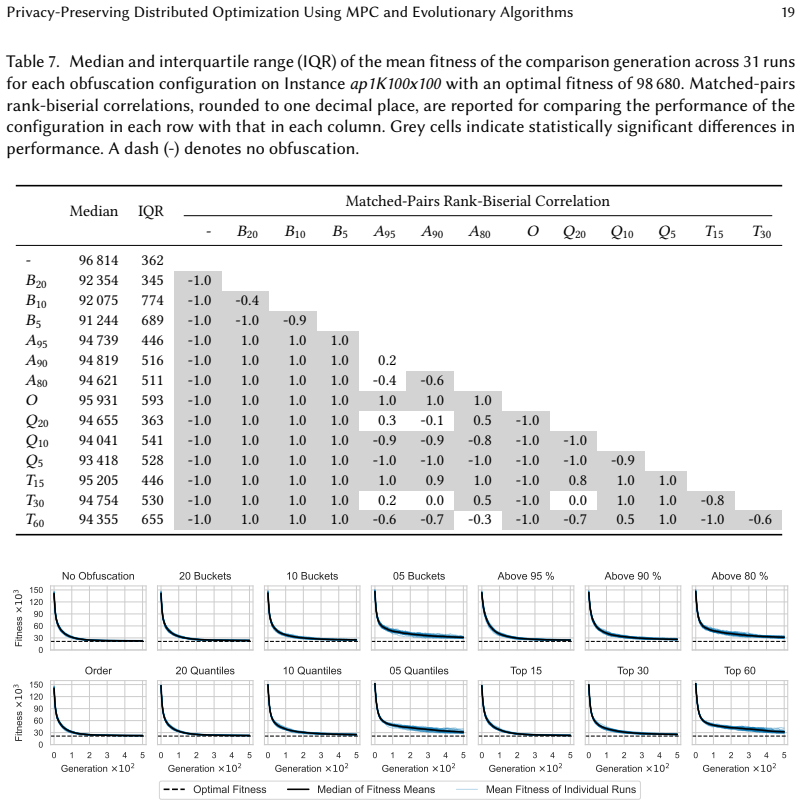
combines evolutionary algorithms for solution search and MPC for the evaluation of solutions... obfuscation methods (Order, Order Quantiles, Fitness Buckets, Top Individuals, Above Threshold)
-
IndisputableMonolith/Foundation/ArithmeticFromLogic.leanLogicNat recovery unclear?
unclearRelation between the paper passage and the cited Recognition theorem.
time budget... 135.27 seconds... comparison generations
What do these tags mean?
- matches
- The paper's claim is directly supported by a theorem in the formal canon.
- supports
- The theorem supports part of the paper's argument, but the paper may add assumptions or extra steps.
- extends
- The paper goes beyond the formal theorem; the theorem is a base layer rather than the whole result.
- uses
- The paper appears to rely on the theorem as machinery.
- contradicts
- The paper's claim conflicts with a theorem or certificate in the canon.
- unclear
- Pith found a possible connection, but the passage is too broad, indirect, or ambiguous to say the theorem truly supports the claim.
Reference graph
Works this paper leans on
-
[1]
Optuna: A Next-generation Hyperparameter Optimization Framework. InProceedings of the 25th ACM SIGKDD International Conference on Knowledge Discovery & Data Mining(Anchorage, AK, USA)(KDD ’19). Association for Computing Machinery, New York, NY, USA, 2623–2631. doi:10.1145/3292500.3330701 Toshinori Araki, Jun Furukawa, Yehuda Lindell, Ariel Nof, and Kazuma Ohara
-
[2]
High-Throughput Semi-Honest Secure Three-Party Computation with an Honest Majority. InProceedings of the 2016 ACM SIGSAC Conference on Computer Privacy-Preserving Distributed Optimization Using MPC and Evolutionary Algorithms 29 and Communications Security(Vienna, Austria)(CCS ’16). Association for Computing Machinery, New York, NY, USA, 805–817. doi:10.1...
-
[3]
A fast and elitist multiobjective genetic algorithm: NSGA-II.IEEE Trans. Evol. Comput.6, 2 (2002), 182–197. doi:10.1109/4235.996017 Matthias Ehrgott. 2005.Multicriteria optimization(2 ed.). Springer. doi:10.1007/3-540-27659-9 A. E. Eiben and J. E. Smith. 2015.Representation, Mutation, and Recombination. Springer Berlin Heidelberg, Berlin, Heidelberg, 49–7...
-
[4]
Privacy-Preserving Multi-Objective Evolutionary Algorithms. InParallel Problem Solving from Nature, PPSN XI, Robert Schaefer, Carlos Cotta, Joanna Kołodziej, and Günter Rudolph (Eds.). Springer Berlin Heidelberg, Berlin, Heidelberg, 41–50. doi:10.1007/978-3-642-15871-1_5 Sebastian Gruber, Paul Feichtenschlager, and Christoph G. Schuetz
-
[5]
Using Genetic Algorithms for Privacy-Preserving Optimization of Multi-Objective Assignment Problems in Time-Critical Settings: An Application in Air Traffic Flow Management. InProceedings of the Genetic and Evolutionary Computation Conference(Melbourne, VIC, Australia)(GECCO ’24). Association for Computing Machinery, New York, NY, USA, 1246–1254. doi:10.1...
-
[6]
InData Warehousing and Knowledge Discovery, Il Yeal Song, Johann Eder, and Tho Manh Nguyen (Eds.)
Privacy-Preserving Genetic Algorithms for Rule Discovery. InData Warehousing and Knowledge Discovery, Il Yeal Song, Johann Eder, and Tho Manh Nguyen (Eds.). Springer Berlin Heidelberg, Berlin, Heidelberg, 407–417. doi:10.1007/978-3-540-74553-2_38 Hisao Ishibuchi, Hiroyuki Masuda, Yuki Tanigaki, and Yusuke Nojima
-
[7]
J., 2022, in Bambi C., Santangelo A., eds, , Handbook of X-ray and Gamma-ray Astrophysics
Modified Distance Calculation in Generational Distance and Inverted Generational Distance. InEvolutionary Multi-Criterion Optimization, António Gaspar-Cunha, Carlos Henggeler Antunes, and Carlos Coello Coello (Eds.). Springer International Publishing, Cham, 110–125. doi:10.1007/978- 3-319-15892-1_8 Leqi Jiang and Zhangjie Fu
-
[8]
Privacy-preserving genetic algorithm outsourcing in cloud computing.Journal of Cybersecurity2, 1 (2020),
work page 2020
-
[9]
In: Proceedings of the 2020 ACM SIGSAC Conference on Computer and Commu- nications Security
MP-SPDZ: A Versatile Framework for Multi-Party Computation. InProceedings of the 2020 ACM SIGSAC Conference on Computer and Communications Security(Virtual Event, USA)(CCS ’20). Association for Computing Machinery, New York, NY, USA, 1575–1590. doi:10.1145/3372297.3417872 Dave S. Kerby
-
[10]
The Simple Difference Formula: An Approach to Teaching Nonparametric Correlation1.Comprehensive Psychology3 (2014), 11.IT.3.1. doi:10.2466/11.IT.3.1 Rudolf Kruse, Sanaz Mostaghim, Christian Borgelt, Christian Braune, and Matthias Steinbrecher. 2022.Elements of Evolu- tionary Algorithms. Springer International Publishing, Cham, 255–285. doi:10.1007/978-3-0...
-
[11]
A Secure Federated Data-Driven Evolutionary Multi-Objective Optimization Algorithm.IEEE Trans. Emerg. Top. Comput. Intell.8, 1 (2024), 191–205. doi:10.1109/TETCI.2023.3313555 Manuel López-Ibáñez, Jürgen Branke, and Luís Paquete
-
[12]
Reproducibility in Evolutionary Computation.ACM Trans. Evol. Learn. Optim.1, 4 (2021), 14:1–14:21. doi:10.1145/3466624 Thomas Loruenser, Florian Wohner, and Stephan Krenn
-
[13]
InProceedings of the 2022 on Cloud Computing Security Workshop(Los Angeles, CA, USA)(CCSW’22)
A Verifiable Multiparty Computation Solver for the Linear Assignment Problem: And Applications to Air Traffic Management. InProceedings of the 2022 on Cloud Computing Security Workshop(Los Angeles, CA, USA)(CCSW’22). Association for Computing Machinery, New York, NY, USA, 41–51. doi:10.1145/3560810.3564263 Yang Lu and Minghui Zhu
-
[14]
doi:10.1016/j.automatica.2018.07.005 Tulika Mitra, Jürgen Teich, and Lothar Thiele
Privacy preserving distributed optimization using homomorphic encryption.Automatica 96 (2018), 314–325. doi:10.1016/j.automatica.2018.07.005 Tulika Mitra, Jürgen Teich, and Lothar Thiele
-
[15]
Time-Critical Systems Design: A Survey.IEEE Design & Test35, 2 (2018), 8–26. doi:10.1109/MDAT.2018.2794204 Nadine Pilon, Laurent Guichard, Zoltan Bazso, Giuseppe Murgese, and Marie Carré
-
[16]
doi:10.1016/j.jairtraman.2021.102124 Gerhard Reinelt
User-Driven Prioritisation Process (UDPP) from advanced experimental to pre-operational validation environment.Journal of Air Transport Management97 (2021), 102124. doi:10.1016/j.jairtraman.2021.102124 Gerhard Reinelt
-
[17]
Jun Sakuma and Shigenobu Kobayashi
TSPLIB—A traveling salesman problem library.ORSA journal on computing3, 4 (1991), 376–384. Jun Sakuma and Shigenobu Kobayashi
work page 1991
-
[18]
A genetic algorithm for privacy preserving combinatorial optimization. In Proceedings of the 9th Annual Conference on Genetic and Evolutionary Computation(London, England)(GECCO ’07). Association for Computing Machinery, New York, NY, USA, 1372–1379. doi:10.1145/1276958.1277214 30 Gruber et al. Christoph G. Schuetz, Thomas Lorünser, Samuel Jaburek, Kevin ...
-
[19]
InCooperative Information Systems, Mohamed Sellami, Paolo Ceravolo, Hajo A
A Distributed Architecture for Privacy-Preserving Optimization Using Genetic Algorithms and Multi-party Computation. InCooperative Information Systems, Mohamed Sellami, Paolo Ceravolo, Hajo A. Reijers, Walid Gaaloul, and Hervé Panetto (Eds.). Springer International Publishing, Cham, 168–185. doi:10.1007/978-3-031-17834-4_10 Kevin Schuetz, Christoph G. Sch...
-
[20]
In2023 IEEE Congress on Evolutionary Computation (CEC)
Privacy-Preserving Implementation of Local Search Algorithms for Collaboratively Solving Assignment Problems in Time-Critical Contexts. In2023 IEEE Congress on Evolutionary Computation (CEC). 1–10. doi:10.1109/CEC53210.2023.10253978 Zeneng She, Wenjian Luo, Yatong Chang, Zhen Song, and Yuhui Shi
-
[21]
InAdvances in Swarm Intelligence, Ying Tan, Yuhui Shi, and Wenjian Luo (Eds.)
On the Privacy Issue of Evolutionary Biparty Multiobjective Optimization. InAdvances in Swarm Intelligence, Ying Tan, Yuhui Shi, and Wenjian Luo (Eds.). Springer Nature Switzerland, Cham, 371–382. doi:10.1007/978-3-031-36622-2_30 Kang G. Shin and Parameswaran Ramanathan
-
[22]
Real-time computing: a new discipline of computer science and engineering.Proc. IEEE82, 1 (1994), 6–24. doi:10.1109/5.259423 Bing Sun, Jian-Yu Li, Xiao-Fang Liu, Qiang Yang, Zhi-Hui Zhan, and Jun Zhang
-
[23]
A Privacy-Preserving Evolutionary Computation Framework for Feature Selection. InWeb Information Systems Engineering – WISE 2023, Feng Zhang, Hua Wang, Mahmoud Barhamgi, Lu Chen, and Rui Zhou (Eds.). Springer Nature Singapore, Singapore, 260–274. doi:10.1007/ 978-981-99-7254-8_20 Florian Wohner and Thomas Loruenser. 2026.Privacy Engine. AIT Austrian Insti...
work page 2023
-
[24]
A survey of distributed optimization.Annu. Rev. Control.47 (2019), 278–305. doi:10.1016/J.ARCONTROL. 2019.05.006 Xun Yi, Russell Paulet, and Elisa Bertino. 2014.Homomorphic Encryption and Applications. Springer. doi:10.1007/978-3-319- 12229-8 Zhi-Hui Zhan, Sheng-Hao Wu, and Jun Zhang
-
[25]
In2021 13th International Conference on Advanced Computational Intelligence (ICACI)
A New Evolutionary Computation Framework for Privacy-Preserving Optimization. In2021 13th International Conference on Advanced Computational Intelligence (ICACI). 220–226. doi:10. 1109/ICACI52617.2021.9435860 Bowen Zhao, Wei-Neng Chen, Feng-Feng Wei, Ximeng Liu, Qingqi Pei, and Jun Zhang
-
[26]
Cybern.54, 6 (2024), 3638–3651
PEGA: A Privacy-Preserving Genetic Algorithm for Combinatorial Optimization.IEEE Trans. Cybern.54, 6 (2024), 3638–3651. doi:10.1109/TCYB.2023. 3346863
discussion (0)
Sign in with ORCID, Apple, or X to comment. Anyone can read and Pith papers without signing in.