Boundaries of Siegel Disks for Conservative Systems
Pith reviewed 2026-05-21 02:18 UTC · model grok-4.3
The pith
Numerical visualizations support conjectures about the smoothness of Siegel disk boundaries in a conservative standard map in complex dimension 2.
A machine-rendered reading of the paper's core claim, the machinery that carries it, and where it could break.
Core claim
In this particular conservative standard map in complex dimension 2, Siegel disks can be visualized and analyzed numerically as to the smoothness of their boundaries, leading to the formulation of conjectures that receive numerical support.
What carries the argument
Numerical visualization and smoothness analysis of Siegel disk boundaries inside the conservative standard map in complex dimension 2.
If this is right
- Conjectures on the smoothness class of Siegel disk boundaries can be stated and checked numerically in conservative complex maps.
- The same visualization technique supplies evidence for boundary regularity in systems that preserve a complex symplectic structure.
- The conjectures open a route for further numerical exploration of how boundary smoothness varies with parameters in the map.
- Numerical support of this kind can guide the search for analytic proofs of the same regularity statements.
Where Pith is reading between the lines
- The same numerical pipeline could be applied to other conservative maps to test whether similar boundary conjectures arise.
- If the smoothness conjectures are later proved, they may connect to questions about the persistence of invariant tori under complex perturbations.
- The work suggests that conservative and non-conservative Siegel disks may differ in boundary regularity in ways that can be quantified computationally.
Load-bearing premise
The numerical visualization and analysis methods accurately capture the true smoothness properties of the Siegel disk boundaries without significant artifacts from discretization, iteration limits, or parameter choices.
What would settle it
A higher-resolution computation or an analytic proof that the boundary smoothness differs from the conjectured class would falsify the numerical support.
Figures




read the original abstract
In this paper, we study a particular conservative standard map in complex dimension 2. In this example, Siegel disks can be visualized and analyzed numerically as to the smoothness of their boundaries. We formulate and numerically support some conjectures.
Editorial analysis
A structured set of objections, weighed in public.
Referee Report
Summary. The manuscript studies a conservative standard map in complex dimension 2. It numerically visualizes Siegel disks, examines the smoothness of their boundaries through these visualizations, and formulates conjectures on boundary regularity that are claimed to be supported by the numerical evidence.
Significance. If the numerical visualizations and smoothness assessments hold under rigorous validation, the work would contribute concrete examples and conjectures to the study of invariant curves in conservative complex dynamical systems, potentially informing theoretical questions on boundary regularity in higher dimensions. The numerical support for conjectures is noted as a positive aspect, though its robustness requires further substantiation.
major comments (2)
- [§3] §3 (Numerical Methods): The boundary smoothness claims (e.g., distinguishing C^1 from C^infty regularity) are based on finite-grid visualizations and iteration counts, but no explicit convergence tests, a priori error estimates, or dependence on discretization parameters are reported; this leaves open the possibility that observed regularity is an artifact of truncation or smoothing rather than an intrinsic property.
- [§4] §4 (Boundary Analysis): The conjectures on boundary smoothness lack quantitative diagnostics such as decay rates of Fourier coefficients or computed Sobolev norms along the parametrized boundary; reliance on visual inspection alone is insufficient to support the load-bearing claims about regularity classes.
minor comments (2)
- [Abstract] The abstract would benefit from a concise statement of the specific map studied and the primary numerical techniques employed.
- [Figures] Figure captions should explicitly state the grid resolution, iteration depth, and any post-processing applied to the visualizations.
Simulated Author's Rebuttal
We thank the referee for their detailed review of our manuscript on the boundaries of Siegel disks for conservative systems. We address the major comments below and plan to incorporate revisions to strengthen the numerical evidence and analysis.
read point-by-point responses
-
Referee: §3 (Numerical Methods): The boundary smoothness claims (e.g., distinguishing C^1 from C^infty regularity) are based on finite-grid visualizations and iteration counts, but no explicit convergence tests, a priori error estimates, or dependence on discretization parameters are reported; this leaves open the possibility that observed regularity is an artifact of truncation or smoothing rather than an intrinsic property.
Authors: We agree that additional details on the numerical methods would enhance the credibility of the smoothness claims. In the revised manuscript, we will include explicit convergence tests by varying the grid resolution and iteration counts, along with a discussion of how the observed boundary features persist under these changes. This will address concerns about potential artifacts from truncation or smoothing. revision: yes
-
Referee: §4 (Boundary Analysis): The conjectures on boundary smoothness lack quantitative diagnostics such as decay rates of Fourier coefficients or computed Sobolev norms along the parametrized boundary; reliance on visual inspection alone is insufficient to support the load-bearing claims about regularity classes.
Authors: The current version of the manuscript formulates conjectures based on visual evidence from the numerical visualizations. To provide stronger support, we will add quantitative diagnostics in the revision, including the decay rates of Fourier coefficients for the boundary parametrizations and estimates of Sobolev norms. These additions will offer more objective measures to back the conjectured regularity. revision: yes
Circularity Check
No significant circularity in numerical visualization and conjecture formulation
full rationale
The paper describes a numerical study of a conservative standard map in complex dimension 2, where Siegel disks are visualized computationally to analyze boundary smoothness and formulate conjectures. No derivation chain, first-principles equations, or parameter-fitting procedure is presented that reduces outputs to inputs by construction. The work consists of direct numerical observation and conjecture support rather than any self-definitional, fitted-prediction, or self-citation load-bearing steps. This is a self-contained computational investigation without the circular patterns enumerated in the analysis criteria.
Axiom & Free-Parameter Ledger
Lean theorems connected to this paper
-
IndisputableMonolith/Cost/FunctionalEquation.leanwashburn_uniqueness_aczel unclear?
unclearRelation between the paper passage and the cited Recognition theorem.
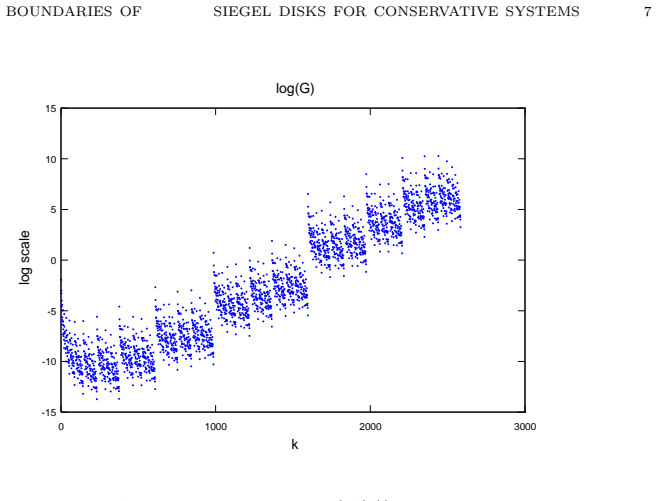
Master equation … G(k,r) … D(k) ≡ 2(1−cos(kα))
What do these tags mean?
- matches
- The paper's claim is directly supported by a theorem in the formal canon.
- supports
- The theorem supports part of the paper's argument, but the paper may add assumptions or extra steps.
- extends
- The paper goes beyond the formal theorem; the theorem is a base layer rather than the whole result.
- uses
- The paper appears to rely on the theorem as machinery.
- contradicts
- The paper's claim conflicts with a theorem or certificate in the canon.
- unclear
- Pith found a possible connection, but the passage is too broad, indirect, or ambiguous to say the theorem truly supports the claim.
Reference graph
Works this paper leans on
-
[1]
Berretti A., Celletti A., Chierchia L. and Falcolini C. Natural boundaries for area- preserving twist maps , J. Stat. Phys. 66 1613-30, 1992
work page 1992
-
[2]
Eric Bedford, John Smillie, POLYNOMIAL DIFFEOMORPHISMS OF C2 II: STABLE MANIFOLDS AND RECURRENCE , JOURNAL OF THE AMERICAN MATHEMATI- CAL SOCIETY Volume 4, Number 4, October 1991
work page 1991
-
[3]
Berretti A. and Chierchia L. On the complex analytic structure of the golden invariant curve for the standard map , Nonlinearity 3 39-44, 1990
work page 1990
-
[4]
V., A universal instability of many-dimensional oscillator systems , Phys
Chirikov B. V., A universal instability of many-dimensional oscillator systems , Phys. Rep. 52 263-79, 1979
work page 1979
-
[5]
M., The critical function for the semistandard map , Nonlinearity 7 219-29, 1994
Davie A. M., The critical function for the semistandard map , Nonlinearity 7 219-29, 1994. BOUNDARIES OF SIEGEL DISKS FOR CONSER V ATIVE SYSTEMS 13
work page 1994
-
[6]
M., A method for determining a stochastic transition , J
Greene J. M., A method for determining a stochastic transition , J. Math. Phys. 20 1183- 201,1979
work page 1979
-
[7]
Greene J. M. and Percival I. C. Hamiltonian maps in the complex plane , Physica D 3 530-48, 1981
work page 1981
-
[8]
De la Llave R. and Rana D. Accurate strategies for KAM bounds and their implementation , Computer Aided Proofs in Analysis (IMA Vol. Math. Appl. 28) ed K Meyer and D Schmidt (Berlin: Springer) pp 127-46, 1991
work page 1991
-
[11]
Siegel C. L. and Moser J. K. Lectures on Celestial Mechanics (Berlin: Springer), 1971
work page 1971
-
[12]
Simo C. Averaging under fast quasiperiodic forcing Hamiltonian Mechanics, Integrability and Chaotic Behaviour , (NATO Adv. Sci., Inst. Ser. B Phys. vol 331) ed J Seimenis (New York: Plenum) pp 13-34, 1994
work page 1994
-
[13]
Tere M Seara and Jordi Villanueva, Asymptotic behaviour of the domain of analyticity of invariant curves of the standard map ,Nonlinearity 13, pp 1699-1744, 2000
work page 2000
- [14]
-
[15]
O. Knill and J. Lesieutre, Analytic continuation of Dirichlet series with almost periodic coefficients, to appear in Complex Analysis and Operator Theory"
-
[16]
O. Knill and F.M. Tangerman A random walk above the golden rotation , in preparation, 2010
work page 2010
- [17]
-
[18]
MacKay R. S. Renormalization in Area Preserving Maps (Singapore: World Scientific), 1993
work page 1993
-
[19]
MacKay R. S. Transition to Chaos for Area Preserving Maps , (Lecture Notes in Physics vol 247) (Berlin: Springer) p 390, 1985
work page 1985
-
[20]
D. Rand, S. Ostlund, J. Sethna, E.D. Siggia, Universal Transition from Quasiperiodicity to Chaos in Dissipative Systems ,Phys. Rev. Lett. 49, 132-135 (1982)
work page 1982
-
[21]
Rand D, Universality and renormalization New Directions in Dynamical Systems (Lon- don Math
D. Rand D, Universality and renormalization New Directions in Dynamical Systems (Lon- don Math. Soc. L. N. Ser. 127) ed T Bedford and J Swift, 1988
work page 1988
discussion (0)
Sign in with ORCID, Apple, or X to comment. Anyone can read and Pith papers without signing in.