pith. sign in

arxiv: 2605.21031 · v2 · pith:NGPU7NR5new · submitted 2026-05-20 · 💻 cs.RO

Modeling and Control of a Pneumatic Morphing Soft Quadrotor based on the SOFA Framework for Dynamic Soft Robotic Simulation

Pith reviewed 2026-05-25 06:16 UTC · model grok-4.3

classification 💻 cs.RO
keywords softpneumaticcontroldynamicmodelingmorphingbehaviorproposed
0
0 comments X

The pith

SOFA-based FEM framework for dynamic simulation and PI control of a pneumatic morphing soft quadrotor that preserves traditional quadrotor dynamics.

A machine-rendered reading of the paper's core claim, the machinery that carries it, and where it could break.

The work models a flying robot whose arms are soft and can bend or stretch when air is pumped in or out. Instead of treating the arms as rigid, the simulation breaks them into many small pyramid-shaped pieces called tetrahedrons. Each piece follows simple rules for how stretchy materials push back when deformed. Air pressure is then applied inside the arms using two kinds of signals: repeating patterns and corrections based on position error. A standard proportional-integral controller adjusts the pressure to move an arm to a chosen spot. The overall drone still uses the usual equations for how quadrotors tilt and move, but the soft parts add time-varying forces. Computer runs are said to show that the arms can morph and that the controller works. Because only the abstract is available, these descriptions remain high-level claims without numbers or comparisons to real hardware.

Core claim

The proposed SOFA based finite element method for the soft body modeling preserves the physical interpretability and control structure of traditional quadrotor dynamics, while capturing the complex, time-varying behavior of pneumatically actuated soft arms.

Load-bearing premise

The tetrahedral mesh discretization following an elastic material law produces internal forces adequate to the real dynamic behavior of the pneumatic arms (stated in the modeling description).

Figures

Figures reproduced from arXiv: 2605.21031 by B. Vanderborght, F. Labra Caso, G. Nikolakopoulos, J. Haluska, P. Ferrentino, V. Sumathy.

Figure 1
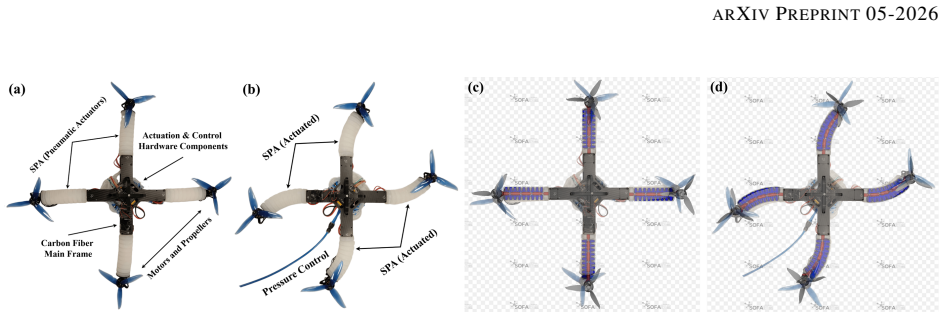
Figure 1. Figure 1: Visualization of the presented morphing pneumatic quadrotor design in SOFA at initial state (b) and during [PITH_FULL_IMAGE:figures/full_fig_p003_1.png] view at source ↗
Figure 2
Figure 2. Figure 2: Overview of the components in a SOFA scene [PITH_FULL_IMAGE:figures/full_fig_p003_2.png] view at source ↗
Figure 3
Figure 3. Figure 3: Soft Morphing Quadrotor at initial state (a) and during actuation (b). The Soft Pneumatic Arms connect [PITH_FULL_IMAGE:figures/full_fig_p004_3.png] view at source ↗
Figure 4
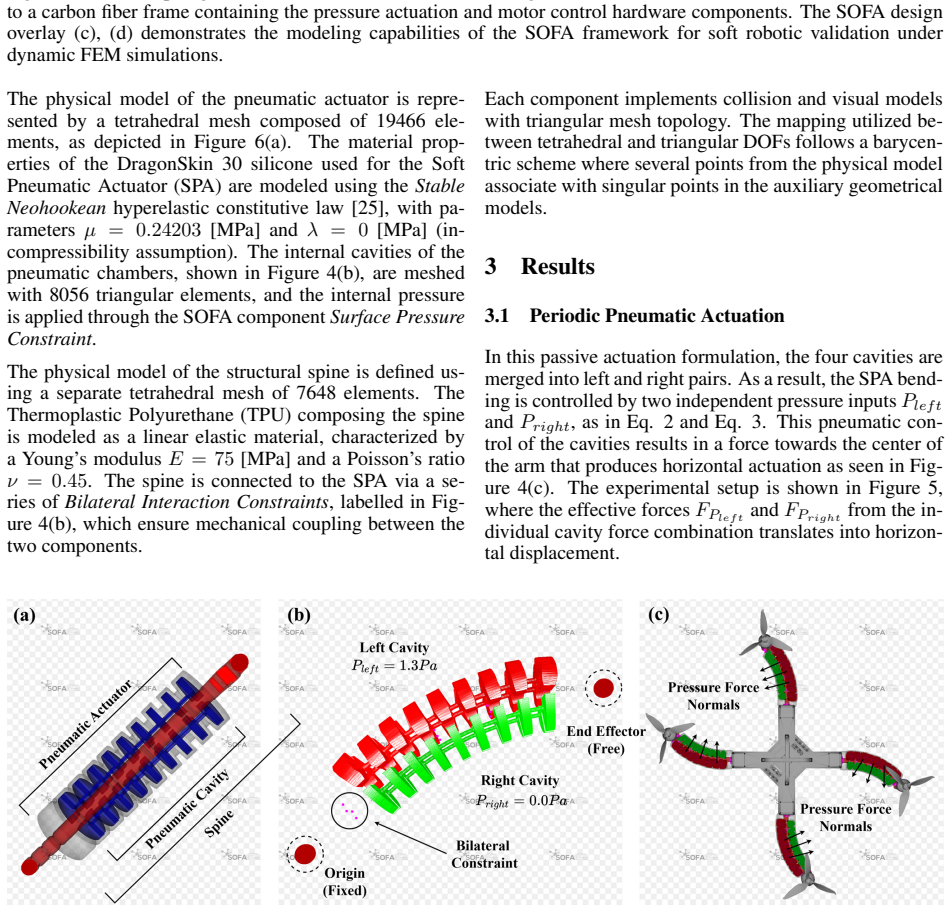
Figure 4. Figure 4: (a) The different parts of the UAV arm modelled in SOFA. The pneumatic actuator (white), the pneumatic [PITH_FULL_IMAGE:figures/full_fig_p004_4.png] view at source ↗
Figure 5
Figure 5. Figure 5: Experimental setup of the periodic control for [PITH_FULL_IMAGE:figures/full_fig_p005_5.png] view at source ↗
Figure 6
Figure 6. Figure 6: Pneumatic actuation effect under the passive [PITH_FULL_IMAGE:figures/full_fig_p005_6.png] view at source ↗
Figure 8
Figure 8. Figure 8: Experimental setup of the pressure controller [PITH_FULL_IMAGE:figures/full_fig_p006_8.png] view at source ↗
Figure 10
Figure 10. Figure 10: Distributed control signal i.e. individual cavity pressure for every quadrant experiment [PITH_FULL_IMAGE:figures/full_fig_p007_10.png] view at source ↗
read the original abstract

This article presents a novel SOFA based finite element method for the soft body modeling and the corresponding dynamic simulation and control of a pneumatic morphing soft quadrotor. The proposed modeling preserves the physical interpretability and control structure of traditional quadrotor dynamics, while capturing the complex, time-varying behavior of pneumatically actuated soft arms. In SOFA, the soft pneumatically actuated arms are discretized as a tetrahedral mesh following an elastic material law that produces internal forces adequate to the real dynamic behavior of the body. Pneumatic actuation governed by both periodic and error-based control signals is applied within the internal cavities to analyze the morphing capability. Finally, a proportional-integral controller is proposed to study the controlled dynamic behavior and morphing capabilities of the pneumatic arm, wherein the pneumatic actuation to the soft arm is controlled to achieve the desired target position. The simulation results show the effectiveness of the proposed novel modeling framework and the related controller design.

Editorial analysis

A structured set of objections, weighed in public.

Desk editor's note, referee report, simulated authors' rebuttal, and a circularity audit. Tearing a paper down is the easy half of reading it; the pith above is the substance, this is the friction.

Axiom & Free-Parameter Ledger

0 free parameters · 1 axioms · 0 invented entities

The central claim rests on the domain assumption that the chosen elastic material law and tetrahedral discretization capture real pneumatic arm dynamics; no explicit free parameters or invented entities are stated in the abstract.

axioms (1)
  • domain assumption The tetrahedral mesh discretization following an elastic material law produces internal forces adequate to the real dynamic behavior of the pneumatic arms.
    This premise is invoked directly in the description of the soft-body modeling approach.

pith-pipeline@v0.9.0 · 5721 in / 1215 out tokens · 50427 ms · 2026-05-25T06:16:19.842987+00:00 · methodology

discussion (0)

Sign in with ORCID, Apple, or X to comment. Anyone can read and Pith papers without signing in.