Neutron star-companion interaction in core collapse supernovae. Population synthesis based on detailed binary evolution models
Pith reviewed 2026-05-21 02:09 UTC · model grok-4.3
The pith
Periodic companion-neutron star interactions occur in more than half of surviving binary systems that produce hydrogen-poor core-collapse supernovae.
A machine-rendered reading of the paper's core claim, the machinery that carries it, and where it could break.
Core claim
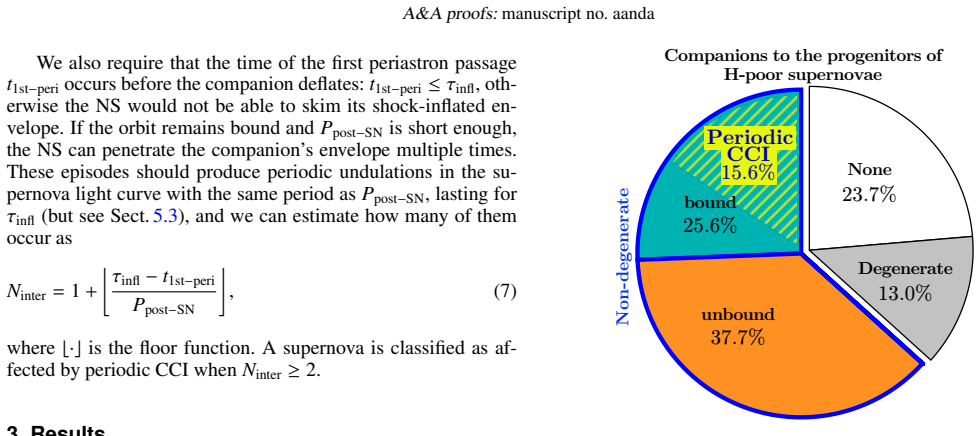
Analyzing a comprehensive grid of detailed binary stellar evolution models with the SN-ORACLE population synthesis code and analytic prescriptions for companion expansion after supernova ejecta impact, the authors find that periodic CCI occurs in more than half of the binary systems that produce a hydrogen-poor core collapse SN and are not disrupted, while the occurrence rate in systems producing hydrogen-rich SNe is small. The resulting period distribution is broad and peaks around 20-50 days, with interactions lasting 0.5-10 years. Specific models in the grid reproduce the observed periods of SN2022jli, SN2015ap, and SN2022esa, and the inflated companions reach J-band magnitudes of 21-23,,
What carries the argument
Population synthesis of a grid of detailed binary evolution models, combined with analytic prescriptions for the expansion of the companion star after supernova ejecta interaction and its subsequent orbital dynamics with the compact object.
If this is right
- The interactions produce broad period ranges peaking at 20-50 days and lasting 0.5-10 years.
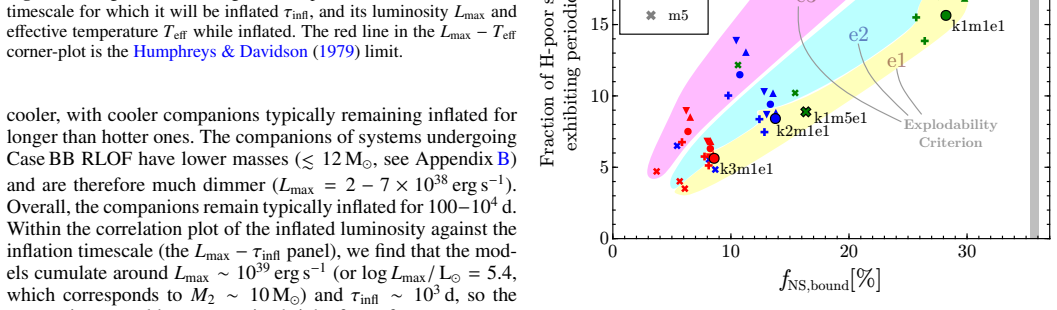
- Up to 27 percent of hydrogen-poor supernovae could display periodicity in their light curves.
- The expanded companions increase in luminosity and reach J-band magnitudes of 21-23 for up to 10 years after events like SN2022jli.
- The effect is far more common for hydrogen-poor than for hydrogen-rich core-collapse supernovae.
Where Pith is reading between the lines
- A systematic search for periodic modulations in existing and future hydrogen-poor supernova light curves could directly measure the surviving binary fraction.
- The models identify specific binary configurations that match known events, offering targets for multi-wavelength follow-up years after explosion.
- Different choices for neutron-star birth kicks would change the exact bound fraction but are unlikely to erase the large difference between hydrogen-poor and hydrogen-rich channels.
Load-bearing premise
The analytic prescriptions implemented for the expansion of the companion star following its interaction with the SN ejecta accurately capture the physical response and subsequent orbital interaction with the compact object.
What would settle it
A large observational sample of hydrogen-poor core-collapse supernovae showing a rate of periodic light-curve modulations with 20-50 day periods well below 50 percent among surviving binaries would falsify the predicted occurrence fraction.
Figures





read the original abstract
Most massive stars live in binary systems. When the first supernova (SN) in a binary occurs, the ejecta hit the companion, which may inflate as a consequence, and then interacts with the newly formed compact object. The recent Type Ic SN2022jli shows a periodic modulation in its emission, which is interpreted as evidence for such interaction. We derive predictions for the occurrence rate and observables of SNe exhibiting these companion - compact-object interactions (CCIs). We analyze a comprehensive, state-of-the-art grid of detailed binary stellar evolution models, and implement analytic prescriptions for the expansion of the companion star following its interaction with the SN ejecta. We employ the newly developed population synthesis code SN-ORACLE to derive the distribution functions of the properties of the SNe affected by CCI and their companions, where we use different explodability and neutron star birth kick distributions. We find that periodic CCI is expected to occur in more than half of the binary systems that produce a hydrogen-poor core collapse SN and are not disrupted, while the occurrence rate in systems producing hydrogen-rich SNe is small. We find broad period ranges, peaking around 20-50 days, with the interaction lasting for 0.5-10 years. We identify specific binary evolution models that reproduce the observed period of the light curve undulations of SN2022jli, SN2015ap, and SN2022esa. The inflation of the companion also increases its luminosity and brightness, increasing its detectability with current instruments. For SN2022jli, our best fitting models predict a J-band magnitude of 21-23 for up to 10 years. We find that up to 27% of H-poor SNe could show periodicity in their light curves, while only a few such events have been identified so far. Our results may help find periodic CCI features in future and archival SN observations.
Editorial analysis
A structured set of objections, weighed in public.
Referee Report
Summary. The manuscript analyzes a comprehensive grid of detailed binary stellar evolution models with the newly developed SN-ORACLE population synthesis code. It implements analytic prescriptions for companion-star expansion after SN ejecta impact and derives occurrence rates, period distributions, and observables for periodic neutron-star–companion interactions (CCI) in core-collapse supernovae, using varied explodability and kick prescriptions. The central claim is that periodic CCI occurs in more than half of non-disrupted hydrogen-poor CCSN binaries (with periods peaking at 20–50 days and durations 0.5–10 yr) while remaining rare for hydrogen-rich events; specific models are identified that reproduce the light-curve periods of SN 2022jli, SN 2015ap, and SN 2022esa.
Significance. If the analytic expansion prescriptions hold, the work supplies concrete, falsifiable predictions for periodic modulations in SN light curves and for the long-term brightness of companions, directly relevant to ongoing and archival searches. Credit is due for the use of state-of-the-art detailed binary grids, the introduction of the SN-ORACLE code, and the explicit matching of individual evolutionary sequences to three observed events. The quantitative rates, however, rest on unvalidated analytic steps whose accuracy controls the headline >50 % fraction.
major comments (2)
- [Methods / analytic prescriptions] The section describing the analytic prescriptions for companion expansion and cooling (post-ejecta impact): the >50 % periodic-CCI rate for non-disrupted H-poor systems is obtained by post-processing the binary grid with these prescriptions. No quantitative comparison to hydrodynamical simulations is reported for the mass ratios and orbital separations realized in the grid; an error in the assumed expansion factor or cooling timescale would directly rescale the reported fraction and the H-poor versus H-rich distinction.
- [Results / occurrence rates] Results section on occurrence rates and period distributions: no error propagation or sensitivity study is presented for the derived fractions with respect to plausible variations in the explodability prescription, neutron-star kick distribution, or the free parameters of the analytic expansion model. This omission leaves the robustness of the central >50 % claim and the 0.5–10 yr duration range difficult to assess.
minor comments (2)
- [Abstract] Abstract: the statement that 'up to 27 % of H-poor SNe could show periodicity' is not immediately reconciled with the >50 % rate among non-disrupted binaries; a short parenthetical on the disrupted fraction would remove ambiguity.
- [Figures] Figure showing period distributions: inclusion of the corresponding distribution for H-rich systems would allow immediate visual comparison and strengthen the claimed contrast.
Simulated Author's Rebuttal
We thank the referee for the constructive and detailed review of our manuscript. We address each major comment below and describe the revisions we will implement to improve the robustness and clarity of our results.
read point-by-point responses
-
Referee: [Methods / analytic prescriptions] The section describing the analytic prescriptions for companion expansion and cooling (post-ejecta impact): the >50 % periodic-CCI rate for non-disrupted H-poor systems is obtained by post-processing the binary grid with these prescriptions. No quantitative comparison to hydrodynamical simulations is reported for the mass ratios and orbital separations realized in the grid; an error in the assumed expansion factor or cooling timescale would directly rescale the reported fraction and the H-poor versus H-rich distinction.
Authors: We acknowledge that the manuscript does not include a direct quantitative comparison of the analytic prescriptions to hydrodynamical simulations specifically for the mass ratios and orbital separations present in our binary grid. The prescriptions are based on analytic models calibrated against existing hydrodynamical studies in the literature. To address this point, we will add a dedicated paragraph in the methods section discussing the validity range of the prescriptions, citing the relevant hydrodynamical benchmarks, and include a sensitivity analysis varying the expansion factor and cooling timescale within plausible uncertainties. This will quantify the effect on the reported occurrence rates. revision: yes
-
Referee: [Results / occurrence rates] Results section on occurrence rates and period distributions: no error propagation or sensitivity study is presented for the derived fractions with respect to plausible variations in the explodability prescription, neutron-star kick distribution, or the free parameters of the analytic expansion model. This omission leaves the robustness of the central >50 % claim and the 0.5–10 yr duration range difficult to assess.
Authors: The manuscript already explores results across multiple explodability prescriptions and neutron-star kick distributions, with the >50% fraction for non-disrupted H-poor systems remaining consistent. We agree, however, that a more systematic sensitivity study including variations in the free parameters of the analytic expansion model and basic error propagation would better demonstrate robustness. In the revised version we will add a new subsection or appendix presenting these sensitivity tests, including how the central fraction and duration range respond to changes in the analytic parameters. revision: partial
Circularity Check
No significant circularity in derivation chain
full rationale
The paper derives CCI occurrence rates (>50% for non-disrupted H-poor CCSN binaries) by post-processing an external grid of detailed binary evolution models with analytic prescriptions for companion expansion after ejecta impact, then feeding results into the new SN-ORACLE population synthesis code along with separate explodability and kick distributions. No step reduces by construction to its own inputs: the rates are forward predictions from the binary grid properties (separations, mass ratios) rather than any fitted parameter, self-definitional loop, or load-bearing self-citation. The H-poor vs. H-rich distinction follows directly from the grid's orbital statistics, which are independent of the CCI classification step. The derivation remains self-contained against external benchmarks.
Axiom & Free-Parameter Ledger
free parameters (2)
- explodability and neutron star birth kick distributions
- analytic prescriptions for companion expansion
axioms (2)
- domain assumption Most massive stars live in binary systems.
- domain assumption The detailed binary stellar evolution models in the grid correctly capture mass transfer, common-envelope phases, and core evolution up to the supernova.
Lean theorems connected to this paper
-
IndisputableMonolith/Cost/FunctionalEquation.leanwashburn_uniqueness_aczel unclear?
unclearRelation between the paper passage and the cited Recognition theorem.
We implement analytic prescriptions for the expansion of the companion star following its interaction with the SN ejecta... E_heat = p · E_kin,ej · Ω̃_eff with p=0.08... log R_max... τ_infl = α E_heat / L_max with α∼0.18
-
IndisputableMonolith/Foundation/DimensionForcing.leanreality_from_one_distinction unclear?
unclearRelation between the paper passage and the cited Recognition theorem.
post-supernova orbital periods P_post-SN = 9.8–226 d, peaking at 20–70 d... N_inter ≥2 for periodic CCI
What do these tags mean?
- matches
- The paper's claim is directly supported by a theorem in the formal canon.
- supports
- The theorem supports part of the paper's argument, but the paper may add assumptions or extra steps.
- extends
- The paper goes beyond the formal theorem; the theorem is a base layer rather than the whole result.
- uses
- The paper appears to rely on the theorem as machinery.
- contradicts
- The paper's claim conflicts with a theorem or certificate in the canon.
- unclear
- Pith found a possible connection, but the passage is too broad, indirect, or ambiguous to say the theorem truly supports the claim.
Reference graph
Works this paper leans on
-
[1]
Modules for Experiments in Stellar Astrophysics (MESA)
Modules for Experiments in Stellar Astrophysics (MESA). , keywords =. doi:10.1088/0067-0049/192/1/3 , archivePrefix =. 1009.1622 , primaryClass =
work page internal anchor Pith review Pith/arXiv arXiv doi:10.1088/0067-0049/192/1/3
-
[2]
2013, Astrophysical Journal Supplement Series, 208, 4, doi: 10.1088/0067-0049/208/1/4
Modules for Experiments in Stellar Astrophysics (MESA): Planets, Oscillations, Rotation, and Massive Stars. , keywords =. doi:10.1088/0067-0049/208/1/4 , archivePrefix =. 1301.0319 , primaryClass =
work page internal anchor Pith review Pith/arXiv arXiv doi:10.1088/0067-0049/208/1/4
-
[3]
2015, ApJS, 220, 15, doi: 10.1088/0067-0049/220/1/15
Modules for Experiments in Stellar Astrophysics (MESA): Binaries, Pulsations, and Explosions. , keywords =. doi:10.1088/0067-0049/220/1/15 , archivePrefix =. 1506.03146 , primaryClass =
work page internal anchor Pith review Pith/arXiv arXiv doi:10.1088/0067-0049/220/1/15
-
[4]
Modules for Experiments in Stellar Astrophysics (MESA): Convective Boundaries, Element Diffusion, and Massive Star Explosions. , keywords =. doi:10.3847/1538-4365/aaa5a8 , archivePrefix =. 1710.08424 , primaryClass =
work page internal anchor Pith review Pith/arXiv arXiv doi:10.3847/1538-4365/aaa5a8
-
[5]
Modules for Experiments in Stellar Astrophysics (MESA): Pulsating Variable Stars, Rotation, Convective Boundaries, and Energy Conservation. , keywords =. doi:10.3847/1538-4365/ab2241 , archivePrefix =. 1903.01426 , primaryClass =
work page internal anchor Pith review Pith/arXiv arXiv doi:10.3847/1538-4365/ab2241 1903
-
[6]
, year = 1955, month = jan, volume =
The Luminosity Function and Stellar Evolution. , year = 1955, month = jan, volume =. doi:10.1086/145971 , adsurl =
-
[7]
SN 1993J: A Type IIb Supernova. , keywords =. doi:10.1086/174319 , adsurl =
-
[8]
Luminous Type II Short-Plateau Supernovae 2006Y, 2006ai, and 2016egz: A Transitional Class from Stripped Massive Red Supergiants. , keywords =. doi:10.3847/1538-4357/abf6d6 , archivePrefix =. 2010.15566 , primaryClass =
-
[9]
Supernova Light Curves Powered by Fallback Accretion
Supernova Light Curves Powered by Fallback Accretion. , keywords =. doi:10.1088/0004-637X/772/1/30 , archivePrefix =. 1210.7240 , primaryClass =
work page internal anchor Pith review Pith/arXiv arXiv doi:10.1088/0004-637x/772/1/30
-
[10]
The progenitor of supernova 1993J: a stripped supergiant in a binary system?. , keywords =. doi:10.1038/364509a0 , adsurl =
-
[11]
Supernovae from massive stars with extended tenuous envelopes
Supernovae from massive stars with extended tenuous envelopes. , keywords =. doi:10.1051/0004-6361/201732363 , archivePrefix =. 1801.02056 , primaryClass =
work page internal anchor Pith review Pith/arXiv arXiv doi:10.1051/0004-6361/201732363
-
[12]
The VLT-FLAMES Tarantula Survey. X. Evidence for a bimodal distribution of rotational velocities for the single early B-type stars. , keywords =. doi:10.1051/0004-6361/201220273 , archivePrefix =. 1212.2424 , primaryClass =
work page internal anchor Pith review Pith/arXiv arXiv doi:10.1051/0004-6361/201220273
-
[13]
The chemical make-up of the Sun: A 2020 vision
The chemical make-up of the Sun: A 2020 vision. , keywords =. doi:10.1051/0004-6361/202140445 , archivePrefix =. 2105.01661 , primaryClass =
work page internal anchor Pith review Pith/arXiv arXiv doi:10.1051/0004-6361/202140445 2020
-
[14]
Radiative Atomic Rosseland Mean Opacity Tables. , keywords =. doi:10.1086/191659 , adsurl =
-
[15]
OPAL Equation-of-State Tables for Astrophysical Applications. , keywords =. doi:10.1086/176705 , adsurl =
-
[16]
Presupernova evolution of massive stars. , keywords =. doi:10.1086/156569 , adsurl =
-
[17]
The JINA REACLIB Database: Its Recent Updates and Impact on Type-I X-ray Bursts. , keywords =. doi:10.1088/0067-0049/189/1/240 , adsurl =
-
[18]
Evolution of massive stars in the Large Magellanic Cloud : models with semiconvection. , keywords =
-
[19]
Constraining mixing in massive stars in the Small Magellanic Cloud
Constraining mixing in massive stars in the Small Magellanic Cloud. , keywords =. doi:10.1051/0004-6361/201935046 , archivePrefix =. 1903.10423 , primaryClass =
work page internal anchor Pith review Pith/arXiv arXiv doi:10.1051/0004-6361/201935046 1903
-
[20]
The Binding Energy Parameter for Common Envelope Evolution
The binding energy parameter for common envelope evolution. Research in Astronomy and Astrophysics , keywords =. doi:10.1088/1674-4527/16/8/126 , archivePrefix =. 1605.03668 , primaryClass =
work page internal anchor Pith review Pith/arXiv arXiv doi:10.1088/1674-4527/16/8/126
-
[21]
Common Envelope Evolution and Double Cores of Planetary Nebulae. , keywords =. doi:10.1086/168974 , adsurl =
-
[22]
The origin of subdwarf B stars - I. The formation channels. , keywords =. doi:10.1046/j.1365-8711.2002.05752.x , archivePrefix =. astro-ph/0206130 , primaryClass =
-
[23]
The origin of subdwarf B stars - II. , keywords =. doi:10.1046/j.1365-8711.2003.06451.x , archivePrefix =. astro-ph/0301380 , primaryClass =
-
[24]
Is Betelgeuse the Outcome of a Past Merger?. , keywords =. doi:10.3847/1538-4357/ab91bb , archivePrefix =. 2005.04172 , primaryClass =
-
[25]
Type Ib and IIb supernova progenitors in interacting binary systems
Type Ib and IIb Supernova Progenitors in Interacting Binary Systems. , keywords =. doi:10.3847/1538-4357/aa6afe , archivePrefix =. 1701.02089 , primaryClass =
work page internal anchor Pith review Pith/arXiv arXiv doi:10.3847/1538-4357/aa6afe
-
[26]
Common envelopes in massive stars: towards the role of radiation pressure and recombination energy in ejecting red supergiant envelopes. , keywords =. doi:10.1093/mnras/stac049 , archivePrefix =. 2111.00923 , primaryClass =
-
[27]
doi:10.1088/2514-3433/abb6f0 , adsurl =
Common Envelope Evolution. doi:10.1088/2514-3433/abb6f0 , adsurl =
-
[28]
On the Energy Equation and Efficiency Parameter of the Common Envelope Evolution
On the energy equation and efficiency parameter of the common envelope evolution. , keywords =. doi:10.48550/arXiv.astro-ph/0007034 , archivePrefix =. astro-ph/0007034 , primaryClass =
work page internal anchor Pith review Pith/arXiv arXiv doi:10.48550/arxiv.astro-ph/0007034
-
[29]
Common envelope: enthalpy consideration
Common Envelope: Enthalpy Consideration. , keywords =. doi:10.1088/2041-8205/731/2/L36 , archivePrefix =. 1103.2790 , primaryClass =
work page internal anchor Pith review Pith/arXiv arXiv doi:10.1088/2041-8205/731/2/l36 2041
-
[30]
The role of mass transfer and common envelope evolution in the formation of merging binary black holes. , keywords =. doi:10.1051/0004-6361/202039992 , archivePrefix =. 2103.09243 , primaryClass =
-
[31]
The dependence of convective core overshooting on stellar mass. , keywords =. doi:10.1051/0004-6361/201628779 , adsurl =
-
[32]
The spectroscopic Hertzsprung-Russell diagram of Galactic massive stars
The spectroscopic Hertzsprung-Russell diagram of Galactic massive stars. , keywords =. doi:10.1051/0004-6361/201425028 , archivePrefix =. 1410.3499 , primaryClass =
work page internal anchor Pith review Pith/arXiv arXiv doi:10.1051/0004-6361/201425028
-
[33]
Rotating massive main-sequence stars. I. Grids of evolutionary models and isochrones. , keywords =. doi:10.1051/0004-6361/201016113 , archivePrefix =. 1102.0530 , primaryClass =
work page internal anchor Pith review Pith/arXiv arXiv doi:10.1051/0004-6361/201016113
-
[34]
Parametrization of stellar rates of mass loss as functions of the fundamental stellar parameters M, L, and R. , keywords =
- [35]
-
[36]
Mass-loss predictions for O and B stars as a function of metallicity
Mass-loss predictions for O and B stars as a function of metallicity. , keywords =. doi:10.1051/0004-6361:20010127 , archivePrefix =. astro-ph/0101509 , primaryClass =
work page internal anchor Pith review Pith/arXiv arXiv doi:10.1051/0004-6361:20010127
-
[37]
Mass-loss rates of Wolf-Rayet stars as a function of stellar parameters. , keywords =
-
[38]
Towards a better understanding of the evolution of Wolf-Rayet stars and Type Ib/Ic supernova progenitors. , keywords =. doi:10.1093/mnras/stx1496 , archivePrefix =. 1706.04716 , primaryClass =
work page internal anchor Pith review Pith/arXiv arXiv doi:10.1093/mnras/stx1496
-
[39]
A comparative study of the evolution of a close binary using a standard and an improved technique for computing mass transfer. , keywords =
-
[40]
Presupernova Evolution of Rotating Massive Stars. I. Numerical Method and Evolution of the Internal Stellar Structure. , keywords =. doi:10.1086/308158 , archivePrefix =. astro-ph/9904132 , primaryClass =
work page internal anchor Pith review Pith/arXiv arXiv doi:10.1086/308158
-
[41]
Formation of contact in massive close binaries
Formation of contact in massive close binaries. , keywords =. doi:10.1051/0004-6361:20010151 , archivePrefix =. astro-ph/0102244 , primaryClass =
work page internal anchor Pith review Pith/arXiv arXiv doi:10.1051/0004-6361:20010151
-
[42]
The Internal Constitution of the Stars
-
[43]
, year = 1929, month = nov, volume =
Internal circulation in rotating stars. , year = 1929, month = nov, volume =. doi:10.1093/mnras/90.1.54 , adsurl =
-
[44]
, year = 1950, month = jan, volume =
The importance of rotation in stellar evolution. , year = 1950, month = jan, volume =. doi:10.1093/mnras/110.6.548 , adsurl =
-
[45]
, year = 1967, month = nov, volume =
Differential Rotation in Stars. , year = 1967, month = nov, volume =. doi:10.1086/149360 , adsurl =
-
[46]
Instabilit \"a t station \"a rer Rotation in Sternen. , year = 1968, month = jan, volume =
work page 1968
-
[47]
, year = 1973, month = jan, volume =
The adiabatic stability of stars containing magnetic fields-I.Toroidal fields. , year = 1973, month = jan, volume =. doi:10.1093/mnras/161.4.365 , adsurl =
-
[48]
IV - The influence of rotation
The adiabatic stability of stars containing magnetic fields. IV - The influence of rotation. , keywords =. doi:10.1093/mnras/216.2.139 , adsurl =
-
[49]
Dynamo action by differential rotation in a stably stratified stellar interior
Dynamo action by differential rotation in a stably stratified stellar interior. , keywords =. doi:10.1051/0004-6361:20011465 , archivePrefix =. astro-ph/0108207 , primaryClass =
work page internal anchor Pith review Pith/arXiv arXiv doi:10.1051/0004-6361:20011465
-
[50]
Comments on Astrophysics and Space Physics , keywords =
Instabilities of Differential Rotation. Comments on Astrophysics and Space Physics , keywords =
-
[51]
Stellar Instability and Evolution , year = 1974, editor =
Rotational Instabilities and Stellar Evolution. Stellar Instability and Evolution , year = 1974, editor =
work page 1974
-
[52]
Presupernova Evolution of Differentially Rotating Massive Stars Including Magnetic Fields
Presupernova Evolution of Differentially Rotating Massive Stars Including Magnetic Fields. , keywords =. doi:10.1086/429868 , archivePrefix =. astro-ph/0409422 , primaryClass =
work page internal anchor Pith review Pith/arXiv arXiv doi:10.1086/429868
-
[53]
The evolution of rotating stars. II. Calculations with time-dependent redistribution of angular momentum for 7 and 10 M sun stars. , keywords =. doi:10.1086/155904 , adsurl =
-
[54]
Evolutionary Models of the Rotating Sun. , keywords =. doi:10.1086/167210 , adsurl =
-
[55]
Effect of horizontal turbulent diffusion on transport by meridional circulation. , keywords =
-
[56]
Single star progenitors of long gamma-ray bursts. I. Model grids and redshift dependent GRB rate. , keywords =. doi:10.1051/0004-6361:20065912 , archivePrefix =. astro-ph/0606637 , primaryClass =
work page internal anchor Pith review Pith/arXiv arXiv doi:10.1051/0004-6361:20065912
-
[57]
The Rotation Rates of Massive Stars: The Role of Binary Interaction through Tides, Mass Transfer, and Mergers. , keywords =. doi:10.1088/0004-637X/764/2/166 , archivePrefix =. 1211.3742 , primaryClass =
work page internal anchor Pith review Pith/arXiv arXiv doi:10.1088/0004-637x/764/2/166
-
[58]
Evolution of binary stars and the effect of tides on binary populations. , keywords =. doi:10.1046/j.1365-8711.2002.05038.x , archivePrefix =. astro-ph/0201220 , primaryClass =
-
[59]
doi:10.1007/978-3-662-55054-0 , adsurl =
Supernova Explosions. doi:10.1007/978-3-662-55054-0 , adsurl =
-
[60]
Stripped-envelope stars in different metallicity environments. I. Evolutionary phases, classification, and populations. , keywords =. doi:10.1051/0004-6361/202142895 , archivePrefix =. 2112.06948 , primaryClass =
-
[61]
Stripped-envelope stars in different metallicity environments. II. Type I supernovae and compact remnants. , keywords =. doi:10.1051/0004-6361/202243519 , archivePrefix =. 2204.00025 , primaryClass =
-
[62]
, year = 1993, month = aug, volume =
SN 1993J : explosion of a massive cool supergiant with a small envelope nass ?. , year = 1993, month = aug, volume =
work page 1993
-
[63]
Core-collapse explosions of Wolf-Rayet stars and the connection to Type IIb/Ib/Ic supernovae. , keywords =. doi:10.1111/j.1365-2966.2011.18598.x , archivePrefix =. 1102.5160 , primaryClass =
-
[64]
Interacting Binary Stars , year = 1985, editor =
Stellar evolution and binaries. Interacting Binary Stars , year = 1985, editor =
work page 1985
-
[65]
Thresholds for Rapid Mass Transfer in Binary System. I. Polytropic Models. , keywords =. doi:10.1086/165412 , adsurl =
-
[66]
The spectroscopic Hertzsprung-Russell diagram
The spectroscopic Hertzsprung-Russell diagram. , keywords =. doi:10.1051/0004-6361/201423374 , archivePrefix =. 1403.2212 , primaryClass =
work page internal anchor Pith review Pith/arXiv arXiv doi:10.1051/0004-6361/201423374
-
[67]
Thermonuclear and electron-capture supernovae from stripped-envelope stars. , keywords =. doi:10.1051/0004-6361/202243035 , archivePrefix =. 2201.00871 , primaryClass =
- [68]
-
[69]
A model of anisotropic winds from rotating stars for evolutionary calculations. arXiv e-prints , keywords =. doi:10.48550/arXiv.2302.10992 , archivePrefix =. 2302.10992 , primaryClass =
-
[70]
Effects of winds on the leftover hydrogen in massive stars following Roche lobe overflow
Effects of winds on the leftover hydrogen in massive stars following Roche lobe overflow. , keywords =. doi:10.1093/mnras/stz1134 , archivePrefix =. 1904.09221 , primaryClass =
work page internal anchor Pith review Pith/arXiv arXiv doi:10.1093/mnras/stz1134 1904
-
[71]
Binary progenitor models of type IIb supernovae
Binary progenitor models of type IIb supernovae. , keywords =. doi:10.1051/0004-6361/201015410 , archivePrefix =. 1102.1732 , primaryClass =
work page internal anchor Pith review Pith/arXiv arXiv doi:10.1051/0004-6361/201015410
-
[72]
Progenitors of Type IIb Supernovae. I. Evolutionary Pathways and Rates. , keywords =. doi:10.3847/1538-4357/ab4ad7 , archivePrefix =. 1808.07580 , primaryClass =
-
[73]
Progenitors of Type IIb Supernovae. II. Observable Properties. , keywords =. doi:10.3847/1538-4357/abb8d5 , archivePrefix =. 2009.06405 , primaryClass =
-
[74]
How much hydrogen is in Type Ib and IIb supernova progenitors?. , keywords =. doi:10.1093/mnras/stac088 , archivePrefix =. 2111.04432 , primaryClass =
-
[75]
Winds from stripped low-mass Helium stars and Wolf-Rayet stars
Winds from stripped low-mass helium stars and Wolf-Rayet stars. , keywords =. doi:10.1051/0004-6361/201731902 , archivePrefix =. 1710.02010 , primaryClass =
work page internal anchor Pith review Pith/arXiv arXiv doi:10.1051/0004-6361/201731902
-
[76]
Pulsations in red supergiants with high L/M ratio. Implications for the stellar and circumstellar structure of supernova progenitors. , keywords =. doi:10.48550/arXiv.astro-ph/9705097 , archivePrefix =. astro-ph/9705097 , primaryClass =
work page internal anchor Pith review Pith/arXiv arXiv doi:10.48550/arxiv.astro-ph/9705097
-
[77]
Implications of massive close binaries for black hole formation and supernovae
Implications of massive close binaries for black hole formation and supernovae. , keywords =. doi:10.48550/arXiv.astro-ph/9904256 , archivePrefix =. astro-ph/9904256 , primaryClass =
work page internal anchor Pith review Pith/arXiv arXiv doi:10.48550/arxiv.astro-ph/9904256
-
[78]
Efficiency of mass transfer in massive close binaries. Tests from double-lined eclipsing binaries in the SMC. , keywords =. doi:10.1051/0004-6361:20067007 , archivePrefix =. astro-ph/0703480 , primaryClass =
work page internal anchor Pith review Pith/arXiv arXiv doi:10.1051/0004-6361:20067007
-
[79]
The massive binary companion star to the progenitor of supernova 1993J
The massive binary companion star to the progenitor of supernova 1993J. , keywords =. doi:10.1038/nature02161 , archivePrefix =. astro-ph/0401090 , primaryClass =
work page internal anchor Pith review Pith/arXiv arXiv doi:10.1038/nature02161
-
[80]
Structure and Evolution of Close Binary Systems , year = 1976, editor =
Common Envelope Binaries. Structure and Evolution of Close Binary Systems , year = 1976, editor =
work page 1976
discussion (0)
Sign in with ORCID, Apple, or X to comment. Anyone can read and Pith papers without signing in.