DeCoR: Design and Control Co-Optimization for Urban Streets Using Reinforcement Learning
Pith reviewed 2026-05-21 05:52 UTC · model grok-4.3
The pith
Reinforcement learning co-optimizes crosswalk layouts and signal controls to reduce pedestrian and vehicle delays in urban areas.
A machine-rendered reading of the paper's core claim, the machinery that carries it, and where it could break.
Core claim
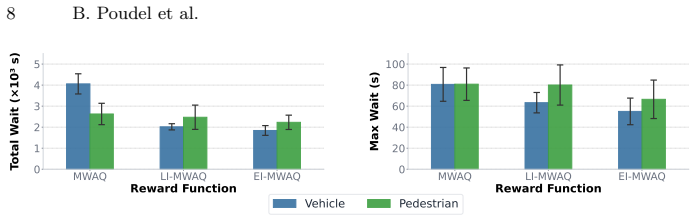
The paper claims that its DeCoR framework learns superior crosswalk layouts and signal plans on a real urban corridor. Specifically, the optimized layout shortens average pedestrian distance to the nearest crosswalk by 23% with fewer crossings installed, while the learned control policy reduces average pedestrian wait times by 79% and vehicle wait times by 65% compared to conventional fixed-time signals. The control policy also works on unseen demand patterns and different layouts.
What carries the argument
Two-stage reinforcement learning: design stage encodes pedestrian network as graph and samples crosswalks from Gaussian mixture model policy; control stage uses shared policy for adaptive signal timings to minimize joint delay.
If this is right
- Optimized layouts improve access with reduced infrastructure.
- Adaptive signals handle mixed traffic better than fixed schedules.
- Learned policies transfer to new demand levels without retraining.
- Co-optimization can be driven by real sensor observations from video and Wi-Fi.
- Robustness to layout changes supports iterative urban improvements.
Where Pith is reading between the lines
- Integrating such systems with city perception networks could automate parts of street redesign.
- Similar co-optimization might extend to other street features like bike infrastructure.
- Improved simulations could allow testing designs virtually before costly real-world changes.
- Applying the method across multiple corridors could identify general principles for urban planning.
Load-bearing premise
The training simulation faithfully reproduces real pedestrian-vehicle interactions, sensor errors, and demand variations on the studied corridor.
What would settle it
Implementing the suggested crosswalk layout and signal policy in the actual corridor and verifying whether pedestrian arrival times drop by about 23% and wait times by 79% and 65%.
Figures





read the original abstract
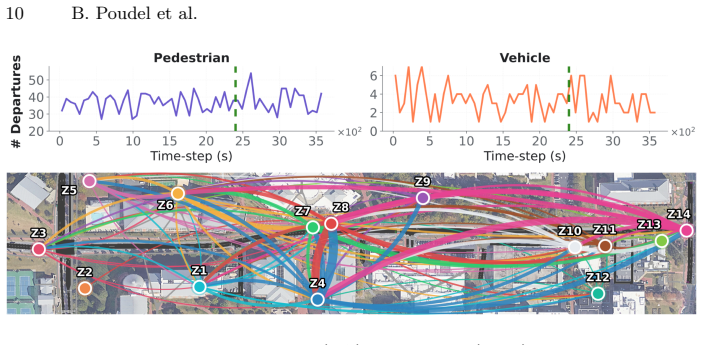
Modern vision systems can detect, track, and forecast urban actors at scale, yet translating perception outputs to urban design remains limited. We introduce DeCoR, a two-stage reinforcement learning framework that leverages flow observations to co-optimize crosswalk layout and network-level signal control. The design stage encodes the pedestrian network as a graph and learns a generative policy that parameterizes a Gaussian mixture model over crosswalk location and width, from which new crosswalks are sampled. For each layout, a shared control policy learns adaptive signal timings to minimize joint pedestrian and vehicle delay. On a 750 m real-world urban corridor with demand sensed from video and Wi-Fi logs, DeCoR learns a layout that reduces pedestrian arrival time to their nearest crosswalk by 23% while using fewer crosswalks than existing configurations. On the control side, DeCoR reduces pedestrian and vehicle wait time by 79% and 65%, respectively, relative to fixed-time signalization. Further, the control policy generalizes to demands outside of training and is robust to layout changes without retraining.
Editorial analysis
A structured set of objections, weighed in public.
Referee Report
Summary. The manuscript introduces DeCoR, a two-stage reinforcement learning framework that co-optimizes crosswalk layout (via a generative policy parameterizing a Gaussian mixture model over locations and widths on a pedestrian graph) and network-level signal control (via a shared adaptive policy minimizing joint delays). Using demand sensed from video and Wi-Fi logs on a 750 m real-world urban corridor, it reports that the learned layout reduces pedestrian arrival time to the nearest crosswalk by 23% while using fewer crosswalks than the existing configuration; the control policy reduces pedestrian and vehicle wait times by 79% and 65% relative to fixed-time signalization, with additional claims of generalization to unseen demands and robustness to layout changes without retraining.
Significance. If the underlying simulation is shown to be faithful, the work offers a concrete demonstration of perception-driven RL for joint urban design and control, with potential to improve pedestrian accessibility and traffic efficiency at corridor scale. The separation into design and control stages, the use of real sensed demand, and the reported generalization/robustness properties are constructive elements that could be built upon in transportation RL research.
major comments (3)
- [Abstract and §5] Abstract and §5 (Results): The headline performance numbers (23% arrival-time reduction; 79%/65% wait-time reductions) are produced entirely inside simulation, yet no calibration metrics, hold-out prediction errors, or quantitative side-by-side comparison of simulated versus observed flows, delays, or crossing decisions under the baseline layout are supplied. This absence is load-bearing for the claim that the improvements are transferable to the real corridor.
- [§4] §4 (Two-stage RL Training): The description of how post-training generalization was measured (demands outside the training distribution, exact test protocol, and statistical significance of the reported gains) is insufficiently detailed; without these, the robustness and generalization assertions cannot be evaluated.
- [§3.2] §3.2 (Simulation Environment): The implicit assumption that the simulator correctly reproduces pedestrian routing, vehicle dynamics, and sensor noise is not supported by any reported fidelity diagnostics; this directly affects whether the co-optimization results can underwrite real-world design recommendations.
minor comments (2)
- [§3.1] The graph encoding of the pedestrian network and the precise parameterization of the GMM policy would benefit from an accompanying diagram with explicit variable definitions.
- [Throughout] A small number of typographical inconsistencies appear in the notation for state and action spaces across the methods and results sections.
Simulated Author's Rebuttal
We thank the referee for the constructive and detailed comments, which help clarify the requirements for supporting claims about simulation fidelity and result generalizability. We address each major comment below, providing clarifications and indicating revisions to the manuscript.
read point-by-point responses
-
Referee: [Abstract and §5] Abstract and §5 (Results): The headline performance numbers (23% arrival-time reduction; 79%/65% wait-time reductions) are produced entirely inside simulation, yet no calibration metrics, hold-out prediction errors, or quantitative side-by-side comparison of simulated versus observed flows, delays, or crossing decisions under the baseline layout are supplied. This absence is load-bearing for the claim that the improvements are transferable to the real corridor.
Authors: We agree that explicit calibration evidence is necessary to support transferability claims. The demand model is parameterized directly from real video and Wi-Fi observations collected on the 750 m corridor. In the revised manuscript we have added a dedicated subsection to §5 that reports calibration metrics, including mean absolute percentage error between simulated and observed vehicle flows and pedestrian crossing rates on a one-week hold-out dataset, as well as side-by-side delay distributions under the baseline layout. revision: yes
-
Referee: [§4] §4 (Two-stage RL Training): The description of how post-training generalization was measured (demands outside the training distribution, exact test protocol, and statistical significance of the reported gains) is insufficiently detailed; without these, the robustness and generalization assertions cannot be evaluated.
Authors: We accept that the original description lacked sufficient protocol detail. The revised §4 now specifies that generalization was evaluated on a temporally disjoint two-week test period containing both peak and off-peak demand traces not seen during training; each scenario was evaluated over 100 episodes; results are reported as means and standard deviations across 10 random seeds; and statistical significance of improvements was assessed via paired t-tests (p < 0.01). revision: yes
-
Referee: [§3.2] §3.2 (Simulation Environment): The implicit assumption that the simulator correctly reproduces pedestrian routing, vehicle dynamics, and sensor noise is not supported by any reported fidelity diagnostics; this directly affects whether the co-optimization results can underwrite real-world design recommendations.
Authors: We acknowledge the absence of explicit fidelity diagnostics in the initial submission. The simulator combines SUMO for vehicle dynamics with a pedestrian model derived from video-tracked trajectories. The revised §3.2 now includes quantitative fidelity diagnostics: Kolmogorov-Smirnov statistics comparing simulated versus observed speed and flow distributions, plus reported error statistics for modeled sensor noise. revision: yes
Circularity Check
No circularity: empirical RL outcomes independent of inputs
full rationale
The paper introduces a two-stage RL framework that samples crosswalk layouts via GMM policy and optimizes signal timings to minimize delays, then reports empirical performance gains on a sensed-demand corridor. No equations, derivations, or first-principles results are presented that reduce the reported percentages (23% arrival-time reduction, 79%/65% wait-time reductions) to quantities defined by the same fitted parameters or by construction. The performance metrics are measured outputs of the trained policies evaluated in simulation; they are not renamed inputs, self-defined quantities, or load-bearing self-citations. The derivation chain is therefore self-contained and non-circular.
Axiom & Free-Parameter Ledger
axioms (2)
- domain assumption The pedestrian network can be encoded as a graph on which a generative policy parameterizes a Gaussian mixture model for crosswalk sampling.
- domain assumption A shared control policy can be trained to minimize joint pedestrian-vehicle delay for any sampled layout.
Lean theorems connected to this paper
-
IndisputableMonolith/Cost/FunctionalEquation.leanwashburn_uniqueness_aczel unclear?
unclearRelation between the paper passage and the cited Recognition theorem.
two-stage reinforcement learning framework that leverages flow observations to co-optimize crosswalk layout and network-level signal control... generative policy that parameterizes a Gaussian mixture model over crosswalk location and width
-
IndisputableMonolith/Foundation/DimensionForcing.leanalexander_duality_circle_linking unclear?
unclearRelation between the paper passage and the cited Recognition theorem.
On a 750 m real-world urban corridor... reduces pedestrian arrival time... by 23%... pedestrian and vehicle wait time by 79% and 65%
What do these tags mean?
- matches
- The paper's claim is directly supported by a theorem in the formal canon.
- supports
- The theorem supports part of the paper's argument, but the paper may add assumptions or extra steps.
- extends
- The paper goes beyond the formal theorem; the theorem is a base layer rather than the whole result.
- uses
- The paper appears to rely on the theorem as machinery.
- contradicts
- The paper's claim conflicts with a theorem or certificate in the canon.
- unclear
- Pith found a possible connection, but the passage is too broad, indirect, or ambiguous to say the theorem truly supports the claim.
Reference graph
Works this paper leans on
-
[1]
In: 21st IEEE International Conference on Intelligent Transportation Systems (ITSC)
Alvarez Lopez, P., Behrisch, M., Bieker-Walz, L., Erdmann, J., Fl”otter”od, Y.P., Hilbrich, R., L”ucken, L., Rummel, J., Wagner, P., Wießner, E.: Microscopic traffic simulation using sumo. In: 21st IEEE International Conference on Intelligent Transportation Systems (ITSC). IEEE (2018),https://elib.dlr.de/124092/
work page 2018
-
[2]
Blackburn, L., Zegeer, C.V., Brookshire, K., et al.: Guide for improving pedestrian safety at uncontrolled crossing locations. Tech. rep., United States. Federal Highway Administration. Office of Safety (2018)
work page 2018
-
[3]
Brody, S., Alon, U., Yahav, E.: How attentive are graph attention networks? arXiv preprint arXiv:2105.14491 (2021)
work page internal anchor Pith review Pith/arXiv arXiv 2021
-
[4]
Chandler, B.E., Myers, M., Atkinson, J.E., Bryer, T., Retting, R., Smithline, J., Trim, J., Wojtkiewicz, P., Thomas, G.B., Venglar, S.P., et al.: Signalized intersections informational guide. Tech. rep., United States. Federal Highway Administration. Office of Safety (2013)
work page 2013
-
[5]
In: European conference on computer vision
Chang, W.J., Pittaluga, F., Tomizuka, M., Zhan, W., Chandraker, M.: Safe-sim: Safety-critical closed-loop traffic simulation with diffusion-controllable adversaries. In: European conference on computer vision. pp. 242–258. Springer (2024)
work page 2024
-
[6]
In: Proceedings of the AAAI conference on artificial intelligence
Chen, C., Wei, H., Xu, N., Zheng, G., Yang, M., Xiong, Y., Xu, K., Li, Z.: Toward a thousand lights: Decentralized deep reinforcement learning for large-scale traffic signal control. In: Proceedings of the AAAI conference on artificial intelligence. vol. 34, pp. 3414–3421 (2020)
work page 2020
-
[7]
Coholich, J.: A bag of tricks for deep reinforcement learning (2023), https://www.jeremiahcoholich.com/post/rl_bag_of_tricks/ #observation-normalization-and-clipping, accessed: 2025-02-21 16 B. Poudel et al
work page 2023
-
[8]
Transportation Research Part C: Emerging Technologies54, 56–73 (2015)
Cong, Z., De Schutter, B., Babuˇ ska, R.: Co-design of traffic network topology and control measures. Transportation Research Part C: Emerging Technologies54, 56–73 (2015)
work page 2015
-
[9]
In: 2019 IEEE Intelligent Vehicles Symposium (IV)
Diehl, F., Brunner, T., Le, M.T., Knoll, A.: Graph neural networks for modelling traffic participant interaction. In: 2019 IEEE Intelligent Vehicles Symposium (IV). pp. 695–701. IEEE (2019)
work page 2019
-
[10]
dlr.de/docs/Simulation/Pedestrians.html, accessed: 2025-02-27
DLR and contributors: SUMO Documentation: Pedestrians (2025), https://sumo. dlr.de/docs/Simulation/Pedestrians.html, accessed: 2025-02-27
work page 2025
-
[11]
IEEE Transactions on Intelligent Transportation Systems14(3), 1140–1150 (2013)
El-Tantawy, R., Abdulhai, B., Abdelgawad, H.: Multiagent reinforcement learning for integrated network of adaptive traffic signal controllers. IEEE Transactions on Intelligent Transportation Systems14(3), 1140–1150 (2013)
work page 2013
-
[12]
SUMO 2015-Intermodal Simulation for Intermodal Transport28, 103–118 (2015)
Erdmann, J., Krajzewicz, D.: Modelling pedestrian dynamics in sumo. SUMO 2015-Intermodal Simulation for Intermodal Transport28, 103–118 (2015)
work page 2015
-
[13]
Federal Highway Administration: Guide for improving pedestrian safety at un- controlled crossing locations. Tech. Rep. FHWA-SA-17-072, U.S. Department of Transportation (2021)
work page 2021
-
[14]
Federal Highway Administration: Manual on Uniform Traffic Control Devices for Streets and Highways. U.S. Department of Transportation, 11th edn. (2023)
work page 2023
-
[15]
Technical report, Governors Highway Safety Association (2023)
Governors Highway Safety Association: Pedestrian traffic fatalities by state: 2022 preliminary data. Technical report, Governors Highway Safety Association (2023)
work page 2022
-
[16]
In: Proceedings of the IEEE/CVF conference on computer vision and pattern recognition
Guo, K., Miao, Z., Jing, W., Liu, W., Li, W., Hao, D., Pan, J.: Lasil: learner- aware supervised imitation learning for long-term microscopic traffic simulation. In: Proceedings of the IEEE/CVF conference on computer vision and pattern recognition. pp. 15386–15395 (2024)
work page 2024
-
[17]
In: European Conference on Computer Vision
He, L., Aliaga, D.: Coho: Context-sensitive city-scale hierarchical urban layout generation. In: European Conference on Computer Vision. pp. 1–18. Springer (2024)
work page 2024
-
[18]
The ICLR Blog Track 2023 (2022)
Huang, S., Dossa, R.F.J., Raffin, A., Kanervisto, A., Wang, W.: The 37 imple- mentation details of proximal policy optimization. The ICLR Blog Track 2023 (2022)
work page 2023
-
[19]
Jha, M.K., Jha, M.K., Schonfeld, P., Jong, J.C.: Intelligent road design, vol. 19. WIT press (2006)
work page 2006
-
[20]
In: European Conference on Computer Vision
Kong, Q., Kawana, Y., Saini, R., Kumar, A., Pan, J., Gu, T., Ozao, Y., Opra, B., Sato, Y., Kobori, N.: Wts: A pedestrian-centric traffic video dataset for fine-grained spatial-temporal understanding. In: European Conference on Computer Vision. pp. 1–18. Springer (2024)
work page 2024
-
[21]
Koohy, B., Stein, S., Gerding, E., Manla, G.: Reward function design in multi-agent reinforcement learning for traffic signal control (2022)
work page 2022
-
[22]
Koonce, P., et al.: Traffic signal timing manual. Tech. rep., United States. Federal Highway Administration (2008)
work page 2008
-
[23]
In: Proceedings of the 4th middle East Symposium on Simulation and Modelling (MESM20002)
Krajzewicz, D., Hertkorn, G., R¨ ossel, C., Wagner, P.: Sumo (simulation of urban mobility)-an open-source traffic simulation. In: Proceedings of the 4th middle East Symposium on Simulation and Modelling (MESM20002). pp. 183–187 (2002)
work page 2002
-
[24]
In: Proceedings of the IEEE/CVF Conference on Computer Vision and Pattern Recognition
Lin, H., Huang, X., Phan, T., Hayden, D., Zhang, H., Zhao, D., Srinivasa, S., Wolff, E., Chen, H.: Causal composition diffusion model for closed-loop traffic generation. In: Proceedings of the IEEE/CVF Conference on Computer Vision and Pattern Recognition. pp. 27542–27552 (2025)
work page 2025
-
[25]
Marshall, W.: Killed by a Traffic Engineer: Shattering the Delusion that Science Underlies Our Transportation System. Island Press (2024)
work page 2024
-
[26]
Mo, X., Huang, Z., Xing, Y., Lv, C.: Multi-agent trajectory prediction with hetero- geneous edge-enhanced graph attention network. IEEE Transactions on Intelligent Transportation Systems23(7), 9554–9567 (2022) DeCoR: Design and Control Co-Optimization 17
work page 2022
-
[27]
In: Proceedings of the IEEE/CVF conference on computer vision and pattern recognition
Mohamed, A., Qian, K., Elhoseiny, M., Claudel, C.: Social-stgcnn: A social spatio- temporal graph convolutional neural network for human trajectory prediction. In: Proceedings of the IEEE/CVF conference on computer vision and pattern recognition. pp. 14424–14432 (2020)
work page 2020
-
[28]
National Committee on Uniform Traffic Laws and Ordinances, Alexandria, VA (2000)
National Committee on Uniform Traffic Laws and Ordinances: Uniform Vehicle Code: Millennium Edition. National Committee on Uniform Traffic Laws and Ordinances, Alexandria, VA (2000)
work page 2000
-
[29]
National Highway Traffic Safety Administration: Traffic safety facts: 2021 data. Tech. Rep. DOT HS 813 375, U.S. Department of Transportation (2023)
work page 2021
-
[30]
National Safety Council: Injury facts: Pedestrians. Tech. rep., National Safety Council (2023), https://injuryfacts.nsc.org/motor-vehicle/road-users/ pedestrians/, analysis of NHTSA Fatality Analysis Reporting System (FARS) data
work page 2023
-
[31]
In: 21st Interna- tional IEEE Conference on Intelligent Transportation Systems (ITSC)
Nishi, T., Otaki, K., Hayakawa, K., Yoshimura, T.: Traffic signal control based on reinforcement learning with graph convolutional neural networks. In: 21st Interna- tional IEEE Conference on Intelligent Transportation Systems (ITSC). pp. 877–883 (2018)
work page 2018
-
[32]
Advances in Neural Information Processing Systems33, 4079–4090 (2020)
Oroojlooy, A., Nazari, M., Hajinezhad, D., Silva, J.: Attendlight: Universal attention- based reinforcement learning model for traffic signal control. Advances in Neural Information Processing Systems33, 4079–4090 (2020)
work page 2020
-
[33]
Poudel, B., Wang, X., Li, W., Zhu, L., Heaslip, K.: Joint pedestrian and vehicle traffic optimization in urban environments using reinforcement learning. arXiv:2504.05018 (2025)
-
[34]
High-Dimensional Continuous Control Using Generalized Advantage Estimation
Schulman, J., Moritz, P., Levine, S., Jordan, M., Abbeel, P.: High-dimensional continuous control using generalized advantage estimation. arXiv preprint arXiv:1506.02438 (2015)
work page internal anchor Pith review Pith/arXiv arXiv 2015
-
[35]
Proximal Policy Optimization Algorithms
Schulman, J., Wolski, F., Dhariwal, P., Radford, A., Klimov, O.: Proximal policy optimization algorithms. arXiv preprint arXiv:1707.06347 (2017)
work page internal anchor Pith review Pith/arXiv arXiv 2017
-
[36]
In: Proceedings of the IEEE/CVF Conference on Computer Vision and Pattern Recognition
Suo, S., Regalado, S., Casas, S., Urtasun, R.: Trafficsim: Learning to simulate realistic multi-agent behaviors. In: Proceedings of the IEEE/CVF Conference on Computer Vision and Pattern Recognition. pp. 10400–10409 (2021)
work page 2021
-
[37]
In: Proceedings of the Computer Vision and Pattern Recognition Conference
Tan, S., Lambert, J., Jeon, H., Kulshrestha, S., Bai, Y., Luo, J., Anguelov, D., Tan, M., Jiang, C.M.: Scenediffuser++: City-scale traffic simulation via a generative world model. In: Proceedings of the Computer Vision and Pattern Recognition Conference. pp. 1570–1580 (2025)
work page 2025
-
[38]
ITE Journal92(12), 12–12 (2022)
of Transportation Engineers, I.: New ite informational report - crosswalk policy guide. ITE Journal92(12), 12–12 (2022)
work page 2022
-
[39]
In: Proceedings of the 28th ACM international conference on information and knowledge management
Wei, H., Xu, N., Zhang, H., Zheng, G., Zang, X., Chen, C., Zhang, W., Zhu, Y., Xu, K., Li, Z.: Colight: Learning network-level cooperation for traffic signal control. In: Proceedings of the 28th ACM international conference on information and knowledge management. pp. 1913–1922 (2019)
work page 1913
-
[40]
In: Machine Learning: Proceedings of the Seventeenth International Conference (ICML’2000)
Wiering, M.A., et al.: Multi-agent reinforcement learning for traffic light control. In: Machine Learning: Proceedings of the Seventeenth International Conference (ICML’2000). pp. 1151–1158 (2000)
work page 2000
-
[41]
In: Proceedings of the 29th ACM SIGKDD Conference on Knowledge Discovery and Data Mining
Wu, Q., Li, M., Shen, J., L¨ u, L., Du, B., Zhang, K.: Transformerlight: A novel sequence modeling based traffic signaling mechanism via gated transformer. In: Proceedings of the 29th ACM SIGKDD Conference on Knowledge Discovery and Data Mining. pp. 2639–2647 (2023)
work page 2023
-
[42]
In: Proceedings of the IEEE/CVF conference on computer vision and pattern recognition
Xie, H., Chen, Z., Hong, F., Liu, Z.: Citydreamer: Compositional generative model of unbounded 3d cities. In: Proceedings of the IEEE/CVF conference on computer vision and pattern recognition. pp. 9666–9675 (2024) 18 B. Poudel et al
work page 2024
-
[43]
In: Proceedings of the 35th AAAI Conference on Artificial Intelligence (AAAI)
Xu, B., Wang, Y., Xu, Z., Lu, Z.: Hierarchically and cooperatively learning traffic signal control (hilight). In: Proceedings of the 35th AAAI Conference on Artificial Intelligence (AAAI). pp. 1177–1185 (2021)
work page 2021
-
[44]
Transportation Research Part C: Emerging Technologies146, 104743 (2023)
Yazdani, M., Sarvi, M., Bagloee, S.A., Parineh, H.: Intelligent vehicle-pedestrian light (ivpl): A deep reinforcement learning approach for traffic signal control. Transportation Research Part C: Emerging Technologies146, 104743 (2023)
work page 2023
-
[45]
IEEE transactions on intelligent transportation systems24(2), 2024–2034 (2022)
Ye, Q., Feng, Y., Macias, J.J.E., Stettler, M., Angeloudis, P.: Adaptive road configu- rations for improved autonomous vehicle-pedestrian interactions using reinforcement learning. IEEE transactions on intelligent transportation systems24(2), 2024–2034 (2022)
work page 2024
-
[46]
In: European conference on computer vision
Yu, C., Ma, X., Ren, J., Zhao, H., Yi, S.: Spatio-temporal graph transformer networks for pedestrian trajectory prediction. In: European conference on computer vision. pp. 507–523. Springer (2020)
work page 2020
-
[47]
Travel Behaviour and Society39, 100985 (2025)
Yuan, Y., Zhu, L., Joshi, M.: A hierarchical wi-fi log data processing framework for human mobility analysis in multiple real-world communities. Travel Behaviour and Society39, 100985 (2025)
work page 2025
-
[48]
In: The world wide web conference
Zhang, H., Feng, S., Liu, C., Ding, Y., Zhu, Y., Zhou, Z., Zhang, W., Yu, Y., Jin, H., Li, Z.: Cityflow: A multi-agent reinforcement learning environment for large scale city traffic scenario. In: The world wide web conference. pp. 3620–3624 (2019)
work page 2019
-
[49]
In: Proceedings of the AAAI conference on artificial intelligence
Zhang, M., Cui, Z., Neumann, M., Chen, Y.: An end-to-end deep learning architec- ture for graph classification. In: Proceedings of the AAAI conference on artificial intelligence. vol. 32 (2018)
work page 2018
-
[50]
CCF Transactions on Pervasive Computing and Interaction5(1), 31–44 (2023)
Zhang, S., Deng, B., Yang, D.: Crowdtelescope: Wi-fi-positioning-based multi- grained spatiotemporal crowd flow prediction for smart campus. CCF Transactions on Pervasive Computing and Interaction5(1), 31–44 (2023)
work page 2023
-
[51]
In: Proceedings of the Computer Vision and Pattern Recognition Conference
Zhang, Z., Karkus, P., Igl, M., Ding, W., Chen, Y., Ivanovic, B., Pavone, M.: Closed-loop supervised fine-tuning of tokenized traffic models. In: Proceedings of the Computer Vision and Pattern Recognition Conference. pp. 5422–5432 (2025)
work page 2025
-
[52]
IEEE Access11, 7247–7261 (2023)
Zhao, X., Flocco, D., Azarm, S., Balachandran, B.: Deep reinforcement learning for the co-optimization of vehicular flow direction design and signal control policy for a road network. IEEE Access11, 7247–7261 (2023)
work page 2023
-
[53]
Nature Computational Science3(9), 748–762 (2023)
Zheng, Y., Lin, Y., Zhao, L., Wu, T., Jin, D., Li, Y.: Spatial planning of urban communities via deep reinforcement learning. Nature Computational Science3(9), 748–762 (2023)
work page 2023
-
[54]
Zheng, Y., Su, H., Ding, J., Jin, D., Li, Y.: Road planning for slums via deep reinforcement learning. In: Proceedings of the 29th ACM SIGKDD International Conference on Knowledge Discovery and Data Mining (KDD). pp. 3799–3809 (2023) DeCoR: Design and Control Co-Optimization 1 Supplementary Material A Design Agent We adopt a GMM-based policy parameterizat...
work page 2023
discussion (0)
Sign in with ORCID, Apple, or X to comment. Anyone can read and Pith papers without signing in.