Partition Tree Search Acceleration for VVC: Survey and Evaluation with VTM Evolution
Pith reviewed 2026-05-22 01:41 UTC · model grok-4.3
The pith
Partitioning acceleration techniques for VVC must evolve with updates to the VTM reference software to effectively reduce encoding complexity.
A machine-rendered reading of the paper's core claim, the machinery that carries it, and where it could break.
Core claim
The paper claims that state-of-the-art partitioning acceleration techniques for VVC have been adapted to internal changes in successive versions of the VVC Test Model, such as updated heuristics for fast partitioning decisions, while highlighting the challenges in improving the trade-off between encoding complexity and compression efficiency across diverse configurations and multiple software versions.
What carries the argument
The Quad Tree Multi Type Tree (QTMTT) partitioning structure that increases the split combinatorial complexity, along with acceleration techniques that adapt to VTM heuristic updates.
If this is right
- Techniques require adaptation when VTM versions update their internal heuristics.
- Fair evaluation of methods demands consideration of software version differences.
- Improving the complexity-efficiency trade-off becomes harder with evolving reference software.
- Standardized approaches to benchmarking across versions could help future developments.
Where Pith is reading between the lines
- Developers of new video coding tools might use this survey to identify which acceleration strategies have proven most resilient to software changes.
- Future work could explore acceleration methods that are independent of specific heuristic implementations in the reference software.
- This review implies that practical deployment of VVC encoders will require ongoing updates to acceleration techniques as standards evolve.
Load-bearing premise
Comparisons of acceleration techniques across multiple VTM versions and configurations remain meaningful despite internal heuristic updates in the reference software that affect partitioning decisions.
What would settle it
If re-testing the same acceleration technique on an older and newer VTM version shows drastically different complexity reductions due to changes in default partitioning heuristics, that would question the reliability of cross-version evaluations.
Figures


read the original abstract
The Versatile Video Coding (VVC) standard, introduced in 2020, offers 40-50% bitrate savings for equivalent visual quality of reconstructed videos over its predecessor, High Efficiency Video Coding (HEVC), at the cost of significantly increased encoding complexity. This growth in encoding complexity is mainly due to the addition of the Quad Tree Multi Type Tree (QTMTT) partitioning structure, which increases the split combinatorial complexity. This paper presents a critical evaluation of state-of-the-art (SOTA) partitioning acceleration techniques designed to reduce the complexity of the partitioning search in VVC. Particular attention is given to how these methods have evolved alongside successive versions of the VVC Test Model (VTM), which serves as the reference software for benchmarking coding tools. These techniques are analyzed in the context of their adaptation to internal changes in VTM, such as updated heuristics for fast partitioning decisions. The study also highlights the challenges involved in improving the trade-off between encoding complexity and compression efficiency. This challenge becomes more pronounced when evaluating methods across diverse VTM configurations and multiple software versions.
Editorial analysis
A structured set of objections, weighed in public.
Referee Report
Summary. The paper surveys state-of-the-art partitioning acceleration techniques for Versatile Video Coding (VVC) and critically evaluates their performance and evolution alongside successive releases of the VVC Test Model (VTM). It examines how these methods adapt to internal VTM changes such as updated fast-partitioning heuristics and discusses the resulting challenges in balancing encoding complexity against rate-distortion performance across multiple VTM versions and configurations.
Significance. A rigorous cross-version evaluation that isolates technique contributions from reference-software evolution would supply a valuable reference for VVC complexity-reduction research and help practitioners select methods that remain effective as the test model advances. The focus on adaptation challenges directly addresses a practical barrier to deploying these accelerators.
major comments (2)
- [Evaluation methodology and cross-version analysis] The abstract states that techniques are 'analyzed in the context of their adaptation to internal changes in VTM, such as updated heuristics for fast partitioning decisions,' yet the evaluation sections provide no explicit normalization protocol, re-anchoring of all methods to a single VTM baseline, or quantification of how much the reference software's own early-termination logic has shifted between releases. This omission leaves reported speed-ups and RD trade-offs vulnerable to confounding by undocumented VTM-internal updates rather than the surveyed accelerators themselves.
- [Results and discussion of adaptation challenges] When presenting performance trends 'across diverse VTM configurations and multiple software versions,' the manuscript does not report whether each acceleration technique was re-implemented or re-tuned under identical VTM build settings or whether baseline VTM partitioning decisions were held constant; without such controls the claimed improvement in the complexity-efficiency frontier cannot be isolated from software evolution.
minor comments (2)
- [Figures and tables] Figure captions and table headers should explicitly state the exact VTM version(s) and configuration flags used for each data point to improve reproducibility.
- [Survey organization] A consolidated table listing each surveyed method, its original publication, the VTM versions it was originally tested on, and any re-implementation notes would help readers track adaptation details.
Simulated Author's Rebuttal
We thank the referee for the constructive and detailed comments, which highlight important aspects of cross-version evaluation in our survey. We address each major comment below and indicate planned revisions to strengthen the manuscript.
read point-by-point responses
-
Referee: [Evaluation methodology and cross-version analysis] The abstract states that techniques are 'analyzed in the context of their adaptation to internal changes in VTM, such as updated heuristics for fast partitioning decisions,' yet the evaluation sections provide no explicit normalization protocol, re-anchoring of all methods to a single VTM baseline, or quantification of how much the reference software's own early-termination logic has shifted between releases. This omission leaves reported speed-ups and RD trade-offs vulnerable to confounding by undocumented VTM-internal updates rather than the surveyed accelerators themselves.
Authors: We agree that the current presentation would benefit from greater explicitness regarding cross-version confounding factors. In the revised version we will add a dedicated subsection in the Evaluation Methodology section that (i) describes the absence of a unified normalization protocol across the surveyed literature, (ii) references VTM release notes and prior studies to quantify observable shifts in early-termination heuristics where such information is publicly documented, and (iii) discusses the resulting limitations on isolating accelerator contributions. A full re-anchoring of every method to one common VTM baseline, however, lies outside the scope of a survey that compiles and critiques existing published results. revision: partial
-
Referee: [Results and discussion of adaptation challenges] When presenting performance trends 'across diverse VTM configurations and multiple software versions,' the manuscript does not report whether each acceleration technique was re-implemented or re-tuned under identical VTM build settings or whether baseline VTM partitioning decisions were held constant; without such controls the claimed improvement in the complexity-efficiency frontier cannot be isolated from software evolution.
Authors: The performance trends and adaptation observations presented are taken directly from the original publications; none of the surveyed techniques were re-implemented or re-tuned by us under a common VTM build. We will revise the Results and Discussion sections to state this limitation explicitly and to expand the analysis of how VTM-internal changes affect the interpretation of reported speed-ups and RD trade-offs. This clarification will better isolate the discussion of adaptation challenges from any implication of controlled, unified experimentation. revision: yes
- A complete re-implementation and re-evaluation of all surveyed methods under identical VTM build settings and a single fixed baseline, because the work is a survey of published results rather than an original experimental study.
Circularity Check
No circularity: survey evaluates external techniques without self-referential derivations
full rationale
This paper is a survey and critical evaluation of published SOTA partitioning acceleration methods for VVC, tracking their adaptation across VTM versions and internal heuristic updates. It contains no original derivations, equations, fitted parameters, or predictions that could reduce to the paper's own inputs by construction. The analysis draws on external literature rather than self-citation chains or ansatz smuggling for its core claims, and the evaluation of complexity-efficiency trade-offs is framed as comparative review against independent benchmarks. No load-bearing steps match the enumerated circularity patterns.
Axiom & Free-Parameter Ledger
Lean theorems connected to this paper
-
IndisputableMonolith/Foundation/AbsoluteFloorClosure.leanreality_from_one_distinction unclear?
unclearRelation between the paper passage and the cited Recognition theorem.
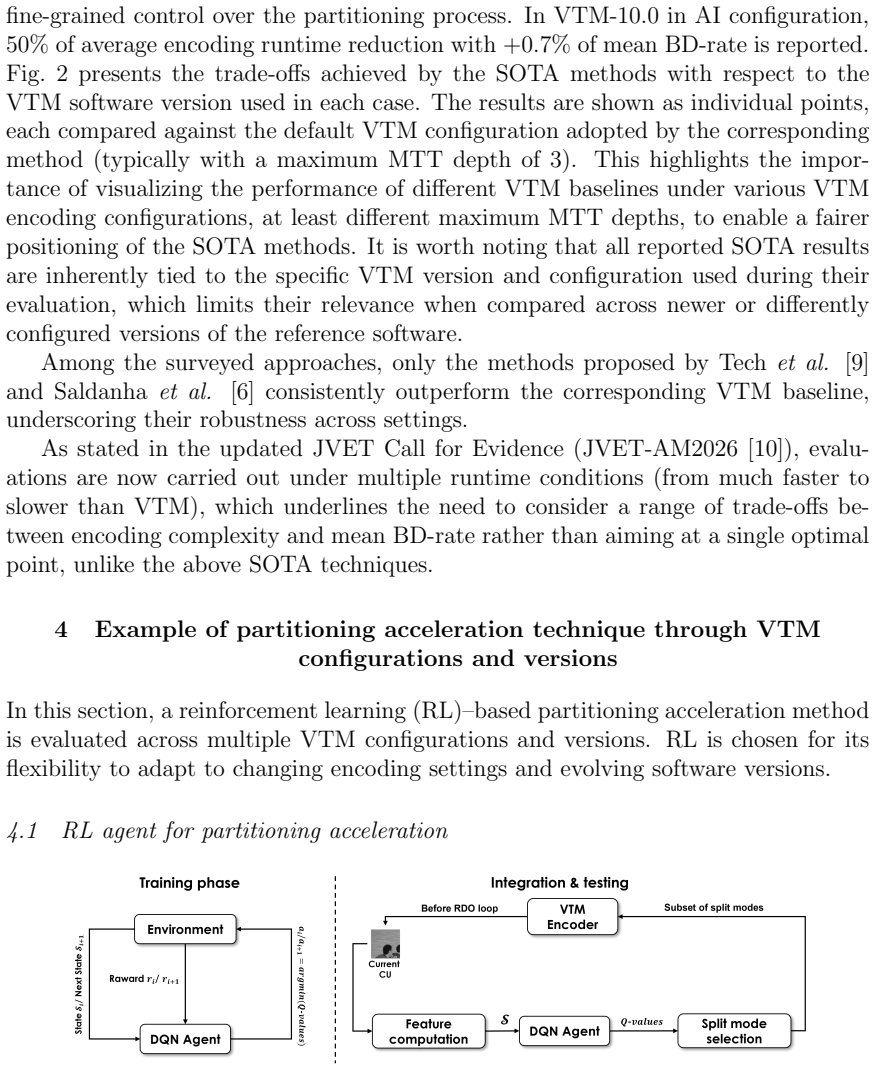
QTMTT partitioning structure which increases the split combinatorial complexity... reinforcement learning (RL)–based partitioning acceleration method
-
IndisputableMonolith/Cost/FunctionalEquation.leanwashburn_uniqueness_aczel unclear?
unclearRelation between the paper passage and the cited Recognition theorem.
gradient-based early termination... CNN-based approach... DQN agent learns to approximate the Q-value function using the RD cost as a reward signal
What do these tags mean?
- matches
- The paper's claim is directly supported by a theorem in the formal canon.
- supports
- The theorem supports part of the paper's argument, but the paper may add assumptions or extra steps.
- extends
- The paper goes beyond the formal theorem; the theorem is a base layer rather than the whole result.
- uses
- The paper appears to rely on the theorem as machinery.
- contradicts
- The paper's claim conflicts with a theorem or certificate in the canon.
- unclear
- Pith found a possible connection, but the passage is too broad, indirect, or ambiguous to say the theorem truly supports the claim.
Reference graph
Works this paper leans on
-
[1]
Overview of the versatile video coding (vvc) standard and its applications,
B. Bross, Y.-K. Wang, Y. Ye, S. Liu, J. Chen, G. J. Sullivan, and J.-R. Ohm, “Overview of the versatile video coding (vvc) standard and its applications,”IEEE Transactions on Circuits and Systems for Video Technology, vol. 31, no. 10, pp. 3736–3764, 2021
work page 2021
-
[2]
Gradient-based early termination of cu partition in vvc intra coding,
J. Cui, T. Zhang, C. Gu, X. Zhang, and S. Ma, “Gradient-based early termination of cu partition in vvc intra coding,” in2020 Data Compression Conference (DCC), 2020, pp. 103–112
work page 2020
-
[3]
Cnn oriented com- plexity reduction of vvc intra encoder,
A. Tissier, W. Hamidouche, J. Vanne, F. Galpin, and D. Menard, “Cnn oriented com- plexity reduction of vvc intra encoder,” in2020 IEEE International Conference on Image Processing (ICIP), 2020, pp. 3139–3143
work page 2020
-
[4]
Accelerate ctu partition to real time for hevc encoding with complexity control,
T. Li, M. Xu, X. Deng, and L. Shen, “Accelerate ctu partition to real time for hevc encoding with complexity control,”IEEE Transactions on Image Processing, vol. 29, pp. 7482–7496, 2020
work page 2020
-
[5]
Deepqtmt: A deep learning approach for fast qtmt-based cu partition of intra-mode vvc,
T. Li, M. Xu, R. Tang, Y. Chen, and Q. Xing, “Deepqtmt: A deep learning approach for fast qtmt-based cu partition of intra-mode vvc,”IEEE Transactions on Image Processing, vol. 30, pp. 5377–5390, 2021
work page 2021
-
[6]
Configurable fast block parti- tioning for vvc intra coding using light gradient boosting machine,
M. Saldanha, G. Sanchez, C. Marcon, and L. Agostini, “Configurable fast block parti- tioning for vvc intra coding using light gradient boosting machine,”IEEE Transactions on Circuits and Systems for Video Technology, vol. 32, no. 6, pp. 3947–3960, 2022
work page 2022
-
[7]
Machine learning based efficient qt-mtt partitioning scheme for vvc intra encoders,
A. Tissier, W. Hamidouche, S. B. D. Mdalsi, J. Vanne, F. Galpin, and D. Menard, “Machine learning based efficient qt-mtt partitioning scheme for vvc intra encoders,” IEEE Transactions on Circuits and Systems for Video Technology, vol. 33, no. 8, pp. 4279–4293, 2023
work page 2023
-
[8]
Partition map prediction for fast block par- titioning in vvc intra-frame coding,
A. Feng, K. Liu, D. Liu, L. Li, and F. Wu, “Partition map prediction for fast block par- titioning in vvc intra-frame coding,”IEEE Transactions on Image Processing, vol. 32, pp. 2237–2251, 2023
work page 2023
-
[9]
Rate-distortion-time cost aware cnn training for fast vvc intra-picture partitioning decisions,
G. Tech, J. Pfaff, H. Schwarz, P. Helle, A. Wieckowski, D. Marpe, and T. Wiegand, “Rate-distortion-time cost aware cnn training for fast vvc intra-picture partitioning decisions,” in2021 Picture Coding Symposium (PCS), 2021, pp. 1–5
work page 2021
-
[10]
Joint call for evidence on video compression with capability beyond vvc,
J.-R. Ohm, M. Wien, and F. Bossen, “Joint call for evidence on video compression with capability beyond vvc,” Joint Video Experts Team (JVET), Tech. Rep. JVET-AM2026, July 2025, 39th Meeting, Daejeon, KR, 26 June – 4 July 2025. [Online]. Available: https://jvet-experts.org/doc end user/documents/39 Daejeon/ wg11/JVET-AM2026-v2.zip
work page 2025
-
[11]
BVI-DVC: A training database for deep video compression,
D. Ma, F. Zhang, and D. R. Bull, “BVI-DVC: A training database for deep video compression,”IEEE Transactions on Multimedia, vol. 24, pp. 3847–3858, 2022. [Online]. Available: https://doi.org/10.1109%2Ftmm.2021.3108943
-
[12]
R. S. Sutton and A. G. Barto,Reinforcement Learning: An Introduction, 2nd ed. MIT Press, 2018. [Online]. Available: https://web.stanford.edu/class/psych209/ Readings/SuttonBartoIPRLBook2ndEd.pdf
work page 2018
-
[13]
Common test conditions and evaluation procedures for en- hanced compression tool testing,
K. Marta and Y. Yan, “Common test conditions and evaluation procedures for en- hanced compression tool testing,”WG 05 MPEG Joint Video Coding Team(s) with ITU-T SG 16,30 th meeting, Antalya, 2023
work page 2023
discussion (0)
Sign in with ORCID, Apple, or X to comment. Anyone can read and Pith papers without signing in.