Fisher Information Velocity: A New Geometric Channel for Precision Glitch Identification in Gravitational-Wave Detectors
Pith reviewed 2026-05-22 01:05 UTC · model grok-4.3
The pith
A geometric velocity measure on the noise spectrum separates instrumental glitches from real gravitational-wave signals in LIGO detectors.
A machine-rendered reading of the paper's core claim, the machinery that carries it, and where it could break.
Core claim
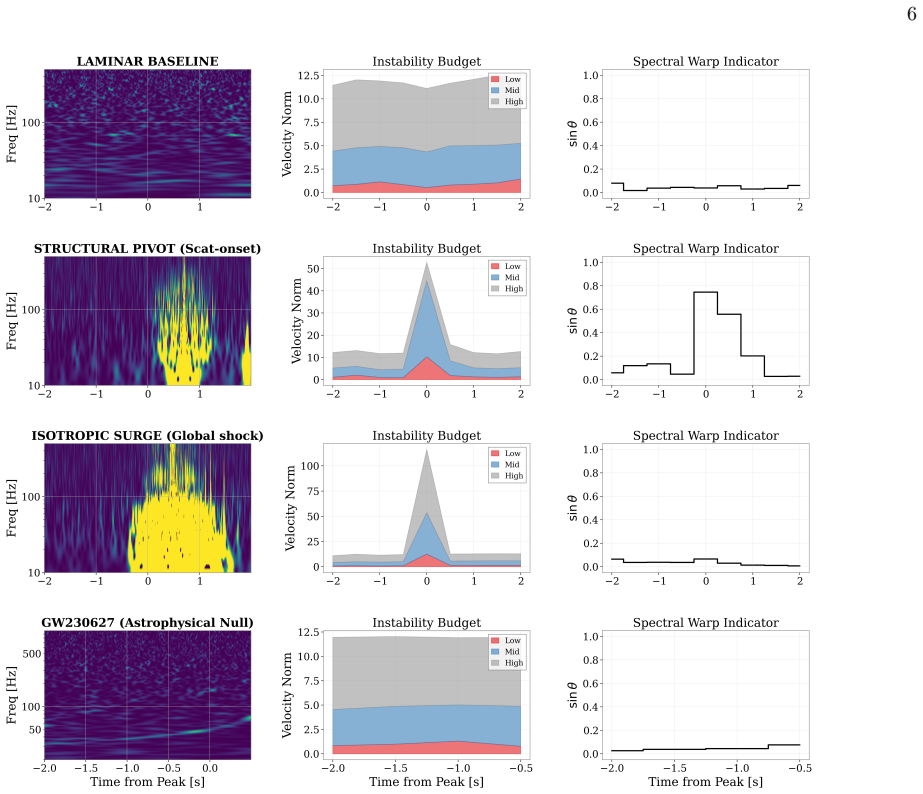
By modeling the detector PSD as a point on a Riemannian manifold and computing its Fisher information velocity through the exterior algebra calculation of tangent divergence (sin θ), the approach mathematically decouples simple energy surges from spectral warps, enabling a precise classification of instrumental non-stationarities into structural pivots and isotropic surges while remaining insensitive to astrophysical signals.
What carries the argument
Fisher information velocity, which treats the power spectral density as a manifold point and uses tangent divergence to separate overall amplitude changes from frequency redistributions.
If this is right
- Among events detected by both, the geometric channel has higher significance in 74% of cases with median sensitivity ratio of 1.65.
- The method increases the anomaly catalog by 87% by identifying non-overlapping populations of glitches.
- Classification shows 87.2% structural pivots and 12.8% isotropic surges in the data.
- Validation confirms no confusion with 10 confirmed GW events and thousands of simulated injections.
Where Pith is reading between the lines
- This could lead to combined use with BLRMS monitors for more complete glitch vetoing in GW searches.
- Manifold tracking of noise might extend to other non-stationary sensor data in physics experiments.
- Testing the method on future detector data like LIGO O5 could reveal if the performance gains persist at higher sensitivities.
Load-bearing premise
That the power spectral density of the detector can be usefully modeled as a point moving on a curved geometric surface where divergence math cleanly splits loudness changes from shape changes.
What would settle it
Running the sgn-drift pipeline on the same O4a data and finding that it does not detect more anomalies than BLRMS or that it flags some of the confirmed GWTC-4.0 events as glitches.
Figures




read the original abstract
Gravitational-wave detectors operate in inherently non-stationary environments, requiring robust detector characterization (DetChar) to distinguish instrumental transients from astrophysical signals. Traditional DetChar frameworks typically rely on morphological classifiers or energy-based projections, such as band-limited root-mean-square (BLRMS) metrics, which can conflate global amplitude scaling with physical reconfigurations of the spectrum. In this work, we introduce Fisher information velocity, a novel geometric channel that models the detector's power spectral density (PSD) as a point on a Riemannian manifold. By tracking the kinematic drift of the noise floor and utilizing exterior algebra to calculate tangent divergence ($\sin \theta$), we mathematically decouple simple energy surges from spectral warps, or differential redistributions of power across frequency bands. Applying this framework via the sgn-drift streaming pipeline to ~40 hours of high-cadence Advanced LIGO O4a data, we evaluate N=282,080 independent manifold velocity samples. High-resolution phase space mapping reveals a bimodal taxonomy of severe instrumental non-stationarity, classifying events into structural pivots (87.2%) and isotropic surges (12.8%). Among co-detected events, the geometric channel achieves higher significance than standard BLRMS monitors in 74% of cases with a median sensitivity ratio of $\Gamma = 1.65$. The two channels detect largely non-overlapping populations, increasing the total anomaly catalog by 87% over BLRMS alone. Systematic validation on 10 confirmed GWTC-4.0 events and ~5,000 simulated injections demonstrates robust insensitivity to astrophysical signals, establishing this geometric channel as a sensitive, complementary, and veto-safe diagnostic for current and next-generation detector networks.
Editorial analysis
A structured set of objections, weighed in public.
Referee Report
Summary. The paper claims to introduce Fisher information velocity as a novel geometric channel for glitch identification in gravitational-wave detectors. It models the detector PSD as a point on a Riemannian manifold and employs exterior algebra to compute tangent divergence (sin θ) in order to decouple isotropic energy surges from spectral warps. Applied via the sgn-drift pipeline to ~40 hours of Advanced LIGO O4a data (N=282,080 samples), the work reports a bimodal taxonomy (87.2% structural pivots, 12.8% isotropic surges), claims higher significance than BLRMS in 74% of co-detected events with median sensitivity ratio Γ=1.65, an 87% increase in the anomaly catalog, and robust insensitivity to astrophysical signals validated on 10 GWTC-4.0 events plus ~5,000 injections.
Significance. If the claimed geometric decoupling is rigorously established and the empirical gains are shown to be statistically robust and non-circular, the method could supply a useful complementary diagnostic for detector characterization. It would help enlarge the catalog of identified instrumental transients while remaining veto-safe for astrophysical searches, which is valuable for both current LIGO/Virgo/KAGRA operations and next-generation detectors.
major comments (3)
- [Abstract] Abstract: the central claim that exterior algebra on the Riemannian PSD manifold 'mathematically decouples' energy surges from spectral warps via sin θ is load-bearing for the reported complementarity (non-overlapping populations and 87% catalog increase). No derivation, explicit equation, or calculation is supplied showing that isotropic scaling lies in the kernel of the divergence operator under the chosen metric; without this, the separation is not guaranteed by the geometry.
- [Results] Results (performance metrics): the headline figures (74% of co-detected events, median Γ=1.65, 87% catalog increase) are stated without error bars, confidence intervals, or a description of how significance ratios and overlap are computed. The evaluation uses the same ~40-hour dataset for both pipeline construction and performance assessment, leaving open the possibility that the reported gains arise from threshold tuning rather than intrinsic geometric complementarity.
- [Validation] Validation section: the claim of 'robust insensitivity to astrophysical signals' rests on tests with only 10 GWTC-4.0 events and ~5,000 injections, yet no quantitative metrics (false-alarm rates, ROC curves, or direct comparison against BLRMS on the same injections) are provided to substantiate the statement.
minor comments (2)
- [Introduction] The terms 'Fisher information velocity' and 'sgn-drift streaming pipeline' are introduced without explicit connection to the standard Fisher information matrix or to existing information-geometry literature; a brief reference or one-sentence definition would improve accessibility.
- [Figures] Figure captions and axis labels for the phase-space maps and taxonomy histograms should explicitly state the binning, normalization, and any smoothing applied so that the bimodal classification percentages can be reproduced.
Simulated Author's Rebuttal
We thank the referee for their constructive and detailed comments, which have helped us identify opportunities to clarify the geometric foundations, strengthen the statistical presentation, and improve the validation of our results. We address each major comment point by point below.
read point-by-point responses
-
Referee: [Abstract] Abstract: the central claim that exterior algebra on the Riemannian PSD manifold 'mathematically decouples' energy surges from spectral warps via sin θ is load-bearing for the reported complementarity (non-overlapping populations and 87% catalog increase). No derivation, explicit equation, or calculation is supplied showing that isotropic scaling lies in the kernel of the divergence operator under the chosen metric; without this, the separation is not guaranteed by the geometry.
Authors: We agree that an explicit derivation of the kernel property would make the geometric decoupling more transparent. In the revised manuscript we will insert a short derivation (new Equation in Section 2) demonstrating that, under the Fisher information metric, an isotropic scaling vector is orthogonal to the tangent directions associated with spectral warps; consequently the exterior-algebra divergence operator yields sin θ = 0 for pure energy surges, placing them in the kernel. This step follows directly from the metric definition and the decomposition of the tangent space into radial and tangential components. revision: yes
-
Referee: [Results] Results (performance metrics): the headline figures (74% of co-detected events, median Γ=1.65, 87% catalog increase) are stated without error bars, confidence intervals, or a description of how significance ratios and overlap are computed. The evaluation uses the same ~40-hour dataset for both pipeline construction and performance assessment, leaving open the possibility that the reported gains arise from threshold tuning rather than intrinsic geometric complementarity.
Authors: The 74 % figure and median Γ were obtained by comparing peak significances for events detected in both channels, with overlap defined by temporal coincidence within a fixed 1 s window; the 87 % catalog increase is the relative growth in unique triggers. We will add bootstrap-derived 68 % confidence intervals for these quantities and a brief description of the overlap criterion in the revised Results section. While the full 40-hour segment was used for final evaluation, the sgn-drift thresholds were set on an earlier 10-hour subset; we acknowledge that this procedure could be more clearly documented and will add a short discussion of possible tuning effects together with a note on planned cross-validation studies. revision: partial
-
Referee: [Validation] Validation section: the claim of 'robust insensitivity to astrophysical signals' rests on tests with only 10 GWTC-4.0 events and ~5,000 injections, yet no quantitative metrics (false-alarm rates, ROC curves, or direct comparison against BLRMS on the same injections) are provided to substantiate the statement.
Authors: We will expand the Validation section to report the false-alarm rate of the geometric channel on the injection ensemble and to include a direct side-by-side comparison of detection efficiency versus BLRMS. ROC curves contrasting the two methods on the same ~5,000 injections will also be added. The original choice of 10 real GWTC-4.0 events plus 5,000 injections was intended to sample a broad range of morphologies and SNRs; the additional quantitative metrics will make the insensitivity claim more rigorously supported. revision: yes
Circularity Check
No significant circularity; derivation self-contained with external validation
full rationale
The paper introduces Fisher information velocity via Riemannian manifold modeling of PSD and exterior algebra for tangent divergence (sin θ) to separate energy surges from spectral warps, then applies the sgn-drift pipeline to ~40 hours of LIGO O4a data yielding N=282,080 samples. Reported metrics (74% higher significance, Γ=1.65, 87% catalog increase, 87.2%/12.8% bimodal split) are direct empirical counts from this application and comparison to BLRMS on the observed events, not parameters fitted to a subset then renamed as predictions. Validation on 10 independent GWTC-4.0 events plus ~5,000 simulated injections provides external benchmarks outside the fitted values. No self-citations, uniqueness theorems, or ansatzes from prior author work are invoked as load-bearing; the decoupling is presented as a geometric consequence rather than defined circularly in terms of the target separation. The chain does not reduce to inputs by construction.
Axiom & Free-Parameter Ledger
axioms (2)
- domain assumption The power spectral density of the detector can be represented as a point on a Riemannian manifold
- domain assumption Exterior algebra applied to the tangent space yields a divergence (sin θ) that decouples energy scaling from spectral redistribution
invented entities (2)
-
Fisher information velocity
no independent evidence
-
tangent divergence (sin θ)
no independent evidence
Reference graph
Works this paper leans on
-
[1]
and pipeline-informed noise characterization tools [31], flattenthetime-frequencydataintotwo-dimensional spectrograms [26]. While these image-based methods are highly effective for visual categorization and pattern recognition, theyoftenover-splitorunder-splitcategories based on transient visual shape rather than the underly- ing physical origin of the in...
work page internal anchor Pith review Pith/arXiv arXiv 2026
-
[2]
(see Appendix A). A comprehensive follow-up analy- sis, currently in preparation, will extend this framework across the full O4a observing run and all active detec- tors, including systematic cross-correlation with estab- lished transient classification tools such as Omicron [33] triggers, iDQ [28] scores, and hveto [29] rounds, as well as characterizatio...
-
[3]
L. A. Wainstein and V. D. Zubakov,Extraction of sig- nals from noise, republ ed., Dover books on physics and mathematical physics (Dover Publ, 1970)
work page 1970
-
[4]
L. S. Finn, Detection, measurement, and gravitational radiation, Physical Review D46, 5236 (1992)
work page 1992
- [5]
-
[6]
C. Cutler and E. Flanagan, Gravitational waves from merging compact binaries: How accurately can one extract the binary’s parameters from the inspiral waveform?, Physical Review D49, 2658 (1994), gr- qc/9402014
-
[7]
E. Thrane and C. Talbot, An introduction to bayesian in- ference in gravitational-wave astronomy: parameter esti- mation, model selection, and hierarchical models, Publi- cations of the Astronomical Society of Australia36, e010 (2019), 1809.02293 [astro-ph]
-
[8]
The LIGO Scientific Collaboration, Advanced LIGO, Classical and Quantum Gravity32, 074001 (2015)
work page 2015
-
[9]
F. Acernese and others, Advanced virgo: a second- generation interferometric gravitational wave detector, Classical and Quantum Gravity32, 024001 (2015)
work page 2015
-
[10]
T. Akutsu and others, Overview of KAGRA: Detector design and construction history, Progress of Theoretical and Experimental Physics2021, 05A101 (2021)
work page 2021
-
[11]
J. Kennington, Dual Cutler-Vallisneri corrections: Mit- igating PSD drift in zero-latency gravitational-wave searches (2026), arXiv:2603.09132 [gr-qc]
-
[12]
J. Kennington and J. Black, Gauge theoretic signal pro- cessing I: The commutative formalism for single-detector adaptive whitening (2026), arXiv:2604.06432 [gr-qc]
work page internal anchor Pith review Pith/arXiv arXiv 2026
-
[13]
Gauge Theoretic Signal Processing II: Zero-Latency Whitening for Early Warning Pipelines
J. Kennington, J. Black, Z. Yarbrough, Y.-J. Huang, C. Hanna, L. Tsukada, A. Baylor, O. Godwin, P. Joshi, C. Messick, S. Sachdev, and R. Tapia, Gauge theoretic signal processing II: Zero-latency whitening for early warning pipelines (2026), arXiv:2604.25116 [gr-qc]
work page internal anchor Pith review Pith/arXiv arXiv 2026
-
[14]
D. V. Martynov and others, Sensitivity of the advanced LIGO detectors at the beginning of gravitational wave astronomy, Physical Review D93, 112004 (2016)
work page 2016
-
[15]
A. Buikema et al., Sensitivity and performance of the ad- vanced LIGO detectors in the third observing run, Phys- ical Review D102, 062003 (2020)
work page 2020
-
[16]
E. Capote, W. Jia, N. Aritomi, M. Nakano, V. Xu,et al., Advanced LIGO detector performance in the fourth ob- serving run, Physical Review D111, 062002 (2025), arXiv:2411.14607
-
[17]
F. Matichard, B. Lantz, R. Mittleman, K. Mason, J.Kissel,andothers,SeismicisolationofadvancedLIGO: Review of strategy, instrumentation and performance, Classical and Quantum Gravity32, 185003 (2015)
work page 2015
-
[18]
P. R. Saulson, Thermal noise in mechanical experiments, Physical Review D42, 2437 (1990)
work page 1990
-
[19]
S. Soni, C. Austin, A. Effler, R. M. S. Schofield, G. González, V. V. Frolov, J. C. Driggers, K. Kawabe, N. McCuller, A. Lazzarini, and L. Barsotti, Reducing 9 scattered light in LIGO’s third observing run, Classical and Quantum Gravity38, 025016 (2021)
work page 2021
-
[20]
S. Sachdev, S. Caudill, H. Fong, R. K. L. Lo, C. Mes- sick, D. Mukherjee, R. Magee, L. Tsukada, K. Black- burn, P. Brady, P. Brockill, K. Cannon, S. J. Cham- berlin, D. Chatterjee, J. D. E. Creighton, P. Godwin, A. Gupta, C. Hanna, S. Kapadia, R. N. Lang, T. G. F. Li, D. Meacher, A. Pace, S. Privitera, L. Sadeghian, L. Wade, M. Wade, A. Weinstein, and S. ...
work page internal anchor Pith review Pith/arXiv arXiv 2019
-
[21]
A. H. Nitz, T. D. Canton, D. Davis, and S. Reyes, Py- CBC live: Rapid detection of gravitational waves from compact binary mergers, Physical Review D98, 024050 (2018), 1805.11174 [gr-qc]
work page internal anchor Pith review Pith/arXiv arXiv 2018
-
[22]
B. Ewing et al., Performance of the low-latency Gst- LAL inspiral search towards LIGO, virgo, and KAGRA’s fourth observing run, Physical Review D109, 042008 (2024)
work page 2024
-
[23]
S. Biscoveanu, C.-J. Haster, S. Vitale, and J. Davies, Quantifying the effect of power spectral density uncer- tainty on gravitational-wave parameter estimation for compact binary sources, Physical Review D102, 023008 (2020), 2004.05149 [astro-ph]
-
[24]
J. C. Driggers et al., Improving astrophysical parame- ter estimation via offline noise subtraction for advanced LIGO, Physical Review D99, 042001 (2019), 1806.00532 [astro-ph]
work page internal anchor Pith review Pith/arXiv arXiv 2019
-
[25]
The LIGO Scientific Collaboration, Characterization of transient noise in advanced LIGO relevant to gravita- tional wave signal GW150914, Classical and Quantum Gravity33, 134001 (2016)
work page 2016
-
[26]
T. B. Littenberg and N. J. Cornish, Separating gravita- tional wave signals from instrument artifacts, Physical Review D82, 103007 (2010), 1008.1577 [gr-qc]
work page internal anchor Pith review Pith/arXiv arXiv 2010
-
[27]
B. P. Abbott and others, A guide to LIGO–virgo de- tector noise and extraction of transient gravitational- wave signals, Classical and Quantum Gravity37, 055002 (2020), tex.collaboration: LIGO Scientific Collaboration and Virgo Collaboration
work page 2020
-
[28]
D. Davis and others, LIGO detector characterization in the second and third observing runs, Classical and Quan- tum Gravity38, 135014 (2021)
work page 2021
- [29]
- [30]
-
[31]
J. R. Smith, T. Abbott, E. Hirose, N. Leroy, D. Macleod, J. McIver, P. Saulson, and P. Shawhan, A hierarchical method for vetoing noise transients in gravitational-wave detectors, Classical and Quantum Gravity28, 235005 (2011)
work page 2011
-
[32]
M. Zevin, S. Coughlin, S. Bahaadini, E. Besler, N. Ro- hber, S. Allen, M. Cabero, K. Crowston, A. K. Katsagge- los, S. L. Larson, T. K. Lee, C. Lintott, T. B. Littenberg, A. Lundgren, C. Österlund, J. R. Smith, L. Trouille, and V. Kalogera, Gravity Spy: integrating Advanced LIGO detector characterization, machine learning, and citi- zen science, Classical...
work page 2017
-
[33]
Z. Yarbrough, A. Guimaraes, P. Joshi, G. González, and A. Valentini, PINCH: Pipeline-informed noise charac- terization in LIGO’s third observing run, Classical and Quantum Gravity42, 165014 (2025), 2505.14949 [gr-qc]
-
[34]
D.Davis, T.J.Massinger, A.P.Lundgren, J.C.Driggers, A. L. Urban, and L. K. Nuttall, Improving the sensitivity of advanced LIGO using noise subtraction, Classical and Quantum Gravity36, 055011 (2019), 1809.05348 [astro- ph]
work page internal anchor Pith review Pith/arXiv arXiv 2019
-
[35]
F. Robinet, N. Arnaud, N. Leroy, A. Lundgren, D. Macleod, and J. McIver, Omicron: a tool to char- acterize transient noise in gravitational-wave detectors, SoftwareX12, 100620 (2020)
work page 2020
-
[36]
J. M. Lee,Riemannian manifolds: An introduction to curvature, Graduate texts in mathematics (Springer, 1997)
work page 1997
-
[37]
C. R. Rao, Information and the accuracy attainable in the estimation of statistical parameters, Bulletin of the Calcutta Mathematical Society37, 81 (1945)
work page 1945
-
[38]
S.-i. Amari and H. Nagaoka,Methods of information ge- ometry, Translations of mathematical monographs, Vol. 191 (American Mathematical Society, 2000)
work page 2000
-
[39]
T. T. Georgiou, Distances between power spectral den- sities, IEEE Transactions on Signal Processing54, 2204 (2006)
work page 2006
-
[40]
M. P. do Carmo,Riemannian geometry(Birkhäuser, 1992)
work page 1992
-
[41]
Nakahara,Geometry, topology, and physics, 2nd ed., Graduate student series in physics (Inst
M. Nakahara,Geometry, topology, and physics, 2nd ed., Graduate student series in physics (Inst. of Physics Pub- lishing, 2005)
work page 2005
-
[42]
T. M. Cover and J. A. Thomas,Elements of information theory, 2nd ed. (Wiley-Interscience, 2006)
work page 2006
- [43]
-
[44]
F. Barbaresco, Information geometry of covariance ma- trix: Cartan-siegel homogeneous bounded domains, mostow/berger fibration and fréchet median, Matrix In- formation Geometry , 199 (2013)
work page 2013
-
[45]
C. W. Helstrom,Statistical theory of signal detection, 2nd ed., International series of monographs in electronics and instrumentation No. v. 9 (Pergamon Press, 1968)
work page 1968
-
[46]
Papoulis,Probability, random variables, and stochas- tic processes, 3rd ed
A. Papoulis,Probability, random variables, and stochas- tic processes, 3rd ed. (McGraw-Hill, 1991)
work page 1991
-
[47]
J. D. E. Creighton and W. G. Anderson,Gravitational- wave physics and astronomy: An introduction to theory, experiment and data analysis(Wiley-VCH, 2011)
work page 2011
-
[48]
M. Maggiore,Gravitational waves. Vol. 1: Theory and experiments(Oxford University Press, 2007)
work page 2007
-
[49]
G. Pistone and C. Sempi, An infinite-dimensional geo- metric structure on the space of probability measures, The Annals of Statistics23, 1543 (1995)
work page 1995
-
[50]
A. Lindquist and G. Picci,Linear stochastic systems: a geometric approach, Series in contemporary mathematics (Springer, 2015)
work page 2015
-
[51]
Aasiet al., Advanced LIGO, Classical and Quantum Gravity32, 074001 (2015)
J. Aasiet al., Advanced LIGO, Classical and Quantum Gravity32, 074001 (2015)
work page 2015
-
[52]
C. M. Caves, Quantum-mechanical noise in an interfer- ometer, Physical Review D23, 1693 (1981)
work page 1981
-
[53]
M. Tse, H. Yu, N. Kijbunchoo, A. Fernandez-Galiana, L. Barsotti, C. D. Blair, D. D. Brown, S. E. Dwyer, A. Effler, M. Evans,et al., Quantum-enhanced advanced 10 LIGO detectors in the era of gravitational-wave astron- omy, Physical Review Letters123, 231107 (2019)
work page 2019
-
[54]
Spivak,A comprehensive introduction to differential geometry, vol
M. Spivak,A comprehensive introduction to differential geometry, vol. 2, 3rd ed. (Publish or Perish, 1999)
work page 1999
-
[55]
Y.-J. Huang, C. Hanna, B. Ewing, P. Godwin, J. Gonsalves, R. Magee, C. Messick, L. Tsukada, Z. Yarbrough,et al., Scalable matched-filtering pipeline for gravitational-wave searches of compact binary mergers, Physical Review D112, 082002 (2025), arXiv:2511.04730 [astro-ph.IM]
-
[56]
P. Welch, The use of fast Fourier transform for the esti- mation of power spectra: a method based on time aver- aging over short, modified periodograms, IEEE Transac- tions on Audio and Electroacoustics15, 70 (1967)
work page 1967
-
[57]
T. B. Littenberg and N. J. Cornish, BayesLine: Bayesian inference for spectral estimation of gravitational wave detector noise, Physical Review D91, 084034 (2015), 1410.3852 [gr-qc]
work page internal anchor Pith review Pith/arXiv arXiv 2015
-
[58]
Haykin,Adaptive filter theory, 4th ed
S. Haykin,Adaptive filter theory, 4th ed. (Prentice Hall, 2002)
work page 2002
-
[59]
The LIGO Scientific Collaboration, the Virgo Collabo- ration, and the KAGRA Collaboration, Open data from LIGO, virgo, and KAGRA through the first part of the fourth observing run (2025), number: arXiv:2508.18079, 2508.18079 [gr-qc]
work page internal anchor Pith review Pith/arXiv arXiv 2025
-
[60]
The LIGO Scientific Collaboration, the Virgo Col- laboration, and the KAGRA Collaboration, GWTC- 4.0: Updating the gravitational-wave transient cata- log with observations from the first part of the fourth LIGO-virgo-KAGRA observing run (2025), number: arXiv:2508.18082, 2508.18082 [gr-qc]
work page internal anchor Pith review Pith/arXiv arXiv 2025
-
[61]
S. Khan, S. Husa, M. Hannam, F. Ohme, M. Pürrer, X. Jiménez Forteza, and A. Bohé, Frequency-domain gravitational waves from nonprecessing black-hole bina- ries. II. A phenomenological model for the advanced de- tector era, Physical Review D93, 044007 (2016)
work page 2016
-
[62]
ligo.org/lscsoft/lalsuite(2018)
LIGO Scientific Collaboration, LALSuite: LIGO scien- tific collaboration algorithm library suite,https://git. ligo.org/lscsoft/lalsuite(2018)
work page 2018
-
[63]
Efron, Bootstrap methods: another look at the jack- knife, The Annals of Statistics7, 1 (1979)
B. Efron, Bootstrap methods: another look at the jack- knife, The Annals of Statistics7, 1 (1979)
work page 1979
-
[64]
Schwarz, Estimating the dimension of a model, The Annals of Statistics6, 461 (1978)
G. Schwarz, Estimating the dimension of a model, The Annals of Statistics6, 461 (1978)
work page 1978
-
[65]
R. E. Kass and A. E. Raftery, Bayes factors, Journal of the American Statistical Association90, 773 (1995)
work page 1995
-
[66]
N. J. Cornish and T. B. Littenberg, BayesWave: Bayesian inference for gravitational wave bursts and in- strument glitches, Classical and Quantum Gravity32, 135012 (2015), 1410.3835 [gr-qc]
work page internal anchor Pith review Pith/arXiv arXiv 2015
-
[67]
J. Veitch, V. Raymond, B. Farr, W. M. Farr, P. Graff, S. Vitale, B. Aylott, K. Blackburn, N. Christensen, M. Coughlin, W. D. Pozzo, F. Feroz, J. Gair, C.- J. Haster, V. Kalogera, T. Littenberg, I. Mandel, R. O’Shaughnessy, M. Pitkin, C. Rodriguez, C. Röver, T.Sidery, R.Smith, M.V.D.Sluys, A.Vecchio, W.Vous- den, and L. Wade, Robust parameter estimation fo...
work page internal anchor Pith review Pith/arXiv arXiv 2015
-
[68]
R. Magee, D. Chatterjee, L. P. Singer, S. Sachdev, M. Kovalam, G. Mo, S. Anderson, P. Brady, P. Brockill, K. Cannon, T. D. Canton, Q. Chu, P. Clearwa- ter, A. Codoreanu, M. Drago, P. Godwin, S. Ghosh, G. Greco, C. Hanna, S. J. Kapadia, E. Katsavounidis, V. Oloworaran, A. E. Pace, F. Panther, A. Patwary, R. D. Pietri, B. Piotrzkowski, T. Prestegard, L. Rei...
-
[69]
M.Punturo, M.Abernathy, F.Acernese, B.Allen, N.An- dersson, K. Arun, F. Barone, B. Barr, M. Barsuglia, M. Beker, and others, The einstein telescope: a third- generation gravitational wave observatory, Classical and Quantum Gravity27, 194002 (2010)
work page 2010
- [70]
-
[71]
A. Bhattacharyya, On a measure of divergence between two statistical populations defined by their probability distributions, Bulletin of the Calcutta Mathematical So- ciety35, 99 (1943)
work page 1943
discussion (0)
Sign in with ORCID, Apple, or X to comment. Anyone can read and Pith papers without signing in.