From Licensing to Open Access: Designing a Sustainable Transition in Operational Weather Data
Pith reviewed 2026-05-22 07:54 UTC · model grok-4.3
The pith
A tiered service model can reconcile open-access obligations with operational sustainability for weather data.
A machine-rendered reading of the paper's core claim, the machinery that carries it, and where it could break.
Core claim
The paper shows that through an iterative planning cycle of setting annual revenue reduction targets, adding to the open tier, provisioning infrastructure, and assessing outcomes, the transition resulted in high retention of service agreements and increased open access usage, supporting the idea that a tiered model can balance open data obligations with the need for operational sustainability.
What carries the argument
The tiered service model that keeps core forecast data open while offering operationally supported delivery as a cost-recovered service.
If this is right
- Over 93% of previously paying organisations retained a Service Agreement in the first six months after the transition.
- Open endpoint download volumes increased substantially.
- Compliance overheads from redistribution restrictions were reduced.
- The approach improves scalability for global data distribution.
- Longer-term monitoring over annual contract renewal cycles is needed to confirm sustainability.
Where Pith is reading between the lines
- Similar tiered approaches could help other providers of operational scientific data meet open access mandates without immediate revenue collapse.
- The rise of free AI-based forecast products may require future adjustments to the cost-recovery tier to maintain viability.
- Tracking user retention and revenue over multiple years would provide stronger evidence for the model's effectiveness.
- Decisions on what specific resolutions and parameters to include in the open tier will influence both accessibility and sustainability.
Load-bearing premise
That the observed 93% retention rate and increased open downloads in the first six months will persist through future annual contract renewals despite potential competition from freely available AI-based forecast products.
What would settle it
Observing a retention rate well below 93% or unsustainable costs in the subsequent annual renewal cycles would falsify the sustainability of the tiered model.
Figures




read the original abstract
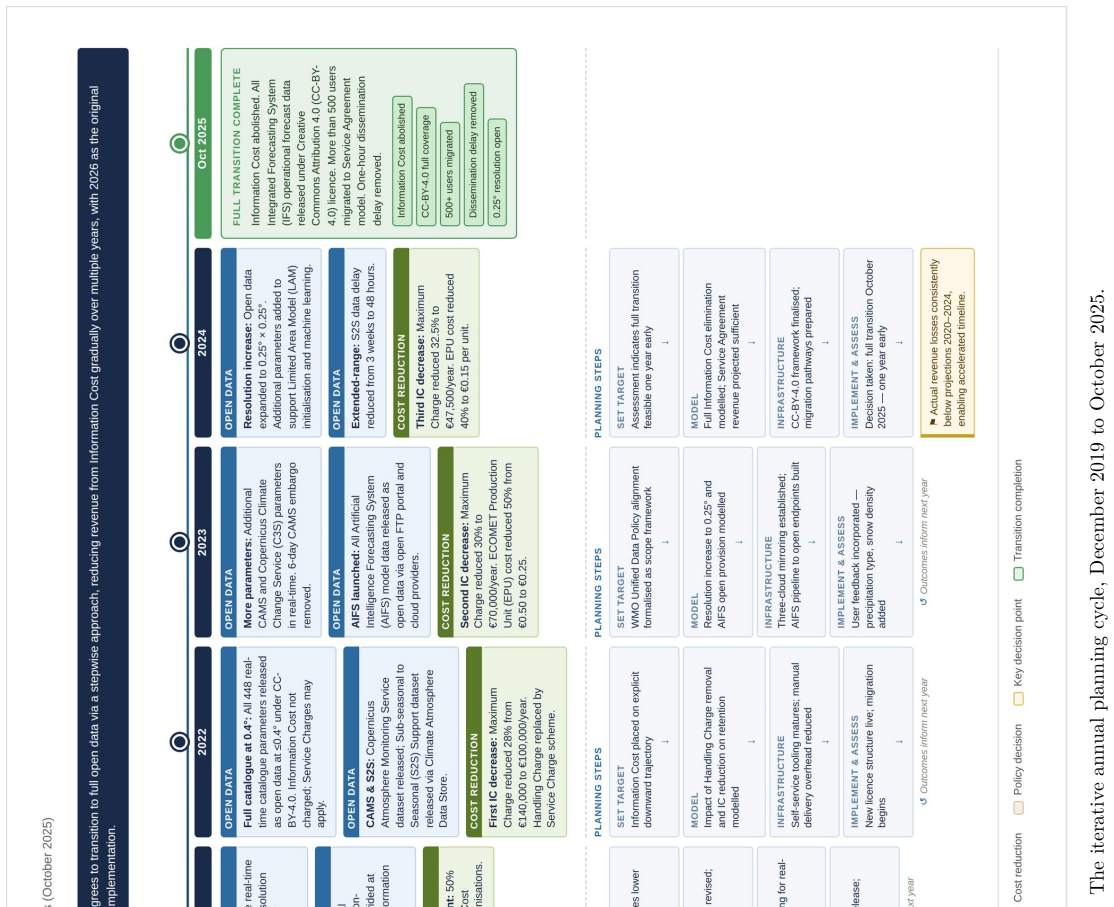
This translational article documents the European Centre for Medium-Range Weather Forecasts (ECMWF) transition from a restricted data licensing model to open access under CC BY 4.0, completed in October 2025. The policy context included EU open data requirements and alignment with international data exchange frameworks. The transition was implemented through a tiered service model that kept core forecast data open while offering operationally supported delivery as a cost-recovered service. Between 2020 and 2025, ECMWF executed an iterative planning cycle: setting an annual target for revenue reduction, specifying additions to the open tier under that target, provisioning infrastructure, and assessing outcomes to update assumptions. Drawing on internal administrative records (2014 - 2025), we describe design choices, operational constraints, and early outcomes. In the six months following the end of the transition, more than 93% of previously paying organisations retained a Service Agreement, while open endpoint download volumes increased substantially. We discuss trade-offs in defining the open tier (resolution, parameters, schedule), the reduction of compliance overheads formerly associated with redistribution restrictions, and the scalability implications of global distribution. We note an emerging sustainability question as AI-based forecast products become freely available. The early evidence is consistent with the view that a tiered service model can be designed to reconcile open-access obligations with operational sustainability, subject to monitoring over longer contract renewal cycles (typically annual).
Editorial analysis
A structured set of objections, weighed in public.
Referee Report
Summary. The manuscript documents the European Centre for Medium-Range Weather Forecasts (ECMWF) transition from a restricted data licensing model to open access under CC BY 4.0, completed in October 2025. It describes an iterative planning cycle (2020–2025) that set annual revenue-reduction targets, added data to the open tier, and provisioned infrastructure. Drawing on internal administrative records (2014–2025), the paper reports that in the six months after the transition more than 93% of previously paying organisations retained Service Agreements and open-endpoint download volumes increased substantially. It discusses trade-offs in defining the open tier (resolution, parameters, schedule), reductions in compliance overhead, and scalability implications, while noting emerging risks from AI-based free forecasts. The central conclusion is that early evidence is consistent with a tiered service model reconciling open-access obligations with operational sustainability, subject to monitoring over longer (typically annual) contract renewal cycles.
Significance. If the reported retention and download trends hold over multiple renewal cycles, the work supplies a concrete, operationally grounded case study for other national and international meteorological centres facing similar open-data mandates. It illustrates practical design choices for tiered services, quantifies short-term compliance-cost reductions, and flags a forward-looking risk (AI forecast products) that other providers will encounter. The iterative target-setting process and explicit discussion of scalability to global distribution add transferable operational knowledge beyond abstract policy statements.
major comments (2)
- [Abstract / Early outcomes paragraph] Abstract and the paragraph reporting early outcomes: the sustainability conclusion rests on six-month retention (>93%) and download-volume increases without any accompanying revenue figures, cost-recovery margins, or sensitivity analysis under reduced paid-tier demand. These quantitative elements are necessary to evaluate whether the tiered model actually achieves operational cost recovery rather than merely preserving user numbers.
- [Discussion section on sustainability risks] Discussion of emerging sustainability risks: the manuscript identifies AI-based forecast products as a potential threat but supplies no comparison of data quality, timeliness, or user requirements that would allow assessment of how seriously this competes with the paid service tier.
minor comments (2)
- [Methods / Data sources] Clarify the precise definition and measurement protocol for 'open endpoint download volumes' and 'Service Agreement' retention so that the metrics can be reproduced or compared with other centres.
- [Introduction / Policy context] Add explicit references to the specific EU open-data directives and international exchange frameworks cited in the policy context.
Simulated Author's Rebuttal
We thank the referee for the constructive comments. We address each major comment below and indicate planned revisions to the manuscript.
read point-by-point responses
-
Referee: [Abstract / Early outcomes paragraph] Abstract and the paragraph reporting early outcomes: the sustainability conclusion rests on six-month retention (>93%) and download-volume increases without any accompanying revenue figures, cost-recovery margins, or sensitivity analysis under reduced paid-tier demand. These quantitative elements are necessary to evaluate whether the tiered model actually achieves operational cost recovery rather than merely preserving user numbers.
Authors: We agree that revenue figures, cost-recovery margins, and sensitivity analysis would strengthen the sustainability assessment. The manuscript relies on internal administrative records (2014–2025) that track user retention and download volumes but do not include disclosable proprietary financial data. The reported 93% retention and volume increases are presented as early indicators of continuity rather than a complete financial proof. We will revise the abstract and early outcomes paragraph to explicitly qualify the conclusions as preliminary, note the data limitations due to commercial confidentiality, and emphasize monitoring over full annual renewal cycles. This is a partial revision. revision: partial
-
Referee: [Discussion section on sustainability risks] Discussion of emerging sustainability risks: the manuscript identifies AI-based forecast products as a potential threat but supplies no comparison of data quality, timeliness, or user requirements that would allow assessment of how seriously this competes with the paid service tier.
Authors: The discussion flags AI-based products as an emerging risk based on observed developments in the field. Direct comparisons of data quality, timeliness, and user requirements are not feasible from our internal records, as these products remain nascent and external benchmarking lies outside the manuscript's focus on the transition process and operational records. We will expand the discussion to provide additional qualitative context on differences in operational support and reliability. This is a partial revision. revision: partial
Circularity Check
Descriptive policy report with no derivation chain or fitted predictions
full rationale
The manuscript is a descriptive account of an implemented transition from licensing to open access at ECMWF, drawing on internal administrative records (2014-2025) to report observed outcomes such as >93% retention of paying organisations and increased open downloads in the first six months. There are no equations, models, parameters fitted to subsets of data, or predictions that reduce to inputs by construction. The central claim is explicitly framed as 'early evidence is consistent with' the viability of a tiered model 'subject to monitoring over longer contract renewal cycles', with no self-citation load-bearing steps, uniqueness theorems, or ansatzes smuggled in. This is a standard honest non-finding for a translational policy document rather than a theoretical derivation.
Axiom & Free-Parameter Ledger
axioms (1)
- domain assumption EU open data requirements and international frameworks require a transition to open access for core forecast data
Reference graph
Works this paper leans on
-
[1]
Climate and Catastrophe Insight: 2025 Annual Report , institution =. 2026 , url =
work page 2025
-
[2]
and Prabhakar, Guru and Tseng, Hsing-Tai , title =
Carbonara, Nunzia and Nisar, Tahir M. and Prabhakar, Guru and Tseng, Hsing-Tai , title =. R&D Management , volume =. 2025 , doi =
work page 2025
-
[3]
Global Climate Highlights 2025 , institution =
work page 2025
-
[4]
A European Strategy for Data , number =
-
[5]
Commission Delegated Regulation (EU) 2021/1338 , howpublished =
work page 2021
-
[6]
Commission Implementing Regulation (EU) 2023/138 on high-value datasets , howpublished =
work page 2023
-
[7]
The Economic Impact of Open Data , institution =
-
[8]
Directive (EU) 2019/1024 on open data and the re-use of public sector information , year =
work page 2019
-
[9]
RODEO: Provision of Real-time Open Data and Enhanced Observations , howpublished =. 2024 , url =
work page 2024
-
[10]
Open Data on the Web Workshop , address =
Ferro, Enrico and Osella, Michele , title =. Open Data on the Web Workshop , address =
-
[11]
WeatherNext Real-time Experimental Data: Terms of Use , year =
-
[12]
Information Systems Management , volume =
Janssen, Marijn and Charalabidis, Yannis and Zuiderwijk, Anneke , title =. Information Systems Management , volume =
- [13]
-
[14]
Koski, Heli , title =
- [15]
-
[16]
Manyika, James and Chui, Michael and Farrell, Diana and Van Kuiken, Steve and Groves, Peter and Almasi Doshi, Elizabeth , title =
-
[17]
The Impacts of the Crisis on Funding for Development Research , institution =
-
[18]
Pollock, Rufus , title =
-
[19]
Resolution 1 (Cg-Ext(2021)):
work page 2021
-
[20]
Zhu, Zhe and Wulder, Michael A. and Roy, David P. and Woodcock, Curtis E. and Hansen, Matthew C. and Radeloff, Volker C. and Healey, Sean P. and Schaaf, Crystal and Hostert, Patrick and Strobl, Peter and Pekel, Jean-Francois and Lymburner, Leo and Pahlevan, Nima and Scambos, Ted A. , title =. Remote Sensing of Environment , volume =
-
[21]
Government Information Quarterly , volume =
Zuiderwijk, Anneke and Janssen, Marijn , title =. Government Information Quarterly , volume =
discussion (0)
Sign in with ORCID, Apple, or X to comment. Anyone can read and Pith papers without signing in.