Mass Segregation in the CMZoom Survey
Pith reviewed 2026-05-22 03:55 UTC · model grok-4.3
The pith
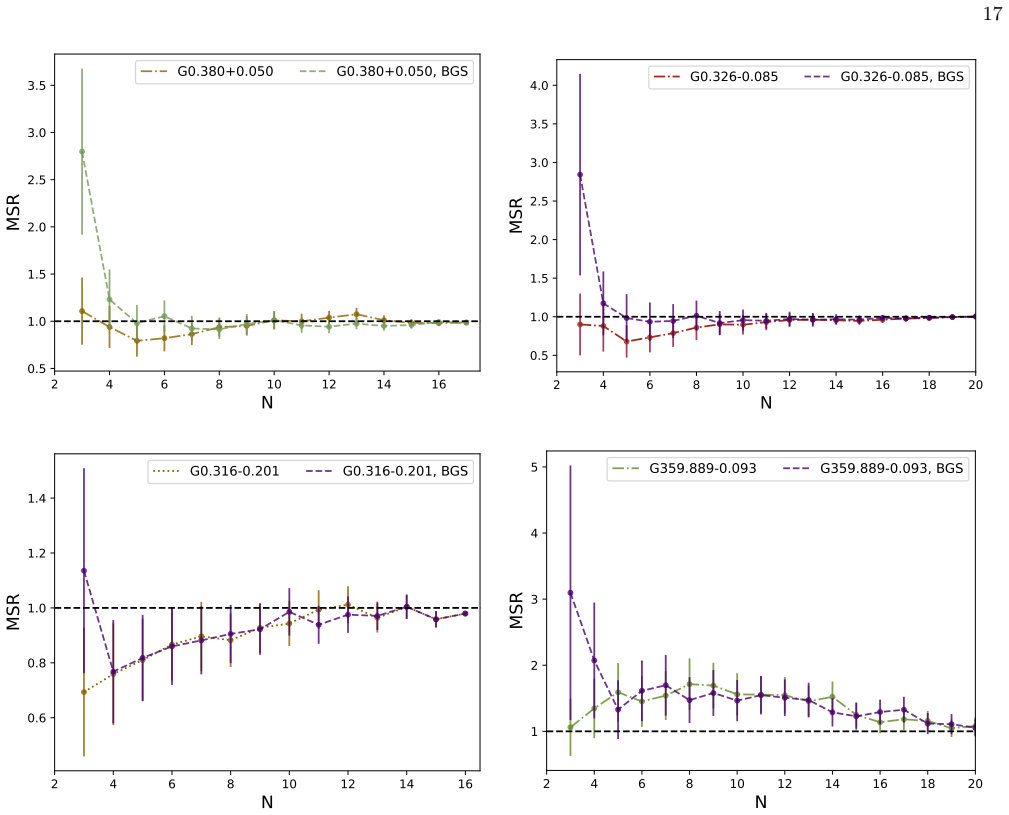
Five of seventeen Central Molecular Zone clouds show mass segregation among their compact millimeter sources, while most exhibit none or the inverse pattern with no clear tie to star-forming activity.
A machine-rendered reading of the paper's core claim, the machinery that carries it, and where it could break.
Core claim
The minimum spanning tree analysis of the modified CMZoom 1.3 mm catalog reveals that compact source separations and masses are consistent with thermal fragmentation, while mass segregation ratios indicate true mass segregation in five of the seventeen analyzed clouds, inverse segregation in some of the remainder, and no clear segregation in others, with an unclear correlation to evolutionary stage for star-forming clouds in the CMZ.
What carries the argument
The mass segregation ratio Λ_MSR derived from minimum spanning tree lengths, which measures how much more clustered the most massive sources are compared with random subsets of the same number.
If this is right
- Thermal fragmentation sets the typical separations and masses of compact sources at 0.1 pc scales across most CMZ clouds.
- Mass segregation is not a universal feature even among actively star-forming clouds in the galactic center.
- The spatial distribution of sources in most clouds reflects initial conditions more than later dynamical sorting.
- Evolutionary stage alone does not predict whether a cloud will display mass segregation under the current sample.
Where Pith is reading between the lines
- Similar MST analyses applied to other high-pressure star-forming regions could test whether thermal dominance is unique to the CMZ.
- If magnetic fields or external shear suppress segregation, then clouds with different large-scale kinematics should show systematically different Λ_MSR distributions.
- Resolving the internal structure of the compact sources themselves might reveal whether apparent lack of segregation is an artifact of source blending.
Load-bearing premise
The modified complete 1.3 mm dust continuum catalog supplies an unbiased sample of compact sources whose masses and positions can be compared directly to Jeans lengths without major selection or resolution effects.
What would settle it
A new catalog or higher-resolution map that adds many previously missed low-mass sources or alters the mass ranking of existing sources would shift the calculated Λ_MSR values and reclassify which clouds show segregation.
Figures


read the original abstract
We employ a Minimum Spanning Tree (MST) approach to characterize the spatial distribution and mass segregation of compact millimeter continuum sources within the Central Molecular Zone (CMZ) of the Milky Way. We use a modified form of the complete version of the 1.3 mm dust continuum catalog from the CMZoom survey, which identifies 685 compact sources with typical effective radii of $\sim0.1$ pc. For 22 of 35 CMZ clouds, we calculate the thermal and turbulent Jeans lengths and masses, and determine that compact source separations, as well as compact source masses, are more consistent with thermal fragmentation at $\sim0.1$ pc size scales. We construct the mass segregation ratios for compact sources in 17 CMZ clouds and determine that 5 of the analyzed clouds display some form of mass segregation ($\Lambda_{MSR} > 1.5$), while the remaining clouds show either inverse mass segregation ($\Lambda_{MSR} < 0.75$), or no evidence of true mass segregation ($0.75 < \Lambda_{MSR} < 1.5$). Finally, we find that although some actively star-forming clouds do exhibit mass segregation, other similarly active clouds do not, indicating an unclear correlation with evolutionary stage for star forming clouds in the CMZ, given the current available data.
Editorial analysis
A structured set of objections, weighed in public.
Referee Report
Summary. The paper applies the Minimum Spanning Tree (MST) method to characterize spatial distribution and mass segregation of compact sources in the CMZ using a modified version of the CMZoom 1.3 mm dust continuum catalog containing 685 sources with typical radii ~0.1 pc. For 22 of 35 clouds, thermal and turbulent Jeans lengths and masses are calculated, showing that source separations and masses are more consistent with thermal fragmentation. Mass segregation ratios Λ_MSR are computed for 17 clouds, with the result that 5 show mass segregation (Λ_MSR > 1.5), while the remainder exhibit inverse segregation (Λ_MSR < 0.75) or none (0.75 < Λ_MSR < 1.5). No clear correlation with evolutionary stage is found for actively star-forming clouds.
Significance. If the central claims hold after addressing data-handling details, the work supplies useful observational constraints on fragmentation and mass segregation in the high-density, high-turbulence CMZ environment. The application of standard MST and Jeans analyses to an existing survey catalog is a methodological strength, and the finding that mass segregation is not ubiquitous (only 5/17 clouds) and shows no obvious link to star-formation activity provides a falsifiable benchmark for theoretical models of CMZ star formation.
major comments (1)
- [Abstract and catalog description] The claim that 5 of the 17 analyzed clouds display mass segregation (Λ_MSR > 1.5) while the rest show inverse or no segregation rests on the modified 1.3 mm CMZoom catalog supplying unbiased positions and masses. In the high-column-density CMZ, 1.3 mm emission can be optically thick or temperature-dependent; if lower-mass sources are systematically missed or have underestimated masses in the densest sub-regions, the MST lengths for the top-N massive sources will be artificially shortened relative to random draws, inflating Λ_MSR. The manuscript does not quantify completeness as a function of local column density or test whether the observed segregation pattern survives a mass-dependent recovery correction (see abstract and the catalog description).
minor comments (2)
- [Methods] The exact criteria used to select the 17 clouds out of 35 for the Λ_MSR analysis, as well as the precise definition of the random comparison sample size and the choice of N for the top-N massive sources, should be stated explicitly to allow reproduction.
- [Results] Error propagation for the derived masses, positions, and Jeans lengths is not detailed; adding a brief description or table of uncertainties would strengthen the results section.
Simulated Author's Rebuttal
We thank the referee for their careful and constructive review. The major comment raises a valid concern about possible catalog biases that could affect the mass segregation results. We address this point directly below and outline the revisions we will make to improve the manuscript.
read point-by-point responses
-
Referee: [Abstract and catalog description] The claim that 5 of the 17 analyzed clouds display mass segregation (Λ_MSR > 1.5) while the rest show inverse or no segregation rests on the modified 1.3 mm CMZoom catalog supplying unbiased positions and masses. In the high-column-density CMZ, 1.3 mm emission can be optically thick or temperature-dependent; if lower-mass sources are systematically missed or have underestimated masses in the densest sub-regions, the MST lengths for the top-N massive sources will be artificially shortened relative to random draws, inflating Λ_MSR. The manuscript does not quantify completeness as a function of local column density or test whether the observed segregation pattern survives a mass-dependent recovery correction (see abstract and the catalog description).
Authors: We appreciate the referee highlighting this potential systematic effect. The modified catalog is drawn from the complete CMZoom 1.3 mm continuum catalog, which applies a uniform signal-to-noise threshold and has been cross-checked against independent surveys. The highest-mass sources used for Λ_MSR are the brightest and least susceptible to optical-depth suppression. Nevertheless, we agree that a quantitative assessment of completeness versus local column density is needed to fully rule out bias. In the revised manuscript we will add a dedicated subsection that (1) estimates recovery fractions as a function of column density using the available Herschel-derived maps and (2) performs a Monte-Carlo test in which lower-mass sources in the densest regions are down-weighted or removed according to simulated recovery rates before re-computing Λ_MSR. The results of this test will be reported transparently; if the segregation signal in the five clouds remains significant we will state so, and if it weakens we will qualify the original claim accordingly. revision: yes
Circularity Check
No significant circularity; purely observational application of published MST and Jeans methods to external catalog
full rationale
The paper applies the standard Minimum Spanning Tree (MST) method and Jeans length calculations to the modified CMZoom 1.3 mm catalog for 17 and 22 clouds respectively. The central results (5/17 clouds with Λ_MSR > 1.5, consistency with thermal fragmentation at ~0.1 pc) are direct empirical measurements and comparisons from the input positions and masses. No equation or step reduces the reported segregation ratios or fragmentation conclusions to a fitted parameter, self-referential definition, or self-citation chain by construction. The derivation chain is self-contained against external benchmarks and published techniques.
Axiom & Free-Parameter Ledger
axioms (1)
- domain assumption The compact millimeter sources identified in the modified CMZoom catalog accurately trace genuine fragmentation products whose separations and masses can be compared directly to thermal and turbulent Jeans scales.
Lean theorems connected to this paper
-
IndisputableMonolith/Foundation/AbsoluteFloorClosure.leanreality_from_one_distinction unclear?
unclearRelation between the paper passage and the cited Recognition theorem.
We employ a Minimum Spanning Tree (MST) approach to characterize the spatial distribution and mass segregation of compact millimeter continuum sources... We construct the mass segregation ratios for compact sources in 17 CMZ clouds and determine that 5 of the analyzed clouds display some form of mass segregation (Λ_MSR > 1.5)
-
IndisputableMonolith/Cost/FunctionalEquation.leanwashburn_uniqueness_aczel unclear?
unclearRelation between the paper passage and the cited Recognition theorem.
We compare the mean edge length (ℓ̄) of the particular cloud’s minimum spanning tree (MST) to both the cloud’s thermal Jeans length, λ_th and its turbulent Jeans length, λ_turb.
What do these tags mean?
- matches
- The paper's claim is directly supported by a theorem in the formal canon.
- supports
- The theorem supports part of the paper's argument, but the paper may add assumptions or extra steps.
- extends
- The paper goes beyond the formal theorem; the theorem is a base layer rather than the whole result.
- uses
- The paper appears to rely on the theorem as machinery.
- contradicts
- The paper's claim conflicts with a theorem or certificate in the canon.
- unclear
- Pith found a possible connection, but the passage is too broad, indirect, or ambiguous to say the theorem truly supports the claim.
Reference graph
Works this paper leans on
-
[1]
3-D CMZ II: Hierarchical Structure Analysis of the Central Molecular Zone. arXiv e-prints , keywords =. doi:10.48550/arXiv.2410.17332 , archivePrefix =. 2410.17332 , primaryClass =
-
[2]
The Astropy Project: Building an inclusive, open-science project and status of the v2.0 core package
The Astropy Project: Building an Open-science Project and Status of the v2.0 Core Package. , keywords =. doi:10.3847/1538-3881/aabc4f , archivePrefix =. 1801.02634 , primaryClass =
work page internal anchor Pith review Pith/arXiv arXiv doi:10.3847/1538-3881/aabc4f
-
[3]
doi:10.1093/mnras/stz2646 , url =
Hayley L Alcock and Richard J Parker , title =. doi:10.1093/mnras/stz2646 , url =
-
[4]
J., Johnston, S., Weltevrede, P., & Kramer, M
Richard J. Allison and Simon P. Goodwin and Richard J. Parker and Simon F. Portegies Zwart and Richard de Grijs and M. B. N. Kouwenhoven , title =. doi:10.1111/j.1365-2966.2009.14508.x , url =
-
[5]
Richard J. Allison and Simon P. Goodwin and Richard J. Parker and Richard de Grijs and Simon F. Portegies Zwart and M. B. N. Kouwenhoven , title =. doi:10.1088/0004-637x/700/2/l99 , url =
-
[6]
Barnes, A. T. and Longmore, S. N. and Battersby, C. and Bally, J. and Kruijssen, J. M. D. and Henshaw, J. D. and Walker, D. L. , year=. Star formation rates and efficiencies in the Galactic Centre , volume=. Monthly Notices of the Royal Astronomical Society , publisher=. doi:10.1093/mnras/stx941 , number=
-
[7]
Young massive star cluster formation in the Galactic Centre is driven by global gravitational collapse of high-mass molecular clouds. , keywords =. doi:10.1093/mnras/stz796 , archivePrefix =. 1903.06158 , primaryClass =
work page internal anchor Pith review Pith/arXiv arXiv doi:10.1093/mnras/stz796 1903
-
[8]
Barrow, John D. and Bhavsar, Suketu P. and Sonoda, D. H. , title = ". Monthly Notices of the Royal Astronomical Society , volume =. 1985 , month =. doi:10.1093/mnras/216.1.17 , url =
-
[9]
ALMA Central Molecular Zone Exploration Survey (ACES) I: Overview. arXiv e-prints , keywords =. doi:10.48550/arXiv.2602.20340 , archivePrefix =. 2602.20340 , primaryClass =
-
[10]
Battersby, C. and Bally, J. and Ginsburg, A. and Bernard, J.-P. and Brunt, C. and Fuller, G. A. and Martin, P. and Molinari, S. and Mottram, J. and Peretto, N. and Testi, L. and Thompson, M. A. , year=. Characterizing precursors to stellar clusters withHerschel , volume=. doi:10.1051/0004-6361/201116559 , journal=
-
[11]
CMZoom: Survey Overview and First Data Release. , keywords =. doi:10.3847/1538-4365/aba18e , archivePrefix =. 2007.05023 , primaryClass =
- [12]
-
[13]
3-D CMZ II: Hierarchical Structure Analysis of the Central Molecular Zone , author=. 2024 , eprint=
work page 2024
-
[14]
3D CMZ. I. Central Molecular Zone Overview. , keywords =. doi:10.3847/1538-4357/adb5f0 , archivePrefix =. 2410.17334 , primaryClass =
-
[15]
3D CMZ. II. Hierarchical Structure Analysis of the Central Molecular Zone. , keywords =. doi:10.3847/1538-4357/adb844 , archivePrefix =. 2410.17332 , primaryClass =
-
[16]
Mathematical Proceedings of the Cambridge Philosophical Society , year=
The shortest path through many points , author=. Mathematical Proceedings of the Cambridge Philosophical Society , year=
-
[17]
Galactic structure based on the ATLASGAL 870mum survey
Galactic Structure Based on the ATLASGAL 870 m Survey. , keywords =. doi:10.1088/0004-637X/747/1/43 , archivePrefix =. 1112.4609 , primaryClass =
work page internal anchor Pith review Pith/arXiv arXiv doi:10.1088/0004-637x/747/1/43
- [18]
-
[19]
Bonnell, I. A. and Bate, M. R. and Clarke, C. J. and Pringle, J. E. , year=. Competitive accretion in embedded stellar clusters , volume=. Monthly Notices of the Royal Astronomical Society , publisher=. doi:10.1046/j.1365-8711.2001.04270.x , number=
-
[20]
Accretion in stellar clusters and the initial mass function. , keywords =. doi:10.1046/j.1365-8711.2001.04311.x , archivePrefix =. astro-ph/0102121 , primaryClass =
-
[21]
CMZoom III: Spectral line data release. , keywords =. doi:10.1093/mnras/stad388 , archivePrefix =. 2301.04699 , primaryClass =
-
[22]
Annabel Cartwright and Anthony P. Whitworth , title =. doi:10.1111/j.1365-2966.2004.07360.x , url =
-
[23]
Measuring clustering in 2dv space , volume =
Cartwright, Annabel , year =. Measuring clustering in 2dv space , volume =. Monthly Notices of the Royal Astronomical Society , doi =
-
[24]
Dynamical evolution of fractal structures in star-forming regions. , keywords =. doi:10.1093/mnras/staa575 , archivePrefix =. 2002.11140 , primaryClass =
-
[25]
Molecular gas in the Galactic center region. II. Gas mass and N\_, = H\_2/I\_\^(12)CO conversion based on a C\^(18)O(J = 1 -> 0) survey. , keywords =. doi:10.48550/arXiv.astro-ph/9711117 , archivePrefix =. astro-ph/9711117 , primaryClass =
work page internal anchor Pith review Pith/arXiv arXiv doi:10.48550/arxiv.astro-ph/9711117
-
[26]
Journal of Korean Astronomical Society , year = 2007, month = dec, volume =
The Unusual Stellar Mass Function of Starburst Clusters. Journal of Korean Astronomical Society , year = 2007, month = dec, volume =. doi:10.5303/JKAS.2007.40.4.157 , adsurl =
-
[27]
doi:10.1051/0004-6361/201834080 , url =
Sami Dib and Thomas Henning , title =. doi:10.1051/0004-6361/201834080 , url =
-
[28]
S. Dib and J. Kim and M. Shadmehri , title =. doi:10.1111/j.1745-3933.2007.00362.x , url =
-
[29]
Structure and mass segregation in Galactic stellar clusters
Structure and mass segregation in Galactic stellar clusters. , keywords =. doi:10.1093/mnras/stx2413 , archivePrefix =. 1707.00744 , primaryClass =
work page internal anchor Pith review Pith/arXiv arXiv doi:10.1093/mnras/stx2413
-
[30]
J., Jameson , A., van Straten , W., et al
Sami Dib and Mohsen Shadmehri and Paolo Padoan and G. Maheswar and D. K. Ojha and Fazeleh Khajenabi , title =. doi:10.1111/j.1365-2966.2010.16451.x , url =
-
[31]
Richard Edgar and Cathie Clarke , title =. doi:10.1111/j.1365-2966.2004.07533.x , url =
-
[32]
Mass segregation of embedded clusters in the Milky Way , volume=
Er, Xin-Yue and Jiang, Zhi-Bo and Fu, Yan-Ning , year=. Mass segregation of embedded clusters in the Milky Way , volume=. Research in Astronomy and Astrophysics , publisher=. doi:10.1088/1674-4527/13/3/004 , number=
-
[33]
Federrath, Christoph and Klessen, Ralf S. , title =. The Astrophysical Journal , abstract =. 2012 , month =. doi:10.1088/0004-637X/761/2/156 , url =
-
[34]
Federrath, C. and Rathborne, J. M. and Longmore, S. N. and Kruijssen, J. M. D. and Bally, J. and Contreras, Y. and Crocker, R. M. and Garay, G. and Jackson, J. M. and Testi, L. and Walsh, A. J. , year=. THE LINK BETWEEN TURBULENCE, MAGNETIC FIELDS, FILAMENTS, AND STAR FORMATION IN THE CENTRAL MOLECULAR ZONE CLOUD G0.253+0.016 , volume=. The Astrophysical ...
-
[35]
and Cunningham, Maria and Kauffmann, Jens and Pillai, Thushara and Mills, Elisabeth A
Ginsburg, Adam and Walsh, Andrew and Henkel, Christian and Jones, Paul A. and Cunningham, Maria and Kauffmann, Jens and Pillai, Thushara and Mills, Elisabeth A. C. and Ott, Juergen and Diederik Kruijssen, J. M. and Menten, Karl M. and Battersby, Cara and Rathborne, Jill and Contreras, Yanett and Longmore, Steven and Walker, Daniel and Dawson, Joanne and L...
-
[36]
Ginsburg, Adam and Henkel, Christian and Ao, Yiping and Riquelme, Denise and Kauffmann, Jens and Pillai, Thushara and Mills, Elisabeth A. C. and Requena-Torres, Miguel A. and Immer, Katharina and Testi, Leonardo and Ott, Juergen and Bally, John and Battersby, Cara and Darling, Jeremy and Aalto, Susanne and Stanke, Thomas and Kendrew, Sarah and Diederik Kr...
-
[38]
Distributed star formation throughout the Galactic Center cloud Sgr B2
Distributed Star Formation throughout the Galactic Center Cloud Sgr B2. , keywords =. doi:10.3847/1538-4357/aaa6d4 , archivePrefix =. 1801.04941 , primaryClass =
work page internal anchor Pith review Pith/arXiv arXiv doi:10.3847/1538-4357/aaa6d4
-
[39]
S2D2: Small-scale Significant substructure
Marta Gonz. S2D2: Small-scale Significant substructure. Astronomy. doi:10.1051/0004-6361/202038123 , url =
-
[40]
The dynamical evolution of fractal star clusters: the survival of substructure
The dynamical evolution of fractal star clusters: The survival of substructure. , keywords =. doi:10.1051/0004-6361:20031529 , archivePrefix =. astro-ph/0310333 , primaryClass =
work page internal anchor Pith review Pith/arXiv arXiv doi:10.1051/0004-6361:20031529
- [41]
-
[42]
Henshaw and Jens Kauffmann and J
H Perry Hatchfield and Cara Battersby and Eric Keto and Daniel Walker and Ashley Barnes and Daniel Callanan and Adam Ginsburg and Jonathan D. Henshaw and Jens Kauffmann and J. M. Diederik Kruijssen and Steve N. Longmore and Xing Lu and Elisabeth A. C. Mills and Thushara Pillai and Qizhou Zhang and John Bally and Natalie Butterfield and Yanett A. Contreras...
-
[43]
CMZoom. IV. Incipient High-mass Star Formation throughout the Central Molecular Zone. , keywords =. doi:10.3847/1538-4357/ad10af , archivePrefix =. 2312.09284 , primaryClass =
-
[44]
Inefficient star formation in high Mach number environments: I
Hennebelle, Patrick and Brucy, Noé and Colman, Tine , year=. Inefficient star formation in high Mach number environments: I. The turbulent support analytical model , volume=. doi:10.1051/0004-6361/202450524 , journal=
-
[45]
Henshaw, J. D. and Longmore, S. N. and Kruijssen, J. M. D. and Davies, B. and Bally, J. and Barnes, A. and Battersby, C. and Burton, M. and Cunningham, M. R. and Dale, J. E. and Ginsburg, A. and Immer, K. and Jones, P. A. and Kendrew, S. and Mills, E. A. C. and Molinari, S. and Moore, T. J. T. and Ott, J. and Pillai, T. and Rathborne, J. and Schilke, P. a...
-
[46]
Star Formation in the Central Molecular Zone of the Milky Way , author=. 2022 , eprint=
work page 2022
-
[47]
Fractal statistics in young star clusters: structural parameters and dynamical evolution. , keywords =. doi:10.1093/mnras/stz2698 , adsurl =
-
[48]
Hillenbrand, A. and Hartmann, W. , year =. A Preliminary Study of the Orion Nebula Cluster Structure and Dynamics , volume =. The Astrophysical Journal , doi =
-
[49]
Hopkins, Philip F. , year=. A general theory of turbulent fragmentation , volume=. Monthly Notices of the Royal Astronomical Society , publisher=. doi:10.1093/mnras/sts704 , number=
-
[50]
Immer, K. and Schuller, F. and Omont, A. and Menten, K. M. , year=. Recent star formation in the inner Galactic bulge seen by ISOGAL: II. The central molecular zone , volume=. doi:10.1051/0004-6361/201117857 , journal=
-
[51]
Jeans, J. H. The Stability of a Spherical Nebula. Phil. Trans. A. Math. Phys. Eng. Sci. 1902. doi:10.1098/rsta.1902.0012
-
[52]
Jones, P. A. and Burton, M. G. and Cunningham, M. R. and Tothill, N. F. H. and Walsh, A. J. , year=. Spectral imaging of the central molecular zone in multiple 7-mm molecular lines , volume=. Monthly Notices of the Royal Astronomical Society , publisher=. doi:10.1093/mnras/stt717 , number=
-
[53]
MAMBO Mapping of Spitzer c2d Small Clouds and Cores
MAMBO mapping of Spitzer c2d small clouds and cores. , keywords =. doi:10.1051/0004-6361:200809481 , archivePrefix =. 0805.4205 , primaryClass =
work page internal anchor Pith review Pith/arXiv arXiv doi:10.1051/0004-6361:200809481
-
[54]
Kauffmann, Jens and Pillai, Thushara and Zhang, Qizhou and Menten, Karl M. and Goldsmith, Paul F. and Lu, Xing and Guzmán, Andrés E. , year=. The Galactic Center Molecular Cloud Survey: I. A steep linewidth-size relation and suppression of star formation , volume=. doi:10.1051/0004-6361/201628088 , journal=
-
[55]
The Galactic Center Molecular Cloud Survey. II. A lack of dense gas and cloud evolution along Galactic center orbits. , keywords =. doi:10.1051/0004-6361/201628089 , archivePrefix =. 1610.03502 , primaryClass =
work page internal anchor Pith review Pith/arXiv arXiv doi:10.1051/0004-6361/201628089
-
[56]
The Star Formation Law in Galactic Disks. , keywords =. doi:10.1086/167834 , adsurl =
-
[57]
The Core Mass Function Across Galactic Environments. IV. The Galactic Center , author=. 2024 , eprint=
work page 2024
-
[58]
Kirk, Helen and Johnstone, Don and Francesco, J. and Lane, J. and Buckle, Jenny and Berry, David and Broekhoven-Fiene, H. and Currie, M. and Fich, M. and Hatchell, J. and Jenness, Timothy and Mottram, J. and Nutter, D. and Pattle, Kate and Pineda, Jaime and Quinn, Cameron and Salji, C. and Tisi, S. and Hogerheijde, M. and Ward-Thompson, D. , year =. The J...
-
[59]
On the variation of the initial mass function. , keywords =. doi:10.1046/j.1365-8711.2001.04022.x , archivePrefix =. astro-ph/0009005 , primaryClass =
-
[60]
The dynamical evolution of molecular clouds near the Galactic Centre - I
JMD Kruijssen and JE Dale and SN Longmore , note =. The dynamical evolution of molecular clouds near the Galactic Centre - I. Orbital structure and evolutionary timeline , publisher =. 2014 , journal =. doi:http://dx.doi.org/10.1093/mnras/stu2526 , pages =
-
[61]
The dynamical evolution of molecular clouds near the Galactic Centre - II. Spatial structure and kinematics of simulated clouds. , keywords =. doi:10.1093/mnras/stz381 , archivePrefix =. 1902.01860 , primaryClass =
work page internal anchor Pith review Pith/arXiv arXiv doi:10.1093/mnras/stz381 1902
-
[62]
J., Jameson , A., van Straten , W., et al
Lomax, O. and Whitworth, A. P. and Cartwright, A. , year=. Statistical comparison of clouds and star clusters: Statistical comparison of clouds and clusters , volume=. Monthly Notices of the Royal Astronomical Society , publisher=. doi:10.1111/j.1365-2966.2010.17935.x , number=
-
[63]
Longmore, S. N. and Bally, J. and Testi, L. and Purcell, C. R. and Walsh, A. J. and Bressert, E. and Pestalozzi, M. and Molinari, S. and Ott, J. and Cortese, L. and Battersby, C. and Murray, N. and Lee, E. and Kruijssen, J. M. D. and Schisano, E. and Elia, D. , year=. Variations in the Galactic star formation rate and density thresholds for star formation...
-
[64]
Lu, Xing and Mills, Elisabeth A. C. and Ginsburg, Adam and Walker, Daniel L. and Barnes, Ashley T. and Butterfield, Natalie and Henshaw, Jonathan D. and Battersby, Cara and Kruijssen, J. M. Diederik and Longmore, Steven N. and Zhang, Qizhou and Bally, John and Kauffmann, Jens and Ott, Jürgen and Rickert, Matthew and Wang, Ke , year=. A Census of Early-pha...
-
[65]
Star Formation Rates of Massive Molecular Clouds in the Central Molecular Zone
Star Formation Rates of Massive Molecular Clouds in the Central Molecular Zone. , keywords =. doi:10.3847/1538-4357/ab017d , archivePrefix =. 1901.07779 , primaryClass =
work page internal anchor Pith review Pith/arXiv arXiv doi:10.3847/1538-4357/ab017d 1901
-
[66]
ALMA Observations of Massive Clouds in the Central Molecular Zone: Jeans Fragmentation and Cluster Formation. , keywords =. doi:10.3847/2041-8213/ab8b65 , archivePrefix =. 2004.09532 , primaryClass =
-
[67]
Lu, Xing and Li, Shanghuo and Ginsburg, Adam and Longmore, Steven N. and Kruijssen, J. M. Diederik and Walker, Daniel L. and Feng, Siyi and Zhang, Qizhou and Battersby, Cara and Pillai, Thushara and Mills, Elisabeth A. C. and Kauffmann, Jens and Cheng, Yu and Inutsuka, Shu-ichiro , title =. The Astrophysical Journal , abstract =. 2021 , month =. doi:10.38...
-
[68]
Magnetic Fields in the Central Molecular Zone Influenced by Feedback and Weakly Correlated with Star Formation. , keywords =. doi:10.3847/1538-4357/ad1395 , archivePrefix =. 2312.01776 , primaryClass =
-
[69]
Mac Low, Mordecai-Mark and Klessen, Ralf S. , year=. Control of star formation by supersonic turbulence , volume=. Reviews of Modern Physics , publisher=. doi:10.1103/revmodphys.76.125 , number=
-
[70]
Mangilli, A. and Aumont, J. and Bernard, J.-Ph. and Buzzelli, A. and de Gasperis, G. and Durrive, J. B. and Ferriere, K. and Foënard, G. and Hughes, A. and Lacourt, A. and Misawa, R. and Montier, L. and Mot, B. and Ristorcelli, I. and Roussel, H. and Ade, P. and Alina, D. and de Bernardis, P. and de Gouveia Dal Pino, E. and Dubois, J. P. and Engel, C. and...
-
[71]
Normalization of the minimum spanning tree , Author =. 1993 , Journal =
work page 1993
-
[72]
Global mass segregation in hydrodynamical simulations of star formation. , keywords =. doi:10.1111/j.1365-2966.2011.19067.x , archivePrefix =. 1106.1181 , primaryClass =
-
[73]
The Formation of Massive Stars from Turbulent Cores
The Formation of Massive Stars from Turbulent Cores. , keywords =. doi:10.1086/346149 , archivePrefix =. astro-ph/0206037 , primaryClass =
work page internal anchor Pith review Pith/arXiv arXiv doi:10.1086/346149
-
[74]
Stephen L. W. McMillan and Enrico Vesperini and Simon F. Portegies Zwart , title =. doi:10.1086/511763 , url =
-
[75]
F. Meng and. The physical and chemical structure of Sagittarius B2 , journal =. doi:10.1051/0004-6361/201935920 , url =
-
[76]
Mills, E. A. C. and Morris, M. R. , year=. DETECTION OF WIDESPREAD HOT AMMONIA IN THE GALACTIC CENTER , volume=. The Astrophysical Journal , publisher=. doi:10.1088/0004-637x/772/2/105 , number=
-
[77]
Mills, E. A. C. and Butterfield, N. and Ludovici, D. A. and Lang, C. C. and Ott, J. and Morris, M. R. and Schmitz, S. , year=. ABUNDANT CH3OH MASERS BUT NO NEW EVIDENCE FOR STAR FORMATION IN GCM0.253+0.016 , volume=. The Astrophysical Journal , publisher=. doi:10.1088/0004-637x/805/1/72 , number=
-
[78]
The Dense Gas Fraction in Galactic Center Clouds
The Dense Gas Fraction in Galactic Center Clouds. , keywords =. doi:10.3847/1538-4357/aae581 , archivePrefix =. 1810.00266 , primaryClass =
work page internal anchor Pith review Pith/arXiv arXiv doi:10.3847/1538-4357/aae581
-
[79]
J., Johnston, S., Weltevrede, P., & Kramer, M
Nickolas Moeckel and Ian A. Bonnell , title =. doi:10.1111/j.1365-2966.2009.14813.x , url =
-
[80]
and Tatematsu, Ken'ichi and Izumi, Natsuko and Sakai, Takeshi and Silva, Andrea , year =
Morii, Kaho and Sanhueza, Patricio and Nakamura, Fumitaka and Zhang, Qizhou and Sabatini, Giovanni and Beuther, Henrik and Lu, An and Li, Shanghuo and Garay, Guido and Jackson, James and Olguin, Fernando and Tafoya, D. and Tatematsu, Ken'ichi and Izumi, Natsuko and Sakai, Takeshi and Silva, Andrea , year =. The ALMA Survey of 70 μm Dark High-mass Clumps i...
-
[81]
T. Nony and J.-F. Robitaille and F. Motte and M. Gonzalez and I. Joncour and E. Moraux and A. Men'shchikov and P. Didelon and F. Louvet and A. S. M. Buckner and N. Schneider and S. L. Lumsden and S. Bontemps and Y. Pouteau and N. Cunningham and E. Fiorellino and R. Oudmaijer and P. Andr. Mass segregation and sequential star formation in. doi:10.1051/0004-...
discussion (0)
Sign in with ORCID, Apple, or X to comment. Anyone can read and Pith papers without signing in.