Fourier--Galerkin Methods for Subwavelength Resonances in two-dimensional Acoustic Metamaterials
Pith reviewed 2026-05-25 04:04 UTC · model grok-4.3
The pith
A Fourier-Galerkin projection of the boundary integral operator reduces subwavelength resonance computation to a low-dimensional nonlinear eigenvalue problem.
A machine-rendered reading of the paper's core claim, the machinery that carries it, and where it could break.
Core claim
Starting from the boundary integral formulation, projecting the operator onto Fourier modes produces an explicit finite-dimensional effective matrix. The singularity of this matrix characterizes the resonant frequencies. In the subwavelength regime, asymptotic expansions in terms of frequency and material contrast identify the leading-order operators and their kernel structure, transforming the problem into a low-dimensional nonlinear eigenvalue problem.
What carries the argument
The finite-dimensional effective matrix obtained from the Fourier-Galerkin projection of the boundary integral operator, whose entries admit FFT-based quadrature.
If this is right
- The resonance problem is reduced to solving a low-dimensional nonlinear eigenvalue problem instead of large discretizations.
- The effective matrix entries are explicitly computable and can be evaluated rapidly using FFT-based quadrature.
- The method applies to general smooth geometries in finite domains.
- Subwavelength asymptotic expansions capture the leading kernel structure of the projected operator.
Where Pith is reading between the lines
- The explicit matrix form may permit direct parametric studies of how resonances vary with geometry without repeated full simulations.
- The same projection framework could be reused across multiple scatterers to improve efficiency in systems with repeated units.
Load-bearing premise
The boundary of the scatterer must be sufficiently smooth for rapid Fourier series convergence and accurate capture of the leading kernel by the subwavelength asymptotic expansions.
What would settle it
A comparison of resonant frequencies computed by this method against those from a high-resolution finite element or boundary element discretization for the same smooth geometry, checking agreement to the predicted asymptotic order.
Figures




read the original abstract
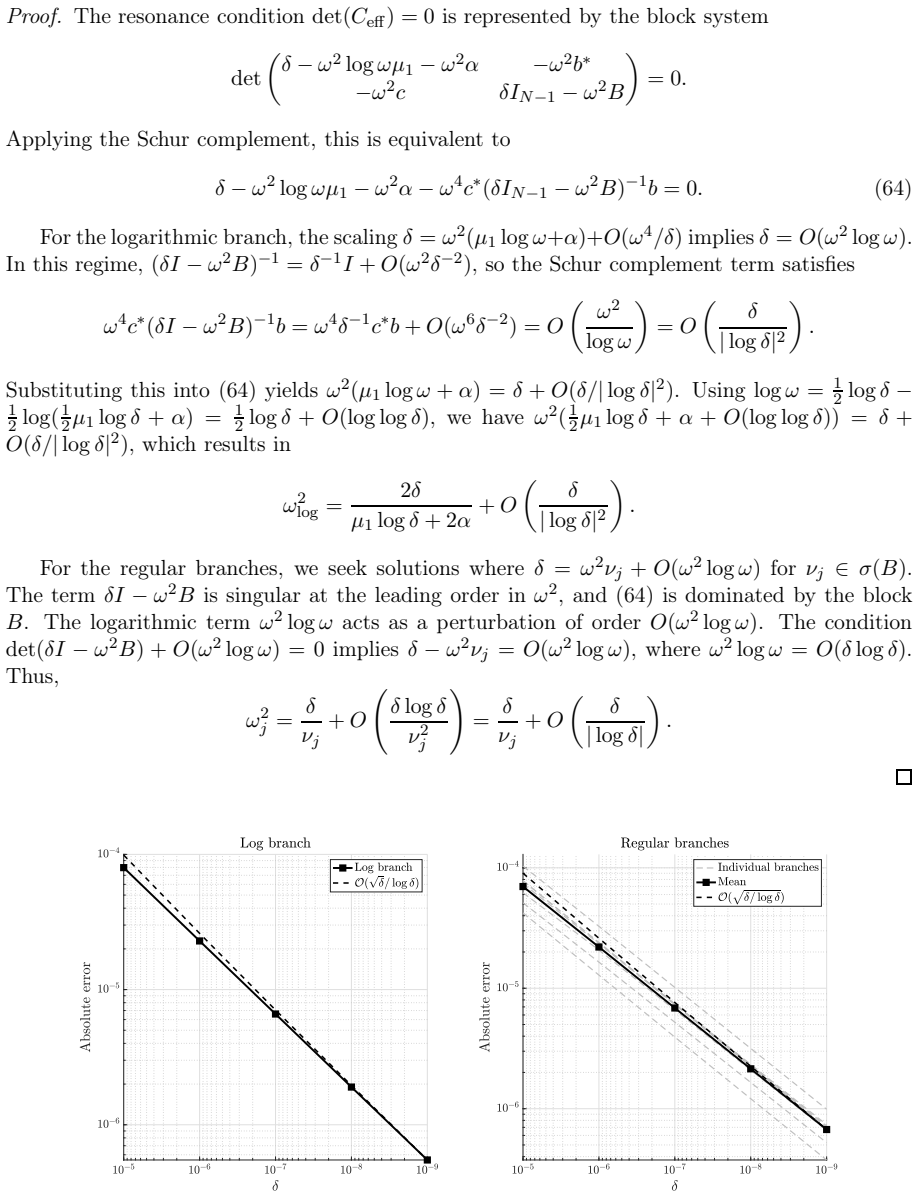
We present a Fourier--Galerkin asymptotic framework for the analysis and computation of subwavelength resonances in two-dimensional scattering problems in finite domains. Starting from the boundary integral formulation, we apply a Fourier--Galerkin discretization to derive an explicit finite-dimensional effective matrix whose kernel characterizes the resonant frequencies. In the subwavelength regime, we obtain asymptotic expansions of this matrix in terms of $\omega$ and the material contrast, identifying the leading-order operators and their kernel structure. This reduction transforms the resonance problem into a low-dimensional nonlinear eigenvalue problem, avoiding large-scale discretizations and global root-search procedures. The entries of the effective matrix are explicitly computable and admit fast evaluation using FFT-based quadrature. The resulting approach provides an efficient and robust computational framework for resonances in general smooth geometries.
Editorial analysis
A structured set of objections, weighed in public.
Referee Report
Summary. The manuscript develops a Fourier-Galerkin framework for subwavelength resonances in 2D acoustic metamaterials. Starting from the boundary integral formulation, the scattering operator is projected onto Fourier modes to produce an explicit finite-dimensional effective matrix whose singularities locate the resonant frequencies. Subwavelength asymptotics in frequency ω and material contrast are derived to identify leading-order operators and kernel structure, reducing the problem to a low-dimensional nonlinear eigenvalue problem. Matrix entries are stated to be explicitly computable via FFT-based quadrature, avoiding large-scale discretizations and global root searches for general smooth geometries.
Significance. If the derivations hold, the approach offers a computationally attractive reduction for resonance computation in smooth scatterers, replacing high-dimensional discretizations with a small nonlinear eigenproblem whose entries admit fast quadrature. The explicit construction and avoidance of root-search procedures constitute a practical advantage for metamaterial design, provided the asymptotic accuracy and quadrature error are controlled.
major comments (2)
- Abstract: the central claim that the reduction yields an 'explicit finite-dimensional effective matrix' whose singularity characterizes resonances is load-bearing, yet the provided description contains no derivation steps or explicit form of the projected operator; without these the accuracy of the subsequent subwavelength expansions cannot be verified.
- The subwavelength asymptotic expansions: the identification of leading-order operators and kernel structure is asserted but no error bound or remainder estimate is referenced, which is required to justify that the low-dimensional nonlinear eigenvalue problem accurately locates the resonances rather than only approximating them.
minor comments (3)
- The smoothness hypothesis on the scatterer boundary is invoked for rapid Fourier convergence but should be stated with a precise regularity class (e.g., C^∞ or C^k) and a reference to the corresponding convergence theorem.
- Notation for the material contrast parameter and the frequency variable ω should be introduced once and used consistently; currently the abstract introduces them without prior definition.
- The manuscript would benefit from at least one concrete numerical example (circular or elliptical scatterer) showing the computed resonances against a reference method to illustrate the claimed efficiency.
Simulated Author's Rebuttal
Thank you for the opportunity to respond to the referee's report. We address each major comment below.
read point-by-point responses
-
Referee: Abstract: the central claim that the reduction yields an 'explicit finite-dimensional effective matrix' whose singularity characterizes resonances is load-bearing, yet the provided description contains no derivation steps or explicit form of the projected operator; without these the accuracy of the subsequent subwavelength expansions cannot be verified.
Authors: The explicit construction of the finite-dimensional matrix via Fourier-Galerkin projection is derived in detail in Section 2 of the manuscript. Starting from the boundary integral formulation of the scattering problem, the operator is projected onto the Fourier basis, yielding the matrix entries as Fourier coefficients that can be computed via FFT. The characterization of resonances as singularities of this matrix is established in Theorem 2.1. The abstract summarizes this reduction concisely, but we will revise it to include a brief reference to the projection step and the resulting matrix form to improve clarity. revision: yes
-
Referee: The subwavelength asymptotic expansions: the identification of leading-order operators and kernel structure is asserted but no error bound or remainder estimate is referenced, which is required to justify that the low-dimensional nonlinear eigenvalue problem accurately locates the resonances rather than only approximating them.
Authors: Section 4 presents the subwavelength asymptotic analysis, where we expand the effective matrix in powers of the frequency ω and the material contrast parameter, identifying the leading-order operators and their kernels. The low-dimensional nonlinear eigenvalue problem is obtained by retaining these leading terms. While the formal expansions are provided, we agree that an explicit error bound would strengthen the justification. We will include a new remark or subsection providing the remainder estimate based on the analyticity of the operators in the subwavelength regime. revision: yes
Circularity Check
No significant circularity; derivation self-contained from boundary integral formulation
full rationale
The paper begins with the standard boundary integral formulation of the scattering problem, projects the operator onto Fourier modes, and derives an explicit finite-dimensional effective matrix whose singularities locate the resonances. Asymptotic expansions in the subwavelength regime are obtained directly from this projected operator. No step reduces by construction to a fitted parameter, self-citation chain, or renamed input; the low-dimensional nonlinear eigenvalue problem follows from the projection and smoothness hypothesis without circularity. The construction is internally consistent and externally falsifiable via the underlying integral equation.
Axiom & Free-Parameter Ledger
axioms (1)
- domain assumption The scatterer boundary is smooth
discussion (0)
Sign in with ORCID, Apple, or X to comment. Anyone can read and Pith papers without signing in.