A comparison between Galactic magnetic field models and polarized synchrotron emission with C-BASS at 4.76 GHz and S-PASS at 2.3 GHz
Pith reviewed 2026-05-25 03:54 UTC · model grok-4.3
The pith
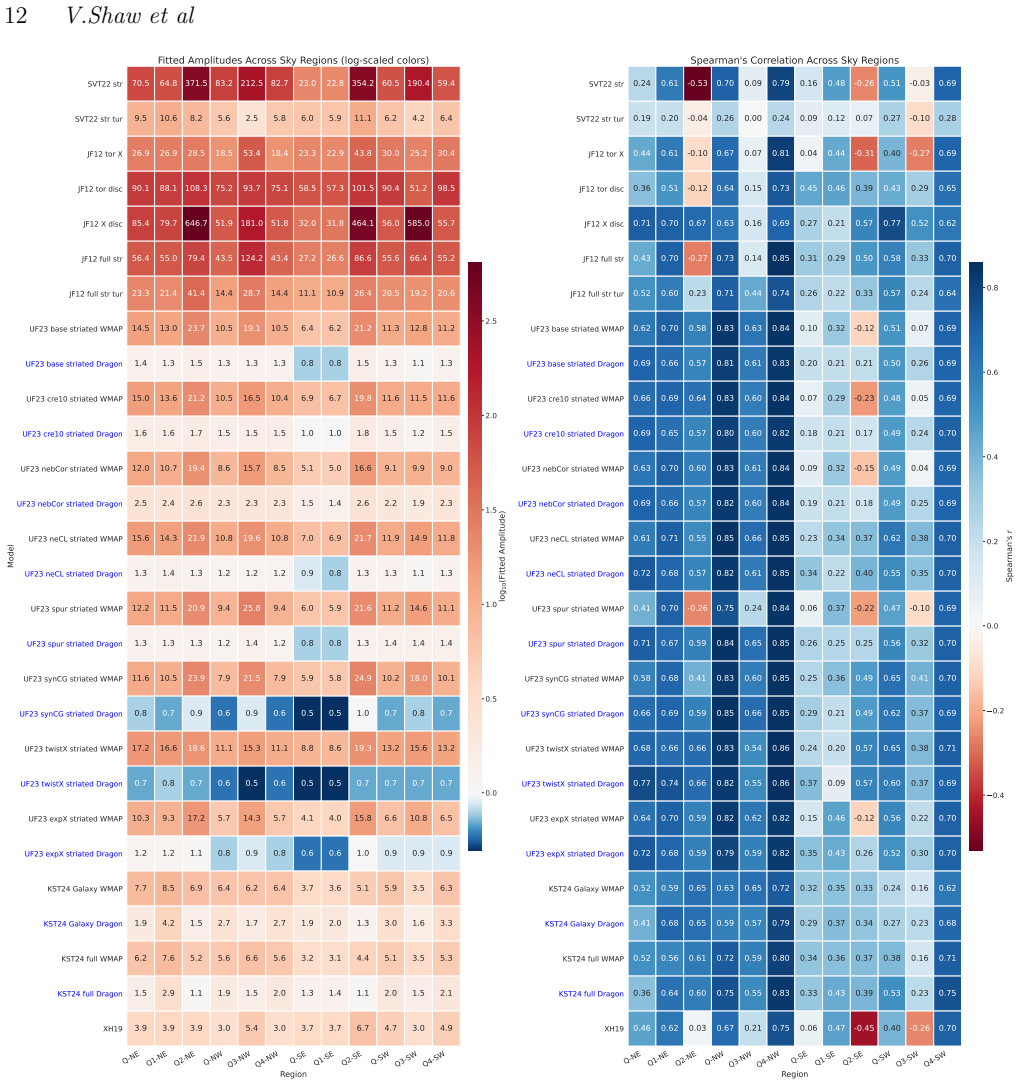
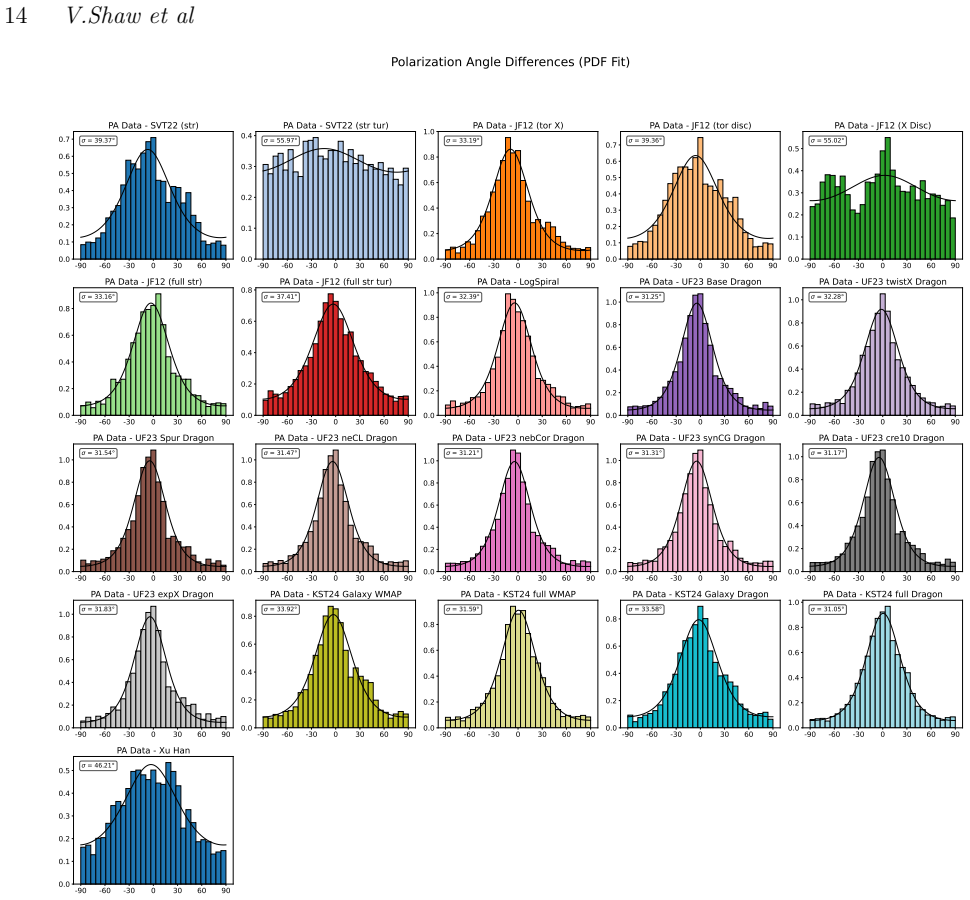
Galactic magnetic field models match polarization angles but not intensity because local structures dominate the polarized sky.
A machine-rendered reading of the paper's core claim, the machinery that carries it, and where it could break.
Core claim
Contemporary Galactic magnetic field models generally reproduce observed polarization angles on large scales but fail to match the morphology of polarized intensity. A significant fraction of the polarized sky is shaped by local foreground structures such as the North Polar Spur/Loop I and the Fan region. Accurate modeling of polarized synchrotron emission at microwave frequencies therefore requires incorporating these local structures.
What carries the argument
Template-fitting approach that compares each model's predicted polarization amplitudes and angles to the survey data after Faraday corrections.
If this is right
- Most models reproduce polarization angles on large scales but not the morphology of polarized intensity.
- There is a clear correlation between data and models for polarization angles but not for polarized intensity.
- Local structures such as the North Polar Spur and the Fan region shape a large portion of the polarized sky.
- Incorporating local structures is required for accurate modeling of polarized synchrotron emission at microwave frequencies.
Where Pith is reading between the lines
- Global magnetic field models alone may be insufficient without explicit local additions to describe microwave polarization data.
- This result could influence how polarized foregrounds are subtracted in analyses of the cosmic microwave background.
- Repeating the template comparison at additional frequencies would test whether the mismatch with intensity persists.
Load-bearing premise
Excluding pixels with potentially large Faraday rotation and applying small corrections to the remainder does not introduce selection bias that affects the comparison between models and data.
What would settle it
A polarized intensity map at 4.76 GHz in which a global magnetic field model without added local structures matches the observed morphology as closely as a model that includes the North Polar Spur and Fan region would falsify the central claim.
Figures





read the original abstract
We compare a set of contemporary Galactic magnetic field (GMF) models with polarized synchrotron observations from the S-PASS and C-BASS radio surveys and combine them to create a reconstructed 4.76~GHz full sky map. Pixels that potentially have a large Faraday rotation are excluded while small ($< 80\degree$) Faraday corrections derived at the respective frequencies of the two surveys are applied to the rest of the map. Using a template-fitting approach, we evaluate the ability of each model to reproduce the observed polarization amplitudes and polarization angles. We find that while most GMF models match the polarization angles reasonably well, they often fail to reproduce the morphology of the polarized intensity. We find that for most models there is a clear correlation between the data and models in polarization angles on large scales, but this does not hold true for polarized intensity. Our results show that a large portion of the polarized sky is shaped by local ``foreground'' features such as the North Polar Spur/Loop\,I and the Fan region. We conclude that incorporating such local structures is essential for accurately modelling the polarized synchrotron emission at microwave frequencies.
Editorial analysis
A structured set of objections, weighed in public.
Referee Report
Summary. The paper compares several contemporary Galactic magnetic field (GMF) models against polarized synchrotron emission from the S-PASS survey at 2.3 GHz and C-BASS at 4.76 GHz. Pixels with potentially large Faraday rotation are excluded and small (<80°) corrections are applied to the remainder; a template-fitting analysis then evaluates model performance on polarization angles and amplitudes. The authors report that most models reproduce large-scale polarization angles reasonably well but fail to match the morphology of polarized intensity, and conclude that local structures such as the North Polar Spur/Loop I and the Fan region must be incorporated into models for accurate reproduction of microwave polarized synchrotron emission. A combined 4.76 GHz full-sky map is also presented.
Significance. If the template-fit comparison after pixel selection is unbiased, the result would be significant for Galactic astrophysics and CMB foreground modeling: it would demonstrate that global GMF models are insufficient for polarized intensity at these frequencies and motivate inclusion of local features. The use of two independent surveys and published models (rather than internally fitted parameters) is a methodological strength.
major comments (2)
- [Abstract and Methods] Abstract and Methods (pixel exclusion and Faraday correction procedure): the description of excluding pixels with large Faraday rotation and applying corrections to the rest does not include a quantitative test (e.g., sky-fraction overlap or correlation statistics) of whether the retained pixels are biased away from the local structures (North Polar Spur/Loop I, Fan) invoked in the conclusion. This selection step is load-bearing for the central claim that global models fail on intensity morphology because of missing local features.
- [Results] Results section (template-fitting evaluation): the claims that models 'match the polarization angles reasonably well' but 'often fail to reproduce the morphology of the polarized intensity' are presented without reported quantitative statistics (correlation coefficients, reduced chi-squared values, or error budgets on the fits). This leaves the strength of the angle-intensity discrepancy unquantified and weakens support for the conclusion.
minor comments (2)
- [Abstract] The abstract states that a reconstructed 4.76 GHz map is created but does not specify the exact weighting or combination method used; this should be clarified in the main text for reproducibility.
- [Figures and Methods] Figure captions and text should explicitly state the number of pixels retained after exclusion and the sky fraction covered, to allow readers to assess the scope of the comparison.
Simulated Author's Rebuttal
We thank the referee for their constructive comments, which help clarify and strengthen the presentation of our results. We address each major comment below and will incorporate revisions to provide the requested quantitative support.
read point-by-point responses
-
Referee: [Abstract and Methods] Abstract and Methods (pixel exclusion and Faraday correction procedure): the description of excluding pixels with large Faraday rotation and applying corrections to the rest does not include a quantitative test (e.g., sky-fraction overlap or correlation statistics) of whether the retained pixels are biased away from the local structures (North Polar Spur/Loop I, Fan) invoked in the conclusion. This selection step is load-bearing for the central claim that global models fail on intensity morphology because of missing local features.
Authors: We agree that explicitly demonstrating the absence of selection bias is important for the robustness of our central claim. In the revised manuscript we will add a quantitative comparison of the retained pixel set against the full sky, including sky-fraction overlap statistics and spatial correlation measures specifically evaluated within the North Polar Spur/Loop I and Fan regions. This analysis will confirm that the local structures remain well represented after the Faraday-based selection and will be presented in an expanded Methods section. revision: yes
-
Referee: [Results] Results section (template-fitting evaluation): the claims that models 'match the polarization angles reasonably well' but 'often fail to reproduce the morphology of the polarized intensity' are presented without reported quantitative statistics (correlation coefficients, reduced chi-squared values, or error budgets on the fits). This leaves the strength of the angle-intensity discrepancy unquantified and weakens support for the conclusion.
Authors: We accept that the manuscript would benefit from explicit quantitative metrics. We will revise the Results section to report Pearson correlation coefficients and reduced chi-squared values for both the polarization-angle and polarized-intensity template fits, together with a brief error budget derived from the fit residuals. These statistics will be shown for each GMF model and will directly quantify the reported difference in performance between angles and amplitudes. revision: yes
Circularity Check
No significant circularity; comparison uses independent data and models
full rationale
The paper's central result follows from a template-fit comparison of published GMF models against independent S-PASS and C-BASS survey data after described pixel exclusions and Faraday corrections. No equations reduce any prediction to a fitted parameter defined inside the paper, no self-citation chain bears the load of the conclusion, and the mismatch in polarized intensity morphology is an empirical observation not forced by the inputs. The derivation is self-contained against external benchmarks.
Axiom & Free-Parameter Ledger
axioms (1)
- domain assumption Faraday rotation corrections derived at the survey frequencies can be applied without introducing significant residual bias to the polarization comparison.
Reference graph
Works this paper leans on
-
[1]
Jansson, Ronnie and Farrar, Glennys R. , year=. A NEW MODEL OF THE GALACTIC MAGNETIC FIELD , journal=
-
[2]
Galactic halo bubble magnetic fields and UHECR deflections
- [3]
- [4]
-
[5]
arXiv , author =:1610.02743 , journal =
work page internal anchor Pith review Pith/arXiv arXiv
-
[6]
CMB-S4 Science Case, Reference Design, and Project Plan
CMB-S4 Science Case, Reference Design, and Project Plan. arXiv e-prints , keywords =. doi:10.48550/arXiv.1907.04473 , archivePrefix =. 1907.04473 , primaryClass =
work page internal anchor Pith review Pith/arXiv arXiv doi:10.48550/arxiv.1907.04473 1907
-
[7]
Abbott, B. P. and Abbott, R. and Abbott, T. D. and Abernathy, M. R. and Acernese, F. and Ackley, K. and Adams, C. and Adams, T. and Addesso, P. and Adhikari, R. X. and Adya, V. B. and Affeldt, C. and Agathos, M. and Agatsuma, K. and Aggarwal, N. and Aguiar, O. D. and Aiello, L. and Ain, A. and Ajith, P. and Allen, B. and Allocca, A. and Altin, P. A. and A...
-
[8]
doi:10.1016/j.newar.2003.09.016 , journal =
-
[9]
2016 , bdsk-url-1 =. doi:10.3847/0067-0049/223/2/26 , eid =. arXiv , author =:1602.07246 , journal =
work page internal anchor Pith review Pith/arXiv arXiv doi:10.3847/0067-0049/223/2/26 2016
-
[10]
, keywords =. doi:10.1111/j.1365-2966.2009.14599.x , eprint =
-
[11]
SpDust/SpDust.2: Code to Calculate Spinning Dust Spectra , year =
Ali-Ha. SpDust/SpDust.2: Code to Calculate Spinning Dust Spectra , year =. Astrophysics Source Code Library , month =
-
[12]
doi:10.1086/184494 , journal =
-
[13]
, keywords =. doi:10.1111/j.1365-2966.2012.20796.x , eprint =
-
[14]
doi:10.1093/mnras/stv751 , eprint =
, keywords =. doi:10.1093/mnras/stv751 , eprint =
-
[15]
, keywords =. doi:10.1111/j.1365-2966.2011.18925.x , eprint =
-
[16]
, keywords =. doi:10.1111/j.1365-2966.2011.18755.x , eprint =
-
[17]
arXiv , author =:2103.10466 , journal =
doi:10.3847/1538-4365/abef65 , eid =. arXiv , author =:2103.10466 , journal =
-
[18]
21 cm observation of LSS at z~1 Instrument sensitivity and foreground subtraction
doi:10.1051/0004-6361/201117837 , eid =. arXiv , author =:1108.1474 , journal =
work page internal anchor Pith review Pith/arXiv arXiv doi:10.1051/0004-6361/201117837
- [19]
-
[20]
, keywords =. doi:10.1111/j.1365-2966.2012.21314.x , eprint =
-
[21]
, keywords =. doi:10.1046/j.1365-8711.2000.03751.x , eprint =
-
[22]
D. S. Proposed Array-Based Deep Space Network for NASA , volume =. Proceedings of the IEEE , keywords =. 2007 , bdsk-url-1 =. doi:10.1109/JPROC.2007.905046 , issn =
-
[23]
doi:10.1093/mnras/115.6.690 , journal =
1955 , bdsk-url-1 =. doi:10.1093/mnras/115.6.690 , journal =
-
[24]
Radio Astronomy and the Galactic System , editor =
-
[25]
, keywords =. doi:10.1046/j.1365-8711.2003.07008.x , eprint =
-
[26]
doi:10.1093/mnras/stt1158 , eprint =
, keywords =. doi:10.1093/mnras/stt1158 , eprint =
-
[27]
Dark Energy: Observational and Theoretical Approaches , publisher =
-
[28]
E. S. Battistelli and E. Carretti and A. Cruciani and P. de Bernardis and R. Genova-Santos and S. Masi and A. Naldi and R. Paladini and F. Piacentini and C. T. Tibbs and L. Verstraete and N. Ysard , journal =. New Radio Observations of Anomalous Microwave Emission in the H II Region RCW175 , url =. 2015 , bdsk-url-1 =
work page 2015
-
[29]
Strong evidence of Anomalous Microwave Emission from the flux density spectrum of M31
2019 , bdsk-url-1 =. doi:10.3847/2041-8213/ab21de , eid =. arXiv , author =:1905.12276 , journal =
work page internal anchor Pith review Pith/arXiv arXiv doi:10.3847/2041-8213/ab21de 2019
-
[30]
doi:10.1093/mnras/stt1082 , eprint =
, keywords =. doi:10.1093/mnras/stt1082 , eprint =
-
[31]
A look at possible microwave dust emission via AKARI infrared all-sky surveys
The Cosmic Wheel and the Legacy of the AKARI Archive: From Galaxies and Stars to Planets and Life , editor =. arXiv , author =:1803.04888 , keywords =
work page internal anchor Pith review Pith/arXiv arXiv
-
[32]
, keywords =. 2019 , bdsk-url-1 =. doi:10.1093/pasj/psz110 , eprint =
-
[33]
, keywords =. doi:10.1086/377252 , eprint =
-
[34]
, keywords =. doi:10.1086/377253 , eprint =
-
[35]
, keywords =. doi:10.1086/310075 , eprint =
-
[36]
Nine-Year Wilkinson Microwave Anisotropy Probe (WMAP) Observations: Final Maps and Results
doi:10.1088/0067-0049/208/2/20 , eid =. arXiv , author =:1212.5225 , journal =
work page internal anchor Pith review Pith/arXiv arXiv doi:10.1088/0067-0049/208/2/20
-
[37]
doi:10.1086/186505 , journal =
-
[38]
BEYONDPLANCK. I. Global Bayesian analysis of the Planck Low Frequency Instrument data. , keywords =. doi:10.1051/0004-6361/202244953 , archivePrefix =. 2011.05609 , primaryClass =
-
[39]
Millimeter, Submillimeter, and Far-Infrared Detectors and Instrumentation for Astronomy VII , doi =. arXiv , author =:1407.2973 , keywords =
work page internal anchor Pith review Pith/arXiv arXiv
-
[40]
, year = 1971, month = sep, volume =
Are the galactic loops supernova remnants?. , year = 1971, month = sep, volume =
work page 1971
-
[41]
Astronomy and Astrophysics Supplement Series , month = Mar, pages =
-
[42]
https://doi.org/10.1111/j.1365-2966.2004.07486.x
, keywords =. doi:10.1111/j.1365-2966.2004.07797.x , eprint =
-
[43]
, keywords =. doi:10.1086/378398 , eprint =
-
[44]
de Bernardis, P and Ade, Peter and J. Bock, J and R. Bond, J and Borrill, J and Boscaleri, A and Coble, K and R. Contaldi, C and P. Crill, B and De Troia, G and Farese, P and Ganga, Ken and Giacometti, M and Hivon, Eric and V. Hristov, V and Iacoangeli, A and Jaffe, AH and Jones, William and Lange, AE and F. Scaramuzzi, and , doi =. Multiple Peaks in the ...
work page 2008
-
[45]
L. S. Bernstein and F. O. Clark and J. A. Cline and D. K. Lynch , doi =. The Astrophysical Journal , month =
-
[46]
doi:10.1051/0004-6361/200911624 , eprint =
, keywords =. doi:10.1051/0004-6361/200911624 , eprint =
-
[47]
arXiv , author =:1807.02199 , journal =
work page internal anchor Pith review Pith/arXiv arXiv
-
[48]
BICEP2 / Keck Array VIII: Measurement of gravitational lensing from large-scale B-mode polarization
doi:10.3847/1538-4357/833/2/228 , eid =. arXiv , author =:1606.01968 , journal =
work page internal anchor Pith review Pith/arXiv arXiv doi:10.3847/1538-4357/833/2/228
-
[49]
BICEP2 I: Detection Of B-mode Polarization at Degree Angular Scales
doi:10.1103/PhysRevLett.112.241101 , eid =. arXiv , author =:1403.3985 , journal =
work page internal anchor Pith review Pith/arXiv arXiv doi:10.1103/physrevlett.112.241101
-
[50]
, keywords =. doi:10.1086/590487 , eprint =
-
[51]
doi:10.1038/311517a0 , journal =
-
[52]
Bock, D. , journal =. Measurements of a scale-model ortho-mode transducer , year =
-
[53]
Society of Photo-Optical Instrumentation Engineers (SPIE) Conference Series , date-modified =. doi:10.1117/12.674051 , eid =
-
[54]
American Astronomical Society Meeting Abstracts , month = dec, pages =
-
[55]
astro-ph/0604101 , journal =
work page internal anchor Pith review Pith/arXiv arXiv
-
[56]
P. T. Boggs and J. E. Rogers , booktitle =. Orthogonal Distance Regression , volume =. Statistical analysis of measurement error models and applications: proceedings of the AMS-IMS-SIAM joint summer research conference held June 10-16, 1989 , month =
work page 1989
-
[57]
, keywords =. doi:10.1111/j.1365-2966.2007.12477.x , eprint =
-
[58]
The Spectrum of the Diffuse Galactic Light I: The Milky Way in Scattered Light
doi:10.1088/0004-637X/744/2/129 , eid =. arXiv , author =:1109.4175 , journal =
work page internal anchor Pith review Pith/arXiv arXiv doi:10.1088/0004-637x/744/2/129
-
[59]
, keywords =. 2005 , bdsk-url-1 =. doi:10.1051/0004-6361:20052990 , eprint =
-
[60]
The distance and radius of the neutron star PSR B0656+14
The Distance and Radius of the Neutron Star PSR B0656+14. , keywords =. doi:10.1086/378184 , archivePrefix =. astro-ph/0306232 , primaryClass =
work page internal anchor Pith review Pith/arXiv arXiv doi:10.1086/378184
-
[61]
doi:10.1088/0004-637X/705/1/978 , eprint =
, keywords =. doi:10.1088/0004-637X/705/1/978 , eprint =
-
[62]
doi:10.1016/S1384-1076(02)00105-7 , eprint =
, month = jun, pages =. doi:10.1016/S1384-1076(02)00105-7 , eprint =
-
[63]
doi:10.1007/BF02639066 , journal =
-
[64]
arXiv , author =:astro-ph/9906360 , journal =
work page internal anchor Pith review Pith/arXiv arXiv
-
[65]
A New 1.4GHz Radio Continuum Map of the Sky South of Declination +25 deg
doi:10.1017/pasa.2013.36 , eid =. arXiv , author =:1310.2414 , journal =
work page internal anchor Pith review Pith/arXiv arXiv doi:10.1017/pasa.2013.36 2013
-
[66]
doi:10.1038/nature11734 , eprint =
, month = jan, pages =. doi:10.1038/nature11734 , eprint =
-
[67]
A., Schnurr, O., Hirschi, R., et al
, keywords =. doi:10.1111/j.1365-2966.2005.08761.x , eprint =
-
[68]
, keywords =. 2019 , bdsk-url-1 =. doi:10.1093/mnras/stz806 , eprint =
-
[69]
, keywords =. doi:10.1111/j.1365-2966.2010.16608.x , eprint =
-
[70]
, keywords =. doi:10.1111/j.1365-2966.2008.13954.x , eprint =
-
[71]
, keywords =. doi:10.1086/499517 , eprint =
-
[72]
doi:10.1093/mnras/staa4016 , eprint =
, keywords =. doi:10.1093/mnras/staa4016 , eprint =
-
[73]
Measuring Anomalous Microwave Emission with QUIJOTE , year =
Roke Cepeda-Arroita , school =. Measuring Anomalous Microwave Emission with QUIJOTE , year =
-
[74]
Detection of spectral variations of Anomalous Microwave Emission with QUIJOTE and C-BASS. , keywords =. doi:10.1093/mnras/stab583 , archivePrefix =. 2001.07159 , primaryClass =
-
[75]
doi:10.1088/0004-637X/711/2/1123 , eprint =
, keywords =. doi:10.1088/0004-637X/711/2/1123 , eprint =
-
[76]
doi:10.1093/mnras/stx1982 , eprint =
, keywords =. doi:10.1093/mnras/stx1982 , eprint =
-
[77]
European Physical Journal Web of Conferences , doi =
-
[78]
https://doi.org/10.1111/j.1365-2966.2004.07486.x
, keywords =. doi:10.1111/j.1365-2966.2004.07737.x , eprint =
-
[79]
A., Schnurr, O., Hirschi, R., et al
, keywords =. doi:10.1111/j.1365-2966.2005.09037.x , eprint =
-
[80]
The global dust SED: Tracing the nature and evolution of dust with DustEM
doi:10.1051/0004-6361/201015292 , eid =. arXiv , author =:1010.2769 , journal =
work page internal anchor Pith review Pith/arXiv arXiv doi:10.1051/0004-6361/201015292
discussion (0)
Sign in with ORCID, Apple, or X to comment. Anyone can read and Pith papers without signing in.