Reachability for Low-Thrust Trajectories via Maximum Initial Mass
Pith reviewed 2026-06-30 15:13 UTC · model grok-4.3
The pith
Reachability of low-thrust targets reduces to computing the maximum initial mass that permits a feasible transfer.
A machine-rendered reading of the paper's core claim, the machinery that carries it, and where it could break.
Core claim
Determining the maximum initial mass for fixed transfer time and boundary conditions yields a scalar threshold whose comparison with the actual initial mass decides reachability, thereby converting the set-valued reachability question into a family of scalar optimization problems that can be solved by indirect methods and approximated by surrogate models.
What carries the argument
The maximum initial mass (MIM) obtained from the indirect optimal control formulation, which acts as the reachability threshold for each target.
If this is right
- Reachability queries reduce to one scalar optimization per target rather than repeated forward simulations over a grid.
- The resulting MIM field is smooth and supplies equivalent feasibility data to classical reachable sets.
- Indirect formulations exist for both electric low-thrust and solar-sail dynamics.
- Residual-network surrogates approximate the MIM field while preserving the numerical properties of the dual formulation.
Where Pith is reading between the lines
- The scalar MIM field could be directly optimized over during mission-design loops to select initial mass or launch windows.
- The same dual approach may apply to other continuous-thrust systems once their indirect optimality conditions are available.
- Surrogate models trained on MIM values could support real-time feasibility checks inside onboard planners.
Load-bearing premise
The maximum initial mass computed from the indirect formulation exactly coincides with the boundary of reachability, so that a feasible trajectory exists if and only if the spacecraft starts with mass at or below this value.
What would settle it
Discovery of a feasible trajectory to a target when the initial mass exceeds the computed MIM value, or consistent failure to reach the target when the initial mass is below that value.
Figures

read the original abstract
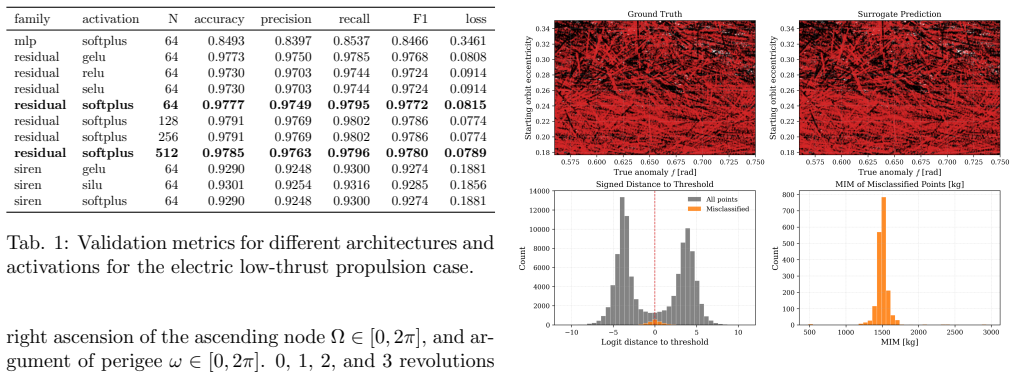
Reachability analysis plays a central role in low-thrust spacecraft trajectory optimization by identifying which target states can be achieved under constraints on time, thrust, and propellant. Classical approaches construct reachable sets by solving many optimal control problems over grids of terminal states, requiring extensive forward simulations with fixed initial conditions. While effective, this approach is computationally expensive and becomes impractical for high-dimensional systems or strongly nonlinear dynamics, such as those encountered in cislunar environments or solar sail missions. This work introduces a dual formulation of the reachability problem. Instead of computing reachable sets directly, we determine, for fixed transfer time and boundary conditions, the maximum allowable initial mass (or, for solar sails, a scalar sail-strength parameter) that permits a successful transfer. A target is reachable if the spacecraft's initial mass does not exceed this threshold. This reformulation reduces reachability assessment to a scalar optimization problem for each target, producing a smooth scalar field that encodes equivalent feasibility information to classical reachable sets. We develop indirect maximum-initial-mass (MIM) formulations for both electric low-thrust and solar-sail dynamics and show how they can serve as efficient reachability oracles. Building on this formulation, we construct data-driven surrogate models to approximate the MIM-based reachability indicator. We investigate fully connected neural networks and demonstrate that residual networks provide the best trade-off between accuracy, training stability, and model complexity. The resulting surrogates enable rapid reachability evaluation while preserving the numerical advantages of the dual formulation, offering a practical tool for preliminary mission design and feasibility assessment.
Editorial analysis
A structured set of objections, weighed in public.
Referee Report
Summary. The paper claims that reachability for low-thrust and solar-sail trajectories can be assessed via a dual formulation that computes, for each fixed target and transfer time, the maximum initial mass (MIM) permitting a feasible transfer; a target is reachable precisely when the spacecraft initial mass is at or below this MIM value. This is obtained from indirect optimal-control formulations enforcing Pontryagin’s necessary conditions, yielding a smooth scalar field equivalent to classical reachable sets. The approach is further approximated by residual neural-network surrogates for rapid evaluation.
Significance. If the central equivalence holds, the reformulation would replace expensive gridding of reachable sets with per-target scalar optimizations and cheap surrogate queries, offering a practical tool for preliminary feasibility assessment in nonlinear regimes such as cislunar space. The explicit construction of indirect MIM problems and the reported preference for residual networks over fully connected nets constitute concrete, reproducible contributions that could be adopted by mission-design workflows.
major comments (2)
- [Abstract] Abstract, dual-formulation paragraph: the claim that 'a target is reachable if the spacecraft's initial mass does not exceed this threshold' and that the MIM field 'encodes equivalent feasibility information to classical reachable sets' is load-bearing. Indirect methods solve the TPBVP arising from Pontryagin’s principle and therefore locate only stationary points; the low-thrust orbital problem is non-convex, so distinct control histories can produce distinct stationary values of initial mass. Without additional arguments or numerical evidence that the computed MIM is the global supremum, the claimed if-and-only-if equivalence to reachable sets does not follow.
- [Abstract] Abstract, surrogate paragraph: the statement that the neural-network surrogates 'preserve the numerical advantages of the dual formulation' presupposes that the underlying MIM values are themselves globally optimal. If the indirect solutions are only locally optimal, the training data already embed classification errors; the surrogates then propagate rather than mitigate the mismatch with classical reachable sets.
minor comments (1)
- [Abstract] The abstract supplies no quantitative validation (error metrics, comparison against grid-based reachable sets, or convergence statistics), making it impossible to assess how closely the computed MIM field matches classical results even on the tested cases.
Simulated Author's Rebuttal
We thank the referee for the constructive comments identifying the need for explicit support of global optimality in the indirect MIM formulation. We address each major comment below and will revise the manuscript accordingly to strengthen the equivalence claims.
read point-by-point responses
-
Referee: [Abstract] Abstract, dual-formulation paragraph: the claim that 'a target is reachable if the spacecraft's initial mass does not exceed this threshold' and that the MIM field 'encodes equivalent feasibility information to classical reachable sets' is load-bearing. Indirect methods solve the TPBVP arising from Pontryagin’s principle and therefore locate only stationary points; the low-thrust orbital problem is non-convex, so distinct control histories can produce distinct stationary values of initial mass. Without additional arguments or numerical evidence that the computed MIM is the global supremum, the claimed if-and-only-if equivalence to reachable sets does not follow.
Authors: We acknowledge that the non-convex nature of the problem means indirect methods yield stationary points that are not automatically guaranteed to be global maxima. In the revised manuscript we will add a dedicated subsection (in the MIM formulation section) that (i) states the conditions under which the computed stationary point is the global supremum for the low-thrust and solar-sail problems considered, and (ii) supplies numerical evidence obtained by cross-validating a representative set of cislunar and solar-sail test cases against direct collocation solutions. These additions will explicitly support the if-and-only-if equivalence asserted in the abstract. revision: yes
-
Referee: [Abstract] Abstract, surrogate paragraph: the statement that the neural-network surrogates 'preserve the numerical advantages of the dual formulation' presupposes that the underlying MIM values are themselves globally optimal. If the indirect solutions are only locally optimal, the training data already embed classification errors; the surrogates then propagate rather than mitigate the mismatch with classical reachable sets.
Authors: We agree that surrogate fidelity is contingent on the global optimality of the training labels. The new subsection and numerical cross-validation described in the response to the first comment will confirm that the MIM data used for training are globally optimal. With this verification in place, the claim that the surrogates preserve the dual formulation’s advantages will be justified; we will also edit the abstract to reference the added validation. revision: yes
Circularity Check
No circularity: dual MIM formulation is an independent reformulation
full rationale
The paper's central step is a reformulation of reachability as the computation of maximum initial mass (MIM) via indirect optimal control for fixed boundaries, asserting equivalence to classical reachable sets because a target is reachable iff m0 ≤ MIM. No equations, definitions, or claims in the abstract reduce this equivalence to a fitted parameter, self-definition, or load-bearing self-citation. The derivation relies on standard Pontryagin necessary conditions applied to the dual problem and is presented as self-contained against external benchmarks; the provided text contains none of the enumerated circular patterns. This is the expected honest non-finding for a reformulation paper.
Axiom & Free-Parameter Ledger
axioms (1)
- domain assumption Standard models of electric low-thrust and solar-sail spacecraft dynamics
Forward citations
Cited by 1 Pith paper
-
The Maximum Initial Mass
Introduces maximum-initial-mass optimal control problem for low-thrust transfers, establishes correspondence to minimum-time extremals, and applies it to recover global solutions for a GTO-to-GEO benchmark.
Reference graph
Works this paper leans on
-
[1]
Reachabil- ity results for nonlinear systems with ellipsoidal ini- tial sets
Holzinger, M. J. and Scheeres, D. J. “Reachabil- ity results for nonlinear systems with ellipsoidal ini- tial sets.” IEEE transactions on aerospace and elec- tronic systems, Vol. 48, No. 2, pp. 1583–1600, 2012
2012
-
[2]
Reachability of a passive solar sail in earth orbit
Pellegrino, M. and Scheeres, D. J. “Reachability of a passive solar sail in earth orbit.” Journal of Guidance, Control, and Dynamics, Vol. 44, No. 2, pp. 360–369, 2021
2021
-
[3]
Reachable set computation for spacecraft relative motion with energy-limited low-thrust
Lee, S. and Hwang, I. “Reachable set computation for spacecraft relative motion with energy-limited low-thrust.” Aerospace Science and Technology, Vol. 77, pp. 180–188, 2018
2018
-
[4]
Minimum- fuel low-thrust trajectory optimization via reacha- bility analysis and convex programming
Chen, Q., Qiao, D., and Wen, C. “Minimum- fuel low-thrust trajectory optimization via reacha- bility analysis and convex programming.” Journal of Guidance, Control, and Dynamics, Vol. 44, No. 5, pp. 1036–1043, 2021. 30th International Symposium on Space Flight Dynamics 1–5 June 2026, Toulouse, France
2021
-
[5]
Rapid approximation of low-thrust spacecraft reachable sets within com- plex two-body and cislunar dynamics
Bowerfind, S. and Taheri, E. “Rapid approximation of low-thrust spacecraft reachable sets within com- plex two-body and cislunar dynamics.” Aerospace, Vol. 11, No. 5, p. 380, 2024
2024
-
[6]
Analytical optimal solution for the reachable domain of low-thrust spacecraft
Wang, Z. and Jiang, F. “Analytical optimal solution for the reachable domain of low-thrust spacecraft.” Journal of Spacecraft and Rockets, Vol. 61, No. 1, pp. 274–284, 2024
2024
-
[7]
Fast approx- imators for optimal low-thrust hops between main belt asteroids
Hennes, D., Izzo, D., and Landau, D. “Fast approx- imators for optimal low-thrust hops between main belt asteroids.” “2016 IEEE Symposium Series on Computational Intelligence (SSCI),” pp. 1–7. IEEE, 2016
2016
-
[8]
Machine learn- ing of optimal low-thrust transfers between near- earth objects
Mereta, A., Izzo, D., and Wittig, A. “Machine learn- ing of optimal low-thrust transfers between near- earth objects.” “International Conference on Hy- brid Artificial Intelligence Systems,” pp. 543–553. Springer, 2017
2017
-
[9]
Acciarini, G., Beauregard, L., and Izzo, D. “Com- puting Low-Thrust Transfers in the Asteroid Belt, a Comparison between Astrodynamical Manipula- tions and a Machine Learning Approach.” “29th International Symposium on Space Flight Dynam- ics (ISSFD 2024),” Darmstadt, Germany, Apr. 2024. doi:10.48550/arXiv.2405.18918
-
[10]
Asteroid mining: ACT&Friends’ results for the GTOC12 problem
Izzo, D., M¨ artens, M., Beauregard, L., Bannach, M., Acciarini, G., Blazquez, E., Hadjiivanov, A., Grover, J., Heißel, G., Shimane, Y., et al. “Asteroid mining: ACT&Friends’ results for the GTOC12 problem.” Astrodynamics, Vol. 9, No. 1, pp. 19–40, 2025
2025
-
[11]
Kirk, D. E. Optimal control theory: an introduc- tion. Courier Corporation, 2004
2004
-
[12]
Hamilton-jacobi reachability: A brief overview and recent advances
Bansal, S., Chen, M., Herbert, S., and Tomlin, C. J. “Hamilton-jacobi reachability: A brief overview and recent advances.” “2017 IEEE 56th annual con- ference on decision and control (CDC),” pp. 2242–
2017
-
[13]
Reach-avoid problems with time-varying dy- namics, targets and constraints
Fisac, J. F., Chen, M., Tomlin, C. J., and Sastry, S. S. “Reach-avoid problems with time-varying dy- namics, targets and constraints.” “Proceedings of the 18th international conference on hybrid systems: computation and control,” pp. 11–20. 2015
2015
-
[14]
How many impulses redux
Taheri, E. and Junkins, J. L. “How many impulses redux.” The Journal of the Astronautical Sciences, Vol. 67, No. 2, pp. 257–334, 2020
2020
-
[15]
Pretrained Approximators for Low- Thrust Trajectory Cost and Reachability
Zhang, Z., Acciarini, G., Izzo, D., Baoyin, H., and Topputo, F. “Pretrained Approximators for Low- Thrust Trajectory Cost and Reachability.” Journal of Guidance, Control, and Dynamics, 2026. To ap- pear
2026
-
[16]
S., Boltyanskii, V
Pontryagin, L. S., Boltyanskii, V. G., Gamkrelidze, R. V., and Mishchenko, E. F. The Mathematical Theory of Optimal Processes. Interscience Publish- ers / John Wiley & Sons, New York; London, 1962
1962
-
[17]
Fuel optimization for low-thrust Earth–Moon transfer via indirect op- timal control
P´ erez-Palau, D. and Epenoy, R. “Fuel optimization for low-thrust Earth–Moon transfer via indirect op- timal control.” Celestial Mechanics and Dynamical Astronomy, Vol. 130, No. 2, p. 21, 2018
2018
-
[18]
Indirect forward– backward shooting for low-thrust trajectory opti- mization in complex dynamics
Sidhoum, Y. and Oguri, K. “Indirect forward– backward shooting for low-thrust trajectory opti- mization in complex dynamics.” Journal of Guid- ance, Control, and Dynamics, Vol. 47, No. 10, pp. 2164–2172, 2024
2024
-
[19]
Guo, X., Wu, D., and Jiang, F. “Minimum-Time Rendezvous via Simplified Initial Costate Normal- ization and Auxiliary Orbital Transfer.” Journal of Guidance, Control, and Dynamics, Vol. 46, No. 8, pp. 1627–1636, 2023. doi:10.2514/1.G007268
-
[20]
Practical tech- niques for low-thrust trajectory optimization with homotopic approach
Jiang, F., Baoyin, H., and Li, J. “Practical tech- niques for low-thrust trajectory optimization with homotopic approach.” Journal of guidance, control, and dynamics, Vol. 35, No. 1, pp. 245–258, 2012
2012
-
[21]
New smoothing tech- niques for solving bang–bang optimal control prob- lems—numerical results and statistical interpreta- tion
Bertrand, R. and Epenoy, R. “New smoothing tech- niques for solving bang–bang optimal control prob- lems—numerical results and statistical interpreta- tion.” Optimal Control Applications and Methods, Vol. 23, No. 4, pp. 171–197, 2002
2002
-
[22]
A practical guide to implement- ing zero-order-hold interplanetary trajectory legs
Izzo, D., Holt, H., Acciarini, G., Beauregard, L., and Shimane, Y. “A practical guide to implement- ing zero-order-hold interplanetary trajectory legs.” 30th International Symposium on Space Flight Dy- namics, 2026
2026
-
[23]
Forward–Backward Indirect Shooting for Low- Thrust Trajectories with Interior Events
Zhang, Z., Yang, J., Izzo, D., and Topputo, F. “Forward–Backward Indirect Shooting for Low- Thrust Trajectories with Interior Events.” 30th In- ternational Symposium on Space Flight Dynamics, 2026
2026
-
[24]
A hybrid method for nonlinear equa- tions
Powell, M. J. “A hybrid method for nonlinear equa- tions.” Numerical methods for nonlinear algebraic equations, pp. 87–161, 1970. 30th International Symposium on Space Flight Dynamics 1–5 June 2026, Toulouse, France
1970
-
[25]
McInnes, C. R. Solar sailing: technology, dynamics and mission applications. Springer Science & Busi- ness Media, 2004
2004
-
[26]
Solar sail mission applications for non-Keplerian orbits
McInnes, C. R. “Solar sail mission applications for non-Keplerian orbits.” Acta Astronautica, Vol. 45, No. 4-9, pp. 567–575, 1999
1999
-
[27]
Implicit neural representations with periodic activation functions
Sitzmann, V., Martel, J., Bergman, A., Lindell, D., and Wetzstein, G. “Implicit neural representations with periodic activation functions.” Advances in neural information processing systems, Vol. 33, pp. 7462–7473, 2020
2020
-
[28]
Deep resid- ual learning for image recognition
He, K., Zhang, X., Ren, S., and Sun, J. “Deep resid- ual learning for image recognition.” “Proceedings of the IEEE conference on computer vision and pattern recognition,” pp. 770–778. 2016. 30th International Symposium on Space Flight Dynamics 1–5 June 2026, Toulouse, France
2016
discussion (0)
Sign in with ORCID, Apple, or X to comment. Anyone can read and Pith papers without signing in.