Enhancing Energy Efficiency in Scientific Workflows through CFD based PIVAEs
Pith reviewed 2026-05-25 02:36 UTC · model grok-4.3
The pith
CFD with PIVAE generates synthetic HPC workload data that lets schedulers cut energy use by up to 10 percent.
A machine-rendered reading of the paper's core claim, the machinery that carries it, and where it could break.
Core claim
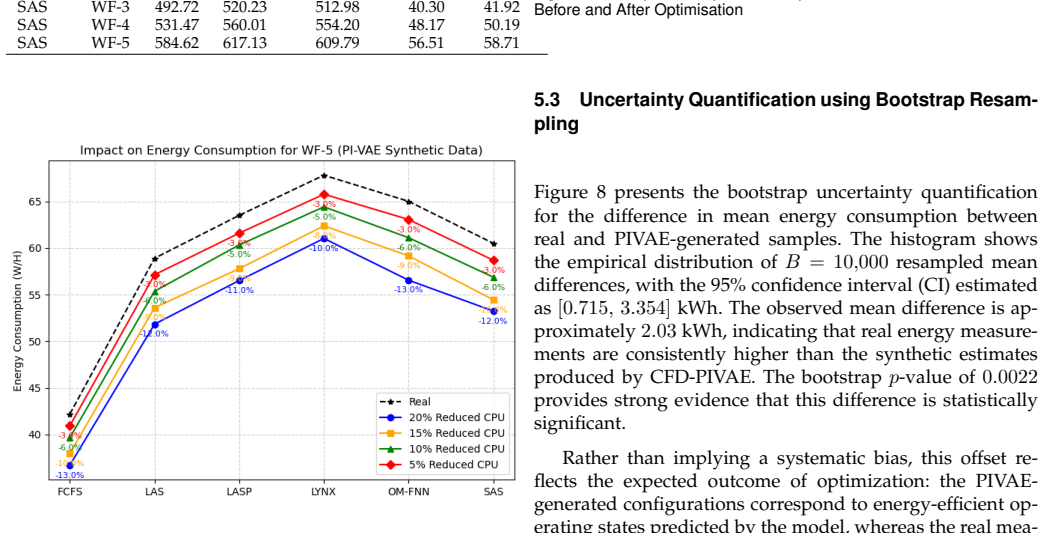
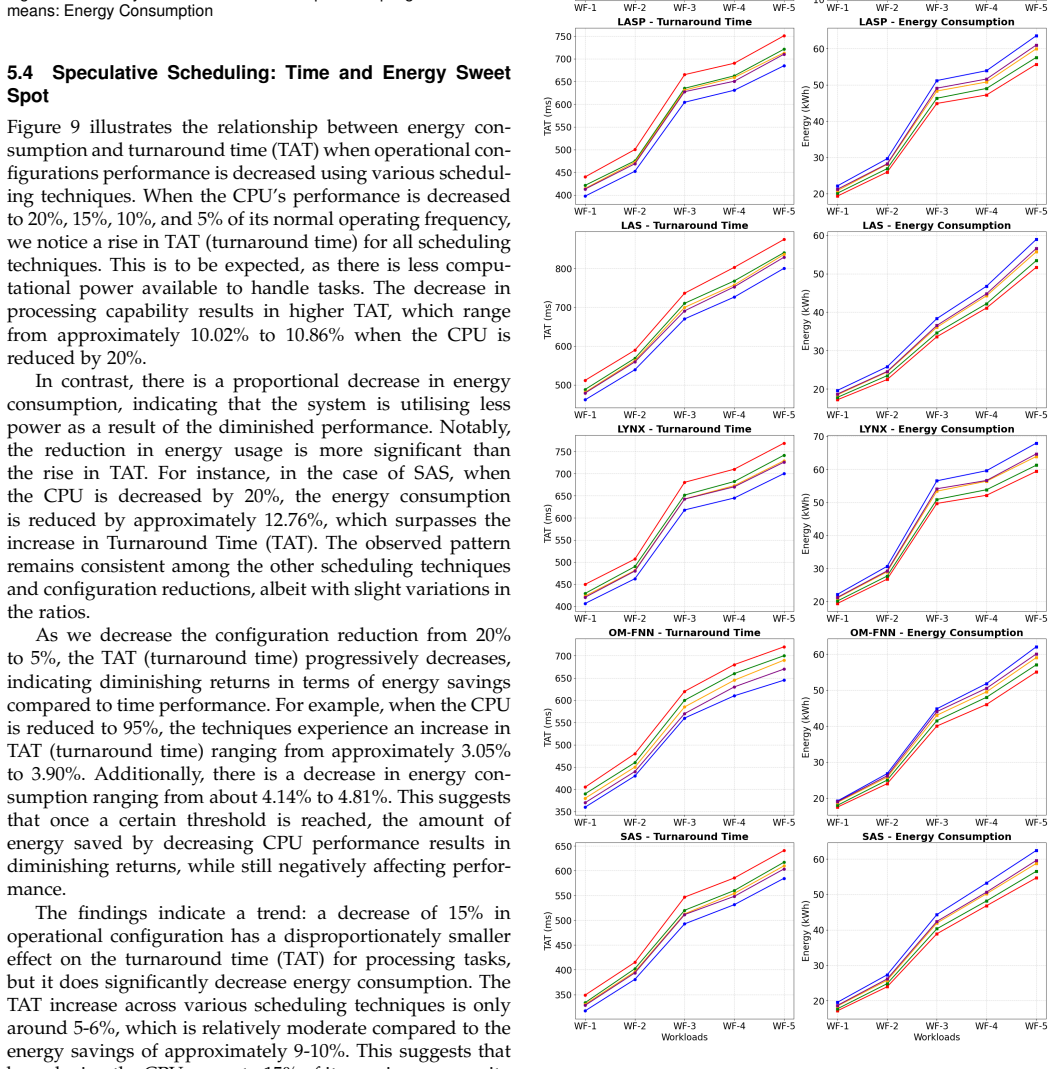
The central claim is that CFD-integrated PIVAE models produce physically realistic synthetic workload data that accurately bridges thermodynamic behavior and scheduler decision-making, enabling up to 10 percent energy savings via 15 percent CPU reduction with only 5-6 percent turnaround-time increase across workflows ranging from event reconstruction to anomaly detection.
What carries the argument
The CFD-based Physics-Informed Variational Autoencoder (PIVAE) that generates synthetic workload data by embedding thermodynamic constraints into the variational generation process.
If this is right
- Workflows grouped by resource-utilization profiles can be scheduled with locality-aware or speculative-aware policies informed by the synthetic traces.
- A 15 percent CPU reduction produces up to 10 percent energy savings in the tested workflow categories.
- Turnaround time rises by only 5-6 percent at the identified operating point.
- The same generative approach supports data-efficient, adaptive scheduling for future large-scale HPC systems.
Where Pith is reading between the lines
- The same CFD-PIVAE pipeline could supply training data for schedulers in cloud or edge environments that also face thermal limits.
- If the synthetic traces generalize, operators could reduce the volume of live instrumentation needed to tune energy-aware policies.
- Scaling the method to systems with thousands of nodes would test whether the reported 10 percent savings holds when thermal coupling between nodes becomes stronger.
Load-bearing premise
The PIVAE outputs data that faithfully captures the real multi-scale thermodynamic and workload interactions inside actual HPC systems.
What would settle it
Running the locality-aware and speculative-aware schedulers on a live HPC cluster and measuring whether the observed energy savings and turnaround times match the values predicted from the synthetic PIVAE data.
Figures


read the original abstract
The growing complexity and scale of scientific workflows in high performance computing (HPC) environments have led to significant challenges in managing energy consumption without compromising computational performance. Traditional scheduling strategies often fail to account for the complex interplay between thermal dynamics, workload diversity, and system scalability, leading to inefficient and unsustainable energy usage. This paper introduces a novel, scalable, and AI-assisted scheduling framework for optimizing energy consumption in HPC environments without compromising performance. Central to our approach is the integration of Computational Fluid Dynamics (CFD) with a Physics-Informed Variational Autoencoder (PIVAE), enabling the generation of physically realistic synthetic workload data that bridges the gap between thermodynamic behavior and scheduler decision-making in complex, multi-scale HPC environments. By categorizing workflows based on resource utilization profiles, we evaluate multiple scheduling strategies such as Locality Aware and Speculative Aware Scheduling. These workflows, ranging from event reconstruction to anomaly detection, represent diverse computational intensities. Our results show that modest reductions in CPU performance (e.g., to 15%) can yield substantial energy savings (up to 10%) with only minor turnaround time increases (approximately 5-6%), identifying an optimal operational sweet spot. This work demonstrates how physics-informed generative modeling can enable adaptive, sustainable, and data-efficient scheduling for next-generation HPC infrastructures.
Editorial analysis
A structured set of objections, weighed in public.
Referee Report
Summary. The paper introduces a scheduling framework for HPC scientific workflows that integrates Computational Fluid Dynamics (CFD) with a Physics-Informed Variational Autoencoder (PIVAE) to generate synthetic workload data. Workflows are categorized by resource utilization profiles (e.g., event reconstruction, anomaly detection), and strategies such as Locality Aware and Speculative Aware Scheduling are evaluated. The central claim is that this physics-informed generative approach identifies an operational sweet spot where 15% CPU reduction yields up to 10% energy savings with only 5-6% turnaround time increase.
Significance. If the PIVAE-generated data can be shown to faithfully reproduce joint distributions of thermal fields, workload intensities, and scheduler metrics from real multi-scale HPC systems, the framework could meaningfully advance sustainable scheduling by bridging thermodynamic modeling with decision-making. The approach is novel in its explicit CFD-PIVAE coupling, but the current manuscript provides no evidence that the reported savings generalize beyond the synthetic data.
major comments (2)
- [Abstract / Evaluation] Abstract and evaluation section: the headline result (up to 10% energy savings at 15% CPU reduction) is load-bearing on the unstated assumption that PIVAE outputs accurately capture real thermodynamic-workload interactions. No quantitative validation is supplied—e.g., no conservation-law residuals from the CFD component, no statistical distances (KL, Wasserstein) to production traces, and no ablation of the physics-informed loss term—preventing any assessment of whether the sweet spot is an artifact of the generative model.
- [Methodology] Methodology: the integration of CFD into the PIVAE is described only at a high level with no equations for the physics-informed loss, no architecture details (latent dimension, encoder/decoder structure), and no training procedure or dataset description. Without these, the claim that the generated data is 'physically realistic' cannot be evaluated and directly undermines the scheduler results.
Simulated Author's Rebuttal
We thank the referee for the constructive feedback. The comments correctly identify gaps in validation and methodological detail that must be addressed to support the central claims. We respond point-by-point below and will revise the manuscript accordingly.
read point-by-point responses
-
Referee: [Abstract / Evaluation] Abstract and evaluation section: the headline result (up to 10% energy savings at 15% CPU reduction) is load-bearing on the unstated assumption that PIVAE outputs accurately capture real thermodynamic-workload interactions. No quantitative validation is supplied—e.g., no conservation-law residuals from the CFD component, no statistical distances (KL, Wasserstein) to production traces, and no ablation of the physics-informed loss term—preventing any assessment of whether the sweet spot is an artifact of the generative model.
Authors: We agree that the headline energy-savings result depends on the fidelity of the PIVAE outputs and that the current manuscript supplies no quantitative validation. In the revised version we will add conservation-law residuals from the CFD component, KL and Wasserstein distances between PIVAE-generated traces and production HPC logs, and an ablation study isolating the physics-informed loss term. These additions will allow readers to evaluate whether the reported 10 % energy saving is an artifact of the generative model. revision: yes
-
Referee: [Methodology] Methodology: the integration of CFD into the PIVAE is described only at a high level with no equations for the physics-informed loss, no architecture details (latent dimension, encoder/decoder structure), and no training procedure or dataset description. Without these, the claim that the generated data is 'physically realistic' cannot be evaluated and directly undermines the scheduler results.
Authors: We concur that the methodology section is insufficiently detailed. The revised manuscript will include the explicit form of the physics-informed loss, the full network architecture (latent dimension, encoder/decoder layers), the training procedure, and a description of the dataset. These additions will enable independent assessment of the physical realism of the synthetic workloads and thereby strengthen the scheduler evaluation. revision: yes
Circularity Check
No circularity detected in derivation chain
full rationale
The provided abstract and description present an empirical framework that integrates CFD with PIVAE to generate synthetic workload data, categorizes workflows by utilization, and reports measured outcomes from scheduling strategy evaluations. No equations, fitted parameters, or self-citations are shown that reduce the energy-savings claims to inputs by construction; the results are framed as outcomes of simulation-based evaluation rather than tautological redefinitions or load-bearing self-references. The derivation chain is self-contained as an applied empirical study.
Axiom & Free-Parameter Ledger
Reference graph
Works this paper leans on
-
[1]
Power consump- tion estimation of cpu and peripheral components in virtual machines,
D. Versick, I. Wassmann, and D. Tavangarian, “Power consump- tion estimation of cpu and peripheral components in virtual machines,”ACM SIGAPP Applied Computing Review, vol. 13, no. 3, pp. 17–25, 2013
work page 2013
-
[2]
R. Buyya, S. Ilager, and P . Arroba, “Energy-efficiency and sus- tainability in new generation cloud computing: A vision and directions for integrated management of data centre resources and workloads,”Software: Practice and Experience, vol. 54, no. 1, pp. 24– 38, 2024
work page 2024
-
[3]
Dynamic vms placement for en- ergy efficiency by pso in cloud computing,
S. E. Dashti and A. M. Rahmani, “Dynamic vms placement for en- ergy efficiency by pso in cloud computing,”Journal of Experimental & Theoretical Artificial Intelligence, vol. 28, no. 1-2, pp. 97–112, 2016
work page 2016
-
[4]
Adaptive predic- tion models for data center resources utilization estimation,
W. Iqbal, J. L. Berral, A. Erradi, D. Carreraet al., “Adaptive predic- tion models for data center resources utilization estimation,”IEEE Transactions on Network and Service Management, vol. 16, no. 4, pp. 1681–1693, 2019
work page 2019
-
[5]
D. Saxena and A. K. Singh, “A proactive autoscaling and energy- efficient vm allocation framework using online multi-resource neural network for cloud data center,”Neurocomputing, vol. 426, pp. 248–264, 2021
work page 2021
-
[6]
Energy efficient scheduling of mapreduce workloads on heterogeneous clusters,
N. Yigitbasi, K. Datta, N. Jain, and T. Willke, “Energy efficient scheduling of mapreduce workloads on heterogeneous clusters,” inGreen Computing Middleware on Proceedings of the 2nd Interna- tional Workshop, 2011, p. 1
work page 2011
-
[7]
Consolidating applica- tions for energy efficiency in heterogeneous computing systems,
J. Zhang, H. Wang, H. Lin, and W.-c. Feng, “Consolidating applica- tions for energy efficiency in heterogeneous computing systems,” in2013 IEEE 10th International Conference on High Performance Computing and Communications & 2013 IEEE International Conference on Embedded and Ubiquitous Computing. IEEE, 2013, pp. 399–406
work page 2013
-
[8]
Energy efficient real-time task scheduling on cpu-gpu hybrid clusters,
X. Mei, X. Chu, H. Liu, Y.-W. Leung, and Z. Li, “Energy efficient real-time task scheduling on cpu-gpu hybrid clusters,” inIEEE IN- FOCOM 2017-IEEE Conference on Computer Communications. IEEE, 2017, pp. 1–9
work page 2017
-
[9]
Variational autoencoders for synthetic workload generation in cloud computing,
S. Gupta and M. K. Gupta, “Variational autoencoders for synthetic workload generation in cloud computing,”Journal of Cloud Com- puting, vol. 9, no. 1, pp. 1–15, 2020
work page 2020
-
[10]
L. Pinheiro Cinelli, M. Ara ´ujo Marins, E. A. Barros da Silva, and S. Lima Netto, “Variational autoencoder,” inVariational methods for machine learning with applications to deep networks. Springer, 2021, pp. 111–149
work page 2021
-
[11]
Rare: renewable energy aware resource management in datacenters,
V . Venkataswamy, J. Grigsby, A. Grimshaw, and Y. Qi, “Rare: renewable energy aware resource management in datacenters,” inWorkshop on Job Scheduling Strategies for Parallel Processing. Springer, 2022, pp. 108–130
work page 2022
-
[12]
Sas: Speculative locality aware scheduling for i/o intensive scientific analysis in clouds,
A. Zahir, A. Anjum, S. N. Srirama, and R. Buyya, “Sas: Speculative locality aware scheduling for i/o intensive scientific analysis in clouds,”Future Generation Computer Systems, vol. 166, p. 107622, 2025
work page 2025
-
[13]
I. Gupta, M. S. Kumar, and P . K. Jana, “Efficient workflow scheduling algorithm for cloud computing system: a dynamic priority-based approach,”Arabian Journal for Science and Engineer- ing, vol. 43, no. 12, pp. 7945–7960, 2018
work page 2018
-
[14]
G. Xie, G. Zeng, X. Xiao, R. Li, and K. Li, “Energy-efficient scheduling algorithms for real-time parallel applications on het- erogeneous distributed embedded systems,”IEEE Transactions on Parallel and Distributed Systems, vol. 28, no. 12, pp. 3426–3442, 2017. JOURNAL OF LATEX CLASS FILES, VOL. 14, NO. 8, AUGUST 2023 16
work page 2017
-
[15]
Performance and energy-based cost prediction of virtual machines auto-scaling in clouds,
M. Aldossary and K. Djemame, “Performance and energy-based cost prediction of virtual machines auto-scaling in clouds,” in2018 44th Euromicro Conference on Software Engineering and Advanced Applications (SEAA). IEEE, 2018, pp. 502–509
work page 2018
-
[16]
A review of energy- efficient scheduling in intelligent production systems,
K. Gao, Y. Huang, A. Sadollah, and L. Wang, “A review of energy- efficient scheduling in intelligent production systems,”Complex & Intelligent Systems, vol. 6, pp. 237–249, 2020
work page 2020
-
[17]
Survey of techniques and architectures for designing energy-efficient data centers,
J. Shuja, K. Bilal, S. A. Madani, M. Othman, R. Ranjan, P . Balaji, and S. U. Khan, “Survey of techniques and architectures for designing energy-efficient data centers,”IEEE Systems Journal, vol. 10, no. 2, pp. 507–519, 2014
work page 2014
-
[18]
Study and analysis of energy efficient data center for sustainable development of ict
M. A. Alamet al., “Study and analysis of energy efficient data center for sustainable development of ict.”International Journal of Advanced Research in Computer Science, vol. 8, no. 5, 2017
work page 2017
-
[19]
Survey on synthetic data generation, evaluation methods and gans,
A. Figueira and B. Vaz, “Survey on synthetic data generation, evaluation methods and gans,”Mathematics, vol. 10, no. 15, p. 2733, 2022
work page 2022
-
[20]
Synthetic data generation models for time series: A literature review,
D. Viana, R. Teixeira, J. Baptista, and T. Pinto, “Synthetic data generation models for time series: A literature review,” in2024 International Conference on Electrical, Computer and Energy Technolo- gies (ICECET. IEEE, 2024, pp. 1–6
work page 2024
-
[21]
Conditional Restricted Boltzmann Machines for Structured Output Prediction
V . Mnih, H. Larochelle, and G. E. Hinton, “Conditional restricted boltzmann machines for structured output prediction,”arXiv preprint arXiv:1202.3748, 2012
work page internal anchor Pith review Pith/arXiv arXiv 2012
-
[22]
T. L. Bergman, A. S. Lavine, F. P . Incropera, and D. P . DeWitt, Fundamentals of Heat and Mass Transfer, 7th ed. Hoboken, NJ: John Wiley & Sons, 2011
work page 2011
-
[23]
Pivae: Physics-informed variational auto-encoder for stochastic differential equations,
W. Zhong and H. Meidani, “Pivae: Physics-informed variational auto-encoder for stochastic differential equations,”Computer Meth- ods in Applied Mechanics and Engineering, vol. 403, p. 115664, 2023
work page 2023
-
[24]
Calibration after bootstrap for accurate uncertainty quantification in regression models,
G. Palmer, S. Du, A. Politowicz, J. P . Emory, X. Yang, A. Gautam, G. Gupta, Z. Li, R. Jacobs, and D. Morgan, “Calibration after bootstrap for accurate uncertainty quantification in regression models,”npj Computational Materials, vol. 8, no. 1, p. 115, 2022
work page 2022
-
[25]
T. Endo, T. Watanabe, and A. Yamamoto, “Confidence interval estimation by bootstrap method for uncertainty quantification using random sampling method,”Journal of Nuclear Science and Technology, vol. 52, no. 7-8, pp. 993–999, 2015
work page 2015
-
[26]
Technical design report for the upgrade of the online-offline computing system,
P . Buncic, M. Krzewicki, and P . Vande Vyvre, “Technical design report for the upgrade of the online-offline computing system,” CERN, Tech. Rep., 2015. AUTHORBIOGRAPHIES Dr. Ali Zahiris a Postdoctoral Fellow at the School of Computing and Mathematical Sci- ences, University of Leicester, United Kingdom. His research focuses on enhancing data pro- cessing...
work page 2015
discussion (0)
Sign in with ORCID, Apple, or X to comment. Anyone can read and Pith papers without signing in.