Discovery and Analysis of a Type II Supernova Candidate at z = 3.19 from JWST's COSMOS-Web Survey
Pith reviewed 2026-06-30 14:56 UTC · model grok-4.3
The pith
JWST photometry at two epochs classifies SN 2023aeaf at z=3.195 as a Type II supernova from a ~12 solar mass progenitor with ~0.5 solar masses of circumstellar material.
A machine-rendered reading of the paper's core claim, the machinery that carries it, and where it could break.
Core claim
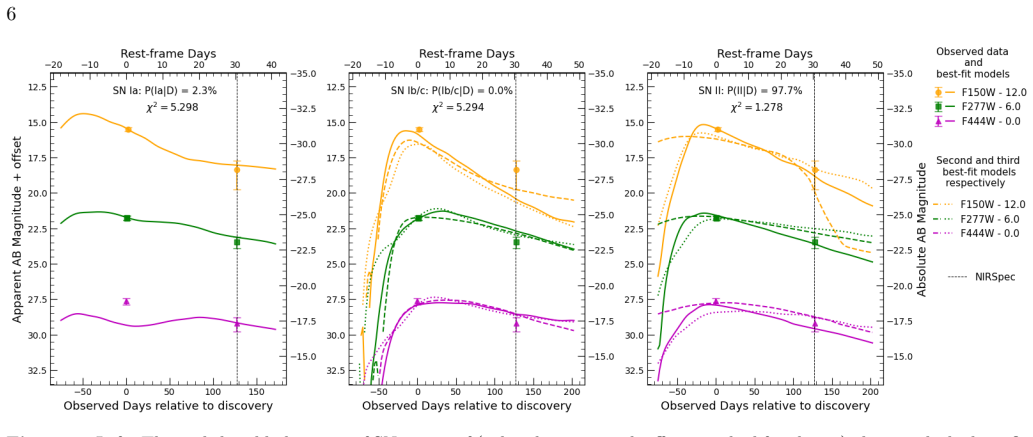
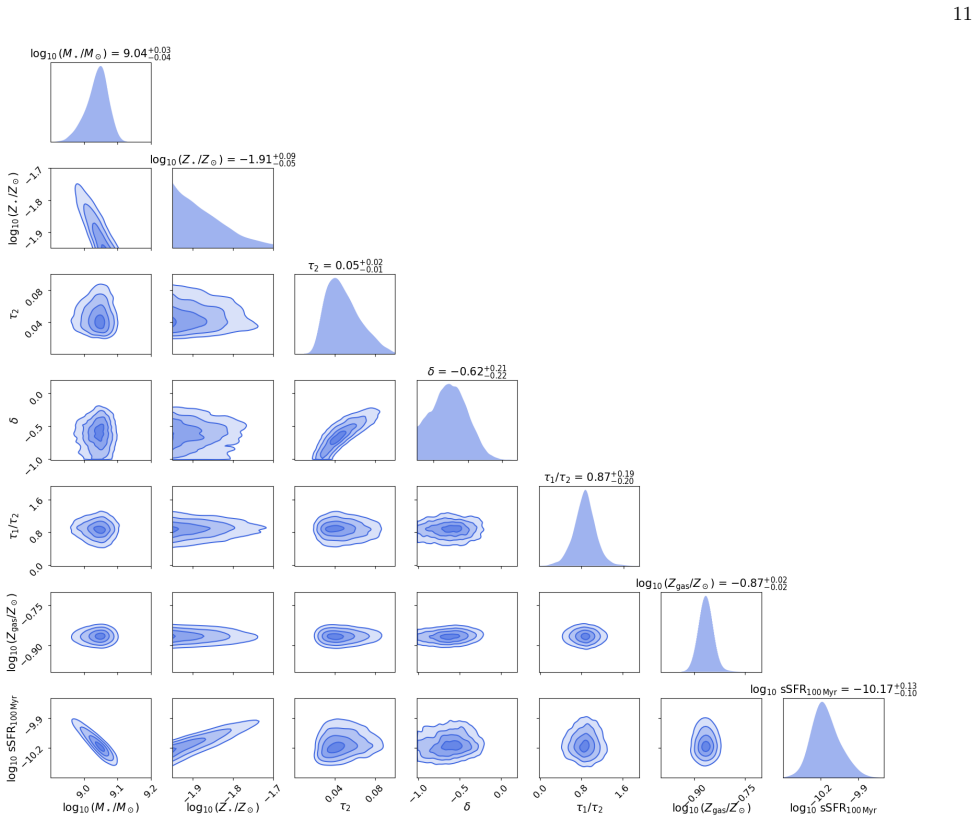
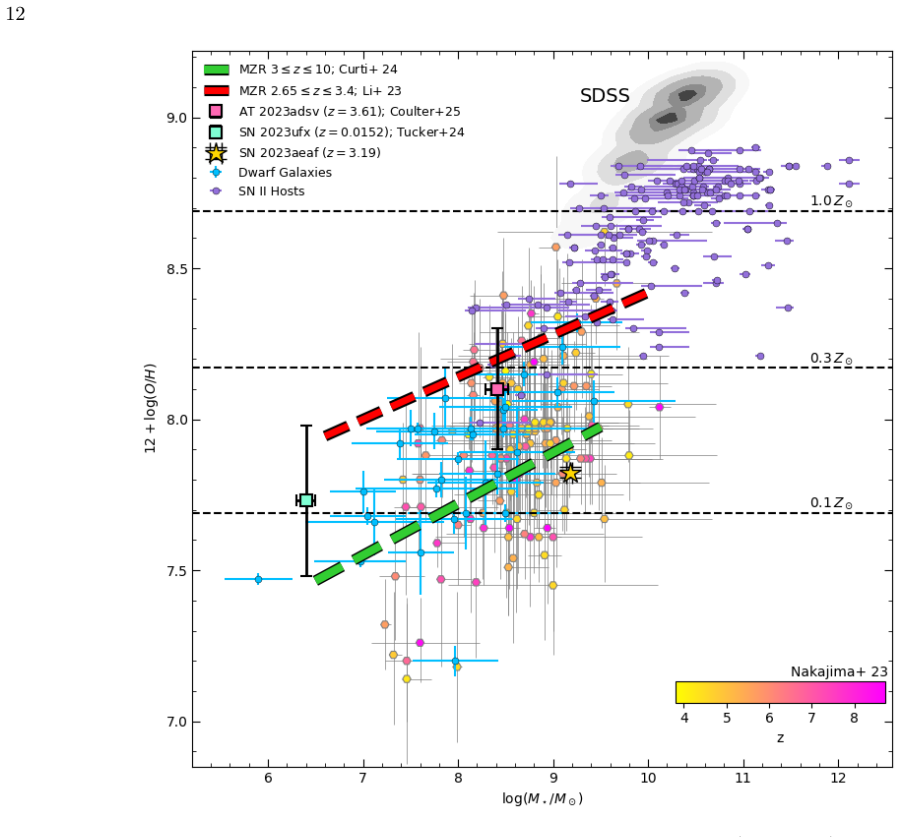
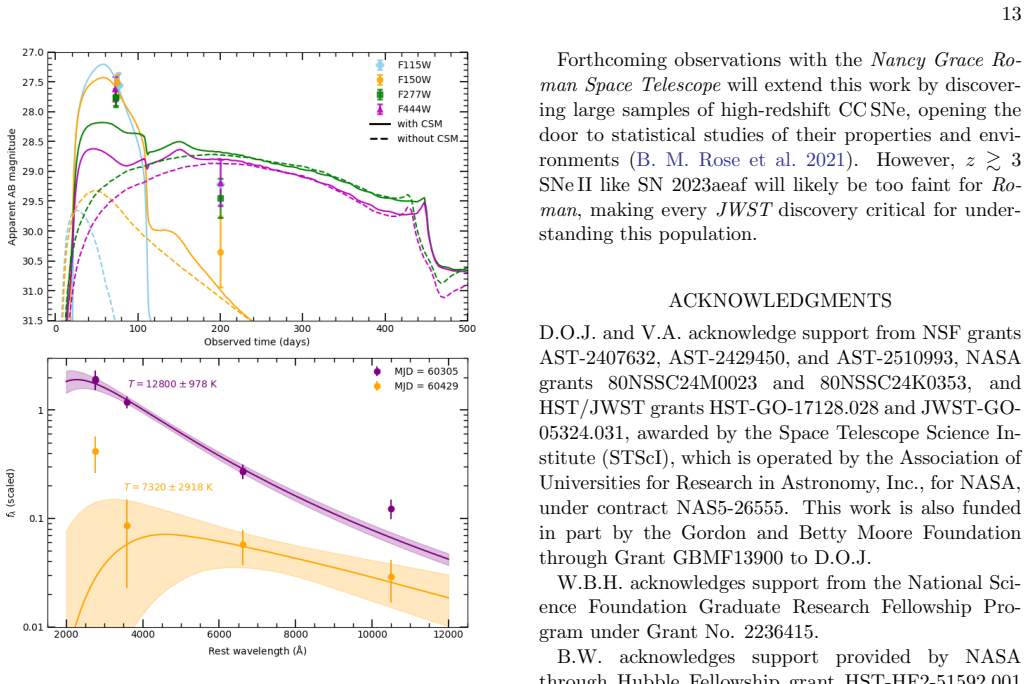
SN 2023aeaf is identified in two epochs of JWST photometry at z = 3.195 and photometrically classified as a Type II supernova by comparison to spectrophotometric core-collapse and Type Ia models. The data are most consistent with a ~12 M_⊙ progenitor surrounded by ~0.5 M_⊙ of circumstellar material. A spectrum taken ~30 rest-frame days after discovery shows no clear supernova features, with host Hα emission possibly masking any supernova signal. The host is characterized via Prospector SED modeling as a star-forming galaxy with log(M*/M⊙) = 9.04, log(sSFR/yr^{-1}) = -10.17, and 12 + log(O/H) = 7.82. The object joins other early-universe core-collapse supernovae that exhibit high luminosities
What carries the argument
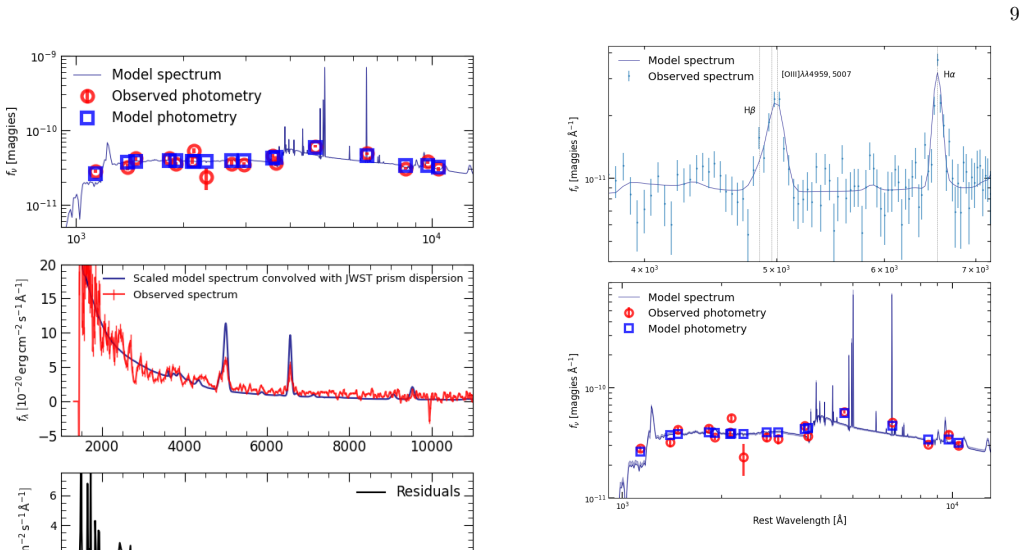
Two-epoch JWST photometry matched to spectrophotometric supernova templates for photometric classification, combined with Prospector Bayesian SED fitting of the host-galaxy photometry and spectrum.
If this is right
- The discovery supplies a new test of massive-star evolution at redshift greater than 3.
- It increases the sample of high-redshift core-collapse supernovae that display high luminosities and dense circumstellar material.
- The low-metallicity host environment is consistent with the conditions inferred for such events in the early universe.
- JWST two-epoch photometry can be used to identify and roughly characterize supernovae at redshifts beyond 3.
Where Pith is reading between the lines
- Additional photometric epochs or a spectrum with clear supernova features could tighten the progenitor-mass and circumstellar-material constraints beyond the current photometric limits.
- If similar events continue to show dense circumstellar material, mass-loss rates in massive stars may already have been high at early cosmic times.
- The combination of low host metallicity and circumstellar material could be used to test whether explosion mechanisms or progenitor channels differ from those observed locally.
Load-bearing premise
Two epochs of broadband JWST photometry separated by about one month in the rest frame are sufficient to distinguish a Type II supernova from other core-collapse or Type Ia events when compared to standard templates, even without clear spectroscopic supernova features.
What would settle it
A spectrum taken near peak or a set of additional photometric epochs that either match or systematically deviate from the Type II template light-curve shape used in the classification.
Figures

read the original abstract
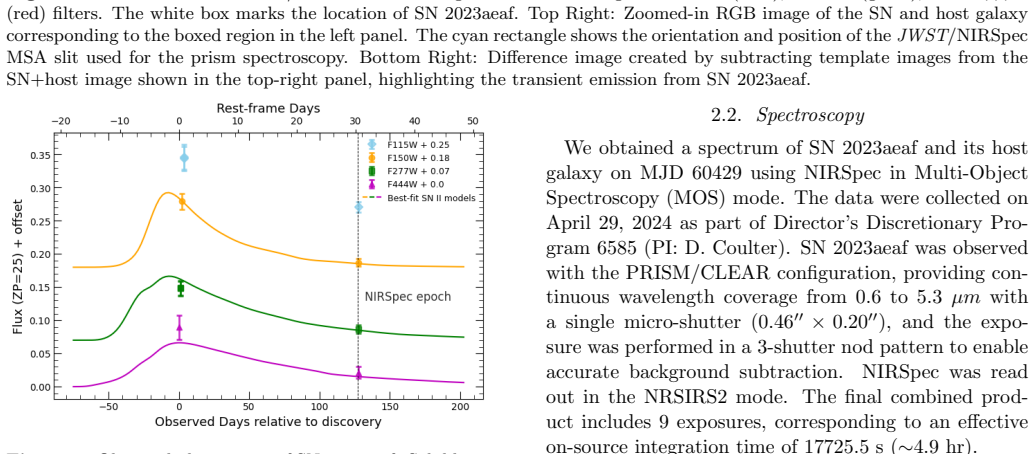
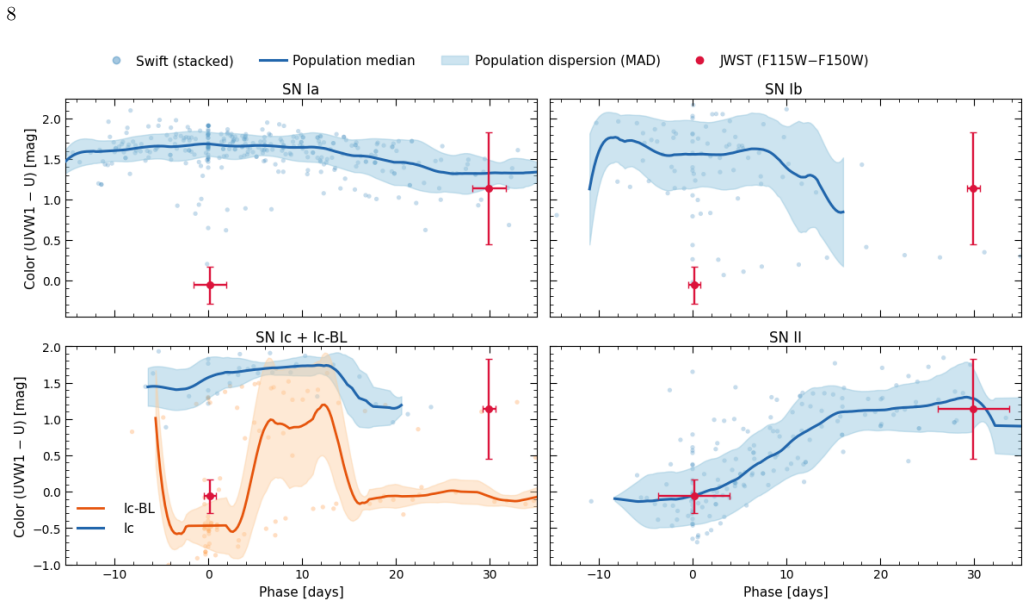
The launch of the James Webb Space Telescope (JWST) has enabled the discovery of a small but increasing sample of high-redshift core-collapse supernovae (CC SNe), which provide new tests of massive star evolution in the early Universe. In this study, we report the discovery of SN 2023aeaf in COSMOS-Web survey observations, which at $z = 3.195$ has one of the highest SN spectroscopic redshifts to date. Using two epochs of JWST photometry separated by $\sim$1 month in the rest frame, we photometrically classify SN 2023aeaf by comparing the JWST photometry to spectrophotometric CC SN and Type Ia (SN Ia) models and UV observations of SNe from the Swift telescope, finding that SN 2023aeaf is highly likely to be a Type II SN. A spectrum of the SN$+$host galaxy was also obtained $\sim$30 rest-frame days after discovery but shows no clearly identifiable SN features, with H$\alpha$ emission from the host potentially masking emission from the SN. Although the limited photometric coverage prevents strong constraints on the explosion properties, we find that the data are most consistent with a $\sim$12$M_\odot$ progenitor with $\sim$0.5$M_{\odot}$ of circumstellar material. We next use the host-galaxy spectrum and photometry to model the host spectral energy distribution (SED) using the Prospector Bayesian inference framework. We find that the host is a star-forming galaxy with a sSFR of $ \log_{10}(\rm sSFR/yr^{-1})= -10.17^{+0.13}_{-0.10}$, a stellar mass of $\log(M_\star/M_\odot) = 9.04^{+0.03}_{-0.04}$, and a gas-phase metallicity of $12 +{\rm log_{10}}({\rm O/H}) = 7.82\pm0.02$. SN 2023aeaf joins a growing sample of early Universe CC SNe with high luminosities, dense CSM, and low-metallicity environments.
Editorial analysis
A structured set of objections, weighed in public.
Referee Report
Summary. The manuscript reports the discovery of SN 2023aeaf at spectroscopic redshift z=3.195 in JWST COSMOS-Web data, one of the highest-z SNe with a spectrum. Using two epochs of JWST photometry separated by ~1 month (rest frame), the authors photometrically classify the event as a Type II supernova via template matching to CC SN and SN Ia models plus Swift UV data. They infer consistency with a ~12 M_⊙ progenitor and ~0.5 M_⊙ of CSM. The spectrum shows no clear SN features (host Hα may mask them). Host SED modeling with Prospector yields a star-forming galaxy with log(sSFR) = -10.17, log(M_*/M_⊙)=9.04, and 12+log(O/H)=7.82.
Significance. If the classification is robust, the result adds a high-luminosity, dense-CSM CC SN in a low-metallicity host to the small sample of z>3 core-collapse events, enabling tests of massive-star evolution at early times. The analysis employs standard, publicly available template libraries and the Prospector framework on public JWST photometry, providing a reproducible path for future high-z SN studies.
major comments (1)
- [photometric classification and progenitor inference] The photometric classification (abstract and associated analysis) as Type II rests on matching two rest-UV JWST points over a ~30-day rest-frame baseline to CC SN and SN Ia templates. With no identifiable SN spectral lines and the possibility that host Hα masks features, it is not shown that other templates are excluded at high significance within the reported photometric uncertainties; this directly underpins the ~12 M_⊙ + 0.5 M_⊙ CSM inference.
minor comments (1)
- [abstract and observations section] Clarify the exact rest-frame timing of the spectrum relative to the two photometric epochs and discovery date.
Simulated Author's Rebuttal
We thank the referee for their thoughtful review and for highlighting the limitations of the photometric classification. We respond to the major comment below and propose targeted revisions to strengthen the presentation of uncertainties.
read point-by-point responses
-
Referee: [photometric classification and progenitor inference] The photometric classification (abstract and associated analysis) as Type II rests on matching two rest-UV JWST points over a ~30-day rest-frame baseline to CC SN and SN Ia templates. With no identifiable SN spectral lines and the possibility that host Hα masks features, it is not shown that other templates are excluded at high significance within the reported photometric uncertainties; this directly underpins the ~12 M_⊙ + 0.5 M_⊙ CSM inference.
Authors: We agree that the classification is photometric only and that the two-epoch baseline plus absence of clear SN spectral features limits the ability to exclude alternative templates at high statistical significance. The manuscript already notes the lack of identifiable SN features and the potential masking by host Hα, but we will revise the abstract, Section 3, and the progenitor discussion to (i) explicitly state that the Type II preference is based on relative template matches rather than formal model exclusion, (ii) report the available goodness-of-fit metrics (χ² or equivalent) for the CC SN versus SN Ia libraries, and (iii) qualify the ~12 M_⊙ progenitor and ~0.5 M_⊙ CSM values as those of the best-matching model rather than a unique solution. These changes will make the strength of the inference commensurate with the data quality while preserving the scientific utility of the candidate. revision: partial
Circularity Check
No circularity: classification and inferences rely on external templates and standard fitting codes.
full rationale
The paper's core steps—photometric classification via direct comparison of two JWST epochs to external CC SN and SN Ia spectrophotometric models plus Swift UV data, plus Prospector SED fitting of the host—are independent of the target result. No equation or claim reduces by construction to a fitted parameter renamed as prediction, no self-citation chain bears the classification load, and the progenitor mass/CSM estimate is presented as a consistency check rather than a derivation. This matches the default expectation of a non-circular empirical analysis.
Axiom & Free-Parameter Ledger
free parameters (2)
- progenitor mass =
~12 M_sun
- CSM mass =
~0.5 M_sun
axioms (2)
- domain assumption Standard core-collapse and Type Ia supernova spectrophotometric models remain valid at z~3.
- domain assumption Prospector SED modeling yields reliable stellar mass, sSFR, and metallicity for the host.
Reference graph
Works this paper leans on
-
[1]
2011, ApJS, 193, 29, doi: 10.1088/0067-0049/193/2/29
Aihara, H., Allende Prieto, C., An, D., et al. 2011, ApJS, 193, 29, doi: 10.1088/0067-0049/193/2/29
-
[2]
2022, PASJ, 74, 247, doi: 10.1093/pasj/psab122
Aihara, H., AlSayyad, Y., Ando, M., et al. 2022, PASJ, 74, 247, doi: 10.1093/pasj/psab122
-
[3]
Anderson, J. P., James, P. A., Habergham, S. M., Galbany, L., & Kuncarayakti, H. 2015, PASA, 32, e019, doi: 10.1017/pasa.2015.19
-
[4]
P., Dessart, L., Guti´ errez, C
Anderson, J. P., Dessart, L., Guti´ errez, C. P., et al. 2018, Nature Astronomy, 2, 574, doi: 10.1038/s41550-018-0458-4
-
[5]
2017, Hydrogen-Rich Core-Collapse Supernovae, doi: 10.1007/978-3-319-21846-5 39
Arcavi, I. 2017, Hydrogen-Rich Core-Collapse Supernovae, doi: 10.1007/978-3-319-21846-5 39
-
[6]
Asplund, M., Grevesse, N., Sauval, A. J., & Scott, P. 2009, ARA&A, 47, 481, doi: 10.1146/annurev.astro.46.060407.145222 14
-
[7]
1934, Proceedings of the National Academy of Sciences, 20, 254, doi: 10.1073/pnas.20.5.254
Baade, W., & Zwicky, F. 1934, Proceedings of the National Academy of Sciences, 20, 254, doi: 10.1073/pnas.20.5.254
-
[8]
2014, The Journal of Open Source Software, 1, 58, doi: 10.21105/joss.00058
Barbary, K. 2014, The Journal of Open Source Software, 1, 58, doi: 10.21105/joss.00058
-
[9]
2015, HOTPANTS: High Order Transform of PSF ANd Template Subtraction,, Astrophysics Source Code Library, ascl:1504.004
Becker, A. 2015, HOTPANTS: High Order Transform of PSF ANd Template Subtraction,, Astrophysics Source Code Library, ascl:1504.004
2015
-
[10]
Berg, D. A., Skillman, E. D., Marble, A. R., et al. 2012, ApJ, 754, 98, doi: 10.1088/0004-637X/754/2/98
-
[11]
Blinnikov, S., Eastman, R., Bartunov, O. S., Popolitov, V. A., & Woosley, S. E. 1998, Astrophysical Journal, 496, 454, doi: 10.1086/305375
-
[12]
2000, Astrophysical Journal, 532, 1132, doi: 10.1086/308588
Iwamoto, K. 2000, Astrophysical Journal, 532, 1132, doi: 10.1086/308588
-
[13]
Blinnikov, S., R¨ opke, F. K., Sorokina, E. I., et al. 2006, Astronomy & Astrophysics, 453, 229, doi: 10.1051/0004-6361:20054594
-
[14]
2014, Ap&SS, 354, 89, doi: 10.1007/s10509-014-2059-8
Pritchard, T. 2014, Ap&SS, 354, 89, doi: 10.1007/s10509-014-2059-8
-
[15]
Byler, N., Dalcanton, J. J., Conroy, C., & Johnson, B. D. 2017, ApJ, 840, 44, doi: 10.3847/1538-4357/aa6c66
-
[16]
Casey, C. M., Kartaltepe, J. S., Drakos, N. E., et al. 2023, COSMOS-Web: An Overview of the JWST Cosmic Origins Survey, https://arxiv.org/abs/2211.07865
-
[17]
Conroy, C., & Gunn, J. E. 2010, ApJ, 712, 833, doi: 10.1088/0004-637X/712/2/833
work page internal anchor Pith review doi:10.1088/0004-637x/712/2/833 2010
-
[18]
Conroy, C., Gunn, J. E., & White, M. 2009, ApJ, 699, 486, doi: 10.1088/0004-637X/699/1/486
work page internal anchor Pith review doi:10.1088/0004-637x/699/1/486 2009
-
[19]
Cooke, J., Sullivan, M., Barton, E. J., et al. 2009, Nature, 460, 237, doi: 10.1038/nature08082
-
[20]
2012, Nature, 491, 228, doi: 10.1038/nature11521
Cooke, J., Sullivan, M., Gal-Yam, A., et al. 2012, Nature, 491, 228, doi: 10.1038/nature11521
-
[21]
Coulter, D. A., Pierel, J. D. R., DeCoursey, C., et al. 2025, https://arxiv.org/abs/2501.05513
-
[22]
Coulter, D. A., Larison, C., Pierel, J. D. R., et al. 2026, A spectroscopically confirmed, strongly lensed, metal-poor Type II supernova at z = 5.13, https://arxiv.org/abs/2601.04156
-
[23]
2024, Astronomy & Astrophysics, 684, A75, doi: 10.1051/0004-6361/202346698
Curti, M., Maiolino, R., Curtis-Lake, E., et al. 2024, Astronomy & Astrophysics, 684, A75, doi: 10.1051/0004-6361/202346698
-
[24]
Curtin, C., Cooke, J., Moriya, T. J., et al. 2019, ApJS, 241, 17, doi: 10.3847/1538-4365/ab07c8
-
[25]
Dahlen, T., Strolger, L.-G., Riess, A. G., et al. 2012, ApJ, 757, 70, doi: 10.1088/0004-637X/757/1/70
- [26]
-
[27]
Dessart, L., Hillier, D. J., Waldman, R., & Livne, E. 2013, Monthly Notices of the Royal Astronomical Society, 433, 1745, doi: 10.1093/mnras/stt817
-
[28]
Eisenstein, D. J., Weinberg, D. H., Agol, E., et al. 2011, AJ, 142, 72, doi: 10.1088/0004-6256/142/3/72
-
[29]
Overview of the JWST Advanced Deep Extragalactic Survey (JADES)
Eisenstein, D. J., Willott, C., Alberts, S., et al. 2023, Overview of the JWST Advanced Deep Extragalactic Survey (JADES), https://arxiv.org/abs/2306.02465
work page internal anchor Pith review Pith/arXiv arXiv 2023
-
[30]
2024 https://arxiv.org/abs/2404.01776
Fang, Q., Maeda, K., Ye, H., Moriya, T., & Matsumoto, T. 2024 https://arxiv.org/abs/2404.01776
-
[31]
Foreman-Mackey, D., Hogg, D. W., Lang, D., & Goodman, J. 2013, Publications of the Astronomical Society of the Pacific, 125, 306–312, doi: 10.1086/670067
-
[32]
Fox, O. D., Rest, A., Pierel, J. D. R., et al. 2026, arXiv e-prints, arXiv:2601.08931, doi: 10.48550/arXiv.2601.08931
work page internal anchor Pith review Pith/arXiv arXiv doi:10.48550/arxiv.2601.08931 2026
-
[33]
2019, ARA&A, 57, 305, doi: 10.1146/annurev-astro-081817-051819
Gal-Yam, A. 2019, ARA&A, 57, 305, doi: 10.1146/annurev-astro-081817-051819
-
[34]
Galbany, L., Stanishev, V., Mour˜ ao, A. M., et al. 2014, A&A, 572, A38, doi: 10.1051/0004-6361/201424717
-
[35]
2004, in AIP Conference Proceedings, Vol
Gehrels, N. 2004, in AIP Conference Proceedings, Vol. 727 (AIP), 637–641, doi: 10.1063/1.1810924
-
[36]
Grogin, N. A., Kocevski, D. D., Faber, S. M., et al. 2011, ApJS, 197, 35, doi: 10.1088/0067-0049/197/2/35 Guti´ errez, C. P., Pastorello, A., Jerkstrand, A., et al. 2020, MNRAS, 499, 974, doi: 10.1093/mnras/staa2763
-
[38]
Hartmann, D. H. 2003b, The Astrophysical Journal, 591, 288, doi: 10.1086/375341
- [39]
-
[40]
Hoogendam, W. B., Shappee, B. J., Brown, P. J., et al. 2024, ApJ, 966, 139, doi: 10.3847/1538-4357/ad33ba
-
[41]
James, P. A., & Anderson, J. P. 2006, A&A, 453, 57, doi: 10.1051/0004-6361:20054509
-
[42]
Johansson, J., Perley, D. A., Goobar, A., et al. 2025, ApJL, 995, L17, doi: 10.3847/2041-8213/ae1d61
-
[43]
D., Leja, J., Conroy, C., & Speagle, J
Johnson, B. D., Leja, J., Conroy, C., & Speagle, J. S. 2021, ApJS, 254, 22, doi: 10.3847/1538-4365/abef67 15
work page internal anchor Pith review doi:10.3847/1538-4365/abef67 2021
-
[44]
Jones, D. O., McGill, P., Manning, T. A., et al. 2024, Blast: a Web Application for Characterizing the Host Galaxies of Astrophysical Transients, https://arxiv.org/abs/2410.17322
-
[45]
Kelly, P. L., & Kirshner, R. P. 2012, ApJ, 759, 107, doi: 10.1088/0004-637X/759/2/107
-
[46]
Kessler, R., Bernstein, J. P., Cinabro, D., et al. 2009, PASP, 121, 1028, doi: 10.1086/605984
-
[47]
Kobulnicky, H. A., Kennicutt, Jr., R. C., & Pizagno, J. L. 1999, ApJ, 514, 544, doi: 10.1086/306987
-
[48]
M., Aussel, H., Calzetti, D., et al
Koekemoer, A. M., Aussel, H., Calzetti, D., et al. 2007, ApJS, 172, 196, doi: 10.1086/520086
-
[49]
Koekemoer, A. M., Faber, S. M., Ferguson, H. C., et al. 2011, ApJS, 197, 36, doi: 10.1088/0067-0049/197/2/36
-
[50]
Kong, M. Y., Jones, D. O., Drakos, N. E., et al. 2026, arXiv e-prints, arXiv:2602.11261, doi: 10.48550/arXiv.2602.11261
-
[51]
Larson, R. B. 1998, Monthly Notices of the Royal Astronomical Society, 301, 569, doi: 10.1046/j.1365-8711.1998.02045.x
-
[52]
2017, ApJ, 837, 170, doi: 10.3847/1538-4357/aa5ffe
Byler, N. 2017, ApJ, 837, 170, doi: 10.3847/1538-4357/aa5ffe
-
[53]
2023, The Astrophysical Journal Letters, 955, L18, doi: 10.3847/2041-8213/acf470
Li, M., Cai, Z., Bian, F., et al. 2023, The Astrophysical Journal Letters, 955, L18, doi: 10.3847/2041-8213/acf470
-
[54]
2011, MNRAS, 415, 2101, doi: 10.1111/j.1365-2966.2011.18820.x
Li, W., Chornock, R., Leaman, J., et al. 2011, Monthly Notices of the Royal Astronomical Society, 412, 1441, doi: 10.1111/j.1365-2966.2011.18162.x
-
[55]
Martinez, L., Anderson, J. P., Bersten, M. C., et al. 2022, Astronomy & Astrophysics, 660, A42, doi: 10.1051/0004-6361/202142555
-
[56]
McGaugh, S. S. 1991, ApJ, 380, 140, doi: 10.1086/170569
-
[57]
Morgan, W. W. 1941, PASP, 53, 224, doi: 10.1086/125315
-
[58]
J., Tanaka, M., Yasuda, N., et al
Moriya, T. J., Tanaka, M., Yasuda, N., et al. 2019, ApJS, 241, 16, doi: 10.3847/1538-4365/ab07c5
-
[59]
Moriya, T. J., Coulter, D. A., DeCoursey, C., et al. 2025, https://arxiv.org/abs/2501.08969
-
[60]
2023, The Astrophysical Journal Supplement Series, 269, 33, doi: 10.3847/1538-4365/acd556
Nakajima, K., Ouchi, M., Isobe, Y., et al. 2023, The Astrophysical Journal Supplement Series, 269, 33, doi: 10.3847/1538-4365/acd556
-
[61]
2020, A&A, 637, A73, doi: 10.1051/0004-6361/201936097
Nyholm, A., Sollerman, J., Tartaglia, L., et al. 2020, A&A, 637, A73, doi: 10.1051/0004-6361/201936097
-
[62]
Oppenheimer, J. R., & Snyder, H. 1939, Physical Review, 56, 455, doi: 10.1103/PhysRev.56.455
-
[63]
E., & Ferland, G
Osterbrock, D. E., & Ferland, G. J. 2006, Astrophysics of Gaseous Nebulae and Active Galactic Nuclei, 2nd edn. (Sausalito, CA: University Science Books)
2006
-
[64]
Pessi, T., Desai, D. D., Prieto, J. L., et al. 2025, A&A, 703, A34, doi: 10.1051/0004-6361/202556799
-
[65]
Pierel, J. D. R., Rodney, S., Avelino, A., et al. 2018, Publications of the Astronomical Society of the Pacific, 130, 114504, doi: 10.1088/1538-3873/aadb7a
-
[66]
Pierel, J. D. R., Jones, D. O., Kenworthy, W. D., et al. 2022, The Astrophysical Journal, 939, 11, doi: 10.3847/1538-4357/ac93f9
-
[67]
Pierel, J. D. R., Engesser, M., Coulter, D. A., et al. 2024, ApJL, 971, L32, doi: 10.3847/2041-8213/ad6908
-
[68]
Pierel, J. D. R., Coulter, D. A., Siebert, M. R., et al. 2025, ApJL, 981, L9, doi: 10.3847/2041-8213/adb1d9
-
[69]
2012, ApJS, 199, 25, doi: 10.1088/0067-0049/199/2/25
Postman, M., Coe, D., Ben´ ıtez, N., et al. 2012, ApJS, 199, 25, doi: 10.1088/0067-0049/199/2/25
-
[70]
P., Valenti, S., Dong, Y., et al
Ravi, A. P., Valenti, S., Dong, Y., et al. 2025, ApJ, 982, 12, doi: 10.3847/1538-4357/adb0bb
-
[71]
2023, arminrest/jhat: The JWST HST Alignment Tool (JHAT), v2 Zenodo, doi: 10.5281/zenodo.7892935
Rest, A., Pierel, J., Correnti, M., et al. 2023, arminrest/jhat: The JWST HST Alignment Tool (JHAT), v2 Zenodo, doi: 10.5281/zenodo.7892935
-
[72]
Rodney, S. A. 2014, STARDUST2: Bayesian Light-Curve Classification Tool,, https://github.com/srodney/starDust2 GitHub
2014
-
[73]
Rodney, S. A., Riess, A. G., Strolger, L.-G., et al. 2014, AJ, 148, 13, doi: 10.1088/0004-6256/148/1/13
-
[74]
M., Baltay, C., Hounsell, R., et al
Rose, B. M., Baltay, C., Hounsell, R., et al. 2021, A Reference Survey for Supernova Cosmology with the Nancy Grace Roman Space Telescope, https://arxiv.org/abs/2111.03081
-
[75]
Sanders, R. L., Shapley, A. E., Jones, T., et al. 2021, The Astrophysical Journal, 914, 19, doi: 10.3847/1538-4357/abf4c1
-
[76]
2021, ApJS, 255, 29, doi: 10.3847/1538-4365/abff5e
Schulze, S., Yaron, O., Sollerman, J., et al. 2021, ApJS, 255, 29, doi: 10.3847/1538-4365/abff5e
-
[77]
2022, ApJ, 938, 113, doi: 10.3847/1538-4357/ac8b7a
Scolnic, D., Brout, D., Carr, A., et al. 2022, ApJ, 938, 113, doi: 10.3847/1538-4357/ac8b7a
-
[78]
Shuntov, M., Akins, H. B., Paquereau, L., et al. 2025, A&A, 704, A339, doi: 10.1051/0004-6361/202555799
-
[79]
Siebert, M. R., DeCoursey, C., Coulter, D. A., et al. 2024, The Astrophysical Journal Letters, 972, L13, doi: 10.3847/2041-8213/ad6c32
-
[80]
Siebert, M. R., Pierel, J. D. R., Engesser, M., et al. 2025, arXiv e-prints, arXiv:2512.19783, doi: 10.48550/arXiv.2512.19783
work page internal anchor Pith review Pith/arXiv arXiv doi:10.48550/arxiv.2512.19783 2025
-
[81]
Smartt, S. J. 2009, Annual Review of Astronomy and Astrophysics, 47, 63–106, doi: 10.1146/annurev-astro-082708-101737
discussion (0)
Sign in with ORCID, Apple, or X to comment. Anyone can read and Pith papers without signing in.