pith. sign in

arxiv: 2605.24327 · v1 · pith:NUDQ5U5Lnew · submitted 2026-05-23 · 🧮 math.CO · math.RT

On the Common Generalization of Gentle Algebras and Framed Directed Acyclic Graphs

Pith reviewed 2026-06-30 13:48 UTC · model grok-4.3

classification 🧮 math.CO math.RT
keywords turbulence polyhedraframed DAGsgentle algebrasflow polytopestau-tiltingtriangulationssubdivisionsunimodular triangulations
0
0 comments X

The pith

Turbulence charts generalize framed DAGs and gentle algebras to yield common triangulation results on their flow polyhedra.

A machine-rendered reading of the paper's core claim, the machinery that carries it, and where it could break.

This paper unifies two separate theories by defining turbulence charts as a generalization of framed directed acyclic graphs used in flow polytopes and of gentle algebras from representation theory. The key step is removing the directedness and acyclicity conditions to create a broader class of objects. On these charts, the space of unit nonnegative flows forms a turbulence polyhedron. The author shows that these polyhedra have presentations, subdivisions, and regular unimodular triangulations that recover the known results from each original theory when restricted appropriately. A sympathetic reader would care because the unification indicates that flow combinatorics and tau-tilting structures arise from the same underlying generalized objects.

Core claim

The space of unit flows on a turbulence chart is its turbulence polyhedron, and this polyhedron admits a presentation, a subdivision, and a regular unimodular triangulation that restrict to the corresponding results for framed DAGs in the flow polytope setting and for paired representation-finite gentle algebras in the tau-tilting setting.

What carries the argument

Turbulence charts, analogs of framed DAGs without directedness and acyclicity, define the turbulence polyhedra whose flow spaces carry the unified combinatorial results.

Load-bearing premise

The premise that flows on gently framed DAGs coincide exactly with flows on paired representation-finite gentle algebras, allowing the two theories to be viewed as instances of one generalized structure.

What would settle it

Construct a turbulence chart from a specific framed DAG and check whether the proposed regular unimodular triangulation on its turbulence polyhedron matches the known triangulation of the corresponding flow polytope.

Figures

Figures reproduced from arXiv: 2605.24327 by Jonah Berggren.

Figure 1
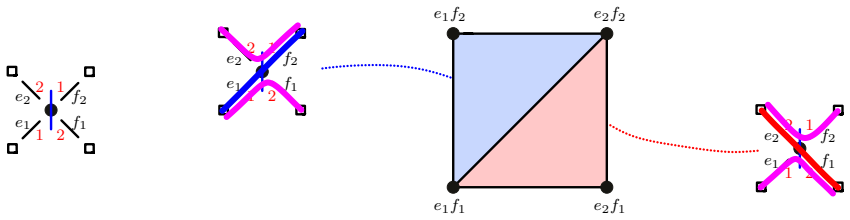
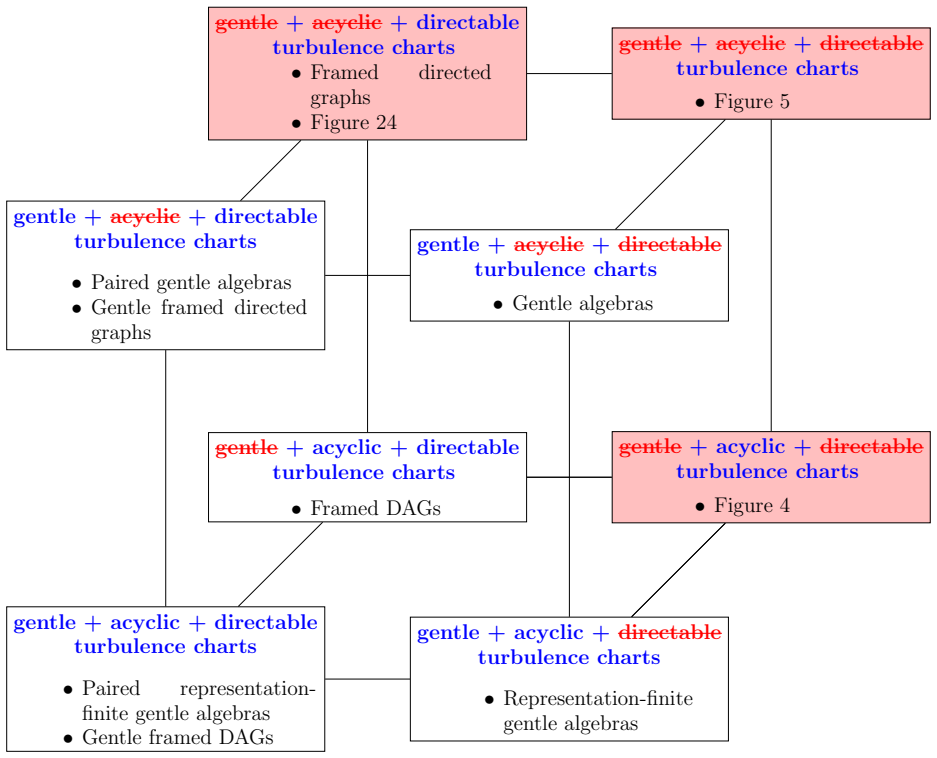
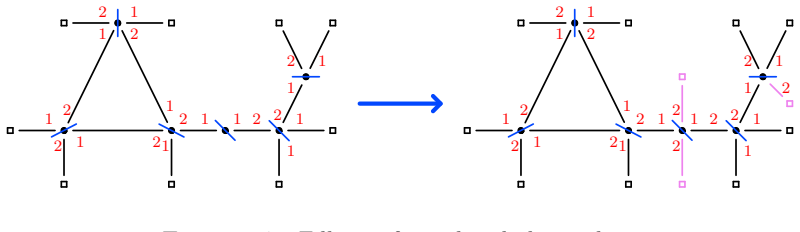
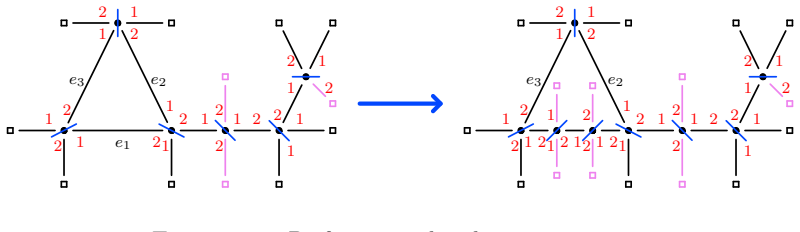
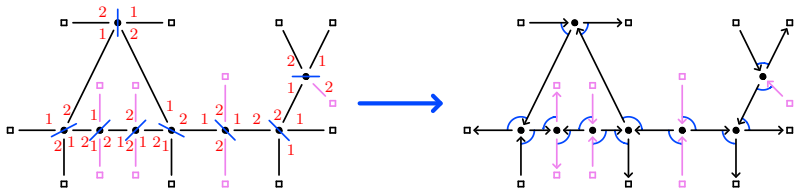
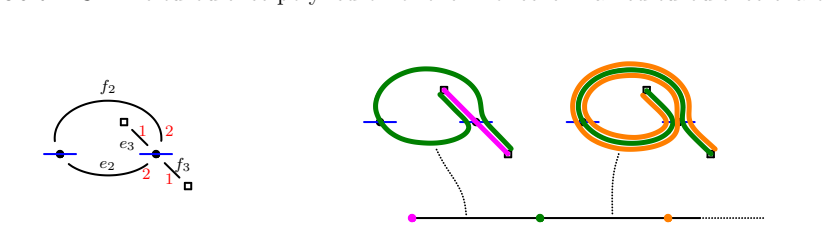
Figure 1. Figure 1: A framed turbulence chart (middle) with an associated framed DAG (left) and fringed algebra (right). of F1(Λ). Can something more structural be said about the relationship between ˜ the representation theory of Λ and the bundle subdivision S1(G, ∼, F), perhaps using techniques similar to those used in [BS24]? 1.1. Summary of results in more detail. Define a turbulence chart (G, ∼) to be an undirected graph… view at source ↗
Figure 2
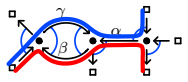
Figure 2. Figure 2: Examples of elementary (blue) and nonelementary (red) routes and bands. Theorem A (Theorem 8.7). The map p 7→ I(p) bijects elementary routes to vertices of F1(G, ∼). The map B 7→ I(B) is a map from elementary bands to the extremal rays of F1(G, ∼) which is injective on simple bands but 2-to-1 on barbells. Note, then, that a turbulence polyhedron is bounded if and only if its turbulence chart has no bands. … view at source ↗
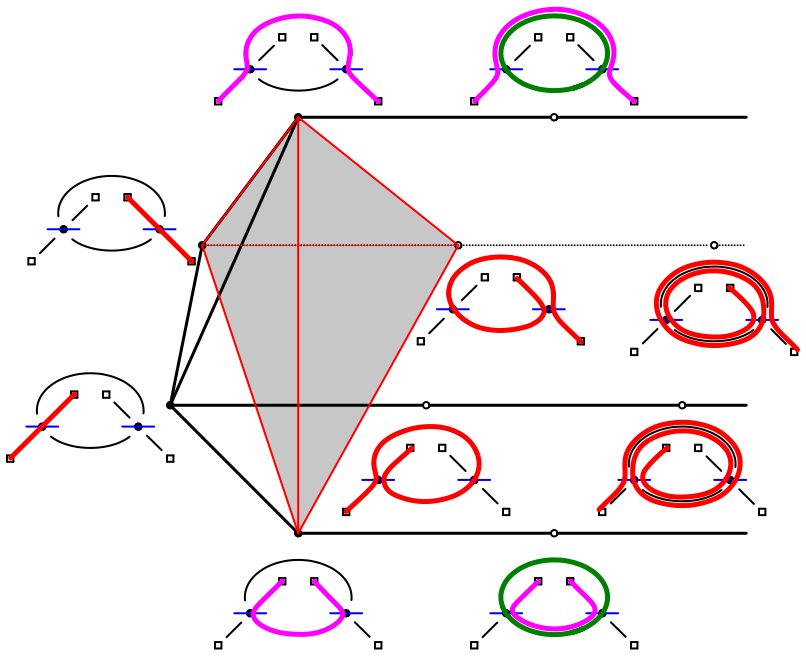
Figure 3
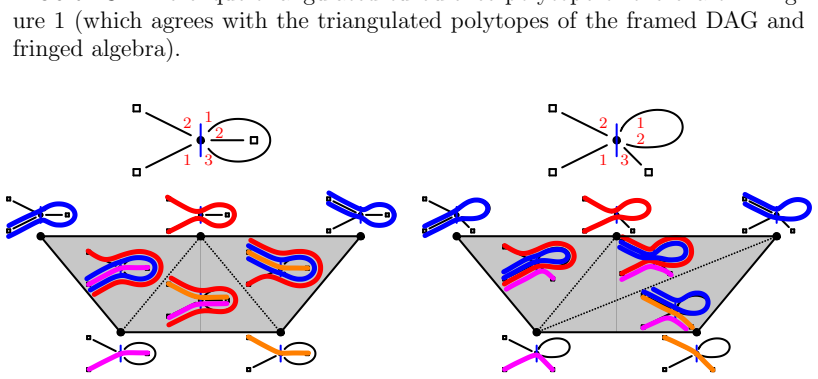
Figure 3. Figure 3: The clique-triangulated turbulence polytope of the chart in Fig￾ure 1 (which agrees with the triangulated polytopes of the framed DAG and fringed algebra). 3 2 2 1 1 2 1 1 2 3 [PITH_FULL_IMAGE:figures/full_fig_p005_3.png] view at source ↗
Figure 4
Figure 4. Figure 4: Two framings of a turbulence chart which are acyclic, but not directable or gentle. The five integer points are labelled by routes, and the three maximal simplices of the bundle subdivision are labelled by maximal bundles. is a subdivision of F1(G, ∼) into simplihedra which covers every rational point of F1(G, ∼). When (G, ∼, F) is bounded, there are no bands the bundle subdivision is a unimodular triangul… view at source ↗
Figure 5
Figure 5. Figure 5: A framed turbulence chart which is not directable, acyclic, or gentle. obtain a gentle framed turbulence chart (G′ , ∼′ , F ′ ) with a set of edges W such that deleting the edges of W from (G′ , ∼′ , F ′ ) and then performing some contractions retrieves the original (G, ∼, F); this is similar to the construction of ample envelopes appearing in [BS24]. In this way, we show that (up to unimodular equivalence… view at source ↗
Figure 6
Figure 6. Figure 6: Framed turbulence charts which are directable, acyclic, and gentle correspond to [PITH_FULL_IMAGE:figures/full_fig_p006_6.png] view at source ↗
Figure 6
Figure 6. Figure 6: The cube of turbulence charts generated by the three independent generalizations to gentle framed DAGs which we treat in this article. Gentle framed DAGs lie at the bottom-left; moving up generalizes by removing the assumption of acyclicity, moving right generalizes by removing the assumption of directability, and moving up-right diagonally generalizes by removing the assumption of gentleness. The three sh… view at source ↗
Figure 7
Figure 7. Figure 7: Recall that taking indicator vectors gives a bijection from routes of G onto vertices of F1(G). Through this correspondence, we may view a maximal clique of (G, F) as a collection of vertices of F1(G) which form a simplex. The set of such simplices forms a regular uni￾modular triangulation of F1(G), called the framing triangulation. We refer to [DLRS10, §2.2] for the definition of a regular triangulation. … view at source ↗
Figure 7
Figure 7. Figure 7: A framed DAG with framing marked in red on the left with its maximal cliques and framing-triangulated flow polytope on the right. Definition 3.6. A route of a directed graph is a path from a source vertex do a sink vertex. A band B of a directed graph is a path of the form e1e2 . . . em, where h(em) = t(e1) and B is not a power of a strictly smaller cycle. We consider bands only up to cyclic equivalence, s… view at source ↗
Figure 8
Figure 8. Figure 8: A gentle algebra (left) and its fringed algebra (right). string modules. For context, we cite the following theorem stating that the combinatorics of strings describes much of the representation theory of Λ. Theorem 4.4 ([BR87, p. 161]). The string and band modules are a complete list of the indecomposable Λ-modules up to isomorphism. Moreover, (1) a string module is never isomorphic to a band module, (2) … view at source ↗
Figure 9
Figure 9. Figure 9: Two incompatible routes. e1f2 e2f2 e1f1 e2f1 e2 f2 e1 f1 e2 f2 e1 f1 e2 f2 e1 f1 [PITH_FULL_IMAGE:figures/full_fig_p015_9.png] view at source ↗
Figure 10
Figure 10. Figure 10: A fringed algebra with its two maximal cliques and turbulence polyhedron on the right. Definition 4.6. A route of Λ is a maximal string in ˜ Λ (thus beginning and ending at fringe ˜ vertices of Λ). A route is ˜ straight if it is an oriented walk in Λ, and ˜ bending otherwise. A trail of Λ is a route or band of ˜ Λ. ˜ Definition 4.7. Let σ be a string of Λ from vertices ˜ v to w. Let αβ be a relation at v … view at source ↗
Figure 11
Figure 11. Figure 11: A directable gentle turbulence polyhedron (left) with the corre￾sponding fringed algebra (middle) and gentle framed directed graphs (right). Framings are labelled in red and the same unit flow is labelled in blue on all four diagrams. most of our discussion to F1(G, ∼), though analogous results will hold for F≥0(G, ∼). A turbulence chart with a unit flow labelled in blue is given in the left of [PITH_FUL… view at source ↗
Figure 12
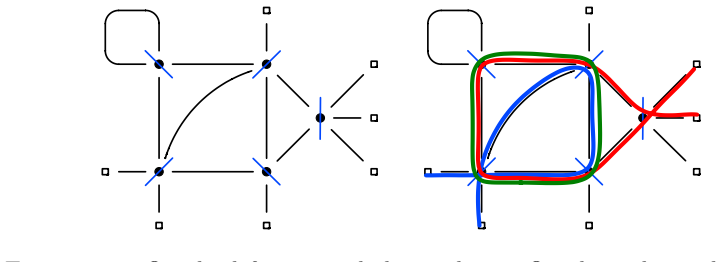
Figure 12. Figure 12: On the left is a turbulence chart. On the right is the same turbulence chart with two routes (red and blue) and one band (green). Under our conventions for drawing turbulence charts, a string is a walk on the graph subject to the rule that each time one reaches an internal vertex one may only continue by crossing the blue line at that vertex. See the right of [PITH_FULL_IMAGE:figures/full_fig_p021_12.png] view at source ↗
Figure 13
Figure 13. Figure 13: On the left is a framed turbulence chart. The middle is not a bundle because the red route and green route are incompatible, and the right is not a bundle because the red route is incompatible with the blue band. Definition 5.8. Let v and w be internal vertices of G. Let ˜e1 and ˜e2 be oriented edges ending at v such that ˜e h 1 and ˜e h 2 are equivalent in ∼v and such that ˜e h 1 <F e˜ h 2 . Let ˜f1 and … view at source ↗
Figure 14
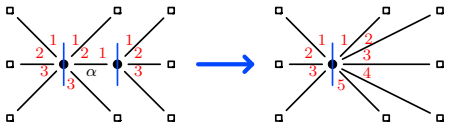
Figure 14. Figure 14: Contracting the left framed turbulence chart at α gives the right framed turbulence chart. 7. Gentle Envelopes In this section, we will realize an arbitrary turbulence polyhedron as a face of a gentle tur￾bulence polyhedron in a way which respects the bundle complex. On the level of turbulence charts, this will amount to starting with an arbitrary turbulence chart (G, ∼, F) and finding a gentle turbulence… view at source ↗
Figure 15
Figure 15. Figure 15: Performing a degree-reduction at v with a = 1. Proof. (1) and (2) are immediate. The unimodular equivalence of (3) is the projection given by forgetting the coordinate of R E associated to α. □ We now describe a process by which one may start with a general turbulence chart (G, ∼, F) and perform several kinds of moves to pull it closer to being gentle. We begin with the following move which pulls (G, ∼, R… view at source ↗
Figure 16
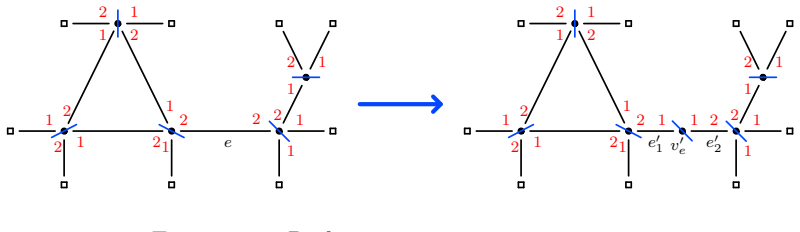
Figure 16. Figure 16: Performing a steepening move at e. We may take a general framed turbulence chart (G, ∼, F) and repeatedly apply degree￾reduction moves until we reach a framed turbulence chart (G1, ∼1, F1) which is sub-full. Our next move will allow us to make all edges of (G, ∼, F) steep. Definition 7.5. Let (G, ∼, F) be a sub-full framed turbulence chart. Let e be an edge which is between two fringe vertices (hence is s… view at source ↗
Figure 17
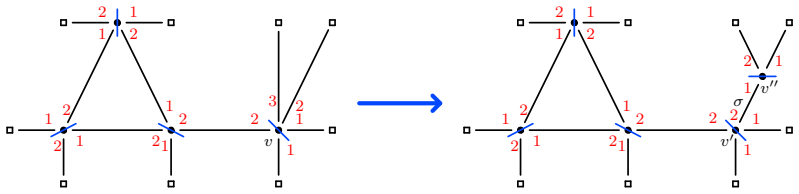
Figure 17. Figure 17: Filling a framed turbulence chart. (1) For every vertex v ∈ G, there is a vertex v ′ ∈ G′ . (2) For every edge e ∈ G, there is an edge e ′ ∈ G′ with the same start and end points. (3) The equivalence relations ∼′ v ′ and the orders of F ′ are inherited as expected from ∼ and F with respect to these edges. (4) There is one additional fringed vertex v ′′ of G′ and one additional edge e ′ v ′′ from v ′′ to v… view at source ↗
Figure 18
Figure 18. Figure 18: Performing a band-correction move. Let (G′′ , ∼′′ , F ′′) be a filling of (G′′ , ∼′ , F ′ ) such that ˜f2 is descending (note that ˜f1 and ˜f3 are forced to be ascending). We say that (G′′ , ∼′′ , F ′′) is a band-correction of (G, ∼, F) with respect to the band B. Note that the steep band B has been replaced with the band ˜f1 ˜f2 ˜f3e˜2e˜3 . . . e˜m, which is not steep because ˜f2 is descending. See [PIT… view at source ↗
Figure 19
Figure 19. Figure 19: Obtaining the gentle algebra of the result from [PITH_FULL_IMAGE:figures/full_fig_p035_19.png] view at source ↗
Figure 20
Figure 20. Figure 20: Examples of elementary (blue) and nonelementary (red) routes and bands. See [PITH_FULL_IMAGE:figures/full_fig_p036_20.png] view at source ↗
Figure 21
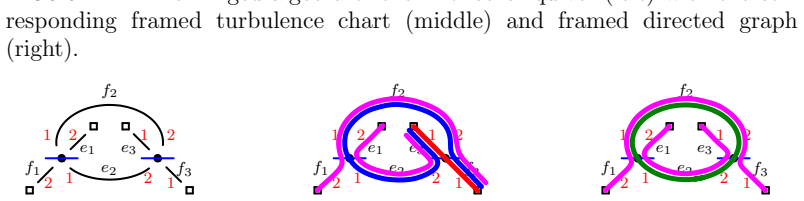
Figure 21. Figure 21: The fringed algebra of the Kronecker quiver (left) with the cor￾responding framed turbulence chart (middle) and framed directed graph (right). e1 e3 f1 f3 f2 e2 e1 e3 f1 f3 f2 e2 e1 e3 f1 f3 f2 e2 2 1 2 2 1 2 1 1 2 1 2 2 1 2 1 1 2 1 2 2 1 2 1 1 [PITH_FULL_IMAGE:figures/full_fig_p044_21.png] view at source ↗
Figure 22
Figure 22. Figure 22: The Kronecker framed turbulence chart drawn using the clock￾wise framing. The routes pe := ˜e1e˜2e˜3 and pf := ˜f1 ˜f2 ˜f3 are exceptional (i.e., they are compatible with every trail). For a ∈ Z≥0, define the self-compatible routes la := ˜e1(˜e2 ˜f −1 2 ) a ˜f −1 1 and ra := e˜ −1 3 (˜e −1 2 ˜f2) a ˜f3. Then the self-compatible trails of (G, ∼, F) are {pe, pf , e˜2 ˜f −1 2 } ∪ {ra : a ∈ Z≥0} ∪ {la : a ∈ Z… view at source ↗
Figure 23
Figure 23. Figure 23: The turbulence polyhedron of the Kronecker framed turbulence chart. e3 f3 f2 e2 1 2 2 1 [PITH_FULL_IMAGE:figures/full_fig_p045_23.png] view at source ↗
Figure 24
Figure 24. Figure 24: A face of the Kronecker framed turbulence chart. We finally remark that the framed directed graph is an example of a directed graph with an ample framing all of whose cycles are monochromatic (i.e., all half edges have the same label in {1, 2}). Such framings on directed graphs are called cyclic ample framings in [ABD+26, Definition 6.7] and studied in greater depth. In particular, the amply framed direct… view at source ↗
Figure 25
Figure 25. Figure 25: The Kronecker turbulence chart with an altered framing. e3 f3 e1 f1 f2 e2 2 2 2 1 1 2 1 1 [PITH_FULL_IMAGE:figures/full_fig_p046_25.png] view at source ↗
Figure 26
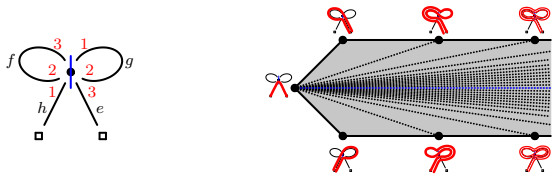
Figure 26. Figure 26: A final framing of the Kronecker turbulence chart. Examples 10.1 and 10.3 showed the bundle subdivisions from two different framings on the same Kronecker turbulence chart. Both examples featured exceptional routes, corresponding to points of the turbulence polyhedron which appear in every maximal bundle simplihedron. The former example had an infinite number of simplices with one lower-dimensional bundle… view at source ↗
read the original abstract

In the study of flow polytopes, a directed acyclic graph (DAG) with a choice of framing gives a regular unimodular triangulation on its space of unit nonnegative flows. In representation theory, a gentle algebra has recently been equipped with a space of unit flows admitting triangulation and subdivision results capturing its tau-tilting theory. These theories from different areas of mathematics overlap: flows on gently framed DAGs are the same as flows on paired representation-finite gentle algebras. In this article we develop the common generalization of these two theories by defining (framed) turbulence charts, which may be thought of as analogs of (framed) DAGs without the conditions of (D)irectedness and (A)cyclicity. The space of unit flows on a turbulence chart is its turbulence polyhedron. We give presentation, subdivision, and triangulation results on turbulence polyhedra which restrict to known results in the settings of framed DAGs and gentle algebras.

Editorial analysis

A structured set of objections, weighed in public.

Desk editor's note, referee report, simulated authors' rebuttal, and a circularity audit. Tearing a paper down is the easy half of reading it; the pith above is the substance, this is the friction.

Referee Report

2 major / 0 minor

Summary. The manuscript introduces framed turbulence charts as a common generalization of framed directed acyclic graphs (DAGs) and gentle algebras, removing the directedness and acyclicity conditions. It defines the associated turbulence polyhedron as the space of unit nonnegative flows and establishes presentation, subdivision, and triangulation theorems for these polyhedra. The results are asserted to restrict to known results on flow polytopes in the framed DAG setting and on tau-tilting structures in the gentle algebra setting, justified by an asserted equivalence between flows on gently framed DAGs and paired representation-finite gentle algebras.

Significance. If the central claims hold, including proper specialization under the overlap, the work would provide a unifying combinatorial framework bridging flow polytopes from graph theory with representation-theoretic invariants from gentle algebras. This could enable transfer of triangulation and subdivision techniques across fields and extend results beyond acyclic directed structures.

major comments (2)
  1. [Introduction] Introduction and abstract: The assertion that 'flows on gently framed DAGs are the same as flows on paired representation-finite gentle algebras' is used to motivate the common generalization and to claim that the new theorems restrict to both settings, but no explicit bijection, flow-space identification, or verification that the triangulations match under specialization is supplied. This identification is load-bearing for the restriction claims.
  2. [Main theorems] Main results on turbulence polyhedra (presentation, subdivision, and triangulation theorems): Without a detailed check that the turbulence polyhedron construction recovers the original flow polytopes (including their known triangulations) when specialized to framed DAGs and to paired gentle algebras, it is unclear whether the unification is faithful; the abstract states the overlap but the body must supply the correspondence for the theorems to restrict as claimed.

Simulated Author's Rebuttal

2 responses · 0 unresolved

We thank the referee for their detailed report and for identifying the need to make the specialization claims fully rigorous. We agree that explicit correspondences are required to substantiate the restriction of the new theorems to the framed DAG and gentle algebra settings, and we will revise the manuscript accordingly.

read point-by-point responses
  1. Referee: [Introduction] Introduction and abstract: The assertion that 'flows on gently framed DAGs are the same as flows on paired representation-finite gentle algebras' is used to motivate the common generalization and to claim that the new theorems restrict to both settings, but no explicit bijection, flow-space identification, or verification that the triangulations match under specialization is supplied. This identification is load-bearing for the restriction claims.

    Authors: We acknowledge that the current manuscript asserts the overlap between the two settings without supplying a self-contained explicit bijection or flow-space identification. In the revision we will add a new subsection (likely in Section 2 or 3) that constructs the explicit correspondence: we will define the map from gently framed DAGs to paired representation-finite gentle algebras (and conversely), prove that it induces an isomorphism of the respective unit-flow spaces, and verify that the known triangulations are preserved under this identification. This will make the motivational claim and the restriction statements fully rigorous. revision: yes

  2. Referee: [Main theorems] Main results on turbulence polyhedra (presentation, subdivision, and triangulation theorems): Without a detailed check that the turbulence polyhedron construction recovers the original flow polytopes (including their known triangulations) when specialized to framed DAGs and to paired gentle algebras, it is unclear whether the unification is faithful; the abstract states the overlap but the body must supply the correspondence for the theorems to restrict as claimed.

    Authors: We agree that the body of the paper must contain explicit verification that the turbulence-polyhedron theorems specialize correctly. In the revised version we will insert, immediately after the statements of the main theorems, a dedicated subsection that (i) recalls the specialization functors to framed DAGs and to paired gentle algebras, (ii) shows that the defining equations of the turbulence polyhedron reduce to the known flow-polytope equations in each case, and (iii) confirms that the subdivision and triangulation constructions restrict to the previously established ones. These checks will be stated as propositions with short proofs. revision: yes

Circularity Check

0 steps flagged

No circularity: overlap stated as external fact; results claimed to restrict without definitional reduction

full rationale

The abstract presents the overlap ('flows on gently framed DAGs are the same as flows on paired representation-finite gentle algebras') as an observed fact from different areas, then defines turbulence charts as the common generalization and states that the new results restrict to prior known results in each setting. No equations, self-citations, or definitions are supplied that would make any claimed prediction or result equivalent to its inputs by construction. No uniqueness theorems, ansatzes, or fitted parameters appear. This is the normal case of a generalization paper whose central claims remain independent of the motivating overlap statement.

Axiom & Free-Parameter Ledger

0 free parameters · 1 axioms · 2 invented entities

Ledger extracted from abstract only; full definitions and proofs unavailable.

axioms (1)
  • domain assumption Flows on gently framed DAGs coincide with flows on paired representation-finite gentle algebras
    Invoked to justify that the two theories overlap and can be generalized together.
invented entities (2)
  • framed turbulence chart no independent evidence
    purpose: Object that relaxes directedness and acyclicity while retaining flow and framing data
    Newly introduced to serve as the common generalization.
  • turbulence polyhedron no independent evidence
    purpose: Space of unit nonnegative flows on a turbulence chart
    Defined as the direct analog of the flow polytope.

pith-pipeline@v0.9.1-grok · 5687 in / 1221 out tokens · 32992 ms · 2026-06-30T13:48:01.526198+00:00 · methodology

discussion (0)

Sign in with ORCID, Apple, or X to comment. Anyone can read and Pith papers without signing in.

Forward citations

Cited by 1 Pith paper

Reviewed papers in the Pith corpus that reference this work. Sorted by Pith novelty score.

  1. Locally anti-blocking $\mathbf{g}$-polytopes for flow polytopes

    math.CO 2026-05 unverdicted novelty 5.0

    Combinatorial characterization of locally anti-blocking g-polytopes arising from amply framed DAG flow polytopes, including minimal faces, pulling triangulations, and coherence diagrams.

Reference graph

Works this paper leans on

10 extracted references · 8 canonical work pages · cited by 1 Pith paper · 2 internal anchors

  1. [1]

    Morales, GaYee Park, and Hugh Thomas

    [ABD+26] Antoine Abram, Jose Bastidas, Benjamin Dequˆ ene, Alejandro H. Morales, GaYee Park, and Hugh Thomas. Flows on graphs with cycles, locally gentle algebras, and the mutoperhedron. 2026.arXiv:2601.08150. [AH81] Ibrahim Assem and Dieter Happel. Generalized tilted algebras of typeA n.Comm. Algebra, 9(20):2101–2125, 1981.doi:10.1080/00927878108822697. ...

  2. [2]

    [Asa21] Sota Asai

    URL:http://eudml.org/doc/183692. [Asa21] Sota Asai. The wall-chamber structures of the real Grothendieck groups.Adv. Math., 381:Pa- per No. 107615, 44, 2021.doi:10.1016/j.aim.2021.107615. 46 [AY23] Toshitaka Aoki and Toshiya Yurikusa. Complete gentle and special biserial algebras areg- tame.J. Algebraic Combin., 57(4):1103–1137, 2023.doi:10.1007/s10801-02...

  3. [3]

    [Ber25] Jonah Berggren

    doi:10.4153/s0008414x19000397. [Ber25] Jonah Berggren. Flows on gentle algebras. 2025.arXiv:2507.12688. [BGDMCY21] Matias von Bell, Rafael S. Gonz´ alez D’Le´ on, Francisco A. Mayorga Cetina, and Martha Yip. On framed triangulations of flow polytopes, theν-Tamari lattice and Young’s lattice.S´ em. Lothar. Combin., 85B:Art. 42, 12,

  4. [4]

    Tilting theory and cluster combinatorics.Adv

    [BMR+06] Aslak Bakke Buan, Robert Marsh, Markus Reineke, Idun Reiten, and Gordana Todorov. Tilting theory and cluster combinatorics.Adv. Math., 204(2):572–618, 2006.doi:10.1016/ j.aim.2005.06.003. [BR87] M. C. R. Butler and Claus Michael Ringel. Auslander-Reiten sequences with few middle terms and applications to string algebras.Comm. Algebra, 15(1-2):145...

  5. [5]

    Kostant partitions functions and flow polytopes.Trans- form

    [BV08] Welleda Baldoni and Mich` ele Vergne. Kostant partitions functions and flow polytopes.Trans- form. Groups, 13(3-4):447–469, 2008.doi:10.1007/s00031-008-9019-8. [CKM21] Sylvie Corteel, Jang Soo Kim, and Karola M´ esz´ aros. Volumes of generalized Chan- Robbins-Yuen polytopes.Discrete Comput. Geom., 65(2):510–530, 2021.doi:10.1007/ s00454-019-00066-1...

  6. [6]

    [EM16] Laura Escobar and Karola M´ esz´ aros

    Structures for algorithms and applications.doi:10.1007/978-3-642-12971-1. [EM16] Laura Escobar and Karola M´ esz´ aros. Toric matrix Schubert varieties and their polytopes. Proc. Amer. Math. Soc., 144(12):5081–5096, 2016.doi:10.1090/proc/13152. [GDMP+25] Rafael S. Gonz´ alez D’Le´ on, Alejandro H. Morales, Eva Philippe, Daniel Tamayo Jim´ enez, and Martha...

  7. [7]

    Proof of a conjecture of Meszaros and Morales on the volume of a flow polytope

    Special issue on linear algebra methods in representation theory.doi:10.1016/S0024-3795(02)00406-8. [HPS18] Christophe Hohlweg, Vincent Pilaud, and Salvatore Stella. Polytopal realizations of finite typeg-vector fans.Adv. Math., 328:713–749, 2018.doi:10.1016/j.aim.2018.01.019. [Kim14] Jang Soo Kim. Proof of a conjecture of Meszaros and Morales on the volu...

  8. [8]

    Non-kissing complexes and tau- tilting for gentle algebras.Mem

    [PPP21] Yann Palu, Vincent Pilaud, and Pierre-Guy Plamondon. Non-kissing complexes and tau- tilting for gentle algebras.Mem. Amer. Math. Soc., 274(1343):vii+110, 2021.doi:10.1090/ memo/1343. [PPPP23] Arnau Padrol, Yann Palu, Vincent Pilaud, and Pierre-Guy Plamondon. Associahedra for finite-type cluster algebras and minimal relations betweeng-vectors.Proc....

  9. [9]

    [vBC26] Matias von Bell and Cesar Ceballos

    A Wiley-Interscience Publication. [vBC26] Matias von Bell and Cesar Ceballos. Framing lattices and flow polytopes. 2026.arXiv:2512. 20575. [Zei99] Doron Zeilberger. Proof of a conjecture of Chan, Robbins, and Yuen. volume 9, pages 147–

  10. [10]

    Sketch of a Proof of an Intriguing Conjecture of Karola Meszaros and Alejandro Morales Regarding the Volume of the $D_n$ Analog of the Chan-Robbins-Yuen Polytope (Or: The Morris-Selberg Constant Term Identity Strikes Again!)

    Orthogonal polynomials: numerical and symbolic algorithms (Legan´ es, 1998). [Zei14] Doron Zeilberger. Sketch of a proof of an intriguing conjecture of Karola Meszaros and Ale- jandro Morales regarding the volume of theD n analog of the Chan-Robbins-Yuen polytope (or: The Morris-Selberg constant term identity strikes again!). 2014.arXiv:1407.2829. 48