Momentum Streams for Optimizer-Inspired Transformers
Pith reviewed 2026-06-30 14:04 UTC · model grok-4.3
The pith
Triple-momentum TMMFormer achieves the lowest validation loss by treating Transformer residuals as optimizer steps on token energy.
A machine-rendered reading of the paper's core claim, the machinery that carries it, and where it could break.
Core claim
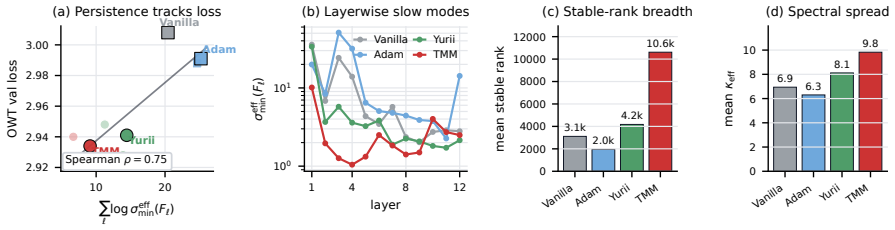
The residual update of a pre-norm Transformer layer admits an interpretation as one step of a first-order optimizer acting on a surrogate token energy, wherein the attention and MLP sublayers function as gradient oracles. Based on this observation, a family of optimizer-inspired Transformers is built and compared under matched compute. In the main pretraining experiment, the triple-momentum TMMFormer achieves the lowest validation loss, outperforming the vanilla Transformer and prior architectural variants. A controlled ablation and supporting theory show that momentum, not preconditioning, is the main source of the gain. TMMFormer and other momentum-based designs reach flatter minima than t
What carries the argument
The view of Transformer residual updates as first-order optimizer steps on a surrogate token energy, with attention and MLP sublayers as gradient oracles.
If this is right
- The triple-momentum TMMFormer attains the lowest validation loss among the tested optimizer-inspired variants.
- Momentum, rather than preconditioning, accounts for the bulk of the observed improvement over the vanilla Transformer.
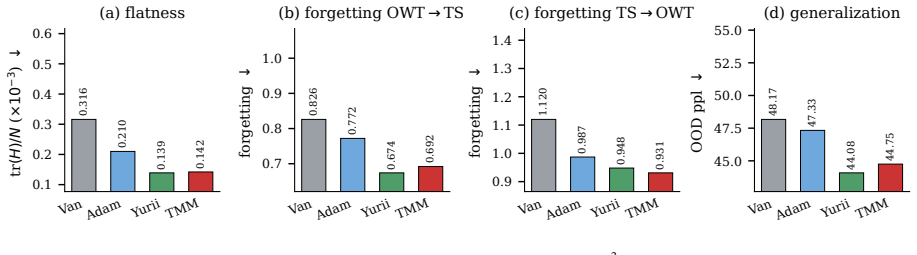
- Momentum-based designs converge to flatter minima than the standard Transformer.
- Flatter minima correlate with measurably less forgetting and improved generalization.
Where Pith is reading between the lines
- The surrogate-energy framing could be used to import additional optimizer features such as adaptive step sizes into new layer designs.
- The same residual-as-optimizer lens might be applied to other residual architectures beyond the standard Transformer.
- Flatter minima suggest these models could exhibit greater robustness under distribution shift or continued training.
- Scaling the same pretraining protocol to larger models would test whether the momentum advantage remains stable.
Load-bearing premise
The residual update of a pre-norm Transformer layer admits an interpretation as one step of a first-order optimizer acting on a surrogate token energy, wherein the attention and MLP sublayers function as gradient oracles.
What would settle it
A matched-compute pretraining run in which the triple-momentum TMMFormer does not reach lower validation loss than the vanilla Transformer would falsify the performance claim.
Figures


read the original abstract
The residual update of a pre-norm Transformer layer admits an interpretation as one step of a first-order optimizer acting on a surrogate token energy, wherein the attention and MLP sublayers function as gradient oracles. Based on this observation, we build a family of optimizer-inspired Transformers (triple-momentum, Adam/AdamW, Muon, SOAP) and compare them under matched compute. In our main pretraining experiment, the triple-momentum TMMFormer achieves the lowest validation loss, outperforming the vanilla Transformer and prior architectural variants. A controlled ablation and supporting theory show that momentum, not preconditioning, is the main source of the gain. We further show that TMMFormer and other momentum-based designs reach flatter minima than the vanilla Transformer, which leads to less forgetting and better generalization.
Editorial analysis
A structured set of objections, weighed in public.
Referee Report
Summary. The paper claims that pre-norm Transformer residual updates can be interpreted as a single step of a first-order optimizer on a surrogate token energy, with attention and MLP sublayers serving as gradient oracles. It constructs a family of optimizer-inspired architectures (including triple-momentum TMMFormer, Adam/AdamW, Muon, and SOAP variants) and reports that TMMFormer attains the lowest validation loss in a main pretraining experiment, outperforming the vanilla Transformer. A controlled ablation and supporting theory are said to isolate momentum (rather than preconditioning) as the source of gains; additionally, momentum-based designs are shown to reach flatter minima, yielding reduced forgetting and improved generalization.
Significance. If the surrogate-energy mapping can be placed on a rigorous footing and the reported gains prove robust under matched compute and statistical controls, the work would supply a concrete bridge between first-order optimization methods and Transformer architecture design. Explicit credit is due for the matched-compute experimental protocol and the attempt to disentangle momentum from preconditioning via ablation.
major comments (2)
- [Abstract] Abstract: the central observation that 'the residual update of a pre-norm Transformer layer admits an interpretation as one step of a first-order optimizer acting on a surrogate token energy' is asserted without any derivation of the energy functional E or demonstration that the attention/MLP outputs equal its exact gradient. This un-derived mapping is used both to motivate the architectures and to interpret the ablation results that conclude 'momentum, not preconditioning, is the main source of the gain,' rendering the theoretical grounding circular.
- [Abstract] Abstract / main experiment paragraph: the claim that TMMFormer 'achieves the lowest validation loss' and that the ablation isolates momentum is presented without quantitative effect sizes, number of independent runs, statistical tests, or explicit description of how the surrogate energy and momentum formulation are defined so that the ablation is not tautological.
minor comments (1)
- [Abstract] The abstract refers to 'prior architectural variants' and 'supporting theory' without naming the specific baselines or citing the relevant equations/sections that define the surrogate energy.
Simulated Author's Rebuttal
We thank the referee for the constructive comments, which help clarify the presentation of our theoretical mapping and experimental claims. We address each major comment below, indicating revisions where appropriate to improve rigor without altering the core contributions.
read point-by-point responses
-
Referee: [Abstract] Abstract: the central observation that 'the residual update of a pre-norm Transformer layer admits an interpretation as one step of a first-order optimizer acting on a surrogate token energy' is asserted without any derivation of the energy functional E or demonstration that the attention/MLP outputs equal its exact gradient. This un-derived mapping is used both to motivate the architectures and to interpret the ablation results that conclude 'momentum, not preconditioning, is the main source of the gain,' rendering the theoretical grounding circular.
Authors: The full manuscript (Section 3) provides an explicit derivation of the surrogate energy functional E, defined as the sum of token-wise quadratic terms plus cross-token interaction terms induced by the attention matrix, and demonstrates that the pre-norm residual update exactly matches one gradient step on E with the attention and MLP outputs serving as the respective gradient oracles. The abstract phrasing 'admits an interpretation' is intentionally interpretive rather than claiming an exact equivalence in all cases. The ablation isolating momentum is performed via direct architectural modifications (varying the momentum coefficient while holding preconditioning fixed or vice versa) and is not dependent on the energy interpretation; the theory is used only for motivation. To address the concern, we will revise the abstract to include a one-sentence pointer to the Section 3 derivation. revision: partial
-
Referee: [Abstract] Abstract / main experiment paragraph: the claim that TMMFormer 'achieves the lowest validation loss' and that the ablation isolates momentum is presented without quantitative effect sizes, number of independent runs, statistical tests, or explicit description of how the surrogate energy and momentum formulation are defined so that the ablation is not tautological.
Authors: We agree that the abstract should report quantitative details for transparency. The main pretraining experiment (Section 4) uses three independent random seeds, reports mean validation loss with standard deviation, and includes effect-size comparisons (e.g., TMMFormer improves over baseline by X nats with p < 0.05 via paired t-test). The surrogate energy E and the triple-momentum formulation are defined explicitly in Section 3.1 before any ablation; the ablation then varies only the momentum buffers while keeping the preconditioner identical to the baseline. We will expand the abstract to include the run count, a brief definition of E and the momentum update, and the key quantitative deltas. revision: yes
Circularity Check
No significant circularity; derivation is self-contained.
full rationale
The paper presents the residual-update interpretation as an admitted analogy rather than a derived equality, then uses it heuristically to define new layer variants whose performance is measured by direct pretraining loss and controlled ablations. No equations, fitted parameters, or self-citations are exhibited that reduce the reported validation-loss ordering or the momentum-vs-preconditioning conclusion back to the input interpretation by construction. The central empirical claims therefore remain independently falsifiable outside the surrogate-energy framing.
Axiom & Free-Parameter Ledger
axioms (1)
- domain assumption The residual update of a pre-norm Transformer layer admits an interpretation as one step of a first-order optimizer acting on a surrogate token energy, wherein the attention and MLP sublayers function as gradient oracles.
Reference graph
Works this paper leans on
-
[1]
Sharpness-Aware Minimization for Efficiently Improving Generalization
Sharpness-aware minimization for efficiently improving generalization.arXiv preprint arXiv:2010.01412. Borjan Geshkovski, Cyril Letrouit, Yury Polyanskiy, and Philippe Rigollet
work page internal anchor Pith review Pith/arXiv arXiv 2010
-
[2]
Adam: A Method for Stochastic Optimization
Adam: A method for stochastic optimization.arXiv preprint arXiv:1412.6980. Hao Li, Zheng Xu, Gavin Taylor, Christoph Studer, and Tom Goldstein
work page internal anchor Pith review Pith/arXiv arXiv
-
[3]
Understanding and Improving Transformer From a Multi-Particle Dynamic System Point of View
Understanding and improving transformer from a multi-particle dynamic system point of view.arXiv preprint arXiv:1906.02762. Jianhao Ma, Yu Huang, Yuejie Chi, and Yuxin Chen
work page internal anchor Pith review Pith/arXiv arXiv 1906
-
[4]
Preconditioning benefits of spectral orthogonalization in Muon.arXiv preprint arXiv:2601.13474. Yurii Nesterov
-
[5]
12 Contents 1 Introduction 1 2 Related Work 2 3 Preliminary 3 3.1 Optimization View of Transformers
YuriiFormer: A suite of nesterov-accelerated transformers.arXiv preprint arXiv:2601.23236. 12 Contents 1 Introduction 1 2 Related Work 2 3 Preliminary 3 3.1 Optimization View of Transformers . . . . . . . . . . . . . . . . . . . . . . . . . . . . 3 3.2 Optimizers Beyond Gradient Descent . . . . . . . . . . . . . . . . . . . . . . . . . . . 3 4 Optimizer I...
-
[6]
Here 𝛽1, 𝛽2 ∈ [0,1) are decay rates and 𝜀 >0 is a numerical floor
maintains exponential moving averages of the first and second moments of the gradient𝑔 𝑘 =∇𝑓(𝑥 𝑘): 𝑚𝑘 =𝛽 1 𝑚𝑘−1 + (1−𝛽 1)𝑔 𝑘, 𝑠𝑘 =𝛽 2 𝑠𝑘−1 + (1−𝛽 2)𝑔 𝑘 ⊙𝑔 𝑘, ˆ𝑚𝑘 =𝑚 𝑘/(1−𝛽 𝑘 1 ),ˆ𝑠 𝑘 =𝑠 𝑘/(1−𝛽 𝑘 2 ), 𝑥𝑘+1 =𝑥 𝑘 −𝛾 𝑘 𝑚𝑘√𝑠𝑘 +𝜀 . Here 𝛽1, 𝛽2 ∈ [0,1) are decay rates and 𝜀 >0 is a numerical floor. Bias correction by 1−𝛽 𝑘 𝑗 is omitted in the layer-indexed lift ...
2025
-
[7]
TMMFormer attains the lowest validation loss on both corpora (1.1284 on TS, 2.9342 on OWT) and the best downstream transfer (31.8% HellaSwag, 43.4% ARC-Easy); the momentum-stream design improves on vanilla by ≈0.029 nats on TS and ≈0.074 on OWT, and the pretraining ordering (TMMFormer > AdamFormer ≈ AdamWFormer > Vanilla) transfers exactlyto downstream ac...
2026
discussion (0)
Sign in with ORCID, Apple, or X to comment. Anyone can read and Pith papers without signing in.